Unspun
Rethinking The Two-Party System | Unspun
Season 2 Episode 208 | 27m 14sVideo has Closed Captions
Unspun asks: Is America ready for a third party, or stuck in two-party rule?
For years, voters have voiced frustration with both major parties. Unspun asks if there is room for a real third party in American politics, or are we locked into a two-party system? As more Americans, especially independents and younger voters, say the system feels broken, we examine whether a new political movement can break through long-standing barriers.
Problems playing video? | Closed Captioning Feedback
Problems playing video? | Closed Captioning Feedback
Unspun is a local public television program presented by PBS Charlotte
Unspun
Rethinking The Two-Party System | Unspun
Season 2 Episode 208 | 27m 14sVideo has Closed Captions
For years, voters have voiced frustration with both major parties. Unspun asks if there is room for a real third party in American politics, or are we locked into a two-party system? As more Americans, especially independents and younger voters, say the system feels broken, we examine whether a new political movement can break through long-standing barriers.
Problems playing video? | Closed Captioning Feedback
How to Watch Unspun
Unspun is available to stream on pbs.org and the free PBS App, available on iPhone, Apple TV, Android TV, Android smartphones, Amazon Fire TV, Amazon Fire Tablet, Roku, Samsung Smart TV, and Vizio.
Providing Support for PBS.org
Learn Moreabout PBS online sponsorship(upbeat music) - [Announcer] This is a production of PBS Charlotte.
(chiming music) For years now, voters have said they're frustrated with both the Democrat and Republican parties.
Tonight, on "Un-Spun," is there room for a real third party in American politics, or are we locked into a two-party system that can't or won't change?
Pew research shows a growing number of Americans don't feel either party represents their values.
In fact, large majorities of voters, including independents and younger voters, say the two party system is broken, and that a third option sounds appealing.
Okay, so Americans want more choices, that sounds good, but our political system has a long history of shutting third parties out.
Next, we're taking a closer look at a new political party that speaks to the growing center of the country, voters who are tired of partisan warfare and just want government that works.
(chiming music) In today's America, welcome to the spin game.
Believe me, I know.
I'm Pat McCrory.
When I was governor and mayor, I played the spin game, I was played by the spin game, but aren't we all done being spun?
Let's take the spin out of the world we're in, here on "Un-Spun".
(energetic music) Good evening, I'm Pat McCrory.
Tonight, we're joined by someone who's not just talking about this problem, she's trying to change it.
Our guest is Christine Todd Whitman, two-term former governor of New Jersey, former EPA administrator, and co-founder of the Forward Party, a party built with leaders for both the left and the right around the idea that Americans deserve more than two bad options.
Let's get to it.
Welcome, Governor, glad to have you.
- Always good to be with you, Pat.
- So now, why now?
Why do we need more than two parties?
- Well, because right now, 80% of the states are single-party states, which means that one party controls both houses, and that's just wrong, and in any given election, fully 70% of seats are, there's one candidate, and so people don't have a choice, and that's, again, wrong when... I don't care whether it's Republicans or Democrats, if the government is under control of one party, the public in general is not being served, and that's why we've got to break up this duopoly.
It's what our Founding Fathers warned us of.
If everybody would go back and read George Washington's farewell address to his troops, he outlines exactly what we're seeing right now.
- Well, we're seeing in North Carolina the independent party or the independent voters, the unaffiliated voters, is now larger in registration than the Republican Party or the Democratic Party, so a lot of people are avoiding the two-party system, but in fact, Governor, the two-party system is a duopoly for a reason.
They control the rules.
How are you gonna break through the rules of setting up a party in all 50 states?
- Well, actually, we're on ballot now as a recognized party in seven states, and partially on the ballot in four others, or five others.
As you say, they make it very hard for independents to get on the ballot and independent parties to be recognized, but we're very active in North Carolina, actually, and we are the independent party there, because Forward hasn't yet become recognized, but we are affiliated with them and supporting those candidates.
So we're doing it, really, as a fulcrum theory.
You don't have to have everybody in the legislature to change the process, you only need enough to get those other ones who have a conscience and really wanna do the right thing for the people they represent, to join with them, to know that they have others who are there, who will give them the kind of leverage that they need to change things.
- As you know, in politics, money dominates the equation on who has power and who doesn't have power, especially now with the Super PACS, that one person can write a seven-figure check and get someone elected, or more, it could be a incredible amount of money, which didn't exist when you and I were around initially.
Where are you gonna get your money from?
'Cause this isn't, this doesn't come cheap to set up a third party and get on ballots.
- No, it doesn't, and it takes a lot of work, and it's taking a lot of time, but we're raising our money while we don't have the million dollar donors, I will say that, because they'd rather play at the presidential level and they want things to change overnight, and what we're saying is that's not gonna happen.
You can't build a party overnight.
And what we need to do now and where we're concentrating while we're, we have a... Actually, one of your North Carolina congressman is a Forward-affiliated congressman, Democrat.
We have a Republican senator from Utah, but we're really focusing on state and local, because those are the positions where, that make the decisions the most to directly affect your life, and we can make a big difference there without spending huge amounts of money and start to build that farm team that's gonna be able to rebuild our democracy once we're finished with Trump, whatever's left.
- Well, I think that needs to be emphasized.
You're emphasizing state and local, and the dilemma is, even as being a former mayor for 14 years here in Charlotte, we're becoming a one=party system in most major cities.
Most major cities are blue right now.
In fact, I was one of the, even 15, 20 years ago, I was one of the few big-city Republican mayors, and now I don't even know if there are many, any, Republican large-city mayors.
So do you see the Forward Party bringing about competition and choice in our big cities, now?
- Oh, absolutely!
I mean, that's really where we're... As I say, state and local politics is where we're concentrating.
You know, as I said to you before, what we'll do is support Republicans, Democrats, independents, if they sign or pledge, and if we believe, after thorough examination, that they've actually walked the talk before.
but all they have to do is say they'll uphold the rule of law, respect the constitution, work with anyone to solve their problems, create a safe space to discuss those controversial issues, and work to ensure that anyone who has a legal right to vote gets to vote, and base that on decency, democracy, and diversity.
- Is that, - But beyond that, - is that your pledge?
- That's the pledge, that's the pledge.
And beyond that, every state is different.
You know, every city's different and their needs are different, and so it should be up to the elected representatives or the people running for office to decide, "What's important to my constituents, what do I need to do here?"
not what some party in Washington is telling them they have to think, or they have to do or say, so.
- So when you're asked, Governor, are you a left-leaning, right-leaning, moderate, what's the answer?
Or do you go issue by issue?
- We go issue by issue.
I mean, it's up to the candidates, it's up to the local parties.
I mean, we're gonna have, for instance, pro-choice Forwarders and pro-life Forwarders, depending on where they are, and what they believe, and what their constituents want, as long as we, and they get vetted both at the local level, the state level, and we go do a deep background check to make sure that they're not just trying to use the label to get on the ballot, but they actually have walked the talk, and they strode on the path.
- Now do you have a committee, - do you have a committee that you've selected to interview these candidates to see if they at least meet the standards of that pledge?
Is that what you do - Yes, yeah.
before you- - Yeah, absolutely, and when it started, - Tell me how that works.
- the state, the state party does it and then we do it at the federal level.
They come to us different ways.
Sometimes people just come to us and say, "I wanna run."
Others go to the state party or to the local leaders and say, "I'd like to run for this office."
And then we encourage our state people to say, "Hey, if you know somebody you think would be good for the school board, or would be good for, run for mayor or town council, encourage them, get them to do it."
And if they have the background that we are looking for and will commit to that pledge, then we'll do what we can for them.
And there's so many, Pat, your mind would be blown, or I'm sure you know this already, but the tools that are available today versus when we were running for office are just incredible.
Your ability to identify people and to figure out what issues, the issues about which they care, it's just amazing, and we're creating that toolbox for our candidates.
- So one thing I learned working with Joe Lieberman and Ben Chavis with No Labels, as we were co-chairmen of that effort, the two political parties not only are a duopoly, but they almost feel, you almost feel like kind of a mafia type, where if you dare go against them, they will threaten your livelihood, or any staff members - Oh, yes.
- that support.
I mean, Ben Chavis, a very close friend of mine and a North Carolina native, and a famous civil rights pioneer, I mean, literally, he was threatened with livelihood, and we had staff members of No Labels who said, "You will never work in DC again."
This was coming from the left.
And then me, I was threatened with being canceled from the Republican Party.
Are you feeling - Yes.
- those pressures of recruiting for fear of them being canceled, or staff members?
- Some of them are, but what we're saying and what scares them, if they're the kind of people we want, what makes a difference for them is they know we'll have their back, because with all that No Labels did and is doing, which is great, and the Problem Solvers Caucus, but, you know, the presidential thing didn't work out because there wasn't the infrastructure underneath to be there to support the candidates, and that's what we're doing, that's the difference, we're building an infrastructure and it's tough.
I mean, here in Arizona, which is where I am for the winter, to get on the ballot as a Republican or Democrat, you need 5,000 signatures, to get on the ballot as an independent, you need 45,000 signatures.
That means- - How convenient.
(laughs) - Yeah, exactly.
That's really even, that's makes a lot of sense to me.
No, it is just extraordinary.
And once people start hearing that, they get mad.
To a great degree, they didn't really understand the control that the parties have doing what you said that they will, they will basically cancel you.
I mean, I was told back in, after I won my reelect in 1977, '97, in '97, that I went down to Washington, they asked me if I'd run for the Senate, and I didn't want to, but I said I'd go down there, and I met with the Republican Senatorial Campaign Committee, and I was told then that if I said one word about campaign finance reform, that was it.
I'd get no money, they'd run somebody against me in the primary, you know.
And I said, "I don't play that way, so I like being governor, I'm gonna stick with this job."
(laughs) - Let me ask you about the media.
Is the media receptive to a third party, or is it all talk?
I mean, because, you know, I've even heard media people, "Well I'm a little afraid of talking to a third party 'cause our advertising dollars come from the two-party system."
Do you see a coalition of media that wants this, or doesn't want it?
- We have been, really... I mean, that's a good question, and we haven't really dug into that, and I haven't seen that.
Media gets interested, they get very interested in it, 'cause they like controversy, and we'll be controversial.
We've been pretty much under the radar screen.
There aren't a lot of people that know about us, which is actually fine (chuckles), because for now, the two parties haven't really come after us 'cause they haven't taken us seriously, but when we get through this cycle, we have 76 elected officials serving in office at all levels of government right now who are Forward, where we are on the ballot, they're Forward Party members or they're Forward-affiliated, but after this election cycle, I suspect we'll have a lot more in some pretty high-profile races where we're going to be supporting candidates, and that's when it'll even get more serious, so, - Well, let's talk about that.
- we're being very careful - In the final minute here, where are some success stories, both now and possibly in the future, that you can tell the people of North Carolina, here, and South Carolina?
- Well, North and South Carolina are some of our best organizations, some of our Forward organizations, and you will find local candidates.
We have mayors, we have council members, we have school board, or library commission members, school board members, that are Forward and Forward-affiliated.
As I said, John Curtis, from Utah, is a Republican-affiliated US senator, you have, actually, a congressman from North Carolina who is Forward-affiliated, a Democrat.
- That might be Don Davis.
It could be Don Davis.
- Yes.
Yeah.
- I think so.
- Yeah.
- But it's growing, it's growing.
There are a lot of people who have wanted it for a long time.
- So, and- - and when they hear about it, they like it.
- In the final 30 seconds here, what's the next step for you and the Forward Party?
- Continue to build.
We wanna be on the ballot on every state by 2028.
We wanna be recognized by the Federal Election Commission as a legitimate party, and that takes a whole bunch of states, and it involves running candidates.
Certain states require different things to get on the ballot, but we're working hard at that.
- And 10 seconds, if someone's interested, how do they get involved?
- forwardparty.com.
- Forward Party.
- Not left, not right, but Forward.
- Governor, it's an honor to see a good friend.
We worked together when I was mayor, - Yep.
- and you did a great job of supporting the EPA right here in Charlotte, with our, the brownfields.
You were ahead of your time with brownfields, and our light-rail line worked because of some of the things - So were you - you did, - with the environment.
- so congratulations.
- You were great for the environment.
- Thank you.
- Take care, good to see you always, Pat.
- Great seeing you, Governor.
Thank you very much.
(energetic music) All right, we've got the "Un-Spun" top five countdown, the top five reasons third-party efforts tend to fail in our country and in our state.
Number five, number five, two parties make selections for legislative leadership, so if you wanna run for a state representative job, or a congressional job, in DC, the problem is the two parties select what committee you're gonna be on, and who's gonna be the next chairman of appropriations or DOT.
And guess what?
The two parties aren't gonna pick a third-party candidate.
Number four, special interest lobbyists like the status quo.
Listen, lobbyists don't like change, they like to know who they give support to and who they give their money to.
A third party only confuses things for the special interest lobbyists.
Number three, third-party registered voters in many states cannot vote in primaries.
Guess who makes that rule?
The two parties.
How convenient.
Number two, career threats against anyone who works for a third party.
Believe me, I know this, working with No Labels in the past.
Especially in DC, if you're a staff member and you work for a third party, they will tell you flat out you will never work in DC again.
Wow, sounds like the mafia!
Number one.
Huh (chuckles), this is the best.
The two parties make the rules on getting on the ballot.
How convenient.
(energetic music) Joining me for "1-on-1" is Ben Kinney, the publisher of Business North Carolina.
So after all the talk, Ben, about all the frustration of third parties, and political dynamics, and conflicts, what does the business community feel about this chaos at this point in time?
- So, Governor, thanks for having me on.
- No problem.
- I really appreciate it.
Congratulations with the show.
- [Pat] Oh, thank you very much.
- So being publisher of Business North Carolina is, I'm a lucky guy, because I get to go out and talk to business leaders across the state about, you know, take their temperature, about what's going on in the economy.
You know, one of the things that our magazine does is cover the people, the places, the trends that make up our state's very diverse and great economy, and we ask, "How's business?
What's going on?
What do you think about all this stuff?
- Right, with the tariffs and everything else.
- Absolutely.
And the one thing that businesses want is certainty.
You know, if you're gonna invest, if you're going to hire people, you wanna be able to plan down the road, to know what the economy looks like.
- [Pat] Right.
- You can't do it day by day.
And so they want certainty more than anything, and when you throw in uncertainty, there's a little bit more of a fear of doing those things in terms of investing in your company.
So that's what we're seeing a lot of.
I had one executive tell me something about all this, 'cause we do a economic forecast, and he said, "Man, I'm just putting blinders on right now and trying to focus on the business at hand."
So I think our folks are starting to do that a little bit more.
It's obvious, North Carolina's still the number one state for business, so we're doing something right, right?
- Right.
- but the uncertainty can only last for so long.
- Right.
- What about you?
What are you hearing?
- Well, I still hear labor being an issue, especially in the trades, - Right.
- how I'm gonna find the plumbers, and the HVAC people, - Skilled labor.
- and the technicians, and they're begging for labor construction workers.
That continues to be.
And I think the other big question is AI.
- [Ben] Right.
- I think there's some certainty, not political uncertainty, but political certainty regarding "Will I need paralegals?
Will I need lawyers?
Will I need accountants?
Can I cut those people?"
And I'm seeing executives, for example, using AI to answer their mail.
(Ben laughs) I mean, really.
- Right.
- In fact, the late Doug Lebda, a very close friend of mine, who, I hate to say, passed away, - Oh, I'm sorry.
- tragically killed in an accident, he was telling me the week before he passed that he was using AI to answer his emails.
- Right, right.
It makes total sense, and in some cases, it's a good thing they're using AI to write those emails, 'cause they make more sense.
- Right.
(Ben laughs) Right, well, - I'm just kidding.
- plus it's a time management thing, - Right, right.
- 'cause he gets hundreds and thousands of emails.
I'd be curious if I was governor today, or mayor today, how I would be using AI, and would I need all the different communication specialists or would I just go, "Heck, I'll just ask EI"?
- Do you know how AI, - AI.
- Do you know how it kinda helps the folks in the media?
'cause we're one of the folks that it really comes to.
It's like, well, the stories will write themselves.
And that's yes and no.
- There's an ethics issue with you in the media regarding that, too, - Absolutely, absolutely.
But I will tell you where, in terms of doing research, which a lot of companies do, - Yeah.
- it really takes up the slack in terms of that portion of what we do, and so if you're a researcher, you know, for a news publication or something like that, that's something that has you worried.
- Well, what makes me wonder, now, politically, with all these campaigns coming up, we used to have to hire and spend a lot of money on opposition research.
- Right.
- Now, I'd go, "The heck with that."
I'll just ask AI, "Tell me everything there is to know about this candidate that's running against me."
Because you know, there's, you know, that's one of the big businesses in politics is opposition research.
And even do research on yourself, - Right.
- to find out where you're gonna be attacked.
- You bring up the media, which I think is really cool, and I think, on a previous episode, you talked about partisanship and politics, and you mentioned the media as well, and talked a little bit about that.
Speaking of the North Carolina Tribune, what we're trying to do with that, it's a statewide newsletter that we send out on a daily basis, covering the state legislature, for the most.
We kinda stay out of the national stuff, but we try our best to keep as independent as we possibly can; here's a bill that got voted on, here's what it means for business, just to kinda put it out there.
Sometimes it's not that easy to do, because of the different sources that you get.
- Right, right.
- What do you think about the state of media these days?
I mean, what's going on?
- It's segregated, we're in our silos.
You listen, people are listening to what they wanna hear, and business, even pressure from you might be, "God, I don't want to irritate a business."
If you wanna do an investigative report on a business, you know, you gotta determine where your conflicts of interest are, just like politicians have to determine where their conflicts of interest are.
So, you know, I see this on business news nationally, I see this on political news.
You know, CNN talks to their audience, they know exactly what their demographics are.
Fox knows what their demographics are.
When I was a Meet the Press - That's right.
- commentator and analyst, they knew who their audience was, and afterwards, you know, I'd look at notes on social media, "Why are you having that Pat McCrory on?"
And, you know, we even have to be careful on PBS, you know?
- Yeah.
- We know their audience and what the demographics and political leanings of every viewer of NBC, ABC, CBS, PBS, and so forth.
So do you wanna upset your current audience while also wanting to expand your current audience?
- Right.
It seems like if you were independent, you could expand it.
I mean, if we wanna base it on demographics, I mean, the majority of folks are in the middle, right?
- That's what the statistics say.
- Yeah.
- but then we get into our corners again.
And now, with social media, the minute you start scanning certain things on X, or YouTube, or whatever, you get the same stories, and I always go, "Oh, this is neat.
Everyone's reading about the Beatles."
I'm a big Beatle guy.
- Right, right, right.
- So I'm getting all this stuff on whatever Paul McCartney's doing.
- (laughs) Yeah.
- "Oh, that's great, young kids will see this."
No, they're reading about, you know, Taylor Swift.
- Yeah, yeah.
- I'm not getting any Taylor Swift.
- You're not getting any of that.
- but apply that to politics, and even to business, you know, if I'm searching for certain things, or business, they'll see where my leaning is immediately, and only send me that information to make me return.
- Let me ask you a, this might be a tough question: When you're seeking that independent news source, what are you going to?
Is there anything in particular that sticks out?
- I'd probably go to the Wall Street Journal, although some would say that's a Murdoch, that's conservative.
I watch "PBS NewsHour," definitely.
And then I switch channels, you know.
In fact, during the riots, I was very upset - Yeah!
- because I was seeing two different riots in Minnesota, - Right.
- you know, the riot that Fox was showing and the riot that CNN was showing.
- Very different.
It was two, to quote John Edwards, "It was two Americas."
And it's sad, 'cause I grew up in Walter Cronkite period, or MacNeil/Lehrer period, right here on PBS.
- Right.
- and we need more of that, but the economics of it doesn't ask you to give fair information anymore.
- That half-hour news show, back in the day, that still exists today, was great, because they had so much news that they had to get into one half hour, there wasn't any time to give any commentary.
- It's sad, and business commentary is more difficult now than ever, because business doesn't wanna get into politics anymore.
10 years ago, they were getting involved in politics.
Now, they're underground.
They don't wanna risk the shareholder value.
You know, I do wanna promote what you do, though, because we need it in media now - Thank you.
- more than ever.
If you want Business NC's political newsletter, NC Tribune, go to nctribune.com, - That's right.
- because I'm a firm believer, even though I hate the media, wink, wink, (Ben laughs) you know, when they attack me, I hate them, when they're with me, I love them, but we need more media now more than ever, actually, because that helps transparency.
- Well, thank you, we appreciate it.
We've been doing it for 45 years and hope to do it for another 45.
- It's an honor, it's an honor to have you in on "1-on-1, Un-Spun".
- Thank you very much.
- Thanks.
(upbeat music) - Hypocrisy is one word politicians hate to talk about, or even hear, especially when it's used around flip-flopping on major issues, and yet it's hard to overlook that word when you consider some of the most controversial debates dominating the headlines today.
Take tariffs.
Democrats once supported them, while Republicans waved the banner of free trade.
Not anymore.
Those positions have completely flipped.
Immigration is another example.
Democrats used to oppose open borders, worried it would drive down wages for American workers.
Republicans, on the other hand, often sided with business interest looking for labor.
Fast-forward a decade, and those rules have reversed.
But the biggest flip-flop of all is over states' rights versus federal authority.
Wow, what a change!
This one's a head-scratcher.
On immigration enforcement, Republicans now support the federal government sending troops into American cities, while Democrats argue states should resist enforcing federal law.
Then there's voting.
President Trump has actually floated federal control over elections, and suddenly, Democrats are the ones loudly defending constitutional state authority.
Now, there's nothing wrong with changing your mind on an issue, or as President Obama once put it, evolving, but what we're now seeing isn't evolution, it's inversion.
These aren't small policy tweaks, they're fundamental reversals of how liberals and conservatives used to define themselves.
And that's the real issue.
When political labels lose their meaning, voters lose their compass, debate turns into branding, principles turn into tactics, and hypocrisy becomes just another strategy instead of a warning sign.
In today's political environment, the old definitions no longer apply, and neither party seems eager to admit it.
That confusion isn't accidental, and it's not healthy for democracy.
Well, that's the truth as I see it.
Thanks for watching "Un-Spun," where we tell you what politicians are thinking, but not saying.
Goodnight, folks.
(upbeat music) (dramatic music) - [Announcer] A production of PBS Charlotte.
(chiming music)
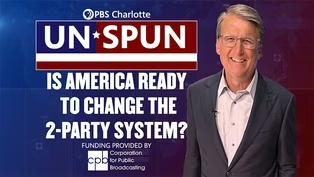
Rethinking The Two-Party System Preview | Unspun
Preview: S2 Ep208 | 30s | Unspun asks: Is America ready for a third party, or stuck in two-party rule? (30s)
Providing Support for PBS.org
Learn Moreabout PBS online sponsorship
- News and Public Affairs

Top journalists deliver compelling original analysis of the hour's headlines.

- News and Public Affairs

FRONTLINE is investigative journalism that questions, explains and changes our world.












Support for PBS provided by:
Unspun is a local public television program presented by PBS Charlotte