Roots, Race & Culture
Is Diversity & Inclusion Under Attack
Season 3 Episode 4 | 26m 35sVideo has Closed Captions
Explore the backlash against diversity and inclusion and the threat toward equality.
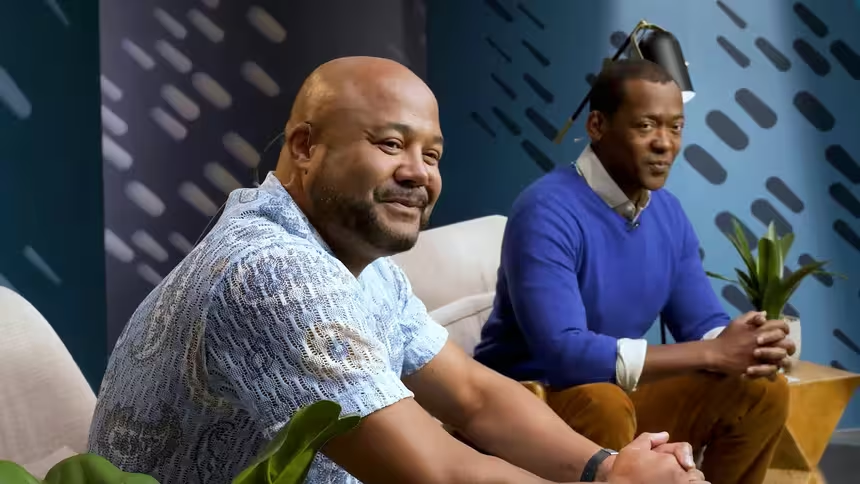
Lonzo and Danor lead a conversation about diversity and inclusion, specifically within higher education. The episode addresses the backlash against diversity, equity, and inclusion (DEI) initiatives and how this threatens progress towards equality. The guests, Dr. Sidney Shorter and Nikki Walker, provide their insights and experiences related to DEI challenges.
Problems playing video? | Closed Captioning Feedback
Problems playing video? | Closed Captioning Feedback
Roots, Race & Culture is a local public television program presented by PBS Utah
Roots, Race & Culture
Is Diversity & Inclusion Under Attack
Season 3 Episode 4 | 26m 35sVideo has Closed Captions
Lonzo and Danor lead a conversation about diversity and inclusion, specifically within higher education. The episode addresses the backlash against diversity, equity, and inclusion (DEI) initiatives and how this threatens progress towards equality. The guests, Dr. Sidney Shorter and Nikki Walker, provide their insights and experiences related to DEI challenges.
Problems playing video? | Closed Captioning Feedback
How to Watch Roots, Race & Culture
Roots, Race & Culture is available to stream on pbs.org and the free PBS App, available on iPhone, Apple TV, Android TV, Android smartphones, Amazon Fire TV, Amazon Fire Tablet, Roku, Samsung Smart TV, and Vizio.
Welcome to Season 7
Bold and honest conversations tackled with humor, insight, and empathy.Providing Support for PBS.org
Learn Moreabout PBS online sponsorship(gentle music) - [Announcer] "Roots, Race & Culture" is made possible in part by the contributions to PBS Utah from viewers like you, thank you.
(upbeat music) ♪ Yeah, yeah, yeah, yeah ♪ (upbeat music) - Hello, everyone, and welcome back to "Roots, Race & Culture."
Well, you know, the routine.
We're here to bring you into some candid conversations about shared cultural experiences.
I'm Danor Gerald.
- And I'm Lonzo Liggins.
In the summer of 2020, protests erupted around the world following the death of George Floyd.
Diversity, equity, and inclusion would soon take center stage in universities, corporations, schools, city, state, and federal-run programs.
Change was in the air.
But just as soon as change began to take shape, a swift and harsh backlash started to happen in the years to follow.
Earlier in this year in Utah, four bills were introduced into this legislative session that targeted diversity, equity, and inclusion, or DEI, and similar challenges are happening in other states.
Many who have been on the front lines of DEI in our state were perplexed.
How could something that seemed to be such a vital force for the betterment of the state, and the nation for that matter, be harmful in any way?
Joining us today, we have Nikki Walker and Dr. Sidni Shorter, welcome.
- Thank you, thank you for having us.
- Absolutely, well, Nikki, why don't you introduce yourself and tell us about.
- Sure, so, I'm Nikki Walker.
I serve as the director of diversity, equity, and inclusion for a Utah-based software company.
And, in my free time, I spend time serving the public by doing DEI workshops and talking with people about what inclusivity looks like.
- Dr.
Shorter, introduce yourself, please.
- Well, again, thank you for having me.
I am the president and CEO of the Utah Black Chamber of Commerce.
I hailed from Baton Rouge, Louisiana, and love it here in Utah.
But the focus of my work here is really all about business and ensuring that all businesses have the opportunity to be a vital part of the economic ecosystem.
- Oh, I love it, love it.
- Ooh, I love the intro, yeah.
- Well, I hear you're doing some really great things and we're just really glad to have you in the state.
- Thank you.
- Well, I'm curious now, clearly you're taking things in a positive direction, as she said, but from your point of view, give us an understanding of what diversity, equity, and inclusion is.
Give us your definition of DEI.
- Well, I call it we.
- We?
- We, because we are here, we are in it.
We have to make decisions around it, but that's how we exist.
We are not singular, we are not solo.
And the best way to ensure that a system works is that all parts of it can do its part.
- Since it's been under scrutiny lately, how can something so positive be getting a lot of perceived backlash, or, you know, people are just questioning whether it's really valuable?
- Yeah, it's unfortunate for a number of reasons.
One of the things is that people begin to feel like they are under attack when other people are pushed forward.
And in DEI, diversity, we look at it and say it's a fact.
It is a fact that diversity needs to exist.
We look at stats and 35% increases in business at the end of the day when management teams are diverse.
So we're looking at research from the Harvard Business Review.
We're looking at research from prestigious colleges and institutions that are telling us that the bottom line is affected when there are diverse voices at the table.
And DEI is about accessibility.
In order for us to be positively motivated to be upwardly mobile, we need to have diversity, and those diverse individuals should be equitably treated.
And equity is not the same thing as equality, I wanna make that distinction.
So equality says that everybody gets the same thing, but equity says everybody gets the thing that they need in order to succeed.
So there's a huge difference there.
- That's a really big difference when you explain it that way.
And I don't think people understand that.
- I don't think people understand that, and that's where the pushback comes from.
- And I have a question for you.
Are there other ways that DEI is important outside of business?
'Cause I know we had spoken about the culture of a company.
Can you speak to that?
- Yeah, so what's really important, we look at the investments that are made by many companies who want to ensure that they have diversity, right?
But what happens when that diverse candidate arrives?
So it's really taking a serious look at the culture of your organization, because every organization does have a culture, and all cultures are not conducive to diversity.
And so as much as you may want it, there is work that's involved.
And that's the aspect around the skepticism now, because it's not a add water and mix.
I'll go back to our roots of Louisiana, when we talk about gumbo, America was built on the premise of a melting pot.
That meant that everyone had to conform, assimilate, and become like the majority.
Gumbo has different ingredients.
And all the ingredients, although they are in the same pot, preserve their unique flavor and that's what makes it great.
- Oh, yeah, you get three or four layers of flavor when you get some of that gumbo.
- And the melting pot is very different, because it is all melded into one.
But when we all work and simmer together and preserve our own unique flavors, that's what makes it wonderful.
That's what makes it beautiful.
That's what makes it work.
- I like that analogy.
That's beautiful.
- Can I share with you guys an article?
I wanted to share with you an article that was in "The Washington Post."
It reads, "Ex-Morgan Stanley executive alleges reverse discrimination in a lawsuit.
He said he was unfairly terminated in the interest of Morgan Stanley's diversity goals.
The idea of," and it's in quotes, "'reverse discrimination' gets thrown around a lot by people who are fighting against DEI initiatives."
- My response to that is that this idea of reverse discrimination is not new, first of all.
We've heard this over and over again in different ways, whether through universities or corporations.
But the fact of the matter is in order to discriminate, you have to have a level of power.
Power comes from institutions, and power comes from systems.
And if I am not a part of the system, I don't have any power over you.
So there's a disconnect there.
This idea of reverse discrimination doesn't make sense, because you are the person with the power.
When we are instituting diversity, equity, and inclusion policies, it is because something has happened that has forced certain people to be starting from a different space, and we need to get everybody on a level playing field.
And so a lot of people think, "Oh, we're just hiring Black people for diversity," no.
- Yes, I was about to say that.
- We're padding the pipeline.
We're creating a pipeline that actually has diverse people in the pipeline, so that when these opportunities arise, diverse people are part of that opportunity and they get to stand on their own legs like everybody else.
- I think how we get there also informs the skepticism, because most often it's reactive as opposed to being planned, prepared for, and responsive, and so that makes a difference as well.
I had an experience here in Utah to go speak with a large organization about their thoughts around DEI and their considerations.
I couldn't get in the building.
- You had an appointment though?
- I had an appointment, and when I got there to security, security was certain that I was in the wrong space, that I was in the wrong place.
And I was excited about having this conversation and their considerations, but it became a teachable moment about culture.
So we had the meeting, they had wonderful ideas, they're looking at really making the investment and those considerations.
And then, I told them about my experience getting into the building.
What I shared with them was, "Don't reprimand, don't punish, and don't go right into making a reactive policy.
Let's do some of the things that we talked about."
Because what would really be a shame is if the only Black person he sees again, is when I come back two months from now.
- There's such a fear, I think, from people when it comes to diversity, equity, and inclusion now.
And I think the fear from the other side seems to be, as you were saying, "Something's getting taken away from me."
Do you think that that's mainly a lot of the pushback?
Or do you think there's other aspects of this pushback?
- Can I jump in here for second?
- Oh, yeah, yeah, yeah, go for it, go for it.
- Part of it is, and I say this often, we have talked about DEI to nauseam.
People are tired of hearing about it.
There are organizations who have made the investment.
But defining it, and defining it, and defining it without implementation and real results can get a bit exhausted.
And so I think that's what we are realizing, and that's what we're experiencing now.
- Well, I don't know if this is, I'm gonna try to make this short, this is the story.
This lady took two young white men, two young Black men, gave one of each in each category a false felony record.
Sent 'em out to do some job interviews.
And based upon how many of 'em got called back or were able to, you know, have a chance to continue forward and get the job, they said being Black is like the same thing as having a felony conviction, even if you aren't a felon.
They said the white guy, who was a felon, had a better chance of getting a job than the Black guy who had no criminal record.
And these were all false.
So there are some actual reasons why we're really trying to change the culture, and that's just not a business.
That's business, that's our country.
Like, you said, that's everything who we are.
- Can I say?
- Oh yeah, yeah, absolutely.
- That example is why, in corporate America, people who are doing the work of DEI are doing things like removing names from resumes.
We are doing things like- - So you're just looking at the merits?
- It's called a blind resume.
- Blind resume review.
So that we don't know if you are a man, we don't know if you are a woman, Black, white, veteran.
- That's amazing!
I think that's great!
- And this is a small step in the right direction.
But some people in corporate America got it right.
- Now I wanna ask you both a question.
Now this is about an article.
So this was an article that was written in the "Deseret News," by Sidnee Gonzalez.
It was March of 2023.
In the article, she says, she quotes Representative Sandra Hollins, Utah's only Black state lawmaker.
Sandra says, "My phone has been blowing up with messages from concerned students, teachers, and professors who don't feel safe in Utah school systems, as well as organizations that are trying to recruit diverse businesses and talent into the state.
It seems like we are taking two steps forward and five steps back."
So I wanna hear your thoughts on this quote.
I wanna start with you, Dr.
Shorter.
- Well, I'll start with, I think it's unfortunate and it is real.
That is the reality.
But as we mentioned earlier, I still believe that a lot of it is couched in fear, which I've never understood.
But it's our reality.
There are a lot of things I believe, even over time, when you look at the span of history in the US when we are talking about diversity, diversity doesn't just mean race.
But what's unfortunate is many times the issues around it, that's how they are experienced and lived out.
- I'm curious about like this idea that people have that somehow DEI is like just a passing phase, right?
Like, "Let's move on," you know.
You mentioned earlier this idea of virtue fatigue, you know, like how do we get to a point where it's the culture.
- So it's really step by step.
How do you eat an elephant?
One bite at a time, right?
It's step by step.
And what I want people to realize is this idea of DE&I, not idea, this industry of DE&I, this activation of DE&I is incredibly important.
And we have only been, and I'm speaking from a Black perspective at this point, if you look at the span of history of Black people in the United States, the timeframe that we have actually been free is very short in comparison to how long we've been here.
And so I always wanna position that, because people think that DEI should become the culture immediately.
Well, the fact of the matter is, it's been more than 400 years since we've been here and just less than 100 years since we've been free.
- Been working together to try to make it equal.
- Right, exactly.
So you can't expect that overnight, because 2020 happened, that DEI is gonna be accepted or respected.
There is this idea of there's not gonna be anything left for the majority if everybody else gets something.
But here's the reality, there's a very large pie here and there's enough for everybody to get a piece, and you need everybody to be a part of that mix.
What we don't want see is homogenous spaces anymore.
Homogenous spaces, they just repeat the same output over and over, because, again, there's no one there to provide a separate perspective.
- Here's what I often say here in Utah that I think is critical to this work in any industry or institution, there are some great things happening here.
We don't elevate that.
That stays too much in the background.
The teacher who is of the majority culture, who is inclusive, respectful, doing all of those things, they're off in the background.
And so it's happening, we just don't elevate it enough.
Because I believe if we elevate it enough, others will get the courage.
We keep talking about the fear, right?
Others will become encouraged and we can diminish the fear of stepping into that arena.
Because it is happening, but it is unfortunate that we spend so much time elevating where it's not happening, and it does deserve our attention.
But I think for others to really gravitate to it, or for us to attract others in the work, we have to talk about some wins.
We have to talk about, as Nikki talked about, the implementation aspect of it and where it's actually working.
- Is there a mental health aspect to all of this?
- Oh, my goodness.
- That's a big one.
- So it's huge, it's huge.
And I'll, again, speak from the Black perspective.
And that is that every day as a Black woman, somebody chooses violence against me.
Every day, every day.
Whether it's a microaggression, whether it's a macro-aggression, whether it is me having to watch another Black person being murdered on TV by whomever, these are acts of violence that are pushing themselves against our being.
And to carry that around every day causes angst.
It causes anxiety.
The anxiety of a Black mother who has a Black son, the anxiety that she has when her Black son goes out into the world in his car, the anxiety about whether or not he's gonna make it home is a very real thing.
- Absolutely.
- When we talk about our Black men, my son, we were in a predominantly white community.
And in high school, this was before Trayvon Martin.
Living on the east coast, it's cold, you wear your hoodie.
Well, his friends were white, everyone would wear their hoodie.
But I have a 6'4, almost 200-pound high schooler, you can't wear your hoodie, and he couldn't understand that.
And so one evening after dinner, I told him, I said, "Let's go around to the CVS, make sure you have your wallet, your ID, and some money.
And I want you to put your hoodie on and I want you to walk in that store."
I said, "Shop for something, find something.
I said, "But I want you to linger and I want you to stay a little while."
I said, I want you to pay attention to what begins to happen."
I said, "Because someone's going to watch you.
Someone's going to follow you.
And you may hear some things over the intercom that might not make sense to you, but it's their code."
He came out crying.
That was a hard lesson to teach a young man whose a great guy, great student, concert pianist, all of that.
But they didn't know that, they just saw the being.
But as a mother, I had to teach him that to save his life.
- That is heartbreaking.
Anytime I'm near a police officer, whether I'm driving or we happen to be in the same, I don't even look at him.
I don't even look at him, because of the feeling that I have inside, the trauma.
They might be like trying to make me feel welcome.
I'm like, "Man, the more attention you give me, the less comfortable, the more uncomfortable I feel."
You know what I'm saying?
- It's a double-edged sword.
I mean, well, it is a double-edged sword.
I tell a story similarly about myself.
I have two very good girlfriends that are white and we used to work in the same place.
And one of our locations for the company was very far away, an hour away.
And so when we used to work at that location, we would leave to come back to headquarter at the same time, and I would always arrive 15 minutes after they got to headquarters.
And so we went to lunch one day and they're like, "Why do you drive so slow?"
And so I had to explain to my two white girlfriends that, "I'm a Black woman in Utah driving a BMW, and if a police officer gets behind me and pulls me over, I don't know how that interaction is going to end.
I can't speed from down south to Salt Lake City like you can in your luxury vehicle."
- Ooh we.
- "You have the complexion for protection, I do not, so I drive the speed limit."
And it brought them to tears.
But these are the stories these are the situations that need to be shared, because in order for people to understand DEI, there has to be empathy.
People have to be in your shoes and understand what it is like to live life in this body, whether it is a Black body, or a handicapped body, or a body of a veteran, we can keep going all day.
People need to understand what it is like to be unique, to be different, and what those experiences are.
And if they don't know, it doesn't affect them, so we have to insist upon empathy from people in order for them to get fully in the game.
- Because a lot of people don't realize when you may be a part of a majority and you're in a room and there's one person who's different, it doesn't matter if they're Black, it doesn't matter if they're LGBT, if you are not recognizing that person's different and may have a different thought than you do, and you start spouting off at the mouth about different things and that person feels uncomfortable, they may not come out and tell you that.
They may not come out and say, "Look, I feel uncomfortable right now," because they don't wanna rock the boat.
- And not everybody has just the courage when you're the only one in the room to speak up.
You know what I mean?
That doesn't feel like a safe place already because you're already alone, so yeah.
- And there could be a power dynamic why they're not speaking up and recognizing that.
- But relationships are what changes those dynamics.
- Talk about it.
- Because we have to be in proximity to be able to empathize.
I don't know you if you're just on the other side of the room.
That's why so much of the work with the chamber is predicated on community and inclusivity of bringing all those different cultures together, because now I get to be in proximity, I get to hear, I get to engage, I get to understand.
now I can empathize.
But as long as you're over there, and I am either guessing or being informed by outside sources that still don't know me, it keeps us divided, right?
- Yeah, there's separation.
- And so being in proximity and having those conversations, we can go on and on about relationships and business that has happened right here in Utah because people were in proximity with each other.
You talked about the aspect of mental health.
Right?
- Yeah.
- We have this thing that we talk about, I always go back to we, illness starts with I, wellness starts with we.
- Mm, I like that.
- We have to do it together.
We're here anyway, right?
We're here, we are really not separate, we are here.
And so how do we, with intention, get closer to listen, to hear, to understand.
Because we can all call folks that we are in relationship with no matter what they look like.
- Yeah, yeah.
- It's hard when there's the absence of that, but that takes work.
- You have to get out of your comfort zone.
- That takes work.
- Yeah.
- So what would be one thing you would want our audience to take away from this?
What would you say, Nikki?
- I think the one thing that I want people to take away from this is actually two things, so empathy and action.
I think that if we want to be in a space where DEI is once again celebrated as opposed to being questioned, I think we need an empathetic base.
So get to know your neighbor.
Get to know somebody that you have never met, and then, action.
Again, we talked about it earlier on the show, we've been taught what DEI is supposed to look like, we've been shown all of the tools.
Activate on something, get the momentum behind you and lead with empathy.
- Dr.
Shorter.
- So I, you know, I go back to this, 'cause I always go back to economics, right?
Make an investment in someone that you don't know or that doesn't look like you.
And that investment is your time, your intentionality, and being deliberate about developing a relationship.
Those are the things that yield dividends.
Those relationships will yield dividends that go beyond us and become generational.
- That's awesome, thank you so much.
You gotta be doers of the word, not hearers only.
- Amen.
- Well, that was a very amazing show.
And we're so grateful to have these two powerful Black women in our community who've really made a tremendous impact on diversity, equity, and inclusion in our state.
If you'd like to learn more about them or their organizations, go to PBSUtah.org/roots.
- Thanks for watching today.
For "Roots, Race & Culture," y'all, we are out!
(upbeat music) - [Announcer] "Roots, Race & Culture" is made possible in part by the contributions to PBS Utah from viewers like you, thank you.
(upbeat music continues)
Is Diversity & Inclusion Under Attack
Preview: S3 Ep4 | 30s | Explore the backlash against diversity and inclusion and the threat toward equality. (30s)
Providing Support for PBS.org
Learn Moreabout PBS online sponsorship













Support for PBS provided by:
Roots, Race & Culture is a local public television program presented by PBS Utah