Chat Box with David Cruz
Is Fulop Ready to Run? A Chat with the Jersey City Mayor
4/1/2023 | 26m 46sVideo has Closed Captions
Mayor Fulop talks Jersey City's future, Prof. Williams on Paterson PD state takeover
Jersey City Mayor Steve Fulop discusses his ‘State of the City’ address, a possible gubernatorial run in 2025 & what the future holds for the town in terms of Liberty State Park development. Plus, with the death of Najee Seabrooks still reverberating throughout the state, David Cruz talks with Montclair State Univ. Prof. Jason Williams about the state takeover of the Paterson police Dept.
Problems playing video? | Closed Captioning Feedback
Problems playing video? | Closed Captioning Feedback
Chat Box with David Cruz is a local public television program presented by NJ PBS
Chat Box with David Cruz
Is Fulop Ready to Run? A Chat with the Jersey City Mayor
4/1/2023 | 26m 46sVideo has Closed Captions
Jersey City Mayor Steve Fulop discusses his ‘State of the City’ address, a possible gubernatorial run in 2025 & what the future holds for the town in terms of Liberty State Park development. Plus, with the death of Najee Seabrooks still reverberating throughout the state, David Cruz talks with Montclair State Univ. Prof. Jason Williams about the state takeover of the Paterson police Dept.
Problems playing video? | Closed Captioning Feedback
How to Watch Chat Box with David Cruz
Chat Box with David Cruz is available to stream on pbs.org and the free PBS App, available on iPhone, Apple TV, Android TV, Android smartphones, Amazon Fire TV, Amazon Fire Tablet, Roku, Samsung Smart TV, and Vizio.
Providing Support for PBS.org
Learn Moreabout PBS online sponsorship>> Major funding of "Chat Box" with David Cruz funded by the New Jersey education Association making public schools great for every child.
Njm insurance group serving residents and businesses over 100 years.
Promotional support provided by insider nj, a political intelligence network committed to New Jersey news.
Insider nj gives serious players and interactive forum for ideas, discussion and insight.
Online at insidernj.com.
♪ David: hi, welcome to "Chat Box ."
I'm David Cruz.
The big news out of paterson is the state takeover of the police department.
We begin today with a mayor who might be angling for a shot at the governor's office.
Steve fulop announced he is not seeking reelection as mayor, but is interested in governor.
We will try to get an announcement today.
We welcome Jersey mayor Steve Fulop back to Chat Box.
Welcome.
Steve: Good to be here.
You just delivered your 10th state of the city address.
I assume you think the state of the city is somewhere between good and great?
Steve: The biggest challenges we face going forward is around affordability and making sure we are creating a city that works for everybody.
On the positive side, we have a lot of great projects we want to see through to completion and it would be hard to argue that Jersey City has not been a success city.
It has become the economic engine for New Jersey.
David: I want to discuss statewide issues.
You mentioned affordability, something we keep hearing a lot about in the city.
The rent is too damn high.
You have tenants fighting landlords and lots of people on Twitter saying your administration is not enforcing rent control laws.
What is up with that?
Steve: We are enforcing rent control laws.
On the port side front, there is a process with regards to any person who feels their rent is wrongfully raised.
They go in front of a board and a board of their peers adjudicates it.
In the port side situation, a lawyer took a look at the facts, rendered a decision counter to those residents' interests.
She is not political, looks at the facts the way she sees them.
It would have been easier to do what the residents wanted, but tried to do the right thing.
Portside has a remedy and they can pursue that.
I do not know why they have not.
Around affordability, the city has done more on building affordable housing than anywhere else in New Jersey.
Part of the conversation is building market rate housing because if you have enough supply to meet demand, prices will be stabilized.
We have built six times per capita what New York has.
Other cities are not building as much as they should, you will have a housing crisis around affordability.
It is not solely Jersey City, but we are doing more to solve it than anywhere else.
David: A city that used to be Jersey City's Times Square environments, you are reinventing it as an arts and entertainment focused community.
A satellite of this French Museum.
Estimated $50 million projects.
I know it was $9 million to buy it, millions more to renovate, millions and annual payment to the museum.
How does the city make that money back?
Steve: It is going to cost more than $50 million.
It is the same kind of project as nj pack, the Aquarian in Camden, it is a cultural institution that will attract millions to the region, act as an economic driver and anchor, and stimulus for young people and educational facilities to bring children there to learn.
It is one of the most significant locations in the world.
They have locations in Saudi Arabia, seoul, Korea, Brussels.
It is a coup for Jersey.
Critics will be critics.
It is a major institution that will be here.
People should view it through the lens of crating a new Liberty science Center or nj pack.
That is how it will drive economic benefits to the area.
David: Are you come to bow with critics, me included, who say you are imported arts and culture, not providing enough opportunities for some of the stuff that existed here before?
Steve: Not true.
We crated the first arts trust fund to support homegrown organizations in Jersey, we built three black box theaters.
At the same time, it would be wrong to say we should not be inclusive and look globally to expand Jersey City's horizons.
The larger the pie, it benefits every nonprofit in the city area to attract more people, more opportunity, benefits every local non-profit.
It is a shortsighted way to look at things to say we should not included because maybe it will infringe on a small pie I have today.
We should think about how to make it larger for everybody.
David: A couple state issues that intersect with our city.
Liberty State Park.
Critics say your silence is deafening.
Are you for commercial developments in the park, like a hockey arena, concert facility?
Have you been talking with Paul Fireman who owns Liberty National Golf course?
Steve: It is interesting when people say that.
There has been no fiercer protector of the park than myself.
We sued and fought every single turn.
Last year when there was a proposal from legislators that gave us access to $200 million and then $50.
When I read that legislation I thought it was good for Jersey City and conveyed that because it had checks and balances and guardrails to make sure the park remains safe.
I have also been clear that I do not entirely agree with either side of the conversation.
Of course I think the park should be protected.
It is a nonstarter to expand it.
I do think community centers, recreation facilities like a pool, ice rink, in areas of the park better underutilized or not utilized, are worthwhile to explore.
I do not think a concert venue or big stadium is appropriate, but a healthy conversation is good.
Let the process play out.
I think the park is a huge asset for Jersey City and I am not looking to undermine the.
-- that.
David: The suggestion is you are buddies with Paul Fireman.
Steve: He has not been a funder of my campaign.
Paul Fireman and I speak on occasion.
I speak to the friends of the state liberty Park often and they are not funders of my campaign.
I look at what is in the best long-term interest of liberty State Park.
The name calling, rhetoric, assuming everyone is in it with the worst of intentions is not beneficial.
There is a possibility state advocate or's -- advocaters are coming from a sincere place and it is possible friends of liberty State Park who want less space are coming from a sincere place as well.
David: Mass transit.
Are you OK with nj transit service?
Weekend light rail is almost nonexistent and bus service is spotty at best.
The governor said he would fix it if it killed him.
He is still alive, but it is not much better.
Steve: In the year 2023 you need to rethink and reimagine what nj transit can be.
We created via, an opportunity to connect transit deserts.
David: a rideshare program.
Steve: Using technology.
It has expanded to more than one million rides.
There are a lot of things you can do to rethink mass transit.
I have been a critic of the turnpike expansion because I think dollars would be better utilized as a one-time opportunity to build better facilities.
Ultimately it is the governor's decision.
You are asking if I think it has been a success story.
The short answer is no.
David: A couple questions the governor might have to answer.
Your thoughts on the elections transparency act set for a vote this week in the assembly?
It gives the governor power to appoint the commissioners to the election law enforcement commission, no Senate approvals required.
Would you sign that bill?
Steve: If I was the governor, no, not in its current form.
There are good things in there like raising limits.
I think that is necessary.
Has not been done in 20 years.
A couple things are major concerns.
One, it does not empower county organizations.
Or individual candidates.
Eventually the concept of a slush fund will go sideways and there will be legal issues around somebody regarding that eventually.
That is two.
It has been well documented, concerns around the independence of ELEC.
It is strange to me it is a one-time opportunity to appoint an entirely new board and then it reverts back to the structure of senatorial approval, which basically is implicitly acknowledging that process is the best.
I would say that is what should prevail.
David: Did you agree with the state takeover of the Paterson Police Department?
Steve: I am not familiar with the nuances of the Paterson Police Department.
I am always concerned when you have the state thinking they can do a better job than local government.
Local government is closest to the residents, and tends to be the most functioning level.
It functions better than state government and federal government.
I do not know all the details around that takeover.
Whenever you see a takeover, it gives me pause.
David: There was a program called arrive together you may be familiar with, a state program that pairs plain clothes police officers with crisis interventionist specialists to respond to people in crisis, whether they are on the street or in their home.
Some say there should be no police sent to mental health crisis situations.
What do you think?
Steve: We spoke to the Attorney General about the program as they were exploring it in Jersey City.
Ultimately there was a cost issue around police officers we would have to remove to travel with mental health professionals and the number of calls we see during the day and how we would respond to those and best utilizing police officers and who would be responsible for those for the dollars associated with that.
We could not get to a place we were comfortable where it would make the most sense.
We did explore it.
We are working with anti-violence groups and will allocate to nonprofits in that space.
Even if you have a mental health professional respond to a call and there is a risk of violence, which is often the case, they have to wait for a police officer anyway, and police are part of the process.
You can't just have mental health professionals responding to 911 calls solely.
David: Last time we talked you said you were leaning toward running for governor.
What is going into your thinking?
Steve: I am leaning more.
There are a lot of things.
Can you put together the structure that makes sense?
How do you want that to look?
Do you want to build it from grassroots, which is the best way.
How do you approach structure in New Jersey so if you run for governor and are successful, you can have a consequential administration?
That starts with how you build it.
I think I made mistakes when I think about how I approached it in 2016 when I was looking at running for governor.
I had a heavy reliance on doing what I did -- doing the opposite of what I did when I started to run for mayor.
That means relying on the traditional structure.
If I was to run for governor in 2025, I would do it regardless of the traditional structure.
I would not play that inside game.
I do not think that is the way to be consequential in this business.
David: Jersey City Mayor Steve Fulop, good to see you.
In the biggest move of his brief tenure as Attorney General general, he announced estate takeover of the Paterson Police Department.
Just weeks over -- after the death of najee seabrooks.
The announcement was received with hope and trepidation.
Jason Williams has been watching the police community dynamic for years in Paterson and around the state and joins us.
Professor, good to see you.
Welcome to "Chat Box."
Your thoughts about the state intervention announced in Paterson this week?
Jason: It is a step in the right direction.
We want to give credit to the Attorney General.
There were decades old issues.
Where it falls short is whether or not he consulted the community about the three major directives he plans to enact.
David: That is one of the things we heard a lot this week.
Noting the optics of the announcement, one called it eternal is stick.
What terminology would you use?
Jason: The same terminology.
It is part and parcel for how the Black community and others have been treated.
Spoken down to.
A good example would be the community policing program that sparked in the 1990's where Black communities were subjected to this program without being consulted.
It resulted in a technocratic product not on par with what the community wants.
This is what we see with this directive.
It is still a good step in the right direction because at least we have this acknowledgment, which we were not getting from city officials, but it is important moving forward.
The third directive, he wants to put together a study group.
It will be crucial he foregrounds community voices in that process.
David: What steps can the Attorney General's office take to get this rate?
Jason: Imagining a new system not necessarily connected to the criminal legal system, but still state-sponsored.
That includes organizations such as the Paterson collective, community-based organizations whose sole mission is to prevent violence.
Credible messengers who work for these organizations.
Though they are not clinicians, they are doing the work of a clinician.
People on the ground trust them, understand the plight.
Some have been system-impacted themselves, similarly to Mr. Seabrooks.
We need to legitimate these and visuals -- these individuals so they can qualify for grants.
David: We talked about the arrive together program the state says it wants to expand to Paterson.
It pairs a plain clothes cop in an unmarked car with a crisis interventionist expert.
There has been pushed back from some who say there should be no police involvement.
We just spoke to Mayor Fulop who said you need law enforcement if there is potential for violence.
Where do you come down on that?
Jason: I am with the cahoots program in Oregon.
There are models in existence that have long shown community-based responses are more effective.
The community tends to trust these organizations because they are not law enforcement and we have to understand this is often based on lived experiences of very negative and adverse reactions with law enforcement.
We ought to listen to the community and democratize how we govern these communities.
They must have a say over how they governed.
With the arrive program, a law enforcement agent would go out alongside a clinician.
There can be a paradigm where we just send out the clinicians.
As noted under the cahoots program in the state of Oregon.
David: Is that what they do in Oregon, it is just clinicians and crisis intervention specialists?
Jason: Absolutely.
Folks who understand what these crises are, have been trained.
If they may need law enforcement presence, they can call for backup.
At the outset it is just the clinicians and crisis workers going out to those calls.
I think New Jersey ought to have the courage to embark on the same programming.
We have been regressive in other outlets as it relates to the criminal system.
We have to do the same in New Jersey.
David: On the state level, Civilian review boards with subpoena power, which a lot of people have been calling for, say could be a deterrent.
Lipservice for a minute, but now you do not even hear the legislative Black caucus talking about it.
Jason: These matters of policing and criminal justice reform have become a political football.
That is unfortunate.
Politicians should not allow these subjects to become hyper politicized.
People's very lives depend on these issues.
I would encourage our legislative body to reconsider.
Aside from the excessive use of force and police-involved murders, there is a need to democratize how we make policy and changes with the criminal legal system.
A long-standing outcry from Black Americans is that we are not listened to, do not have a say in how we are governed.
Civilian review boards would help stifle these feelings of powerlessness and hopelessness.
It gives voice to the community.
David: We hear a lot about why CCRB's have stalled is the great hold police unions have on legislators.
Jason: That has been a persistent theme.
I would encourage law enforcement to have the courage to engage in the heavy messiness required in dealing with police unions.
They can find a way.
It is about finding courage to move forward on what we know needs to be done.
The community has to have a say in how they are governed and how their police officers are held accountable.
It is the most democratic way to apply remedies.
David: There really needs to be a change in police culture.
The idea of armed police and its history in this country is one thing, but as we have evolved to today, police culture is immediately confrontational.
Jason: Absolutely.
This is why when we have had progressive changes and policy protocol it has been hard to institute.
You could have a chief that enforces reforms, but line officers and supervisors, sergeants, if they are not on board, agencies have a tough time instituting new policies.
Something has to account for the culture.
Simple measures around accountability will go a long way toward changing the police culture.
The subculture is hostile.
They do not have to worry about being held accountable for actions done under the guise of this culture.
If we hold officers accountable, we will see changes in the subculture as well.
David: I should have used the word subculture, I do not want to condemn all police.
People point to Camden and work as models -- and newark as models.
Jason: If you go to Camden or Newark, residents are still exclaiming that their voices are not being heard.
With mental health crises, when a person is going through a mental breakdown, these programs fall short.
One does have crisis intervention workers.
We can give that some credit, but these communities do not trust the police.
We have to have that conversation.
David: Still miles to go.
Professor Jason Williams, thank you.
Jason: Thanks for having me.
David: That is "Chat Box" for this week.
Thanks to Mayor Steve Fulop for joining us.
You can watch our live streams and other great content when you subscribe to the YouTube channel.
I am David Cruz.
We are off next week for Easter.
Thanks for watching.
♪ >> Major funding for "Chat Box" with David Cruz provided by members of the New Jersey education Association making public schools great for every child.
Njm insurance group, serving insurance needs of New Jersey residents and businesses for more than 100 years.
Promotional support provided by insider nj, dedicated to New Jersey political news.
Insider nj gives serious political players and interactive forum for ideas, discussion and insight.
Online at insidernj.com.
♪
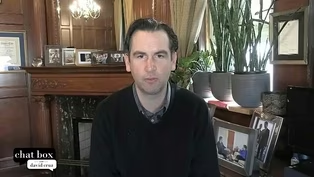
Beyond the Box: Jersey City Mayor Steve Fulop on Amy DeGise
Clip: 4/1/2023 | 1m 25s | David Cruz talks with Jersey City Mayor Steve Fulop about Amy DeGise. (1m 25s)
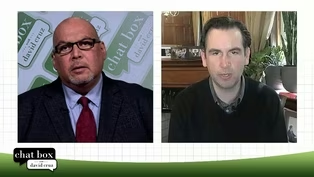
Beyond the Box: Mayor Steve Fulop on Jersey City Crime Stats
Clip: 4/1/2023 | 1m 52s | David Cruz talks with Mayor Steve Fulop on Jersey City's crime statistics. (1m 52s)
Providing Support for PBS.org
Learn Moreabout PBS online sponsorship
- News and Public Affairs

Top journalists deliver compelling original analysis of the hour's headlines.

- News and Public Affairs

FRONTLINE is investigative journalism that questions, explains and changes our world.












Support for PBS provided by:
Chat Box with David Cruz is a local public television program presented by NJ PBS