
Is That Black Enough For You?!?/Bookstock 2023
Season 51 Episode 15 | 26m 46sVideo has Closed Captions
Elvis Mitchell’s “Is That Black Enough For You?!?” Netflix documentary, Bookstock 2023
Acclaimed filmmaker, film critic and historian Elvis Mitchell joins host Stephen Henderson to discuss his Netflix documentary “Is That Black Enough For You?!?”. And, they talk about his Endowed Chair in Media position at Wayne State University. Plus, Bookstock returns this year to once again benefit literacy and education projects in Southeast Michigan. Henderson gets the details on Bookstock 2023
Problems playing video? | Closed Captioning Feedback
Problems playing video? | Closed Captioning Feedback
American Black Journal is a local public television program presented by Detroit PBS
Is That Black Enough For You?!?/Bookstock 2023
Season 51 Episode 15 | 26m 46sVideo has Closed Captions
Acclaimed filmmaker, film critic and historian Elvis Mitchell joins host Stephen Henderson to discuss his Netflix documentary “Is That Black Enough For You?!?”. And, they talk about his Endowed Chair in Media position at Wayne State University. Plus, Bookstock returns this year to once again benefit literacy and education projects in Southeast Michigan. Henderson gets the details on Bookstock 2023
Problems playing video? | Closed Captioning Feedback
How to Watch American Black Journal
American Black Journal is available to stream on pbs.org and the free PBS App, available on iPhone, Apple TV, Android TV, Android smartphones, Amazon Fire TV, Amazon Fire Tablet, Roku, Samsung Smart TV, and Vizio.
Providing Support for PBS.org
Learn Moreabout PBS online sponsorship- Coming up on American Black Journal film critic Elvis Mitchell is here to talk about his documentary that celebrates the African American movies and actors of the 1970s.
Plus this year's book Stock is a bargain lover's dream.
With more than 400,000 used books and media on sale we're gonna get the details.
Stay where you are.
American Black Journal starts right now.
- From Delta faucets to Bear Paint.
Masco Corporation is proud to deliver products that enhance the way consumers all over the world experience and enjoy their living spaces.
Masco serving Michigan communities since 1929.
Support also provided by the Cynthia & Edsel Ford Fund for journalism at Detroit Public .
- The DTE Foundation proudly supports 50 years of American Black Journal in covering African American history, culture, and politics.
The DTE Foundation and American Black Journal partners in presenting African American perspectives about our communities and in our world.
- Also brought to you by Nissan Foundation and viewers like you.
Thank you.
(Intro Music begins playing) - Welcome to American Black Journal.
I'm your host, Stephen Henderson.
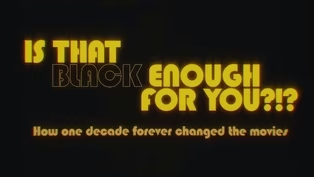
The documentary is that black enough for you is showing at the Detroit Free Press Film Festival later this month.
The film by writer and historian Elvis Mitchell examines how the African American movies of the 1970s had a major influence on Hollywood.
It's a directorial debut for Mitchell, who is from Highland Park, Michigan and a graduate of Wayne State University.
Here's the trailer for the Netflix documentary followed by my conversation with Mitchell.
- You are capable of great feats of strength and courage.
- My grandmother told me that movies turned her dreams into something resembling stories but the onscreen crushing of Black Hope was institutional.
When I was a kid kid be a stepping Willie Best, Buckwheat but I still wanted to be them.
One decade answered the question what happens to a dream deferred?
Does it dry up like a raisin in the sun or does it explode?
(Upbeat music) This is the story about a group of artists that changed the culture forever.
- These movies were about us.
- That's a nice change.
[Laughter] - The music.
The style.
- Is that black enough for you?
- The heroes.
- You want the black guy Richard, cause he's gonna help you get out.
- When Billy B. Williams came on every woman in Hollywood hollered up.
- I fell in love with myself.
I said, my goodness gracious.
- You see your role as a positive force or a negative one.
And then we made the film about the way things actually are.
All the artists, since I know them personally are responsible people who are concerned about what is happening in the black community.
- Movies is the stuff for fantasies.
I needed a black cowboy.
- First and foremost I'm an artist.
- You've gotta walk in Like it's yours.
- They were proof that we were here, that we create culture that we have voices and that we will be heard - Am I black enough for you - Elvis Mitchell, welcome to American Black Journal and also welcome back to Detroit.
You're a, you're in the Detroit area native and it's always great to have folks come back and talk about their work.
- Well, thank you for both welcomes.
You know, it's a thrill to be doing this and a thrill to be a Detroit man, so thank you.
- Yeah.
We're gonna, we're gonna talk a little more about Detroit in a bit, but first I do wanna talk about the film festival and your film.
Is that black enough for you?
This is one of my favorite subjects, by the way.
- Yeah?
- Is blacks films, especially of the 1970s.
I grew up during the 1970s and I wasn't allowed to watch some of these movies when I was little, [Laughter] but I saw 'em later and and I got really into 'em because, you know they're fun and, and especially when you were when I was like a young black kid, I, you know these were the first movies I experienced where you had black casts and, and black stories.
And so it kind of frames the whole understanding of that for me.
But, but, but tell me first what inspires you to, to make this movie?
- I, I think it's a similar experience to what you're describing.
- Yeah.
- And also he buttressed that I guess the kinds of things we would see on television, you know, and, and and those images unlike now didn't come with disclaimers or warnings or, or contexts.
It's just Wow.
And you watch watched it thing.
Gee wears a white people must be crazy if they think that's what we're like.
- (Laughter) - And, and because I remember as a kid, you know you watch these old movies you think, so, a white married couple sleep in separate beds.
- That's long.
- Okay.
I don't know any white married people.
So that's Huh, What?
So all these things that were never really explicated but left an impact anyway.
So they had these films of, of the 1970s which created a whole new mythology, I think for not only for just people of color, but for the world.
I mean, one of the points I make in the movie is just how pop culture was shifted by the way music was used in these films and how that created a whole new appetite and new way to market movies that black filmmakers and more importantly black recording artists never got credits for or never got their due you know?
But isn't that always the story of the platinum experience?
- Yes.
- That's not getting our due.
- Yes, it really is.
So I wanna talk about the the sort of cultural challenge that this this era and these films present as you point out, you know there are a lot of things about 'em that are troubling in terms of the way that they portray African American life and and the way television of course was, was doing it that but they do, they do really importantly capture parts of the culture that that, that were that were accurate and, and that that kids like me could kind of relate to.
And just as important, they paved the way for for the black film that comes in the nineties and after.
When, when we really start to come into our own and start to tell our own stories in a way that is really authentic.
I wanna talk about that tension, I guess between being uncomfortable with with some of these films, but also appreciating them.
Well, I think that tension you're talking about was the extent even during that period, because while you had Black Ashton films, you also had Sounder which was the first black first film, have a a nominations for the actor had actors African-Americans that had never happened before that moment.
Yep.
1972 was also a pretty incredible year.
Cause you also have the nomination of Di Diane, Diana Ross.
Lady Sings the Blues.
That's the first time a a black woman is nominated for a best original screenplay.
Suzanne De Passe Lady Sings the Blues.
That still hasn't happened since.
And, and you, the, the Thawing You, you have Claudine which is a project that the late Diane Sin was developing for herself.
And when she got too sick wasn't able to do it she passed the baton on to her dear friend Diane Carroll who got to make that movie and got an Oscar nomination that got a chance to respond to this image of her that existed in this TV show called Julia just five years earlier.
And you put her feet on the ground and show this (inaudible) that she hadn't really had a chance to demonstrate in mass media before.
You've got Sparkle which has given us enduring songs that are still part of the world.
You've got, my gosh, what I think is one of the crowning achievements of American cinema.
And, and that's, you know, Killer of Sheep by Charles Burnett.
There are extraordinary fellows that came out of that that that period that make it a much more complex time than it's giving granted for to do.
And that's why I've been very specific about saying even though people seem to miss the points about, is this is not a film about black exploitation, right?
This is a film about the breadth and expanse of films that were being offered.
You've got the movie done by Bill Greer, William Greer, Symbiopsychotaxiplasm: Take One without that you've got no Eric Andre you've got no Sasha Baron Cohen.
There's so much experimentation in in four terms being done.
And also you've got movies that I think set the tone for what Black Action films were, but are bigger than that.
You've got Sweet Sweetback, which is something that comments on black imagery that plays with the idea of, of of the way we respond to black imagery.
And, and, and you know, it's interesting too that so many of these films, in addition to being enormously impactful on the African American community were huge popular successes.
And they don't get their due for that either.
- Connect the dots between that era and this era and and, and the errors in between.
What are we to make of what comes out of the black films of the seventies that, that you know, we enjoy, we enjoy today.
You know, I can't help but watch Michelle Yeoh win for Everything Everywhere, all at once and think about the action film she did in the nineties and think, you know without the example of Pam Greer does that exist certainly five years after Coffee there's Charlie's Angels on television, which then then becomes a huge movie and, and that changed the culture.
There are so many of these moments that in these films I think were set seismic, seismic impact on on the way the world worked.
And I think the world of hip hop doesn't exist without the example of what Curtis Mayfield was doing.
When you hear Chuck D talk about Public Enemy being, you know, like black CNN while Curtis Mayfield was doing that and influenced Marvin Gaye, who then probably influenced a bunch of other people so we could go on that was a problem with making this documentary is that it could have been 10 hours long and just trying to call stuff.
But also it's, it's, it's one of the fun things for me and I I hope you got this from the, from the two is seeing in a lot of these cases the thrill that black actors got from working with other black actors because they had been so isolated.
And I think we're about old enough to remember that when you saw a black and white person on TV in a movie that was adult entertainment.
So what, because they're talking it's adult entertaining.
That's huh.
- (Laughter) - What?
Yeah, it was a really, a huge and terrifying thing.
So the way the laws have come down I think is that, we don't look as scans at the idea of of of a white person and a person of color being on screen.
In fact, it's on the CNN every morning now, just everywhere else.
So, so those things have changed too.
But the way I think I what I think they've changed movies is that there's always been an entrepreneurial aspect to black cinema.
Yeah.
And we look at Melvin Van Peebles to Spike Lee, to Robert Townsend.
These have been people and, and and filmmakers who changed the independent film movement who are still, their practices are still being employed today to get movies back.
You know, I was just interviewing Robert Townsend last year.
I called him up because I knew it was the 35th anniversary of Hollywood Shuffle which the movie he made with his credit cards.
I just thought, well gee, I wanna hurry and get to this before somebody else does.
And I just thought, nobody's gonna do this.
- No one's thinking about it Right?
- Yeah.
No, no, no, no.
They'll do something.
Oh, you know, the 20 anniversary of the OC Yeah.
But they, but they won't deal with this.
And, and you know they're filmmakers who are still using credit card to get films made and he changed the narrative.
And also because, and this goes back to, you know being along the All Stars and the Negro Leagues the fact that the Negro Leagues they had to build an audience, bring that audience literally with them to the stadium, sell snacks that audience like if the audience to engage with the team.
So in addition to everything else they had to play nine innings of baseball.
- Yeah.
- So for, for Oscar re show or Melvin Van Peebles or, or even Ava de Verne you gotta find the money for the movie.
You gotta make the movie.
You have to market the movie.
I mean, that's a rarity.
- Yeah.
- And this still exists.
You, you asked me to connect the dots that that through line that A to B is still an issue for filmmakers of color.
- Yeah.
So I do wanna talk a little about Detroit.
Of course you're coming here for the, the airing of is that black enough for you?
And it's a, it's a return home.
You were born in, in Highland Park, you went to Wayne State and you have a new role at Wayne State.
I I love that.
I love that that idea of returning home to, to pursue your craft.
Talk about that, that narrative.
- Well that's been a great too, cause you know I've been lucky enough to teach you a few places I've taught at Harvard.
I've taught the American Film Institute here in Los Angeles.
I've taught the (inaudible) film program.
I've spoken universities around the world.
So, you know, it's, it's pretty awe-inspiring.
You know, it knocks me off my feet to be invited back to my alma mater to be able to tell people how important it was for me to, to be here when when I was in school, I was, I had managed and was a projectionist back when we used to have such things at a movie theater in downtown Detroit and - Wow - And, and so in the early eighties I was doing that and putting myself through a school.
And so just to get a chance to talk to the student body of Wayne about the way that place the way growing up in Detroit formed me.
I don't want people to think that.
In fact, I'm so much a Detroiter that wherever I go around the world my watch is always set on Eastern Standard time.
That's, I was just in Rotterdam for the Rotterdam Film Festival and people is your watch broken?
No, that's Eastern Standard Time.
Where you from?
I'm from Detroit.
Was that on Central Time?
No, it's not on central time.
So yes, that's, but anyway, that's, that's how foundational Detroit is to me and my sensibilities.
So I'm, I'm beyond honored to be asked to come back and, and and teach a course there.
And I hope yeah, there's more of that in my future.
- Yeah, no, we do too.
It's, it's really special.
Alright Elvis Mitchell.
Looking forward - Before you go I wanna say - Yeah - How much the tradition of Black Journal has meant to me.
- Oh - Growing up in Detroit.
I just wanna say what the reason I fought to make time for this, and I'm glad you're able to be flexible in your schedule too.
And, and you know, the same way I do how important this show is and that it's still this standard is built.
So being kept aloft and a light is really important.
And I hope for generations of, of of people of color to come.
- Yeah.
Yeah.
We're, we're working on it.
We're working hard at preserving what what they've built here for us.
Great to talk with you and we look forward to you being at the film festival.
- Thank you so much.
I'm looking forward to it too.
Thanks again for your time.
- And you can get a look at, is that Black Enough for You at the Free Film Festival on April 27th.
Another event to look forward to this month is the annual book stock sale.
More than 400,000 gently used books, DVDs and CDs.
Books on tape and vinyl are gonna be available at bargain prices.
The event is April 23rd through the 30th at Laurel Park Place in Livonia and proceeds benefit literacy and education projects here in Michigan.
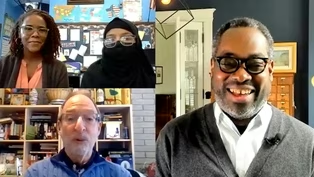
We spoke with book stock's honorary chairperson Neil Ruben of the Detroit Free Press along with last year's winner of the student essay contest.
Syeda Tasia and her teacher at Detroit's Davis Elementary School, Kenya Posey.
So Neil, I'm gonna start with you.
Tell me about book stock this year.
400,000 media available at gently used at bargain prices.
One of my favorite events.
- Yes.
Michigan's largest charity used book and media sale.
We've raised more than 2.5 million for literacy and education projects.
It's coming back April 23rd through 30th at Laurel Park Place Mall in Livonia.
All kinds of special stuff going on during the week.
You can catch up with that@bookstockmi.org.
But a key thing to know ahead of time is there's a presale on Sunday the 23rd from 8:15 AM to 11:00 AM for $20.
You can join the throng, go racing in the door get first crack at all the good stuff.
And my advice to newcomers don't stand between the throng and especially the cookbooks.
I actually saw a TV reporter doing a live report get elbowed out of the way by the cookbook fans.
So be very careful of your surroundings but it's a terrific way to get first crack at the Book.
- Yeah, I was gonna say, and I feel like you've gotta get to that presale to get all the good stuff cause there's a lot of people who show up for it and, and and get in line quickly, so - Although we're putting out, you know, with 400,000 items books, vinyl, all of it, we're putting out new material all week long.
So if you don't get there Sunday, there's plenty of good stuff.
- Keep going Right?
Yeah So Syeda I wanna turn to you next.
You won the essay contest last year during book stock which is very cool.
Tell me about the essay that you wrote and tell me about how you love writing.
- So the essay was about (inaudible) and she (inaudible) about the education of children (inaudible) and what I like about writing about her is that she can (inaudible) to create a bright future - Oh wow.
What is writing your favorite subject in school?
You're in the fifth grade, is that right?
- Yes, I do write my own journals at home.
- Very good.
- I think she wrote, she competed for the other contests this year for fifth graders for the NAACP as well.
- Oh, very good.
- Leading for the results or that as well it should be coming this week.
- Yeah.
Very exciting.
So, Kenya, tell me about the role of not just list essay contests, but but events like Book Stock, which celebrate the idea of writing and reading and books in, in, in in teaching young kids like Syeda - Yes.
It's a, it's pretty much a it's a good blessing and a curse kind of like, because some of the students I have to constantly pull all of the details out of them.
But the exciting part about it is was like I said when they saw she won last year, it kind of motivated the new students I got this year to say, oh when are we gonna do that book stock contest?
Oh.
So they're excited about the money component they got.
- Right.
- But like, we do the 20 minutes of DEAR we should drop everything and read every day.
So that was great for the month of March for the reading month.
And then once they finished reading their books they do a book report anyway.
So the ones who pretty much were committed and stayed after and stayed during lunch and submitted their papers.
So we had about 15 entries.
So we're excited to see how it all - That's good - Turns out.
But yeah, we love it, Book stock is a great program and it gets the kids excited about reading and writing.
- Yeah, I I mean it seems to me that that as a teacher, you know, I mean obviously reading and writing are, are huge building blocks in the the early education years, but it, it it's when students feel like they can own it themselves that they really kind of turn the corner and this is this is a great way to, to, to have an essay contest and an essay contest that that pays you a little money.
- Yeah.
That then they, like I said we have Davidson 4.0 so they are displayed on the broadcast of the morning cause we still utilize the team's platform to get announcements out.
So we have students that are running their own their own broadcast and they display everything that's going on in the classrooms so they get to shine across the building as well.
So it's (voice call cuts out) the kids.
(voice call cuts out) - Very cool.
Syeda what did you do with the money that you won from the essay contest?
- What'd you do?
- I gave it to my parents.
- Oh, that's a great kid, right - (inaudible) - Yes.
So Neil, what year is this now for book stock?
This is something you guys been doing for some time.
- Oh geez.
21 years, 22 I think?
- Is that right?
- It gets hard to count because we skipped a year or two with a, with the pandemic.
- Oh.
- But, but the excitement is still there.
The best awards like the one Syeda won., you know the winners announced on TV on Channel four.
And I I seeing that and it's great to see the kids the finalist essays are poster size on the wall and the winners are so excited.
They're literally jumping up and down and how great is it you know, you're a dad and you're a word guy.
How great is it to see kids so excited about reading and writing that they're jumping up and down.
- Yeah yeah - It's just fabulous - It doesn't happen all the time right.
- No - It's a lot of work, Brett.
- Yeah.
Yeah.
So, so Neil, I'm also curious if people have things that they want to give to book stock how do you do that?
- Well, we accept donations throughout the year.
We're not accepting anymore at this point because we're still frantically sorting and transporting through them all But there are always donation.
There's a donation button at books.mi.org.
So we would encourage people as soon as this one is over, keep an eye on that because we're very happy to get those books outta your basement and back in people's laps where they belong.
- Yeah, yeah.
I, I know that what's, what kind of interesting with my kids is they're teenagers now late teens and they're really into records.
They're really into albums which was the way I started listening to music when I was a kid.
And that went away.
But now it's super popular and I know you guys have a lot of of those for sale as well.
- Tons and tons and a lot of 'em are really collectibles.
A few years ago I got Ray Charles Modern Sounds in Country in Western music, which is just a holy grail.
It's a legend.
- Yeah.
- In absolutely pristine condition for $2.
I think the price has gone I think we're charging a little more maybe $4 or something like that per vinyl now.
But there are just ama-, there are fines basically throughout end to end at Laurel Park place for this.
We don't have time to identify the really valuable stuff.
- Yeah right.
- So You know, people are basically - You gotta go through it - Gold mining throughout this whole thing.
We don't care, we just wanna sell books and raise money.
And if you find a $60 book that we're selling for $3 God bless you.
- Yeah.
- Tell your friends.
- Yeah.
Well, Neil, congrats again on Book Stock and Kenya and Syeda, Congrats on Syeda's Big win last year and maybe you'll get another winner this year.
- (inaudible) Thanks for being here on American Black Journal.
- Alright Thank You - Thank You Steven - That's it for this weeks show, thanks for watching, and you can find out more about our guests at AmericanBlackJournal.org and connect with us anytime, on Facebook and on Twitter.
Take care, and we'll see you next time.
(Outro Music begins playing) - From Delta faucets to Bear Paint.
Masco Corporation is proud to deliver products that enhance the way consumers all over the world experience and enjoy their living spaces.
Masco serving Michigan communities since 1929.
Support also provided by the Cynthia & Edsel Ford Fund for journalism at Detroit Public TV.
- The DTE Foundation proudly supports 50 years of American Black Journal in covering African American history, culture, and politics.
The DTE Foundation and American Black Journal Partners in presenting African American perspectives about our communities and in our world.
- Also brought to you by, Nissan Foundation and viewers like you.
Thank you.
(Piano music)
Bookstock 2023 benefits literacy, education projects
Video has Closed Captions
Clip: S51 Ep15 | 8m 12s | Stephen Henderson gets the details on Bookstock 2023, Detroit’s used book and media sale. (8m 12s)
Elvis Mitchell’s ‘Is That Black Enough For You?!?’ film
Video has Closed Captions
Clip: S51 Ep15 | 14m 24s | Elvis Mitchell’s “Is That Black Enough For You?!?” documentary chronicles Black cinema. (14m 24s)
Providing Support for PBS.org
Learn Moreabout PBS online sponsorship
- News and Public Affairs

Top journalists deliver compelling original analysis of the hour's headlines.

- News and Public Affairs

FRONTLINE is investigative journalism that questions, explains and changes our world.












Support for PBS provided by:
American Black Journal is a local public television program presented by Detroit PBS