Roots, Race & Culture
Is Your History Being Erased?
Season 4 Episode 3 | 26m 46sVideo has Closed Captions
Examine book banning and the exclusion of African American history from school curricula.
Examine the disturbing trend of book banning and the exclusion of African American history from school curricula. With Utah ranking among the top five states for book bans, join us as we explore what exactly is being banned and who has the authority to decide. Prepare to explore censorship and the ongoing struggle to ensure an accurate and inclusive representation of African American history.
Problems playing video? | Closed Captioning Feedback
Problems playing video? | Closed Captioning Feedback
Roots, Race & Culture is a local public television program presented by PBS Utah
Roots, Race & Culture
Is Your History Being Erased?
Season 4 Episode 3 | 26m 46sVideo has Closed Captions
Examine the disturbing trend of book banning and the exclusion of African American history from school curricula. With Utah ranking among the top five states for book bans, join us as we explore what exactly is being banned and who has the authority to decide. Prepare to explore censorship and the ongoing struggle to ensure an accurate and inclusive representation of African American history.
Problems playing video? | Closed Captioning Feedback
How to Watch Roots, Race & Culture
Roots, Race & Culture is available to stream on pbs.org and the free PBS App, available on iPhone, Apple TV, Android TV, Android smartphones, Amazon Fire TV, Amazon Fire Tablet, Roku, Samsung Smart TV, and Vizio.
Welcome to Season 7
Bold and honest conversations tackled with humor, insight, and empathy.Providing Support for PBS.org
Learn Moreabout PBS online sponsorship(gentle music) - [Narrator] Funding for Roots, Race, and Culture is provided in part by the Norman C and Barbara L. Tanner Charitable Support Trust, and by donations to PBS Utah from viewers like you.
Thank you.
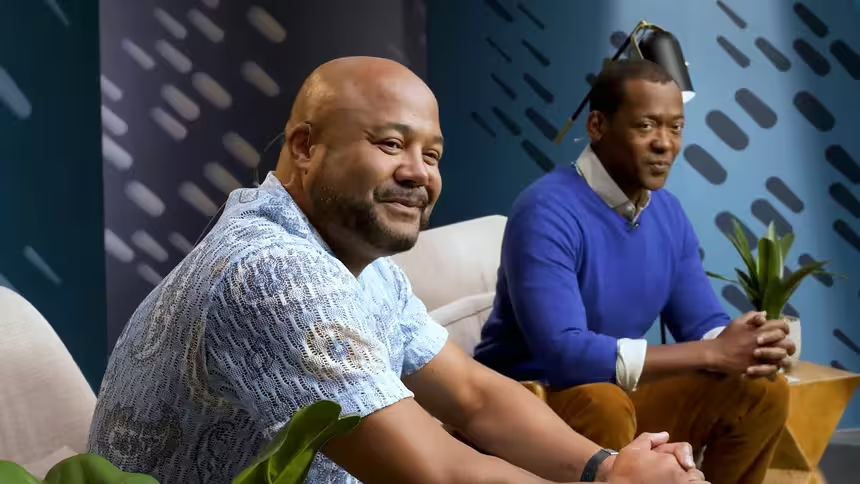
(upbeat music) - Hello my friends and welcome to Roots, Race, and Culture, where we bring you into candid conversations about shared cultural experiences.
I'm Danor Gerald.
- Hey, and I'm Lonzo Liggins.
In September of 2020, President Donald Trump directed federal agencies to remove training which involved the teaching of critical race theory, or CRT, and white privilege for all federal employees.
From that moment forward, the teaching of black history and the cloudy definition of critical race theory was hoisted into the spotlight.
- That's right, and across the country a massive campaign to ban books took place.
According to pen.org, an organization that tracks the practice, Utah became the fourth highest book banning state in the nation.
So moving forward, how do we teach black history to our children?
Is there a right or wrong way to teach the subject?
Our two guests today are going to offer us their opinions on this controversial topic.
Welcome ladies.
- Yes, welcome.
Lucy, tell us about yourself.
- My name is Lucy and I'm from Alexandria, Virginia, DC area.
I was raised there and then I came here for grad school and I stayed, and now I teach here at a college.
So I'm a professor here in Utah and I have loved being here.
I am conservative, but I have liberal views.
I hope that as we meet together, we can also recognize that we can be both and not fit in labels.
- That's what our show's about.
Is like you can't put all black people under one monolithic construction.
- And then of course, Michelle.
- Hello, thank you for having me.
I'm Michelle Love-Day.
I am a wife, a mother, an educator of 22 years, which still hard to believe that it's been that long.
Sometimes I feel like I just started out.
I moved to Utah 19 years ago, and I'm originally from the international city of Loraine, Ohio, which is outside of Cleveland.
- Nice.
- Well, let me just start off by saying this, that no one would ever think that you were a teacher for 22 years, or that you were college professors, because black don't crack.
You ladies look young and beautiful.
- Yeah, thank you.
- Thank you very much.
- Yeah, you know, I think the first thing that we'd want to get into is to define what critical race theory is.
Danor, could you explain to us a little bit what critical race theory is?
- Well, we have a full screen graphic that we can really use to help people understand and follow along here.
So let's pull that up.
Critical race theory is an academic concept that's more than 40 years old.
The core idea is that race is a social construct and that racism is not merely the product of individual bias or prejudice, but also something embedded in legal systems and policies.
The basic tenets of critical race theory or CRT emerged out of a framework for legal analysis in the late 1970s and early eighties created by legal scholars, Derrick Bell, Kimberle Crenshaw, and Richard Delgado among others.
- So part of that definition I agree with, and part of it I, maybe that's where we may differ.
So in the beginning part, yes, I agree.
Critical race theory is socially constructed, or when we say even critical race theory, we're saying race in general is socially constructed.
So just be on the same page let's define race.
So culturally we've been taught that race is significant in our culture, right?
So we think that race equals personality, equals traits, equals biology when it comes to who we are.
In fact, it's just the color of our skin.
Just like the color of your eyes or the color of your hair.
It's just culturally influenced that we really believe that color equals personality.
- Right, so you're saying like the difference between race and ethnicity right?
- Race and culture.
- Race and culture.
- Yeah, so culture is probably the one that really shapes us today.
So if we could recognize that and see that that's really what's making a difference and I love to use the word culture probably more so because it shows that it's environmentally influenced, it's created by society and you can change and you don't have to follow cultural norms.
You are an individual person that can decide that.
So that part I agree with.
Where I differ is that we think still a lot of these policies are still inactive today.
If we're gonna talk about critical race theory, let's talk about policies today.
How are they affecting today?
Yeah, it was legit then, but how is it affect affecting today?
- Perfect.
Michelle, what do you think about that?
- Well, within critical race theory and how you have it described 40 plus years ago, it was created so that lawyers could analyze the policies and things that were put in place for black and brown people so that they could critically understand where to go and how to navigate and work within people.
And so that is studied so that those policies can change and drive organizations today.
And so having the basis and the importance of what is being said in the past, I think, Lucy, you said it perfectly of the difference between race and culture and ethnicity and how those affect how and why policies are made.
- So prior to 2020, okay, prior to 2020, there wasn't this huge push to ban books, right?
But then all of a sudden this legislation about banning books and this big conversation around banning books started to take place.
And what I want to ask both of you, and I wanna start with you Lucy, is why do you think that all of a sudden there was this change to let's focus on banning these books or worrying about what's happening and what's being spoken about in these classrooms?
- Yeah, I would say it was the rise of critical race theory being taught in school.
All of a sudden we saw these companies come in and say, there is this thing that we need to be aware of.
It's called critical race theory.
And you need to recognize that you being black, you're a victim, and you being white, you're an oppressor.
And so I feel like that's when a lot of people started voicing and saying, hold on.
I don't want to teach my kid that they're a victim and therefore cannot go and get that mortgage that they desire to have.
Culturally, we need to recognize as a society that we are writing our culture every day.
But the thing is we keep holding ourself back and saying, oh, it's because I'm black.
Oh, it's because of this.
And that's where I'm trying to help people recognize you are holding yourself back by putting yourself in that box and not recognizing the free that you're given today.
- What about, but the interesting thing about the book banning thing though, is like some of these books aren't even historically based, right?
- And to that point, one, to say critical race theory is not being taught in schools.
As a teacher myself and still working for the school district, there is no way that I can share with a second grader the components and tenets of critical race theory.
When it started, you know, evolving in 2020 and somebody called and said, are you teaching critical race theory in your district?
And I was like, no, that's like a college level course.
So that belief that was passed down then created fear, right?
So the false narrative that critical race theory was being taught in schools started the belief that something else was going on.
- So that's when they started looking at books.
- And that's why they started looking at books.
But the thing is, the books had been there, right?
And if you look at the data before Covid, there was probably 600 and some book bannings, right?
So there were book bannings that were happening prior to 2020.
But then when the false narrative and the fear came in that there was some underlying Trojan horse that schools were doing, that's when you saw 2020.
Even now there's 1300 books that are being banned and looked at as much as, you know, that's just triple and double of what was normally being banned and looked at because of that false narrative that it was being taught in schools.
- You know what I think it is, and this is my humble opinion, okay?
I really think, and this is my dime store psychology here, that what happened in 2020 was that all of a sudden you saw this massive amount of young white kids out there rioting in the streets with the George Floyd thing.
And I think a lot of white parents saw this happening, and they started saying to themself, you know what, what are they teaching our kids in school?
Because a lot of those kids were the ones who were out there kind of causing a lot of the damage and pulling down the things.
And I think what happened was that became a real big issue because it seems like right after that, all of a sudden history and what were we, what was being taught in schools became a paramount issue.
And I'm just wondering if you all kind of got that same impression at some point.
Lucy?
- I feel like it was way before all of that.
I feel like by the time that started happening, there's already a lot of issues happening in school.
Even though schools may say they're not teaching critical race theory, there's other, like there's ethnic studies.
Obviously there's nothing wrong with learning about ethnicity, but you need to be looking at what is actually being taught or the agendas being pushed within that study.
And part of ethnic study is still that idea of oppression and victim hood.
What we worry is that if you start teaching kids that they can't do anything when they're young, they're gonna perform that way.
- Who's teaching kids that they can't do anything?
- In classrooms we have, so with ethnic studies, that's a college level.
So you have ethnic studies and then there's a few schools within our state that do allow ethnic studies to be taught.
I don't believe teachers are out there, you know, identifying who the victim is and who the victor is and making people be oppressed.
That's never the message within lessons.
And I hate that that narrative is being taught because if you look within schools, there's curriculums that school districts look through Utah State Board of Education that have to be vetted, they have to be looked through, they have to be voted by the board.
You know, parents have opinions on what books go in and out of it.
And I've been in many classrooms in the past, you know, 22 years, my own, and there's never been that victim hood.
It's always the, yes, this was happening and this was sad and it's, you know, Dr. King and Rosa Parks.
However, because of that, we can learn together kind of celebratory thing.
I think the key thing when you're looking at what is being taught and why the book banning started, I don't know your opinion definitely does have some validity because it doesn't make sense.
So I don't believe in book banning in general.
I think it went, it was gone about wrong.
There should be age appropriate looking at, are these books, you know, should they be in the seventh and eighth grade classrooms and should we move them to high school?
But to just completely get books off the shelf is.
- And that's something I completely agree with.
I think that any kind of book banning is never good.
But I completely also agree that we should recognize that within every age group there's certain information that kids can handle or not.
We know, at least when we look at the brain, it develops differently a 5-year-old compared to a 10-year-old compared to an adolescent.
So to just say here are books regardless of any age, that's ridiculous.
- And thankfully schools have procedures to keep that from happening.
- Yeah, so I think that that's like, are you really trusting kids to make their own decisions or are you trying to decide what the narrative is that you want history to tell?
- Are you trusting teachers to teach the material correctly?
I think there's this disconnect and mistrust in the education system in general, that the teachers are gonna just be flippant.
You know, as a professor how would you feel if like, as a professor they're coming in and you can't teach this and you can't teach that.
I think that's what that is.
- So I think it's because there's more, even a rooter issue within our culture.
It's not even just saying that the teachers are doing this and there's certain teachers are doing this.
We need to look at the culture in America.
How do African Americans feel about themselves?
How do they present themselves to their children?
And whatever that is, is how they'll teach.
And these books that are coming in, or not even books, just policies, not policies.
These companies are coming in.
- But these are laws, some of them, I mean these are laws that are hitting the books about like stuff in Florida too.
So you're all right when you say policy and things, 'cause they're, they're legally mandating certain things.
- That's where we need to recognize are they teaching history?
Are they passing propaganda?
And that's where, yeah, policies and governors and all these people need to be aware.
If we don't have any of that, when we look at public schools, who is the one that's writing curriculums?
Who is the one that's allowing any of that?
- Gimme an example of propaganda in your mind, what are you thinking of when you're saying that?
- Just misinformation of trying to push agendas politically of like maybe, I mean we're gonna use the victim hood mentality again.
Let's keep blacks low, let's make sure whites recognize that they're always the oppressor and the victims, and blacks are always the victims.
So pushing the idea that you will always be judged.
You cannot go anywhere in this world because of the color of your skin.
Stop there, because look at me.
I'm African American or black American, whatever you'd like to call me.
I was born in Africa.
- Which is I think pretty cool.
That's a very different culture.
- Even if, yeah, let's even look at that.
Raised in a village remote part of Africa.
Hardly really any good education.
I'm a professor today.
You know why?
Because I did not limit myself to the culture of African-American ideology that I'm oppressed.
- Okay, hold on there.
Okay, no, no, no, no, no, no, no, no, no.
Lemme stop, lemme stop you there.
I was with you until you got on that thing.
I want you to define what you think culture is.
- So culture is completely defined.
- Black culture.
- Black culture.
If we look at black culture, the history of black culture, we need to go back and recognize that a lot of Africans came here from different tribes.
And so because they couldn't even speak the same language, they couldn't really communicate very well.
A new culture emerged.
- Yes.
- Here in United States.
- We're basically our own tribe.
- Yes, and so that culture is, at least as we look at it today, comes back to slavery.
We cannot pretend that's not real right?
So even when we look at fried food for example, and I'm not saying everyone follows this and they should, this is where I worry that a lot of people are like, oh, I'm black.
I need to follow this culture.
You need to recognize that that culture, for example, fried food, Africans were being given leftover oils, whatever it was and all they were using was to try to yeah, to live off.
So that fried food culture started because of slavery.
- Soul food, yeah.
- My mother when I asked her the other day, I said mom, what black history did you get in school?
Right, my mom is 75, shout out, she doesn't look it.
So I'm gonna say her age.
Sorry mama ahead of time.
But my mom is 75.
I said mom, what black history did you get in school?
She goes, maybe, you know, Carver and peanuts.
That's it, that's it.
So now as we've progressed forward in black history, we get Dr. Martin Luther King and Rosa Parks.
Now when Rosa Parks sat on that bus, she wasn't being a victim, she was being a protestor right?
And that's what we teach students.
If we look at the pictures behind Rosa Parks, that might be where it's like, oh, it's gonna make kids feel bad because they see the dichotomy of the black versus white in that one picture.
But then if we move forward and we come back to all of what we just said, what's missing from the curriculum is the fact that we do not teach students the African tribes and the beauty of Africa.
- Exactly.
- And the strength of the kings and queens that rise.
So the erasure of African history is only given and it's only starting in schools from victim hood.
So what do you expect when you're teaching we shall overcome every year during February.
What do you think kids are gonna start to think right?
And what do you think they're going to associate?
However, if it changes and it's something that's continual because black history is world history, and you put in the information of the, where Africa is beauty and how yes, Wakanda was a fake movie.
However, there is that in Africa.
- I want to kind of shift gears and go back to some laws right.
There's a stop woke law that was passed in Florida because we're talking, having a great conversation here about black culture amongst ourselves.
But black people aren't out there trying to ban these books.
Some may be, actually, let me, let me not generalize, because we know that's not possible.
But there's this stop woke law that prohibits teachers from making students feel any kind of discomfort, guilt, anguish, or any psychological distress based upon their race, their color, their sex, national origin right?
And the law is designed to prevent teachers from making students feel that white guilt.
So in Oklahoma, they also have a law where they don't teach different content like the Tulsa Massacre, black Wall Street, - Osage.
- Osage murders.
- The Osage murders were the Killers of the Flower Moon movie that's out.
- Yeah, so, and they're passing laws about that.
And to me I find that interesting 'cause they're not wanting to teach that history 'cause they don't want their kids to feel guilty and shamed about, like you said, victim, oppressor.
They don't wanna feel like they're oppressors.
But to me it's like that's not necessarily guilt.
That's what I would consider empathy.
I would consider it empathy.
Once you see the situation and you empathize and understand how bad it was, that's good.
Because look, just like the golden rule, one thing I learned early on is like, if you don't know history, it's gonna repeat itself, right?
- Well and I'm curious about the title stop woke, right?
So if we, like what is woke?
- Who defines it?
- Who defines what woke is?
Like we are awoke right now 'cause we're talking and looking at each other.
And I remember reading from Erykah Badu who created the song, you know, stay woke, stay woke.
And that it was from her song.
And she said, I wrote that because I wanted black people to be aware of their surroundings so that they can change the outcomes for themselves.
And I wanted them to become woke.
So when you take the word woke and then it's being used as a counter, it's weaponized, because we are trying to make sure that our black people are woke in the sense of you don't have to put yourself in a box.
You don't have to be something.
But then they put it in a policy of the stay woke law.
Can we just call it for what it is?
That's racism right there.
- And that's, you hit it right there where it's who is writing these rules and why are we following it?
And this is where I try to help people recognize the war isn't between us.
It isn't between us, black, whites, or any of that.
The war is who's writing the rules?
Policy, government.
Yeah, power is writing the rules.
- And then when you look at who's writing the rules though Lucy, here's one thing that my opinion started forming.
We, you know, we've always as black people, I think that's something that we can say, we've always been true Americans.
Even when absolutely the laws didn't work in our direction.
Black women, Delta Sigma Theta in 1913 marched in the women's suffered march knowing that getting the right to vote would not affect them immediately.
We've always been American despite, right?
So that history that needs to be taught is that.
But with that being said though, if we start to share black stories as if it's a normal thing interweaving, then it would be a normal thing day to day.
- It'd be part of America.
- It would be part of America.
And Maya Angelou said, history despite its wrenching pain cannot be unlived.
But if faced with courage need not be lived again.
So I think as people are afraid that there's gonna be this victim hood, no, there's just gonna be this empathy and empowerment that comes.
- You know.
- And understanding.
I think that there's like, I remember I was in this class when I was in 11th grade.
It was world history and it was this coach.
And I remember I said to him, why?
What were Africans doing before slavery?
Were we just always slaves?
And my thing, my question about, the reason why I brought that up is because I think a lot of people would be very, I think happy to learn what did Africans think about success?
What was their view or mindset of success?
What were Asian people's thoughts of success?
What were, you know, the Middle Eastern?
What are Palestinians ideas of what success means?
You know, if we have that collective idea of what every culture thought about success and what they thought about what the world meant.
- Happy to know.
- We would be happy to know and we could make a choice.
- We're the same.
- But it seems like we're taught this is the specific idea of success that you're going to be molded to.
- We're looking at a curriculum and pieces of the curriculum, there's a big piece of the black history of the Negro Leagues.
That is, that's the name.
Like there's no editing around what and who the Negro Leagues are and historically the path that they paved within baseball.
But because that book was in there, I literally sat through and listened to someone say that book can't be in there because it uses the N word.
So while we are saying, you know, scholars, we need to look at the books that are being presented.
We have to also acknowledge that there are people looking at just the authors and their culture, race, ethnicity.
And they're saying that needs to be banned, that needs to be banned, that needs to be banned.
When you look at the number of authors that are black that are writing them.
- Can give you examples of that because like the ones.
- Toni Morrison, Maya Angelou, there's also Ebran Kendi, like just any black author really that challenges the thought are asked to be banned.
- And this is where I'm saying we need to read those books.
We can't just be like, oh, it's African American, pass.
Oh it's LGBT, pass.
And that's where, that's where, that's where the problem is, is that we're just like, oh, they were African American, therefore it should have been allowed.
And it's like what was written in there, like these books, what is going on?
- With the book banning, the good thing is there's procedures and policies to follow.
So parents can bring the concern of the book to the school.
The school has a committee that looks at it and reads the book.
The appeals committee that I sit on, I've read every book, good, bad.
And some of these authors, I'm like, oh, you've passed your prime.
But I've read every book and we have a discussion.
It's probably the best authentic book club I've been a part of 'cause we're actually reading the books.
And we do have these discussions and questions.
Is this too, is this too high level for someone in seventh and eighth grade?
Some school systems have issues because while the content is great for ninth through 12th grade, we have schools that are seventh, eighth, and ninth.
And they're in the book library.
So then it's like, ah, we need this for the ninth graders, but seventh graders shouldn't be reading this.
How do we do this dance?
Which is then where the parents do have the autonomy to go to the school and say, flag my child if they try to check out this book, this book, this book, this book.
And then when they go to check it out, eh, you can't do that right?
- I want to ask you guys just one, you know, both of you, just a quick question because when we're talking about stuff being banned, you mentioned that there was, you know, a large amount of LGBT books that are banned 'cause that's a huge number, a percentage of books that are being banned.
And there's concerns with parents.
But how do we broach that subject when it comes to African American history?
You know, recently there was a movie called Bayard, It's called Rustin, excuse me.
It's about the story of Bayard Rustin.
He was one of the people that was along with King.
He was a very predominant figure in the civil rights movement.
And then there was also a documentary about Little Richard who suffered a lot of blow back because of his sexuality.
And so did Bayard Rustin.
And here's the question about it.
When we have a figure in our community who is openly gay, proud of their homosexuality, do we discuss that when it comes to history?
Because that's an important part of their life and they don't want that not talked about.
So where do we broach that?
- So when you ask that question, you can't look at little Richard and not share who he was and what he brought musically to the community.
And so when you restrict certain conversations because of fear of what's gonna be exposed, I think it hinders the full picture.
And Lucy said it best, it's all perspectives.
You ask students okay, what was Utah when this place was acquired?
And many students can't tell you that it was Mexico, right?
And they can't tell you the history of like, Utah was not a part of America.
And that is why, there's certain reasons why pioneers moved here for certain liberties and freedoms they wanted.
What were the, and so when we start to ask those questions, we're not questioning the patriarchy.
We're getting them to think logically and critically.
- We're gonna wrap up here.
I just wanna give you the last word Lucy.
Gimme about one minute 'cause we gotta, we gotta head outta here.
- Okay.
First of all, I, we really need to push conversations like these and I want people to really recognize that we have so much in common.
It is just, we turn on the TV and we say conservatives, oh, we are taught conservatives believe this, liberals believe this, therefore you guys don't agree.
But if you actually sit down and recognize that, oh my gosh, we love our kids.
We wanna make sure that they're learning things that are actually helping them and they can help 'em progress.
We wanna make sure that they're not watching or seeing things that are inappropriate due to their age.
We want to see us as America excel and take all these like different cultural norms.
We want all of this.
If we could just recognize that we are on the same page, I think that's when we could see a great America.
- That's a great way to end this sound.
So you know what, thank you so much ladies.
This has been such a pleasure.
Dan and I, I think all four of us could probably sit here for another couple hours.
- Let's do it.
- That's it for this week, y'all.
If you have comments on this episode or ideas or anything else then we'd love to hear from you.
Feel free to drop us a line on social media.
- Or you can visit our website where you can catch other episodes.
Just go to PBSutah.org/roots.
Until next time, for Roots, Race, and Culture y'all, we are out.
(upbeat music) - [Narrator] Funding for Roots, Race, and Culture provided in part by the Norman C. and Barbara L. Tanner Charitable Support Trust, and by donations to PBS Utah from viewers like you.
Thank you.
(upbeat music)














Support for PBS provided by:
Roots, Race & Culture is a local public television program presented by PBS Utah