
Islam at the Nation’s Founding
How Islam figured in debates about religious freedom and citizenship in the early Republic.
From
Islam at the Nation’s Founding
Episode 2 | 24m 45sVideo has Closed Captions
How Islam figured in debates about religious freedom and citizenship in the early Republic.
Two rare books show how Islam figured in debates about religious freedom and citizenship in the early Republic.
From
Problems playing video? | Closed Captioning Feedback
Problems playing video? | Closed Captioning Feedback
Islam at the Nation’s Founding
Episode 2 | 24m 45sVideo has Closed Captions
Two rare books show how Islam figured in debates about religious freedom and citizenship in the early Republic.
From
Problems playing video? | Closed Captioning Feedback
Where to Watch American Muslims: A History Revealed
American Muslims: A History Revealed is available to stream on pbs.org and the PBS app.
Providing Support for PBS.org
Learn Moreabout PBS online sponsorship[Aymann Ismail] It's a little known part of the nation's founding, explored through two books.
One is a translation of the Qur'an once owned by Thomas Jefferson.
[curator] That's Jefferson's initial.
The fact that Jefferson has a copy of the Al Qur'an is a tribute to the power of Islam and Muslims in world history.
[Ismail] The other book is an autobiography written by an enslaved African man trafficked to the United States during Jefferson's presidency.
On this first page, that's Qur'an, isn't it?
It is.
[Ismail] His name was Omar ibn Said, and he was a Muslim.
[Vincent Brown] The founders are thinking about Islam and they're thinking about Muslims, but they're thinking about the great centers of Islamic learning and power.
They're not thinking about thousands upon thousands of enslaved African Muslims being shipped to the Americas.
[John Ragosta] You can see some fingerprints in the bricks.
Enslaved children likely are forming these bricks.
-You know here.
-[Ismail] Wow.
One story longs for freedom.
The other test its limits.
To think about Muslims as future citizens was a way of imagining a completely new nation that included more than just Christians.
[Ismail] I'm one of three journalists following a trail.
There was one of the founding fathers imagining Muslim Americans.
Absolutely.
[Ismail] Each of us exploring a defining moment in American history.
-Strong words.
-Very powerful words.
He wanted this mosque here in the US?
[Shamim Khan] They were all so proud of it.
[Ismail] Tracing the legacy that's coming back into view.
There's never been an America without Muslims.
[Zain Abdullah] This is not a foreign story.
It's a part of the American story.
♪♪ [Ismail] It feels like everyone knows everything there is to know about Thomas Jefferson.
Especially 250 years after he wrote the Declaration of Independence.
We know the contradictions too.
How a champion of freedom enslaved hundreds of people.
But here's the thing many people don't know.
Jefferson owned a translation of the Qur'an, Islam's most sacred text.
In 2007, the first Muslim elected to Congress, Keith Ellison, took his private oath of office with his hand on that book.
[Ellison] People didn't know Jefferson owned a Qur'an and had it as an important part of his library.
But the United States has always been a country with an Islamic presence.
Never not.
Never not.
[Ismail] And yet, Muslims are rarely mentioned in the story of the nation's founding.
So I want to look more closely at this moment in American history, starting here at the Library of Congress in Washington, D.C., with Jefferson's Qur'an and what it can tell us about the place of Muslims in the United States from the very beginning.
[Edward Curtis] The fact that Jefferson has a copy of the Alcoran is a tribute to the power of Islam and Muslims in world history.
This was one of the great texts of the world.
In order to be an educated person, you had to know about the Qur'an.
[Denise Spellberg] These revolutionary leaders who became the head of government were great readers, and the British before them had in fact contact with Muslim kingdoms such as the Ottoman Empire from the 16th century and North African kingdoms in the 17th century.
So Americans inherited a transatlantic connection.
Jefferson's fundamental curiosity would compel him to buy a Qur'an, to learn about Islam, to want to think about what Islamic philosophy would teach him about government.
[Spellberg] Islam wasn't as foreign as many people think it was at the time.
[Ismail] Jefferson's Qur'an has been kept at the Library of Congress since 1815.
It's part of a vast collection of books.
He sold them back then.
Before that, he would have kept it at his mountaintop home in central Virginia, now carefully preserved as a National Historic Landmark and World Heritage Site.
-Aymann.
-Pleasure to meet you.
-It's a pleasure.
-How you doing?
-Welcome to Monticello.
-Thank you.
[Ismail] Historian John Ragosta has spent years studying Thomas Jefferson, especially his views on religion and its role in the New Republic.
[Ragosta] So, Aymann, welcome to Jefferson's study.
This-- Before he sends all those books to the Library of Congress, this would have been lined with books.
There would have been bookcases everywhere.
He has 6,500 books that he sells to the Library of Congress.
And of course, among them is his Qur'an.
So people talk about the Jefferson Qur'an.
Sometimes hear people say, "He wanted to know his enemies."
[Ismail] Yeah.
It's completely ridiculous.
He buys that Qur'an in 1765 when he's a student.
He's interested in comparative religion.
He's interested in law.
He has a number of books on North African nations, on Muslim nations.
They're probably over in that area of the library.
[Ismail] Like many of his peers, Jefferson inherited European ideas about Islam.
Some of them deeply critical.
But that didn't stop him from wanting to know more about it as part of a wider search for knowledge.
[Ragosta] He's certainly more advanced than many people of his era in this regard.
He believes that through science, through our minds, the illimitable freedom of the human mind Jefferson talks about, we're going to improve.
Each generation is going to learn from the last, and it's through study of things like the Qur'an and comparative religion, through studies of comparative laws.
That's going to make us a better people.
Let's go on into the parlor.
[Ismail] Jefferson's belief in the freedom of the human mind was central to his commitment to religious freedom.
The idea that the state should not interfere in matters of belief.
But there was a practical side to it, too.
[Ragosta] Politically, Jefferson realizes that religion was dividing the American people.
And if we're going to fight an American revolution against what's the 18th century superpower, Britain, we need everybody to participate.
[Ismail] That political reality pushed Jefferson even further than his intellectual hero, the philosopher John Locke.
[Ragosta] In the 17th century, John Locke, he actually has to flee England because religious disputes are... He's worried about his life at that point in time.
He writes the "Second Letter of Toleration," and Locke says we should be open politically to Jews and to Mohammedans, which is the term they would use for Muslims.
Jefferson says "We can go further than Locke."
In America, all people can participate in religious freedom.
[Ismail] That belief shows up in the bill Jefferson drafted for the Virginia Legislature in 1777.
It would later influence the religion clauses of the Bill of Rights.
At a moment when some founders, like Patrick Henry, believed the state should favor Christianity, Jefferson pushed back.
In his autobiography, he made it clear who his bill was meant to protect.
Jefferson writes this beautiful phrase.
He says, "Religious freedom was intended to apply to the Jew and Gentile, the Christian and the the Mohammedan, the Hindu and the infidel of every denomination."
[Ismail] So at the very foundation of this country, there was one of the founding fathers -imagining Muslim Americans.
-Absolutely.
To think about Muslims as future citizens was a way of imagining a completely new nation that included more than just Christians, particularly Protestant Christians.
♪♪ [Ismail] Where are we right now?
Well, we're actually coming up on Thomas Jefferson's gravesite, which is down below the Monticello, the house.
But this is where Jefferson is buried.
And unlike most of us, Jefferson actually specifies what he wants on his tombstone.
And he says, "I want it to say, 'Here was buried Thomas Jefferson, author of the Declaration of American Independence of the Statute of Virginia for Religious Freedom, and father of the University of Virginia.'"
And then he writes, "And not a word more."
To see religious freedom on the tombstone, that feels very significant.
This was America.
This is the nation they were building.
Built on political freedom, religious freedom, public education.
And they're interrelated.
It's a three-legged stool.
[Ismail] For its time, Jefferson's vision was radical.
It meant that people of any faith could practice freely, and that belief alone should not bar a citizen from public life.
The fact that Jefferson held on to the image of Muslims as people who might one day not only have religious freedom, but political equality is really the beginning, I think, of his political understanding of a future society that had a universal, inclusive precedence for the future.
[Ismail] Muslims clearly mattered to Jefferson in theory, but what did that look like in real life?
There's a clue in the diary of John Quincy Adams, then a young senator, long before he became president.
He records the only meeting we know of between Jefferson and a Muslim on American soil.
A visit from a diplomat named Sidi Soliman Mellimelli.
It happened while Jefferson was in the White House.
[Spellberg] In 1805, the first Muslim ambassador to the United States arrived from Tunis.
We were in the middle of an undeclared war that Thomas Jefferson had waged against Tripoli.
Tunis was an ally of Tripoli, so the Tunisian ambassador was sent to negotiate with President Jefferson.
Mellimelli, he was dressed in finery of all sorts of brocade, gold, scarlet, and he had a diamond snuffbox that was the talk of the town.
Jefferson received him at a state dinner that he set the time for at 3:30 in the afternoon.
Well, someone let it be known that Mellimelli is obviously Muslim, and it's Ramadan.
And Jefferson doesn't skip a beat.
He says, "Okay, then dinner will begin precisely at sundown."
Which indicates that Jefferson learned from his Qur'an and from other books about what Muslims believe.
[Ragosta] And Mellimelli arrives very shortly after sundown, and then they break bread and have an iftar dinner.
This is often referred to as the first iftar dinner in the White House, and it's happening in Jefferson's presidency.
[Ismail] The way Jefferson treated Mellimelli tells us something.
Mellimelli was a diplomat, a man of power, visiting from a part of the world many early Americans associated with Islam.
He was very different from the thousands of Muslims already living in the United States at the time.
The founders are thinking about Islam and they're thinking about Muslims, but they're thinking about the kind of great centers of Islamic learning and power in the Middle East.
They're not thinking about Muslims who are in the new United States.
Thousands upon thousands of enslaved African Muslims being shipped to the Americas.
[Einboden] Many of the places from which people were horrifically taken in West Africa were places impacted by Islam.
And so the people who were brought to America, estimates range from thousands to tens of thousands, were Muslim.
[Ismail] There's no firm evidence that any of the enslaved people at Monticello were Muslim.
But this was still a plantation where Jefferson enslaved over 400 men, women and children over his lifetime.
[Ragosta] You can actually see some of the fingerprints in the bricks.
Enslaved children likely are forming these bricks.
You know, here in the bricks.
Young children.
-Oh, wow.
-When these bricks were formed 230 years ago.
[Ismail] Wow.
[Ragosta] But it's a brutal system.
And literally, they're the ones who are making the material that builds this mansion.
You don't have Monticello at that time built like this without that enslaved labor that Jefferson is using.
Enslaved people built this country.
As long as we're talking about the founding principles that established a nation based on freedom, then we have to be talking about slavery and the unfree.
As long as we're talking about Thomas Jefferson and George Washington, we have to be talking about their slaves because any ideas they had about human freedom and how it would flourish, the conditions in which it would flourish are immediately contradicted by the fact that they held slaves.
And by the mid-19th century, the United States becomes the largest slave society in modern history.
[Ismail] This gap between ideals and reality and what it meant for Muslims comes into focus at another historic site.
Mount Vernon, George Washington's plantation home.
Over his lifetime, Washington enslaved around 600 people here.
They were not granted any rights, let alone the right to practice their religion.
Their names passed down the generations suggest some were Muslim.
[Mary Thompson] Welcome to the library.
This is a page from George Washington's tax list.
They call it tithables lists from 1774.
And this is the first document that shows a person with a Muslim name.
Right in here, you can see the name Fatimer.
-[Ismail] Yeah.
-[Thompson] And under here is little Fatimer.
[Ismail] That's the name of the prophet's daughter.
This makes it very real for me.
[Spellberg] The idea there would have been a Fatima and a little Fatima... that suggests strongly that there was a mother and daughter.
A mother who had control over nothing in her life except the name she gave her child, who was also enslaved.
This is-- Cash is being paid for the following Negroes.
Abram, Oxford, Tom, Jack, Ede, Fattimore.
All those people brought in 2,303 pounds and 19 shillings.
This is years before the Declaration of Independence, and here we have evidence that Muslims might have lived here.
Do we know anything else about Fatima?
It gives you an idea of how hard, maybe in a family situation, it might be to pass on Islam in a family, because if they are a mother and daughter, they're being split up here.
I can't imagine if I would have been Muslim at all had I been separated from my parents in this way.
The Fatimers represent the thousands of Muslims already living in North America when the United States was founded.
These weren't the future citizens Jefferson and Washington had in mind when they spoke of religious freedom.
They were real people right there, right then.
Their presence survives largely in fragments, hints, clues.
But a few left something more.
Not just their names, their words.
♪♪ Back at the Library of Congress, I've come to see another book.
It also contains verses from the Qur'an.
But this book wasn't imported by a founder.
It was written here in the United States by an enslaved African man trafficked to North America in 1807, just two years after Jefferson entertained Mellimelli in the White House.
This is the only known autobiography that we have written by an enslaved man in this country in Arabic.
So it is short, small, tiny, but incredibly powerful in terms of what it can tell us about history.
Do we know anything about who wrote it?
[Lanissa Kitchiner] Omar ibn Said was living in the Senegambia, in a little area called Futa Toro.
He was born in 1770, and he studied Islam and Arabic language and writing before he was taken from his hometown.
[Omar ibn Said] "There came to our country a big army.
It killed many people.
It took me and walked me to the big sea and sold me into the hand of a Christian man who walked me to the big ship in the big sea.
We sailed in the big sea for a month and a half, until we came to a place called Charleston.
And in a Christian language, they sold me.
A weak, small, evil man called Johnson, an infidel who did not fear Allah at all, bought me.
I'm a small man who cannot do hard work.
I escaped."
[Ismail] Omar reached Fayetteville, North Carolina.
There, he was captured and locked in the local jail.
While he was imprisoned, he wrote in Arabic on the jailhouse walls.
Likely verses from the Qur'an.
At a time when enslaved Africans were assumed to have no written culture, it caused a stir.
Word spread.
It reached a man who would become his next enslaver.
[Said] "After a month, Allah presented us into the hands of a righteous man who fears Allah and loves to do good deeds, and whose name is General Jim Owen."
[Ismail] I know that this is introduced as an autobiography.
But on this first page, -that's Qur'an, isn't it?
-It is.
The surah that he starts this autobiography with is the Surah Al-Mulk, which talks about justice.
And that, to me, just gives me chills.
[Spellberg] He was attempting to tell the story of his enslavement, but also to capture a chapter of the Qur'an called Al-Mulk, which is known as the dominion or the sovereignty.
Some scholars think that it was his way of protesting his enslavement.
[Said] "Blessed be he in whose hand is the dominion and who has power over all things.
He created death and life that he might put you to the proof.
He is the mighty, the forgiving one."
Muslims who were enslaved and had been educated in West Africa before their enslavement carried with them to the United States learning about Islam.
Memorized passages of the Qur'an so the faith traveled with them, inside them.
[Ismail] Some enslaved Muslims who could read and write were considered exceptional and freed.
But not Omar.
[Kitchiner] Omar ibn Said, despite however exalted he may have been as an enslaved African man, as an enslaved Muslim African man, he was never made free.
He was never made free.
This is a piece of history, a missing piece of history written by a man in his own hand who not only survived the Middle Passage, who not only survived the plantation system, but lived to write about it.
So this is American history at its finest, but it's also Senegalese history.
It's also African history.
It is also Islamic history.
It is world history.
[Ismail] The presence of enslaved Muslims who could read and write did not escape Thomas Jefferson.
Researchers recently found Arabic documents among his papers.
They were written by two African Muslims who had escaped and made it to western Kentucky.
From there, they wrote letters in Arabic asking for help.
In 1807, these letters reached Jefferson at the White House.
[Einboden] And then the story unfolds of him trying to get these Arabic writings translated.
But in the meantime, the two men who were taken captive escape, and Jefferson eventually receives updates.
And then the last moment that we have any glimpse of where they are is Carthage, Tennessee.
[Ismail] For a moment, these men had Jefferson's attention.
He even considered supporting their freedom because of their literacy.
Then they disappear from the record.
And we don't know what happens after 1808 as Jefferson fails to translate them and their case is forgotten.
And yet he keeps the papers.
[Ismail] Jefferson drafted the Virginia Statute for Religious Freedom in 1777.
The Bill of Rights was ratified in 1791.
But the idea of religious freedom for all Americans was a long time coming.
Some states continued to require office holders to affirm Christian belief well into the 1800s.
It wasn't until 1947 that the Supreme Court ruled that states were also prohibited from establishing a religion.
And the government restricted Native American spiritual practices until 1978, with access to some sacred sites still limited.
For American Muslims, a powerful moment came in 2006, when Keith Ellison was elected to Congress against a backdrop of anti-Muslim sentiment.
Here was a Muslim descended from enslaved people, placing his hand on a copy of the Qur'an Thomas Jefferson once owned.
[Ellison] It was an amazing moment.
I felt weight.
I also felt light, like a feather.
And I felt the weight of a civilization.
It did make for some interesting TV moments when people were trying to argue that you had to swear on a Bible.
Well, the funny thing is, nobody has to swear in on anything.
When the speaker says, "Do you swear to uphold the Constitution, defend the Constitution against enemies foreign and domestic?"
I do.
Bam.
After there's this ceremony, and it's common for people to use books.
Debbie Wasserman Schultz brings out a copy of the Tanakh.
Tulsi Gabbard brings the Bhagavad Gita because she's Hindu.
It opened up a tradition where people got to do this.
When Keith Ellison decides to get sworn in on Jefferson's Al Qur'an, it's a way of saying, first of all, "We've always been here."
And second of all, "We're writing a new chapter."
The story of Islam in America is also a story of how the idea of Muslims as future citizens brings us to the present day, when we do have a population of Muslims whose citizenship is often perceived as suspect or foreign.
There's nothing foreign about the practice of Islam in the United States.
♪♪ [announcer] For educational resources, visit "The American Muslims: A History Revealed" collection at PBS LearningMedia.
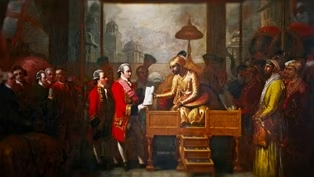
Islam at the Nation's Founding Preview
Video has Closed Captions
Preview: Ep2 | 30s | How Islam figured in debates about religious freedom and citizenship in the early Republic. (30s)
Providing Support for PBS.org
Learn Moreabout PBS online sponsorship












Support for PBS provided by: