
Israel, Hamas, and the Important Historical Context
Clip: 12/2/2023 | 13m 20sVideo has Closed Captions
Israel, Hamas, and the Important Historical Context
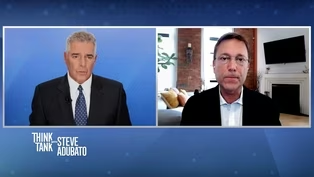
R. Joseph Huddleston, Ph.D., Associate Professor, School of Diplomacy and International Relations at Seton Hall University, sits down with Steve Adubato to provide his perspective on the complex, ongoing conflict between the Israeli government and Hamas, and its important historical context.
Problems playing video? | Closed Captioning Feedback
Problems playing video? | Closed Captioning Feedback
Think Tank with Steve Adubato is a local public television program presented by NJ PBS
Israel, Hamas, and the Important Historical Context
Clip: 12/2/2023 | 13m 20sVideo has Closed Captions
R. Joseph Huddleston, Ph.D., Associate Professor, School of Diplomacy and International Relations at Seton Hall University, sits down with Steve Adubato to provide his perspective on the complex, ongoing conflict between the Israeli government and Hamas, and its important historical context.
Problems playing video? | Closed Captioning Feedback
How to Watch Think Tank with Steve Adubato
Think Tank with Steve Adubato is available to stream on pbs.org and the free PBS App, available on iPhone, Apple TV, Android TV, Android smartphones, Amazon Fire TV, Amazon Fire Tablet, Roku, Samsung Smart TV, and Vizio.
Providing Support for PBS.org
Learn Moreabout PBS online sponsorship- Hi everyone, Steve Adubato.
Yes, we are based in New Jersey, but what goes on in the country and the world matters to those of us in New Jersey and the region and frankly, everyone watching right now.
And we're joined by Dr. Joseph Huddleston, Associate Professor at the School of Diplomacy and International Relations at our higher ed partner at Seton Hall University.
Doctor, good to see you.
- Good to be here, thank you.
- So we're taping on October the 17th.
The graphic will come up many times.
Why?
Because we're not the news, we are not here to talk about the current state of the conflict between Israel and Hamas.
But this is an ongoing issue, thousands of years, and God knows how long it is going to continue to go on.
Let me ask you, at the core, for those who say, hey, wait a minute.
This is a horrible thing, obviously, a horrible event that happened, the war that happened, the conflict, the atrocities in Israel, the bombing that followed up Israel toward Hamas and the Gaza Strip.
But beyond the day-to-day reporting on the conflict slash war, why is this situation so important to all of us?
- The situation is important to everyone because it represents one of the most intractable, ongoing human rights catastrophes that repeats itself over and over again.
And we see that in both the victimization of Israeli civilians by the act of terrorism by Hamas, and then the bombardment of the Gaza Strip that follows, that has killed just as many, if not more people, at the time of this recording.
And the fact that it still doesn't have a political solution means that we won't see an end to these kinds of outbursts until the parties at conflict find a political solution to it.
- Is Hamas, in your view, as an expert on diplomacy and international relations, a terrorist organization?
- Hamas is an organization that uses terrorism.
Hamas, as an organization- - Are we gonna get into semantics?
- Here's the thing about the word terrorism, is that as a term, it has one meaning in the media, one meaning with sort of popular language, but in terms of analyzing dynamics in a conflict, it has a very specific meaning, right?
So terrorism as a tactic is common in many kinds of conflicts, especially when you have an organization fighting a state, right, trying to sort of break away, make territorial claims, but it's a very common tactic.
So I will leave it to policymakers to sort of define that, but what I will say is that what we saw was an act of terrorism.
- So there's hundreds, thousands of young people in their 20s beyond and some teens who were at a concert.
And again, we're not doing the news, but that is obviously a seminal event in this whole most current iteration of this conflict.
That had nothing to do with policy.
That had nothing to do with Israel's policies as it relates to those in the Gaza Strip.
Did it?
Because those were not policymakers.
Those were concert goers.
- True, true.
And it might be useful to just talk a little bit about why groups use terrorism.
Very often the point of terrorism by a group like Hamas or the Islamic State or many other groups in conflicts around the world is to spoil peaceful processes that are ongoing.
It is to provoke strong repressive reactions from a state against their own constituencies, right?
And it is to try to rally support of a base, right?
So they victimize innocent people in order to cause further victimization of more innocent people, right?
That is, it's the sowing of fear to make everyone in a conflict like this feel like they have no choice but to turn to violence.
- So I'm gonna ask in a moment about the history of Israel and Israel government and military policy, policies plural as it relates to the Gaza Strip and Palestinians living in the Gaza Strip.
But if I were to say, because we've been debating if we were gonna even put a graphic underneath this, you know, the Israeli-blank conflict.
Is it the Israeli-Palestinian conflict?
Is it the Israeli-Hamas conflict?
Or is Palestine Hamas and Hamas Palestine?
Please, Professor.
- Absolutely.
Very good question.
Probably one of the most important questions in understanding this.
Hamas cannot be taken to be equivalent to the Palestinian cause.
In fact, the existence, the tactics used by Hamas is probably one of the most harmful things to the Palestinian cause that could be.
And this is a subject of much confusion for people on either side of sort of trying to understand this conflict.
So I would say Israel's stated purpose is to eliminate Hamas.
They never say anything like that about the Palestinian people.
I'm not convinced that they want to take over the Gaza Strip.
What they want is to end an organization whose founding charter calls for their destruction, right?
So that is not what most Palestinians want, right?
Most people in both Palestine and Israel proper want a peaceful political solution to this decades-long conflict.
The problem is that you always, in any political actor, any sort of group, you always have people who want to take a hard line, use violence, make no compromises, and people who want to use politics, peaceful negotiations, and accept and even seek compromise, right?
So what we have to look at is what does this moment, what does this horrendous act, who does it empower in those societies, right?
The problem is that with this kind of violence, it tends to make the hardliners on either side kind of gain more relevance as a sort of spokesperson, right?
So that's part of why we see violence escalate in a spiral.
- You're talking about an extraordinary kind of leadership, a very rare kind of leadership.
That being said, please put in perspective, we're talking to Professor Dr. Joseph Huddleston, Associate Professor of the School of Diplomacy, excuse me, in International Relations at Seton Hall University, one of our longtime hired partners.
Put in perspective for us, Professor, the history of Israeli government-slash-military policy as it relates to the Gaza Strip.
- Do you mind if I go a little further back in history to kind of think about this?
- I'm trying to learn along with everyone else, please.
- Of course, and it's a very confusing conflict.
I think if I were gonna basically make two points for your viewers, it would be the following.
You cannot understand this conflict without understanding the origins of it in British colonialism, right?
What you have, when the British controlled that part of the Levant, they made a promise.
- Of the what?
- I'm sorry, the Levant, that area on the eastern bank of the Mediterranean.
So what is now Palestine?
We'll just say that.
The British had something called the Palestinian Mandate.
So this was a type of colony.
- When was this?
- This was in the early 1900s.
The early 1900s, right?
So they made a promise to Jewish people all over Europe that they wanted to have a homeland for Jews there.
Now, Jews being a stateless people for many centuries, being subject to persecution in many of the places they lived said, okay, you're the governing power there.
Of course we'll go there if this is sort of what we're being offered, right?
But in so doing, as that migration happened, it forced the displacement of the people who lived there, right?
The British colonial powers were also responsible for some of that displacement.
So what you have is a story of displacement for both- - Who was displaced?
Were they Israelis?
Were they Palestinians?
Who were they?
- Palestinians who lived in the state already were displaced from their homes.
Many Palestinians were displaced from villages.
You had an event in the 1940s when Israel was properly recognized.
You had a civil war that followed.
- Is that 1946?
- 1948 is when it became a state.
So you had immediate conflict.
Now, of course, Israel is attacked at that time by the neighboring countries.
It immediately sets off a conflict.
And who are the victims of this conflict?
Both Israeli and Palestinian civilians at the time, right?
So it's really a story of displacement for everyone involved, right?
Which is why- - Including now with Palestinians, again, we are taping on the 17th of October.
We don't know how this is gonna play out, but what we see on the news, regardless of where you watch, is thousands, tens of thousands, hundreds of thousands of Palestinians trying to move physically with babies.
We saw children on ventilators in hospitals.
They're supposed to move.
Again, we don't know how that policy is gonna play out, but it's constant displacement.
- Constant displacement.
That is the story.
That is the history of this place for 100 years.
Jews displaced from villages they had in Europe, moving to Israel and displacing people there.
It's a very complex dynamic.
- Well, before I let you go, doctor, tough questions.
You're talking about geopolitics and complex, longstanding conflict and displacement.
In one minute or less, could you bring it back to quote-unquote New Jersey?
We have a very large Palestinian, very large Jewish population.
Does it matter disproportionately in states like New Jersey with very large populations who have a real familiar cultural historical interest?
Please.
- Of course it matters.
I mean, what I always urge people is to check yourself and see the human suffering on every side of this conflict.
It's always there.
It is there for you to witness.
You have to see that, or else you cannot be open to the kinds of peaceful political solutions that are necessary to end a sort of repeating conflict like this.
- You optimistic about anything positive coming out of the situation?
- Currently, as we're taping, I'm not very optimistic because I see that, as I told you a few minutes ago, the goals of terrorism, most of those goals have been met.
Peaceful processes have been spoiled.
A repressive reaction has been provoked.
A base has been rallied.
The kinds of things that Hamas wanted out of an attack like this, it is getting.
So that does not make me optimistic.
But as you said, good leadership always has an opportunity to steer the ship in a new direction.
- Professor, I wanna thank you so much for joining us and let everyone watching know that this will be the first of what will likely be a series of conversations with people who understand the conflict between Israel and Hamas, and some may argue Israel slash and Palestine.
Not so black and white, but we'll continue those conversations.
Professor, thank you so much for joining us.
- Thank you for having me.
- Stay with us, we'll be right back.
- [Narrator] Think Tank with Steve Adubato has been a production of the Caucus Educational Corporation.
Funding has been provided by Holy Name.
New Jersey Sharing Network.
NJ Best, New Jersey'’s five-two-nine college savings plan.
The Russell Berrie Foundation.
New Brunswick Development Corporation.
PSE&G, Operating Engineers, Local 825.
The New Jersey Education Association.
And by Eastern Atlantic States Regional Council of Carpenters.
Promotional support provided by CIANJ, and Commerce Magazine.
And by Insider NJ.
- (Narrator) New Jersey is home to the best public schools in the nation, and that didn't happen by accident.
It's the result of parents, educators and communities working together year after year to give our students a world class education.
No matter the challenge, because parents and educators know that with a shared commitment to our public schools, our children can learn, grow and thrive.
And together, we can keep New Jersey's public schools the best in the nation.
Rudy Giuliani's Role in our Failing Democracy
Video has Closed Captions
Rudy Giuliani's Role in our Failing Democracy (12m 35s)
Providing Support for PBS.org
Learn Moreabout PBS online sponsorship
- News and Public Affairs

Top journalists deliver compelling original analysis of the hour's headlines.

- News and Public Affairs

FRONTLINE is investigative journalism that questions, explains and changes our world.












Support for PBS provided by:
Think Tank with Steve Adubato is a local public television program presented by NJ PBS