
Israeli-American Chef Shares New Book of Rescued Recipes from WWII
Clip: 9/25/2026 | 17m 58sVideo has Closed Captions
Chef and author Alon Shaya discusses his new book, "Memories of a Good Meal"
Food can be a vessel for memory. Chef Alon Shaya’s cookbook, "Memories of a Good Meal," tells the stories of Jewish Holocaust survivors, Navajo Code Talkers, Japanese Americans held in internment camps, and more. Shaya pairs their experiences with recipes that evoke memories of family and identity. He joins Walter Isaacson to discuss how recipes can preserve history and stories of resilience.
Problems playing video? | Closed Captioning Feedback
Problems playing video? | Closed Captioning Feedback
Israeli-American Chef Shares New Book of Rescued Recipes from WWII
Clip: 9/25/2026 | 17m 58sVideo has Closed Captions
Food can be a vessel for memory. Chef Alon Shaya’s cookbook, "Memories of a Good Meal," tells the stories of Jewish Holocaust survivors, Navajo Code Talkers, Japanese Americans held in internment camps, and more. Shaya pairs their experiences with recipes that evoke memories of family and identity. He joins Walter Isaacson to discuss how recipes can preserve history and stories of resilience.
Problems playing video? | Closed Captioning Feedback
Where to Watch Amanpour and Company
Amanpour and Company is available to stream on pbs.org and the PBS app.
Watch Amanpour and Company on PBS
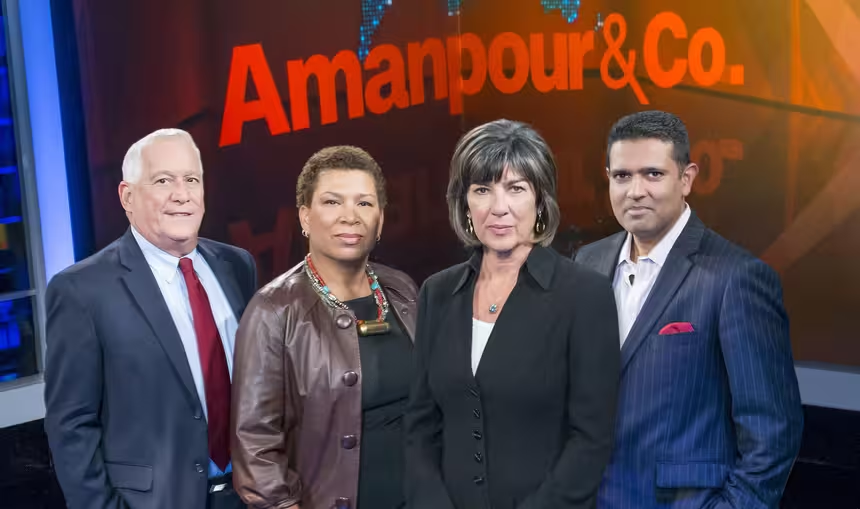
PBS and WNET, in collaboration with CNN, launched Amanpour and Company in September 2018. The series features wide-ranging, in-depth conversations with global thought leaders and cultural influencers on issues impacting the world each day, from politics, business, technology and arts, to science and sports.Providing Support for PBS.org
Learn Moreabout PBS online sponsorshipFood can be a powerful vessel for memory, preserving stories that might otherwise be lost.
Chef Alon Shaya's new cookbook, Memories of a Good Meal, tells the stories of Jewish Holocaust survivors, Navajo Code talkers and Japanese Americans held in internment camps during World War II.
Shaya pairs their experiences with recipes that evoke memories of family and identity.
The James Beard Award-winning chef joins Walter Isaacson now to discuss how recipes can preserve history and stories of survival.
Thank you, Christiane and Alon Shaya.
Welcome to the show.
Thank you so much for having me.
You have this wonderful, beautifully designed and printed new cookbook called Memories of a Good Meal, and it comes out of the Rescued Recipes Initiative.
So let's start by explaining what the Rescued Recipes Initiative is.
Yeah, I started the Rescued Recipes Initiative in partnership with the United States Holocaust Memorial Museum and my late dear friend Stephen Fenves.
And it really started with me coming across Stephen Fenves' family's cookbook that was rescued from his home while he was being sent to Auschwitz.
I saw the recipes, I wanted to cook some of the recipes for him, and they were all in Hungarian.
He began translating them into English for me, and I started cooking him his mother's recipes for the first time in 80 years.
We became fast friends, and fast forward, we've raised close to a million dollars by taking his recipes and taking him around the country to cook.
You know, there was a cut triangle of red cloth at the beginning of the book that really just brought it all home to me.
It was actually part of a Nazi flag.
Explain where that was and who had it.
I came across that at the Yad Vashem Holocaust Museum in Jerusalem.
It was part of their kind of culinary artifacts from the Holocaust.
And it was a torn cloth signed by women in the Ravensbrook concentration camp.
As they were starving to death, they came together in these dark barracks and kind of fantasized about meals and shared stories of their family's favorite meals, their children's favorite soup, the significance of the tablecloth and Shabbat candles on the table.
And it hit me so hard that in the darkest of times, that food can really bring people together in a way that nothing else can.
And I wanted to really learn more about those times.
And that's eventually what led to the Rescued Recipes Initiative and then to writing this book.
I know you were told about these recipes, most of them.
You had to listen to people describing them and you had to recreate them yourself.
Sometimes you found a recipe.
How did you go about recreating these recipes?
And were some of them very hard?
Yeah, some of them were more literal.
Others were really just part of the storytelling.
We, you know, there's the chapter of the partisans who were living in the Polish forest through the winter, and pretty much all they ate were potatoes.
And so that chapter is all recipes with potatoes in different ways.
And we wanted to kind of have the recipes be an extension of these survivors' stories so that as people are cooking them and gathering around the kitchen or the table that the recipe really brings up parts of their stories.
So one of the recipes from this Polish partisan chapter is a smashed potato with a vodka sauce.
And, you know, potatoes and vodka were a big part of their lives as they were derailing the German war machine and, you know, bombing trains and armaments throughout small villages in Poland.
And so the recipe isn't one that they actually made, but the act of smashing the potato, the vodka cream sauce that goes along with it, it really helps to bring what they were going through together and becomes an extension of that storytelling.
What was it like to watch someone taste a dish you had reconstructed from their memories?
And were there moments when you knew you got it right or you knew you got it wrong?
Yeah, Stephen Fenves, who we write about in one of the chapters and was the catalyst for the Rescued Recipes Initiative, he grew up in this pretty wealthy household.
They had a family cook, her name was Marish.
She was the one that rescued the cookbook.
And as a child, Stephen would walk into the kitchen and he would, you know, reach up on the counter and try to grab little bites of food when their parents were entertaining for their friends.
And he had these memories of Marish kind of slapping his wrist and saying, "No, these are for the adults.
Get out of the kitchen, I'm busy."
And one of the recipes are these little potato doughnuts, savory potato doughnuts with lamb.
And when he came to our first Rescued Recipes event in DC, I was waiting at the front door for him with this tray of potato circles stuffed with lamb and sour cream.
And I said, "Steven, I'm not going to slap your wrist.
You can have as many of these as you want."
And it was one of those moments where his eyes really lit up and I saw the power of how this dish that he remembers from such a young age, that was one of his mother's recipes kind of coming back to him full circle.
And it was just one of the most impactful moments throughout this entire experience for me, especially as a chef who works to bring food and make that connection and make somebody feel something from what they're eating.
That was a very special moment.
The book is beautifully rendered, great high-quality art paper, photographs of the wonderful recipes.
To what extent is it supposed to be the type of cookbook you'd have on your kitchen table and you'd try to make the recipes, or to what extent is it something larger than that?
I think it can be both.
I think that the idea is that these recipes are, everything is available at a grocery store.
You can actually make these recipes and follow along with them.
But it's also a history book and I think that history and food are two things that if you're, if you want to remember what happened during the war, if you want to share these lessons from these survivors, it's a way to do that while gathering with other people.
And that to me is what I think makes this book really special.
It isn't just a cookbook, it's also a way to get your history lesson in and to teach those lessons to other people.
Well, you smuggle in a dollop of history and a dash of morality amid the recipes, which makes it feel like a worthy endeavor.
And you do it sometimes not just with Holocaust survivors, but as the book goes on, you're taking Japanese who are in internment camps during World War II.
- Yeah.
- The Navajo code calls.
When did you decide you were gonna add to the group of people who had to have their recipes recovered?
- Yeah, well, I wanted this book not just to be about the Holocaust.
I wanted it to be about World War II and to show the breadth of what this war was.
And so we got a chance to cook alongside a Navajo code talker on the Navajo reservation.
We went to Manzanar in California and met with survivors of the internment camps there where Japanese Americans were taken and held prisoner.
And I worked with June Hirsch, who was an incredible co-author with me on this book.
And she really had a lot of experience with interviewing survivors and researching stories.
So we went along and found really, I think, what made, you know, the World War II such a wide conflict, such a wide war, and affected everybody in the world.
And we wanted all of those stories to share.
We could only fit 10 stories into this book, but each one of them, I think, brings another angle into how wide and far spread this war really was.
- And when you'd spread it out, go into others, where did you find the recipes say, what surprised you about the recipes say for the Navajo Code Breakers?
Well you know the blue corn mush that we made for John Kinsel who was one of the Navajo Code Talkers is a very classic Navajo dish where they would take blue corn and millet and kind of make like a polenta or a porridge out of it and and they would burn juniper branches and add the ashes to the porridge to you know add minerals and vitamins to it.
And so John Kinsel who served in Guadalcanal had this moment where there were these large coconut crabs and these crabs would kind of climb the coconut trees and crack coconuts with their claws.
That's how powerful they were.
But they would also lacerate the soldiers as they were sleeping in the foxholes.
So one of the recipes in his chapter is this very classic blue corn mush, but it's topped with crab meat that is then braised in coconut milk.
And so that recipe really in one dish tells the story of how John used his skills of being able to work the land and understand how to cook wild animals and help save his company through doing that.
Ice cream comes up several times in the book.
American forces figured out how to make it by using the freezing temperatures and high altitude planes.
I think another point, the Navy group figures out how to do operating ice cream barge in the South Pacific.
What does that tell us about the power of food to boost morale?
Yeah, they would attach these canisters of milk and sugar to the airplane wings and put little propellers on them and as they would fly, you know, 30,000 feet in the air, the propellers would spin and the milk and sugar would freeze into ice cream and as soldiers from the Navy were rescued in Guadalcanal and throughout the Pacific Theater, they would, the first thing that they would get as they came onto these ships after being rescued was a bowl of ice cream.
And it really, it really did help boost their morale.
And it really, I think, helped to show people that one bite of food can turn something very horrible into something a little bit more tolerable.
And that's why we included an ice cream recipe in the book and told the story of what the Navy did in the Pacific theater.
Why is this book particularly relevant now?
Why did you decide to do it?
Is it had something to do with the immigration issues we're facing?
Well, yes.
And also, you know, now is really our last chance to get first-person narratives from survivors.
A lot of the people that we interviewed for this book were well into their 90s.
And John Kinsel was 106 years old when we got a chance to spend the day with him.
And he passed 23 days later.
And so we really don't have a lot of time left to hear these stories directly from survivors.
I think that it's so important that everybody goes out and tries to meet survivors and understand their lessons.
There are so many parallels to what we're going through in the world now, whether it's immigration or just divisiveness.
And these lessons, I hope, can teach us and our younger generations what values are important and how we should show up to the polls, how we should show up to teach our friends and teach our communities so that we don't enter these these horrible times again.
We should learn from what happened and I think today people are getting their news in such horrible ways, you know, the way the algorithms are feeding you what you want to hear or what you might have clicked on and so much of it is false and this book is really heartfelt stories from people what they went through and and that can't be argued with.
You came to New Orleans as an Israeli immigrant you opened a wonderful restaurant Saba on Magazine Street which I think is just a few blocks from where you're sitting now how is your experience being accepted into the community of New Orleans and being an immigrant in New Orleans and being an Israeli how did that help inform this?
Well I think that we are all going through these really hard times where people are trying to pull us apart they're trying to create conflict and what I do through cooking food and at our restaurants is to really show that there's humanity behind all of this and if you get sucked into the politics of it all or what decisions governments are making whether it's in America or in Israel.
You can really be torn apart and you will not understand that within these communities whether it's in America or in Israel there are beautiful people that are living their lives and eating together and sharing meals together and through cooking I really try to bring that to the forefront and and break bread with everybody creates a creates a atmosphere of conversation where you can agree you can disagree but at least you're sitting down together and I think that that's such an important piece of all of this.
If you were to continue this project, do more about Recovered Recipes, would you try to do the Palestinians at some point?
Absolutely.
I mean, I think that the Palestinians are a beautiful people and they've been ravaged by their government decisions.
And I think that what this book is really all about is to kind of strip away the politics, strip away the divisiveness, and to show that at our core, we all want to be together.
We all want everyone to be safe.
We want people to be well-fed and healthy.
And that, I think, is what the power-- I think that is the power of food.
It can do that.
One of the things you do in your restaurant, one of the things we do in New Orleans, is have a diversity of cultures.
Diversity is under attack today.
But to me, it's a way of having creativity, having the food you have at Saba, as well as the food that young Duke Chase has at Dukie Chases.
It's all a mix of different cultures.
Tell me about how seeing food helps you appreciate the diversity, particularly in a place like New Orleans.
Sure.
You know, food is a window into people's lives, into people's history, whether it's dark history in New Orleans through the slave trade and how African and Haitian and Caribbean cuisine came into New Orleans to create dishes like gumbo and jambalaya.
What food does is it creates this medium where we can gather around it and we can talk about those things.
But we can also learn about people and we can learn about their family traditions.
What makes, what makes their dining room table delicious and vibrant.
And that's everything that I think this book represents.
It's about how do you see past this dark, this darkness into something that is more humane.
And how do you learn these lessons and how do you learn this history and then be able to teach it to other people through the act of eating and sharing meals.
When you eat and share a meal, you retain so much memory, more so than just watching a movie or reading an article.
Food enters your body.
It becomes a part of who you are.
The smells, the textures, the sounds of eating, all of that helps to really build memory in a way that can then be shared.
And that to me is just one of the most important things that we can do.
- Alon Shaya, thank you for joining us.
Appreciate it.
- Thank you.
Thank you so much.
 New Episode
- News and Public Affairs

Top journalists deliver compelling original analysis of the hour's headlines.

- News and Public Affairs

Today's top journalists discuss Washington's current political events and public affairs.

 New Episode




 New Episode


 New Episode
Support for PBS provided by: