
It’s in the Voices
Season 9 Episode 903 | 16m 53sVideo has Closed Captions
A historian revisits the oral history of a 1920s school teacher in the Mississippi Delta.
Clinton Bagley revisits his first interview from Mississippi’s Washington County Oral History Program. Amongst the files, one piece of material sticks out, the catalyst for the whole program. In a conversation he recorded in 1975 with Daisy Greene, a retired school teacher from his hometown, we learn about a devastating flood, cruel systems of oppression, and the voices that define the Delta.
Problems playing video? | Closed Captioning Feedback
Problems playing video? | Closed Captioning Feedback
Support for Reel South is made possible by the ETV Endowment of South Carolina, National Endowment for the Arts, and Wyncote Foundation.
It’s in the Voices
Season 9 Episode 903 | 16m 53sVideo has Closed Captions
Clinton Bagley revisits his first interview from Mississippi’s Washington County Oral History Program. Amongst the files, one piece of material sticks out, the catalyst for the whole program. In a conversation he recorded in 1975 with Daisy Greene, a retired school teacher from his hometown, we learn about a devastating flood, cruel systems of oppression, and the voices that define the Delta.
Problems playing video? | Closed Captioning Feedback
Where to Watch REEL SOUTH
REEL SOUTH is available to stream on pbs.org and the PBS app.
Providing Support for PBS.org
Learn Moreabout PBS online sponsorship[ambient music] [car engines rumbling] [birds tweeting] [footsteps tapping] [car engines rumbling] [calm music] - [Clinton] I'm a seventh-generation Mississippian, a river person, Delta person, I like to call it.
[calm music continues] Deltans love to talk.
I'm one of 'em.
I can just babble and love conversation and talking to people.
Talking was the main thing I think about with this oral history program.
Talking with each other.
- [Interviewee] Never share, well, I was glad to do this.
- [Clinton] It's the voices that make it, to hear the real Delta accents and not talking about the beautiful people of the Delta.
- [Daisy] Yes, it's their right.
- [Clinton] We're talking about the grassroots, servants, people who worked with the newspaper, school teachers, farmers, worked in the mills.
It brought to surface what did people do, what did they eat, what did they think, what did they read in some cases.
Some of 'em couldn't read.
- [Interviewee] That I was really there.
- [Clinton] We have a chance to look at one community that had these voices.
That's the beauty of this.
- [Daisy] That is their right.
[calm music] - [Clinton] But Daisy Greene was the one that started it because of the interview I did with her and talking about the whole community and what she knew in her world.
[calm music] [cassette clicks] [machinery rumbling] - [Daisy] Daisy M. Greene, I was born 1904, April 22nd.
- [Clinton] We're at North Orange Street in Greenville.
[machinery rumbling] [wind whooshing] [leaves rustling] We have this idea that the Delta is old, but it's not.
It really came into being after the Civil War, and then people began to move in, once they cleared the land, drained some of the bayous.
[gentle music] Now, Greenville's a unique nucleus of the Delta.
It was really this progressive place of the whole state in thinking and education and businesses.
The airbase brought in people from all over the world to come there.
You had the Experiment Station at Leland, and that brought in people from all over the world to come and study agriculture, cotton, corn, peaches.
[gentle music] From 1900 to 1976, Greenville was more of a melting pot than anywhere in the state.
[water lapping] In the early '70s, my mother, she'd had some surgery, so I was staying in Greenville a good bit.
I was associated with the archives in Jackson.
I had done oral histories before in the Natchez area.
So I was asking a few people, I knew Roberta Miller, and she was saying, "Well, y'all need to do some oral histories, particularly with Daisy Greene."
Well, Daisy fit all the qualifications you'd want.
She was African American, a retired school teacher, her father being a physician in Greenville.
And so I called on her, and we were kind of hesitant, just thinking, "Well, do I trust him, or does he trust me" or this, that, and the other.
She used the term "pigeon dropping," and I didn't know what that meant.
But then she explained to me, "You're trying to make money off of this interview."
And I, "No, no, no, no, this is for posterity.
I'm not trying to just use you."
But we got to be friends, and all I did was ask a few questions, and she answered them so beautifully, and with that voice, heavenly.
A retired school teacher.
- [Daisy] That's right, retired school teacher.
- [Daisy] And you retired when?
- [Daisy] Five years ago.
- [Clinton] Which school did you teach in last?
- [Daisy] Coleman High School, under Mrs. Coleman.
[gentle music] - [Clinton] So you came and taught in 1924?
- [Daisy] Yes.
Education was not popular then.
And for many years, there were just 10 and 12 high school graduates from Coleman High School.
No one sent their children to school, except, we'll say affluent people.
It just wasn't stylish to go to school.
So it's very fortunate that the system changed as we- - [Clinton] Now, where did you go to school in Greenville, or did you?
- [Daisy] Well, this Catholic school opened.
- [Clinton] And what was it?
- [Daisy] Sacred Heart, it's right over here.
Oh, it was a new brick school, which was unheard of for Black children.
There were new desks, nice surroundings, you know, everything freshly painted.
- [Clinton] Is that the school over here on Gloster?
- [Daisy] That's right, and we were just thrilled to death.
- [Clinton] Well, how was this Catholic school for, was it just for Blacks?
- [Daisy] Now they put it in the paper that it's open to all races, but their doors would've been shut then.
You had to keep segregation under the law.
White people have always helped Black students.
It seems that they didn't mind helping, but you'd be down there in your place.
It's kind of a paternal help, but "I don't wanna help you so much when you get up on the same plane with me."
Of course, this integration has broken that barrier down.
- [Clinton] We listened to the tape back at the archives, said, "Do another one," so I did a second one, and by then, it got to where I would be invited to lunch with her.
Sometimes we even rode around town.
What was the town.
She knew what she was talking about, and she didn't try to tell me, "This is what you wanna hear."
No, she talked about what she knew in her world, which was totally foreign for me, 'cause I was on the other side of the town growing up.
- [Daisy] For Blacks to practice in the white hospital.
- [Clinton] Daisy Greene talked about the medical facilities and how poorly they were for her community.
- [Daisy] Office.
- [Clinton] She was concerned about education.
- [Daisy] On Washington- - [Clinton] The '27 flood particularly comes to mind to me.
Now let's talk about the '27 flood.
Were you in Greenville then?
- [Daisy] I had just come back from Thibodeaux where my sister was teaching.
[gentle music] The papers had said that there was no need for alarm.
There was no flood.
Early that morning, we got up, and we looked up North Broadway, and you could see a little silver ribbon of water coming down the gutters on either side.
And as time passed, that ribbon grew larger and larger, and before we knew it, the street was covered with water.
So I said, "Mama, I can't take this."
So she said, "Well, you go to the city, to your uncle."
[calm music] There was a barge, an oil barge that loaded up people and took them to Vicksburg.
All the people were just singing the old spirituals, and they're echoing on the water, and the sun was going down.
It was very romantic, you know.
But after we [indistinct], the romance was lost.
When we arrived in Vicksburg, believe it or not, I'm not saying this to hurt your feelings, but this is true.
Before we could get off that barge, we were detained quite some time because some white man said he wanted to get us to sing some song often the preachers would sing.
And they would not open their mouth.
[water lapping] [calm music] [insects chirping] [children chattering] [calm music] [calm music continues] [calm music continues] This is Daisy Greene for the Mississippi Department of Archives and History.
- [Roberta] This is Roberta Miller, interviewer.
- Bert and Daisy Greene's legacy is that oral history project with all those interviews.
- [Interviewee] And it was quite a fight we'd been through.
- [Kay] 170 interviews were conducted that covered just a broad spectrum of the community at that time.
You had the Chinese population.
There are people here of Lebanese descent, a really large Jewish population.
There were people included that those memories would've just gone by the wayside.
- [Daisy] Daisy Greene, interviewing Lieutenant Willie Carson at 1718 Queen City Lane.
- [Clinton] They wanted to know what is the pulse beat of this community?
- [Bert] 545 West Moore Street.
- [Daisy] 430 North Delta Street.
- [Clinton] What did you contribute?
What did you see?
What did you hear?
And where did you live?
All these things were important.
These two ladies, they carried that ball, and they ran with it.
[calm music] It evolved more than laid out.
Like, "Let's go find out what this person has to say."
They would meet at the library and rehash over what they had heard.
- [Daisy] He's seven years old, and he never stayed out outside nary a night.
- [Clinton] It's a window of the people in Greenville at that time who were up in age and had stories to tell.
- [Interviewee] Oh, the chickens, the dogs, the people and everybody else.
- [Clinton] And they brought with them some photographs that we wouldn't have had copies of otherwise.
- [Daisy] Almost close?
- [Interviewee] That's right, I remember I was carrying- - [Clinton] People told about the tragedies that they went through in certain scenes.
- [Daisy] So when the levee broke, about 14.
- [Interviewee] About 14 years old, and they was afraid.
Some they rescued, and some the didn't.
- [Clinton] The whole community at the time was interested in what they were finding and what they were saying, and it became newsworthy.
- [Daisy] July the 5th, 1978, this is Daisy Greene interviewing Mrs. Clemmy B. Martin.
- [Clemmy] I wanna comment on why I'm here for this.
- [Daisy] Yes.
- [Clemmy] I like to think I'm here because I am a Black woman, and I found this out in Greenville, that it's okay to be Black.
Then I found out also it's okay to be a woman in business.
So I like to think I'm here because I have pursued business for the last 30 years as a Black woman in business.
- [Clinton] It's a window into that timeframe, when that community was coming about in Greenville.
People were making money off of the river and the towboat industry, no more.
You have to realize in the 1970s, things were really changing again fast because neighborhoods were changing.
Factories were closing in Greenville.
The airbase was closing.
Schools have changed, too.
Private schools were surfacing.
You didn't have that much in 1976 and '77.
So things began to drift apart, and these people were vanishing.
- [Interviewee] Greenville, you know, we get along very good now, but the last 20 years, you know, and understand each other better, too, you know.
We had a better understanding.
- [Clinton] It's not being used anymore.
It seems to be forgotten, and it needs to be re-looked at and use it 'cause there were characters in Greenville when I was growing up, really good characters, and that's what they were also capturing, too, that flavor.
[calm music] I'm very proud of it, I'll tell you that much.
And this has been happy to review and look at certain names I had even forgotten about, because that's been a long time ago, what, 47 years ago?
- [Daisy] Daisy M. Greene, I was born 1904, April 22nd.
- [Clinton] We're at North Orange Street in Greenville.
Daisy Greene's voice is part of what made this successful because it was so calming and tranquil to be around her.
That's what she was.
- [Daisy] Oh, about school?
Oh, lemme tell you this.
- [Clinton] She was harmony in the community.
- [Daisy] I was telling you how I had to get this started, when I started off, and I started off [indistinct].
[calm music] [calm music continues] [cassette recorder clicks] - I had forgotten her cadence, how smooth and beautiful it was.
She seemed so happy that somebody was interested in what her story was or is and in the past.
I could just listen to her from now on.
When you listen to this, I don't talk much.
She just says it all, and she seems to know how to make the story come alive.
And I was so surprised, 'cause it was a whole new world for me, too, as well as it was for having some fellow like me to come along and interview her.
[calm music] It was exchange of ideas but very welcoming.
[calm music continues] ♪ ♪ - [Announcer] Support for "Reel South" is provided by the ETV Endowment and the National Endowment for the Arts.
Additional funding for this program is provided by:
Video has Closed Captions
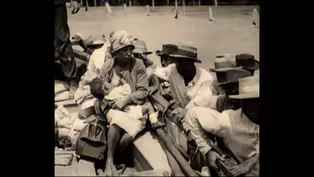
Clip: S9 Ep903 | 2m 9s | Clinton Bagley listens to an interview with Daisy Greene about a devastating flood. (2m 9s)
It's in the Voices | Official Trailer
Video has Closed Captions
Preview: S9 Ep903 | 10s | A historian revisits the oral history of a 1920s school teacher in the Mississippi Delta. (10s)
Providing Support for PBS.org
Learn Moreabout PBS online sponsorship











Support for PBS provided by:
Support for Reel South is made possible by the ETV Endowment of South Carolina, National Endowment for the Arts, and Wyncote Foundation.