You Gotta See This!
J. Draper Glass Blowing | Mythili Dance | Dragon Boat - Peoria Chinese Association | Miracle League
Season 5 Episode 8 | 27m 5sVideo has Closed Captions
Revisit your favorite episodes of season 5!
Feel the excitement all over again as you revisit these favorite segments of You Gotta See This! season five, including glass blowing with J. Draper Glass, Indian cultural dancing with Mythili Dance Academy, rowing down the Illinois River with the Peoria Chinese Association and welcoming all kids to the baseball field with the Miracle League of Central Illinois.
Problems playing video? | Closed Captioning Feedback
Problems playing video? | Closed Captioning Feedback
You Gotta See This! is a local public television program presented by WTVP
You Gotta See This!
J. Draper Glass Blowing | Mythili Dance | Dragon Boat - Peoria Chinese Association | Miracle League
Season 5 Episode 8 | 27m 5sVideo has Closed Captions
Feel the excitement all over again as you revisit these favorite segments of You Gotta See This! season five, including glass blowing with J. Draper Glass, Indian cultural dancing with Mythili Dance Academy, rowing down the Illinois River with the Peoria Chinese Association and welcoming all kids to the baseball field with the Miracle League of Central Illinois.
Problems playing video? | Closed Captioning Feedback
How to Watch You Gotta See This!
You Gotta See This! is available to stream on pbs.org and the free PBS App, available on iPhone, Apple TV, Android TV, Android smartphones, Amazon Fire TV, Amazon Fire Tablet, Roku, Samsung Smart TV, and Vizio.
Providing Support for PBS.org
Learn Moreabout PBS online sponsorship(upbeat music) (upbeat music continues) (bright music) (bells chiming) - It developed from the very simple concept of everybody should have a chance to participate, including sports.
- Come and enjoy it, you know, and just get a sense of fulfillment.
(bright music continues) (bells chiming) (bells chiming continues) - It's the power of like adrenaline, just like rushing through.
It's like when you go on stage, you see everybody, but like at the same time, you see nobody because they're all black on screen.
But that drill in when the music starts or if someone's singing it, I just can't describe it.
(bells chiming continues) - There are many different Indian classical dances.
Bharatanatyam originated from the South, it's from Thanjai.
- It's a very traditional Indian classical dance that's been passed down for generations, and it's a very beautiful and divine art form.
- 2,000 years back, you know, Bharatanatyam was only coined about seven decades back, that name, it was called a Suddha is what it was called.
And it was mainly danced by the courtesans or the handmaidens of God, who were in the temple.
They were dedicated to the God and there were dancers for each rituals in the temple, that's how it all started.
It's like ballet, you know, it takes years of rigorous training.
It's huge, there's so much to learn and I find myself in it, which is why I've been doing this for the longest, you know, time, and I've been teaching for 40 years.
And I think it's only because I have that respect for that art form, and I have that passion for the art form, and I really teach true to my heart to the students because I want this divine art form to be handed to the next generations.
(lively music) I owe it to my mom.
My mom learned Bharatanatyam when she was younger, so she took me to my guru, who was a dhun of the Thanjai traditional form of Bharatanatyam.
In those days, even then, he had about 200 students.
I was very blessed because I was one of his very rare private students that could have one-on-one class with him, so it all started there.
So I owe it all to my mom and my dad, to my parents.
For the longest time, I was a solo performer, but then, when I had my daughter, there came a time when I had to step back a little bit.
That's when my mother encouraged me to start teaching.
I just love it, I love performing and now I love teaching as much.
(upbeat music) (upbeat music continues) (upbeat music continues) - I got started with dance when I lived in India, and I would have friends that used to go to dance and do Bharatanatyam, but once I actually started dancing, I loved dancing, I really, really enjoyed dancing.
You get to be yourself.
I'll admit, it's hard, when you first start, it's definitely hard, it's gonna tire you out and your muscles are gonna be sore, but if you persevere and keep and go through it, you'll have a good journey in the end because you will learn a lot more about culture, like different cultures, but you'll also learn a lot about yourself through this journey.
(upbeat music continues) (upbeat music continues) I think to preserve this dance form is needed because it's a very sacred dance form that I think should be kept in this world.
And I think that the better it is if more people learn about it, because there's so much to learn about, there's so much to explore in it, and it's truly amazing when you actually know how to do the dance and the feel when you dance is really, really awesome.
And second of all, it helps me with my culture, it helps me connect to my culture a lot more.
As a person who's living in the US and not in India right now, there's so many things that I don't know culturally that people do over there.
So I think dance helps me in a form to connect to my culture and connect to my family back in India.
- Every time I teach a student and they dance and they teach others, it's a part of me that they take with them, you know, I feel like a part of me is kept alive, even if I don't dance, somebody else is doing that and keeping that traditional life, you know?
The tradition of my guru alive, the tradition of this beautiful antique divine art form alive.
So I can't talk enough about it.
(chuckles) You know, take the interest to learn it, persevere through it, don't give up, don't lose sight of the goal.
Keep that in mind and keep going, keep going, keep going.
And the joy that comes from it is something that will be valued and it's a joy that they will find in their life all the time.
Let this art form live forever.
(light music) (light music continues) (light music continues) (pleasant music) - [MC] Time to play some Miracle League Baseball.
Get ready, game two coming at ya.
(people cheering) Here they come, Chad's coming around second, Jason's moving around third, can we get 'em all?
Is it gonna be a big three rush?
- The Miracle League as a namesake is an association throughout the country that we're a part of, but we execute that league here with our decisions, our board, our operations with the town of Normal at the front of that.
(pleasant music continues) - How this Miracle League got started, my sister was the inspiration for the field.
Amy was a special needs child.
My dad at, gosh, he was in his '70s, thought, "You know what?
I'm gonna try to build a baseball field with kids with special needs."
And that was in probably 2008, 2009 is when they started.
Her and Dad were really tight and Amy loved baseball, they loved the Yankees and the Cubs.
He went out into the community, found some donors, got a plan together.
Several folks were with him on the board that continue on the board today.
So he had a great group of loyal volunteers, for sure.
And it has now morphed into 2015, we got the field built, and we serve about a hundred kids every year.
- [MC] There's a high fly opposite field as they've got the land this over the fence here, it's a ground rule double, great hit there from Tommy.
- [John] Our games are two innings.
They last about one hour.
Everybody gets a chance to play, everybody gets a chance to hit, to go to the home plate at every inning.
There are buddies associated with every player.
- The buddies are, for instance, they may have Illinois Wesleyans volleyball team come and they would pair up with the players because some of the players need help knowing which base to run to and when to stop and when to go.
Or somebody might need to help with their wheelchair or, you know, if they're blind, they might need to be guided.
So that's the job of the buddies is just to kind of help keep 'em on task, keep the ball in play, keep the game moving, - Buddy is so much fun to hang out with.
And if other people who does come out play baseball, we have a buddy to just help with other people too.
(crowd cheering) - It's very simple, but very exciting.
We have an MC, so there's enthusiasm, there's music.
Names are being used for the players and we make them feel just as special as we can possibly make them feel.
- [MC] Hit ball all the way to the centerfield wall, my goodness.
- I like the Miracle League because I like to play and I like to bat some home runs.
I like that and I like the outfield with my buddy and enjoy my time with all of us.
- Like doing here with the team here because we are all the Hawks anyway.
Basically, we're making new friends here, like we have spend time with the buddies more.
(pleasant music continues) - I think the camaraderie as much as the game itself is what's exciting and what's really cool to see.
- [MC] Hit the plate, nobody's there.
He's in there!
- I would like our community to first of all know about our gratitude and how much they have supported, not only the vision for this facility, which is a beautiful facility for our players, but the support and the enthusiasm they gave us for this project and they continue to support us through volunteering.
We are doing very well financially.
The town of Normal now is running this program.
So we have everything that we need because of the support from the community, because of the encouragement from the community.
And we will always be grateful for that because it's made such a big difference for a generation of kids, - [Michele] I'm overwhelmed really each week about the number of volunteers.
It just really blows my mind, even the people who are here every week and running it, everybody's volunteering and it just blows my mind.
(pleasant music continues) - [John] Such a positive encouraging environment here with laughter and love.
It's uplifting.
- Come out, just I'm going to get hype and get pumped.
Do it, enjoy that so much.
- [Parent] Out here, they can just come have fun.
They're both very, very social.
We generally sit way out in the outfield and just watch from a distance and let 'em have their day and that's great for them too, that they can be independent of us and still enjoy the experience.
- Anybody can play, all ages.
Karen started when she was four years old, she started the second year, so she's been playing for a long time.
But we have players out here who are in their 30s and 40s as well.
So anybody can play, nobody's out here judging your child.
Nobody cares out here, there's no judging.
- Everybody's good enough.
- Yeah, yeah.
- So come on out, we're behind the Corn Crib.
A lot of people don't know where we are, but come on out on a Sunday and I can almost guarantee your life will be changed.
- In a world that, you know, sometimes isn't so happy nowadays, you come out here, you can't leave without a smile on your face.
If you do, there's something wrong with you because it's happy.
(pleasant music continues) - [Michele] Nobody wins or loses.
- It's always a tie.
- It ends in a tie every week.
Every game ends in a tie, so nobody wins or loses and no player can be doing anything wrong out there.
(pleasant music continues) - [Crowd] One, two, three.
(crowd singing) - Oh, you've been practicing!
Great job, guys, great job.
(bright music) (bright music continues) - So I discovered glassblowing at Southern Illinois in Carbondale.
I was a biology student and I had to walk past the glass studio in order to get to my other classes.
And I looked in and I thought, "What are they doing?
This is amazing."
At that time, there was a professor coming in, Che Rhodes, and he was a master glassblower and I had a chance to meet him and watch him work and I was absolutely enthralled with what his skillset was and I was so inspired, I wanted to be like him.
(joyful music) So I decided to change my major and I came home and I told my parents that I discovered glassblowing and their jaws dropped open and they said, 'What?
You're a year from graduating in your biology degree."
I said, "I know, but this is really amazing and I just, I need to touch this class."
I'm celebrating 15 years in business, and after college, I moved to Oregon and I worked for a few glassblowers.
And then, while I was home visiting my parents over the holidays, I picked up a couple of catering gigs for Dave Alwan at Echo Valley Meats.
He also bought and sold equipment on the side.
And he said, "I see a passion in you for the glass, I see how dedicated you are and what a hard worker you are.
Let me help you and you help me by running the catering management with the stipulation that, once you become successful," he didn't say, "If you became," he said, "Once you become successful, promise me that you'll pay it forward and you'll give somebody else an opportunity like I'm giving you right now."
He's like, "Well, I have a spare meat locker and once we find that equipment, we can set you up in the meat locker."
So, yes, my very first studio was in a meat locker.
(joyful music continues) - And then, right here, she's gonna force her air into the end of our blow pipe.
She caps the back end with her thumb and then that air she blew is traveling to the only expandable point right there, which is our hot glass.
So it's gonna start to push itself into the hot glass, and that's what we call our starter bubble.
- I had an opportunity to go out to Corning Museum and work on a project with them for three weeks and they had bus groups of people coming in and watching the glassblowers and their mouths were open in disbelief what they were seeing and they were mesmerized by it.
And I thought to myself, "Well, nobody has seen this in Peoria.
I can do this, let's offer a public studio that people can come in and have a hands-on experience with me."
But I'm fortunate to have some really skilled glass makers.
I have, right now, three employees, two of which are professional glassblowers.
My family has always been there for me, my husband encouraged me to seek a public place out.
So I opened the doors to the public that October of 2013.
(joyful music continues) - The big wooden tool she has is called a block and it helps to shape our glass.
(joyful music continues) (joyful music continues) - One man, I got to teach, he was blind.
I got to teach a blind man how to blow glass and he was turning at the bench back and forth and he could literally feel the contour and the shape of the glass.
I mean, he was blown away by it.
It was one of the most fulfilling experiences that I've ever been able to give before.
- [Instructor] This is the traditional way of blowing glass, usually having a partner here and instructing them when and how much to blow.
And then, this is the more modern way.
One of the newest additions to the glass world in general is the blow hose, and it gives the artists a little bit more independence, as well as when we are teaching classes, it gives the students the ability to blow into their own project as well.
(joyful music continues) - Just come and enjoy it, you know, and just get a sense of fulfillment, just watching some art and some glass on fire.
And so, I love to be able to offer something to somebody that's gonna help them feel better about the space that they're putting it in.
Glassblowing to me is a dance.
So when I really get into it, it's just like this freeform dance for me.
And, of course, through a lot of like practice, you know, you have to fail a lot in order to succeed.
But it just gives me a greater sense of humanity and the fact that I'm in a public studio, if I can inspire others to do something and not even blow glass, but if I can inspire people to go back to something that they love to do, I feel like I'm meeting a lot of my mission, my purpose to being here.
(joyful music continues) (water splashing) (drum banging) - Let's go.
Ready?
Go.
That's one, and then raise your hands up, okay?
So that's one.
Attention, go.
(vibrant music) - Keep it up!
- A dragon boat is a traditional boat that have the dragon head and tail as you see here and also that most interestingly is the drum.
As far as I know, no other race boat have the drum as one of the features.
So rather than just very quietly row the boat, we have the drum hit the rhythm, so make a lot of drama and also it's one of the ways to excite the crew.
Dragon boats are very, very popular in China.
Almost everybody from the town, they line up around the river.
So we hope to achieve similar thing in here, to fully utilize our river and make it the real River City.
- I think what this does for Peoria is just heightens again, just the various diverse cultural aspects that I think we have and what we own in Peoria.
- We have this river we call River City, Peoria, but we don't have a lot of activity in the river.
So the dragon boat would be one of the things to start a activity in the river.
(intriguing music) The dragon boat started many thousand years ago, when one of the Chinese locals, he's very desperate, he's very disappointed at how the government treat the normal people.
He committed suicide by jumping to the river.
So the local people heard about it, they rushed to try to rescue him and then everybody paddled the boat, tried to rescue him and that's the starting of the dragon boat.
- But it all started with a small group of people that we have some motivation to do something here, since we have river, right?
We like the river.
And so, it started in one launch, say, "Okay, we gotta do something interesting."
We started with a little group here and then we get a boat and eventually, we think, okay, this is like a club, this is like a organization, bigger ones, we need a lot of help from different communities.
So it's really more than just a purely Chinese association and more than just ourself, it's pretty much the city.
- It's very important to celebrate diversity but then also be very inclusive of that diversity, inviting others from other walks of life to participate in your culture and that's what they've been doing.
- We're excited to have a partnership with the Peoria Chinese Association and kind of bring to fruition a great way to highlight their culture here in the River City.
- Actually, in our members here, there are a lot of people are non-Chinese.
Anybody, actually, anybody in Peoria, the reason is the first one is we want everybody in the Peorian community to enjoy this new introduction, the new activity.
Secondly, we get a lot of support from the city.
So we want the tax dollar get back to the community.
- I think it's very important to come out here and just open your horizons, so, you know, you come down here and you'll see there's multiple boats and they've got different groups.
So when I attended a couple of weeks ago, there was one that was staffed by the fire department, which I think was very cool, as well as just other representation from other community groups.
- We took a step back and assessed what this was.
It was a good way to compliment other events that are happening on both sides of the river, and particularly on the Peoria side with the riverfront market or other large scale events that find their way downtown.
- We want to attract as many people from the community participation as possible.
Secondly, we want to increase the tourism and also the utilization of the river front because of the dragon boat, so hopefully people come visit Peoria because we have the dragon boat.
They watch our race, our performance in the river front.
- I'm hoping that we can have more people joining and make some events happening in the city in the future.
This can really bring a lot of interesting people here in this city, and I love this and, hopefully, everybody loves the boat, love the sports.
- [JD] We learned that there's multiple walks of life that come to the table for making this, you know, come to fruition.
All the teachers, restaurant owners, engineers, professors, whatever their daily life is, you know, they also have this love for Peoria that comes by living and playing here.
- This culture developed in China over a thousand years.
It's good for bringing a lot of diversity and people can enjoy it.
(intriguing music continues) (upbeat music) (upbeat music continues) (upbeat music continues) (upbeat music continues)
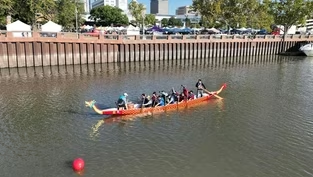
Dragon Boat - Peoria Chinese Association
Video has Closed Captions
Clip: S5 Ep8 | 5m 22s | a traditional dragon boat has made its way to Peoria and everyone is welcome to join the fun! (5m 22s)
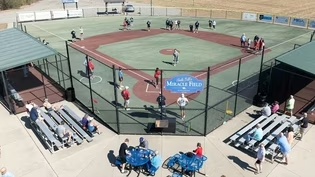
Miracle League of Central Illinois
Video has Closed Captions
Clip: S5 Ep8 | 6m 43s | Miracle League is designed so kids of all ages and abilities can enjoy the game of baseball. (6m 43s)
Providing Support for PBS.org
Learn Moreabout PBS online sponsorship
- News and Public Affairs

Top journalists deliver compelling original analysis of the hour's headlines.

- News and Public Affairs

FRONTLINE is investigative journalism that questions, explains and changes our world.












Support for PBS provided by:
You Gotta See This! is a local public television program presented by WTVP