One-on-One
Jack Cashill; Matt Delmont
Season 2024 Episode 2732 | 27m 53sVideo has Closed Captions
Jack Cashill; Matt Delmont
Author of "Untenable: The True Story of White Ethnic Flight from America’s Cities," Jack Cashill, reflects and investigates the collapse of Newark, NJ. Matthew F. Delmont, Distinguished Professor of History at Dartmouth College and Author of "Half American- The Heroic Story of African Americans Fighting World War II at Home and Abroad," examines the role Black men and women during World War II.
Problems playing video? | Closed Captioning Feedback
Problems playing video? | Closed Captioning Feedback
One-on-One is a local public television program presented by NJ PBS
One-on-One
Jack Cashill; Matt Delmont
Season 2024 Episode 2732 | 27m 53sVideo has Closed Captions
Author of "Untenable: The True Story of White Ethnic Flight from America’s Cities," Jack Cashill, reflects and investigates the collapse of Newark, NJ. Matthew F. Delmont, Distinguished Professor of History at Dartmouth College and Author of "Half American- The Heroic Story of African Americans Fighting World War II at Home and Abroad," examines the role Black men and women during World War II.
Problems playing video? | Closed Captioning Feedback
How to Watch One-on-One
One-on-One is available to stream on pbs.org and the free PBS App, available on iPhone, Apple TV, Android TV, Android smartphones, Amazon Fire TV, Amazon Fire Tablet, Roku, Samsung Smart TV, and Vizio.
Providing Support for PBS.org
Learn Moreabout PBS online sponsorship- [Narrator] Funding for this edition of One-On-One with Steve Adubato has been provided by RWJBarnabas Health.
Let’s be healthy together.
Wells Fargo.
Rowan University.
Proudly serving New Jersey for 100 years.
PSEG Foundation.
The Turrell Fund, a foundation serving children.
The Adler Aphasia Center.
New Jersey Sharing Network.
New Brunswick Development Corporation.
And by The Fidelco Group.
Promotional support provided by NJ.Com.
Keeping communities informed and connected.
And by BestofNJ.com.
All New Jersey in one place.
- This is One-On-One.
- I'm an equal American just like you are.
- The way we change Presidents in this country is by voting.
- A quartet is already a jawn, it’s just The New Jawn.
- January 6th was not some sort of violent, crazy outlier.
- I don't care how good you are or how good you think you are, there is always something to learn.
- I mean what other country sends comedians over to embedded military to make them feel better.
- People call me 'cause they feel nobody's paying attention.
_ It’s not all about memorizing and getting information, it’s what you do with that information.
- (slowly) Start talking right now.
- That's a good question, high five.
(upbeat music) - Hi everyone, Steve Adubato, welcome to a compelling conversation about a subject that most people are aware of on the periphery but never have really delved into it.
It is a story that's gonna be told by our next guest, he's Jack Cashill, author of the book Untenable: The True Story of White Ethnic Flight from America's Cities.
Jack, good to see you.
- Hey, Steve.
Good to see you.
And I think we share a certain link to the city in question.
Newark, New Jersey.
- Newark, New Jersey, Brick City.
You may leave the town and live somewhere else, but as I said to my wife recently, Newark never leaves you and you never leave the city.
At least for me, and a lot of people I grew up with.
I grew up in the northern section of the city, you grew up where, Jack?
- I grew up in Roseville, which is, you know, where- We shared the same high school, that is Barringer.
- I went to Essex Catholic because by the time I was ready to go to high school, let's just say, in the 70s, Barringer was a place that my sister went to, I opted to go to go to Catholic school for the rigor and discipline.
And that's a whole 'nother story, but maybe it's not.
- It was same basic neighborhood, though, in other words.
Where, you know, that is our neighborhood school, yours and mine.
My brother went to Essex Catholic, but I went to- Actually, I went to Regis High School in New York City, so.
the word untenable comes from a conversation you had with an old friend from the neighborhood.
Describe it real quick.
- Sure.
He was the holdout Democrat of all my friends, right?
And so that gives him, he's arguing against interest.
He was the last of us to leave the neighborhood, living there with his widowed mother.
I said, "Artie, why finally did you leave?"
And he said, "Well, Jack, it became untenable."
I said, "What do you mean by 'untenable?'"
He goes, "Well, when your mother gets mugged for the second time, that's untenable.
When your home gets invaded for the second time, that's untenable."
He gave me the title for the book, - So let's talk about this: Newark.
And Newark in Jack's writing, which I find compelling and interesting on so many levels, it's not just Newark, it's the Bronx, it's Boston, it's Philadelphia, it's so many cities across the country.
But Newark is still Newark.
Newark in the 1950s and 60s, what policies do you argue, Jack, on the national level, federal policies, as well as on the local level, pushed quote unquote, "white ethnics," many of whom I grew up with, even though my family stayed in Newark, still in Newark, as you well know, my mom's still there on Clifton Avenue in Newark, why did so many white ethnics leave the city and why are you saying the government forced a lot of that?
- Well, the most wide-ranging government policy, which took a long time to evolve, was the, basically the subsidization of fatherlessness, then made fatherlessness attractive.
That is the, I would say, the larger, the macro reason that Newark and all these other cities collapsed.
The micro reasons were, you know, some of them were unique to Newark, and I know this is close to home for you, but when the city leveled Little Italy to build these monstrous housing projects with the full-throated support of a lot of the Italian leaders, which is really kind of strange, and in my case, the building of I-280, right through the heart of our neighborhood, that took our houses.
It seemed like they were, utterly at that time.
And I read the reports, you know, the planning reports, they're utterly indifferent to the lives they were displacing in the neighborhoods they were ruining.
- Let's put this in perspective, Jack.
First, let's talk about what you're calling Little Italy, which is the community that my family grew up in around St. Lucy's church.
- Right.
- Still go back to the annual feast of St. Gerard, never missed it, our kids go every year with us.
The neighborhood, virtually all Italian American, very ethnic, if you will.
- Right.
- The federal government decided, with the support of many members of Congress, including the member of Congress representing that area, Peter Rodino, who we've even done a documentary on, built what was called Columbus Homes.
- I think the federal government must have said, "Well, we'll call it Christopher Columbus Homes, the Italians, I guess they'll like it because it's called Columbus."
It was a high rise, Italian Americans were never gonna live in a high rise.
Other people were brought in, I believe from the southern part of the country, were shipped up disproportionately African American, and a disproportionate number of Italian Americans did everything they could to get outta the neighborhood.
You're saying the federal government forced that issue and forced white ethnics, more specifically Italian Americans, outta the neighborhood?
- Yeah, you know, we tend to think of, I think it was Baldwin who said, you know, "Urban renewal means negro displacement" or something.
He had said it much more cleverly than I, but the federal government at that time was indifferent to the ethnic group they were about to obliterate, whose neighborhoods they were about to obliterate.
And it was a combination in a city like Newark, I'm sure it was the same elsewhere where the dreamers like Rodino and also the Monsignor at St. Lucy's met with the schemers, like the Boiardo family who just started demolition companies, you know?
- Yeah, to be clear, you're talking about an an organized crime family, Richie "The Boot" Boiardo, his son "Tony Boy" Boiardo, they did a lot to contribute to the church in the area, and were, let's just say influential in the neighborhood.
Please pick it up from there, Jack.
- They were the model, by the way, for the Sopranos.
- Absolutely right.
- David Chase has admitted as much.
But, so they're working hand in glove with the corrupt politicians like future Mayor Addonizio who was a congressman then, and then you have people who, like Rodino, who actually believed that this would be a good thing.
And initially, I found this one self-published book by a young black guy who, his family was one of the first in, they thought it was Heaven, right?
I mean, they had new appliances, they had, you know, the place was spotless, meticulously maintained and clean.
And at that time when it opened, it was probably half Italian.
The people didn't wanna be there because they'd much rather be back in their neighborhoods sitting on their stoops.
You don't have stoops in high rises.
You don't have that sense of neighborhood community and clusters where you have shops and, you know, my neighborhood was like that also, you know, lined with shops, you knew all the shopkeepers.
Most of them were mom-and-pops.
They were unique to the neighborhood.
That was all razed, like, in retrospect, reading about the destruction of Little Italy is mind-blowing.
- As time went on, Columbus Homes became an eyesore.
No one wanted to live there.
If they lived there, it's 'cause they couldn't afford to be anywhere else.
Our production team's gonna show the imploding of Columbus homes.
It was literally exploded by the government, they came in and said, "Let's raze this whole thing."
But Jack, also, 280, I don't go into go into too much detail, Route 280 goes right up through the Roseville section, you gotta remember eminent domain, the government came in and said, "We're getting rid of your houses.
We'll give you a few bucks for your house.
Get outta the way, we're building a highway, we're building a high rise."
You're saying the government did that, but how much did racism and resentment on the part of many white ethnics have to do with the flight from the cities?
Because many white ethnics did not want to live with folks who were not Irish, Italian, Jewish, excuse me, Irish American, Italian American, Jewish American, post- They did not wanna live with African Americans.
And then later on, Hispanics, how much did race have to do with it and race relations?
The city again, the rebellion, the rise, 1967, look it up, it all blew up then.
- Yeah, I would say it's an interesting question, Steve, and it varied with every ethnic group.
So for instance, Jews were the most liberal, most welcoming, and they were the first ones to leave.
Italians were the least welcoming, and they were the last ones to leave.
They were the ones who hung on most tenaciously.
For the Irish and Italians, Catholic schools made a huge difference in rooting us into our neighborhoods.
We did not wanna leave.
When I went back and interviewed the people I grew up with in the 60s, they used the term idyllic to describe our humble working class neighborhood.
I would say in our neighborhood it was about 90% renter.
So we weren't being block busted, we didn't have homes to sell.
And Weequahic, the Jewish neighborhood, heavily Jewish neighborhood, very prominent, I mean, 20 household names came outta that high school, Weequahic High.
They had more homeowners, but they were also fully dependent on public education.
And they also had very high standards for their children.
So once those schools began to erode even a little bit, it became more than they could tolerate or wanted to tolerate.
I would say racism had relatively little to do with the unpeopling of our cities.
- Lemme try this, Jack, Trump is mentioned in the book a tiny bit, not a book about Trump at all, but this is the way I interpret it: -Yeah.
- And I've said this in many interviews, a high percentage of the guys I grew up with, the friends I grew up with in the northern section of the city, Italian American disproportionately, who moved to the suburbs of Essex County, Morris County, other places, they are disproportionately big Trump supporters, MAGA folks.
Is that an accident?
- No, it's not, and I'm sort of a test case of that.
I was there when this was all happening.
You know, Steve, I was 19 in 1967 for the riots.
You know, we moved to a housing project in Bradley Court in Newark after they bought our home, they took our home.
We were one of the few homeowners.
We just had a raggedy, you know, house in the middle of a, you know, working class neighborhood.
- Same for us.
We were on Highland Avenue, a very raggedy house.
But go ahead.
- Yeah.
And by the time I could see what was happening, I could see how the media were treating us.
They were treating us as the villains in this story.
- You mean whites?
- My neighborhood was 99% Democrat for Kennedy in 1960, right?
I mean- - Well, hold on, you're saying the media was portraying Irish American, Italian Americans as evil what?
- As the villains in this saga.
And the villains of this saga, they were the ones who were the racists in Newark who were causing black people problems.
And we looked at the portrayal of ourselves, and they gave us, as our role model Archie Bunker, right?
It was insulting.
- Same thing, but hold on, Jack, some of that was real.
In the riot/rebellion in 1967, it was, in many ways, the cab driver, if you will, John Smith, you can read about it.
The reality is, we had a corrupt police department headed up by Dominick Spina, Italian American, appointed by a corrupt mobbed-up mayor, Hugh Addonizio was his name.
Are you saying that blacks were not mistreated by Italian Americans, Irish Americans, and others who controlled the city government?
- I would say that, you know, as you read my book, is that Spina- - I sure did.
- Was partly responsible my father's death, suicide.
He was a Newark cop.
I mean, I knew these people, Steve, I grew up with these people.
- I'm sorry for your loss, Jack.
- I knew what their ethos was.
I knew- Were they disproportionately harsh towards African Americans?
I don't know.
Here's the problem: They had many more confrontations.
You know, you have these confrontations with resisting arrest, blacks were committing a disproportionate amount of crime, and that is ascended as the families began to break up.
So the, you know, every day 2% of the arrests in America, on a given day, someone resists.
Anytime anyone resists an arrest, it's gonna look bad.
The John Smith case was classic of that, you know, and the rumor was that he was killed, and then the riots started.
- But Jack, you'd be denying- I appreciate the anecdotal evidence you're bringing, but at the same time, the federal government came in years later to document and take over the police department because of the institutional racism that existed.
And that blacks being disproportionately treated by police.
I'm not saying it's black and white, literally, it's clear cut, but to say there was no racism in the city of Newark toward blacks by Italian Americans and Irish Americans when they were in control, really?
- I'm not saying there's no racism.
I'm saying that racism is not what destroyed our neighborhoods.
- Okay.
- It's not what drove people out of our neighborhoods.
- Then what drove- Let me ask you this, go back to the Trump question and team, I know you're telling me to get outta the interview because there's a time issue, but I wanna stay on this.
- Then stay in it.
(laughs) - I'm not gonna leave it and here's why: To what degree do you believe- I'll ask a leading question, to what degree do you believe white resentment of leaving the neighborhood, whether it's Newark or Queens or wherever across the country, how much of the white resentment, whether it's misplaced or not, who knows, against African Americans primarily, Trump being the "retribution," if you will, his words, not mine, for a lot of those folks, how much of it is, "He's our guy who will take the country back"?
- I would say virtually everyone I know, Steve, turned Republican long before we ever heard of Donald Trump.
- He hasn't fueled it?
He hasn't-?
- Nope.
- Okay.
- He never talks about race.
Well, he's the same guy who the Central Park Five- He put ads in all the papers in New York calling for the death penalty for the Central Park Five- - Now I'm gonna correct you on that.
That's not correct.
- Oh, that is correct, Jack.
- No, no, no, check it out and come back and-- - And then when DNA evidence said they weren't the ones, he said, "Do it anyway."
- No, no, read that more carefully, because everyone was against the Central Park Five at that time.
- He called for the death penalty for teenagers before we even knew- - No, he did not.
I hate to correct you on your own show.
- So Trump is a racial- Let me ask you this: It's not a theme in the book, but I'm curious, Trump is a racial healer in your mind?
- I'm not saying he is a racial healer, but he's getting an increasingly high percentage of the black vote, higher than any Republican who preceded him - As we're doing this program, that's true.
- Yeah.
And you know, for the Trump, you know, I live in the middle of America now, and the Trump supporters, by and large, are living in places where there are no black people.
They don't even think about race as an issue.
That may surprise you, but it's true.
It's not true in Ocean County, New Jersey- - No, it's not.
(laughs) - With Trump, you know.
- Many of whom are from the cities, many of who are from Newark and moved down.
Hey, Jack, listen, sorry for- I wanna have you back because this is an important conversation.
Way more importantly, get Jack's book.
He won't have- I won't be interrupting him in the middle of the interview, you can read the book.
- Untenable: The True Story of White Ethnic Flight from America's Cities.
Jack, you've got me thinking a lot, not just about my old neighborhood, but about where we are now and how we got here.
Can't thank you enough.
Appreciate it, Jack.
All the best.
- Steve, great conversation.
Thanks for having me on.
- Better because it was you on the other end.
Stay with us.
We'll be right back.
- [Narrator] To watch more One on One with Steve Adubato find us online and follow us on Social media.
- We're now joined by Matthew Delmont, distinguished professor of history at Dartmouth College, I'll get that out, and author of "Half American: "The Heroic Story of African Americans "Fighting World War II at Home and Abroad."
Professor, great to have you with us.
- Thanks for having me.
- "Half American" isn't just the name, it means a lot.
Describe it please.
- So the title of the book comes from a letter written by a man named James G. Thompson.
James Thompson was a 26-year-old from Wichita, Kansas, and he wrote this amazing letter to the Pittsburgh Courier in late December, 1941, after the bombing of Pearl Harbor.
James Thompson was a black man and he knew that he and other black Americans were about to be drafted into a segregated military.
And so in this letter, he wrote a series of very pressing and pointed questions.
He asked, in part, "Should I sacrifice my life "to live half American?
"Is the America I know worth defending?"
And that phrase, "Should I sacrifice my life to live half American?"
It really stuck with me.
It's why I chose "Half American" as the title of the book.
The Pittsburgh Courier used Thompson's letter to launch what was called the Double Victory Campaign, which really became the rallying cry for Black Americans during the war.
- So, and the rest of that quote is fascinating.
This is again from James Thompson.
"Would it be demanding too much "to demand full citizenship rights "in exchange for sacrificing my life?
"Is the kind of America I know worth defending?"
Do you still think that's a question that a fair number of African Americans in the military would ask today?
- I think unfortunately it is.
I think the military deserves a lot of credit for thinking longer and harder about issues of racial equity than almost any other organization in American society.
And so African Americans are well represented today in the military, much more well represented at different ranks than they were in 1941.
But one of the challenges Black Americans have always faced in terms of service to their country is what does it mean to serve a country where you don't yet have full citizenship and full equality?
Things are obviously better today than they were during World War II, but that question of should I risk my life to serve a country where there's still vast racial wealth gaps, where there's still police brutality, still issues that confront too many African American communities.
So there's still issues that African American service men or women still grapple with today.
- So let's put this in perspective.
You used the term double victory, the theme of double victory, Black Americans were fighting fascism abroad, racism at home, but they're fighting in the war to represent the United States of America.
When they come back after the war, to what degree do you believe, professor, the federal government, the leaders in Washington, disproportionately, obviously almost all white, understood, not just the paradox, but how wrong it was for that to be going on for Jim Crow, for racism, for prejudice, for all kinds of things going on, was there a sense like, "Hey, wait a minute, we just asked "people to put their lives on the line and now."
Was there any of that or is that just pipe dream?
- It was a slow realization for people in power, people like President Truman and other officials in Washington DC and that's why I think it's so powerful about looking at World War II from the Black perspective, this double victory campaign that was launched by the Pittsburgh Courier, a Black newspaper, it really became the focal point for Black Americans throughout the war.
Double victory stood for fighting for victory over fascism abroad and victory over racism at home and it wasn't just a cover slogan or rhetorical device, it really was how Black people thought about the war.
They were absolutely committed to military victory.
They knew that Black Americans and all Americans had to do everything they could to defeat the Nazis and the Axis powers.
But they also recognized that wasn't enough.
It wasn't enough to achieve military victory and then come home to the same kind of racial discrimination here on the home front.
And so that home front story of the fight against racism and the fight for civil rights became important as well.
Those stories are intertwined in the history of World War II.
- Matt, why did this become so... why did you jump into this?
- For me, I'm a historian, all my work focuses on African American history, but it was really a desire to do justice to that generation of Black veterans, for everything they gave to the country, and that everything they continued to give to the country when they came home.
One of the things they say in the book is for Black Americans, World War II didn't end in 1945, that whole generation of Black veterans came back and they kept fighting.
They were just fighting here in the United States fighting for civil rights, fighting to make America country where freedom and democracy would truly be values that could be shared by all people.
- I'm curious about this, you talk about West Point and racism at West Point.
Talk about that.
- One of the characters I feature in the book is a man named Benjamin O. Davis, Jr.
He was the first leader of the Tuskegee Airmen.
He was the fourth Black person to ever graduated from West Point, the first in the 20th century.
- Go back for a second, professor, put the Tuskegee Airmen in perspective because people hear it and don't really understand it and you'll help us, please.
- Absolutely, so the Tuskegee Airmen I think, today are probably the best known servicemen from World War II.
They were the pioneering Black fighter pilots.
But we have to understand, when you go back to the 1930s, 1940 even just in the lead up to World War II, the Army Air Corps didn't allow any Black Americans to serve at all.
They didn't want any Black pilots.
And so there was a real push from civil rights activists and from Black newspaper editors to force the Army Air Corps to finally allow the first cohort of Black pilots to train and to serve and then once those men got into the combat, then they had to prove themselves in combat.
In some cases, prove themselves to their own white officers who still didn't think Black men had what it took to be fighter pilots.
- Go back to the West Point story.
- So Benjamin O. Davis Jr. was the first leader of this Tuskegee Airmen unit.
He graduated from West Point in 1936, only the fourth Black man to ever do so.
But when he graduated, the Army had no idea what to do with him.
He wanted to be a pilot, but at that point, they weren't allowing any Black men to be pilots.
When he described his four years at West Point in the mid 1930s, he said it was horrific, the kind of racism he encountered.
He said no one spoke to him for a full four years other than direct commands.
They tried to isolate him and they ostracized him just because he was a Black serviceman.
Nevertheless, he persevered through that, ended up serving a distinguished tour as one of the leaders of Tuskegee Airmen and then served for the rest of his life in the Air Force, one of the first generals in the Air Force.
- Fast forward.
I had the honor of interviewing a late General Colin Powell, grew up in the Bronx, right?
Family, I believe, from Jamaica, comes here and becomes who Colin Powell was and why he still matters.
For Colin Powell to achieve what he did, when he did, how he did in the Bush administration and then go on to the UN.
Yes, there were problems and challenges, people can check it out, but he also stood up and said, "I was wrong," as it relates to weapons of mass destruction, that's not the issue.
What did his ascension to the role that he played in the military and the federal government mean?
I know we're talking about one person, but it's historically very significant, is it not?
- It absolutely is.
For someone like Colin Powell to break the barriers that he did in the military and then in politics was incredibly important.
Part of the role of someone like Colin Powell is they open up opportunities for the next generation follow and for Colin Powell himself, he said that he would not have been able to achieve what he achieved without the generation that came before him, this World War II generation, that served so proudly and then kept fighting to make the military racially integrated.
By 1948, President Truman signs an executive order, desegregating the military.
That's what makes it the kind of organization where Colin Powell can imagine himself achieving, being judged by his merit and his performance, rather than being judged just by the color of a skin.
- You've decided to give 14,000 copies of your book to students across the country for free.
Who are those students, A, and B, why did you do it?
- So, the students and teachers are from all across the country.
I partnered with a education organization called Zinn Education Project that has a network of teachers who care deeply about sharing these kind of stories in the classroom and I was so grateful that so many teachers signed up and so many students had the opportunity to engage with the book.
For me, it's important because this is why I write, this is what I do as a historian.
I teach students here at Dartmouth, but when I write books like this, I wanna share with as many people as possible and we're at a moment in our country's history where it's so important for us to engage honestly and openly with all aspects of American history and I think this story is powerful because it's a story about people who love the country.
These Black Americans who served during World War II, they loved the country so much, not just to fight for it and serve for it in the military, but to come back and really demand that America become a country that could provide actual freedom and democracy to all people.
- Before I let you go, professor, some people might say, "Oh, this is a story about Black American history."
The reality is this is simply about American history.
- Absolutely, you can't talk about American history without understanding African American history.
I hope that this is a book that appeals to all readers.
These are stories of new heroes that we can count in the stories of World War II and the thing I tell my students in the classroom all the time is that the stories we tell about the past matter.
And so, I hope readers are inspired by the powerful stories of patriotism and service that they'll find in the book.
- Professor Matt Delmont, professor of history at Dartmouth College and also author of "Half American: "The Heroic Story of African Americans "Fighting World War II at Home and Abroad."
Professor, thank you so much for joining us.
We appreciate it.
- Thanks for having me.
- I'm Steve Adubato.
We thank you so much for joining us and we'll see you next time.
- [Narrator] One-On-One with Steve Adubato is a production of the Caucus Educational Corporation.
Celebrating 30 years in public broadcasting.
Funding has been provided by RWJBarnabas Health.
Let’s be healthy together.
Wells Fargo.
Rowan University.
PSEG Foundation.
The Turrell Fund, a foundation serving children.
The Adler Aphasia Center.
New Jersey Sharing Network.
New Brunswick Development Corporation.
And by The Fidelco Group.
Promotional support provided by NJ.Com.
And by BestofNJ.com.
- I am alive today thanks to my kidney donor.
I am traveling and more active than ever before.
- I'm alive today thanks to my heart donor.
I'm full of energy and back singing in my church choir.
- I'm alive today thanks to my lung donor.
I'm breathing easy and I'm enjoying life’s precious moments.
- They are about 4,000 people in New Jersey waiting for a life-saving transplant.
- Donation needs diversity!
- For more information or to become an organ and tissue donor, visit NJSharingNetwork.org.
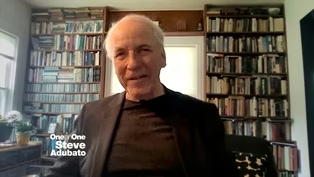
Examining The Historic Divide of Newark, NJ
Video has Closed Captions
Clip: S2024 Ep2732 | 16m 37s | Examining The Historic Collapse of Newark, NJ (16m 37s)

The Role of Black Men & Women During World War II
Video has Closed Captions
Clip: S2024 Ep2732 | 10m 53s | The Role of Black Men & Women During World War II (10m 53s)
Providing Support for PBS.org
Learn Moreabout PBS online sponsorship
- News and Public Affairs

Top journalists deliver compelling original analysis of the hour's headlines.

- News and Public Affairs

FRONTLINE is investigative journalism that questions, explains and changes our world.












Support for PBS provided by:
One-on-One is a local public television program presented by NJ PBS