
Jack Jouett House Historic Site
Clip: Season 31 Episode 8 | 3m 34sVideo has Closed Captions
We’ll learn more about Revolutionary War hero Jack Jouett in this story.
On the night of June 3rd, 1781, Jack Jouett rode 40 miles to warn the governor and legislature of Virginia that 250 British troops who were approaching. His heroic act is credited with saving the American Revolution. After the war, Jouett came to Woodford County where he settled and built his home. We’ll learn more about Jack Jouett and his historic home in this story.
Problems playing video? | Closed Captioning Feedback
Problems playing video? | Closed Captioning Feedback
Kentucky Life is a local public television program presented by KET
You give every Kentuckian the opportunity to explore new ideas and new worlds through KET. Visit the Kentucky Life website.
Jack Jouett House Historic Site
Clip: Season 31 Episode 8 | 3m 34sVideo has Closed Captions
On the night of June 3rd, 1781, Jack Jouett rode 40 miles to warn the governor and legislature of Virginia that 250 British troops who were approaching. His heroic act is credited with saving the American Revolution. After the war, Jouett came to Woodford County where he settled and built his home. We’ll learn more about Jack Jouett and his historic home in this story.
Problems playing video? | Closed Captioning Feedback
How to Watch Kentucky Life
Kentucky Life is available to stream on pbs.org and the free PBS App, available on iPhone, Apple TV, Android TV, Android smartphones, Amazon Fire TV, Amazon Fire Tablet, Roku, Samsung Smart TV, and Vizio.
Providing Support for PBS.org
Learn Moreabout PBS online sponsorship[music playing] [music playing] We're having a great time here today at the Jack Jouett House Historic Site.
This is Linda DeRosett.
She's the Executive Director.
Linda, thanks so much for letting us be here today.
My pleasure.
So, I'm a lifelong Kentuckian.
Before we started working on this, I had not heard of Jack Jouett.
Who was he and what's his importance?
Jack Jouett was incredibly important to Kentucky history and our country's history.
Jack's story and his claim to fame really begins on the night of June 3, 1781.
He's a young man of 26.
He's a soldier, a member of the Virginia militia.
He is visiting friends in the Cuckoo Tavern in Louisa, Virginia.
Nightfall comes.
He's tired.
He lays under a tree and falls asleep.
Wakens to the sound of many horses, many men, looks around the tree, and sees King George's army.
Approximately 250 of his soldiers, led by a man named Banastre Tarleton, who was also known as Bloody Ban for his savagery.
Jack very quickly guessed what they were going to do.
They were going to head to Monticello and capture Thomas Jefferson.
Go on to Charlottesville, where the Virginia Assembly had decided to meet after they had left Richmond, thanks to Benedict Arnold, and they would capture all of these men.
So, he gets on horseback and warns everybody.
Oh, he gets on the fastest steed in seven counties, Sally, named after his childhood sweetheart, and she was quite an amazing horse.
Jack was 6'4” and weighed about 230 pounds.
And he began a 40-mile ride through the Virginia backwoods, over logging roads, through branches, trees.
He's cut.
He's hit by branches.
He's knocked off Sally at least once.
He's crossing streams, but this is the only way that he is going to beat the King's troops to Monticello to warn Mr.
Jefferson So, he got there and warned them, and in doing some background research on this, a lot of people said that he really saved the American Revolution by being able to do that.
At that time, Virginia especially was undermanned.
They were hungry.
They were tired.
They'd been fighting a very long time.
The loss of Thomas Jefferson, the writer of the Declaration of Independence, fore-signers of the Declaration of Independence, and Patrick Henry, who was already famous for saying, “Give me liberty or give me death," these are very important men to the colonists.
And to lose them in that way █ Would have been huge.
Would have been a horrible blow.
So, how did he end up in Kentucky?
How did he come to rest here?
Well, we were still part of Virginia when he came over.
He, in fact, was instrumental in us becoming a separate state and becoming Kentucky.
So, he came over.
He got a land grant as a Revolutionary War soldier.
Settled in a few places before finally coming here to Woodford County in 1797 and building this beautiful home.
And when people come here to see the historic site, what do they get to experience?
What do they take away?
What they get to experience if Jack and his wife, Sally walk through these doors right now with any one of their 12 children, they're walking on the same floorboards that Jack and Sally and the children walked on.
The house was donated in the 1970s to Woodford County.
The Woodford County Fiscal Court and the Woodford County Heritage Committee take wonderful care of it.
They could come in today and except for the electricity and the air-conditioning, they could feel right at home.
They would recognize the place.
Yes.
It really is a remarkable story and a facility here, and we're enjoying checking it out today.
Thanks so much for letting us be a part of it.
Oh, my pleasure.
[music playing]
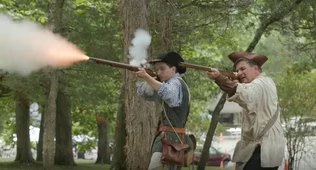
Video has Closed Captions
Clip: S31 Ep8 | 5m 4s | Chip learns about the battle of the Blue Licks. (5m 4s)
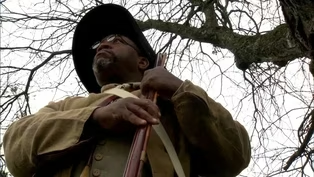
Video has Closed Captions
Clip: S31 Ep8 | 7m 25s | Learn about the fascinating life of African-American Revolutionary War soldier Daniel Goff. (7m 25s)
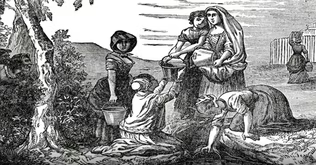
Video has Closed Captions
Clip: S31 Ep8 | 6m 7s | Learn about the siege at Bryan's Station. (6m 7s)
Providing Support for PBS.org
Learn Moreabout PBS online sponsorship












Support for PBS provided by:
Kentucky Life is a local public television program presented by KET
You give every Kentuckian the opportunity to explore new ideas and new worlds through KET. Visit the Kentucky Life website.