The Legacy Series: Living A Legacy
Jackson and Tull (Nzinga Tull)
Season 2 Episode 2 | 26m 44sVideo has Closed Captions
A family legacy of engineering with Nzinga Tull and her father Knox W. Tull
A family of engineers. Nzinga an engineering grad of Spelman College & Georgia Institute of Tech., and an Aerospace Systems Engineer w/NASA on the Hubble Telescope as a contractor through Jackson & Tull. Her father, Knox W. Tull co-founded Jackson and Tull, a full-service tech co. that provides aerospace, manufacturing, nat'l security, robotics, civil engineering, and info systems services.
Problems playing video? | Closed Captioning Feedback
Problems playing video? | Closed Captioning Feedback
The Legacy Series: Living A Legacy is a local public television program presented by WHUT
The Legacy Series: Living A Legacy
Jackson and Tull (Nzinga Tull)
Season 2 Episode 2 | 26m 44sVideo has Closed Captions
A family of engineers. Nzinga an engineering grad of Spelman College & Georgia Institute of Tech., and an Aerospace Systems Engineer w/NASA on the Hubble Telescope as a contractor through Jackson & Tull. Her father, Knox W. Tull co-founded Jackson and Tull, a full-service tech co. that provides aerospace, manufacturing, nat'l security, robotics, civil engineering, and info systems services.
Problems playing video? | Closed Captioning Feedback
How to Watch The Legacy Series: Living A Legacy
The Legacy Series: Living A Legacy is available to stream on pbs.org and the free PBS App, available on iPhone, Apple TV, Android TV, Android smartphones, Amazon Fire TV, Amazon Fire Tablet, Roku, Samsung Smart TV, and Vizio.
Providing Support for PBS.org
Learn Moreabout PBS online sponsorship♪♪ ♪♪ ♪♪ >> Welcome to "The Legacy Series: Living a Legacy."
I'm your host, Bremante Bryant.
We explore a remarkable family in the nation's capital and their crowning achievement... A young man's aspirations that would carry him to achieve his wildest dreams.
A young woman free to delight in all the love, culture and opportunities that her city has to offer.
Not at all harnessed by judgment, expectations, or limitations -- this is a story of a tale of a not-so-ordinary family's remarkable responsibility to bridge the cultural gap, build strong foundations, as well as foster a deeper understanding of our universe.
This is the story of Knox and Nzinga Tull.
Tell us a little bit about your upbringing.
>> I was born and raised in Hampton, Virginia.
And I attended the public schools, which were segregated.
I graduated from Phoenix High School, which was the black high school.
And I attended Hampton Institute, which is now university.
But it was then Hampton Institute -- for two years, and I studied what is now would be called construction management.
I decided that I became fascinated with structural engineering.
That is, designing the frame of buildings.
So I eventually transferred to the University of Michigan, at Ann Arbor, and I got my bachelor's degree in civil engineering.
And structural engineering was the focus.
I worked for a couple of years, first with the California Highway Department in the Los Angeles region.
Then I came back to Washington, D.C., and began working with small structural-engineering companies.
And then I had an opportunity to pursue graduate work at Georgia Tech.
So I moved to Atlanta and spent two years in Atlanta, at Georgia Tech, receiving my master's degree in civil engineering and came back to Washington, D.C., and worked for structural-engineering companies for a while, and then founded Jackson and Tull in 1974.
Now, my company is called Jackson and Tull.
It started out as a partnership with a gentleman who was a few years older than me.
His name is -- he's no longer with us -- Frederick Jackson, and he is a Howard graduate, a very talented brother.
And so Jackson and Tull was formed in 1974 and he passed in 2000.
Took over the firm and just kept the name.
>> What was the Tull household like?
>> My earliest memories were of being 7 or 8 years old, and my father waking me up on Saturday mornings and taking me to the Harambee House, which became the Howard Inn, and we would have breakfast and he would ask me a lot of questions about what was going on in school -- I'm the oldest of four -- what was going on with my siblings, and then we'd go to the office, and that's when we were on Wisconsin Avenue, and I would do my homework.
And then when I got finished, he would have me sharpen pencils and sweep the floors and do other things, write the dates on checks.
>> The company was like the seventh member of our family.
It really was, because I remember it always being a part of my consciousness.
I remember playing in the conference room of our original headquarters when I could barely run or walk.
>> We came of age in our home, but also in the larger "Chocolate City" in D.C. in the '70s and '80s.
So I kind of feel like the whole city was home.
My parents were very nationalistic.
We were Pan-Africanists at a time, at least in D.C., where that was not particularly abnormal.
Jackson and Tull was always part of our family culture, and I always understood that this was an institution that my dad was building to build wealth and stability for our family, first and foremost, and so that we would have the access and the opportunity after we're stable, to support our community and other causes that were important to us.
>> One of our first projects was converting the Freedman Square Freedmen's Hospital into its current use.
We also designed the Louis Stokes Building on campus, and we designed the parking garage for the hospital, Howard Hospital.
So those were projects that I'm very proud of.
And we have designed several churches in Washington, D.C., one of which is we worked on the renovation of the Metropolitan AME Baptist Church, which is on M Street.
Our early focus was working as structural engineers for architects, most of whom were black architects.
And that's a tremendous story that needs to be told, which is kind of unique to Washington, D.C. And when Marion Barry got elected, and he was a very great mayor and very farsighted, and one of the things that he wanted to do was to give black folks the opportunity to have contracts, based on our qualifications, of course.
And that gave us the opportunity to begin to work on areas where we did not really have the upper -- that we were locked out of and that's bridges and highways and wastewater-treatment plants.
So we had that opportunity.
And another great American is Mr. William T. Coleman, who was a secretary of transportation in the late '70s.
And he was a secretary of transportation during the Northeast Corridor Improvement Project, which is improving and upgrading the railroad between Washington and Boston.
And because of Mr. Coleman's insights and dedication, we and other black engineering firms were given the opportunity to work on the projects.
>> Did you ever encourage your children to go into engineering?
>> I've learned that one thing to do is you tell your children what you want them to do too vociferously, there's something in their DNA, and they'll do exactly the opposite.
So, it was my wife had that wisdom, don't beat them over the head.
"You're going to be an engineer.
You're going to be an engineer."
No, we just said, "We love you and we want to support you.
And you are welcome.
And we encourage you."
Thanks to my wife's brilliance and leadership, we have four children that we're very proud of.
They're all technically competent, smarter than their father will ever be.
>> So this is Jackson and Tull's manufacturing facility here in Beltsville, Maryland.
We generally just call it the shop, the machine shop.
And we can take you inside and give you a little tour.
>> So, part of what we have to pay attention to, obviously, with what we're working with a high level of demand and technical expertise that's required.
We can't just always walk into different rooms in the machine shop.
We have to be wary of what people are not just wearing, but even what they apply to their body.
So lotion, perfume, a lot of these things, which to us humans doesn't seem like a big deal, can have an adverse impact, especially when you're dealing with space electronics or space components.
This is where our electrical engineers and our electrical technicians come in to perform high-level tests, particularly board=level tests and, to a lesser extent, a box-level test.
So, we have just an array of equipment and breakout boxes for our team to use.
We also do a lot of work with the government, which, with not just NASA but also with DoD, and there are certain ITAR restrictions.
So, as a result, we can't always provide everyone with an access to what's going on.
So Assembly area two, unfortunately, we won't be able to show it to you today, but it's another test area where we perform high-level tests.
We have a couple of different test beds that are inside.
And, actually, our engineers right now are in the process of building up, of fabricating a mockup for one of our partners, Northrop Grumman.
>> What was it like growing up with your sister Nzinga?
>> Well, I'm the oldest of four.
It was great being with Nzinga.
She's always been very independent, brilliant, independent and fearless.
And the best example I have is I'm two years older than Nzinga.
I was in 12th grade with 30 other people taking French 3.
She was in 10th grade taking French 4 by herself.
So that's the kind of academic -- >> High achievement.
>> That's not even the sciences.
That's just the languages and literatures.
So she's always been sharpest knife in the drawer.
>> Since a kid, I wanted to be a botanist because I like plants.
And I thought it was a cool word.
I wanted to be a doctor.
They had all had all kinds of, you know, the myriad of professional aspirations that a kid might have.
I had the aptitude in math and science.
As I got older and in high school, I came to appreciate the different types of engineering that I could go into.
I'm a very proud Spelman woman.
I'm a Spelman College graduate.
I was part of the dual-degree program, where you're in this joint program.
It's a five year program with one of the schools from the Atlanta University Center, in my case, Spelman, and then an engineering school, in my case, Georgia Tech.
And because of the course of study, it was a very compressed five-year program because you basically graduate with two undergraduate degrees in five years.
>> Have you felt over the years seeing the success of your father and obviously you and your siblings, did you ever feel that you had to prove anything, whether it was to yourself or others?
>> No.
I think that my dad in particular has done a really good job of affirming me as a person and that my value and my worthiness is inherent.
So I've never had any recollection of feeling like I had anything to prove.
I felt -- I have felt a sense of responsibility.
I'm a very privileged and fortunate person that there are people who are just as good and honorable as I am that were not born into the family I was born into.
So that's a matter of privilege.
So I do feel a sense of responsibility to honor that and in doing so, doing the best that I can, building upon it, not taking it for granted, using my skills and talents to expand the kind of, privilege that I've gotten so that more people can benefit because that's how privilege works, right?
You didn't earn it.
>> You know, there's that saying.
African-Americans, you got to work twice as hard, be twice as smart.
Now, you're African-American woman.
You might have to double that.
Do you ever have that feeling of weight?
>> No.
I think that is also not just my family but the broader cultural sociocultural experience of being in D.C. and growing up in D.C. in the '70s and '80s.
Everybody was black.
The smart kids were black.
The kids who smoked weed were black.
The drug dealers were black.
The skateboard kids were black.
Everybody was black.
So the kind -- while I have, I had an awareness that there was a school of thought, that simply was not my experience, and it wasn't my belief system.
My parents did a really good job, I think, of articulating theoretically and historically the kinds of political and interpersonal and social challenges that we have experienced as black people in this country on any different level.
The sense of needing to... be more or different based on my racial or cultural identity simply didn't exist.
I had a very strong racial and cultural identity based on my upbringing and my family and being in D.C., but my identity as a woman and my politics around black feminism really took shape at Spelman.
>> You have achieved a lot.
And still working on it, I'm sure.
But the Hubble Space Telescope is one of the biggies.
>> I'm actually currently working on Hubble now, and this is what I call my second tour.
So I started when I first came out of undergrad at Jackson and Tull, a system engineer in the power-system group for Hubble was my first position.
Much of what we do, certainly in aerospace and mission operations ends up being on-the-job training.
And so, again, as a lifelong overachiever and being accustomed to being at the top of my game at every turn, first coming into Hubble was kind of like drinking out of a fire hose, right?
Everyone speaks in acronyms.
That's kind of across NASA.
Like, what is this language people are using?
And, you know, the working world is different from undergrad, right?
Like, people are there to get projects done.
There's not a built-in support system.
So it was a challenge in that regard.
But it's probably a challenge that many of us face.
But I did come to, you know, I came up to speed.
And in addition to being able to represent for the family firm, I came to appreciate the import of an institution like the Hubble Space Telescope.
It's one of the longest-running science observatories in space.
People all over the planet love it.
They're all invested in the telescope being able to continue to collect science.
And it collects all this amazing data that helps all these astronomers help us learn more about our universe and in learning more about the universe learning about ourselves.
NASA is its own kind of ecosystem with its own culture.
And at the time earlier, you know, in the '90s, in the early 2000s, we were still doing servicing missions.
One of the unique things about Hubble is that it was designed to be serviced by the astronauts.
And so part of the reason the longevity has been there is because every 3 or 4 years when we were still, the Space Shuttle program was still functional, the astronauts could go and change out old parts, replace science instruments, and then it could extend the life of the telescope.
So, learning how to -- and then the astronauts are like rock stars within the agency.
So learning that particular kind of culture and figuring out my place in that and how I can also serve that mission now, right?
Like, that really grand mission of expanding, you know, humanity's knowledge about the universe, was, again, challenging and humbling.
So this is a model of the Hubble Space Telescope.
It's the program that I currently work on in mission operations, Kimathi has supported it over the years in integration and test.
And Jackson and Tull has played a critical role in both the integration and tests of the different critical components and mission operations for decades.
One of our crowning achievements is the design and build of the 46, which is the computer that is the brains of the Hubble Space Telescope and has been functioning for some time now.
But our work in aerospace is about developing satellites that help us learn more about the larger systems of our Earth, and then turning around and looking deeper into the universe so we can learn more about the places around us.
>> What do you see next for Nzinga?
>> There is much on the horizon from the technical aspect that she will be always, I think, involved in because she has a, I guess, a rare talent of being technically capable and also having a very positive personality that she gets along with people.
Folks will work with her.
They'll listen to her.
And so that is going to just benefit not only our company but the whole world.
>> Is there one or some proud moments that come to your mind when you think of your sister?
I think when she was interviewed, along with four other people with Ed Bradley in 2002 on the Hubble Space Telescope, at the time there were about 2,000 people working on the project.
They narrowed it down to 100, narrowed it down to 50, and then 5 and Nzinga was one of two women and the only black person.
>> I really appreciated that.
He made a point to speak to me, ask me where I went to school.
That was really lovely and humbling and delightful.
>> Talk a little bit about Teaching for Change.
What is it for folks who don't know and how Jackson and Tull has sort of integrated that into the business.
>> Teaching for Change is a D.C.-based nonprofit with a national impact, and our primary cause is to build social justice starting in the classroom.
And we support the development of young people in K-through-12 education and the general population, learning how citizenship and social-justice issues can influence and improve the lifestyle of everyone around us and can help people become more engaged citizens.
It's an amazing organization.
It's a really small team that does really remarkable, cutting-edge social-justice work.
And we've been very fortunate that my dad is also an amateur historian, a bibliophile, and deeply invested in promoting and establishing the stories of everyday black folks and so we've been very fortunate to use some of the expertise of Teaching for Change to help, digitize and document that history so that those stories are not being lost as his generation transitions.
>> So, Nzinga does what for fun?
I hear dancing in my head somewhere, right?
Is that your thing?
>> It is my thing.
Taking classes as a kid, fell out of it in junior high school.
I started doing, you know, running track and doing 50 million other things.
And then when I got to undergrad, there was an organization on campus that had Barefoot Ballet, was in Atlanta and had an organization, Atlanta University Center.
And I started taking classes again, and I fell completely back in love with it.
And I've been dancing ever since.
So once I graduated from undergrad, I came back to D.C. and KanKouran has been my home.
Dance helps me to continue to cultivate my creative side.
I feel my most free when I dance, and it helps me stay connected to community and culture.
>> It's important to both of us to really combat the narrative that seems to be present in our society, that people who look like us are not capable of the things that we have chosen to dedicate our lives to.
And so Nzinga's in many ways not just my sister, she's also a kindred spirit of sorts, someone for me to admire and look up to and to use as a measuring stick of ensuring that I'm staying on top of what I should stay on top of and working as hard as I can.
>> Full disclosure, you were brought to us by one of your friends, Hadiya Williams, who appeared in one of our other shows.
And so what does that feel like when you know you have others out there, friends who have that adoration for you, that appreciation for you?
>> I just feel incredibly fortunate.
I think that there is so much beauty and grace and talent in my circles, in my personal circles and in the communities in which I've grown up.
They have shaped and held and formed me.
I feel deeply grateful to be in community with people and to be loved by people like Hadiya.
>> Hadiya is a fellow engineer?
>> She does have an engineering background.
She's also a designer and a creative and amazing artist and one of my favorite people.
>> I'm going to guess maybe another one might be your dad?
>> My dad is such a -- he's such a quiet force, and I think he's certainly been foundational in the sense that he's my father.
One of the things that has been really remarkable for me as I've gotten older is that I've learned to not take for granted that my relationship with him and his presence in my life has become even more grounding and more substantive as time has gone on.
I think it can be easy to take your parents for granted and that not everyone has the kind of relationship with elders, parents or other elders in their community, where I feel like at every point in my life, as I've evolved, his presence has become more relevant, more important, and more grounding.
You know, when you become an adult, the whole idea is that, you know, your parents, your parents raise you so that you don't need them.
Right?
That's the idea, that as an adult you can choose who is in your space.
And as I've gotten older, I've realized that I would choose my -- I choose my dad over and over and over again because as time goes on, his presence has become just even more important and more relevant.
So, yeah, I'm just -- I'm swimming in gratitude here.
>> Have you ever thought about what you would want your legacy to be?
>> I think that the greatest legacy that I can have is an extension of what my dad has given me.
The more people that I can point to, to say, "I showed up for this person professionally, creatively, in my community work so that they can tap into who they are, be their full selves, and be in service of others in a way that's honest to who they are?
That's the legacy I want to leave."
>> This concludes the story of Knox and Nzinga Tull.
Their journey stretches far beyond the career path they've each chosen.
One might even say that their achievements and accolades are quite impressive.
But what if that's not the story to be told?
Perhaps the message that should be passed on is simply a father who dared to dream so his daughter could soar.
Perhaps that's the story.
Thanks for watching.
♪♪ ♪♪ >> This program was brought to you by WHUT and made possible by contributions from viewers like you.
For more information on this program or any other program, please visit our website at WHUT.org.
Thank you.
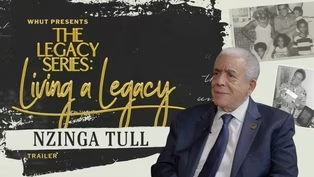
Preview: S2 Ep2 | 30s | A family legacy of engineering with Nzinga Tull and her father Knox W. Tull (30s)
Providing Support for PBS.org
Learn Moreabout PBS online sponsorship













Support for PBS provided by:
The Legacy Series: Living A Legacy is a local public television program presented by WHUT