State of Affairs with Steve Adubato
Jacqueline Meiluta; Joe Bertolino, Ed.D.; Greg Lalevee
Season 9 Episode 26 | 26m 46sVideo has Closed Captions
Jacqueline Meiluta; Joe Bertolino, Ed.D.; Greg Lalevee
Jacqueline Meiluta, Executive Director of Volunteers in Medicine of Cape May County, discusses how the organization delivers free healthcare to uninsured residents. Dr. Joe Bertolino, President of Stockton University, discusses the value of expanding access to higher education. Greg Lalevee, Business Manager & General Vice President of IUOE Local 825, about NJ’s energy policy.
Problems playing video? | Closed Captioning Feedback
Problems playing video? | Closed Captioning Feedback
State of Affairs with Steve Adubato is a local public television program presented by NJ PBS
State of Affairs with Steve Adubato
Jacqueline Meiluta; Joe Bertolino, Ed.D.; Greg Lalevee
Season 9 Episode 26 | 26m 46sVideo has Closed Captions
Jacqueline Meiluta, Executive Director of Volunteers in Medicine of Cape May County, discusses how the organization delivers free healthcare to uninsured residents. Dr. Joe Bertolino, President of Stockton University, discusses the value of expanding access to higher education. Greg Lalevee, Business Manager & General Vice President of IUOE Local 825, about NJ’s energy policy.
Problems playing video? | Closed Captioning Feedback
How to Watch State of Affairs with Steve Adubato
State of Affairs with Steve Adubato is available to stream on pbs.org and the free PBS App, available on iPhone, Apple TV, Android TV, Android smartphones, Amazon Fire TV, Amazon Fire Tablet, Roku, Samsung Smart TV, and Vizio.
Providing Support for PBS.org
Learn Moreabout PBS online sponsorship- [Narrator] Funding for this edition of State of Affairs with Steve Adubato has been provided by Horizon Blue Cross Blue Shield of New Jersey.
Congress Hall.
A Cape Resorts property.
Atlantic Health System.
Robert Wood Johnson Foundation.
Working to create a future where health is no longer a privilege, but a right.
Community FoodBank of New Jersey.
The New Jersey Education Association.
NJ Best, New Jersey’s five-two-nine college savings plan.
The Fidelco Group.
And by New Jersey Manufacturing Extension Program.
Promotional support provided by NJBIZ.
Providing business news for New Jersey for more than 30 years, online, in print, and in person.
And by Meadowlands Media.
A print and digital business news network.
[INSPRATIONAL MUSIC] - Hi, everyone, Steve Adubato.
We kick off the program.
For the first time, she's joining us.
It won't be the last time.
She's Jacqueline Meiluta and she's the executive director of an organization called Volunteers in Medicine of Cape May County.
Good to see you, Jacqueline.
- Thank you.
Thank you for having me.
- Yeah, describe the organization.
- So Volunteers in Medicine is a free clinic for the uninsured.
We're staffed largely by credentialed volunteers.
So all of our doctors, our nurses, our administrative people are all volunteers.
They freely give of their time to take care of their neighbors in need.
- Who's in need in Cape May County?
Describe the folks who are most vulnerable.
- Yeah, so Cape May County has beautiful coastline, fabulous second homes, but not a lot of year-round work.
So most of the jobs down here are tourist-based and seasonal.
So our patients work crazy hours during the summer and either not at all or just weekends during the winter.
So our economy is certainly the haves and the have-nots here in Cape May County, particularly in the winter.
- Let's talk about some of the healthcare changes in our country.
There are changes in federal policy as it relates to Medicaid eligibility.
From a very practical, relatable perspective, help us understand what that means for the people you serve every day in Cape May County.
- So our patients are the working poor.
They don't have insurance.
10 years ago before the Affordable Care Act, we had a different patient base, but all of those patients will probably lose their Medicaid or their tax incentives through the Affordable Care Act.
- Why?
- So come January, thank you to the Big Beautiful Bill, there's gonna be a lot of people in New Jersey that will be either uninsured... (throat clears) excuse me, or underinsured, and they will rely on safety nets like Volunteers in Medicine for care.
- Do you have the resources to serve those folks with their healthcare needs?
- So we have a patient panel currently of about 600 families.
All of our doctors are volunteers and they're pretty much at full capacity.
We're worried.
Many of our doctors will step up and see a few more patients, but we will always need more doctors, more nurses, and then of course, unfortunately more money.
Yeah.
- Well, talk about money.
We are a not-for-profit 501(c)(3) organization that does not seek government grants, that we don't have a line item appropriation in the state budget.
And my understanding is your support is purely philanthropic as well, correct?
- 100% philanthropic.
No state or federal money.
We do get a grant from the County of Cape May.
We have a lovely grant from Horizon Foundation and from the Community Health Connections Foundation, but there's not many large businesses in Cape May County.
In fact, there's no large businesses in Cape May County.
So it's all grassroots individuals.
We operate two thrift stores to provide a reliable source of income, but it's a constant struggle to raise the funds we need to keep the doors open.
- Jacqueline, I know how I got into this business.
How'd you get into yours?
- I don't know.
(laughs) - Come on.
No, seriously, how- - Yeah, no, I'm- - There must be some passion- - This is sort of my retirement gig.
- What?
(Jacqueline laughs) - I just wanted to use my skills that I had acquired in working for big business.
I worked for a Fortune 100 company.
My husband and I wanted to retire to the beach town that I grew up in and I saw a need.
And VIM is the best job I ever had.
So... - So this is your retirement and you are looking to bring in more money to manage a budget.
Go back to the budget again.
And lemme disclose, you mentioned Horizon.
The foundation has been a big supporter of public broadcasting as well.
That Horizon grant, as I understand it, is it a new obesity program that it supports?
- It is.
So the fabulous new drugs, the Ozempics and Wegovies, are way too expensive if you don't have insurance.
So probably even if you have insurance.
Our patients will never have access to those drugs.
But lifestyle, although it's so much harder than taking a pill, can show promise.
So we're doing a lot of classes.
We're doing a lot of education, a lot of coaching, anything we can do to help our patients understand the relationship between behavior choices and their chronic disease, whether it's obesity, but also diabetes, hypertension, - That's what that program is.
- Yes.
- Go on the website, folks.
It'll be up right now.
Find a way to be helpful.
The information's on the website for an organization down in Cape May.
It is called Volunteers in Medicine of Cape May.
Jacqueline, I wanna thank you so much for joining us.
We appreciate it.
- Thank you for all you do for New Jersey to bring light to issues like this.
Thank you.
- Our job is easy, your job is really hard.
Stay with us, we'll be right back.
(grand music) - [Announcer] To see more State of Affairs with Steve Adubato programs, find us online and follow us on social media.
- We are joined once again by the President of Stockton University, Dr.
Joe Bertolino.
Good to see you, Dr.
Joe.
- Good to see you, Steve.
Thank you.
- Just let everybody know that I'm not just calling you President Joe.
That's what you're called on campus.
- That's what I'm called on campus.
Hopefully it's affectionately known as Dr.
Joe, President Joe, yes.
- Yeah, well, by the way, Stockton University, one of our newest higher ed partners, to fully disclose.
Joe, let me ask you this.
- Yeah.
- What would you say as we enter 2026, the most pressing, I know there's so many issues, you and your colleagues, as university and college presidents deal with, the top couple issues you are dealing with right now?
- Well, I think at the top of the list for a place like Stockton is always the issue of access.
Are we making the proper investments to ensure that students have an opportunity to secure an education and formulate a positive career, a positive life?
I mean, as you know, in this state, about 50% of our students who graduate from high school actually leave the state.
And so within this state, I think it's pretty important to ensure that we are keeping our students here in this state at this time, more so than at any other time.
I think that's pretty incredible in terms of what we need to be seeing happen.
- Where does campus safety fit in that conversation?
- I (indistinct).
- In terms of a challenge that you and your colleagues have?
- Yeah, as you know, this has been particularly challenging last week or so, and quite frankly, it's been a challenging year with everything that's happening on college campuses.
But safety is always our top priority.
The safety and security of our entire community.
Not just our students, but our faculty, our staff, and those that we serve.
We have, I think at Stockton, and at many campuses, we have a police department.
We have strong emergency services and systems.
We have resources for the wellbeing of our students.
But at the end of the day, Steve, I think the most important thing is that we are creating environments that allow for civil discourse, that allow for individuals to agree to disagree, and to listen and learn from one another in hearing and sharing different perspectives.
And for us at Stockton, the core to that is what we call an ethic of care.
And that is that everyone in our community, regardless of who you are, what you believe, needs to be treated with dignity, respect, kindness, compassion, and civility.
That's the core.
That's where we start with everything that we do.
- Stay on that.
- Yeah.
- In this, I can't even imagine how hard it to be successful and protect students and faculty members and others and people who come onto the campus.
But the other side of this, which I often struggle with is, the definition of academic freedom and free speech.
Is it this, Joe?
Is it a constant balancing act?
Or is it- - It's a constant balance.
- I think that academic freedom and free speech is a core value within our democracy.
And as a result of that, I think it's critical that if it is important, and if it is something you fight for and stand by, then that means that you support not just your right to academic freedom and free speech, but those with whom you disagree.
And so, as an educator, I think it's my responsibility to educate students on how to listen and learn from people that you disagree with, and how to shape your argument and your debate so that you can engage in civil discourse.
- Yeah, let's shift gears dramatically.
- Yeah.
- Artificial intelligence and higher education.
Go ahead, President Joe, you're on.
(Joe and Steve laugh) - Oh, well, thanks so much.
- There's not even a question, I'm just trying to make sense of it.
- Well, first, I think it's important for us to remember that all of our students are already engaged in using artificial intelligence.
In fact, we all are, more often than not, we just don't realize we're doing it.
And so, assuming that artificial intelligence is already a given, like any technology that has come before us, the technology is going to continue to grow and expand.
It's our responsibility to learn how to work with artificial intelligence, and use it to ensure that we're creating a better community, a better society.
Look, artificial intelligence at the end of the day is still artificial.
And you want to meld the technology with humanity.
And so from my perspective, the artificial intelligence technology is there as a tool, and we as educators have a responsibility to focus on the human part.
- Doctor, you have a strategic plan - Explain to folks why it's even called a strategic plan and these key themes and priorities, many of which we've already talked about.
- Yeah, look, often folks find that strategic plans tend to become very thick documents that collected dust over the course of time and become door stoppers.
From my perspective, a strategic plan is a living document that ebbs and flows with the changing demographics, the changing seasons, if you will, of any institution and of the world around it.
And so, for Stockton in particular, we spent the last year creating a new strategic plan, focused on including about a thousand different individuals in the development of that plan.
And at the end of the day, the goal of the plan is to ensure that we are retaining students, that we're graduating students, that we're preparing them for not just good careers, but a good life.
What most people don't realize, Steve, and I think this is important, most college-educated individuals in this country are actually educated at public, regional universities like Stockton.
Not just the big names, but those institutions that are in your backyard, which from my perspective, means we have an awesome responsibility to prepare both the employers and the employees, and the educators, and good citizens of the future.
- Before I let you go, Dr.
Bertolino, for those who question, "Hey, the four year degree in a college isn't what it used to be."
And you know, "I'm not sure the value of a four year degree."
Got a minute, go.
- Yeah, tell that to the 2,500 students that graduated at Stockton University last year, 55% of the incoming class this year are first generation college students.
And so I can assure you that as an institution that's top 50 in the country for first generation college students, we're making a difference.
And it will change the course and the trajectory of the lives of those students and their families.
So as I shared with you at the top of this interview, from my perspective, the most important issue facing higher ed is access, access and affordability.
And we're providing that at Stockton.
- Dr.
Joe Bertolino is the president of Stockton University, one of our new higher ed partners.
And Dr.
Joe, I cannot thank you enough, you and your team, for joining with us and wish you all the best down in South Jersey moving forward.
- Thank you so much, Steve.
Appreciate the time.
- That's Dr.
Joe, I'm Steve Adubato.
Stay with us, we'll be right back.
(grand music) - [Announcer] To see more State of Affairs with Steve Adubato programs, find us online and follow us on social media.
- Once again, he's back.
He's Greg Lalevee.
He's a business manager and General Vice President, International Union of Operating Engineers Local 825.
Good to see you, Greg.
- Good to be back, Steve, good to see you.
- You got it.
Let me disclose, longtime underwriter of our State of Affairs programming.
And I also have done some leadership coaching at Local 825.
Is that a fact, Greg?
- It is a fact, and we have a lot of fun having you here doing it.
- Yeah, I'm surprised you would admit that in public.
(both chuckle) Hey, let's talk leadership about energy policy.
Why do I get that look from you, right?
Why do you roll your eyes when I'm talking about energy policy?
There's going to be a new governor.
I just interviewed the two candidates for governor.
This is not a campaign program, but there will be a new governor in January of '26.
What should he or she be focused on regarding energy policy in the state, and how the heck does it impact your local?
- Well, the main focus should be to get as much electricity on the grid as fast as possible, irrespective of source.
We are at a severe crisis in our state when it comes to energy.
We demand about 19 gigawatts.
- Greg, translate that.
Gigawatts means?
- Well, it's a large demand, so.
- Okay.
- And we make 13.
So the bottom line is, we're about a third behind in our usage of what we make.
So we have to buy about a third of it off the grid.
And when you do that, your bill goes up 30%.
- How'd that happen?
- Well, it was failed policy.
We shut down several plants in this state.
The decisions to make those are all over the lot, but we shut down several coal-burning plants, we shut down the Oyster Creek nuclear plant, and we replaced it with nothing.
On January 1, 2018, New Jersey was a net exporter of electricity, and today we're a net importer to the tune of 6 gigawatts a year, which is significant.
- How does that impact utility rates in the state?
- Well, we have to go out to the grid and buy the shortage.
So it costs us money to do that.
For those in making public policy and in the public domain, I've seen several people call for us to get off of the PJM grid and make New Jersey.
- Explain to folks who, I'm sorry, Greg, a lot of acronyms.
PJM is what?
- PJM is the regional grid operator.
What what they do is across a number of states, their only job is to make sure that there is enough electricity everywhere through the area they service.
They don't make electricity, they don't run power plants, they just manage the electric through that grid.
So, electric, not to get too deep in the weeds, it's 60 hertz when it hits our house.
That's what we need to turn the lights on.
They make sure we all have it.
When New Jersey is short, they get it from somebody else who has excess.
If somebody else is short, they move electric there.
It's just one big conglomerate of sharing the resource so that we all keep our lights on all the time.
There has been calls for New Jersey to have its own grid, and the two examples for New Jersey to leave PJM and the two examples that I can think of are New York, which is on its own, whose prices have spiked higher than ours, and Texas.
And we remember a couple of years ago, citizens of Texas getting $3,000 electric bills for one month.
So, not a good solution.
- Speaking of solutions, there was a study done, Greg, and we may be talking about this before it becomes public, but by the time this airs, it will be public, right, Greg?
- Yes.
- So this was a study commissioned by your organization?
- Yes, it was.
- And Professor Matt Hale from Seton Hall University conducted the study.
- True.
Yes.
- And looked at, I'm not deposing you, Greg, I'm just trying to clarify.
(both chuckle) So, as I read an executive summary of this, there was an examination of New Jersey energy policy, but also comparing it to two other states, Pennsylvania and New York, correct?
- Yes.
Yeah, the three states.
- What were the most significant findings in that study?
- The most significant is that Pennsylvania shut down more plants, coal plants, than New Jersey did, but Pennsylvania still produces more electricity than it consumes.
So Pennsylvania is a net exporter to the grid.
New Jersey, again, a net importer.
New York, which stands on its own, had significantly higher price increases than New Jersey did.
- So, hold on, I want to be clear.
Are we saying that the governors of both states, all three are Democrats, by the way, in all three states.
Are the energy policies of those governors, as we speak right now, significantly different?
- Well, there's one major difference.
New Jersey, essentially, put everything on the line for offshore wind.
Pennsylvania does not have a coastline to deal with offshore wind, so Pennsylvania stayed into more traditional gas fuels because there is natural gas coming out of the Marcellus area in Pennsylvania.
They also built renewables.
There are onshore wind farms in Pennsylvania, not large but they're there.
There is solar fields in Pennsylvania.
But again, the dominant energy sources there have been coal and gas.
- And by the way, one of the quotes here in the executive summary from Professor Hale, New Jersey bet the farm on wind... and lost.
That being said, for those, including you, me, so many others, concerned about the climate, climate change.
What did the current administration do in New Jersey that does anything other than try to reduce the dangers of climate change?
- Well, it's a laudable goal, but some of the facts are just being completely ignored.
There was a large effort years ago to switch from coal to natural gas to improve the environment because gas was cleaner.
- Right.
- It burns cleaner, and the environment has significantly improved over that time.
During the Obama administration, there were regulations signed to switch out all of the gas pipes that are in the ground.
We have aging infrastructure here in New Jersey, we have cast iron pipes that are leaking, and there was an effort, and a still ongoing effort, because they're old and leaking to switch those to polypropylene and not leaking and seal the leaks up.
Since that time, carbon emissions have improved 38%.
We are moving in the right direction, we are making progress using natural gas.
The thought here was, we were shutting down plants while we hadn't even built the offshore wind yet.
If you build one, then turn off the other, then there's a discussion to be had.
When you shut down energy-producing plants and don't have them replaced yet, you end up where we are.
- A minute left.
These things were communicated to Governor Murphy from you and others who see it this way?
They were communicated clearly?
- We have been on a campaign for years, ringing the alarm bell about the energy crisis in this state.
- Before energy, before utility rates skyrocketed?
- Absolutely.
And I think one of the misses here.
Now, to be clear, Governor Murphy didn't make the call to shut down the energy plants, those who operated them did.
- Okay.
- That being said, though, when PSE&G shut down their last couple of coal plants, the quotes in there said that they were getting very expensive to operate.
That's true.
Many of the environmentalists will cite those quotes, what they won't do is finish the quote, which at the time said, because of cheap natural gas that was being harvested in the Marcellus region.
- Hey, Greg, let's do this.
This is when our time limits are always an issue.
Let's not only continue to talk about energy, but I want to talk more about, next time you join us, about infrastructure, and also, which this is partly about infrastructure, but also about safety and training and a whole range of other things.
Greg wrote an op-ed piece around some of those and other issues.
We'll talk about that next time.
Hey, Greg, thank you.
- Thanks, Steve, I appreciate it.
- Energy policy is complicated, that's the part I've taken away so far.
Thank you, Greg Lalevee.
We'll keep talking energy policy.
There'll be a new governor in 2026, and we'll engage he or she in this discussion.
See you next time.
- [Narrator] State of Affairs with Steve Adubato is a production of the Caucus Educational Corporation.
Funding has been provided by Horizon Blue Cross Blue Shield of New Jersey.
Congress Hall.
A Cape Resorts property.
Atlantic Health System.
Robert Wood Johnson Foundation.
Community FoodBank of New Jersey.
The New Jersey Education Association.
NJ Best, New Jersey’s five-two-nine college savings plan.
The Fidelco Group.
And by New Jersey Manufacturing Extension Program.
Promotional support provided by NJBIZ.
And by Meadowlands Media.
- (Narrator) This holiday season, the Community Food Bank of New Jersey the state's largest anti-hunger, anti-poverty organization, together with the hundreds of food pantries, soup kitchens and nutrition programs it serves is calling on all of us to unite.
Unite to end hunger.
Together we can make the holidays brighter for our New Jersey neighbors in need and help build a food secure future for our state.
New Jersey, now is the time.
Unite to end hunger.
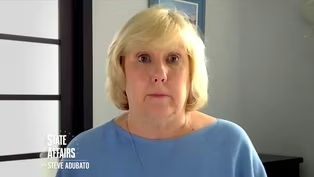
Giving healthcare to uninsured residents in Cape May County
Video has Closed Captions
Clip: S9 Ep26 | 7m 4s | Giving healthcare to uninsured residents in Cape May County (7m 4s)
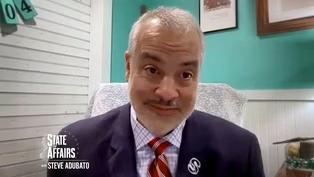
President of Stockton University addresses academic freedoms
Video has Closed Captions
Clip: S9 Ep26 | 9m 31s | President of Stockton University addresses academic freedoms (9m 31s)
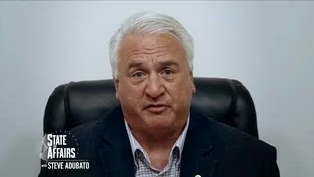
VP of IUOE Local 825 talks New Jersey's energy crisis
Video has Closed Captions
Clip: S9 Ep26 | 10m 58s | VP of IUOE Local 825 talks New Jersey's energy crisis (10m 58s)
Providing Support for PBS.org
Learn Moreabout PBS online sponsorship
- News and Public Affairs

Top journalists deliver compelling original analysis of the hour's headlines.

- News and Public Affairs

FRONTLINE is investigative journalism that questions, explains and changes our world.












Support for PBS provided by:
State of Affairs with Steve Adubato is a local public television program presented by NJ PBS