Yan Can Cook
Jacques Pépin Visits Martin Yan
6/1/1986 | 24m 41sVideo has Closed Captions
Jacques Pepin and Martin Yan meet up in Hong Kong for a friendly cooking challenge.
Jacques Pepin and Martin Yan, friends and legendary public television chefs, meet up in Hong Kong for a friendly cooking challenge. The two chefs buy the same ingredients at the open air market, but each uses them to prepare a flavorful dish in their own unique style. What do you think? Which dish would you rather eat?
Problems playing video? | Closed Captioning Feedback
Problems playing video? | Closed Captioning Feedback
Yan Can Cook is a local public television program presented by KQED
Yan Can Cook
Jacques Pépin Visits Martin Yan
6/1/1986 | 24m 41sVideo has Closed Captions
Jacques Pepin and Martin Yan, friends and legendary public television chefs, meet up in Hong Kong for a friendly cooking challenge. The two chefs buy the same ingredients at the open air market, but each uses them to prepare a flavorful dish in their own unique style. What do you think? Which dish would you rather eat?
Problems playing video? | Closed Captioning Feedback
How to Watch Yan Can Cook
Yan Can Cook is available to stream on pbs.org and the free PBS App, available on iPhone, Apple TV, Android TV, Android smartphones, Amazon Fire TV, Amazon Fire Tablet, Roku, Samsung Smart TV, and Vizio.
Providing Support for PBS.org
Learn Moreabout PBS online sponsorship(Joyful music) (audience clapping) - It seems like the world smaller every day and cooking is becoming a big melting pot.
I love to combine the food of East Asia and the West to create something new and exciting.
Like this Italian ravioli with a Chinese accent.
It's very easy to do.
First, you'll either make your own ravioli dough or you make your dough by just buying in the supermarket.
And this is a round pot sticker dough, nice and thick.
And this is the regular wonton dough.
And you can buy them, you can freeze them.
So it's no problem at all.
I wanna show you how easy.
After you have all of these, you cover up, lay them out and cover up with wet towel, moist towel, like this to keep it from drying up.
In the meantime I'm gonna show you how and what kind of filling I have for this ravioli.
Egg plant ravioli.
First, you got to roast the eggplant, okay?
The whole egg plan in the oven.
It takes about hour and a half to roast this eggplant.
And you roast some garlic, which takes about hour and 15 minutes.
And you also roast some onion.
And then we mixed them all together with the ground pork and chili sauce and green and you cook them.
And after you cook them you cool down a little bit and then you put in a blender or food processor, puree it and you have something like this.
Okay?
Of course, if you have time, you can also roast the red bell pepper.
Look at this.
You can roast red bell pepper and .. Red bell pepper takes about only 45 minutes to roast.
It's nice and wonderful.
After this is done, let it cool down.
I'm gonna show you how easy it is to make this ravioli Chinese style.
Get some water ready here.
And you'll use half of it.
You put a tiny bit of water.
And then you use a little spoon, put it right in here.
And then all you have to do is just folded in and you'll have a very simple ravioli.
You don't even have to make your dough very, very simple.
This is one.
Now, I will show you another one that you can make the Chinese style.
You put this filling with pork and egg plant and garlic and onion and chili sauce.
And you'll use this just like your full paste sticker.
Look at that.
I hold on to it and put my hand and I started out one snap it.
Start from the end and I pleat it like this.
One, put another one, pleat, squeeze, pleat, snap, pleat, snap, pleat, snap.
You got to say it.
Otherwise it never work.
Pleat, snap, pleat, snap.
Look at that.
You have a beautiful pot sticker th.. See, after all this is done, you're gonna put this in a big pot of boiling water.
You are going to bring it to a boil until they are nice and cooked.
Because it doesn't take too long because the filling is already cook.
So when this is done, we'll take this out.
I'm gonna show everybody, this is beautiful.
And then you make a simple sauce.
Make a simple sauce and serve with this.
The sauce have roasted egg plant and also onion.
You put it right in the bottom right here.
Very, very good.
And then a tiny bit of soy sauce and also Sesame salt.
And when this is done, you take out this.
Look at this.
This ravioli had been boiling for a while and we take it out and we just slide this out and you put it right here.
Look at this.
And it's so easy when you serve, you have a kind of extra sauce and is so beautiful.
My ravioli with pork and egg plant.
(audience clapping) East West chef have discovered Asian secret of using fresh fruits in all kinds of dishes like this stir fry make with fresh, delicious, colorful cantaloupe and shrimp.
Now all I have here is some shrimp, look at this.
I have some shrimp here and I wanna show you quickly how to shell it, very easy.
If you wanna keep the tail, you start from here.
And then all you have to do is peel it, peel it, hold onto the leg.
And just pull the whole thing out and you have a whole piece like this.
Now don't throw the shrimp shell away because in Asian cuisines, they use this to saute, to get the flavor out.
And then you butterfly this like that.
This way, you can remove the vein but this one have no vein.
So you don't have to worry about that.
Let's check this one.
If you don't care about this, you start from here.
It's easier.
Look at that.
All you have to do snap this and you go one and two and the whole thing comes out like this.
And then once again, you'll butterfly this and then you see this one, I have a little vein right here.
Can you see this?
You got to remove it.
You got to remove it.
Very easy to do.
Now, when this is done, you're gonna marinate this.
We're gonna use this chopstick, put all the shrimp right here.
And then we're gonna marinate it with a tiny bit of salt, a tiny bit of white pepper and a tiny bit of corn starch and a tiny bit of plum wine.
Look at that.
You can use dry sherry, put a tiny bit.
Let them marinate for approximately 15 minutes to half an hour up to overnight.
Depends on how much time you have.
Set it aside and then you get ready the next wonderful ingredient.
I'm gonna use a dark cantaloupe.
Now, first of all, how can you tell if the cantaloupe is nice and ripe?
Very, very easy.
You shake them.
If it rattles, that means it might be a little bit too ripe.
And also when you look at a cantaloupe, you got to look at this.
You should have, choose one with a golden netting li..
Very golden color and a creamy yellow color, but no dents, no bruises.
Now, when you want to use it, you cut it in half.
Just remove the seeds.
This is just right.
It's not too ripe.
It's just right.
And then you can scoop this out.
Get about melon baller, melon baller.
Very easy to do.
And how many do you have?
How many do you need?
I have no idea.
If you love fresh fruit, use more.
If you are not used to it, use even more because you want to enjoy it.
Because you will appreciate this.
You just keep on doing it until you get tired and then you stop and then you already to stir fry.
Now I wanna show you how easy it is.
First, you use a tiny bit oil, make sure the walk is hot.
Not much oil.
You see?
A lot of people don't realize how easy it is to do.
Put a tiny bit off prawn.
How can you tell when it's cooked?
When the prawn is cooked, they immediately turn pink.
And it doesn't take too long to cook.
Put a tiny bit of salt, tiny bit of sugar and a tiny bit of lemon juice.
Wow.
Look at this.
And a tiny bit of broth to make sure you've got nice.
Wow.
Look at this.
Do not overcook.
Now, and then you put the cantaloupe there.
A lot of time, people don't realize, chef in Hong Kong in many types of ways, start using a lot of wonderful, fresh fruit.
You know why?
A lot of people take it for grante..
They don't realize a lot of the ingredient has a lot of nutrients.
For instance, a lot of people probably don't realize cantaloupe is very nutritious.
Got a lot of vitamin A and C. For six and serving, all you have is about 50 calories.
A lot of calcium, iron and powerful phosphorus and other minerals.
It adds color, texture and flavor to our dish.
You can use it.
Now when it's almost ready, all you have to do is put some extra, oh, look at this.
Extra plum wine.
We got plum wine.
And then to add some extra flavor, some lemon zest.
And that's all you have to do.
When it's done, you're gonna serve this in this beautiful platter.
And I wanna show you, you can thicken, quickly thicken this with a tiny bit of corn starch solution.
Yes, and the whole thing is done.
And I want to show you how beautiful.
That's why I love cantaloupe.
This is actually, the best cantaloupe in the world is grown or called the West side cantaloupe.
This is from the Western side of the San Jouaqin Valley, right here.
And then you garnish it with some extra lemon zest and our beautiful, beautiful mint leaf.
You have a beautiful cantaloupe with prawn.
(audience clapping) Now get ready for a special treat.
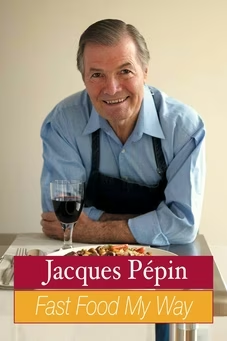
I'm sure all of you know, my good friend Jacques Pepin.
His almost as much a globe Trotter as I am.
Not long ago, Yen met Pepin in Hong Kong.
We took over the kitchen at Metropole hotel and whipped up an east-west feast.
Join us now for Yen meets Pepin.
(traditional Chinese music) I went to the open air market with my good friend, master chef Jacques Pepin, who presented me with an East meets West challenge.
He says, "Let's buy the same ingredients, but let's cook differently in our own style."
We look around for fresh water chestnut.
Then we found some leafy, green vegetable like this great looking spinach.
Done here, now onto the fish market.
They carry all kinds of fresh and saltwater fish here.
I'm getting a striped bass for me and one for Jacques and maybe two for Jacques, because I am gonna sample his great creation later.
(busy market) Have you ever seen a scale this accurate before?
They clean and filet your fish, while you wait.
This is gonna save us a lot of time later on.
Down comes this cash register.
I told the lady she should get one with a ringer.
We just came back from the wonderful open-air market.
- What a market.
Terrific.
Only French ingredient however.
You can only get them in Hong Kong though.
- Yeah, that's amazing.
We've got a whole bunch of nice, wonderful fish filets.
And we also have a Lotus root, yellow chive, fresh water chestnut and of course, fresh, straw mushroom and some spinach.
- You know, I never saw fresh straws mushroom before.
- Only available in Hong Kong.
And I think Jacques and myself is gonna do, each one of us is gonna do one dish.
And I'm gonna let Jacques to do the dish first.
- Oh, okay.
- And I'm gonna get ready.
- Thank you Martin.
So what I'm going to do, as you see those tiny little filler here, which are really nice and fresh are similar to the red snapper that we have.
You could have black bass, red snapper and what I did with that, taking some of the beautiful spinach and that enormous carrot.
I use a vegetable peeler to a strip off the carrot this way.
And I'm going to blanch a strip of the carrot, that is dropped that in boiling water, which is what I have done here.
So this is already soft.
And what I'm going to do, is to use those spinach and wrap that spinach just like this to give beautiful color and taste to the feel of fish.
And I have two which are already on right here.
What we are going to do now, is to cut a little bit of shallots here.
To put in the bottom of the pan, approximately two teaspoon of shallots that we are going to sprinkle here in the pan.
Then I put about one teaspoon of butter.
Just a little touch of butter here so that I can place my two filet on top.
Sprinkle that with a little dash of salt and pepper and now approximately four tablespoons of wine that we're going to put around to give it some taste.
Then we put that on the stove.
I'm gonna cover it with that to cook and this is going to cook for maybe two, two and a half minutes, maybe one minute to come to a boil.
And by the time it comes to a boil, one minute it should be about ready.
So next what we are going to serve with it.
We're going to do a salad and this beautiful, young lettuce that we had at the market there.
I have again, some of the spinach.
I still have some of the carrot.
I have those water chestnuts.
And as you can see here, those are really nice and firm.
I rarely see water chestnuts.
How nice are those?
Actually, you know what I have also here, I have that beautiful shiitake mushroom, which I'm going to slice and a little bit of those straw mushroom that I had never seen before.
When you cut them up and you can see the shape of the mushroom within the volver itself.
And that's very interesting.
And I'm going to actually put some of that with my fish.
I meant to do that.
A bit of two type of mushroom right around here.
It's boiling now, as you can see and that's really going to be cooked within no time at all.
Actually, I'm going to remove it now and put it on t..
This is not on and continue on with the salad.
I have the water chestnut here.
Very crunchy, beautiful, white.
You want different texture.
You want different taste in the salad.
And I think I'm going to do a dressing with all Chinese ingredient.
I do that at home occasionally.
I love to use Chinese ingredient.
And in New York, we have great Chinese food.
San Francisco also.
So now I have a little bit of chive here.
Then, in there, I'm gonna put a little bit of chili sauce, hot sauce, a little bit of soy and oil.
As well a bit of vinegar, a type of French dressing with a different accent.
This way.
We stir it together, my water ches..
The beautiful chives and some the salad that I can toss here.
I would wanna put that and toss it at the last moment.
And maybe a little piece of carrot here and there on top for color before I finish tossing it.
So before we serve it, this is ready to be served.
I'm going to finish the fish now.
I also have a beautiful yellow chive.
Now this is not boiling anymore but I know it's cooked enough.
So what I will do here is to arrange those directly on my serving plate which I have right here.
I like to serve white plate like this.
I like the contrast of the white and all that.
A couple of those mushroom around.
I would rather put the mushroom around so that I can keep the color on top so that I can see the beautiful red of the carrot, as you see here.
I have a bit of the juice of the fish here which is the white wine as well as the juice of the fish.
And this is what we are going to do to sauce with.
Here it is, the rest goes there.
And I have here about two or three table spoons of the juice and into this I'm going to put about the value of a good tablespoon of butter, which we're going to mix it up.
It's good.
I can mix it in there to create a natural sauce.
The bit of liquid that I have here with the butter will create an immersion.
And that's ready to be put on top.
And with this, we'll be putting again a few of those beautiful chive.
Here I have here, about one, two tablespoons of the sauce, fair portion.
Some of the chive around and those chives are really smelling good.
Those are garlic chives so called.
That I can keep warm.
I have my second portion here.
We can serve at least for two.
Be sure to clean up your plate.
Again, as you can see I have a nice, delicate, light butter sauce here.
Maybe a bit the yellow chive in this one to be different.
The yellow chive are milder.
Actually I get those also at the market in New York.
Here we are here.
Although the chive green one have more color and my two fish are ready.
Now I could toss my salad.
And you don't wanna toss your salad just before you're serving otherwise of course, the salad is going to get all wilted.
In that case here, I could put even some of the raw mushroom in it.
But I think the contrast of the acidity, in my sauce and the hotness that I have mentioned that in French cooking, I would have used maybe a different type of oil.
I would have used salt.
I didn't put salt here because I put soy and I would have put a lot of ground pepper.
I didn't use any here because I put the hot chili paste.
So we have a mixture of both.
So here it is now by Salad and if we add a little bit of those Chinese noodle or Chinese rice, I could serve that with it.
It would be very good too.
And this is my dish.
You see, took a couple of minutes to do and now let's see what Martin is going to do with his food.
- Jacques just finished quite delicious, wonderful looking dish.
What do you call that?
- Well, it's in the celebration of the Hong Kong new years.
So I have a little bit left over filet.
So you're going to do a dish with it, right?
- Actually I want us to us to use exactly the same ingredient, similar as ingredient and similar seasoning to do a dish, my version, my style.
Then we're gonna sit down and eat, okay?
- Great, perfect.
- Here, I'm gonna have left over f.. What I do is I put them all together like this with a couple pieces of asparagus or spinach and then I sprinkle a tiny bit off black beans.
This is salted black beans.
I rinse it in water a little bit and put a tiny bit of a salt.
This is exactly what Jacques does.
Tiny bit of salt, tiny bit of pepper.
And a tiny of a Julienne ginger, Julienne ginger and also a little shiitaki mushrooms, put it right here and some green onion.
If you wanna make it hot and spicy all you have to do is put a tiny bit of red chili pepper.
And then garnish it with tiny bit more shiitaki mushroom and then we're gonna steam it.
We're gonna steam fish, fresh fish, Hong Kong fresh fish with black beans.
And I wanna just put it right over here in this is the little bamboo steamer.
Wow.
It's nice and hot.
Put it right here, while I'm steaming this, you know what I can do?
I can use the ingredient, all the vegetables that we just bought, the big gigantic carrot and all that nice lotus root and some bell pepper and we'll pull it together and do a quick stir fry dish.
Here, I have a tiny, tiny bit of oil.
I'll put it right over here.
And then I'm gonna stir fry and use this to serve my steamed fish with black beans.
All the ingredients are already cut up and just put it right over here.
Wow, look at that, sounds great.
While I am steaming this, you remember when Jacques was doing, he was poaching them with wine?
And he'd make a salad.
Take the time to make the salad.
I used the same time.
I'm gonna stir fry my vegetables.
Very good.
All I have to do is put a tiny, tiny little soy sauce.
Tiny bit of soy sauce and a tiny, tiny bit of pepper and a tiny, tiny bit of Sesame seed oil.
That's all I have to do.
Then the whole thing is done.
Very easy to do.
When it's done, I'm gonna serve it right here in this beautiful plate.
And the whole thing is done.
Look at that, beautiful straw mushroom, Lotus root and carrot, gigantic carrot.
Beautiful dish to serve with my steam fish with black beans.
In the meantime, I wanna show you.
This is beautiful.
It's almost done.
Wow.
Look at that.
This whole thing is done.
Hopefully, we can take this out and put it right here.
I don't wanna burn myself because I'm gonna sit down at dinner with Jacques.
Look at this.
We're gonna transfer this with a li.. Just hold on to this.
Look at that.
This is beautiful.
Just slide the whole thing right here.
This is how they do it in China.
All they have to do is put a tiny bit of hot oil.
Make sure I don't burn myself.
Tiny bit of hot oil.
Wow.
Can you hear the sizzling sound?
Put on top the soy sauce.
Look at that.
This is a traditional dish.
Put a tiny, tiny bit off shredded green onion on top.
And then if want, you put a tiny bit of parsley and this is a beautiful dish in less than two or three minutes.
We use the six or seven of the same French ingredient only available in Hong Kong to do a dish, a steam fish, black beans and shiitaki mushroom and still have time to saute our stir fry vegetable dish.
And we will served this over there with Jacques.
Now we're gonna celebrate the culinary triumph of East meets West.
- Yes, I am eating your food, you're eating mine.
This is what friendship is all about.
- Right?
- With a bit of wine in France.
- Actually we have been working so hard, I don't even have time to take my apron off.
Ganbei.
(glasses clinking) - Chin chin.
- If Yan - And Jacques - Can, so can you.
“Goodbye!” (##!)
- À bientôt.
- And see you in Hong Kong.










Support for PBS provided by:
Yan Can Cook is a local public television program presented by KQED