One-on-One
James Horne; Kim Guadagno; Dylan Zajac
Season 2024 Episode 2740 | 27m 22sVideo has Closed Captions
James Horne; Kim Guadagno; Dylan Zajac
James Horne, President and CEO of Junior Achievement of New Jersey, explores how Junior Achievement prepares K-12 students for success. Kim Guadagno, Executive Director, Mercy Center, and Former Lt. Governor of NJ, talks about how Mercy Center supports vulnerable families and children. Dylan Zajac, Founder of Computer 4 People, talks about bridging the gap in computer access and media literacy.
Problems playing video? | Closed Captioning Feedback
Problems playing video? | Closed Captioning Feedback
One-on-One is a local public television program presented by NJ PBS
One-on-One
James Horne; Kim Guadagno; Dylan Zajac
Season 2024 Episode 2740 | 27m 22sVideo has Closed Captions
James Horne, President and CEO of Junior Achievement of New Jersey, explores how Junior Achievement prepares K-12 students for success. Kim Guadagno, Executive Director, Mercy Center, and Former Lt. Governor of NJ, talks about how Mercy Center supports vulnerable families and children. Dylan Zajac, Founder of Computer 4 People, talks about bridging the gap in computer access and media literacy.
Problems playing video? | Closed Captioning Feedback
How to Watch One-on-One
One-on-One is available to stream on pbs.org and the free PBS App, available on iPhone, Apple TV, Android TV, Android smartphones, Amazon Fire TV, Amazon Fire Tablet, Roku, Samsung Smart TV, and Vizio.
Providing Support for PBS.org
Learn Moreabout PBS online sponsorship- [Narrator] Funding for this edition of One-On-One with Steve Adubato has been provided by IBEW Local 102.
Lighting the path, leading the way.
Operating Engineers, Local 825.
NJM Insurance Group.
Serving New Jersey’s drivers, homeowners and business owners for more than 100 years.
Delta Dental of New Jersey.
Everyone deserves a healthy smile.
Rutgers University Newark.
Wells Fargo.
PSEG Foundation.
Johnson & Johnson.
And by The Russell Berrie Foundation.
Making a difference.
Promotional support provided by The New Jersey Business & Industry Association.
And by NJ.Com.
Keeping communities informed and connected.
- This is One-On-One.
- I'm an equal American just like you are.
- The way we change Presidents in this country is by voting.
- A quartet is already a jawn, it’s just The New Jawn.
- January 6th was not some sort of violent, crazy outlier.
- I don't care how good you are or how good you think you are, there is always something to learn.
- I mean what other country sends comedians over to embedded military to make them feel better.
- People call me 'cause they feel nobody's paying attention.
_ It’s not all about memorizing and getting information, it’s what you do with that information.
- (slowly) Start talking right now.
- That's a good question, high five.
(upbeat music) - Hi, everyone.
Steve Adubato.
We kick off the program with James Horne, who is the President and Chief Executive Officer of Junior Achievement in New Jersey.
James, good to see you again.
- Good to see you, Steve.
How's it going?
- Things are great.
Listen, you joined us when you first came on board as the CEO of Junior Achievement.
A lot has gone on since then, but remind people about your experience as an alum of Junior Achievement, 'cause it matters.
- It really does matter and it's very exciting as I make my way around the state and tell my story about being in the company program back in high school and learning how to take a product from production to market.
Being the head of sales for that organization was really very, very important for me in terms of my development.
And Steve, you run into people now that I tell that story to and they say, "Oh, yeah, I remember the company program."
And it's kind of good to know that it's made such a difference.
JA has made such a difference in so many people's lives.
- Tell everyone what the mission of Junior Achievement is and who you serve.
- Well, I mean, the mission, as oddly as it might sound, is really to help improve the quality of life for communities that we serve.
And we say that because once we understand that if we can help our young people matriculate to become productive adults, they're gonna contribute to improving the quality of life for everyone in our community and in our state.
And that's really the mission.
But really by igniting the passion of young people, getting them prepared for tomorrow, making sure that they are contributing to their communities and to their societies and moreover to themselves and their families.
- James, as part of the quote, unquote "strategic plan" of Junior Achievement, you talk about the goal being impacting 20% of the state's population by 2028 with current outreach being about 80,000 students a year.
So what are we talking about?
How the heck would you get to 20% of the state's population over the next-- - Well, it's actually the state students population.
So that would be-- - Student population.
- Incredible if I could do that.
But so we are calculating about 300, 350,000 students represent that 20%.
And so really deploying a lot of different assets to reach that target number, digital assets, a lot of in-school learning, a lot of independent learning, along with some of our hands-on activities, restructuring our organization so that we're serving every region uniquely.
So I've got a regional staff person assigned to each of, to four regions around the state.
Last year we served about 75,000.
This year we're on track to go over 85,000.
We have a goal next year to go over 100,000.
So just really kinda moving the needle along, looking at our business model, as I said, and really engaging our corporate partners to multiply our reach.
- James, talk about BizTown.
What's BizTown?
- BizTown is a civics activity for fifth and sixth graders.
And in that there's about 16 hours of in-school learning around how a community works.
Then the students are given a business identity.
Someone's gonna be the mayor, someone's gonna be the president of the bank, someone's gonna run the architecture firm, someone's gonna run UPS, Phillips 66, and they have employees with them.
They go through the day, you know, doing activities that mimic how work is done in an organization.
At the end of the day, they look at their profit margin ratio, they pay the employees, and they really celebrate the ability to kind of interact as adults for the day.
It's a really fun time.
A lot of our corporate volunteers really enjoy coming here to BizTown.
And the great thing, Steve, is the teachers really enjoy it as well.
This year for the first time we had all the fifth graders from Paterson come and the teachers-- - Really?
- Were blown away by that experience.
And yeah.
- All the fifth graders?
- Yes.
- In Paterson?
- Yes.
- That's awesome.
- Yeah, very intentional.
So having those district-wide relationships, again, helps us get to that number of 25%.
So we reached out to the districts.
We're onboarding several districts in that fashion to really maximize opportunities for students and ultimately create that alumni experience.
So were you involved in JA in fifth grade, middle school, high school, and then you'll be able to talk about being a JA alum someday yourself.
- What is High School Leaders, excuse me, High School Heroes and what's its connection to promoting leadership among young people?
- Well, it's actually just that.
It's a leadership development opportunity for a high school student where we allow them and train them to deliver JA curriculum to kindergartners through fifth graders.
So the Heroes are actually trained on delivering that curriculum.
They're in front of the classroom of those third, fourth graders talking about, you know, how a city works, how money works, and they're really leading the day.
And it's really exciting when you see them in front of the elementary school that they went to talking to students and maybe family members and that exchange is so rewarding for both the Heroes and for the students.
- It's interesting, you mentioned rewarding.
James, you talk about coming through the Junior Achievement program as an alum and for you to be where you are now as the CEO, President, CEO.
I think I asked you this the first time you joined us.
So two years later, I'm gonna ask this again.
How much of your work at Junior Achievement is personal?
- Wow.
It's interesting that you asked that question.
I think when I first took the job, it was more of an emotional pull, but now that I'm in the role for a couple years, it's really personal.
Coming from housing projects, LMI community, understanding personally the benefits and really wanted to give that back to kids with similar backgrounds.
It's really very personal.
- Where'd you grow up, James?
Where'd you grow up again?
- Bridgeport, Connecticut.
- Bridgeport, Connecticut.
- A very industrial city, you know, has had its great years.
- Yep.
- It had some really rough times like a lot of our cities and just trying to get through that environment, single mom, oldest of three boys, and really the importance of things like JA, Boys and Girls Clubs, Big Brothers, Big Sisters really kind of helped me navigate through that journey successfully.
- James Horne, President and CEO of Junior Achievement of New Jersey.
Thank you, James.
We'll talk again soon.
- Steve, thanks a lot for having me on and look forward to coming back and giving an update sometime in the future.
- Absolutely.
Stay with us.
We'll be right back.
- [Narrator] To watch more One on One with Steve Adubato find us online and follow us on Social media.
- Recently, along with my colleague Mary Gamba, the co-host we spoke with Kim Guadagno.
She was the former lieutenant governor of New Jersey who heads up an organization called the Mercy Center down in Monmouth County.
Mercy Center is a not-for-profit organization.
They deal with food insecurity, they deal with homelessness, they deal with a whole range of issues and challenged urban communities in Monmouth County.
This is the former Lieutenant Governor Kim Guadagno over at Mercy Center.
It's an important conversation.
We're honored to be joined by our great friend Kim Guadagno, who is not only the former lieutenant governor of the great state of New Jersey, she's the executive director of Mercy Center.
The website will be up for Mercy Center.
Kim, it's so great to have you on "Lessons in leadership", welcome.
- Well, thank you very much, Steve.
We have a lot to talk about, I think.
- Kim, tell everyone what Mercy Center is so people can find out more and frankly find a way to give back.
- It's very simple.
We just wanna end generational poverty in our lifetime.
It's a very simple mission.
We wanna feed everyone and we wanna make sure that they don't ever have to come back to our food pantry or use our day services, our therapeutical services ever again.
And we do that by feeding their emergency needs.
So we have a free pantry that is open five days a week.
And then we have 13 licensed therapeutic social workers who speak five different languages.
And then finally, we have a school for girls fourth to eighth grade 'cause the idea is get people a great education so they can get out of the generational cycle of poverty.
- Based where, Kim?
Where are you based?
- We're in Monmouth County.
We're in Monmouth County.
We started out about two and a half years ago, just in the greater Asbury Park area.
But with all of our therapeutic services, we are now in four separate counties doing some kind of valuable work to help stabilize people's families.
- Kim, on leadership.
Three years plus into the pandemic, what would you say the most significant change has been in your approach to leadership?
How have you changed as a leader because of COVID?
- Well, I'm much more empathetic, much more empathetic.
The stories I have seen in the last three years... Look, when I was a lieutenant governor, I got all over the state and went through Sandy.
We had some pretty serious disasters, and you learn to love people that way, but you never get to know them.
In the last three years, I can tell you story after story after story that is heartbreaking about the work that we do in the Greater Monmouth County area.
And that is, to me, the greatest change.
I knew there was a need because of my prior job, but now I know there's a need.
And I also know this, Steve, and this is what gives me hope.
We can fix it, we can change it.
It takes a lot of work.
It takes a lot of people both giving and being willing to get help, but we can make this happen.
I'm confident in that.
- Mary.
- Yeah, definitely, Kim.
Can you talk a little bit about women in leadership and the importance of women being mentors, coaches, especially to our young girls today, especially tied to the Sisters Academy?
- Well, the Sisters Academy is a private independent school on the west side of Asbury Park.
I mean, such a tough neighborhood that a month ago, we had a shooting literally on the front steps during school hours.
That's how tough the neighborhood is.
That's why the school is there.
And that's why we need it first, because we wanna create small, strong, independent women.
You get into a good high school and then you're going on to college or a tech school that's gonna get you outta that cycle of coming to the pantry every day.
So to answer your question, what we do with the schools, we bring in women that look like the students.
So all of my students are black Americans, not African Americans, they're black Americans.
They could be Islanders, they could be Haitians, they could be African Americans.
But what we wanna do is bring in successful women.
I'll give you one example.
I'm sure you know Margie Perry, who runs a great construction business.
- She's on our board of trustees.
(clapping) - Oh, there was a- - Here's to Perry.
- There was an accident.
(laughs) - No, she's the best.
- But she came down.
- Marge is the best.
- She is a truth-teller.
She'll tell you the truth, she'll talk to 'em one-on-one and she's not afraid to tell 'em, "Yeah, it's gonna be hard.
Wake up, get a good education and get out there and go get it," and she's been fabulous for us.
Because, you know, I can talk all I want, you know, blah, blah, blah, but I don't live in their world.
Margie comes from their world.
So we like to bring women leaders like that in, Mary, just to make sure these girls have role models, - Who is yours, Kim?
Who is your role model?
- Oh, you know, like- - For being a leader?
- I go back and forth.
My dad and I...
He was a broadcaster, so you can appreciate this.
He moved 25 times before I was 25 years old.
Every time he made his numbers, he moved to a larger market.
- Market, yeah.
- And when he didn't make his numbers, he moved outta that market.
So why was he a leader?
Because he was able to take his five kids and say to them what he believed in, what he thought was the right thing to do.
He was very Catholic, he was very mission-oriented.
He was very centered on getting to a goal.
And that's what I learned from him.
But my mother in later years, I came to appreciate more after I had my own kids, was the one that managed all of it, allowed him to move forward in his career with five kids and move 25 times with five kids.
So I had to say that both of 'em, a one-two punch.
It was always an interesting dinner table conversation.
- As Kim talks about her mom, and it's such a cliche, but it's so true, women running, leading, managing the home and everything that that means and the people in it.
That's leadership.
Go ahead, Mary.
- And going to work.
- And going to work.
- Oh yeah.
- And going to work.
- And going to work.
It doesn't have to...
Right, Mary?
- Oh, that thing.
- We can all that in high heels, skirt, and you know, and went to work, brought home a paycheck.
Sorry, I- - Exactly, exactly.
You got the glue sticks in one side of your pocketbook and the paintbrushes in the other.
It's crazy, definitely.
Talk about we're... We have a nonprofit television production company as well.
Talk about no money, no mission.
We've talked about this offline as well, the importance of building relationships.
We talk about our kids.
I tell my kids all the time, I said, "Listen," I said, "You're not gonna get anywhere in life unless you build relationships.
Do not burn any bridges.
Make sure you understand the importance of connections."
But tie that back to leadership, relationship-building and philanthropy and fundraising.
Why is that important?
- You have an hour?
But- (Mary laughs) Look, kids have it much easier today with social media.
When I grew up, I keep telling my kids, I didn't have a computer.
So you didn't have social media, you didn't have a way to connect with people.
If I wanna ping a big donor and say, Can I get that five minutes?
I promise it won't be more," then I can do that today.
You could not do that 10 years ago.
Now you have to manage it, that people have to understand what you're doing and they have to buy into what you're doing, literally.
I mean, it used to be when I was raising money for a political campaign, they had to buy into the candidate personally.
And lemme tell you how much easier it is to raise money when you talk about sick children or hungry children or getting these children out of this cycle of poverty by getting 'em a good education.
It's so much easier if you tell that story than if you just say, "Hey, I need your five bucks," and walk away.
You have to spend a lot of time, you have to engage.
A one-shot deal isn't gonna help.
You know this already.
It's not gonna help you.
You need long-term sponsors.
You need long-term committed donors, funders, and whether they're engaged writing a check or engaged on my board or engaged in volunteering or engaged in speaking to my kids at the school, all of those things will make them valuable ambassadors for what we do.
Whether it's write a check or do a fund drive, a fundraiser or a, you know, food raiser or go to a golf outing.
All of those things.
There's no single answer, I think.
And you also have to have a really good Rolodex.
- Yeah, you do.
- Yeah.
- Kim, before I let you go, before we let you go- - Yeah.
- We’ve known each other a long time, But I'm curious about this, your level of passion.
You talked about your empathy before and how it's changed you, your level of passion, intensity of your passion and its connection to your leadership style, not an accident.
- Oh no, it's a direct connection.
You have to have a focus or a mission that you believe in.
You have to, like a politician, you have to be authentic.
But when you are in the nonprofit world, you have to believe it.
It has to be in your heart or as I like to say, if you don't cry once a day doing what we do, then you're not connecting with the people that you serve, which are the people coming in off the street needing help.
And to me, if you don't cry once a day, I don't want you in my organization.
You're not gonna be helpful to anybody.
So you need to focus.
You need to be really, really flexible.
So COVID made you very flexible and then you need to have the guts to carry through and follow through on every little thing that comes across your desk.
Kim, thank you so much, we appreciate the work that you're doing with your colleagues at Mercy Center.
We look forward to coming down there and joining the team and working with you.
All the best, Kim.
- Thanks, Steve.
Thank you, Mary.
See you later.
- That's Kim Guadagno, that's Mary Gamba.
We'll be right back.
- [Narrator] To watch more One on One with Steve Adubato find us online and follow us on Social media.
- We're now joined by Dylan Zajac, who's founder and director of Computers 4 People.
Good to see you, Dylan.
- Honored to be here, Steve, thanks for having me.
- Well, it's an honor for us to have you.
We'll put up the website.
Computers 4 People is what, and how the heck did you start it at 15 years of age in 2019?
- Yeah, well, yeah.
Back when I was a sophomore in high school, my friends and I used to go around New York City and New Jersey with our skateboards.
We would ride our skateboards, go on the subway, go to old thrift shops, buy old electronics, like bargain for a deal, and then put them back on our skateboards.
We would stack them up on our skateboards, bring them back to our house, and we would fix them up, refurbish them, and then sell them on e-commerce sites like eBay, Facebook Marketplace, sometimes Craigslist, and yeah, we had a really good business going for us.
But one day I noticed that all of these, all these companies didn't know how to get rid of their old e-waste, and that's why they would end up at these thrift stores, and it turns out now that 80% of e-waste actually ends up in the landfill, getting burned, and leaking toxic chemicals into the water, soil, and air.
That was by the UN.
And so I noticed this need, and I was talking to my stepmother one day who worked at a nonprofit in Brooklyn.
She told me how dozens of her clients don't have access to computers, so this was my light bulb moment of like, oh, I could take all these computers, refurbish them, and donate them to people in need, and at 15, I learned how to build a nonprofit, how to incorporate, how to build a board, and now we've grown it up to donate almost 3000 computers to people in need.
And we have two offices, one in Hoboken, New Jersey, one in Waltham, Massachusetts, and you know, this is just the beginning.
- Talk about leadership and making a difference instead of complaining about things.
It's very impressive on a lot of levels.
Dylan, let me ask you this.
Who gets access to these computers?
And what's the criteria you use to determine that?
- Yeah, we partner with over 400 non-profits now in New Jersey, New York City, and Massachusetts, and those nonprofits serve a variety of clients, but they know their communities the best, so we connect with them, we create a partnership, they nominate individuals in need, whether they're students, senior citizens, formerly incarcerated, refugees, a wide range of people in need.
They apply for a computer, get a recommendation from one of these nonprofits, we have an application committee that goes through, approves those applications, and when they're approved, we drop off the computer for free to the client, and we've seen some really great success stories.
We actually just had our fifth anniversary fundraiser last week where we raised over $30,000, which was amazing.
But we had a former recipient of a computer come to the event and talk about his experience, and he was incarcerated for over 35 years, and he received a laptop when he got out in partnership with the Fortune Society in New York City, and because of that laptop, he was able to get an education, learn about AI.
Now he is doing an internship because he got the laptop and looking for a job now, so that's just like the impact of one device.
Think about multiplying that by a million.
- Dylan, let me ask you something.
Growing up as a kid, where'd you grow up?
- I grew up in Hoboken, born and raised.
- Did you ever think, how old are you right now?
- I'm 21.
- Did you ever think at 21 this is what you would be doing?
- It's interesting because when I was younger I was really into filmmaking and video editing and all of that, so I thought I was gonna be a filmmaker, like as a freshman in high school.
But once I started Computers 4 People, my vision goes way beyond where it is right now, and I knew that since the beginning, so I just know how far this can go and how many people it can- - Hold on one second.
I wanna talk to you about computer literacy in a second 'cause I keep thinking about that.
But also, what do you mean your vision for where does this go?
- I mean, the need is not just here in the United States, it's global.
Like there's so many people around the world that need access to not only computers, but like you said, computer literacy and internet and whatever, you know, digital inclusion, digital equity brings next.
With AI, like who knows what challenges that will bring?
And I know that Computers 4 People can be on the forefront of that.
- We'll put up the website again right now.
How can people, well, I promise I'll come back to computer literacy, but people can donate their computers?
A and B, how the heck would they do it?
- We make it extremely easy for anyone to donate their computers, whether it's an individual or a company.
So they could just go to our website, Computers4People.org, submit to donate their computer.
We can pick it up or they can drop it off to one of our drop off locations, and we're also looking, if people can't support us with a computer donation, we also, you know, need financial donations to help us run the whole process, so we appreciate those as well.
- As someone who's had to raise money for more than a few years, how much are you learning about fundraising?
- A lot, I have learned a lot about grant writing and about talking with people.
I actually dislike writing immensely, but I write multiple grants a week, so I'm learning a lot.
Yeah.
- Computer literacy.
What does it mean and how do people get access to this literacy initiative?
- Definitely, computer literacy is essential.
If we just donate someone a device and they don't know how to use that computer, it's just a brick to them, right?
So we want to go beyond that and also provide basic skills.
So this is teaching someone how to turn on the computer, how to create an email address, how to write a resume, how to use Google Docs, how to, you know, all of the basics so that they can use that device to actually do something really useful and reach opportunities in their life, like applying for a job or going to school.
We actually teach two in-person computer literacy classes every single day, and that's only expanding from here.
We're working with tons of different nonprofits, libraries, schools.
- Before I let you go, the impact of the pandemic on your work.
- It's only made it like skyrocket in terms of need.
We have so many people applying for computers.
I actually, it's interesting 'cause we just started before the pandemic, we realized the need for computers before the pandemic, but when the pandemic came, the need for computers, digital literacy just skyrocketed, so.
And it's consistent with today, we still need, you know, a lot of support in order to address that need.
- Dylan, I've said this before to other young leaders, you're 21 years of age, you started this organization at 15 years of age in 2019.
I say this rarely, but I mean it sincerely.
I'm a student of leadership.
I recognize leaders who are exceptional, and they're hard to come by.
You're an exceptional leader, and you're making a difference, and I'm sure those who work with you are proud of your work and the impact that you're having.
Keep doing what you're doing and keep us posted so we can continue to help tell the story of what you're doing and the people you're serving.
Thank you, Dylan.
- Thank you so much for having me.
- You got it.
I'm Steve Adubato, that's Dylan Zajac.
Great stuff, we'll see you next time.
- [Narrator] One-On-One with Steve Adubato is a production of the Caucus Educational Corporation.
Celebrating 30 years in public broadcasting.
Funding has been provided by IBEW Local 102.
Operating Engineers, Local 825.
NJM Insurance Group.
Delta Dental of New Jersey.
Rutgers University Newark.
Wells Fargo.
PSEG Foundation.
Johnson & Johnson.
And by The Russell Berrie Foundation.
Promotional support provided by The New Jersey Business & Industry Association.
And by NJ.Com.
NJM Insurance Group has been serving New Jersey businesses for over a century.
As part of the Garden State, we help companies keep their vehicles on the road, employees on the job and projects on track, working to protect employees from illness and injury, to keep goods and services moving across the state.
We're proud to be part of New Jersey.
NJM, we've got New Jersey covered.

Bridging the Gap in Computer Access and Media Literacy
Video has Closed Captions
Clip: S2024 Ep2740 | 9m 15s | Bridging the Gap in Computer Access and Media Literacy (9m 15s)
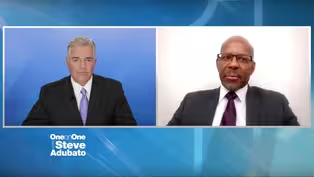
How Junior Achievement of NJ Helps K-12 Students Achieve
Video has Closed Captions
Clip: S2024 Ep2740 | 8m | How Junior Achievement of NJ Helps K-12 Students Achieve (8m)

Kim Guadagno Talks About Mercy Center's Philanthropy Episode
Video has Closed Captions
Clip: S2024 Ep2740 | 10m 48s | Kim Guadagno Talks About Mercy Center's Philanthropy Episode (10m 48s)
Providing Support for PBS.org
Learn Moreabout PBS online sponsorship
- News and Public Affairs

Top journalists deliver compelling original analysis of the hour's headlines.

- News and Public Affairs

FRONTLINE is investigative journalism that questions, explains and changes our world.












Support for PBS provided by:
One-on-One is a local public television program presented by NJ PBS