
Jamie Dimon, CEO of JP Morgan Chase, on Bank's Chicago Impact
Clip: 10/15/2026 | 9m 36sVideo has Closed Captions
The CEO of JP Morgan Chase on economic policy and Chicago.
Jamie Dimon, CEO of JP Morgan Chase, visits Chicago and talks economic policy, claims of discriminatory lending policies by the bank and how cities can remain competitive.
Problems playing video? | Closed Captioning Feedback
Problems playing video? | Closed Captioning Feedback
Chicago Tonight is a local public television program presented by WTTW
WTTW video streaming support provided by members and sponsors.
Jamie Dimon, CEO of JP Morgan Chase, on Bank's Chicago Impact
Clip: 10/15/2026 | 9m 36sVideo has Closed Captions
Jamie Dimon, CEO of JP Morgan Chase, visits Chicago and talks economic policy, claims of discriminatory lending policies by the bank and how cities can remain competitive.
Problems playing video? | Closed Captioning Feedback
Where to Watch Chicago Tonight
Chicago Tonight is available to stream on pbs.org and the PBS app.

WTTW News Explains
In this Emmy Award-winning series, WTTW News tackles your questions — big and small — about life in the Chicago area. Our video animations guide you through local government, city history, public utilities and everything in between.Providing Support for PBS.org
Learn Moreabout PBS online sponsorshipcity's lofty place in the history of the skyscraper.
We begin tonight with an exclusive broadcast interview.
Brandis Friedman sat down this morning with the CEO of JP Morgan Chase, Jamie Dimon, his visit to Chicago coincides with the release of a report on the banks.
Impact here.
The 2 discussed economic policy claims of discriminatory lending practices by the bank and how cities can remain competitive.
She began by asking about a recent Reuters headline that refers to Dimon.
Has Wall Street's say >> For Todd writer should be a little more careful in the headlines and that's because sloppy journalism, not a very optimist, but America I'm talking about and that thing.
It's a terrible word is there are serious issues out there.
We have to do it.
Everyone knows is true.
I don't know how they're going sort out wars, Ukraine, Iran, trade, Realtors, ation the world.
There's huge global deficits.
We need to do that to Frayne American dream.
Those of the issue of the deal with naming deuce, there is no shame on them.
>> Your newly released Chicago impact report.
It shows chases billions of dollars of investment into Chicago institutions like hospitals higher Ed entrepreneurs and small businesses, homeowners and buyers of course, chases own footprint.
How would you rate Chase's investment in the city?
>> He's been great guy.
We got the bank.
One of the stock is down 40%.
We had a layer of people.
We're closing branches.
She's I got the bank.
One in the year.
2000 going from 9,000 people Chicago to 15,000 becoming very healthy, vibrant company here we have more branches, more private banking, more investment banking where commercial banking.
think the city, the schools, the hospitals, the state, we're proud that we lift up society where we do all that.
We also do anything for the black community.
I've been to Stony Island branch.
We bring trying educate people and a mortgage and saving money we've hired.
I think we found veterans will be fired here.
We have a program to give job to disabled and artistic folks.
I went to a lockbox systems here that people do a lot great work confidential.
Roughly 9 states government, you know, doing payments immigration forms Senator.
proud of And to that point, you know, that is what banks do.
Write.
Some folks might say that that is what banks do lending and borrowing and investing in that.
You know, that's something that's the normal business of a bank.
You think?
>> Your approach is any different.
>> He's a different guy.
Say the most important thing to behold, rebuild, a healthy, vibrant bank that can do those things.
Well, I think it is our job to look tough side a little bit.
I think we do well.
I think if you lives in a lot of companies has been a lot more time talking about old charitable things they do, which they don't do well.
And their company stocks.
You know, that doesn't work for society.
So We to be we evaluated those that work.
Those didn't kind of like something or is it a permanent subsidy which this making up for big government that doesn't work.
You know, if you're making up for big government of the school system, you should reform the school system.
Not pretend you're doing a great job by doing something else is not really accomplish as a show.
We're quite critical of that.
And where broke lot of times.
We but that too.
>> All of that said back in 2020, an investigation by WBEZ.
The NPR affiliate here in City bureau found that the city's banks weren't lending nearly as much in the city's black and Latino neighborhoods as they were in white neighborhoods.
Chase being the biggest bank in the city.
Was this the worst offender doing 80% of its lending in majority white neighborhoods?
2% in black neighborhoods.
40 times more lending in white neighborhoods.
Why do you think that was in?
Do you view the work in the investments and all that you just named as an effort to right that wrong?
>> Don't totally different for numbers.
It was never right because they become a simplistic things in different time.
Scales.
If disease, if we do something, we're not going right.
We look at it, admit it, fix it.
Very different.
You're not trying to buy favoritism for anyone.
All of our pro wasn't meant to actually help people, citizens.
America.
We do a tremendous amount black community.
If you don't believe call them all up and we do it in veterans and disabled in in mortgages enough with a large affordable housing in the city would buy benefits.
The black community are all men are is quite a bit.
We started the second chance initiative we've hired.
I think in the city I the exact number.
But in America, we fight for 5,000 and I learned here I went to lunch here and expo could there 70 million people with criminal records in America motion misdemeanors who don't want to go back to jail.
And when we met with, said, right, we don't do enough to give people a second chance and sure public understands the can't get driver's licenses.
They can't get rental.
They can't get jobs.
They can't get is that we meant to do not give people a second chance.
So we started that for ourselves.
The BRT now is like 50 companies doing it.
>> In your annual letter to stakeholders, you said cities need to compete.
Some folks might argue.
And I just heard someone say just a couple of days ago that that means cranes in the sky to show that you are developing and building and growing.
What is what is that competition look like to you?
Especially for city like Chicago.
He prefers?
I think naive to say cranes.
It's not cranes.
So, you know, and I didn't cities.
I said cities, companies and countries, no one has a divine right to success.
And if you think you do, that is guaranteed way to failure.
You know, and and so cities, if you city's a little bit different.
But how you hospitals, how your schools, which a crime, you know, people are their jobs.
Are you are you conducive to healthy companies?
Are you driving them out?
What are you doing to fix things?
How you do with homelessness?
you doing with only 6?
That's how they compete.
And, you know, a lot of people get in jobs, mayors and governors, and they actually think now the ideological phrases is going to fix those problems.
They think they're more moral everybody else.
It's going to fix it will not.
Every mayor learns the hard way you have to attack the problem and understand it and they did not.
Do we have a problem?
Do we have own schools?
Describe to high wind to go up, you know, and then you analyze it and you have a plan.
And if you're politically explain to people because sometimes out your favor in this group or that group, if you drive up business good jobs, you're hurting your city.
You may feel good about yourself.
You may think becomes evil or something like that.
But you will hurt your city and you heard all your sins.
You see Chicago Mayor Brandon Johnson.
He has repeatedly and so far unsuccessfully attempted to tax large corporations often saying that they need to have, quote, skin in the game.
>> Believing that large firms aren't paying their fair share to the city.
Do you think large corporations would leave Chicago if he were able to impose the $33 month per employee had tax that he has proposed.
I find astounding when people say fair share and they have no idea what the facts are.
And and so I think people should pay their taxes.
So by that, he means they're avoiding legitimate taxes.
He's absolutely right.
But if you think that we don't pay our fair share, that's absolutely wrong.
>> You know, and enjoy.
And then when you have policy heat, if you are here home, you should think about if you knew pretty would you pay tax at all because it will drive people out and again, don't don't listen to me.
Go look at the facts.
You know, when people say no, it's not good go.
Look at the facts.
Hot, very high taxing cities detect individual the highs and you guys are not good here.
The North New York, right?
My home California, highest individual, highest corporate highest real estate highest.
People can't afford it.
And she's not even with JP Morgan Chase, which is what our employees want.
Sometimes I'd rather live here and live here and people do a good job.
They're booming.
We have more jobs we had.
When I go to JP Morgan, we had.
12,000 jobs in Texas and 35,000 New York.
And now we have 35 of 3, 3,000 Texas and 26,000 New York.
Is that what York wanted?
I mean, is that is that successful?
You know how many jobs would state in your kit?
They didn't do things to get very expensive.
Do business there.
So that to make a political choice.
You know, Jane will make its choice but to make a political choice, they should do more analysis taxing head count.
would less account just by the nature of the tax.
I mean, thank I mean, taxing profits is a little bit different, but should be very thoughtfully go about But it happened with Chase.
Do you think you would like withdraw some of the footprint that, if I say some you a dime, orange mayor, but I'm not morning anybody.
I'm saying is a fact things that are not conducive to companies and growth.
Unemployment reduce company's headcount unemployment.
It's got nothing to do me.
It's not a moral statement.
Okay.
You know, that's what happens in life.
You move somewhere to a job you like in Chicago.
There few better job.
Dc was day there got nothing to do with your moral view of staff.
I think people should be very careful.
We have done a lot of damage to a company because the shooting policy.
That's what we've done.
If you don't believe look at our schools.
Look at some of our cities.
Look at some of the crime rate over time and we have to get this right to help all of our citizens, you know, the more but the more vibrant people or your of your head count go 9,015 1000.
Is it a lot of jobs?
compensation lot of taxes here.
Chicago's got to get right for Chicago.
I'd be happy spend time with the mayor.
I've spoken the phone.
I think I've ever met him and talk about what policies we think works in wind come to
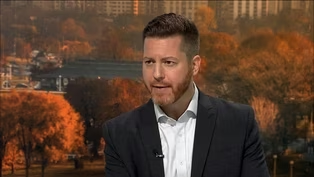 New
NewCollin Corbett on His Independent Candidacy for Illinois Governor
Video has Closed Captions
Meet the independent candidate running for Illinois governor. (10m 22s)
Providing Support for PBS.org
Learn Moreabout PBS online sponsorship New Episode
- News and Public Affairs

Top journalists deliver compelling original analysis of the hour's headlines.
 New Episode
- News and Public Affairs

FRONTLINE is investigative journalism that questions, explains and changes our world.




 New Episode

 New Episode



Support for PBS provided by:
Chicago Tonight is a local public television program presented by WTTW
WTTW video streaming support provided by members and sponsors.