
Jan. 13, 2026 - Full Show
1/13/2026 | 26m 47sVideo has Closed Captions
Watch the Jan. 13, 2026, full episode of "Chicago Tonight."
Illinois sues the Trump administration — what it could mean for immigration enforcement in Chicago. And could your electric bill be going up? A new report looks at data centers and their impact.
Problems playing video? | Closed Captioning Feedback
Problems playing video? | Closed Captioning Feedback
Chicago Tonight is a local public television program presented by WTTW
WTTW video streaming support provided by members and sponsors.
Jan. 13, 2026 - Full Show
1/13/2026 | 26m 47sVideo has Closed Captions
Illinois sues the Trump administration — what it could mean for immigration enforcement in Chicago. And could your electric bill be going up? A new report looks at data centers and their impact.
Problems playing video? | Closed Captioning Feedback
How to Watch Chicago Tonight
Chicago Tonight is available to stream on pbs.org and the free PBS App, available on iPhone, Apple TV, Android TV, Android smartphones, Amazon Fire TV, Amazon Fire Tablet, Roku, Samsung Smart TV, and Vizio.

WTTW News Explains
In this Emmy Award-winning series, WTTW News tackles your questions — big and small — about life in the Chicago area. Our video animations guide you through local government, city history, public utilities and everything in between.Providing Support for PBS.org
Learn Moreabout PBS online sponsorship>> thanks for joining us on Chicago tonight on Brandis Friedman.
Here's what we're looking at.
What Illinois's new lawsuit against the Trump administration could mean for immigration enforcement in Chicago.
And a new report warns Illinois could face electricity shortages and soaring bills in the future.
Our AI data centers to blame.
>> First off tonight, the last of the so-called calm and for has reported to prison for a 2 year sentence in a corruption scandal that also sent longtime Illinois House Speaker Michael Madigan to prison.
Former comment CEO 67 year-old and promise has begun serving her time at a federal prison in Mariana, Florida.
She was convicted along with Madigan's longtime confidant Michael McClain x comment consultant Jay Dougherty and former comment executive John on bribery, conspiracy and willfully falsifying the company's books 2023 trial.
The other 3 along with Madigan have all begun serving their sentences.
Chicago's Office of Reentry is releasing its first year and report tasked with creating and investing in resources for formerly incarcerated Chicagoans.
The office out outlined what they call their key accomplishments the past year, including establishing Chicago's first women focused community reentry support center, creating a micro Grant program providing funding to 32 organizations to expand mental health services and reentry support watching a policy survey incorporating feedback from system impacted individuals and developing the youth re-entry guidebook to support young people impacted by the justice system.
And that office's director will join us here tomorrow evening for more on their goals.
Our federal immigration operating with absolute legal immunity.
That's right.
After this.
>> Chicago tonight is made possible in part why the Alexander and John Nichols family.
The Pope Brothers Foundation.
And the support of these donors.
>> Illinois and Minnesota officials are separately suing the Trump administration over the enforcement tactics used by federal immigration agents.
The lawsuits seek broader limits on the conduct of immigration agents in both states.
It comes after last week's fatal shooting of Minneapolis mother Renee Nicole.
Good by an ICE agent following the shooting.
Vice president JD Vance said the agent was, quote, protected by absolute immunity.
>> The president here is very simple.
You have a federal law enforcement official engaging in federal law enforcement action.
That's a federal issue.
That guy's protected by absolute immunity.
He was doing his job.
The unprecedented thing is the idea that a local official could actually prosecute a federal official with absolute immunity.
I've never seen anything like that.
It would get tossed out by a judge.
>> Joining us now with more is Chicago.
Can't college of Law Professor Harold Credit?
Welcome back.
Harold, A so, you know, going off of what we just heard, the vice president say they're do federal immigration agents have absolute immunity from prosecution.
>> The vice president simply wrong.
There'd been a number of cases and to shun pronouncements on that say that the individuals are not absolutely immune and Supreme Court decisions over help them.
That being said the road to a prosecution by state official is tough.
And obviously we're not going to see federal prosecution in this administration that there could be a federal prosecution in a subsequent administration.
And then there are some civil damages routes that are available as well.
So those who was horrific can't But there are some avenues available for some kind of accountability for what the ice agent did.
>> Both Illinois and middle law, Minnesota lawsuits are federal case is raising some potential conflicts with the U.S.
Constitution's supremacy clause.
What is the supremacy clause and how might it affect lawsuits?
>> Under Constitution, if there's a clash between state and federal law, federal law prevails.
So going back to Minnesota incident, it's clear that the federal government has the ability to have ICE agents in Minnesota or in Illinois and that even if there is a state law to the contrary to federal law would win out because of the supremacy sitting talking.
We only in Minnesota are saying is that the use of these aggressive tactics patrols interrogations, the use of tear gas is simply trying bludgeon the state's into changing their form, a government, which is also protected under the Constitution in our 10th Amendment.
So what the lawsuit are saying is that this use of aggressive tactics are trying to browbeat the states into abandoning come soon worry all seas for centuries city policies to protect migrant within the communities and then the use of tactics to effect.
thing is actually at SoFi.
We should the Constitution because the rights protected under the 10th Amendment of the Constitution.
So it's a pretty those are both president claims we don't know how many will turn out because at some point there's a clash between the supremacy clause and the tech, the mandate.
And so we're seeing that played out in both states currently.
>> So in Illinois's lawsuit, state attorney Attorney General Kwame Raoul, he wrote that immigration agents, quote, have rampaged for months through Chicago and surrounding areas.
Lawless Lee, stopping interrogating and arresting residents and attacking them with chemical weapons.
Can the state make the argument that immigration agents are breaking the law in the use of chemical weapons?
And so on.
>> that's not what this loss isn't about There may be other aspects of the lawsuit to say that there are illegal tactics and there can be an injunction.
And indeed, Judge just well go talked about the illegal activities, potentially illegal activities of the Border Patrol agents.
But this is more of a wide-ranging on Presenteeism mentioned lawsuit saying that this is really campaign that the federal government is using to try to force the stage to change their laws.
And when the federal government does that, there's arguably in violation of the rights reserved to the states under our federal constitution.
So this isn't about the use tear gas per se for use use of interrogation tactics.
really about using these kinds of tactics to source.
>> states to give her policies.
Sanctuary city policies that the find very important order to protect and then make safe the communities in the states.
>> Illinois's lawsuit also seeks to halt immigration agents from using such tactics as tear gas and other chemical weapons on non resisting individuals and from entering private property without a warrant or consent.
Does that part of the lawsuit?
Is it not run into the same problem that the Chicago Headline Club and other plaintiffs ran into with their case, which is still in a federal court right now because a judge decided that she wanted to hold off before granting the motion to dismiss.
>> I mean, may.
But difference is, is 10th amendment rights reserved to the states part of the lawsuit.
That's what makes this a unique vehicle for trying to test or challenge the policies.
Obviously we have individuals were injured, including when a good whose family I just want to be there soon.
says there is no state prosecution for the agent.
I mean, those of us who've seen the videos that we find them no idea why the ice agent opened fire when he did what in water level went Illinois's trying to do is say, each individual or abuse of discretion.
There's a trigger-happy ICE agent or Border Patrol agent.
Maybe they can be sued under tort claims were for constitutional violation, other problems with as possible.
But what the this lawsuit is saying as school, this is a pressure tactic that it is being used against the state in order for the states to change laws to be more friendly.
2 federal immigration for Smith.
And that's the week.
Colonel of this law.
And that's different and what the headline Club and others brought in the fire lawsuit.
And so wind its way through the courts.
But it's an interesting challenge.
>> Of course, one that will keep an eye on as it does make its way through the courts.
Chicago can't college of law professor held current.
Thank you again.
Up next, the impact data centers in Illinois could have on your energy bill.
Chicago residents could see their electric bills increase by as much as $70 in the next 3 years.
>> That's according to a study from the Citizens Utility Board.
Researchers say the culprit is the rise of AI data centers straining the electric grid as a result, some local municipalities are putting a moratorium on new data centers.
Meanwhile, ComEd says it recently struck an agreement with several large scale data centers in order to mitigate the surge and utility bills.
Joining us now with more are Max Lightman, director of economic development for comment.
Sarah Moscowitz executive director of the Citizens Utility Board.
Allison Lindbergh, director of sustainability for the city of Aurora and Brad teats director of state policy for the Data Collection Center Data Center Collection.
Thanks to all of you for joining us.
Greta, want to start with you, please.
Because there can often be confusion when we're talking about understanding data centers and what they do and what are the different types.
So what do they do and what are the different types?
Yeah.
So the data center industry and it's been around for decades.
But I think, you know, only been until recently like that.
We've some, you know, renewed attention, but >> the data center industry is powering our 21st Century economy.
So everything we do on the Internet is is powered and process through through a data center.
So when you look at the data center industry, historically, what you've had is what's called Multi-tenant enterprise owner and Enterprise Data Center.
So multi-tenant they're going to build to suit building that provides the the space, the power, the infrastructure for tenants in and the tenants can range from one to 200 tenants.
And you might have banks and hospitals, governments and school storing their data in there.
But then you get to the the enterprise or HYPERSCALE data center and those are going to be the household names that that we all know does.
Amazon, Microsoft and Google's of the world and they'll use their own data centers to to, you know, process and on their own computer in their own data.
You know, so really when you look at where demand for data is going, you know, the average household has 21 connected devices now in when you think about all the phones, you have all the computers you have your your 3rd year sparked thermostat.
part of elevation.
Here I was you know, in the next 5 years, we're going to use twice the amount of data that we've used in the last 10 years.
And I used to work at the Chicagoland Chamber of Commerce and every every business now is basically a tech business.
So, you know, the the technology like and like where we are right now is so interwoven into our daily lives.
And we're going of that is the data center.
Yeah, there's a I which is is a whole other level of need as far as data centers go.
But can you tell us about how many data centers are currently active in the state of Illinois?
And it varies different mask are going to have different numbers and how you categorize different data centers as is different.
>> You know, most accounts will show between 150 to 200.
You know, I will make the point that and jail while the site selection from came out last week with a study that showed, you know, 25% of the workload actually occurring in data centers right now as AI.
But about 55% is for cloud-based services and you know, another 30 or so percent is for kind of traditional storage.
So I know all the news about big AI data centers but only a kind of a quarter of what's actually happening in data center, right?
Right.
We've been doing it for a long time.
>> Sarah Moscowitz Cub has studied the impact of data centers on utility costs.
What it find.
Well, we know there's no question that data centers are having an impact on our power prices.
The independent market market monitor that oversees the markets that include northern Illinois, basically said that the biggest reason why our power prices spiked last June was because of forecasted low growth due to data center demand.
So this is already having an impact on our bills.
And I think I understand that data centers are important to our economy, but I think the way that our power sector has been regulated historically has not really equipped for the scale of this energy demand all coming line all at once.
And so we're excited to work with stakeholders in Illinois to try to hammer out some solutions because we need to kind of tackle this from every angle possible.
things that we can do at the state level things we can do at the regional wholesale market level federal level.
It's really an unprecedented challenge, especially after a couple of decades of really flat demand for electricity and I think You know, it's a real opportunity to to kind of work out some technological and some policy solutions to this issue.
That's already affecting consumers.
You mentioned something called forecasted loan growth, which I want to come back to in a little bit little bit later Max, if you would explain to our how energy pricing works and what's comments rolling Yes, that's a great question.
So on every but every individual's electrical bill from ComEd, they're 3 different components.
Theirs.
>> Distribution, which is the cost getting power to homes and businesses there transmission, which is the cost of delivering power over long distances.
And then there's energy supplier generation comment is a is what we call wires, only utility.
So we only own.
>> The distribution lines that that take the power to to the to the mirror and the transmission lines that moving over long distances.
And so we don't have generation assets.
And and so we don't we don't have any control or influence over that portion of the bill.
But we are seeing really significant expressions of interest in terms of applications for for power, from large data centers and so are large customers, which include data centers.
And they include, you know, advanced manufacturing in a range of other.
Customers.
So is the scale for for point of reference within the last 3 or so years we've seen applications for service that total over 30,000 megawatts of power.
your comment is roughly 120 years old has utility and our all-time system peak is about just shy of 24,000 megawatts.
And so what we've seen over the last 3 years projects, if all of those projects are real and they all get built and they all meet their maximum usage.
We project to see demand that that doubles what it took a 120 years, roughly 2 to achieve.
And as you're saying that as you're saying, 30,000 megawatts of, see all of you nodding your heads and understanding that that is that is a significant amount power is to get And I think Sarah mentioned that there's a need to modernize.
>> lot of aspects around how we are addressing the challenge of of of the growth of demand, which also includes things like like Kaisha, none.
You know, people putting solar on their roofs yeah.
We made comment at both the state level with the Illinois Commerce Commission and the federal level at the Federal Energy Regulatory Commission or FERC, which try adapt to these changing types of projects and ensure that all the costs are properly born by the customers who who are receiving that service and that we don't see shifting of costs from one group of customers to OK, I want to come back to that in a second as well.
But I want to bring Allison in here as well because >> Aurora implemented a six-month moratorium on data center development.
White will do that.
What are the concerns?
Yeah, we had a couple of different concerns about that.
So currently has 4 data centers and we have 5 that are in development.
>> But we had received many different request for a new development for data centers.
And at the same time, some of our existing data centers.
We were getting some complaints from residents related to noise related to vibration.
then we had some environmental concerns related to water consumption.
And that would be for new data centers.
And then we obviously had some concerns also about hearing that data centers were causing increased electricity bills as well.
At the same time, Aurora actually treated data centers like warehouses.
So every building used type has certain kinds of regulations.
But we didn't have a definition for data centers and also for a municipality.
We didn't have a way to put any kind of requirements are guardrails on data centers.
We didn't even have a definition.
So in order for our staff to take a look and look at some best practices and see what others were doing to basically deal with high demand for development.
We put a six-month moratorium in place on both data centers and warehouses.
So imagine a data center would function very differently and consume energy very differently from a warehouse.
Yes, absolutely.
Max.
A comment is made these transmissions security agreements with some of the largest data centers in Illinois.
One of those agreements to for consumers ending.
So last week we announced that we had reached agreements with 8 large customers, all for more data centers.
And these are essentially long-term contracts with these customers for the transmission portion.
>> Of their bill.
And so what we're seeking to do is provide a revenue guarantee.
So that it has we defer any customer, any project that we build?
They give us a projection of demand and from that were able to calculate what they would pay in rates.
>> And if the project meets the the energy usage that they project, then comic collect that revenue and rates and we use that money to build and maintain the But if any individual project fall short of that projection, then there's a shortfall.
But the cost of building and maintaining the system remains the same.
And so essentially what has to happen is that that cost gets spread across other customers.
That shortfall gets cup spread across customers.
And so these long-term agreements with these customers ensure that if for some reason they don't meet the projection of energy usage and there is a shortfall in in 4 in the form of the rates that they would pay that comment.
Customers essentially are insured or they're held harmless because the customer we do provide those funds through rates or they'll provide out those funds the security agreement.
And that's sort of like a the problem with forecast low growth that that you mentioned area earlier.
Sara, tell me if you know some of this action addresses, some of the concerns that come house.
Yeah, I think we're happy to see arrangements like that.
And I'm glad that the utilities taking this kind of >> The issue of kind of speculative Lowden this concerned that we could be building out system for data centers that don't show up or that don't use as much energy as they initially requested.
And like Mac said.
>> That means it in cases like that.
That means the rest of the customer base would be holding the bag.
And so I think stuff like that is what we need to see.
I hope to see action in Springfield that would actually kind of mandate arrangements like that and really ensure that data centers and other large customers have to put their money where their mouth is.
And so that we aren't in the situation where you have a risk of the rest of the utility's customers shouldering costs for infrastructure upgrades that were made for a customer that doesn't show up and then is not going to be paying that off over time.
And I think, you know, that's kind of how our utility system has been developed over over history is essentially that, you know, you will have current customers subsidize the cost to increased its increasing infrastructure with the ad for new customers with this idea that new customers would then help pay, you'd be spreading out more kilowatt hours across more customers.
And so that would actually keep costs down.
But because of the speed with which a data center can come online and it's like some of these hyper scalar can use as much dollars as a city.
>> And so that's the issue here.
And so I think we're going to need ideas like that.
But more of that and then also ideas that can apply to the wholesale market level.
Brad, why what do you think?
It's important that Illinois invest data center infrastructure.
>> Well, and there's a lot to unpack with.
All that's been been said here as well.
you know, I mean, the economic benefits are clear and we're getting updated numbers soon.
But in 2023, you know, data centers at about 20 billion dollars to our GDP.
You know, here in Illinois Yoon about 120,000 jobs have been, you know, in and around the data center ecosystem and importantly, for a state that has a lot of property tax issues, about 2 billion dollars in property, taxes, state and local taxes.
So benefits are clear.
Not not just the underpinning of our, you know that digital economy cause when data centers come, they attract other kinds of technology businesses as well.
But, you know, I think, too, and I want to defer speak to the, you know, as you load forecasting.
And that has been something that our organization has been trying to figure out with PJM because there you know, there is a lot of speculation in the market and it's adding to interconnection application cues over at ComEd.
It's it's kind of painting this foggy picture that it's hard to tell what's real and what's not real.
So, you know, we've been pushing for things that, you know, around verification of commercial readiness for, you know, with at T J M Things around, more transparency about new around the assumptions they're using when they're, you know, trying to develop their large load forecast.
So there's a lot going on there.
But at the end of the day, the industry is committed to paying, you know, it's full calls for service full stop and you know, where this should be dealt with is is through our public utility commissions across the country and the dcc active many of these negotiations trying to figure this out.
It's complicated and trying to parse out these costs as Max will tell you is is very, very tedious process.
But, you know, the the last point I want to make, you know, Illinois, obviously we have seen our climate negligible jobs Act in place which has climate goals.
84% of the renewable procurements done nationally last and the first 6 months of 2025 or done by data centers.
So if there is one industry who's kind of power in a clean energy economy, is this one?
>> we've got about 45 seconds left.
You know what kind of agreements have been made with data centers to address environmental concerns?
There's quite a few that are have been done.
I would say on their own accord, some of the large data centers, they see a benefit from doing things related to sustainability, especially because they might have an agreement with an international company that has climate goals.
But by and large, there's no one size fits all solution for sustainability or environmentalism.
I will say that since we started the moratorium, we have had one data center come to us interested in developing in Aurora that wants to become one of the most sustainable data centers in the region.
All right.
Give us a call.
And that goes down.
Want we want to know how they do it because that's what we're going to have to leave it next.
Lightman Sarah Moscowitz Allison Lindbergh and bread to eat.
Thanks to all of you for joining us.
We appreciate it.
Thank you.
And that is our show for this Tuesday night.
Stay connected with our reporters and what they're working on by following us on Instagram at W T Tw Chicago and join us tomorrow night at 5, 30 10 now for all of us here in Chicago Brandis Friedman, thank you for watching.
Stay healthy and safe and have a good night.
>> Closed captioning is made possible by Robert, a different and Clifford law a Chicago personal injury and wrongful death and sponsor
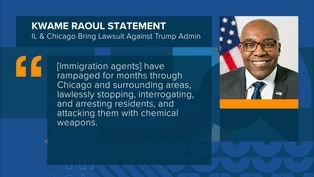
Illinois Sues Trump Administration Over Immigration Enforcement Tactics
Video has Closed Captions
The lawsuit seeks broader limits on the conduct of immigration agents. (6m 50s)
New Report Examines Data Centers' Impact on Electrical Grid
Video has Closed Captions
The Citizens Utility Board said Chicago utility bills could rise by as much as $70. (15m 33s)
Providing Support for PBS.org
Learn Moreabout PBS online sponsorship
- News and Public Affairs

Top journalists deliver compelling original analysis of the hour's headlines.

- News and Public Affairs

FRONTLINE is investigative journalism that questions, explains and changes our world.












Support for PBS provided by:
Chicago Tonight is a local public television program presented by WTTW
WTTW video streaming support provided by members and sponsors.