
Jan. 19, 2026 - Full Show
1/19/2026 | 26m 49sVideo has Closed Captions
Watch the Jan. 19, 2026, full episode of "Chicago Tonight."
How potential gas rate hikes could impact your bill. And the impact of Black male role models in the classroom.
Problems playing video? | Closed Captioning Feedback
Problems playing video? | Closed Captioning Feedback
Chicago Tonight is a local public television program presented by WTTW
WTTW video streaming support provided by members and sponsors.
Jan. 19, 2026 - Full Show
1/19/2026 | 26m 49sVideo has Closed Captions
How potential gas rate hikes could impact your bill. And the impact of Black male role models in the classroom.
Problems playing video? | Closed Captioning Feedback
How to Watch Chicago Tonight
Chicago Tonight is available to stream on pbs.org and the free PBS App, available on iPhone, Apple TV, Android TV, Android smartphones, Amazon Fire TV, Amazon Fire Tablet, Roku, Samsung Smart TV, and Vizio.

WTTW News Explains
In this Emmy Award-winning series, WTTW News tackles your questions — big and small — about life in the Chicago area. Our video animations guide you through local government, city history, public utilities and everything in between.Providing Support for PBS.org
Learn Moreabout PBS online sponsorship>> Hello and thanks for joining us on Chicago tonight.
I'm Brandis Friedman.
Here's what we're looking at.
How to potential gas rate hikes could impact your monthly heating bill.
Kids come >> We have growth socially and emotionally, you might think.
>> I'm looking at the importance of black male role models in the classroom.
We explain the history of redlining and how it began in Chicago.
>> A place like place like Grey's Lake.
>> Plus, a clean slate and a new beginning.
We explain.
We kick things off right after this.
>> Chicago tonight is made possible in part why the Alexandria and John Nichols family.
The Pope Brothers Foundation.
And the support of these donors.
>> Your monthly heating bill could be going up.
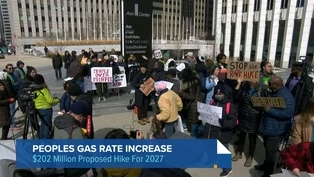
That's if the Illinois Commerce Commission approves a 202 million dollar rate increase for people's gas, which supplies natural gas to nearly 900,000 Chicagoans.
The company says it would mean a monthly bill increase of about 10 to $11.
Meanwhile, Nicor gas, which has 2.3 million customers in Northern Illinois is also requesting a rate hike of 221 million dollars.
The company says the increase would add less than $6 to monthly bills.
Both companies say the money will be used to upgrade infrastructure as a matter of public safety.
Here's David Schwartz with people's gas.
>> We must have a safe, reliable heating system in Chicago.
The pipes currently running underneath the ground.
We're nearing the very end of their useful lives and the closer it gets to actual end of their useful lives, which is coming before too long.
The risk of an issue becomes a much greater concert.
>> Joining us, our apes car director of the Illinois Public Interest Research Group, a consumer advocacy organization and Jim chills and communications director for Citizens Utility Board.
We should note that we did invite representatives from both Nicor gas in Peoples Gas.
Nicor did not respond, but we do have a statement from a news release and people's gas declined our invitation but did do a zoom interview with one of our producers earlier today.
I think both of you for joining tonight.
So I want to get both of your reactions to what we just heard.
What is your response to the idea to the request from both peoples and nicor gas companies that these hikes are necessary to improve infrastructure and prevent a public health issue.
All start with you.
Please.
>> So the utilities are responsible for maintaining safe and reliable infrastructure.
But this should be put in the context of the multiple rate hikes that these utilities have already put into place over many years like or his raise rates already by 137% since 2017 and people's gas rates have effectively doubled over the last decade.
And we believe that while there is some important need for investment in particular and people's gas with their old iron pipes.
lot of times what we found is there over investing in spending wastefully ways to drive up their profits and drive up our bills.
But don't necessarily deliver those safety improvements that they're talking about, Jim?
Yeah, absolutely.
>> You know, they always talk about maintaining the system.
Everybody agrees at the gas companies need to maintain their system, but they should do in way.
That doesn't think bankrupt customers.
And that's what's been happening.
We have a good portion of Chicago and reheating affordability crisis right now.
These companies have been on spending sprees over the last 10 to 15 years.
And they've increased rates.
They've doubled rates in that time.
And at the same time, they've been making monster profits, people's gas has made record profits 7 out of the last 8 years.
People nicor gas over this time city.
It's been raising rates multiple time since 2017.
It's think raked in profits.
Its parent company's made profits of about 30 billion dollars.
So this company is rolling in profits.
>> Jim, as we mentioned earlier, if approved that people's gas rate hike would add about 10 to $11 to the monthly a heating bill.
How does that increase students who into sort of like the broader picture of rising costs for other necessities that lots of people are experiencing.
And what kind of burden might that make for household?
hit the nail on the head.
We're already seeing people.
>> dealing with an affordability crisis threatening a hard time paying the rent or having a hard time paying for groceries and prescriptions.
And now you're going to add, you know, for people's gas.
It's 10 to $11 per month Nicor gas.
It's about $6 per month.
Granted, they just got 168 million Dollar rate hike which was about $4 a month.
If you add those 2 together, that's about a $10 month increase.
People call us and say what the heck is wrong with their gas bills.
And we'd say these companies have been on spending sprees.
Is it possible that they underestimated when they went out for the most previous to the most recent?
>> rate hike or remain.
It's, you know, and this is, you know, speculation, but where they you know, well, you know, they're not going to that win.
That big.
So let's start small and incrementally increase or did they just underestimate what they believe they need They asked for about twice as much as they got in the last rate hike and parties like the Citizens Utility board only per the office.
Illinois attorney general were able to.
>> We believe document that lot of that spending that they were requesting was unnecessary.
That rate hike was unnecessary.
And regulators of the Illinois Commerce Commission agreed and cut MicroStrategy by roughly 50% and to come back months later and ask again, I I think shows a lot of it spent.
>> I mean, they might say it is a reflection of the fact that they needed what they needed in the first place.
But let's hear from them because people's gas says that the rate hike is needed to comply with requirements from the Illinois Commerce Commission.
Let's listen.
>> No, like Commerce Commission directed us to retire more than 1000 miles old eroding iron underground pipes from Chicago's heating system.
This is a large-scale complicated construction.
The ICC said accelerate a deadline for completing it.
That is why we filed this request to be able to do the work that the ICC directed us to do.
>> Yeah, the ICC did not order them to do business as usual business as usual.
It has been this company overspending in over budget and being behind schedule.
ICC's order said let's do this in a timely and cost-effective manner.
Let's consider things other than just replacing prime pipes.
Peoples.
Gas just gone forward with a business as usual format.
And that is what's leading to these multiple rate hikes.
>> Been response to people's gas to announcement.
Illinois Purdue Road quote, despite people's gas spending billions of dollars on pipe replacement.
Multiple outside expert reviews have found the program was not improving.
Safety in proportion to the utilities spending or the improvements that the company is making.
Are they are they reflective of the money that they're spending and asking for?
>> We don't think so.
And that's what the experts found as well, that they've been spending a lot of money.
But when you look at the feel your rates of the pipes, the risks they're supposed to be addressing.
We haven't seen that improvement in safety and any proportion to the billions of dollars they're spending and with the ICC said in this order was we need you to change the way you're doing this program.
Focus more on those risks and don't necessarily default to replacement as the only strategy to address those risks.
And we think there are other more cost effective strategies that will actually address those risks make us safer without bankrupting Chicago gas customers.
The ICC is expected to review people's gas.
Their request over the next 11 months.
What are you doing to make your case and what are some of those other >> improvements that changes that you think they can make that would cost less?
Will we?
In Covent others will hire experts and we have lawyers will be part of the process to make our case.
And it's just starting we're going to spend.
>> The next couple months really digging into the details.
Some of these other alternatives include pipe realigning this and inserting a liner into the pipe.
The can eliminate leaks and extend the life of the pipe by 100 years.
And it eliminates one of the biggest costs of pipe replacement, which is and one of the biggest inconveniences jacking up the streets and replacing all the infrastructure in the streets.
We also think in some circumstances we should be looking at electrifying some homes transitioning off the gas system, especially again, if it's more cost effective really reduces that safety risk that's inherent in any gas electricity is a whole other conversation.
We just had that last week as well with regards to data centers and their impact on the electricity grid.
>> But moving over Nicor gas because they are asking the ICC for a 212 million dollar rate increase that would allow, quote.
>> To continue making strategic investments that help enhance the safety, reliability and resilience of its natural gas system, especially during extreme weather while also complying with state and federal safety standards.
Jim, I just want to look at the big picture to big gas companies asking for millions and millions in rate hikes.
What would you say?
This is a reflection of we would say it's reflection of greed.
Unfortunately, in.
>> Consumers are hurting over this.
It's actually even worse with Nicor to 221 million dollar rate hike request Tanner to $11 a month or excuse me a $6.
And, you know, he's you know, overall what's been happening we've been seeing is that gas companies not only in Illinois, but across the country have been going on a spending spree.
They've been spending a lot for on work and that they do that because they can make a return on that and they can make higher profits, both peoples, gas and nicor gas are asking for profit rates for their shareholders of well over 10%.
That is absolutely excessive.
And that's one of the things we're going to be focusing on in this rate case.
>> What's I guess what's been your to it tonight, Chris, requesting this justification?
Well, the thing to remember with Nicor is unlike people's gas, they do not have a large volume of old at-risk pipes they dealt with those years ago.
What they've done is taken the opportunity by a now defunct state law to ramp up their spending to more than triple their annual capital.
Spending at for reasons.
Jim articulated and now was over and they dealt with some of their safety risks.
I think they're spending should go back down.
They want to create a new normal where they can fire rate hikes every year every other year basically take as much money out of northern Illinois as they can.
seconds left, one of the company's argues that compared to other major cities and metropolitan gas prices here still relatively low.
>> And they The gas company should talk to the people who called Cub who far too many are struggling to afford their bills.
They leave out conveniently the fact that there are large portions of the city that are in the heating affordability.
Affordability crisis in November alone.
About 150,000 people had 65 million in debt with this company.
It's it's they're going overboard, OK?
All right.
That's where we'll have to leave it.
best of luck to both of you to the folks pay heating bills.
>> But to leave it there, a star and Jim thank you so much for joining much.
Up next, how cultural competency impacts CPS students.
Across Illinois, the teaching workforce remains predominantly white and female Chicago public schools reflect that same trend.
Despite most students being young people of color, black male teachers are especially underrepresented, according to the most recent CPS figures available.
Black men make up just 3.6% of the district's teachers in partnership with students at Northwestern University's Medill School of Journalism.
We look at the implications.
Here's McKenzie Kirkwood.
>> The more children can see.
Folks that look like them to talk like them understand the cultural nuances.
>> That they have little bit easier.
It becomes to teach.
We will easier.
becomes to reach them.
>> We nice to have spent 26 years working in CPS.
He teaches honors math at South Shore, High School.
>> I love love seeing the light bulb go off.
I love seeing them get it.
okay.
>> According to the most recent figures from 2022. black male teachers, like he said, make up just 3.6% of all CPS teachers.
>> If I am thought of as inherently deviant.
What does the school space look like for me?
>> University of Illinois, Chicago professor David Stovall studies the impact of race on educational outcomes.
He says the trauma and hyper surveillance that many black youth experience can be seen again in adulthood.
So the same.
Regulatory things that have happened to black youth in schools are the exact same thing that happened in that same when a black coat right into into the teaching force.
>> In a statement, CPS says that this school year the percentage of black teachers increased from 14% to 20%.
The district did not provide current data broken down by gender.
However, Disney to Makign high school educated Joshua Smith.
He's been teaching in CPS for 5 years, says he's yet to see the increases hit the holes of his school.
>> But I think a Disney there are a decent amount of mail.
Educators in general is just that.
I'm the only black male educator at the school.
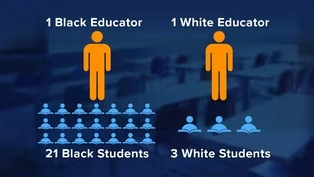
>> According to CPS data, there's one black educator for every 21 black students compared to one white educator for every 3 white students.
Smith says his presence at Disney, 2 is about more than just academics.
>> I have students who I don't even teach that will see me in the building that will come up and say hi to like you need that.
But I get some snacks.
My room next to his wife who have never taught that maybe middle school.
What have you Hassabis said like man like you're the only black knows he's here in building like I wish I had your class.
Even though they're being taught by great teachers, right?
Just being in the presence, I guess, of a of a loving, caring and black male figure.
Thank you.
No means means a lot since many cities and it was just a black son is in general after 40, the Trump administration is threatening to withhold federal dollars from CPS over its black student success plan.
>> And while the plan purports to close opportunity gaps, the Trump administration claims that violates the Civil Rights Act even close despite this program being targeted by the White House.
Another program is having an impact at Chicago State University program.
Director Jermaine Morales runs the Call Me Mister Program, which recruits supports and provides for your tuition assistance to young black men wanting to be teachers.
So with the call me Mister Program, we just try to prepare on this is to sort of walk in some type of classroom environment.
>> And just pay it do any type of situation.
And given the Caps is they goes make sure meet its institution and their productive citizens and they're prepared to teach any situation any school district.
And I'm happy to say that doing my part to try to prepare these individuals to make a mark in the world.
>> Cps and programs like Call Me Mister Work to build a more diverse teaching workforce representation in the classroom affects not only how students respond, how teachers teach for Lisa, his day-to-day approach is rooted in caring for his students.
I teach kids.
>> asked some people teach math.
The kids, the kids come first.
Their growth.
Academically, their growth cognitively.
They have growth socially and emotionally as human Once they see that you care about them all those levels, then they open To learn the map.
>> For Wt TWA Northwestern's Medill School of Journalism, I'm McKenzie Cookbook.
>> You can see this story and others produced in partnership with Northwestern's Medill School of Journalism on our website.
Up next, how redlining shape Chicago communities in ways still being felt today.
>> Reflecting the people and perspectives that make a buck This story is part of Chicago tonight.
Black Voice.
>> Indian race discrimination in housing was a cornerstone of Dr Martin Luther King Junior's mission.
Despite the progress that was made, we still see the impact of discriminatory practices today.
In tonight's episode from our digital series, W T Tw News explains explores the history of redlining and its origins right here in Chicago.
>> To this day, Chicagoans live in a fairly segregated city with the vast majority of the black population living on the city's south and west sides.
The Latino population on the west and northwest sides in the white population on the north and that segregation didn't happen by coincidence.
But by design, it dates back to a time when blacks were prevented from buying homes, not only by real estate agents who steered perspective black buyers to black neighborhoods, but also by banks and federal government through a process called redlining.
What simply redlining is the active denying people access to credit because of where they live.
And they are even if they're qualified borrowers.
So how did early to mid 20th Century Chicago use redlining to deny many blacks from achieving the American dream.
Here's Chicago.
Circa the early 20th century color coded by the federal Home Owners, Loan Corporation and Federal Housing Administration to indicate where it was safe to land and insure mortgages.
The area's color-coded green or blue indicated neighborhoods with a or B ratings considered the best or desirable areas for them to ensure a mortgage a yellow or C rating.
Mensa neighborhood was declining red were deemed meant hazardous, as you can guess those neighborhoods rate red were largely black and deemed too risky to insure mortgages.
A 1940 appraisers map refers to some red lines.
Chicago neighborhoods as virtually 100% overcrowded and lighted another notes and increasing encroachment of for the blacks were often prevented from moving into new developing communities due to racially restrictive covenants or clauses.
Pioneered by Chicago Realty Group's explicitly prohibiting blacks from purchasing that property.
>> The inability to get federally insured home mortgages made blacks vulnerable to predators sold.
That house is on contract, giving the illusion of a mortgage with none of the normal protections.
>> It wasn't until the federal government enacted the Fair Housing Act in 1968.
Just days after the assassination of Reverend Martin Luther King redlining was made illegal in the barriers started to come Unfortunately, the Fair Housing Act contained few provisions for enforcement.
And so in many ways, reading of segregation remains >> You can see more of our Emmy award-winning series W T Tw News explains on our website at W T Tw Dot com Slash explains.
And we're back with more right after this.
Some Illinois residents with previous criminal convictions are now getting a more streamlined path to having their records cleared.
Governor JB Pritzker last week signed the Clean Slate Act.
The law will now automate the state's record sealing system process for people with certain nonviolent convictions.
>> There is no reasonable public safety justification for making it hard for returning citizens to get a job or housing.
We're an education.
It's a policy guided by punishment rather than rehabilitation.
>> Late last year we spoke with activists to look at the impact.
They say this new law would have.
>> Nobody's asking what was your experience when you go through programs?
Activist Marlin Chamberlain has been driving this issue for a long time.
If you filled out a slip, made a phone call sent the email like this is a win for >> Might we went to the Capitol for a year.
>> Waiting Flake and way.
>> He and thousands of others like him have finally notched a win.
>> Feels good feels good.
But the way I'm wired up, my brain is instantly thinking about implementation.
But but this was a huge milestone.
>> He's referring to the Clean Slate Act passed during the fall veto session in Springfield.
The legislation is designed to automate the ceiling of certain criminal offenses.
>> Currently more than 2 million people in Illinois are eligible to have their records sealed, but haven't acted on what is currently a cumbersome, lengthy process.
>> You can talk to one person who would say, hey, because I was well connected, support it in sort of like the nonprofit space had access to attorneys.
And so for me, it took 6 months.
But then there are some we've spoken to what's been a three-year waiting period.
Waves, court dates that were rescheduled, cancel or you didn't have access to an attorney.
That's not true.
Justice justices waits for its fear, the equitable open for everyone.
state senator LG Sims was one of the bill's chief sponsors ceiling allows for law enforcement.
>> certain governmental still have access to the information that would make public any less safe.
But it would make that information not available to approach to private entities so that individuals would have access to housing access to to employment, access to education.
>> 37 year-old Julian Sims was released from prison 3 years ago after serving time on drug related charges.
What I was a cross, right?
I am a culinary I I actually had my electricity because certification and that's it.
>> Did you get a job when here?
You guys what they told me one allowed to go houses because I was a crime.
I have a bag for.
>> As with the current ceiling laws, the legislation only applies to misdemeanors ordinance violations in class, one through 4 felony convictions unless they involve violence.
So no murder convictions, DUIs or class X felonies, like armed robbery or assault.
The new legislation also removes the drug testing requirement to SEAL felony drug convictions, Chamberlain, a longtime advocate and someone who served time for federal drug charges himself says passing the Clean Slate Act is just the beginning.
hundreds of state and local laws prevent system impacted people from moving on.
There's restrictions around.
>> Volunteering children's schools, certain professional license and that folks can have with the arrest and conviction records.
So there's a A-list over 1000 statues that we have catalog this still exist in our goal is to build a permanent institution so that we can continue long after Martin decides to retire.
We want this fight continue until we are.
We have eliminated all of those statutes.
For now.
Julian Sam's says a clean slate is at least a start.
I want to start really like class act he So that could put him on a to grow my neighborhood.
>> Because I feel they got a times they got better ways to grow.
They get a lot of grant money.
>> Some Republican lawmakers did vote against the bill saying it allows criminals to repeatedly get their records clean without repercussions.
The law goes into effect next summer before the first phase of records will be automatically sealed on January.
First 2029.
And that's our show for this Monday night.
Stay connected with our reporters and what they're working on by following us on Instagram at W T Tw Chicago and join us tomorrow night at 5.30, and a special time at 11.
Now for all of us here at Chicago Brandis Friedman, thank you watching.
Stay healthy and safe.
>> A good night.
>> Closed captioning is made possible by Robert and could a Chicago personal injury and wrongful death and sponsor of
How Potential Gas Rate Hikes Could Impact Your Heating Bill
Video has Closed Captions
Peoples Gas is seeking a $202 million rate increase. Nicor wants a $221 million rate increase. (10m 58s)
The Importance of Black Male Role Models in the Classroom
Video has Closed Captions
Across Illinois, the teaching workforce remains predominantly White and female. (5m 12s)
Providing Support for PBS.org
Learn Moreabout PBS online sponsorship
- News and Public Affairs

Top journalists deliver compelling original analysis of the hour's headlines.

- News and Public Affairs

FRONTLINE is investigative journalism that questions, explains and changes our world.












Support for PBS provided by:
Chicago Tonight is a local public television program presented by WTTW
WTTW video streaming support provided by members and sponsors.