
Jan. 22, 2026 - Full Show
1/22/2026 | 26m 50sVideo has Closed Captions
Watch the Jan. 22, 2026, full episode of "Chicago Tonight."
The bitter cold rolls into Chicago, canceling some classes. And the Bears stadium saga is still playing out — where things stand.
Problems playing video? | Closed Captioning Feedback
Problems playing video? | Closed Captioning Feedback
Chicago Tonight is a local public television program presented by WTTW
WTTW video streaming support provided by members and sponsors.
Jan. 22, 2026 - Full Show
1/22/2026 | 26m 50sVideo has Closed Captions
The bitter cold rolls into Chicago, canceling some classes. And the Bears stadium saga is still playing out — where things stand.
Problems playing video? | Closed Captioning Feedback
How to Watch Chicago Tonight
Chicago Tonight is available to stream on pbs.org and the free PBS App, available on iPhone, Apple TV, Android TV, Android smartphones, Amazon Fire TV, Amazon Fire Tablet, Roku, Samsung Smart TV, and Vizio.

WTTW News Explains
In this Emmy Award-winning series, WTTW News tackles your questions — big and small — about life in the Chicago area. Our video animations guide you through local government, city history, public utilities and everything in between.Providing Support for PBS.org
Learn Moreabout PBS online sponsorship>> Hello and thanks for joining us on Chicago tonight.
I'm Brandis Friedman.
Here's what we're looking at.
Bitter cold temperatures are rolling into the Chicago area canceling school for many students.
>> We are working hard.
We bring the Chicago Bears, the Hoosier State.
>> The latest in Chicago Bears attempt to find a new home.
A herd of bison make weary in Kane County, their new home.
>> Human nature and creating cultural connection.
We've come here.
We've answered the call.
But a few days later, we're going to court.
>> And an exhibition explores the influence of Mexican railroad workers in Chicago.
>> First off tonight, dangerously cold weather tomorrow has canceled classes for Chicago.
Public school students and CPS buildings will be closed to the public.
The district says it's been closely monitoring the forecast in collaboration with the city's office of Emergency Management and Communications to make the decision that the temperatures forecast for tomorrow are too dangerous for students and staff to travel to school.
CBS says there will be no remote learning tomorrow and all extracurricular activities are also canceled many suburban districts are also canceling classes Friday as well or shifting to remote learning for a list of those closures.
Please visit our website.
And just how cold will it get?
First brutal.
Then a snow storm may be starting tonight.
Temps take a nosedive with the coal dust hitting from 03:00AM to noon tomorrow.
All of Northeast Illinois will wake up to Sub-Zero degrees Friday morning.
Forecasters expect temperatures won't reach above 0 until Saturday.
And even then not by much high between 5 and 11 degrees Saturday afternoon.
And meteorologists are keeping an eye on a large snowstorm expected to hit central and eastern U.S.
this weekend with the potential for accumulating snow in northern Illinois in northwest Indiana Saturday night through Sunday.
Meanwhile, for more on warming centers in Chicago and Cook County visit our website.
A federal jury has acquitted a 37 year-old carpenter of charges that he placed a $10,000 bounty on the wife of Border Patrol commander Greg Bovino.
This first criminal trial to come out of the Chicago area.
Immigration enforcement effort proved to be short with just 2 days of statements and testimony from 4 witnesses.
The jury deliberated for just 3 hours.
Federal prosecutors say one Espinosa Martinez used Snapchat to tell his brother and a friend that he'd pay quote, 10 k if you taken down along with a picture of vino, that friend turned out to be a government informant.
But Espinosa Martinez, his defense attorney, argued he sent the message as neighborhood gossip, never following up on those exchanges and only had a few dollars in his bank account.
Joliet family is suing the city's police department, accusing them of an unlawful search of a 12 year-old girl during a traffic stop.
The family's attorney says the 12 year-old was in the car with her sister when they were pulled over for a routine traffic stop.
They say she was ordered out of the car and then patted down by a male officer.
The attorney adds the search included contact with her upper thigh and groin area and was captured on the officer's body-worn camera.
So hospital where they were told.
And the sergeant and comes on the scene later says and disbelief.
>> To the officer.
You searched a 12 year-old.
I mean, that's on the tape.
>> The attorney says the Joliet Police Department later acknowledge that the search violated department policy and constitutional standards and issue discipline to the officer involved.
State officials are investigating whether the owner of a South Shore apartment building tipped off immigration agents in an effort to force out black and Latino residents.
The Illinois Department of Human Rights is looking into whether the 3 firms that own and manage the building committed housing discrimination.
The complex was the site of that high profile immigration raid back in September.
37 people were arrested, but no one was ever charged according to a ProPublica report in a statement, Governor JB Pritzker says, quote, state law prohibits discrimination and that includes aiding or abetting conduct intended to interfere with housing and civil rights representatives of the 3 firms could not be reached for comment.
Bally's temporary casino ring up just 15 million dollars in new tax revenue for Chicago last year.
That's down slightly from 2024 and lower than what city officials had originally projected valleys is asking state officials to allow it to continue operating that temporary casino for an additional year until September 2027.
Meanwhile, the company is building a permanent casino in Riverwest hoping to open by the end of the year.
Up next, will the Chicago Bears stay in Chicago?
That's right.
After this.
>> Chicago tonight is made possible in part by the Alexander and John Nichols family.
The Pope Brothers Foundation.
And the support of these donors.
>> The bear season officially ended last Sunday in that overtime thriller against the Rams.
But the saga of the team's future home is still playing out, Bears, leadership and Illinois lawmakers have butted heads over proposed stadium project in Arlington Heights.
As a result, the team says it's considering a number of sites in northwest Indiana, a prospect many Indiana lawmakers and officials seem to be relishing.
Here's Indiana Governor Mike Braun.
>> And with our strong business environment, it's not surprising that another organization.
Has noticed that Indiana is open for business.
The Chicago Bears.
>> We are working hard to bring the Chicago Bears to the Hoosier state.
So they can really see what a great place is to have a business.
We'll work hard to do it.
Let's get it across the finish line.
>> Joining us, our Illinois State representative MaryBeth Canty who represents part of the northwest suburbs, including Arlington Heights and Marc Ganis president and co-founder of Sports business consulting firm Sports Court.
We also invited a representative of the Chicago Bears as well as sponsors of that Indiana legislation to join us.
But they declined or did not respond.
Thanks to both of you for joining us.
Marc So the Indiana Senate Appropriations Committee, they unanimously passed a bill today that would help finance the construction of a new NFL stadium in Indiana.
The bear seemed receptive to that legislation issuing a statement, quote, We appreciate the leadership and responsiveness of Governor Braun, an Indiana lawmakers in advancing a framework that allows these conversations to move forward.
Productively.
Marc Ganis does move into Indiana, make more financial sense for the Bears.
>> Well, as it stands right now, there is no deal in Arlington Heights or the city of Chicago for that matter.
So I'm the Bears may not have an alternative.
If the state of Illinois, Springfield does not act and provide certainty that the Bears need to have a ability to build the stadium in Arlington Heights.
So as it stands right now, it may not have a choice.
Now, if you're asking me if they have a choice, where will they go?
They're there.
We have to see what it is that Indiana puts forward and what it is that Illinois puts forward.
Clearly the Bears have said they would prefer to be in Arlington Heights.
They've been working on this very hard for very long time.
It's really the legislators and political side in Springfield that hasn't really moved very quickly.
And that is what is open the door for Indiana to step up and create a competitive environment.
>> So last week, Gary, Indiana, they released some renderings of 3 potential stadium sites, one near Hard Rock casino in northern Indiana and 2 near the water at Buffington Harbor and Miller Beach.
What are some of the pros and cons of the Bears moved to any of those proposed sites in Gary?
>> all the sites there and in Hammond that have been talked about, we're all quite close to downtown Chicago.
They're near the Skyway.
They they all have a rail access that are close to to them with the with R Train stations in downtown Chicago.
They're about 25 miles from downtown Chicago.
It's in a different direction.
There were many of the Bears fans are which are more towards the north and northwest suburbs.
But it is relatively close.
That's very attractive.
But again, I want to come back to a critical point.
There is no deal yet in Arlington Heights for the Bears to say that's an option.
That's what is missing right now.
And that's I think everyone in Arlington Heights.
I everyone in Cook County in Chicago, hoping that's free field actually steps and puts on the table.
>> Okay.
Let's talk about that because we have the state representative who represents Arlington Heights right here the Bears had previously expressed interest in the stadium in Arlington Heights.
But they there's been a lack of legislative partnership and that's the reason for remaining open to to a place like Indiana you've been working, of course, to keep the Bears in Illinois.
Can Illinois match anything that Illinois law that Indiana lawmakers to put on the table so far?
So I think to to Mark's point, suffer, stop.
>> Thank you for having me and and letting Mark in a talk about this topic.
You know, there isn't anything really meaningful on the table yet in Indiana?
I think what we've seen here in Illinois is a desire to make sure that our local communities have the tools that they need in order to attract businesses this economic development.
But we always want to make sure we're doing right by the people who live here by the taxpayers until we want to get this policy, correct.
We want it to be transparent.
We want that will itself to be transparent.
Make sure that the locals have that ability to bring businesses into their communities or to keep them within their community.
You introduced legislation back in February of 25 that would give the Bears more flexibility on property taxes on a new stadium.
>> Tells with that Bill would do.
Thank you for asking me that it's really not just Bears bill.
And I want to be really clear about that.
Going back to getting the policy right and putting the control back in the hands of the locals.
What we're doing is creating an opportunity local governing bodies, right?
Your municipalities, your school, district's, et cetera, to decide together if they believe that they've got a piece of property that is right to be a mega development site that would enable them to then start to enter into a negotiation with the developer.
If certain criteria are met, where they could create an incentive agreement that could look like a flat fee on your property taxes or something else.
But it would provide certainty not just for the developer, but also for the local communities that gives your taxing bodies real concrete dollars that they can budget against making it easier on your local taxpayers.
And what would you say?
The status is of that legislation would come back up in the session?
I think that it well, a lot of lawmakers throughout the state see the value in a program like this and ability like this, not just in Arlington Heights, not just in Chicago, but really all over the state.
This can be meaningful.
Whether the Bears are able to make their case once we pass it, if they're able to make their case to Arlington Heights in the surrounding communities, that would be wonderful.
But Rockford also make a case for battery storage Kaye Ro could make a case for some other type development and their communities as well.
We want to make sure we're creating those jobs and that economic opportunity.
We're getting brought up property taxes.
And that has been, you know, a sticking point for in the Bears negotiation process.
The team is committed to invest 2 billion dollars in the site and has asked the state to contribute an additional 895 million dollars for surrounding infrastructure.
>> The team saying they want something to the effect of property tax certainty.
What kind of taxes would they be looking to pay compared to what would be expected to pay typically on a property like the one that it could be under development.
>> Well, first thing you should know virtually no teams in the NFL pay any next property taxes for their stadium.
That's one thing that that you need to people need to understand.
Sports teams typically do not pay property taxes that's for across most stadiums are owned by and governmental party because most stadiums are paid for in whole or in part by government, by the government itself.
So the Bears are saying will pay for the whole thing.
And you want us to pay property taxes as well.
Ok, we'll pay that.
But we need to know what they are or we can finance the project.
So it's a very reasonable ask on the part of the Bears.
Now, you look at what the property was generating when it was Arlington Park racetrack, I'm not sure what that number was.
Was it about 3?
I I think she will do better than I but about 3 or 4 million dollars a year was what was generating in property taxes for the area.
You it.
That's always a negotiation.
But the idea is needs to have some some certainty associated with so that the totality of the project can be financed.
We have more thing here.
And that is there's been some discussion by, for example, the editorial page of the Tribune that somebody owns a bungalow on the northwest side of Chicago.
This not have property tax certainty.
Well, flying and that's true.
But there are thousands of other bungalows that have comparable analysis and what stadiums, because we're out of time.
How you do know how much was that of the property?
I do.
So when hit second for it was generating 3 million dollars a year in property taxes and 850 male or excuse me, $850,000 a year in food and beverage tax.
>> Right now it is generating 3.6 million dollars a year just in property taxes as vacant land SoFi Stadium in Los Angeles piece about 8.8 million dollars a year in a separate accident.
That's where we'll have to leave it because whether not what's happening in Indiana will prove prove to be leverage for the Bears team in the ownership is something that we'll have to wait and find out more can a state representative Mary back and thank you both for joining us.
Thank you for having us.
Coming up, a herd of bison find their way back Kane County Prairie or Nick Blumberg and guests.
Explain next.
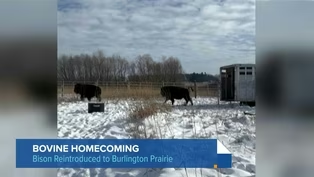
>> Bison are back in Kane County after a 200 year hiatus.
>> That's thanks to a partnership between the county's Forest Preserve District and Chicago's American Indian Center.
The reason tablets presence of the 6 Humpback Bovines has both ecological and cultural significance.
Our Patty, what Lee joins us now with more along with American Indian Center.
President Jessica walks first, who's an enrolled member of Menominee Tribe of Wisconsin.
Thank you both for being here.
We appreciate it.
an exciting story.
All right.
So this homecoming, this is 3 years in the making.
How did it get started?
>> Well, there are quite a few conservation herds in Illinois, including at places like midday.
We National Tallgrass Prairie land managers like the Forest Preserve district.
This is kind of the next step in a natural progression for grassland restoration.
And they had actually gone to the folks in Cook County in gotten a funding referendum passed.
So this is kind of a promise that they had made, although they were originally thinking of this exclusively from ecosystem restorations standpoint, I will say they said they saw Ken Burns, American Buffalo documentary and realized they needed to press pause on their project.
Rethink it and reach out to members of the Native American community and make sure that they were involved in bringing the bison that that's very cool to see a first my feet off doing a story that use euro scientists freezing that Well, you Jessica, the American Indian Center is now taking stewardship of the herd you know, in a lot of indigenous nations in the area have a strong connection to bison.
And of course, you know, they're near extinction.
Coinciding with a lot of violence against Native Americans.
What does it mean to be a part of their revival?
get emotional about this, but it is.
>> Literally like even me as a Menominee person.
We've just reclaimed that piece of our history.
So as an indigenous person, Levy and >> the city struggling to be connected to my culture, being able to do this for our community is life changing.
It is emotional it's impactful.
It's intentional and it's something never dreamed we could able to do for our community and we doing it and it's so amazing and it's really powerful to see.
thank you for for sharing that with us.
>> You know, Patty, Bisons, they're considered a keystone species.
And what what kind value do they bring to the prairie?
Look, keystone species is kind of the one that all things kind of cascade from.
So they people like to say, you know, the prairie evolved with bison bison involved with the prairie and without Bison Prairie isn't really a prairie.
And so from there, while we habits to the Beatles that prefer to eat for lack of to the birds that might, you know, ground some of their hair to build Nas.
All these other things come back with the bison.
So it'll be fascinating.
And that's part of what the American Indian Center is going to be helping monitor what kind of changes are happening on the prairie there in King County yet.
us about that.
So our community engagement quarter, Denise, She's actually working on a community science program.
>> That will again monitor the changes monitor how you know the prairie changes with their presence and how they adapt to the prairie.
So it's, you know, basically we're trying to understand their habits as well as part of our process of reconnecting is learning with them.
And so Denise or be in charge of a lot of that programming that happens not only just for our community members, but for everybody to come out and learn with us.
>> Yeah.
So there's, you know, both sort of the citizen scientist aspect of it.
And then there's also, as you mentioned, the cultural traditions helping United folks in an urban environment.
You know, reconnect with some of the cultural traditions about bison.
How do you hope to help indigenous community members, you know, bond with these animals well, there's a lot of hopes there.
But I the gist of it is like, again, I've said this before.
You know, we live in a concrete jungle.
>> Where we can go out and put our feet on the prairie and we don't get the opportunities to connect with our plant and animal relatives.
So, but, you know, student is heard this gives us opportunity to provide those experiences for community members and to help them connect with their culture.
It's again, you know, living far away from our reservations.
There's a lot of disconnection that happens there.
So this is one major step towards helping community members feel connected whether their tribe has a Buffalo history are not really.
I mean, we all identify with you know, but for relatives, no matter what tribe we come from.
So this is just a good way to put it into practice to and create those connections.
Very exciting to see this project become a reality.
And I'm sure there's going to be much more in the years to come.
Absolutely.
Hattie Whitley, Jessica walks first.
Thank you Thanks, Nick.
Thank you.
>> And you can read more about the bison on our website.
It's all at W T Tw Dot com slash news.
Part of Chicago's identity is rooted in its railroads.
But an important part of that history.
>> He's long gone untold in the early 19, 100's Mexican railroad workers helped shape the city's infrastructure.
Our reporter join Hernandez went to the National Museum of Mexican Art in Pilsen to learn more.
>> Literally 100 years ago if a Mexican came to Chicago and you weren't taking airplane and you weren't taking the highway because it didn't exist.
You are literally taking the train.
And when you landed in Chicago at Union Station or any of the stations on time, the job the most readily available was a rebel doubt or a steel jobs are on.
The stockyards of meet is by way of Co-creator of the LSU basis.
>> exhibition takes a closer look at a time Mexican workers were in high demand and the routes they planted still sheep.
These communities today.
>> This is an example of a newspaper, the Burlington Railroad going to Mexico in asking Mexican workers to come work in Chicago and across the Midwest.
>> A collection of photos reveals a lives families built in Chicago and its suburbs.
Census records help trace some of those families to box car settlements along the tracks.
>> We were able to find Mexicans living along boxcar communities right by Midway Airport in Englewood, we found boxcar communities near Blue Island, even as far south, as for example, on 75th and Western in that big railroad yard.
>> Maps, photographs and personal fines show how communities carry their culture with them.
For example, they built a chapel in that blast.
Her community.
>> And that image of beacon of light will pay the image that was hanging inside of the box car 100 years ago in Aurora, Illinois.
>> It's a passion project he says led him to uncover a personal family connection.
my grandpa told me that I have a great uncle who worked the railroad and he was based out of California.
I'm thinking I was going to find document from California signed a definitive document and it says that he was a section labor.
In 1926.
To 1932.
In the maintenance away department.
>> Ottawa, Illinois, so literally about an hour away from here.
I had an uncle who was living here with his family.
>> The exhibit explores World War.
2 and how a massive labor shortage sparked the but I settle program bringing millions of Mexican workers to farms and railroads across the country.
This is literally of magazine from 1943.
>> And you have literally in the magazine is a bilingual magazine that the child for this edition.
It's a full dollar.
The Federal County soldiers of the railroad.
So while we have soldiers abroad of fighting the Nazis, we have soldiers internally making sure that that our supplies were getting delivered.
>> You said this was a time where America embraced.
America, but the unity Mexicans that were being embraced during this era because they needed to fulfill that labor shortage.
Now.
>> What is really a drastic and almost up a critical that a few years later when we get to that after the war time period, goal into the 1950's and that's when we have operation went back.
>> A photo shows ICE agents deporting Mexicans along the same railroad tracks us as Mexican laborers helped to build.
>> And we're literally moment in history where history repeating itself.
Every it deportation campaigns happen.
The 1930's deportation company happen in the 1950's and happening today.
And it's really important for us to see that we we literally have examples of kettles of the Mexican road workers in Chicago who have bought homes.
And few years later they're dealing with getting deported and are writing letters to their loved ones.
Checking up at the half is still standing still be able our pain the morning to the House.
>> Well, the U.S.
hopes uncovering this piece of history inspires others.
>> This is not just about railroads.
I hope that, you know, come here, boys and girls of all kinds and get inspired to beginning of their history and something they'll have an exhibit.
>> For Chicago tonight, I'm joined on this.
>> The exhibition is free at the National Museum of Mexican Art in Pilsen.
We're back to wrap things up right after this.
>> Reflecting the people perspectives that make up this story is part of Chicago tonight.
Not the >> And that's our show for this Thursday night.
Join us tomorrow night at 5.37, for the week in review.
Now for all of us here at Chicago Brandis Friedman, thank you for watching.
Stay healthy and safe.
We have a good nice.
>> Close pass by Robert and
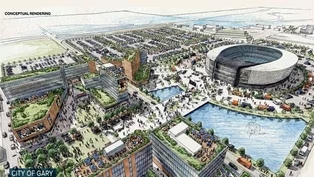
The Bears Stadium Saga Continues. Where Things Stand
Video has Closed Captions
Bears' leadership and Illinois lawmakers have clashed on public funding. (9m 45s)
Bison Are Returned to Kane County and Their Indigenous Stewards
Video has Closed Captions
Bison are officially back on the prairie in Kane County after a 200-year absence. (4m 59s)
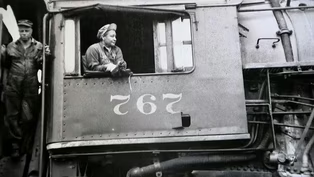
Exhibit Explores Influence of Mexican Railroad Workers in Chicago
Video has Closed Captions
In the early 1900s, Mexican railroad workers helped shaped the city’s infrastructure. (4m 19s)
Providing Support for PBS.org
Learn Moreabout PBS online sponsorship
- News and Public Affairs

Top journalists deliver compelling original analysis of the hour's headlines.

- News and Public Affairs

FRONTLINE is investigative journalism that questions, explains and changes our world.












Support for PBS provided by:
Chicago Tonight is a local public television program presented by WTTW
WTTW video streaming support provided by members and sponsors.