State of Affairs with Steve Adubato
Jane Oates; Aisha Glover; Theresa Maughan
Season 5 Episode 38 | 26m 15sVideo has Closed Captions
Jane Oates; Aisha Glover; Theresa Maughan
Jane Oates shares the ways the pandemic changed workplace environments and the increased need to manage mental health and a work-life balance; Aisha Glover talks about the importance of the economic development programs throughout the Newark community; Theresa Maughan discusses the ways the pandemic changed the future of education and the importance of avoiding burnout in the classroom.
Problems playing video? | Closed Captioning Feedback
Problems playing video? | Closed Captioning Feedback
State of Affairs with Steve Adubato is a local public television program presented by NJ PBS
State of Affairs with Steve Adubato
Jane Oates; Aisha Glover; Theresa Maughan
Season 5 Episode 38 | 26m 15sVideo has Closed Captions
Jane Oates shares the ways the pandemic changed workplace environments and the increased need to manage mental health and a work-life balance; Aisha Glover talks about the importance of the economic development programs throughout the Newark community; Theresa Maughan discusses the ways the pandemic changed the future of education and the importance of avoiding burnout in the classroom.
Problems playing video? | Closed Captioning Feedback
How to Watch State of Affairs with Steve Adubato
State of Affairs with Steve Adubato is available to stream on pbs.org and the free PBS App, available on iPhone, Apple TV, Android TV, Android smartphones, Amazon Fire TV, Amazon Fire Tablet, Roku, Samsung Smart TV, and Vizio.
Providing Support for PBS.org
Learn Moreabout PBS online sponsorship- [Narrator] Funding for this edition of State of Affairs with Steve Adubato has been provided by TD Bank.
PSE&G, committed to providing safe, reliable energy now and in the future.
Horizon Blue Cross Blue Shield of New Jersey.
Here when you need us most, now and always.
Prudential Financial.
The New Jersey Economic Development Authority.
NJ Best, New Jersey'’s five-two-nine college savings plan.
Georgian Court University.
Atlantic Health System.
Building healthier Communities.
And by The Russell Berrie Foundation.
Making a difference.
Promotional support provided by NJBIZ, providing business news for New Jersey for more than 30 years, online, in print, and in person.
And by New Jersey Globe.
[INSPRATIONAL MUSIC] - Welcome everyone.
I'm Steve Adubato.
Hey, listen.
The employment sector, unemployment, the job market, everything you wanted and needed to know.
We got an expert right here.
She's Jane Oates.
She's president of Working Nation.
Jane, great to have you with us.
- Thanks, Steve.
Great to be here.
- Jane, We'll put up the website for Working Nation.
Tell everyone what it is.
- Steve, It's a nonprofit media entity completely devoted to telling the stories of that connection between education and work.
- Okay, so how many more articles do I need to see or reports in the media about, "Hey, there's this great resignation, whatever.
People don't wanna work anymore.
You can't find people to work."
A, how real?
B, is it just the pandemic?
- So look, Steve, it's the most confusing time.
I've been in this workforce education field for a long time.
Most confusing time in my lifetime.
Absolutely, the numbers don't lie.
4.4 million people quit their jobs in September.
That's 3% of the workforce.
But if you dig a little bit deeper, they're still working.
There were over six million hires, and we forget that with the pandemic, the class of 2020, the class of '21 got totally lost in the shuffle, whether they graduated from high school, whether they graduated with an Associate's degree or a Bachelor's degree.
I think a lot of these numbers are them reshuffling, going from being baristas somewhere to going into a full-time job where they studied.
- Do you think... And again, the truth is we lost a couple of our people, talented young producers, but they went to work somewhere else, and they're terrific and are gonna have great careers going beyond this.
But that's not the same as someone saying, "I'm tapping out."
Don't people have to pay bills?
Don't they have to pay rent, their mortgage, the utilities, buy food, get transportation, insurance?
Am I missing something there as well?
- Look, I think there are some people, Steve, and particularly women.
The numbers tell us that the labor market participation rate today for women is about 10% less than it was at its peak in the early part of this decade, but they're worried.
They go back to school.
They have kids.
Their kids go back to school, and what happens if school closes?
What happens if they have to quarantine their kids?
So I think there are still a lot of women sitting back, waiting for the dust to settle.
But what does that mean for their lives?
Maybe they have a partner or a spouse who's supporting them.
Maybe they moved in with their family and they're doing multi-generational living for the short term, but I do think it's possible that some people have just checked out temporarily because they're scared to death about the residuals of the pandemic.
- Jane, you understand work.
And I'’ve been reading and trying to-- We do a separate show on leadership, and I try to connect leadership to the new workplace, if you will, and I tell you why I'm saying this.
There was a great article in the "New York Times" as we do this program last weekend in the business section on more and more employees demanding, and they don't even have to demand it anymore, but a level of flexibility.
Like you say, "You have to be in the office every day," you're gonna have a problem.
If you give people an issue over childcare, you have a problem, and you should because people are more and more expecting a different quality of life.
And if they'’re working at a certain, it'’s not about being at your desk-- I'll get off my soap box.
It's not about being at your desk nine to five any longer, is that correct?
- I agree with that.
I think it's getting the job done, and maybe this pandemic is gonna make us all reevaluate what that means.
Does it matter if you're sitting at a desk?
Does it matter if you're sitting at home, as long as you're getting the job done?
- So we're doing this right now out of a home studio.
I shouldn't say this on the air, but I will.
A lot of people are like, "Oh, that's a great studio you're in."
Well, we built a studio.
We.
I shouldn't say we, I didn't do anything.
A great team behind the scenes built it.
I can do this.
We can do his with producers all over the state, the region, and some, frankly, out of state, doing all kinds of things, but there are some jobs where you can't do this as my point.
Aren't there gonna be some jobs, particularly in the service industry, where you physically have to be there?
And the remote Zoom thing - Absolutely.
- doesn't work.
- Absolutely, and there are gonna some people who have the flexibility of remote work who don't like it, who really prefer working in a team, being in a physical place.
But I do think it's gonna put a lot of pressure post pandemic on HR people because HR people, in order to attract talent and in order to retain talent, are gonna have to move from the one size fits all model that they've been operating under and create a little bit of a mosaic for current employees and future employees.
So you may not need childcare flexibility anymore, but I may need flexibility to care for an aging parent, and that paid leave is gonna be something that is gonna attract me.
And I think the new thing that we're seeing now, which I really like that we used to only see with employees who were in organized labor work sites, we're seeing employees really get some voice and say, "Look, I wanna come and work for you, but what are you gonna do to invest in me?
How are you gonna help me get on a career path?"
So you see the trend, the Walmart, the Amazon, the Target, Macy's now, all saying, "We're gonna pay for your," fill in the blank, Associate's degree, Master's degree, Bachelor's degree.
I think that's gonna be the new normal.
I think that's gonna happen in more and more businesses so then if I can't work remotely in terms of that flexibility, what else are you gonna offer me?
Can I take education benefits during the workday so I don't have to travel to a great college after I leave the workplace?
They're gonna have to offer me something else other than that ability to work remotely.
- So it isn't just going to be, Jane, "Pay me more."
That's not gonna be enough.
- I agree with that.
It's gonna be something.
You saw early on in the pandemic when employers were offering signing bonuses, some of them right there in New Jersey that I would talk to, and they were saying, "I'm offering $1,000 signing bonus, and people still won't come to work."
And they were making the assumption that that meant people weren't going to work, period.
The reality was people weren't going to work at that establishment.
They were probably going somewhere else that where they were giving them something that meant more to them than a one-time $1,000 payment that you had to pay taxes on.
- Jane help me on this.
I think about wellness a lot and not just mine, but in my coaching and on leadership.
I often ask people, "How are you taking care of yourself?"
Point being my sense is that more and more people are more and more concerned about their own wellbeing.
Are you seeing that?
- Absolutely, Steve.
Before the pandemic we played with work-life balance, but now people really want it.
They're demanding it.
They wanna go out and do things with their family.
Basically, they wanna go out and ride their bike or take a walk.
You know I mean, They really do care, and I think it's a real link, I agree with you, with wellness and leadership but also mental health.
I think people are really worried about their long-term mental health.
- Hey Jane, how the heck could I have been in this business for 30 years and not have had you on?
You're awesome.
- (laughs) Steve, you're the best!
You were so good to me - I'm sorry, I'm sorry.
- when I was in New Jersey.
- I didn't hear that.
Could you say that again?
Did you say what?
- You are the B-E-S-T. Georgette, did you get that?
Elvin, did you get that?
- Yeah, no, they're all behind the scenes, and they're all saying, "I can't believe he just mugged and begged for a compliment."
Hey, Jane Oates is the president, (laughs) excuse me, I'm verklempt, (laughs) of Working Nation.
Thanks so much, Jane.
You're terrific.
Thank you so much, Steve.
Bye bye.
- We'll have you back.
I'm so caught up with what Jane had to say.
I think we're going to a break, and we're coming back after this.
(grand music) - [Announcer] To watch more State of Affairs with Steve Adubato, find us online and follow us on social media.
- We're honored to be joined by Aisha Glover, who is Vice President of Urban Innovation at Audible.
She has joined us so many times in the past in a different capacity, talking about issues that matter in urban communities, not just Newark but across this nation.
First of all, welcome Aisha.
- Thank you for having me.
- Talk about Audible and its specific commitment to the city of Newark and the people that you're looking to serve.
- Sure.
So Audible moved to Newark in 2007, I like to say on purpose.
Wanted to really be part of the city's revitalization, and is actually now the fastest growing employer.
And one of the things that I found really appealing was their approach to philanthropy, was not as traditional, very much along the lines of making direct community impact and investments.
And so that looks like everything from working with students to provide them opportunities to be interns, paying them year round for nearly six years, that looks like supporting small businesses and restaurants.
It looks like us also founding and creating Newark Venture Partners.
So the portfolio is pretty diverse.
And how Audible looks at its social and economic impact was just really compelling to me.
- Aisha talk about working local, living local.
- Sure.
So Newark has a pretty transient workforce.
- They leave.
- Oh yeah.
- They're out.
- Kinda in and out.
Right?
And so what that does is it has a tremendous impact during the day while the workforce is there.
And then, you know, you see that tinkering off in the evenings and weekends.
And so you can imagine how much harder the downtown core and the downtown businesses in particular were hit during the pandemic, because what you saw was an absence of corporations, of institutions, of our two major entertainment venues being closed.
And so what we've tried to do is double down on our efforts to kind of make up for our own absence and quite frankly the absence of others, right?
And so personally I was excited about so many of the interventions and the COVID response solutions because it was kind of maintaining a lot of the growth and the economic gains that Newark had been experiencing.
Right?
And so Newark Working Kitchens I think is a great example of that.
Our future leaders program, we actually doubled-- - Go back to Newark...
I'm sorry for interrupting.
I said, go back to Newark Working Kitchens.
I'm fascinated by that.
Explain to folks what it is.
- Sure.
So Newark Working Kitchens was started in April of 2020 and it is essentially a meal prep program.
So we would, we partnered with World Central Kitchens and Marcus Samuelson, as you know, who has a restaurant downtown, to stand up this effort in order to keep the lights on for many of the businesses.
So we would guarantee a certain number of meals would be purchased every week.
And then the beauty of this program is also matching those meals to people across the city that need it the most.
So we're keeping restaurants open, we're keeping their employees employed, many of whom are actually Newark residents.
And then we're bringing that food to people across the city that need it the most.
We've been running that program every single week for nearly a year and a half and we've delivered a million and about 1.2 million meals.
- And people like Marcus Samuelson, I remember we interviewed him at NJPAC several years ago.
I mean, just amazing important entrepreneur in his field, but making a contribution and making a difference philanthropically as well.
Hey, listen, talk to me about Newark Artists Collaboration, because the arts matter here as well.
- The arts absolutely matter.
And I think it's a great example of what started going on in our brains after the huge success of Newark Working Kitchens, like starting to look at other sectors that had also been impacted and potentially even really overlooked, right?
So besides the fact that we have a pretty deep commitment to the cultural life in the city, I think our goal was really, how do we support those local artists and art organizations?
So we're actually commissioning over 15 public art installations.
Some actually, some are internal to our building because we were undergoing a renovation.
And some we've pushed out as kind of a gift to the city around beautification, but more importantly to really put funding into the hands of the arts community in the city.
- And so many of those artists have suffered.
And listen, everyone has suffered in one way or another around the pandemic, but we had an artist on recently who just talked about the devastating impact on his art.
Frankly on the economics of his art.
We need to understand that, do we not?
Because if we lose that, that's losing a part of who we are as a people.
- That's a 100%, you nailed it Steve as usual.
This is really about economic revitalization, about having culturally diverse and dynamic neighborhoods, right?
We don't want to look like any town USA.
We need to really preserve so much of that art history and that creative talent in the city.
And so we were really determined to be pretty intentional about the first go round and then really how we grow this program.
- Before I let you go Aisha there's a, is there a summer internship program we should know about?
- Absolutely.
So this is one of the things I get most excited about because it's not about who you know, it's really-- - Is that at NJ Leap?
- It is.
We did also partner with NJ Leap, but our kind of signature internship program works with only Newark high schools.
We bring interns in as juniors in their high school year and we pay them year round and follow them all through college, which is pretty unprecedented.
It's not your standard corporate summer internship.
And so the exposure that these students get across a range of departments, the investments they get from us, the mentorships and technical assistance and support is really unmatched.
So I love that it's Newark.
I love that it's students and I love that it's deep and meaningful.
- Yeah.
Hey Aisha, it seems to me it doesn't matter where you are, what organization you're with, but now you're with Audible.
You always seem to be making a difference particularly in Brick City, in Newark, and that's important.
- Thank you.
- And you have an open invitation to be with us anytime.
Thanks Aisha.
- Thank you.
I appreciate that.
- You got it.
I'm Steve Adubato, that's Aisha Glover.
We'll be right back.
(grand music) - [Announcer] To watch more State of Affairs with Steve Adubato, find us online and follow us on social media.
- We are honored to be joined by Theresa Maughan, who is a high school Social Studies teacher at East Orange STEM Academy and in fact, the 2022 New Jersey State Teacher of the Year.
Theresa, Congratulations.
- Thank you so much.
Thank you.
- Tell everyone what that means.
- Well for me, having been a teacher for 40 years, it is a little bit surprising, but extremely, extremely rewarding.
It makes me feel like my years of service and dedication to my district and to my students and to my peers, that it's something that has gained recognition and it's given me an opportunity to have a platform to speak about the things that are very important to me.
- Your background is extraordinary.
How you came to teaching, special.
Describe where you grew up, how you grew up.
- Yes, I, my story is an immigrant story.
I arrived in the United States when I was five years old and I grew up in Jersey city.
My dad had come to the United States on a work visa.
He was a printer, and when I was in middle school, it was made known that his visa was not going to be renewed.
So technically, my family, we were undocumented aliens at that point.
My school, I attended parochial school in Jersey city at that time, Our Lady of Victories and the teachers there really rallied around my family, especially my Social Studies teacher, Mrs. Roman, who I've recently reconnected with and she galvanized our student body.
They started to write letters to our congressmen.
She arranged for a story to appear in our local newspaper, the Jersey Journal, and this enabled my family to get the support.
We were able to connect with an immigration lawyer and navigated through the naturalization process over a period of years and ultimately earned our green card and then our citizenship.
- I'm sorry, I'm sorry cause I hate when I'm managing time like this, there's so much more to this story, but why did you decide to become a teacher given everything you just said?
- Well, I realized that the same way that she had helped me, it was something that I felt I would be able to do with others.
Initially I wasn't going to be a teacher.
Initially I was going to be a lawyer at Rutgers University and that's my Alma Mater but I knew there was something missing.
There was something missing and so I changed my major and that led me towards becoming a Social Studies teacher.
- 40 Years.
- 40 Years, yes.
- Let me ask you, the most rewarding aspect of your teaching is?
- The time I spend in the classroom with my students, the realization that I can help in some way to have them fulfill whatever their goals are that they may have.
I find my contact with them to be, I describe it as my life's blood.
It's something that I realized I was missing extremely over the past year and a half.
- The pandemic was tough for them, for you.
- Yes, it definitely was.
We were, it's not the same when you're not in the classroom and it has become exceedingly clear once we came back in September.
There's just something that happens with interaction, personal interaction and so that was definitely missing and it had an impact, took a toll on the social and emotional wellbeing of my students and myself and my coworkers.
- Yeah.
You know, speaking of in-person and remote, the New Jersey Education Association Convention, Atlantic City, you were there, you were recognized, your to be an ambassador in 2022 with this title.
What is the most memorable part of that convention for you?
- Part of it was having my family there to share in the celebration but another part of it was the theme.
It was social and justice and equity and justice and learning and the keynote speakers were unbelievable.
Being a history teacher, I am a groupie of Dr. Henry Louis Gates and having the opportunity to meet him and have a picture with him that was extremely memorable.
- You know, we've had so many educators on over the years and I'm always struck by the passion for teaching.
You've made it clear what your history is and what your passion is, but how is it that you avoid, Theresa, how have you avoided, dare I use the term, burnout in the classroom.
How have you avoided it?
- I've avoided it through professional development.
For me, I was able to utilize resources to take courses in the summer-time or throughout the school year and I do credit my longevity to my growth mindset and to the access to professional development.
I'm able to recharge, is what I say, when I do the workshops in the summer.
- So being with your colleagues and learning together is a big deal?
- Absolutely, absolutely.
That concept of having a professional learning community, it's extremely important.
You know, you're able to share ideas, best practices-- - Struggles.
- Struggles, yes and most importantly, we can put our students in the center and we can discuss and brainstorm ways to meet them, you know, with what they need to have access to, to have a better educational experience.
- One to ten.
Rate, your level of satisfaction, even before you were selected to be the 2022 State Teacher of the Year.
One to ten, your level of satisfaction being a teacher is?
- Definitely a 10.
I don't think I would've been able to continue through to this point 40 years in if it wasn't something that I extremely, I'm passionate about and it's extremely important to me.
- Yeah.
Theresa, congratulations.
Thank you on behalf of all of us who have had children in public schools and still do now.
We wish you nothing but the best.
Thank you to all the educators out there cause I know you will represent them well in 2022 and beyond.
Thank you.
- Thank you very much.
Thank you for having me.
- You got it.
I'm Steve Adubato.
More importantly, that's the teacher of the year.
We'll see you next time.
- [Narrator] State of Affairs with Steve Adubato Is a production of the Caucus Educational Corporation.
Funding has been provided by TD Bank.
PSE&G Horizon Blue Cross Blue Shield of New Jersey.
Prudential Financial.
The New Jersey Economic Development Authority.
NJ Best, New Jersey'’s five-two-nine college savings plan.
Georgian Court University.
Atlantic Health System.
And by The Russell Berrie Foundation.
Promotional support provided by NJBIZ, And by New Jersey Globe.
- [Announcer] What is your child's dream for the future?
Doctor?
Teacher?
Architect?
Whatever they aspire to be, a college education may realize those dreams and NJ Best can help.
It's the college savings plan specifically designed for New Jersey families.
Start saving today with as little as $25, because now is the time to invest in their future.
To learn about NJ Best 529 college savings plan, its investment objectives, risks and cost, Read the investor handbook available at njbest.com.
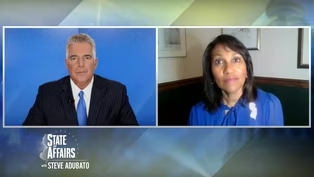
How the Pandemic Changed the Future of Education
Video has Closed Captions
Clip: S5 Ep38 | 8m 51s | How the Pandemic Changed the Future of Education (8m 51s)
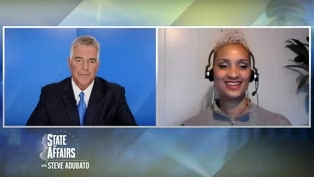
The Importance of the Economic Development Program in Newark
Video has Closed Captions
Clip: S5 Ep38 | 8m 13s | The Importance of the Economic Development Program in Newark (8m 13s)
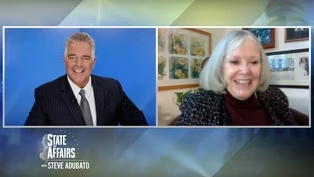
Managing a Mental Health and Work-Life Balance
Video has Closed Captions
Clip: S5 Ep38 | 9m 57s | Managing a Mental Health and Work-Life Balance (9m 57s)
Providing Support for PBS.org
Learn Moreabout PBS online sponsorship
- News and Public Affairs

Top journalists deliver compelling original analysis of the hour's headlines.

- News and Public Affairs

FRONTLINE is investigative journalism that questions, explains and changes our world.












Support for PBS provided by:
State of Affairs with Steve Adubato is a local public television program presented by NJ PBS