
January 10, 2024 - PBS NewsHour full episode
1/10/2024 | 56m 44sVideo has Closed Captions
January 10, 2024 - PBS NewsHour full episode
January 10, 2024 - PBS NewsHour full episode
Problems playing video? | Closed Captioning Feedback
Problems playing video? | Closed Captioning Feedback
Major corporate funding for the PBS News Hour is provided by BDO, BNSF, Consumer Cellular, American Cruise Lines, and Raymond James. Funding for the PBS NewsHour Weekend is provided by...
January 10, 2024 - PBS NewsHour full episode
1/10/2024 | 56m 44sVideo has Closed Captions
January 10, 2024 - PBS NewsHour full episode
Problems playing video? | Closed Captioning Feedback
How to Watch PBS News Hour
PBS News Hour is available to stream on pbs.org and the free PBS App, available on iPhone, Apple TV, Android TV, Android smartphones, Amazon Fire TV, Amazon Fire Tablet, Roku, Samsung Smart TV, and Vizio.
Providing Support for PBS.org
Learn Moreabout PBS online sponsorshipAMNA NAWAZ: Good evening.
I'm Amna Naw Geoff Bennet On the "News Gaza pleads for more food aid, and global leaders condemn the Houthi rebe attack yet against ships in the Red Sea.
Then: Israeli and Palestinian mental health experts work together to im pact the conflict is likely to have on children for generations.
DR. ESTI GALILI- from extreme trauma, as they are, their int Their ability to create, their ability to imagine, they're all damaged.
AMNA NAWAZ: And it was a day of political wrangling on Capitol Hill, with House Republicans holding dual hearings scrutinizing the secretary of homeland security and Hunter Biden.
(BREAK) AMNA NAWAZ: Welcome to the "NewsHour."
The Biden administration has spent this day pressing the Palestinian Authority to reform itself and show it's ready to govern Gaza after the war.
Secretary of State Antony Blinken carried that message to the authority's President Mahmoud Abbas in the West Bank.
William Brangham reports.
WILLIAM BRANGHAM: The meeting in Gaza once Israel's war on Hamas is over.
But, behind the scenes, there was also talk of how the elderly president can rega legitimacy his government needs to lead a possible unified Palestinian state.
Right now, the Palestinian Authority governs parts of the West Bank, but it's widely distrusted and seen as ineffective by many Palestinians.
In one sign of that distrust, protesters clashed with police in the West Bank city of Ramallah, condemning Abbas for even welcoming Blinken's visit.
JAMAL JUMA, Palestinian Activist: It's a shame of the genocide in Gaza Strip.
He should leave immediately.
He should kick h WILLIAM BRANGHAM: Se Authority could reform.
ANTONY BLINKEN, U.S. Sec I think what I take away from this meeting is that much prepared to move forward.
WILLIAM BRANGHAM: Today, Is rael wants out of Gaza.
BENJAMIN NETANYAHU, Gaza or displacing its civilian population.
Israel is fighting Hamas terrorists, not the Palestinian population.
WILLIAM BRANGHAM: In Gaza, this was once the main highway connecting the central part the strip to the south, the Salah al-Din Road.
Residents say Israeli troops left this trail of devastation.
In Deir al Balah in Central Gaza, this building produced eggs that fed people throughout the strip.
Now it's rub Dozens of people are believed to have been killed i under the debris.
MAHMOUD, Relativ telling us: "We're still here.
Come get us."
Here they are.
The bodies a WILLIAM BRANGHAM: Tamer Mohammed is still looking for his loved ones.
He hopes to find any remnant of them so he can bury them with dignity.
TAMER MOHAMMED, Relative of Deceased (through translator): We took out five martyrs that were just limbs and body parts.
I grabbed my uncle, and only half of hi His other half is still under the rubble.
WILLIAM BRANGHAM: In the south, which Israel in to evacuate to, families pick up the pieces after another night of bombardment.
One of the latest Israeli airstrikes in the south pounded this residential building on the outskirts of Rafah.
Hareb Nawfal is in shock as they He said there was no advanced warning before the crowded building was struck.
His is a pain all too common.
HAREB NAWFAL, Relative of Deceased (th of five floors, 14 houses full of children and women full of men and newborns too.
Who should we complain to?
Where is the cease-fire?
They are lying.
They are criminals.
WILLIAM BRANGHAM: As international negotiations br ings more tears, more grief, more death.
For the "PBS NewsHour," I'm William Brangham.
AMNA NAWAZ: In the day's other headlines: Nearly all corners of the country face the fallout from winter storms that brought floods, blizzards and tornadoes.
Tuesday's destructive weather lasted into today and claimed five lives.
Ali Rogin has our report.
ALI ROGIN: Waves crashing into the streets submerged.
An unrelenti Areas of the mid-Atlantic were still underwater after the same storm walloped the region yesterday.
It dumped three inches of rain in some places.
Water leaked into New York City area train stations, turning this Hoboken a river.
In Maryland, emerg In total, yesterday's storms knocked out power to hundreds of thousands across more than a dozen states.
Farther south, the storms were deadly.
Suspected tornadoes in North Carolina and Alabama ki were struck.
In Northern Flor A whole house was knocked over in Panama City on the Panhandle.
By the water, apparent twisters flipped boats and tore a marina to shreds.
RICHARD BRANTLEY, Bayou George, Florida, Resident: I started hearing the wind pick up r strong.
ALI ROGIN: R RICHARD BRANTLEY: so I go over and make sure I got my deadbolt it doesn't blow in.
And next thi So I got all this stuff blowing in around me.
ALI ROGIN: Meanwhile, people in the Midwest and Upper Pl a foot of snow after whiteout conditions on Tuesday.
And there's more to come.
In Iowa, temperatu turnout for Monday's Republican presidential caucuses.
But frigid temperatures may be no match for the Midwestern spirit.
KADEE MILLER, Iowa Resident: If you are in Iowa, you shouldn't be afraid QUESTION: I KADEE MILLER: Yes, yes.
ALI ROGIN: For the "PBS NewsHour," I'm Ali AM NA NAWAZ: The coming cold wave also means frigid football weather for Saturd NFL playoff game in Kansas City.
It's projected to be two below zero at kickoff.
The Chiefs will host the Miami Dolphins, who practiced at home today in Fo rmer New Jersey Governor Chris Christie has dropped out of the Republican presidential race.
He announced Christie was the strongest critic of fo failed to make headway.
FMR.
GOV.
CHRIS CHRIST a path for me to win the nomination, which is why I'm suspending for president of the United States.
AMNA NAWAZ: Supporters of Nikki Haley had in the New Hampshire primary 13 days from now.
But just before his announcement, Christie was heard on a live mic sa -- "She's going to get smoked.
She's not up to this."
Former President Trump will not make his own trial in New York.
Today, Judge Arthur En The judge had warned the former president must not -- quote -- "comment on irrelevant matters or deliver a campaign speech or criticize the court."
Trump lawyers objected to the restrictions, so the judge rescinded his ruling.
Russian dissident Alexey Navalny appeared in court via video link today for the first time since he vanished from view last month.
Supporters had lost contact with him for weeks as he was transf the Arctic.
Today, Naval He's serving a 19-year sentence after being convicted of extremism.
Ukrainian President Volodymyr Zelenskyy headed to the Baltic states today hunting for help to shore up Ukraine's air defenses.
It came as Russia intensifies missile and drone attacks.
Zelenskyy met with Lithuania's president in Vilnius.
Later, he said Ukraine has shown that Russia can be stopped, and he ins has strong support.
VOLODYMYR ZELENSKYY, Ukrainian partners to stop our defense.
I would not say stopping of hostilities.
It is defense, to end our fair defense, to end There is no pressure to freeze the conflict, not yet.
AMNA NAWAZ: NATO pledged today that the flow of military and other supplies wi ll continue, but a new round of U.S. aid remains stalled in Congress.
The death toll from New Year's earthquakes in Japan has reached 206.
Officials say eight of the deaths happened from injuries or sickness at evacuation centers.
Close to 26,000 people remain in shelters.
In the meantime, rescue teams continue the search for bodies, though cold rain are hampering the effort.
More than 50 people are still listed a Back in this country, legendary Alabama football coach Nick Saban is retiring.
It is widely reported tonight that he will call it quits after winning six national c at Alabama and one at LSU.
Saban is 72 years old and has coached And on Wall Street, stocks advanced ahead of tomorrow's report on December inflation.
The Dow Jones industrial average gained 170 points to close at 37695.
The Nasdaq rose 112 points and the S&P 500 added 27.
And in Missouri, Kansas City teen Ralph Yarl has made the All-State Band nine months after being shot in the head.
Yarl was shot when he went to wh ite homeowner opened fire.
Ralph is now 17 and he plays bass Still to come on the "NewsHour": the defense secretary's cancer diagnosis highlights the importance of early detection; an alarming discovery of unmarked graves behind a Mississippi prison leads to an investigation; and an unlikely collaboration, art and quantum computing.
For the first time in nearly 150 years, the House of Representatives is poised to impeach a member of the president's Cabinet.
But while conservative lawmakers are accusing th e border, they're struggling to control their own chamber.
Congressional correspondent Lisa Desjardins saw it all firsthand today and Go od to see you Lisa.
LISA DESJARD AMNA NAWAZ: the homeland security secretary?
And do they all agree amongst themselves LISA DESJARDINS: We know the Th e argument from House Republicans, twofold here.
They're saying that Secretary Mayorkas failed in his duty to prote power.
Specifically control of the border.
I want to play a sound bite from This is Clay Higgins of Louisiana.
REP. CLAY HIGGINS Mayorkas.
I sit here t He's going to be impeached.
And he should be.
He is the executive in charge of LISA DESJARDINS: They say it's a dereliction of duty that is causing a security problem for the country.
Now, Democra They say, first But Mayorkas himself has said An d as far as operational control, he says he sets a reasonable standard.
He's not saying that not a single illegal crossing happens.
Now, as for does everyone agree, House Republicans do seem to agree on this, but no Listen to Senator James Lankford of Oklahoma.
SEN. JAMES LANKFO I don't find Republicans, Democrats, independents, anyone that looks at the border th at's going well, that's being handled well.
Problem that Secretary Mayorkas States and these are the president's policies.
LISA DESJARDINS: He's saying Le t's focus on the border itself.
Also, Jonathan Turley, a fo r failure to do their job.
But it does look lik And I'm told as soon as the last week of t AMNA NAWAZ: So, when you take a step back, help us understand how this impe and what's happening at the border all impact what's going on, on Capi LISA DESJARDINS: It is the keystone, Amna, to all of these major issues that will affect perhaps most of us in this country in the next month.
So, first of all, let me tell you why the pr Members are just coming back from their holiday breaks, many of them now finding that the migrant surge has affected more communities than it did before, cities dealing with populations of migrants.
They are dea I talked to one member of Congress funerals blamed on problems at the border.
Now, when you look at that, let's talk about how this breaks down into th is tangible pressure on this one thing.
First of all, there are members, inclu that their districts are now being affected directly by this.
Now, then you talk about the issues here.
No Ukraine funding will be passed, at least no That's been tied -- those two have been tied together for a month now, and that tie is getting even more strong.
Now, in addition to that, some sp ending until there are changes in border policy.
And as you and I have been talking about, we have two governme up, one in just nine days.
AMNA NAWAZ: On that note, you have b shutdown in just over a week.
What do we know?
LISA DESJARD will see a partial government shutdown.
However, this is very fluid.
It could easily change a w The reason is that House conservatives especially top-line spending deal between Speaker Johnson and Democratic Leader in the Senate Chuck Schumer.
They want bi So, meanwhile, Speaker Johnson, Leader Schumer are trying to pass s They have to pass 12 of them by the 19th -- about four of them, actually, by the 19th.
So, all of this is very confusing.
Four of them by the 19th.
It takes a week for the Senate to So we need probably a temporary spending bill to get through this.
Speaker Johnson has said in past he won't do that.
Here's what he said today over whether he will g REP. MIKE JOHNSON these appropriations done.
And I think we can And we're pu LISA DESJARDINS: Yes, bu the line, saying, if you accept one of -- this temporary spending bill, we may try to you, and also that we want a shutdown.
Here's someone who's not even Wh ere are you on whether a short-term C.R.
is something you could stomach, or if you would rather risk a shutdown?
What do you REP. BRIAN MAST ( for the things that are on the line.
We talk about for the last year bord that's going on, the invasion of America.
It's still not being addressed.
LISA DESJARDINS: Now, are digging in on the House side toward a shutdown.
They think there are advantages to it.
They are the only to force Speaker Johnson into that position.
AMNA NAWAZ: As if that wasn't enough, ther You were covering a surprise appearance by Hunter Bid in contempt.
What should LISA DESJARD Hunter Biden speak publicly to the committee investigating him and family ties for th He showed up at the hearing today that was moving forward on contempt charges against him.
He didn't sp He would lik He was trying to say, listen, I'm willing to talk.
But House Republicans say, no, we need to speak to you for longer an than we would have in a public hearing.
Essentially, what this was, was I do think House Republicans will keep moving forward in impeachment, but this just adds to the drama and confusion.
AMNA NAWAZ: Busy More busy days ahead.
LISA DESJARDINS: Yes.
AMNA NAWAZ: LISA DESJARDINS: You're welcome.
AMNA NAWAZ: Today, the U.N. Security Council demanded that Houthi rebels in Yemen stop attacking international ships in the Red Sea.
The U.S. military says there have been more than two dozen attac the most serious yesterday, when Houthis fired more than 20 drones and missiles right at U.S. and allied warships.
Nick Schifrin looks at the Ho NICK SCHIFRIN: In the middle of the Red Sea, British sailors shoot down incoming Houthi drones and missiles.
The U.K. and Secretary of State Antony Blinken: ANTONY BLINK there will be consequences.
NICK SCHIFRIN: British Def GRANT SHAPPS, British Defense Minister: And we cannot route, a major ability to move goods around the world is being cut off by terrorists and thugs, and we therefore must act.
NICK SCHIFRIN: Since mid-November, Houthi rebels h vessels and kidnapped foreign sailors.
The Houthis have said they target ships linked to Israel, but, today, a Houthi spokesman said the target was an American warship, retribution for the U.S. Navy last month sinking Ho boats and killing 10 Houthi fighters.
YAHYA SAREA, Houthi Military Spokesman (through af firm that they will not hesitate to deal appropriately with all hostile threats within the legitimate right to defend our country, people and nation.
NICK SCHIFRIN: Some 15 percent of world shipping goes through the Suez Canal, which links the Red Sea with the Mediterranean.
Houthi attacks have so far upended international commerce, vessels and increasing shipping costs.
Last month, the U.S. launched a multinational coalition to protect commerc And, last week, the U.S. and 13 other countries issued what an official called a final warning.
"The Houthis will bear the responsibility of the consequences should they continue to threaten lives, the global economy and the free flow of commerce in the region's critical waterways."
But, so far, JOHN KIRBY, NSC Coordinator For Strategic Communications situation not escalating is for the Houthis to stop these attacks.
NICK SCHIFRIN: The Houthis are a rebel group backed by Iran that in 2014 seized the Yemeni capital, Sanaa.
For years, they fought Saudi Arabia as part of a bru of thousands, but, for 20 months, there's been a shaky cease-fire.
Houthi missiles are based on Iranian technology, and a U.S. official tells "P is coordinating the current attacks and helping provide the targets.
MAN: The draft resolution is adopted.
NICK SCHIFRIN: In New York today, the U.N.
Se the Houthis cease all attacks and release two dozen foreign hostages.
BARBARA WOODWARD, British Ambassador to the United Nations: We wil the Houthis to threaten civilian vessels and hold global food and energy supplies h NICK SCHIFRIN: So what is motivating the Houthis to launch these attacks and what should the U.S. do about them?
For that, we turn to J Initiative at the Atlantic Council and the former deputy national intelligence officer for the Middle East.
Jonathan Pan Welcome to the "NewsHo What do the JONATHAN PANIKOFF, Atlantic Council: Thank you I think the Houthis really have fr ame it.
The Houthis do The Houthis are trying to negotiate a final resolution in terms of the wi th Saudi Arabia.
I think it's pro And so I think the Houthis see this as a realistic policy option in order to try and better their position for the long term in Yemen for the years to come.
NICK SCHIFRIN: But do they also risk something by continuing these attacks, especially a they came out today and said explicitly that the target was a U.S. Navy ship?
JONATHAN PANIKOFF: Certainly, they could.
Obviously, the United States It 's had multiple countries join, though, importantly, not some of the Gulf countries, like Saudi Arabia and the Emiratis, who have long been in conflict with the Houthis.
So it's possible, obviously, the U.S. will respond.
And we saw some discussion today and references that the U.S. an doing so.
But the Houthis have been I'm skeptical that a response, especially a one-time response or even two-time response, is necessarily going to deter them if they think that's really going to better their position in the months to come.
NICK SCHIFRIN: The U.S. last week gave what An d you heard earlier today John Kirby from the National Security Council there clearly sending the message that still they hope the Houthis stop these attacks.
Bottom line, do you think the U.S. should launch a military strike?
JONATHAN PANIKOFF: I think a military strike is probably point to try to restore deterrence.
It's not that I think a military strike is necessarily continuing their attacks, but not having the deterrence that the U.S. needs by refusing to respond or declining to respond also signals to other actors in the region, other Iranian-backed proxies that they too may have a level of freedom to engage in attacks against U.S. forces, whether in Iraq or in Syria, or that Hezbollah may be able to actually push the boundaries in Lebanon and into Israel.
The U.S. has said very clearly that's its number one goal, is to avoid a regional conflict.
I think not responding at this point risks deterrence not being taken seriously by our adversaries and actually bringing about the very conflict the U.S. is trying to avoid.
NICK SCHIFRIN: The other argument that I hear from experts who I spoke to today is that, look, a military strike would open up another front, which is a bad idea, and that any weapons or any capabilities of the Houthis that the U.S. destroyed would quickly be refilled by Iran.
What's your re JONATHAN PAN I think whether it opened up another front assumes that the front hasn't already opened.
I think we have seen 26 Houthi attacks since the 19th of November.
We're seeing 15 percent of all maritime commerce goes through the Red Sea.
And you're starting to see huge amounts now having to go around at big cost to companies and countries.
I think we'r front to open.
I actually w about a month-and-a-half, has clearly been a strategy that hasn't worked.
If we don't respond now, I actually think it increases the chance that we end up in a regional conflict, not decreases it.
NICK SCHIFRIN: In some ways, could this military strike, to degrade Houthi capabilities, and then to come in afterward and say, oh, we're the peacemaker, we're going to continue these talks with the Houthis?
JONATHAN PANIKOFF: I think the Saudis are certainly supportive of if the U.S. is successful in them.
And that really means that the U.S. actually mana of deterrence.
The flip sid but not actually keep the pressure on, then my guess is the Saudis are going to be pretty annoyed and feel like it didn't actually do much, because you didn't stay engaged in the conflict.
NICK SCHIFRI The National Security Council th at Iran was -- quote -- "deeply involved in planning the operations against commercial vessels" and was -- quote -- "providing tactical intelligence on that vessel's locations."
How does that work?
JONATHAN PAN to its various partners and proxies throughout the region, and that includes the Houthis.
In this case, it means that the Iranians may have identified targets that they have passed to the Houthis.
It could mea have wanted Houthis to strike, or it could mean that the Houthis identified targets and went to the Iranians to validate them, to say, does this make sense?
So, I think there's a variety of ways that that can work, but the bottom line is, one way or the other, Iranian support for the Houthis is helping them to take these strikes successfully.
NICK SCHIFRI JONATHAN PANIKOFF: Thank you.
AMNA NAWAZ: Well, it's and the damage from the conflict will be felt for years to come.
Hamas' attack on October 7 and Israel's counteroffensive since have left thousands de immense physical destruction.
It's also left an indelible mark on the collecti its children.
William Brangham has the sto WILLIAM BRANGHAM: The Binational School of Psychotherapy launched about seven years ago trains postgraduate students to care for traumatized children, this in an area with seemingly endless conflict.
The trainees are a m together.
I recently s and Shafiq Masalha, a Palestinian Arab Israeli.
Thank you both so much for joining us today.
Obviously, it's impossible to encapsulate everything tha and seeing and experiencing in the midst of this war.
But I wonder if you could just talk a little bit about the kinds of challenges that these professionals will have to deal with trying to help children who are living through this experience.
DR. ESTI GALILI- from extreme Their concentration is damaged, so their intellectual abilities are damaged.
Their ability to create, their ability to imagine, they are all damaged.
The anxiety shows up as behavioral problems, as problems with connecting with the others, or with feeling safe, being able to enjoy play.
It's like basically having something of an iron cast kind of stifling all your mental and cognitive functions.
DR. SHAFIQ MASAL we are counting the number of people who are dead or injured, but we do n any idea now about the psychological harm that's going on and that will show itself very soon.
I'm very afraid that the n suffering from this trauma.
WILLIAM BRANGHAM: As the war grinds on, Masalha and Galili-Weisstub have contin remotely.
Both Israeli and Palestini though some have lost loved ones themselves.
There are two trainees living in Gaza, and the directors have had only sporadic contact with them.
DR. SHAFIQ MASAL in distributing food and all other... DR. ESTI GALILI- DR. SHAFIQ MASAL You know, ou language even when they talk to people around, to children around.
I mean, it's a different attitude.
So even if they don't do pure clinical work and there's influence.
DR. ESTI GALILI- immediate threats is so large, we don't have the ability for meaningful one-on-one ongoing therapy.
So, mostly it' It's not actual therapy.
But even those small interactio or the adolescent, support his family and to give them a little bit of hope and understanding that it is a process.
And, hopefully, they wil we're trying to listen to you, we're trying to do the best we can.
The situation, as Shafiq said in Gaza, is in a different scale, so there is no ab but to deal, and I don't know exactly how they do it, with communities.
But we really hope that better days will come and we will be able to offer therapy again.
DR. SHAFIQ MASAL conflict, they talk in historical or political terms.
And very few talk in psychological terms.
Like, there are two people who are traumatized, who are acting from the place un der threat all the time, feeling anxious all the time, feeling that their existence is in danger.
So this is exactly what happens to the i We believe, if there were two individuals, we would be able much more to help them.
But because it's a mass psychology, it's more difficult.
WILLIAM BRANGHAM: The directors also believe that, by bringing Israeli and Palestinian practitioners together, they can help two traumatized communities start to heal.
DR. ESTI GALILI- other is our only hope to ever bridge and build something together.
If you look into in-depth psychology, the importance of being empathic to parts that are difficult are the most important part of the therapeutic process.
But, here, I must say that it is almost physically painful to sit and to realize how hard it is for the other, and at the same time being scared and being worried and being ashamed and being angry and being, I think, all the myriad of feelings that we have to deal with as students and as supervisors.
Right now, the emphasis is on relating to the others, even i that we are going to share the same piece of land, so relating to the other is actually our future.
DR. SHAFIQ MASAL a lot of resistance in their communities joining a joint group of Israelis and Palestinians.
They live in a very small piece of land, but they live with a lot of boundaries, physical boundaries of meeting each other and psychological boundaries.
So they really don't know each other as human beings.
There's a lot of dehumanization.
The other is an enemy.
You know, I can't talk to th So this is the feeling of the vast majority of both sides.
So, in this case, we created an island, I think, that, within the last 20 years, I believe that there's not such a place where Palestinians and Israelis equally go through the same program and meet each other.
And they have a grou It's not only learning material, but we need to create more events like this.
WILLIAM BRANGHAM: All right, Dr. Shafiq Masalha and Dr. Esti Galili-Weisstub, thank you both so much for talking with us.
DR. SHAFIQ MASAL DR. ESTI GALILI- AMNA NAWAZ: The diagnosis of Defense Secretary Lloyd Austin's prostate canc decision not to disclose it has put that cancer back at the center of some attention.
As John Yang explains, it's one of the most treatable cancers.
But for many men, there's still a stigma around it all too often.
JOHN YANG: Amna, Secretary Austin was one of the estimated 288,000 men diagnose prostate cancer in 2023.
It's the most common cancer among Cancer Society, the five-year survival rate in the United States is 99 percent.
While one in eight of all men will develop the disease in their lifetime, among Black men, it's one in six.
Dr. Jay Raman is professor and chair of t Dr. Raman, we have often heard prostate cancer be described as slow growing.
So help us understand where it is, and how often does it spread?
DR. JAY RAMAN, P I think one a spectrum of disease.
There are certain type They're indolent.
You're more likely to die with it than die fr But there are other types that are more aggressive, and these re radiation, or some combination.
But all of these collectively, as you alluded to, result in a if it's found early.
JOHN YANG: And let is.
DR. JAY RAMAN: S It's about t It's located deep in t And it's really a reproductive It really helps with men having secretions that n and allow them to have children.
Later in life, however, we really know prostate cancer, the other being an enlarged prostate.
And in this case, we're talking about developing prostate cancer in t JOHN YANG: Secretary Austin's physicians say his cancer was detected early and as part of a routine health screening.
Are there lessons in that?
DR. JAY RAMAN: W And screening really involves identifying problems such as cancer at an and an early phase, when it's not only treatable, but highly curable.
For prostate cancer, we're really talking about checking a blood test called the PSA test, as well as a rectal examination to feel the prostate for lumps and bumps.
And an abnormality in either of these could suggest the presence of prostate cancer and at a minimum needs to be pursued further.
JOHN YANG: Screening, how soon should it be DR. JAY RAMAN: S looking at ages between 45 and 50 years of age to have that initial PSA blood test, as well as that initial rectal examination.
Now, there are certain patient Those are patients of Black African American race or Black ancestry, those wi male relative with prostate cancer, or those with genetic or hereditary mutations.
Those patients really need to be screened at an earlier age, about 40 to 45 years, because they're at a higher risk of developing the disease.
JOHN YANG: Is there a stigma around prostate ca disease that leads to impotence, it leads to incontinence?
DR. JAY RAMAN: W If you look at breast cancer i we see in prostate cancer in men.
And women are excellent advocates for their heal You hear a lot about mammography, self-examination, getting ch I think, for men in general, health problems create a little bit more of a stigma, the sense that, if they feel fine, there might not be a problem.
And the reality is, is that diagnosing and checking these conditions pr ostate cancer early allows you to identify it at a point where maybe some of these side effects that you talked about, impotence and incontinence, may be mitigated or minimized.
JOHN YANG: We also hear women talk a lot about breast cancer, talk about it among themselves to bolster each other, men not so much about prostate cancer.
Is that a hurdle to more screening and more detection, early detection?
DR. JAY RAMAN: A If you look stage or a late grade.
And once men start having symptoms, I always wa gon and the ability to treat and cure this disease is less.
So I really believe that high-profile cases like this really underscore the importance that anybody can get prostate cancer, those that are in your community, those that perhaps are of higher profile, and the importance is really getting the word out, having these discussions, understanding that one in eight men do develop this disease, and it's important to have these discussions, and so men get checked and screened.
JOHN YANG: Dr. Jay Raman of Penn State Health, DR .
JAY RAMAN: Thank you.
AMNA NAWAZ: The gruesome discovery of 215 bodies buried in unmarked graves behind a jail outside of Jackson, Mississippi, has left a community in disbelief.
The families are angry their loved ones were buried in so-called pauper's graves marked by just a metal rod and a number and families were never notified of their deaths.
The startling revelation came months after the mother of 37-year-old Dexter Wade filed a missing persons report last March.
It wasn't until August when Bettersten Wade learne and killed, then buried in that same cemetery.
For more about this case and the disturbing details that have emerged since jo ined now by Bettersten Wade and civil rights attorney Ben Crump, who is repr and other families.
Welcome to you both.
Ms. Wade, ca for joining us.
BETTERSTEN W AMNA NAWAZ: I understand, that your son was missing several times, even after he had been buried without your knowledge.
Give us a sense of what they told you over those many months and what those months were like for you, not knowing where your son was.
BETTERSTEN WADE: Well, it was devastating to m And then I was calling them.
They didn't have no informat All the details that I gave them for leads, they never came back to me to say, well, that lead led to something that we can work with.
And I just couldn't believe that he had disappeared off the face he at.
And it was j And every day I wake up, I just just out in the streets looking for him.
And, I mean, that's heartbreaking for a moth in touch with him.
That is a horrible thing AMNA NAWAZ: Mr. Crump, after it was discovered that Dexte buried in this grave, his body was exhumed in November.
There was an autopsy conducted.
He was given a proper buri But I also understand a wallet was found in hi his insurance card.
What's the explanation an d buried?
BENJAMIN CRU they have offered.
They claimed that they t And you should know that Ms. Bettersten is the named plaintiff in a lawsuit against the Jackson Police Department, because they killed her brother three years earlier.
Now, she went through two criminal trials, had several press conferences.
So when they called her house, if they did call her house, like they claim, they knew where she lived.
They knew ho son Dex had been hit by a police car.
So it is very suspicious that they would just bury him said they could not identify his next of kin.
Ms. Bettersten does not accept it.
And because of her tenacity, it has exposed all hole in a bag behind a Mississippi jail.
AMNA NAWAZ: Mr. Crump, the Jackson mayor did say th He also just said that Dexter Wade's death was a tragic accident.
He said there was no malicious intent in failing to notify the family.
We know the police department has new notification procedures right now.
What recourse are you specifically seeking right now in these -- for these families you represent?
BENJAMIN CRU do an investigation to make sure that each and every one of these citizens, disproportionately Black citizens, whose lives matter will be identified, their families notified, and them given a proper funeral.
AMNA NAWAZ: And I should here.
There's been Moore and 39-year-old Jonathan Hankins were also killed and buried in that same cemeter and their families not notified for months.
From your perspective, Ms. Wade, what do you want to see happ BETTERSTEN WADE: Well, first of all, I feel like that the city need to give me an ac to say that, hey, I'm sorry.
I mean, just give me some kind of closure and expl my son on that freeway that night.
How did it actually occur, you know, just what went down, the events t with it?
And I want t I want to see justice done for th It's wrong to take somebody's child and bury them in a field and take -- and I didn't even get a last chance to say anything to my child, or I didn't even get a last chance to just say, babe, I love you, just to look down on them and say, babe, I love you.
They haven't even came and called me and said, Ms. Wade, could you come down and we to you what happened?
I mean, I haven't even got a An d so how do that feel?
That makes y They are guilty of a crime, because they c AMNA NAWAZ: Ms. Wade, do I understand correctly that the mayor, no one from the police department has reached out to you to explain what happened to your son?
BETTERSTEN WADE: No, no one have reached out to me to say -- to explain what happened to my son.
But I did at that they hated what happened to me.
But I haven't had said anything -- nobody from J came to me and acknowledged me.
AMNA NAWAZ: Mr. Crump, the story gets even bodies in that cemetery.
What do we know about those bodi BENJAMIN CRUMP: We know, based on the records from the in the last eight years, we can identify 215 individuals that were buried behind that jail, and their families have not been notified.
Furthermore, Mr. Wade was number 672.
That means there are 671 other people buried behind that jail marked with only a number.
AMNA NAWAZ: Mr. Crump and Ms. Bettersten Wade, I thank you so much for joining us tonight.
I have a feeling we will be following up on this story in the weeks and months ahead.
Thank you so much for joining us.
Appreciate it.
BENJAMIN CRUMP: Thank you.
AMNA NAWAZ: Advanced technology labs are not places you're likely to find much creative artistic expression, let alone color.
But a scientist and an artist have joined forces to help inspire t the next generation of computing at Google's Quantum A.I.
lab.
Special corr Canvas.
MIKE CERRE: an artist collaborated to turn this advanced technology lab for building the next generation of computing into an art museum to help inspire the innovation.
FOREST STEARNS, Artist in Residence: We have created a space where there is no edge between the hardware, the art, the architecture, the scientist and nature itself thro MIKE CERRE: Forest Stearns, a Google artist in residence and Erik Lucero, the Google engineer charged with developing its first quantum A.I.
computer, have a mutual fascination with art and science.
ERIK LUCERO, Director, Google Quantum A.I.
Lab: I think to capture what I think are beautiful things that we make in electrical engineering in physics.
MIKE CERRE: and artist in residency at Google Quantum A.I.
after seeing Stearns' Draweverywhere work imprinted on satellites in space.
FOREST STEARNS: Having figured out how to make the largest art exhibit in space, put the light bulb of let's put art on technological things to amplify humanity.
So you asked him, what is quantum computing?
FOREST STEARNS: I asked Erik, what is And instead of sending me a white pape of the quantum computers.
MIKE CERRE: Since this nex than mathematical computation, like existing computers, quantum computing's connection with nature became the unifying theme for the art everywhere, from the lobby sculptures of some of the hardware and 3-D installations in the company's cafe to wrapping the quantum computers themselves in art.
FOREST STEARNS: The quan (LAUGHTER) ERIK LUCERO: So it's lovely to experience flat you see it adorning a quantum computer.
I feel like that was when -- I do machines kind of like hugged by this art.
MIKE CERRE: Chill is the operative term here, since the chandelier-like gu computer need to be kept running at more than 400 degrees below zero inside these refrigerated containers called cryostats.
FOREST STEARNS: We have 16 Some of them are traditional oil painters.
Some of them are digital artists.
We have craftsmen that work in RA VIS HENRY, Park Ranger, Canyon de Chelly National Monument: My name is Ravis Henry.
I'm a park ranger at Canyon de Chelly Nationa MIKE CERRE: Park ranger Ravis Henry is also an accomplishe maker.
Stearns and Lucero dis parks for the art project's creative exchange.
FOREST STEARNS: He does his work in metal craft.
It is silver and copper.
And we take this piece a wrapped around within the scientific endeavor.
ERIK LUCERO: I actually had the opportunity to pai I basically finished my day working in the lab, change into my paint clothes and grab a paintbrush with Forest and finish the mural.
FOREST STEARNS: Art is very experiential, wh ere people have inspiration to show up and be great.
JACOB AGUILAR, Google Technician: I mean, everything with vibrant color in here really just helps, I think, express our creative side in here, lab in a creative thinking space, just because, when stuff is just too technical, and it's just basic black and white, it really closes off your mind.
MIKE CERRE: Would you hang the Galapagos in your living room?
WILLIAM GIANG, Google Technician Yes, I definitely... (CROSSTALK) WILLIAM GIAN Yes, we aske ERIK LUCERO: It's important to note that there's real humans that are working on these projec and we care deeply about the places that we live, where we have come from and the planet that we live on.
And I believe th protect our Earth.
MIKE CERRE: as American as the 19th century painter Samuel Morse.
In addition to his anatomy portraits, he developed the first telegraph and Morse code.
His first electronic message, "What hath God wrought?"
Sometimes, there's a perception of a love-hate relation between art, science and technology.
Do you think that's misinterpreted?
ERIK LUCERO: I would challenge that it exists MIKE CERRE: In what way?
ERIK LUCERO: I see When you have the opportunity to do great science, there's just an opportunity of looking at it with a particular perspective that can make it look artistic.
FOREST STEARNS: I am celebrating the fact that quantum physics out here.
And when something is way MIKE CERRE: For the "PBS NewsHour," I'm Mike Cerre in Goleta, California.
AMNA NAWAZ: And, remember, there's always much more online, including a look at Republican lawmakers' efforts in Oklahoma to defund diversity, equity and inclusion programs.
That's at PBS.org/NewsHour.
And that is the "NewsHour" for tonight.
I'm Amna Nawaz.
On behalf of
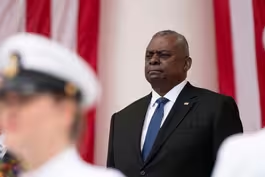
Austin's diagnosis highlights stigma around prostate cancer
Video has Closed Captions
Clip: 1/10/2024 | 5m 13s | Defense secretary's diagnosis highlights stigma surrounding prostate cancer (5m 13s)

Blinken urges Palestinian Authority to govern Gaza after war
Video has Closed Captions
Clip: 1/10/2024 | 4m 6s | Blinken urges Palestinian Authority to show it's ready to govern Gaza after war (4m 6s)

Experts address Israel-Hamas war's impact on children
Video has Closed Captions
Clip: 1/10/2024 | 8m 11s | How mental health experts are handling the Israel-Hamas war's lasting impact on children (8m 11s)
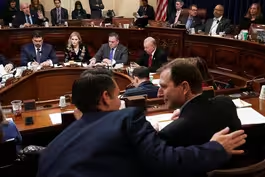
House Republicans poised to impeach DHS Secretary
Video has Closed Captions
Clip: 1/10/2024 | 6m 30s | House Republicans poised to impeach DHS Secretary over problems at southern border (6m 30s)
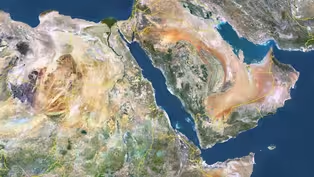
Houthi rebels launch attacks on ships in Red Sea
Video has Closed Captions
Clip: 1/10/2024 | 8m 50s | Houthis launch largest drone and missile attack targeting ships in Red Sea (8m 50s)

Hundreds of bodies found buried behind Mississippi jail
Video has Closed Captions
Clip: 1/10/2024 | 7m 28s | Families in disbelief after hundreds of bodies found buried behind Mississippi jail (7m 28s)

Quantum computing lab transformed into artistic oasis
Video has Closed Captions
Clip: 1/10/2024 | 5m 30s | Why Google transformed a quantum computing lab into an artistic oasis (5m 30s)
Providing Support for PBS.org
Learn Moreabout PBS online sponsorship
- News and Public Affairs

FRONTLINE is investigative journalism that questions, explains and changes our world.

- News and Public Affairs

Amanpour and Company features conversations with leaders and decision makers.











Support for PBS provided by:
Major corporate funding for the PBS News Hour is provided by BDO, BNSF, Consumer Cellular, American Cruise Lines, and Raymond James. Funding for the PBS NewsHour Weekend is provided by...