
January 12, 2026
Season 4 Episode 298 | 26m 31sVideo has Closed Captions
The field of contenders to replace retiring U.S. Senator Mitch McConnell’s seat grows.
The number of candidates vying to replace Kentucky's retiring U.S. Senator Mitch McConnell grows to 19, Louisville Public Media journalist Joe Sonka talks about why so many Republicans will be unchallenged this election year and how a new state law that went into effect January 1st aims to lower the number of colorectal cancer deaths in Kentucky.
Problems playing video? | Closed Captioning Feedback
Problems playing video? | Closed Captioning Feedback
Kentucky Edition is a local public television program presented by KET
January 12, 2026
Season 4 Episode 298 | 26m 31sVideo has Closed Captions
The number of candidates vying to replace Kentucky's retiring U.S. Senator Mitch McConnell grows to 19, Louisville Public Media journalist Joe Sonka talks about why so many Republicans will be unchallenged this election year and how a new state law that went into effect January 1st aims to lower the number of colorectal cancer deaths in Kentucky.
Problems playing video? | Closed Captioning Feedback
How to Watch Kentucky Edition
Kentucky Edition is available to stream on pbs.org and the free PBS App, available on iPhone, Apple TV, Android TV, Android smartphones, Amazon Fire TV, Amazon Fire Tablet, Roku, Samsung Smart TV, and Vizio.
Providing Support for PBS.org
Learn Moreabout PBS online sponsorshipmusic >> Democrats have had a hard time recruiting candidates to run in mostly rural areas.
>> Why?
A lot of ballots in November will have just one candidate.
[MUSIC] >> This bill is targeting children and families across our state that are stuck in persistently underperforming school districts with no way out.
>> The case to split up Kentucky's largest school district once again makes its way to Frankfort.
>> Any family history of advanced or large polyps is now considered also to be equivalent to cancer.
>> And how a new law is intended to save more lives.
[MUSIC] >> Production of Kentucky Edition is made possible in part by the KET Millennium Fund.
>> Good evening and welcome to Kentucky edition for this Monday, January the 12th, I'm Renee Shaw.
Thank you for joining us in this brand new week.
It is official.
19 candidates are running to replace Kentucky's retiring U.S.
Senator Mitch McConnell.
The filing deadline for candidates for May's 2026 primary was Friday.
Seven Democrats are hoping to have a chance at flipping the Senate seat.
That includes some familiar names like Amy McGrath and Charles Booker.
Horse trainer Dale Romans and State House Minority floor leader Pamela Stephenson are also running.
One name not on that list is Joel Willett.
The ex-CIA agent launched his Senate campaign back in September.
Willett told the Lexington Herald-Leader he wasn't able to drum up enough financial support for his campaign.
He added, quote, the mood nationally doesn't seem to be one where many people think Kentucky is a competitive race.
End quote.
On the Republican side, a total of 12 candidates are running.
That includes Andy Barr, Daniel Cameron and Nate Morris, who have raised the most money in their U.S.
Senate campaign so far.
And you can see the other GOP candidates listed here on your screen.
Election day is May 19th.
All five of Kentucky's Republican congressmen will face a challenger in the May primary.
Congressman Morgan McGarvey, the state's only elected Democrat in Washington that represents the third Congressional District, is unopposed.
Turning to state legislative races, it's clear the GOP will hold on its supermajority in Frankfort.
That's because many of the seats up for election this year aren't being contested by Democrats.
Our Mackenzie Spink caught up with Louisville Public Media journalist Joe Sonka about why so many Republicans will be unchallenged and what to expect from the primaries this spring.
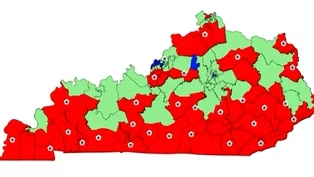
>> According to the Secretary of State's filings, no Democrats filed to run in 42 of the 80 House districts currently served by Republicans.
And in the Senate, half of the 18 GOP held seats have no Democratic candidate.
Louisville Public Media published an article going into detail about the candidate filings.
Coauthor Joe Sonka says the number of uncontested seats reflects the previous 2024 election cycle.
>> Democrats have had a hard time recruiting candidates to run in mostly rural areas where they don't have a great chance of winning, and their districts that Trump won by very large margins, their margins that their districts that Democrats have not done well in over the past decade.
So they tried to to recruit more.
But it's a difficult task when you have a lot of factors going against you.
And and one of those factors is you get lots of mailers saying terrible things about you and all these PACs so that it's a it's a disincentive for a lot of Democrats to run for those offices.
>> Sonka says the way incumbent candidates vote on bills in the General Assembly could reflect whether or not they're facing contests in the May primary.
>> And Northern Kentucky Representative Kim Moser and Representative Kim Banta, they are they're both facing primary challenges, and sometimes they've faced heat from some in the conservative base in Kentucky for not being aggressive enough on social issues.
So the fact that they have primary challengers may be a pressure on them when it comes to any type of more social conservative legislation, whether it's related to T.I.
or trans issues or LGBT rights issues.
>> There will be some rematches of close call primaries from 2024.
One of those is Representative Kim Holloway's seat in Western Kentucky.
>> She had the biggest, probably the biggest upset of the 2024 primary season, where she defeated longtime incumbent Representative Richard Heath, who was chair of the agriculture committee in the House for years.
And not many people saw that one coming.
But she won a very a very tight primary.
And this year Heath is running for that office again, trying to take it back.
>> Some Louisville Democrats are facing primary challenges as well, including Representative Beverly Chester Burton, who has been arrested twice on DUI charges.
>> Representative Daniel Grossberg, who's served a couple terms in the House.
He's also faced a lot of criticism from within his own party and an ethics investigation related to his alleged behavior with women while in office.
He is facing three different Democratic challengers in that race.
>> There are nine Democratic incumbents left unchallenged in this year's election as well, in primarily blue urban districts.
For Kentucky Edition.
I'm McKenzie Spink.
>> Thank you.
McKenzie.
Now, in other news, Kentucky's Medicaid budget has doubled over the last five years and is now more than $20 billion.
Conservative lawmakers say the cost is too high and that Kentuckians aren't getting any healthier.
In tonight's legislative update, our Emily Sisk explains what the Medicaid Oversight and Advisory Board wants to do about it.
>> The big, beautiful bill, which was signed into law by President Donald Trump last summer, made significant changes to Medicaid.
It will substantially cut spending by reducing an estimated $1 trillion over the next ten years.
Americans will see the first impacts of H.R.
one on Medicaid on January 1st, 2027, but the Kentucky General Assembly is preparing for those impacts now with the Kentucky Medicaid Oversight and Advisory Board.
Today, the board finalized nearly a dozen findings related to Medicaid spending and how to move forward.
One of those findings says the current Medicaid delivery model, which has been in place since 2011, has not significantly improved health outcomes.
While the budget has grown unsustainably, the state's Medicaid budget has more than doubled over the past five years and is now more than $20 billion.
But one Democratic lawmaker argued that Kentucky's health outcomes are not as bad as the board was painting them out to be.
>> What data are we relying on to establish this criteria as a state, and what data do we want to rely on moving forward?
I mean, just to say that we're not improving health outcomes.
I mean, a quick review of data in the last 15 years or 16 years show that we have significantly improved our screening rates as a state.
Significantly, a lot of our health data has actually improved tremendously over the last 15 years.
Nothing else.
I mean, just look, over the last three years, our opioid deaths are down year after year after year.
>> What we're talking about outcomes.
We're talking about you're talking about data, particular point of where a particular issue is on health.
We're talking about trends.
We're talking about outcomes.
What's the underlying issue.
In order to move that needle into a and to get a better rankings?
That's what we're talking about.
>> Are screening rates in this state have significantly improved.
>> Senator, you're talking about one particular I'm talking about broad spectrum.
Yes, I agree there are some things that have done quite well.
And we should be proud of those items and those and those movements and the health outcomes.
But when you look at things in total, in general, we need to look at things in totality in order to try to move up.
We're still in the bottom quartile in a lot of these health rankings, even though we moved some into a higher ranking.
>> Republican Senator Stephen Meredith doubled down on the idea that health outcomes have not improved, especially in rural parts of the state.
>> It is not improving.
Rural Kentucky has in some areas, but and we have not as there has been some increases in some areas, but not relative to the amount of expenditure that we're making for the program.
>> I mean, it honestly partially offends me as a health care provider because I think the health care providers in this state are doing an amazing job trying to keep people in this state healthy and happy and happy.
>> In the rest of the board's findings, they recommended the state auditor conduct a comprehensive audit of the Medicaid program every five years to look for potential ways to cut down costs.
The board also recommended the establishment of work and community engagement standards for Medicaid recipients that would begin on January 1st, 2027.
For Kentucky Edition, I'm Emily Sisk.
>> Thank you.
Emily.
The Medicaid Oversight and Advisory Board will continue meeting monthly throughout the legislative session.
Restructuring the largest school district in Kentucky with the state's most underperforming schools is top of mind for one state lawmaker.
As our June Leffler reports, a Louisville lawmaker recommends splitting Jefferson County public Schools into two or more districts.
>> This bill is targeting children and families across our state that are stuck in persistently underperforming school districts with no way out.
We have to give them an option.
We have to give them hope for the future.
>> Underperforming in this case means comprehensive support and improvement schools, or CIS, a designation for the bottom 5% of schools in the state based on test scores and graduation rates.
As the name says, these schools are singled out to receive more resources and intervention to turn things around.
>> That that school district would have over 50% of our state's CSI schools.
That means that over 50% of our schools that need comprehensive support and improvement would lie within that one district.
>> This year, one school district would fall under that distinction JCPS.
>> This bill is not targeting JCPS.
This bill is targeting the future of Kentucky.
>> JCPS serves nearly 15% of Kentucky's public school students, but runs 80% of the state's schools.
The next largest school district, Fayette County Public Schools, has just one school on the CSI roster this year.
>> This bill would allow a local legislative body to propose and pass new maps when a persistently underperforming school district is within their purview.
If they pass those maps by a majority vote, then the general public would vote on whether or not they would like to adopt those maps and the new school districts.
So we're including everyone.
The General Assembly doesn't get to decide what it looks like.
The people of that area will decide what the new district makeup will look like based on that vote.
>> Breaking up into smaller districts is no new idea.
A committee of lawmakers spent nearly all of 2024 studying JCPS, in part to see if splitting the district would work operationally.
>> We've seen very large school districts struggle, just based on the sheer size of trying to accommodate the diverse needs of so many different types of students.
And so I think a smaller school district provides a lot of benefit for governance and for operational methods.
>> An education analyst for the state told lawmakers.
Nationally, smaller districts have merged to pool resources.
Splitting a district is novel and untested.
>> EA is not aware of any deconsolidation efforts that have been finalized into law.
>> The General Assembly dropped the task force in 2025 and passed no legislative restructuring that year for Kentucky Edition.
I'm June Leffler.
>> Thank you.
June KET contacted two JCPS board members and the local teachers union for this story.
None replied to our request for comment.
The 2026 Kentucky General Assembly is our topic tonight on Kentucky tonight, House and Senate leaders, the top will join us as we'll take your questions and comments.
You can see that tonight at eight eastern seven central right here on KET.
[MUSIC] [MUSIC] There are multiple anti ice protests across Kentucky over the weekend.
Kentuckians in Bowling Green, Paducah, Hopkinsville, Frankfort, Lexington and Louisville took part in a nationwide protest against Ice policies as well as the Trump administration.
Protesters denounced the death of Renee Nicole Good, a Minnesota woman shot and killed by an Ice agent last week, and the shootings of two people in Portland, Oregon, by Ice.
Protesters are calling for the removal of Ice agents from those cities and others.
This weekend, Department of Homeland Security Secretary Kristi Noem said hundreds more federal law enforcement officers were being sent to Minnesota.
Congressman Andy Barr of Kentucky's sixth district is commenting on the protests held in his central Kentucky area on social media.
He said, quote, I'm fighting shoulder to shoulder with President Trump to secure our border and deliver the largest deportation operation in American history, end quote, a professor suspended by the University of Kentucky won't be returning to the classroom this semester, the Lexington Herald-Leader reports.
A federal judge denied Ramsey Woodcock's request to pause UC's investigation.
The university removed Woodcock from his teaching position in UC's College of law last July because of an online petition he created that called for the destruction of Israel.
Woodcock claimed his speech is protected.
UK says the petition could violate state and federal antidiscrimination guidelines.
The university says an external investigation into Woodcock's actions is ongoing.
Drivers in northern Kentucky are dealing with a new reality.
A bridge connecting Covington and Newport is now closed.
The licking River bridge, also called the Fourth Street Bridge, will be demolished over the next couple of months.
It will be replaced with a new bridge that the Kentucky Transportation Cabinet expects to open in the summer of 2028.
In the meantime, officials encourage drivers to use the 11th Street Bridge as a detour.
[MUSIC] In medical news, there are around 1400 new cases of colorectal cancer diagnosed in Kentucky each year, with the state consistently ranking among the highest in the nation when it comes to colorectal cancer deaths.
A new law that went into effect January 1st aims to lower the number of those deaths by getting more people screened at an earlier age.
An expert at the University of Louisville Health talks about the change in the guidelines.
[MUSIC] >> So 2025, the screening age for people who are not at high risk for colon cancer, was age 45.
That guideline is actually still the same.
If you have no family history of colon cancer or polyps, you don't have inflammatory bowel disease or you don't have a genetic syndrome, it is still 45.
What has changed that's new is now.
Any family history of advanced or large polyps is now considered also to be equivalent to cancer.
So if you have any first degree like mom, dad, brother, sisters, it had an adenoma or a large polyp that now counts as a cancer.
And so they've moved the screening guidelines down to 40 for patients like that.
So a polyp is basically it's a little abnormal growth in the colon when it first starts.
It's just an extra accumulation of normal cells.
But over time all cells in the body are dividing.
And so when you have an extra growth of, you know, kind of energetic cells, if you will, as they as those cells continue to grow, you can get mutations that can lead to a cancer.
So if you have polyps, that's okay as long as you get them removed so that they don't have the chance to turn into a cancer.
For a polyp to turn into a cancer, there is one pathway that takes ten years.
But since that pathway has been discovered, we have found two other genetic alterations that happened in a polyp to turn into a cancer that we don't know that much about.
There are sessile, serrated lesions.
There are things that are kind of newer polyps that we're just learning about.
We don't know how quickly they take to turn into a cancer.
But the screening recommendation on those is even tighter.
So we think that it's much faster than ten years.
It could be, you know, 2 to 3 years by far and away.
Rectal bleeding was the number one symptom that kind of portended a cancer diagnosis aside from rectal bleeding.
A lot of times if people are passing really thin stool or if they're constipated and they feel like they need to go, but nothing's coming out, that's another symptom where we would try to say, let's go ahead and get a colonoscopy.
Those are really the two biggest warning signs to look out for.
About 30 to 40% of colon cancers are due to what we say, modifiable risk factors.
So things that you and I can change obesity, physical activity, smoking, alcohol and eating a lot of red meat.
Those are the five things that really can put you at risk for colon cancer, and actually count for more causes of colon cancer than genetics.
>> When railroads were the dominant form of transportation of goods in Kentucky, many communities and businesses sprung up around the tracks.
That was the case in Greenup County, where a building that was once vital to the Russell community is now considered a relic.
Our Chip Polston tells us the story of the railroad YMCA in this Kentucky Life extra chip.
>> Thanks much and it's good to be with you again.
In Russell, Kentucky, an abandoned building holds the memories and stories of a bygone era.
The once popular railroad YMCA served its community as a place to sleep, eat, play, sports and more.
Originally built to house railroad workers, the now decaying, an empty shell of this beloved destination is all that remains.
>> This place was socially very connected to Russell.
There was just a lot of stuff here.
[MUSIC] They they sponsored the baseball leagues here.
[MUSIC] There was a bowling alley in there.
[MUSIC] There was all kinds of recreational things that they sponsored.
[MUSIC] So they were a big part of the community.
[MUSIC] And probably the most prominent thing here is everyone came here to eat.
The food was good.
It was kind of homemade.
If you talk to anyone here of any age, they would tell you about eating at the YMCA.
[MUSIC] The reason this place is here is to house railroad men and guys would come in off, you know, the big part of the railroad business here was taking empty cars down into southeastern Kentucky, filling them up with coal, bringing them back up here full and distributing throughout the country or outside the country as well.
>> Well, I mean, this was a home away from home for many of these railroaders.
[MUSIC] And, you know, like I said, the rooms aren't all that big, but they were just sleeping overnight.
Anyways, part of the problem that hurt the the building itself is when the railroads started putting guys up in motel rooms, because when they would leave from here, going on the Lexington end or going to the Columbus end, when they got there, they got to stay in a hotel.
And so, you know, so the guys that came here started demanding that they want the same treatment, you know, better room for Mattel than it is here.
But the thing that was nice about here is you had your food and newspapers and magazines and anything else that would, you know, lay over, but that was started.
I feel that was the start of the end of it.
[MUSIC] >> We had 167 employees.
It was a 24 hour shift.
The doors did not have locks on them.
You could not lock in the exterior doors in this building.
It was known around the clock for biscuits and gravy and fried chicken.
And after hours on Friday and Saturday night, you had to have security in the cafeteria because the drunks would come over and just get loud.
[MUSIC] Not so much cause trouble would just get very loud.
And it became a pillar of our community for so many different settings, from eating to sleeping to living to the divorce.
If you got divorced, you moved in here because we didn't have no local hotels at that time.
This was kind of the hotel for our community too.
When we lost this, we lost a huge part of our community.
>> As bad as we hate to see it, we'd rather it be taken down.
I mean, I don't want to see it in this kind of condition.
It's it's just bad.
I mean, it like I said, it was always full of life and it was always something to do.
You could always come down here and find something to get into or something to do.
And that kept you going.
>> Great stories like this one come your way on our show each Saturday night at 8:00 eastern, 7:00 central, right here on KET.
As we continue to cherish this great Kentucky life.
Back to you.
>> Thank you.
Chip, meet the giant of Letcher County and find out the Kentucky connection to an American flag with 15 stripes.
Our Toby Gibbs explains, both in tonight's look at This Week in Kentucky history.
>> President George Washington authorized a 15 star, 15 stripe American flag on January 13th, 1794, to reflect Kentucky joining the Union a year and a half earlier.
[MUSIC] This flag would last 23 years.
The sight of a flag like this one over Fort McHenry in Maryland inspired Francis Scott Key to write the Star-Spangled banner.
Lexington's first mayor, Charlton Hunt, took office on January 12th, 1832.
[MUSIC] Hunt was reelected in 1833 and 1834, dealt with a cholera epidemic, and established the city's first public school.
Morton High School.
Hunt continued his work as a lawyer after his term as mayor ended.
[MUSIC] The US Senate rejected the so-called Crittenden Compromise on January 16th, 1861.
Senator John Crittenden of Kentucky proposed a series of amendments he hoped would lure seceding states back into the Union and avert a civil war.
Susan B Anthony and Carrie Catt spoke in favor of women's suffrage at the First Unitarian Church in Louisville on January 12th, 1895, but it would be 25 more years before Kentucky lawmakers would vote to allow women to vote.
Martin Van Buren Bates died January 14th, 1919.
The so-called giant of Letcher County stood seven foot 11, weighed 525 pounds, became a friend of presidents, and met Queen Victoria of England.
And that's what was going on this week in Kentucky history.
[MUSIC] I'm Toby Gibbs.
>> Good facts there Toby Gibbs Americans get new guidelines on what to eat.
So how are health experts reacting to the new food pyramid unveiled by the U.S.
Department of Health and Human Services?
We hear from one expert about the benefits and the drawbacks of the new federal nutrition guidelines that's coming your way tomorrow, along with so much more on Kentucky edition at 630 eastern, 530 central, where we inform, connect, and inspire.
We hope that you'll connect with us all the way as you see on your screen, Facebook, Instagram and X on the social media channels to stay in the loop on all that's happening here at KET.
And we encourage you to send us a story idea or just a shout out by email to Public Affairs at KET dot, and look for us on the PBS app that you can download on your phone and other smart devices.
Hope to see you at 8:00 for Kentucky tonight.
When we talk more about the 2026 legislative session.
Until then, take really good care.
So long.
Board Discusses Bringing Down Medicaid Costs
Video has Closed Captions
Clip: S4 Ep298 | 4m 11s | Medicaid Oversight and Advisory Board on plan to tackle Medicaid costs. (4m 11s)
Lawmaker Proposes Splitting JCPS District
Video has Closed Captions
Clip: S4 Ep298 | 3m 10s | Proposal by lawmaker would split JCPS into two districts. (3m 10s)
New State Colorectal Screening Law Takes Effect
Video has Closed Captions
Clip: S4 Ep298 | 3m 10s | UofL Doctor talks about new colorectal screening law and how it could save more lives. (3m 10s)
Why Many State Ballots in May Will Have Only One Candidate
Video has Closed Captions
Clip: S4 Ep298 | 3m 28s | Why many Republicans will be unchallenged in May and what to expect from the primaries. (3m 28s)
Providing Support for PBS.org
Learn Moreabout PBS online sponsorship
- News and Public Affairs

Top journalists deliver compelling original analysis of the hour's headlines.

- News and Public Affairs

FRONTLINE is investigative journalism that questions, explains and changes our world.












Support for PBS provided by:
Kentucky Edition is a local public television program presented by KET