
January 13, 2026 | Carolina Impact
Season 13 Episode 1311 | 27m 29sVideo has Closed Captions
Union County Reading Success; Wrapping Families in Support; Breastfeeding Babies; & Magicians Table.
Union County Public Schools shoots to the stop of the North Carolina State rankings; Three women use the loss of their newborns to uplift families in need; Fewer black infants are ever breast fed compared to Asian, white or Hispanic infants; & A close-up magic experience where the whole room becomes the show.
Problems playing video? | Closed Captioning Feedback
Problems playing video? | Closed Captioning Feedback
Carolina Impact is a local public television program presented by PBS Charlotte
January 13, 2026 | Carolina Impact
Season 13 Episode 1311 | 27m 29sVideo has Closed Captions
Union County Public Schools shoots to the stop of the North Carolina State rankings; Three women use the loss of their newborns to uplift families in need; Fewer black infants are ever breast fed compared to Asian, white or Hispanic infants; & A close-up magic experience where the whole room becomes the show.
Problems playing video? | Closed Captioning Feedback
How to Watch Carolina Impact
Carolina Impact is available to stream on pbs.org and the free PBS App, available on iPhone, Apple TV, Android TV, Android smartphones, Amazon Fire TV, Amazon Fire Tablet, Roku, Samsung Smart TV, and Vizio.

Introducing PBS Charlotte Passport
Now you can stream more of your favorite PBS shows including Masterpiece, NOVA, Nature, Great British Baking Show and many more — online and in the PBS Video app.Providing Support for PBS.org
Learn Moreabout PBS online sponsorship- [Voice-Over] This is a production of PBS Charlotte.
- Just ahead on "Carolina Impact," see how one local school district leads the pack with academic success.
Plus, after losing their own children, discover how three area women support other moms.
And we show you how regional magicians wow the audience by letting them be a part of the show.
It's all on tonight's "Carolina Impact."
(upbeat instrumental music) Good evening, thanks so much for joining us.
I'm Amy Burkett.
The North Carolina State Board of Education recently released its latest performance results, and one local district has soared to the top.
"Carolina Impact's" Jason Terzis takes us inside their success, revealing which district earned the top spot and how they did it, and what other school systems can learn from their playbook.
- Well, due to a number of factors, it can sometimes be challenging for larger school districts to have sustained success.
But Union County, which is the sixth largest public school system in the state, showing that it can in fact be done.
Ranking number one in North Carolina for overall end of grade test scores, with an average proficiency rate of nearly 71%, which is significantly higher than the state average of 55%.
So how'd they do it?
- Shai?
Give me an example of an action verb.
Bring up the energy a little bit for me.
- [Jason] At Sun Valley Middle School in Indian Trail, Nicole Darko reviews the various types of verbs with her students.
- Melanie, what's another type of verb?
We have action verbs on the screen.
What's another type?
- [Jason] Nicole's been doing this a long time, now in her 23rd year teaching.
- We all should feel confident about action verbs, and so we wanna make sure that kids are exposed to new words, but also have a good foundation of the words that all eighth graders should know.
- [Jason] Nicole is just one of many teachers and administrators responsible for Sun Valley moving from a D grade to a B grade in overall performance, the highest growth rate of all the schools in the state.
- We were at 54, which is a D, to a 77, which placed us in about the top 6% of all middle schools in North Carolina.
- Many who had never passed an EOG ever, passed last year.
- [Jason] Improved student performance isn't something just happening at Sun Valley, it's countywide.
- We're gonna go to Ms.
Johnson in the morning, but she's going to cover all of the stuff that Ms.
Marks-Wear was doing with math.
- [Jason] At Wingate Elementary, AJ Wallace enjoys lunch with his daughter.
- She loves it.
She gets up early in the morning, she's ready to go.
- [Jason] A product of Union County schools himself, AJ has sent all four of his kids through the system, and he's glad he did.
- Every teacher is pushing to the max, giving a 120%.
You know, retired police officer.
I have so much respect for the school system and the teachers, of what they're doing, and what they're giving, to pour into each and every student.
- [Jason] A look inside the number shows Union County has 53 public schools, with nearly 41,000 students.
At nearly 71%, ranking is the state's highest in overall end of grade testing proficiency, which includes math, reading, and science.
That's nearly 16 points higher than the state average of just 55%.
90% of county schools earned an A, B, or C rating, three of which moved out of low-performing status.
And the 2025 graduation rate of just over 93% is the highest among the state's 12 largest school districts.
- I think the last three to four years, if you look at our data, you'll see very sharp incremental steps towards becoming that number one district.
- [Jason] Union County public school officials point to three main steps the district took in order to achieve this sort of progress.
- Number one, we've really doubled down on our lowest performing schools.
We saw monumental growth and strength in some of our schools that were identified as low performing.
That was accomplished through a series of research-based strategies we've put into place.
Number two, we focused really hard on core subjects that we are getting strong gains in.
Probably the number one being mathematics performance.
And then the third one was a strong focus on our middle grades.
We saw that children were performing at very high rates in elementary, same with high school, but historically, taking a regressive dip when they hit sixth, seventh, and eighth grade.
- [Jason] So how'd they do it?
Well, a number of factors played a role, starting with just plain old dedication.
- There's just been a real commitment here in this district in making sure that we get it right.
- Everything starts from the top.
But in order to be successful, you have to have a team, and I think Union County has a great team.
- That whole idea of every school must be a quality school and must be a great choice for families, no matter their ZIP code.
That has been a big focus of ours.
- [Jason] Data also played a big part.
In areas identified as lacking, additional resources were allocated.
- We do a lot of professional learning communities, teachers getting together and talking about our kids, analyzing our student, you know, performance data and figuring out what are students doing well, where do they need help, how do we help them?
- [Jason] Then came the curriculum, which is all created locally, not some national apply-to-all implement everywhere plan.
- I think sometimes if you have a prefab curriculum, it's not as meaningful to the students.
You know, it's not at where they are, their experiences.
- [Jason] It also involves support, giving kids what they need to be successful and holding them accountable to do their part.
- I do a lot of analogies with athletes and I talk about, you know, we're building weight.
So if I'm asking you to carry something that's 50 pounds, that's because on the EOG, they're gonna ask you to carry something 40 pounds.
So I'm preparing you so that it's easy.
It's gonna feel like light work at the end.
- [Teacher] Okay, we have, a ski rental shop charges $45 for three hours of equipment rental.
On the same day, they charge $75 for five hours of rental.
- [Jason] And then perhaps the biggest piece, tutoring.
Not voluntary, but mandatory.
- The three focuses are fourth grade math, seventh grade math and math one in ninth grade.
Every day you receive a double dose of math.
You have your core math block and then you have a pullout of math tutoring on top of that.
And that's five days a week, non-negotiable, three to one, small group instruction.
- Three hours gonna be your X, 45 is gonna be Y. So it's gonna be 45 over three.
- And for us, it's become a part of our culture.
It has become ingrained in just kinda what we do.
So much to the point that when kids leave fourth and seventh grade to go to fifth and eighth, they're wondering where their tutor is.
- [Jason] Add it all up, and Union County is making waves not only in North Carolina, but nationally.
- A friend of mine who lives in Connecticut, she's in education, called me and my wife a couple weeks ago, might've been two months, and said, "Hey, what are y'all doing in Union County?"
And we're like, "What are you talking about?"
"You're on the news in Connecticut," off the performance of what we're doing here.
- [Jason] So what lessons could other school districts perhaps take from Union County, and would what works here, work elsewhere?
- I think we've had some communication from other districts who wanna come here and visit.
We had one just visited recently last week.
- We're happy to show you, we're happy to have you come talk to our teachers, visit our schools, and we're happy to support you when you go back.
My question is always, a year later, how many have taken what we're doing and replicating?
One of the pitfalls I see a lot of K-12 systems making is they learn about something that's working, but they decide to ignore it because it's not their idea.
And my big rule of thumb that I preach all the time is, if there's someone out there in the charter, private or public setting, that's working and and getting better results than us, why would we not steal their idea and make it our own?
There's no need to reinvent the wheel.
Go steal the wheel, is what I say.
- Okay, Jason, what's next for Union County schools?
- Well, what's next is always what's next, which is the next challenge.
And the next challenge for Union County is keeping it up.
While they may not be able to duplicate this past year's increase in overall percentage from the previous year, because they've already made those significant strides, they can work to keep up those end of grade test scores high, the long-term goal is sustained success, and as we know for any organization in any capacity, that once you achieve a certain level, keeping it there, that becomes the main challenge.
- Absolutely.
It's just part of life.
But it's great to see that so close by, they're doing so well.
- Absolutely.
- Thanks for sharing their story.
As we continue our focus on lifting up children and families, our next story takes us from heartache to hope.
Three local women, forever changed by the loss of their newborns, found the strength to transform their grief and purpose.
They built a mission that supports mothers and babies who need it most.
"Carolina Impact's" Khaalid and videographer, John Branscum, show us how their nonprofit brings comfort, community and compassion to families across our region.
- [Dara] They're small and oh so precious, just like the little bodies that'll one day wear them.
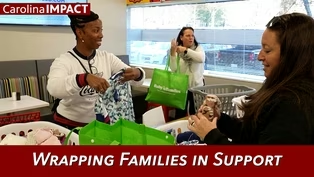
From brand new bibs to colorful onesies, volunteers work to create bundles for the Charlotte nonprofit, Baby Bundles.
- It's empowering that like it's new items and it's special things like handmade blankets and things that like people really put time to put together.
- [Dara] These bright green bags volunteers are carefully filling, aren't just supplies, they're bundles of love and hope.
Each one contains 40 newborn essentials, soft clothes, tiny hats, birth cloths, developmental toys, and even books to spark a lifetime of learning.
Worth about $400 each, these bundles will soon be delivered to families across our region, who need a little extra support during those first precious days.
- It's like a baby shower in a bag, and we all three got together and we first started baby bundles and spoke with other moms, the moms that we would be serving, to find out what would be beneficial to put into a bundle.
- [Dara] This is co-founder, Cat Long, and when she says, "We three," she's talking about the friendship and passion she shares with Heather Levitt and Emily Harry.
Inspired to make sure every baby starts life with love and necessities, the three launched the nonprofit in 2010, turning compassion into action for moms who need it most.
- We hear from moms that they have a sense of hope when they get that bundle.
They come from all different circumstances and that may be the only gift they get.
So we just want them to feel like a sense of belonging.
- [Dara] In 2025, the organization gave away over 4,000 bundles.
It was possible thanks to moments like this, like Coca-Cola Consolidated in Charlotte, where volunteers took time to put them together.
Efforts like this make a huge impact, because 57% of Baby Bundle's recipients report an annual income of less than $10,000.
- A lot of people don't realize the level of poverty here in Charlotte, so we're not just touching people, we're actually giving them something that can benefit their family and their child.
- [Dara] As the ladies serve other moms, they're reminded of another reason they started Baby Bundles.
One that stemmed from the pain of them losing a total of five children.
- We look back on that, and it really was a sad chapter in our lives.
We miss them, we love them.
- [Dara] Even though their hearts were broken, each founder never gave up on their dream of becoming a mom.
Heather now has three kids, and Emily and Cat have two each.
- They mean everything to me.
I think being a mom is what I was meant to be in my heart, and they mean everything, both of them.
- [Dara] They overcame their own challenges to become mothers, and now they're making sure other moms can too.
- It was time to take that grief and that sadness, and do something positive with it.
We couldn't prevent what had happened to us and our children, but we could make an impact.
- [Dara] It's safe to say they've come a long way from making bundles in their homes over 15 years ago, to now having thousands of volunteers who've pitched in to help them serve 20,000 families.
- This is such a happy place to be, our warehouse.
I love telling people to come out here and volunteer, because it's just a very cheerful, joyful place.
- [Dara] You can see that joyfulness reflected through volunteers like Marissa Patty Marshall, who feel deeply connected to the nonprofit's mission.
- It's so special.
I just had my first child, he's 10 months now and so I feel like I am folding bibs and clothes all the time, but to be able to give back, and like I know what that feels like, I know how special it is to be able to put these things on your child and be able to provide.
And so the fact that we can help other moms do that, I mean, there's nothing better.
- [Dara] And for these three friends, each bundle is so much more than supplies.
It's a lifeline, a reminder that no mother should ever face hard times alone.
Hope begins here, one bundle at a time.
For "Carolina Impact," I'm Dara Khaalid.
- Thanks so much, Dara.
It's great to see how those women are able to help others.
Since it began back in 2010, Baby Bundles now has 18 regional partners, including Atrium and Novant.
Here's another story focused on giving babies the healthiest possible start.
Breast milk is often called nature's perfect nutrition.
Yet in the United States, breastfeeding rates have been declining.
Fewer mothers are able to breastfeed for six months or more.
In women of color, who face higher maternal health risks, those numbers are even lower.
Doctors and nutrition experts agree, these gaps can have lasting impact on infant health.
That's why a group of local women is determined to change the statistics and create better outcomes for mothers and babies.
"Carolina Impact's" Bea Thompson and videographer, Russ Hunsinger, show us how their work makes a difference.
- Is that a flower?
It's everyday learning.
He's teaching us a lot.
Is it tasty?
- It's the best decision that I think we could have made for our family.
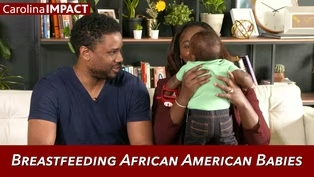
- [Bea] Meet Rachel and Timothy Dean, new parents, and their entry card to the parents club, three month old Jackson Dean.
They're among the growing number of new parents, and in particular, parents of color, who are on the front lines of an old form of nourishment for babies, breastfeeding.
- There you go.
- There was no doubt in my mind that what we were gonna be doing with breastfeeding him was gonna be the best thing for him.
- [Bea] Rachel is a lactation consultant and dietician, and works with moms of color.
She sees firsthand, women who want to provide the best for their newborns, but are unsure about breastfeeding.
- Historically, we are breastfeeding more, if you look at it even finer, like of populations of color, we are breastfeeding more, but still not as much as our white counterparts.
You wanna try to roll over?
You got it.
- And we wanna increase the rate of women breastfeeding, black women breastfeeding, as well as increase the duration and the time period of breastfeeding for African American families and families of color.
- [Bea] LuGenia Grider is a certified doula.
The word doula comes from the ancient Greek, meaning a woman who serves, and is now used to refer to a trained and experienced professional who provides continuous, physical, emotional, and informational support to the mother before, during, and just after birth.
- We work very closely with other dieticians, lactation consultants, childbirth educators, the healthcare systems here in our area, as well as with doulas, to help everyone close the gap, so that disparities can decrease in our community, and we can see the health benefits and the legacy of that.
- [Bea] More than a decade ago, Dean and Grider started Queen City Cocoa B.E.A.N.S, short for breastfeeding, education, advocacy, normalcy and support.
The Charlotte based nonprofit provides a support system for families of color, and it has come at a time when national statistics on black maternal health and that of their babies are dismal.
According to the Centers for Disease Control, breastfeeding disparities do exist.
Fewer black infants are ever breastfed compared to Asian, white or Hispanic infants.
Infants receiving WIC, the Federal Nutrition Program, are less likely to ever breastfeed, and young mothers between the ages of 20 to 29 are less likely to ever breastfeed than mothers over the age of 30.
The US dietary guidelines for Americans, along with the American Academy of Pediatrics and the World Health Organization all recommend that infants be exclusively breastfed for about the first six months of life, with continued breastfeeding while introducing appropriate complimentary foods for one year or longer.
Although most infants receive some breast milk, most are not exclusively breastfeeding, or continuing to breastfeed for as long as recommended.
Queen City Cocoa B.E.A.N.S.
points out two important points.
Families can save more than $2,000 a year by not buying formula, and they say, breast milk is designed for the baby, and it's gentler on the infant system compared to another animal's milk.
- We know those statistics are there, and we know that those statistics, if they are increased, can change the health statistics across the board for women of color, for family and children of color.
Decrease in diabetes, breast cancer, and a numerous amount of other things like asthma, that attack the African American community.
(gentle instrumental music) - I knew I wanted to try to breastfeed.
My mother breastfed me six months, and I knew about the health benefits of being able to breastfeed my child.
- [Bea] This savvy attorney learned of Queen City Cocoa B.E.A.N.S.
while in the hospital.
It led her to become a board member, and to encourage other women and their partners to consider the health of their child first.
- [Karen] They were able to be a huge source of support for not just myself, but my husband, who would be there on the front lines with me.
- So we have our breastfeeding support group for the birthing person or the mom.
And then we also have Daddy B.E.A.N.S.
for the father that is a part of that breastfeeding family.
(Jackson cooing) - Yeah.
- [Bea] And for a new dad like Timothy Dean, information and a dad support system can make the difference for one who has questions.
- There's no fear at all, but there's no shame in having questions either.
I had some questions for my wife about how the process works and what it took to really feed him and give him the nutrients, the daily nutrients that he needs.
And it's okay to ask questions as a man, and there's plenty of resources out there - [Bea] Through their organization, Queen City Cocoa B.E.A.N.S' services range from workshops to lactation consultations, weight management, infant weight monitoring, and virtual support groups.
- Over time, it is a slow increase, but there's always been this gap, this disparity there, where we may not be breastfeeding as long as other groups, but there's still, at least what I see in the community, you know, people interested, people wanting to know how.
- [Bea] For the businesswoman who breastfed both her daughters, making the Cocoa B.E.A.N.S.
connection made a difference for her family, and she says it can make a difference for many moms of color looking for support.
- Being able to look to other people who have maybe hit a wall at different points along that process, but could tell me how they overcame it, I think that really helped in keeping on the road and continuing to pursue the goal set.
- [Bea] Their next goal?
Increase the number of women of color who are lactation consultants.
They're collaborating with Johnson C. Smith University and Novant Health to develop a pathway, making it the first historically black college and university to have this type of program.
In turn, JCSU is working with North Carolina A&T University to develop a program there.
As for the next generation of healthy babies, among them will be Jackson Dean, who seems to be quite comfortable with his parents' decision on the best pathway for his nutrition and health.
For "Carolina Impact," I'm Bea Thompson.
- Thank you, Bea.
To learn more about the work Queen City Cocoa B.E.A.N.S.
does, head over to our website at pbscharlotte.org.
Finally tonight, something new is happening at Charlotte's Blume Studios.
Guests aren't just sitting in the audience, they're stepping into a world where the story unfolds around them.
As "Carolina Impact's" Chris Clark shows us, it's immersive, it's intimate, and it's unlike anything local audiences have seen before.
(spooky music) - Welcome to the Parlor.
- Come on over folks.
- [Chris] Get comfortable.
Lean in.
- In celebration of the greatest magician who ever lived.
- [Chris] But whatever you do, don't blink.
- I have four eyes, and I still missed it.
- [Chris] Because you're closer to magic than you've ever been.
- There was 10 cards and then there was not 10 cards anymore.
- [Chris] This is not your typical magic show.
- It's hard to believe that someone could actually do that, because I was watching.
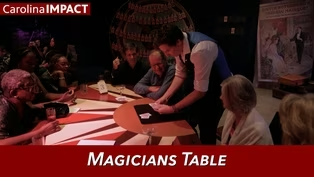
- Welcome to The Magician's Table.
- [Chris] The new immersive experience from Blume Studios, a night where the spotlight doesn't belong to just one person, here, the whole room becomes the show.
- Usually you go see a magic show, you're going to see a singular performer.
You know, you're gonna go see a David Copperfield, or David Blaine or something like that.
You come here and because there's so many, it's almost like magic itself is the star, and front and center.
- [Chris] So who dreamed up this wonderfully strange, immersive world?
The idea didn't come from a script or a stage manual, it came from a brainstorm that went completely off the rails in the best possible way.
- I work for an incredible company, a production company called Right Angle Entertainment.
And they said, "We wanna do a closeup magic experience.
What do you got?"
And we literally brainstormed and just out of nowhere, I said, "What about the memorial service of a great magician?"
- [Chris] The story center's on a final tribute to the legendary magician, Dieter Roterburg.
His widow, Calliope, his ward, Ellis, and a company of fellow magicians guide guests through an intimate memorial unlike anything on a traditional stage.
- We go into the actual memorial service, which is Dieter's warehouse, where he stores all his magical equipment, and you are a part of the experience.
You sit at tables and magicians come up to you every 10 minutes, and they sit down and they perform closeup magic for you.
And you actively participate in the show and solve some and perform some magic tricks yourself.
- [Chris] For an immersive experience like this to work, it has to capture and keep the attention of an audience that lives in a TikTok world.
Today's viewers expect more than a passive performance, they want immediacy and involvement.
- With video games and with phones, especially with phones, we don't want to just sit and observe anymore, we want to be a part of the experience.
- There are some people who loves to go to a theater and watch people perform a musical for two and a half hours.
There are other people for whom that is their worst nightmare.
But what they can get interested in is something like The Magician's Table, where you are interacting with the performers.
- If there's a magician that isn't doing anything for you in 10 minutes, you get another one, in 10 minutes you get another one.
So I think that really taps into sort of that Instagram and TikTok generation, the thing we mentioned before, of just that sort of quick entertainment fixes, and I think that's really resonated with the audiences.
- [Chris] Its success overseas set a very high bar, and when the production moved to Charlotte, one big question remained, could the local magic community match the original impact?
- The quality of magicians we got across was amazing.
You know, it's like when you've been working in this world for like 20 years, it's very difficult to get fooled, and very difficult to sort of have things shown to you that affect you.
All the Charlotte Magicians, at least once or twice, have absolutely blown my mind.
(audience claps and cheers) - It was actually amazing, 'cause I was like, I had that coin, and one move and it went away.
He was the coolest.
- Somebody thinks they know what happened or they do know what happened, but then I hit 'em with that last piece and then it goes nuts.
It's a lemon and lime, but you see the Sprite?
(audience claps and cheers) Wand drop!
Thank you!
- I didn't think I would have cards disappear under my leg, and they did, so that was incredible.
- [Chris] In theater, performers may change, but the script rarely does.
Here's the opposite.
The cast of magicians rotates and new tricks appear, and audiences who return a second time often find an entirely new show waiting for them.
- If you come and see it one night, you would see four magicians up close and personal to the table, as well as a bunch of stage magic, as well as a couple of other surprises that I wouldn't wanna spoil.
But if you then came and saw it a week later, you would probably see completely different magicians.
- [Chris] For Blumenthal, the challenge is always finding what can possibly top the last big immersive hit.
Each new experience raises the bar, and the question becomes, what could be next?
- It's really fun to try to find the next best thing.
I can tell you, when we had "Space Explorers," the VR experience, I thought, "This is the coolest thing.
It's never gonna get cooler."
Then we got Monopoly, and I thought, "Oh, this is really cool.
People are gonna love this."
And then we got The Magician's Table and I thought, "This opens us up to a whole new world of people, because it is such an incredible experience, top to bottom."
- [Chris] The Magician's Table isn't just a show you watch, it's a world you enter.
A place where tricks happen inches away, where every table holds a new secret, and where wonder feels close enough to touch, as audiences lean in, laugh, gasp, and try to catch what their eyes somehow miss, the magic lives exactly where it's meant to be, all around them.
For "Carolina Impact," I'm Chris Clark.
(audience claps and cheers) - That's incredible.
It makes me feel like I was in the room already.
Thanks so much, Chris.
The Magician's table continues through February 15th at Blume Studios.
Before we leave this evening, I'd like to invite you to help us produce "Carolina Impact," by sharing your unique story ideas with us.
It's simple, just email us details to stories@wtvi.org.
Thanks so much for joining us, we always appreciate your time, and we look forward to seeing you back here again next time on "Carolina Impact."
Good night, my friends.
(upbeat instrumental music) (upbeat instrumental music fades) - [Voice-Over] A production of PBS Charlotte.

January 13, 2026 Preview | Carolina Impact
Preview: S13 Ep1311 | 30s | Union County Reading Success; Wrapping Families in Support; Breastfeeding Babies; & Magicians Table. (30s)
Magicians Table | Carolina Impact
Video has Closed Captions
Clip: S13 Ep1311 | 5m 34s | A close-up magic experience where the whole room becomes the show. (5m 34s)
Breastfeeding African American Babies | Carolina Impact
Video has Closed Captions
Clip: S13 Ep1311 | 7m 20s | Fewer black infants are ever breast fed compared to Asian, white or Hispanic infants. (7m 20s)

Union County Reading Success | Carolina Impact
Video has Closed Captions
Clip: S13 Ep1311 | 7m 43s | Union County Public Schools shoots to the stop of the North Carolina State rankings. (7m 43s)
Wrapping Families in Support | Carolina Impact
Video has Closed Captions
Clip: S13 Ep1311 | 4m 49s | Three women use the loss of their newborns to uplift families in need. (4m 49s)
Providing Support for PBS.org
Learn Moreabout PBS online sponsorship
- News and Public Affairs

Top journalists deliver compelling original analysis of the hour's headlines.

- News and Public Affairs

FRONTLINE is investigative journalism that questions, explains and changes our world.












Support for PBS provided by:
Carolina Impact is a local public television program presented by PBS Charlotte