
January 13, 2026
Season 4 Episode 299 | 26m 31sVideo has Closed Captions
Lawmakers discuss the pros and cons of universal pre-K in Kentucky.
Debating the merits of universal pre-K in Kentucky, a lawmaker files a bill to return driver's license renewals to county officials, lawmakers discuss bills to help with the state's housing shortage, and the U.S. Supreme Court takes up a case about transgender athletes.
Problems playing video? | Closed Captioning Feedback
Problems playing video? | Closed Captioning Feedback
Kentucky Edition is a local public television program presented by KET
January 13, 2026
Season 4 Episode 299 | 26m 31sVideo has Closed Captions
Debating the merits of universal pre-K in Kentucky, a lawmaker files a bill to return driver's license renewals to county officials, lawmakers discuss bills to help with the state's housing shortage, and the U.S. Supreme Court takes up a case about transgender athletes.
Problems playing video? | Closed Captioning Feedback
How to Watch Kentucky Edition
Kentucky Edition is available to stream on pbs.org and the free PBS App, available on iPhone, Apple TV, Android TV, Android smartphones, Amazon Fire TV, Amazon Fire Tablet, Roku, Samsung Smart TV, and Vizio.
Providing Support for PBS.org
Learn Moreabout PBS online sponsorshipmusic >>let kids be kids.
>> Kentucky lawmakers debate the merits of pre-K education.
How does it work in other states?
>> Right now, I'm hearing from teachers that say they don't feel safe when they go to go to work every day, and that's not okay.
[MUSIC] >> A Senate Republican wants tougher penalties for violent students.
[MUSIC] >> But can be confusing the public facing.
Part of it makes it seem like we're encouraging people to eat a lot more saturated fat, and.
>> New federal dietary guidelines are out.
Find out what changed and how it could affect your health.
>> Production of Kentucky edition is made possible in part by the KET Millennium Fund.
>> Good evening and welcome to Kentucky edition for this Tuesday, January the 13th, I'm Renee Shaw.
We thank you for spending some of your Tuesday night with us.
Backers of pre-K education in Kentucky say it's the key to getting students off on the right foot.
But critics point to a 2022 study from Vanderbilt University that looked at thousands of students who took part in Tennessee's voluntary pre-K program.
That study found those students didn't show any improvement in their academic performance and actually moved backward in some areas.
That debate comes days after Governor Andy Beshear again called for pre-K in Kentucky.
So how does pre-K work in other states?
Our Mackenzie Spink has more.
As we begin tonight's legislative update.
[MUSIC] >> The 2022 study out of Vanderbilt followed nearly 3000 children through sixth grade.
The study found that by third grade, children who attended the pre-K program were doing worse academically and behaviorally than the children who didn't.
The author of the study later wrote an article sharing that she thought one of the issues in Tennessee was housing the pre-K program in public schools.
Senate President Robert Stivers says he's hearing concerns from constituents within Kentucky's public school system about integrating preschool with the current K-12 system.
>> The need for quality daycare is not the issue, it is what quality daycare looks like, and we know it's an impediment to some people getting back into the workforce.
But when you start thinking about placing this universal pre-K with the K through 12 system, then it has a lot of logistical problems.
>> The recommendation from the state's pre-K for all advisory committee is a mixed service model that would use both school districts and other child care providers for preschool.
In response to the Vanderbilt study.
Democratic leaders Representative Lindsey Burke and Senator Cassie Chambers Armstrong say there's enough studies demonstrating the benefits of pre-K, illustrating that it's the right choice for Kentucky.
>> There have been a lot of studies that have shown if kids have access to pre-K, they're less likely to become justice involved.
If kids have access to pre-K, they have higher educational scores in third grade and in fifth grade on reading and math.
It's going to take a whole lot of evidence to convince me that from what I have seen, pre-K is not the best thing that we can do to invest in our children and in making sure that all of our children are ready to learn the first day they enter kindergarten.
>> Another state with free pre-K is New Mexico.
Their secretary of the Department of Early Childhood Education and Care presented to a legislative panel in October.
She says their state is seeing success with the program.
>> Our pre-K program has been evaluated by our legislative finance committee to find it returns a 6 to $1 to every dollar invested, just that.
We just got the kindergarten scores this year, 21% increase in literacy.
And I think it's a lot to this very dedicated expansion to your point of the 0 to 5 focused on children's development in a very intentional way.
>> At that meeting, Co-Chair Senator Danny Carroll says New Mexico's free pre-K program isn't the right fit for Kentucky.
New Mexico's population is half the size of Kentucky's, and the program is funded largely by its oil and gas industry.
Governor Andy Beshear budget request calls for a phased in approach to pre-K for all over several years, the first step securing $40.5 million in the fiscal year beginning July 2027.
In addressing critics, he said this last week at the state of the Commonwealth and Budget Address.
>> And for those that say pre-K for all is political, let me remind you, four year olds can't vote.
They're not registered.
So if you're against this because you think it gives me a win, what you're really doing is handing these kids a loss.
>> Although Republican leadership maintains that there is not an appetite for universal pre-K, they are supportive of other measures to improve early childhood education.
For Kentucky edition.
I'm Mackenzie Spink.
>> Thank you much.
Mackenzie.
Earlier today, Republican Representative DJ Johnson filed House Bill 190, which aims to expand enrollment for daycare centers by updating the square footage calculation that determines capacity.
A Scott County lawmaker says teachers deserve more protection against violence in the classroom.
Republican State Senator Matt Nunn has a plan to toughen penalties against students, and they could face that they could face for acting out against educators.
Our Emily Sisk sat down with the lawmaker to discuss what he called, quote, common sense legislation.
>> That Republican Senator Matt Nunn filed Senate Bill 101 last week.
The bill is meant to protect educators against violence from students, and he touts another big benefit.
>> This is absolutely necessary to ensure that we can recruit and retain the best and brightest teachers in our Commonwealth.
They play a critical role for our young people, for our Commonwealth as a whole.
And so we got to make sure we got the best and brightest doing that.
And one way to do that is to ensure they feel safe and work at work.
And right now, I'm hearing from teachers that say they don't feel safe when they go to go to work every day, and that's not okay.
You and I want to feel safe when we go to work.
The people that are watching this want to feel safe when they go to work.
And so teachers should have that same, same feel of safety.
>> Nunn shared what he's heard firsthand from a family friend who works as a teacher.
>> She's kind of a small stature person.
And and she said, you know, Matt, I got boys your size in my class, and I'm, I'm sitting down here, but I'm six three, about 235, 240.
And she said, they have no respect for authority, no fear of consequences.
And she said, I've seen it.
I've heard, you know, she was she worried, feared for her safety every day.
And I heard more and more stories about that as I campaigned.
And this summer and fall, I visited a lot of schools, and I heard more and more concerns from teachers and administrators.
>> So what would Senate Bill 101 do?
It would mandate a 12 month expulsion for any student who physically injures an educator.
All other attempts of assault on school staff must be reported, and failure to report could result in criminal penalties for students age 14 and up, the county attorney could choose to prosecute them as an adult for third degree felony assault.
>> Number one, it will require 12 month expulsion for any teacher, that or any student that does this.
And that's not a requirement today.
We require it.
If a student brings a weapon to school or makes threats about something like that, but not if they assault a teacher.
If the county attorney chooses not to charge a student for whatever reason, I want to make sure that students not back in the classroom the next week or the next day.
>> The bill Republican also shared a statistic provided by the Kentucky Education Association about how many instances of assault against teachers have recently occurred.
>> The spokesperson for Kia said there's been since 2021, there have been 25,000 instances of assault against teachers.
>> Nunn was also certain to point out that while this bill is mostly focused toward teachers who typically need the most protection, the bill applies to all school staff members.
>> This bill would extend to any school employee, so bus drivers, cafeteria workers, whomever it is, if you're if you're working in our schools, serving our young people, helping them grow and learn, you deserve to be protected.
So this isn't just teachers, this is all the folks.
>> Nunn said.
The response on social media and throughout the General Assembly has been overwhelmingly positive, with some pointing out this bill would protect teachers instead of putting up more red tape.
>> But I did.
I heard on Facebook someone commented and said, finally, a pro teacher bill.
>> The Senate bill was numbered 101 because Nunn said it's common sense legislation for Kentucky edition.
I'm Emily Sisk.
>> Thank you Emily.
Senate Bill 101 would build on legislation from 2024, which made any assault against a health care worker and a health care setting a felony.
The bill is expected to be picked up and considered in a Senate committee, returning driver's license renewals to county officials is the goal of a new priority bill filed in the state Senate today.
Senator Aaron Reed is the sponsor of Senate Bill seven.
The Republican from Shelbyville says the bill is in response to growing frustration with the state's current system.
In 2020, lawmakers passed a bill to make the Kentucky Transportation Cabinet in charge of issuing licenses.
There are now about three dozen regional driver's license offices across the state.
Senator Reid says the current system is forcing some Kentuckians to drive hours to renew their license in another county.
If passed, Senate Bill seven would allow circuit clerk, county clerk and other local offices to renew driver's licenses and counties without a regional licensing office.
And the bill requires the Kentucky Transportation Cabinet to pay for and install the necessary equipment.
>> The bill also allows counties to work together.
Local officials may enter into interlocal agreements to share equipment, personnel, and facilities with neighboring counties to provide these services.
If no local official in a county chooses to offer license reissue services, the county judge executive could enter into an agreement with another county to make sure residents still have access.
The goal of this bill is simple reduce wait times, improve access, and bring driver's license services back closer to home, especially in rural areas.
And Senate Bill seven does exactly that.
>> Senate Bill seven has nearly 30 co-sponsors in the state Senate.
And a statement Senate President Robert Stivers says, quote, when the need is this apparent, we also have a responsibility to act with intent, end quote.
A Senate committee is scheduled to take up the bill tomorrow morning, and you can watch that right on the Kentucky Channel and online at Keturah.
Kentucky faces a housing shortage.
So what can the Kentucky General Assembly do about it?
State lawmakers and housing advocates met earlier today at the state Capitol for a groundbreaking.
Announcing priorities for the 2026 session.
>> We know that the reality is, is that housing works, housing provides shelter.
It provides stability.
It provides a foundation stone that people can build their lives upon.
And so we are incredibly grateful for the amount of work that the Kentucky General Assembly has put in over the last two years with the Kentucky Housing Task Force.
We need more housing that people can afford to buy.
We need more housing for people to rent.
We need more shelter availability across the country, across the state.
We need to make housing more available.
We need to make housing more affordable.
And we're going to try to do that work for you this year in the legislature, there are several bills.
There are several budget requests that have already been made to make sure that we have funds in the affordable housing funding mechanism in our state, to make sure that we can help cities and states, cities and counties work well with developers in our communities.
>> House Bill 333 does just that, and it's about empowering faith based institutions and churches to use their land to serve these means.
Houses of worship and religious organizations want to help, and obviously they're there, and that's what they do.
And we're so thankful.
The proposal the bill respects local control.
It exists.
And existing zoning laws.
>> To many, working Kentuckians are struggling to find affordable and safe places to live.
So today, I'm going to share a bill that I'll be filing soon that would take meaningful, responsible steps to expand access to housing while respecting the rights of property owners.
This proposed measure would address eviction expungement by requiring automatic sealing of dismissed eviction filings and protecting youth from public disclosure.
Right now, even when a case is dismissed, it can follow individuals for years, showing up on their background checks and limiting their housing options.
>> I've struggled with housing my entire life.
People see numbers, but they don't realize that behind those numbers are people.
The date that I had my quote unquote eviction, I had actually came to my court date with the money owed.
I paid roughly $5,800 to resolve my eviction, only for it to fall on me still.
And I'm not.
I'm not a commodity.
I'm not special.
There are plenty of other people that have done that, you know, so it would be a clean slate even if it hasn't touched you yet.
It may.
You never know.
And everybody should have the right.
Everyone should have the right to be able to be judged for what they are now, not for what they've done in the past.
>> There's also another bill that's filed addressing this, and it's called the Affordable Housing Trust Fund Bill, which would help develop 6000 units over ten years.
Now, in other news, the U.S.
Supreme Court has stepped into the debate over whether transgender girls and women should be allowed to play on female sports teams.
The High Court heard arguments today in cases challenging Idaho and West Virginia state laws.
Those laws ban anyone who's, quote, biological sex is male from playing on female sports teams at the K through 12 and collegiate level.
Supporters of the bans say it preserves fair and safe competition for women and girls.
Opponents say it violates the protections afforded under the 14th Amendment and Title nine.
25 other states have passed similar bans, including Kentucky.
David Walls of the Family Foundation, based in Kentucky, was in Washington, D.C.
today for the hearing.
He says he's optimistic the justices will uphold the bans.
>> Today, the United States Supreme Court is really hearing a monumental case over a challenge to State Steve women's sports laws.
And we were proud to be a part of supporting the efforts in Kentucky back in 2022 to pass the safe women's sports law.
You know, really at the crux of this argument and the crux of these these cases is a situation where we want to see biology upheld.
We want to see our female athletes and and girls across the country be able to be protected, to have their opportunities and championships and, and privacy and dignity protected.
It really is time to to end once and for all.
This idea that men who claim to be women can do so and and be able to play in female sports.
I think that's a, that's an idea that that fails the test just in terms of basic truth, basic biology.
And we obviously believe it ultimately fails a legal test and constitutional test as well.
>> Now to the contrary, Chris Hartman, with the Fairness campaign that works for LGBTQ rights, says he understands concerns about fair competition but says a one size fits all approach is not the solution and can be harmful.
>> These blanket bans simply put, a moratorium on all trans girls from participating in school sports, regardless of their age, regardless of whether they've gone through puberty or not, regardless of whether they've been on hormone replacement therapy.
There are so many factors to consider here, and by simply banning trans kids outright, you've put a target on every one of their backs.
Title nine has protected trans girls for quite a while to participate in all aspects of school life.
I absolutely think that sex protections that currently exist in law should protect trans girls.
And look, we also acknowledge that, you know, there is an issue of competitiveness and fairness at play.
We've never denied that.
But the reality is that for trans girls, trans kids, this should be reviewed on an individual basis for each child and each particular sport in which they are participating.
>> A ruling from the U.S.
Supreme Court is expected this summer.
[MUSIC] How are some Kentucky hospitals handling increased flu cases?
And some Kentuckians are facing higher than normal utility bills?
Our Toby Gibbs has more.
In tonight's look at headlines around Kentucky.
>> Kentucky Power customers.
>> You'll be paying more for electricity, but the increase is smaller than it could have been.
Kentucky Power asked the Kentucky Public Service Commission to allow a 15% increase.
After the public complained.
Kentucky Power proposed a 12% hike.
Weku radio reports customers will end up paying 8% more this year and 9% more next year.
[MUSIC] [MUSIC] With flu cases on the rise and continuing concern over Covid and RSV, Jennie Stuart Health and Deaconess Health facilities are putting restrictions on visitors.
The new era says anyone showing symptoms will be turned away, and anyone under the age of 16 is also banned.
[MUSIC] The News Express says the Red Rover Purple Leash project just gave $26,000 to Mountain Comprehensive Care.
[MUSIC] The money will allow the Healing Place sexual assault shelter to care for the pets of people staying there.
The shelter says this will give sexual assault victims the chance to bring their pets.
The shelter is in Prestonsburg and serves a five county area.
[MUSIC] A new habitat for humanity home in Somerset is dedicated to the shoebox.
Lady Mary Dameron, a West Virginian involved in humanitarian causes, including Operation Christmas Child, a program that delivers shoeboxes of gifts to children in difficult situations.
Dameron died in 2024.
The Commonwealth Journal reports a mother and her three children have been living in the home since November.
[MUSIC] With headlines around Kentucky.
I'm Toby Gibbs.
[MUSIC] .
>> Health experts are weighing in on the new dietary guidelines released by the federal government.
Our Kristi Dutton spoke to a weight management and bariatric surgery specialist about what's different in the new guidelines that could affect your health.
More about this in today's medical news.
[MUSIC] >> Okay, the new guidelines are out and it says it's simple eat real food.
>> Eat real food.
>> What does that mean?
>> Yeah, I think it means, you know, if it's a food that you recognize as a whole product that has not been, you know, heavily manipulated by industry, then it's a whole real food.
We're looking at fruits, vegetables, beans, seeds, nuts, animal proteins, those types of things.
>> Okay.
And the new federal guidelines, they've switched the food pyramid upside down from the one that a lot of us remember from, you know, the 90s.
And what surprised you about these new guidelines.
And what do you agree with.
>> Yeah.
So I think what surprised me is that at the very top left corner, we're seeing a great big old steak.
We do know that red meat is inflammatory, so I wouldn't recommend anyone eat it every single day.
And also we have a lot of excellent protein that comes from plant foods.
And I'm not really seeing those in the protein area of the new pyramid either.
>> So what foods would those be.
The plant proteins.
>> Yeah.
So soy for example soy beans.
Amazing.
You know you can get them dried and roasted.
It's tofu.
And then most vegetables have a degree of protein in it as well okay.
>> Yeah.
And so also in these guidelines they say that saturated fat still try to stay below 10% of your daily calories and saturated fat, which.
>> Is good.
The new recommendations are consistent with the previous recommendations that we need to be keeping our overall daily intake of saturated fat below 10%, and I absolutely agree with that.
So it can be confusing.
The public facing part of it makes it seem like we're encouraging people to eat a lot more saturated fat.
But the evidence, the science behind it, and in the health care space, we would still like people to stay consistent with the actual recommendations.
That fine print of less than 10% saturated fat in their.
>> Diet, but also for the dairy part, they said full fat dairy.
Yeah.
Does that mean no more skim milk?
What have we been drinking?
Skim milk for no reason?
>> No.
I mean, and certainly if you enjoy skim milk, continue to drink it.
Absolutely.
But the evidence is showing that maybe full fat dairy isn't as bad as we once thought.
And usually there's three ingredients that are kind of played with when it comes to foods, okay.
And that's salt, sugar and fat.
So if something is low fat, typically the salt and sugar have been altered to make it more palatable.
You know, yummier for us.
So we like it.
And so reading food labels remains an important part of just being a human being in this kind of modern food space.
So I would encourage people to still read those labels if it says that it's, you know, low fat and you like it, you know, look to see is there added sugar there, has the salt been increased?
Because that may be kind of contradictory to your goals.
>> Okay.
Well, you mentioned added sugar.
That's also a big part of this really eliminating even or avoiding altogether any added sugar.
That's really hard to do.
>> It's hard nowadays.
Yes.
Our food supply is a very large percent of percentage of ultra processed foods, and that's something I really appreciate about the new guidelines.
They are saying please limit ultra processed foods.
Excess sugar is really just not good for us.
It is inflammatory.
We are.
We have very high rates of obesity, overweight, diabetes, heart disease and sugar is a big player there.
It's a great treat now and again.
I mean, I ate plenty of cookies over Christmas and then got back on track, right?
Because my day to day life is I'm trying to optimize my health.
I really want to fuel my body well with good, whole real foods, just as the guidelines say, and try to keep those ultra processed things that are going to be harmful to my health, kind of out of the way.
So if it is coming in a box or a bag and it is just absolutely not even close to something that looks like it came from nature, it's probably not something that's going to serve you incredibly well.
Now there are things like protein shakes, protein bars, and those are great, you know, to supplement here and there and whatnot.
We have busy lives.
We appreciate convenience foods.
But I would still say read those food labels.
This is not something that should be a staple in your diet as much as possible.
I would love to see people sticking with whole real foods, really prioritizing fruits and vegetables.
95% of the average population is not getting enough fiber, and that's a big player when it comes to the health of our microbiome and weight management.
>> Okay.
Well, Gentry from Norton Healthcare, thank you so much for breaking this down.
This is great advice.
>> Thanks.
Thank you.
>> And thank you.
Christie Dutton.
The dietary guidelines are updated every five years by the U.S.
Department of Agriculture and Health and Human Services.
[MUSIC] That'll do it for us tonight.
We've got some great coverage tomorrow of the legislature in action in Frankfort.
We'll bring you stories about the bills they're considering, and also, we'll reboot our candidates series, where you get to meet the candidates who are running for some key congressional races.
And U.S.
Senate and State Representative Ryan Dodson will be with us tomorrow.
And we'll bring you that interview tomorrow night at 630 eastern, 530 central, right here on Kentucky edition, where we inform, connect and inspire.
We hope that you'll connect with us all the way as you see on your screen, Facebook, Instagram and X to stay in the loop on the social media channels, send us a story idea by email, or just give us a shout out at Public Affairs at Keturah.
[MUSIC] I'm Renee Shaw, thanks for being with us tonight, and I'll see you right back here tomorrow night.
[MUSIC]
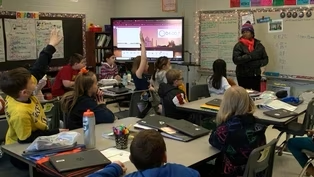
Lawmaker Calls for Tougher Penalties for Violent Students
Video has Closed Captions
Clip: S4 Ep299 | 3m 48s | Lawmaker introduces plan to toughen penalties for students who act out against educators. (3m 48s)

Looking for Solutions to Housing Shortage
Video has Closed Captions
Clip: S4 Ep299 | 3m 15s | Lawmakers discuss bills to help with the state's housing shortage. (3m 15s)

Reaction to New Federal Dietary Guidelines
Video has Closed Captions
Clip: S4 Ep299 | 5m 16s | Weight management and bariatric surgery specialist on what's different in the new food pyramid. (5m 16s)

Weighing Pros and Cons of Pre-K
Video has Closed Captions
Clip: S4 Ep299 | 4m 27s | Lawmakers discuss the pros and cons of universal pre-K in Kentucky. (4m 27s)
Providing Support for PBS.org
Learn Moreabout PBS online sponsorship
- News and Public Affairs

Top journalists deliver compelling original analysis of the hour's headlines.

- News and Public Affairs

FRONTLINE is investigative journalism that questions, explains and changes our world.












Support for PBS provided by:
Kentucky Edition is a local public television program presented by KET