
January 13, 2026 - PBS News Hour full episode
1/13/2026 | 57m 46sVideo has Closed Captions
January 13, 2026 - PBS News Hour full episode
Tuesday on the News Hour, in the deadliest street protests since Iran's revolution, demonstrators face a ruthless crackdown while President Trump promises help is on the way. The Supreme Court hears a landmark case on whether transgender people can be banned from girls' and women's sports. Plus, survivors of alleged abuse by an Army doctor speak out publicly for the first time.
Problems playing video? | Closed Captioning Feedback
Problems playing video? | Closed Captioning Feedback
Major corporate funding for the PBS News Hour is provided by BDO, BNSF, Consumer Cellular, American Cruise Lines, and Raymond James. Funding for the PBS NewsHour Weekend is provided by...
Support provided by:

January 13, 2026 - PBS News Hour full episode
1/13/2026 | 57m 46sVideo has Closed Captions
Tuesday on the News Hour, in the deadliest street protests since Iran's revolution, demonstrators face a ruthless crackdown while President Trump promises help is on the way. The Supreme Court hears a landmark case on whether transgender people can be banned from girls' and women's sports. Plus, survivors of alleged abuse by an Army doctor speak out publicly for the first time.
Problems playing video? | Closed Captioning Feedback
How to Watch PBS News Hour
PBS News Hour is available to stream on pbs.org and the free PBS App, available on iPhone, Apple TV, Android TV, Android smartphones, Amazon Fire TV, Amazon Fire Tablet, Roku, Samsung Smart TV, and Vizio.
Providing Support for PBS.org
Learn Moreabout PBS online sponsorshipAMNA NAWAZ: Good evening.
I'm Amna Nawaz.
Geoff Bennett is away.
On the "NewsHour" tonight: the deadliest street protests since Iran's revolution.
Demonstrators face a ruthless crackdown, while President Trump promises help is on the way.
The U.S.
Supreme Court hears a landmark case on whether transgender people can be banned from girls and women's sports.
And survivors of alleged abuse by an Army doctor speak out publicly for the first time.
"CLAIR," Survivor of Sexual Abuse: If we continue to be silent, it's just going to continue to happen.
And we can't have that for our daughters, for the soldiers that are coming after us.
(BREAK) AMNA NAWAZ: Welcome to the "News Hour."
Tonight, the State Department says all Americans should leave Iran, as protests there are entering their third week and tens of thousands of people continue to take to the streets despite a deadly crackdown.
President Trump tonight said that the death toll appears significant.
Western officials say at least 2,000 have been killed and perhaps many more.
That would make these protests the deadliest since the 1979 revolution and analysts say they could threaten the regime itself.
Nick Schifrin reports.
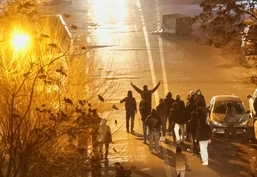
NICK SCHIFRIN: Today in Iran, defiance.
Protesters denounce the regime right in front of its security forces... (GUNSHOTS) NICK SCHIFRIN: ... despite live ammunition shot into the crowds, a brutal crackdown that Western officials say has been led not by police, but by the Islamic Revolutionary Guard Corps.
Estimates vary widely, but Western officials said today at least 2,000 have been killed, perhaps many times that.
This crackdown, combined with an Internet cutoff, has led to slightly fewer protests today and a climate of extreme fear, according to a man in southern Iran we spoke to today by phone whose name we are changing to Meherdad.
MEHERDAD, Iranian Protester (through translator): The protests are not as big as they were last week.
And from what I have heard from those in other towns, the protests are not as big since the crackdown.
I was going, but not since Saturday, because it was impossible to get to the streets.
NICK SCHIFRIN: Experts call these the most serious protests in Iran's history, combining rural and urban, working and middle-class Iranians.
And the ruthless response has in turn affected every Iranian.
MEHERDAD (through translator): Anyone you ask, they have family members, one or multiple, injured or killed.
In the past few days of the protests, their forces have been stronger, and anyone they see on the streets, they either shoot or do something else to make them go away.
DONALD TRUMP, President of the United States: To all Iranian patriots, keep protesting, take over your institutions if possible.
NICK SCHIFRIN: Today, in Detroit, President Trump vowed to avenge the dead by punishing the security forces who fired into the crowds.
DONALD TRUMP: Save their names, because they will pay a very big price.
And I have canceled all meetings with the Iranian officials until the senseless killing of protesters stops.
And all I say to them is, help is on its way.
NICK SCHIFRIN: He didn't define that help, but speaking to CBS News tonight, President Trump brought up previous U.S.
military strikes.
TONY DOKOUPIL, Host, "CBS Evening News": What's the endgame?
DONALD TRUMP: The endgame is to win.
I like winning.
And we're winning.
TONY DOKOUPIL: How do you define that in Iran?
DONALD TRUMP: Well, let's define it in Venezuela.
Let's define it with al-Baghdadi.
He was wiped out.
Let's define it with Soleimani.
NICK SCHIFRIN: The U.S.
is also working to help ensure activists can share these videos with the world by working with Starlink.
AHMAD AHMADIAN, Executive Director, Holistic Resilience: As of this morning, there are reports, confirmed reports that the Starlink subscription is lifted, so it's plug and connect.
NICK SCHIFRIN: Ahmad Ahmadian is the executive director of the Internet freedom organization Holistic Resilience.
He says there are as many as 50,000 Starlinks in Iran and eliminating subscription costs will help activists not only release videos, but also communicate with each other.
AHMAD AHMADIAN: People need to get this information from their leaders, from the coordinators outside of the Iran to be able to protect themselves and also have the instructions how to coordinate, how to mobilize, saying where are the areas that the protest is happening, and getting those information and working with those channels and reporters to broadcast those information back inside the country, so they know what to do and what to do next.
NICK SCHIFRIN: But what the regime is doing next, planning a public execution of protester Erfan Soltani.
They have already broadcast about 100 coerced confessions, an attempt to destroy the dissent that targets the regime and its sources of power.
For the "PBS News Hour," I'm Nick Schifrin.
AMNA NAWAZ: In the day's other headlines: Inflation held mostly steady last month, as the economy wrapped up a year marked by President Trump's tariffs and ongoing concerns about rising prices.
Consumer prices rose 2.7 percent in December when compared to a year before.
That was due largely to gains in grocery prices and airline fares.
The figure was mostly in line with expectations and still above the Federal Reserve's preferred rate of 2 percent.
In Detroit today, President Trump insisted that today's report is further evidence that the Fed should be cutting rates more aggressively.
DONALD TRUMP, President of the United States: In the old days, when you had good numbers, interest rates would go down.
When you had good numbers, the market would go through the roof.
That's the way we're going to make it again.
That's the old-fashioned way.
That's the right way.
Today, if you announce great numbers, they raise interest rates to try and kill it.
So you can never really have the kind of rally you should have.
AMNA NAWAZ: This comes as central bankers from around the world issued a statement today saying they -- quote -- "stand in full solidarity with Fed Chair Jerome Powell."
That's part of a broader backlash to news that the Justice Department had launched a criminal investigation into Powell.
Bill and Hillary Clinton are refusing to testify in a congressional investigation of the late sex offender Jeffrey Epstein.
In a letter to the Republican head of the House Oversight Committee, James Comer, the former president and former secretary of state said they will not comply with the House subpoena, calling it legally invalid.
They add about Comer -- quote -- "You are on the cusp of bringing Congress to a halt to pursue a rarely used process literally designed to result in our imprisonment, and we will forcefully defend ourselves."
Comer told reporters today that he will begin contempt of Congress proceedings next week.
REP.
JAMES COMER (R-KY): They spent a lot of time together while Bill Clinton was president and post-presidency.
And, again, no one's accusing the Clintons of any wrongdoing.
We just have questions.
AMNA NAWAZ: Comer also indicated that the Oversight Committee would not try to compel President Trump to testify since he is in office.
Both Trump and Bill Clinton had well-documented friendships with Epstein decades ago.
Neither has been accused of any wrongdoing.
In Gaza, hospital officials say at least four people are dead after strong winds knocked over walls and destroyed makeshift shelters.
The wind reportedly lifted some tents into the air while others lay in muddy water as families tried to save what they could.
Aid groups say the living conditions are far from sufficient for the harsh Gaza winter, with a 1-year-old boy dying of hypothermia overnight.
Separately, Salim Shreir tells the "News Hour" that his 10-year-old niece, Samira, died instantly when a neighboring house collapsed.
SALIM SHREIR, Displaced Gazan (through translator): The situation was very bad.
She was a martyr.
The house is part of a building with several floors, mostly destroyed.
May God be with all the people who are staying in places that can't handle the heat of summer or the frigidity of winter.
AMNA NAWAZ: Also today, U.N.
officials said at least 100 children have died in Gaza since a cease-fire took effect last October.
A UNICEF spokesperson says those fatalities were due to Israeli military operations, including airstrikes and the use of live ammunition.
Ukrainian officials say Russia targeted their country's power grid overnight, even as Ukraine deals with frigid temperatures.
Firefighters in the Eastern region of Kharkiv worked through the night to put out the flames and rescue those trapped in the rubble.
At least four people were killed.
Ukraine's President Volodymyr Zelenskyy said the barrage included nearly 300 drones across eight regions, plus missiles.
The attack knocked out power for hundreds of thousands of households in the Kyiv region, forcing residents to gather in emergency shelters to stay warm.
The Trump administration is ending temporary protected status for hundreds of immigrants from Somalia.
The protections are provided to those coming from countries impacted by things like natural disasters or conflict.
Homeland Security Secretary Kristi Noem posted on social media today that: "Temporary means temporary.
Country conditions in Somalia have improved to the point that it no longer meets the law's requirement for temporary protected status."
The termination is effective March 17.
The State Department currently lists Somalia with a do-not-travel warning due to crime, terrorism and civil unrest.
This comes amid a Trump administration crackdown in Minneapolis, where many Somali immigrants live.
On Wall Street today, stocks drifted lower following recent gains.
The Dow Jones industrial average fell nearly 400 points on the day.
The Nasdaq slipped more than 20 points and the S&P 500 also ended in negative territory.
And Scott Adams, creator of the comic strip "Dilbert," has died.
His satirical take on office culture first appeared in 1989 and went on to run in 2,000 newspapers worldwide.
But, in 2023, "Dilbert" was abruptly dropped from syndication after he referred to Black people as members of a hate group.
Adams relaunched "Dilbert" on a subscription basis and hosted a podcast where he discussed political and social issues.
Today, President Trump remembered him as a great influencer.
Last year, Adams revealed that he had prostate cancer.
He was 68 years old.
And civil rights pioneer Claudette Colvin has died.
At just 15 years old, Colvin was arrested for refusing to give up her seat on a segregated bus in Montgomery, Alabama, in 1955.
The incident occurred just nine months before Rosa Parks gained international fame for refusing to give up her seat.
The boycott that followed led to a federal lawsuit that outlawed racial segregation on Montgomery's buses with Colvin serving as a plaintiff and star witness.
She spoke in 2018 about her actions on that fateful day.
CLAUDETTE COLVIN, Civil Rights Activist: Most people ask, why didn't you get up when the bus driver asked you to get up?
I tell them, I could not move because history had me glued to the seat.
AMNA NAWAZ: Colvin spent decades in relative obscurity working as a nurse's aide in New York City, but then saw a renewed focus on her role in the civil rights movement later in life.
The foundation that bears her name announced her passing today.
Claudette Colvin was 86 years old.
Still to come on the "News Hour": numerous Justice Department officials resign in protest over the ICE shooting in Minneapolis; a view from Denmark amid the Trump administration's threats to take over Greenland; and women speak out about an army OB-GYN accused of secretly filming his patients.
Across the Justice Department today in both Washington, D.C., and Minnesota, a wave of resignations from top prosecutors.
At least four senior leaders of the division that investigates police killings have resigned in protest over the handling of that fatal shooting last week of a woman in Minneapolis by an ICE officer.
And, in Minnesota, six other federal prosecutors have left their posts.
Joining us with more details is Carol Leonnig.
She's the senior investigative reporter for MS NOW and author of "Injustice: How Politics and Fear Vanquished America's Justice Department."
Carol, welcome back.
It's good to see you.
CAROL LEONNIG, MS NOW: It's great to be with you.
AMNA NAWAZ: So let's start with the news that you first broke, those resignations from a section of the Civil Rights Division, one that we mentioned would normally investigate law enforcement killings like the officer that killed Renee Good.
Why did those prosecutors resign?
CAROL LEONNIG: So these are the senior leaders of this unit that investigates these kinds of shootings and other abuses of civil rights, potential abuses of civil rights of Americans for the Justice Department.
To have an entire leadership team walk out the door roughly at the same time is unprecedented.
At first, we heard that the reason that they resigned was in protest of the handling of the department's decision basically not to investigate this ICE shooting.
It's a little more complicated than that.
These people had indicated that they were interested in retiring early and resigning several days before the shooting, actually a day before the shooting.
But then they decided to cut short their time at the Justice Department in the wake of the department's leadership's decision for not investigating this case.
It's so rare for this unit not to investigate fatal shootings involving federal officers, and that is what's taken away the breath of a lot of people in the Department of Justice.
And now this unit, these leaders, we are told by multiple sources, Amna, are trying to send up an alarm bell and ring that bell very loudly to the American people, making a statement that this is not copacetic, this is not kosher.
AMNA NAWAZ: So what about the resignations that we saw in Minnesota?
The federal prosecutors in the U.S.
attorney's office there, reportedly, according to The New York Times, also resigning in protest of the DOJ's reluctance to investigate the ICE officer here, but also reportedly because they say they were being pushed to investigate Renee Good herself.
What do we know about that?
CAROL LEONNIG: We know very little other than, at MS NOW, we have confirmed that good reporting that indeed those people have resigned, six federal prosecutors in the U.S.
attorney's office based in Minneapolis, and that their reasoning for resigning is multilayered, one, disappointment with main Justice and how they're handling this matter.
You know, the assistant attorney general for civil rights, Harmeet Dhillon, has told her staff as of Friday last week that they were not going to investigate, but also concerns about investigating Good herself.
Remember, just to set the table here, Amna, the president of the United States and the vice president, J.D.
Vance, both within 36 hours of Good's death declared that the ICE officer was in the right, that the shooting was justified, without any evidence really being gathered by anyone in federal authorities, by the Justice Department.
It happened after the FBI declared that they would not allow local Minnesota authorities access to evidence in the case and that they would handle this investigation themselves.
But what we heard was that the FBI was largely investigating Good and not the ICE officer.
AMNA NAWAZ: Carol, for context here, because I know you have been leading the way on the reporting on this, when you look at the Justice Department and the number of departures we have seen over the last year, experienced prosecutors in a number of cases, can we quantify that and what's been the impact on the department itself?
CAROL LEONNIG: Well, I will give you a couple examples.
The reason that I thought that reporting this was urgent late last night at 10:00 p.m.
was because it was an entire leadership team walking out the door.
That's a brain drain from which the Justice Department will not be able to recover for a generation.
You can't replace people with that expertise quickly, but that's writ large happening all over the Justice Department and has been since January 21, 2025, when Trump was inaugurated and ordered the removal of a whole set of top counterterrorism officials at the Justice Department, people who were the senior leaders that represented the U.S.
government and the Department of Justice in foreign halls all over the world.
The removal of all of the prosecutors who had handled the January 6 investigation one after the other, the removal about a month later in February of all of the senior leadership of the FBI, the executive levels, people who protect us and intervene when there are terror plots abroad that are targeting the United States.
The American people need to understand, if they haven't already gotten this message, that the sources that are talking to me and my competitors and my colleagues who cover this material, they are sending a loud signal that America needs to pay attention that we are less safe because this expertise has been either forced out, fired, or has resigned in protest, as these most recent resignation signal.
AMNA NAWAZ: That is Carol Leonnig, senior investigative reporter for MS NOW, joining us tonight.
Carol, always great to have you.
Thank you so much.
CAROL LEONNIG: Thank you.
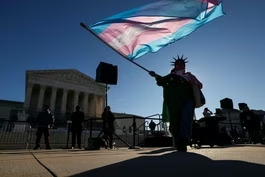
AMNA NAWAZ: One of the most hotly debated political issues in recent years made its way to the U.S.
Supreme Court today.
At issue, can transgender athletes compete alongside women and girls?
The conservative majority seemed skeptical of striking down sports bands already in place in over half of all states.
But, for over three hours, the justices examined the constitutional arguments over science and whether trans athletes are competing on an equal playing field.
Liz Landers has a closer look at the legal and political fight before the nation's highest court.
LIZ LANDERS: Becky Pepper-Jackson says she's not much different than other teenagers.
She plays multiple instruments and likes to spend time at home with her pets.
But the West Virginia high school student has spent years at the center of a political firestorm, because, as a transgender girl, she's looking to stay on her school's track team.
That's despite a state law that bars transgender girls from playing on girls sports teams at public schools and colleges.
BECKY PEPPER-JACKSON, Transgender High School Athlete: Letting these awful laws and bills just stand is not something that should happen.
LIZ LANDERS: Her case is one of two before the nation's highest court, as justices weigh if statewide bands against transgender students from participating in women's sports are constitutional.
Some female athletes have stepped in to support bans, saying it's an issue of fairness.
LAINEY ARMISTEAD, Former Soccer Captain, West Virginia State University: I love soccer and it opened up opportunities for me that I never would have had without it.
LIZ LANDERS: Lainey Armistead played soccer at West Virginia State University.
She intervened in the case to defend the ban in 2021 while she was a student.
LAINEY ARMISTEAD: The West Virginia law doesn't exclude anyone from playing sports.
It just promotes a safe and fair category for women.
LIZ LANDERS: In the years since, Armistead has dedicated her time to fight for the bans in court and at a United Nations event.
LAINEY ARMISTEAD: This stance is about preserving biological reality and saying women deserve a fair place to play, a safe place to play and not be put at risk.
LIZ LANDERS: The second case before the court today centers around Lindsay Hecox, a young woman who previously competed in track at Boise State University in Idaho.
The "News Hour" spoke to her in 2021 at the start of her legal battle.
LINDSAY HECOX, Transgender Athlete: Gender dysphoria just sucks.
You don't get to be the person you were meant to be just because of some random luck when you were born.
LIZ LANDERS: Both Pepper-Jackson and Hecox live in one of the 27 states that have a law or regulation that prevents transgender girls and women from participating in sports based on their gender identity.
And both have fought yearslong legal battles to maintain the right to compete in track and field, while Republican leaders fought them in court.
President Trump also signed an executive order last year threatening to withhold federal funding from programs that allow transgender women and girls to compete in women's sports.
JOSHUA BLOCK, ACLU: All that we're asking for is basic fairness and letting Becky have the same childhood experience as anyone else.
My name is Josh Block.
LIZ LANDERS: Joshua has represented Pepper-Jackson for several years for the ACLU.
He says she doesn't have an unfair physiological advantage against other girls her age because she's been taking puberty-blocking medication since the third grade.
JOSHUA BLOCK: So, that's one of the fundamental problems with laws like this, these sweeping bans, is that they refuse to look at the individual, that the whole point of our civil rights laws and the Constitution's Equal Protection Clause is that people should be recognized as individuals and not just part of amorphous groups.
LIZ LANDERS: There's been little scientific research on if transgender women actually have an advantage against their competitors.
DR.
BRADLEY ANAWALT, University of Washington: The caveat to all of this is that we don't have a lot of high-quality data.
LIZ LANDERS: Dr.
Bradley Anawalt is an endocrinologist and professor at the University of Washington who has advised athletic associations on hormone use in sports.
He says that transgender girls who were prescribed puberty-blockers like Pepper-Jackson have few biological differences from their teammates.
DR.
BRADLEY ANAWALT: The ability to do something, a feet of strength over a short period of time, speed or endurance events, all of those advantages that might occur with testosterone don't occur with these people that are started on gender-affirming hormone therapy and specifically puberty blockers shortly after the development of puberty.
LIZ LANDERS: While it may be the first time the court has weighed in on transgender athletes, it's one of a series of recent cases focused on transgender students.
Just last year, a majority of justices upheld Tennessee's ban on gender-affirming care for minors.
In the court's majority opinion, Chief Justice John Roberts wrote the court will leave the issue to -- quote -- "the people, their elected representatives and the democratic process."
That ruling could signal how the court might decide this case.
KRISTEN WAGGONER, Alliance Defending Freedom: It will be women and girls that suffer the most when biological distinctions are not recognized in the law when those distinctions matter.
LIZ LANDERS: Kristen Waggoner is the president of the Alliance Defending Freedom, a conservative legal group that's worked alongside Idaho and West Virginia in both cases.
KRISTEN WAGGONER: There are hundreds of girls and women who have been displaced, and let's be clear about what that means.
It doesn't just mean that they don't get podiums.
It actually means that they do lose scholarships, which then means that they don't have access to higher education in the same way that they should.
LIZ LANDERS: In oral arguments, Justice Brett Kavanaugh expressed those same concerns about displacing women in sports and how different courts have ruled on the issue.
BRETT KAVANAUGH, U.S.
Supreme Court Associate Justice: And so one way to resolve it, as you say, is the facts, try to figure out, is there really a competitive advantage?
I think we're going to get a lot of scientific uncertainty about that, a lot of debate about that, a lot of different district courts.
LIZ LANDERS: Block and the ACLU acknowledge Pepper-Jackson may face an uphill battle.
JOSHUA BLOCK: Athletics is so unique.
There really is no justification for West Virginia and Idaho to try to use this really unique context to establish a sweeping principle that the government can freely discriminate against transgender people.
LIZ LANDERS: It's a point that Justice Ketanji Brown Jackson also made in arguments today.
KETANJI BROWN JACKSON, U.S.
Supreme Court Associate Justice: I guess I'm struggling to understand how you can say that this law doesn't classify on the basis of transgender status.
The law expressly aims to ensure that transgender women can't play on women's sports teams.
So why is that not a classification on the basis of transgender status?
LIZ LANDERS: "News Hour" Supreme Court analyst and SCOTUSblog co-founder Amy Howe says it's likely the court's conservative majority will side with the states based on today's arguments.
AMY HOWE: This is a conservative court, and conservative groups and conservative plaintiffs see the opportunity to bring these kinds of cases to the court because they believe they will find a receptive audience.
LIZ LANDERS: Until that ruling, the political firestorm over fairness in women's sports will continue on and off the field.
For the "PBS News Hour," I'm Liz Landers.
AMNA NAWAZ: Crucial talks are due to take place in Washington tomorrow between Vice President J.D.
Vance, Secretary of State Marco Rubio and the foreign ministers of Denmark and Greenland, the strategically important Danish region that President Trump has coveted for years.
His repeated threats to take over the island have prompted warnings that such a move could lead to the breakup of NATO.
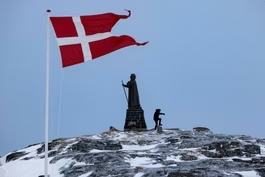
Malcolm Brabant reports from Copenhagen.
MALCOLM BRABANT: High noon in Copenhagen, and the guard changes at the main royal palace, as Danes worried that their kingdom is about to be shrunk by a Trumpian heist.
President Trump has been stretching nerves here in Copenhagen this past week by ramping up his rhetoric, but the Danes haven't responded.
They're hoping that quiet diplomacy will neutralize the threat to annex Greenland.
Denmark is backed by NATO allies who believe in the sanctity of Greenland sovereignty.
They fear the president has been emboldened by his Venezuelan operation and will pull the trigger.
DONALD TRUMP, President of the United States: I'm not talking about money for Greenland yet.
I might talk about that.
But, right now, we are going to do something on Greenland, whether they like it or not, because, if we don't do it, Russia or China will take over Greenland.
And we're not going to have Russia or China as a neighbor, OK?
I would like to make a deal, the easy way, but if we don't do it the easy way, we're going to do it the hard way.
MALCOLM BRABANT: Rasmus Jarlov chairs Denmark's Parliamentary Defense Committee.
He says the Danes will be accommodating, but they have some solid red lines.
RASMUS JARLOV, Chair, Denmark Defense Committee: Trump has said that they need to do something on Greenland.
And I would take him at his word, because we don't mind doing something on Greenland.
But what we do mind and what we can never agree to is just handing over Greenland, selling 57,000 Danish citizens to become Americans.
They don't want to do that.
And it's not a matter of price.
They categorically don't want that.
And we're not going to agree to it.
MALCOLM BRABANT: Greenland possesses vast, untapped mineral wealth.
Its strategic importance grows daily as the arctic ice melts, creating maritime passageways across the top of the globe.
The United States' sole military presence is its Pituffik Space Base, used for missile early warning in defense and space surveillance.
Vice President Vance used his visit there last March to pile pressure on Denmark, which is responsible for Greenland's defense and foreign affairs.
J.D.
VANCE, Vice President of the United States: Denmark has not kept pace in devoting the resources necessary to keep this base, to keep our troops, and in my view to keep the people of Greenland safe from a lot of very aggressive incursions from Russia, from China and from other nations.
MALCOLM BRABANT: Lin Mortensgaard is an Arctic specialist at the Danish Institute for International Studies.
She says that, under a 1951 treaty, there's nothing to stop America beefing up its military presence.
LIN MORTENSGAARD, Danish Institute for International Studies: In this defense agreement, the U.S.
has very wide-ranging options for expanding its military presence in Greenland with bases or increasing troops or having new installations, radar installations.
Many different things could be done under this defense agreement.
MALCOLM BRABANT: Last October, Denmark pledged $4.2 billion to boost Greenland's security with ice-breaking patrol vessels and advanced drones.
This commitment, though, is apparently insufficient for President Trump.
TOM CROSBIE, Royal Danish Defense College: There is basically nothing to stop the United States military from staking a claim in Greenland.
So, for example, a single soldier could just walk down the main street of Nuuk and claim that this is America now, but that is something that would be immediately contested.
MALCOLM BRABANT: Associate Professor Tom Crosbie lectures on military operations at the Royal Danish Defense College.
TOM CROSBIE: This is forcing NATO to contemplate its existence and the possibility that it will not exist in the near future.
So this is an absolute existential question for NATO.
It is unprecedented, and I would say it was unimaginable just a few years ago.
It's the most significant challenge NATO has ever encountered.
MALCOLM BRABANT: But, on Monday, NATO Secretary-General Mark Rutte promised action.
MARK RUTTE, NATO Secretary-General: All allies agree on the importance of the Arctic and Arctic security, because we know that, with sea lanes opening up, there is a risk that Russians and the Chinese will be more active.
And, currently, we are working on the next steps to make sure that indeed we collectively protect what is at stake here.
MALCOLM BRABANT: For a different perspective, we turn to Martin Aaholm, a former Danish soldier who, 16 years ago, lost both legs when he knelt on an IED in Helmand Province in Afghanistan.
We met in 2014 when he was performing in an anti-war ballet and reconnected this week as he drove home after delivering a truckload of donated supplies to frontline Ukrainian forces.
MARTIN AAHOLM, Veteran, Danish Armed Forces: As a soldier that had fought for NATO and helped when USA called for Article 5, I feel offended.
I feel hurt.
MALCOLM BRABANT: Despite his injuries, Aaholm has conducted 29 solo missions to Ukraine and he believes the president is on the wrong side of history.
MARTIN AAHOLM: I actually think that Trump is stupid enough to try to attack Greenland.
There's no invading force waiting to invade Greenland.
You protect Greenland with sensors, with satellites, with radars, not with ten thousands of soldiers.
DONALD TRUMP: If you take a look outside of Greenland right now, there are Russian destroyers, there are Chinese destroyers and bigger, there are Russian submarines all over the place.
We're not going to have Russia or China occupy Greenland, and that's what they're going to do if we don't.
So we're going to be doing something with Greenland either the nice way or the more difficult way.
MALCOLM BRABANT: Danish trepidation about the talks in Washington has increased after learning that America's hawkish vice president will be chairing the meeting.
LIN MORTENSGAARD: It's unclear exactly what the agenda is, and we have seen how, for example, meetings in the White House between Trump and Zelenskyy can backfire also.
So this is the delicate balance for Danish and Greenland diplomacy.
MALCOLM BRABANT: And, tonight, the Greenlandic prime minister, Jens-Frederik Nielsen, laid out his red line.
JENS-FREDERIK NIELSEN, Prime Minister of Greenland (through translator): Now we are faced with a geopolitical crisis.
And if we have to choose between the USA and Denmark, here and now, we choose Denmark.
MALCOLM BRABANT: Should they leave Washington empty-handed, the Danes will ask their European allies in NATO to reinforce the defense of Greenland.
A NATO meeting is slated for next Monday.
For the "PBS News Hour," I'm Malcolm Brabant in Copenhagen.
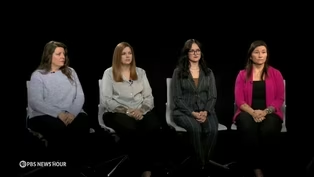
AMNA NAWAZ: Four women who say they were abused by the same Army doctor went to Capitol Hill today to tell their stories to members of Congress.
These women are the tip of the iceberg, four among potentially thousands of victims and what's being called the largest sexual abuse case in the history of the U.S.
military.
In October, the Army's Criminal Investigation Division, or CID, launched a criminal investigation into Major Blaine McGraw, an Army OB-GYN at Fort Hood in Texas, after a patient's husband alleged the doctor had inappropriately touched her.
Investigators discovered McGraw had secretly videotaped hundreds of his patients during sensitive exams he performed.
The Army charged McGraw last month with more than 50 counts of indecent visual recording, as well as conduct on becoming an officer, willful disobedience of a superior officer, and making a false official statement.
And the Army has contacted roughly 3,000 former patients of McGraw from Fort Hood and from his previous post, Tripler Army Medical Center in Hawaii.
McGraw is currently being held in a Texas jail.
I spoke with four survivors of his abuse this morning before they met with lawmakers.
And a warning, this conversation does contain descriptions of sexual abuse.
Thank you so much for being here.
I know this is not an easy conversation, and I want to thank you for taking the time to be here.
But I also want to note that we're not using your real names, at your request, so you can maintain some degree of privacy, as I know, for some of you, this is the first time speaking publicly about these incidents.
So let's jump in.
And, Clair, I will begin with you.
I will note for our viewers your husband is in Air Force Special Operations.
You saw Dr.
McGraw a number of times at Fort Hood.
Tell us a little bit about what you were seeing him for and what you can share about those exams.
"CLAIR," Survivor of Sexual Abuse: I started seeing him after some unsuccessful appointments with my PCM.
They referred me to OB-GYN.
I was seeing him for a year just trying to figure out, being in my 40s, like all of those changes that come with it.
And he actually, in the beginning seemed to be one of the only providers that listened and kind of cared, even understood what I was going through.
He would make weird comments at times.
I kind of just brushed it off.
Like, he would make comments about my breasts during a breast exam.
He made a comment after one of my surgeries about being able to see all of my tattoos, which was -- it caught me off guard because my tattoos are mainly above, like, my arms and my upper body.
So it caught me off guard, but, again, kind of brushed it off.
Almost every visit, I had to have a breast or pelvic exam, and it was always under the guise of the treatment I was receiving.
My mom was going through cancer at the time, so it was just precautionary.
Everything was always kind of explained away.
AMNA NAWAZ: You would question it when something struck you as odd?
And it was explained.
"CLAIR": I kind of would question it, maybe in my head more so than outright, because it was immediately explained away.
And I'm not a doctor.
I don't know what to expect.
I don't know what to look for in certain things.
So I was really trusting that system.
AMNA NAWAZ: Did anything else strike you during those exams?
You mentioned always being asked to undress completely regardless of what you were there for?
"CLAIR": Yes, I always had a breast exam every time, no gown, no chaperone ever.
So it was just take your top off, get on the table, take your pants off, get on the table, like nothing.
And the chaperones were -- someone was always busy, no one was available.
AMNA NAWAZ: So, in late October, you're contacted by Army investigators, and you learn that McGraw had been secretly recording you.
"CLAIR": Yes.
AMNA NAWAZ: What is that moment like?
Just walk us through what goes through your head and what you feel in that moment.
"CLAIR": The day before I learned this, I was just contacted by CID and they asked me to come in answering some questions about a provider.
They presented me with a picture and they said, please identify this person.
How do you know them?
How long have you known them?
And they turned it around, and it was a still image of myself.
AMNA NAWAZ: You recognized yourself.
"CLAIR": Immediately.
I knew the T-shirt, I was, like, that was from last week.
I knew exactly.
And I said: "Where is this from?"
They said: "Well, you were recorded during your entire breast and pelvic exam."
AMNA NAWAZ: What do you think in that moment?
"CLAIR": You don't.
You're just going from, you thought you had this trusting relationship with this provider that had been helping you, and now you're being told in 30 seconds that they had recorded you and violated you in this way.
And you don't know what to think.
AMNA NAWAZ: Angela, you were -- you retired last year, right?
But you were active duty at Fort Hood before that, we should note, as a field artillery fire control specialist.
Tell us a little bit about what brought you to seek care from Dr.
McGraw and what happened during that visit.
"ANGELA," Survivor of Sexual Abuse: In March of 2023, I was sexually assaulted by a fellow soldier.
He decided to take what he wanted while I was sleeping.
The following day, it was very brutal.
I immediately went to the E.R.
to get everything checked out.
McGraw was supposed to be conducting my rape kit.
And I thought I was crazy for the past two years, until I heard that other people experienced similar situations with him.
He never conducted the rape kit.
Ultimately, that was why my report fell through.
I reported the fellow soldier for assaulting me, but there was no physical evidence of the rape because the kit was never completed, just a very invasive exam of parts of my body that didn't need to be examined internally to that extent.
AMNA NAWAZ: I'm so sorry for what you have been through.
Did anything in that exam, anything in that interaction with McGraw, did it strike you as odd at the time?
"ANGELA": I wasn't comfortable, but I was a 19-year-old girl that had just been assaulted and I was just trusting this doctor.
It's like he's gotten know better than me.
This doctor has to be doing what's right.
There's no way that this would happen right after that other event happened in less than 24 hours.
So it was a lot of denial.
AMNA NAWAZ: Did Army investigators contact you as well?
How did you come to learn about this wider pattern of abuse?
"ANGELA": My friend sent me the press conference at Fort Hood.
She said that she was on the patients list and she knew that I had had an interaction with him too and that I should come forward and speak about my interaction.
AMNA NAWAZ: And have you heard from investigators since then?
What's the response been like from them?
"ANGELA": No, there has been no response.
AMNA NAWAZ: No response whatsoever?
"ANGELA": And they won't release my medical records to me either.
So it has been a little bit difficult with them.
AMNA NAWAZ: Nicole, tell us about you and your experience.
Your husband, we should note, is in the Army at Fort Hood.
So you saw McGraw back in 2024.
I understand you were pregnant at the time and you went in because you had a sinus infection.
What happened in that visit?
"NICOLE," Survivor of Sexual Abuse: Yes, I went in for a sinus infection.
I previously told the hospital not to schedule me with any males because of the fact that I'm a domestic violence survivor and sexual assault survivor.
So I didn't feel comfortable and, from the very first appointment, told them over and over again, put it on my chart, I don't want a male provider.
Please do not stick me with one.
I will refuse care if you do.
And I was not aware that Dr.
McGraw was the one that I got stuck with that day.
And at that point, I was 24 weeks pregnant and I just wanted relief.
Went in, he started being touchy-feely, putting his hand on my knee, talking to me.
I told him: "Please remove your hand.
That's uncomfortable."
And he laughed about it, kind of chuckled, laughed, and then proceeded with examining my neck and my nose and my throat and my ears and said: "Yes, you have a sinus infection, but I want to do a pelvic exam."
I told him: "No, I don't need a pelvic exam."
He tried three more times to sit there and tell me that I did need one.
I told him: "I do not.
I don't consent to it, but I will consent to you doing a stomach exam to check on my baby to see how my baby is doing."
And he proceeded to tell me to get on the table and lift my shirt up over my breasts and pull my pants down.
I said: "No, I'm not doing that.
I don't need to do that.
It's a stomach exam, exam in my stomach."
He proceeded to pull my shirt up even more over my breasts.
He started groping my breasts, and then he went to my pelvic area and pulled my pants down.
I told him: "No, remove your hands."
He started laughing about it.
And I told him: "If you don't remove your hands from me, I will punch you in your face.
This exam is over."
I left.
I went to the front and started talking to the lady and tried to report it.
She gave me a number and told me to call the hospital and file a report.
I tried for the rest of that month over and over and over again, calling, went up there.
Nothing.
Everyone was too busy.
Everyone was in a meeting.
No one could take my statement.
Nothing.
AMNA NAWAZ: What does that feel like in the moment when you're trying to raise the alarm, you know something is wrong, and no one will listen to you?
"NICOLE": Helpless.
"CLAIR": It's frustrating, because we're in this system that is supposed to protect our husbands, protect us.
And then when you're supposed to say something is wrong, it just falls on deaf ears.
It makes you feel unimportant.
AMNA NAWAZ: Beth, I want to bring you in here, because everyone else had an experience with Dr.
McGraw at Fort Hood.
But you first met him when he was a medical resident at a facility in Hawaii called Tripler at the base there.
You saw him in an emergency room visit, right?
Tell us what happened.
"BETH," Survivor of Sexual Abuse: I went to the emergency room because I was bleeding excessively, so much so that I needed a blood transfusion.
But I had the same experience, where he was very compassionate and listened, and then proceeded to do an exam in the emergency room just behind the curtain.
While sitting on my bed, he removed my sheets, my gown.
I was exposed completely.
People were walking by.
Someone walks by in a curtain in an emergency room, and it breezes open.
It was uncomfortable.
It was painful.
When he finished, my wife was there, and she looked -- we looked at each other and we went: "That's really weird.
That was really weird."
Ten minutes later, the emergency room doctor came in and said: "OK, it's time to do your pelvic exam."
And I said: "I just had one.
Do I need another one?"
And he looked super confused.
And he said: "Who just gave you a pelvic exam?"
I didn't know his name at the time.
I said "the last doctor who was just here."
And he was like: "No, we need to go to a private room and give you a proper pelvic exam."
And that was done private, three nurses in there, extra blankets because it was cold.
It was exactly what an exam should be.
I wound up spending the night in the E.R.
because there was no rooms available.
And the next morning, Major McGraw came back.
He said he was on his way out.
He wanted to check back.
"What's going on?"
I said: "Well, I haven't been bleeding.
I got blood.
I'm OK."
"Well, we should do another exam."
So, again, sat on my bed, did another very invasive exam and also did a breast exam.
And then when we saw the news, my wife and I looked at each other and said: "Oh, I wonder if it's that guy."
AMNA NAWAZ: You thought of him right away?
"BETH": Right away.
I wound up getting a certified letter in the mail alerting me that I was in the files and that they were going to be doing an investigation.
AMNA NAWAZ: What's it been like since then to hear all the other stories of the other women?
Because we should underscore here, this happened with you at least a year before a number of other women had similar incidents.
"BETH": I have a lot of guilt, because I feel like, if I could have reported that and been strong and did something about it, then maybe these women wouldn't be in that situation.
So I do have a lot of guilt about that.
There's no way to wrestle with that.
There were a lot of women at Tripler who had worse -- similar -- worse situations in mind.
But I do have a lot of guilt that I was not able to let the Army know earlier.
I don't know if anything would have been done, but I don't know how to justify that in my head as to not coming forward sooner.
He said there was a chaperone.
I never had a chaperone.
My records were not accurate.
He never described the exam he gave me or the breast exam.
You just trust that not only is this a doctor, but this is an Army doctor.
Your Army is your family, family first.
Your family is taking care of you.
So why would I question what's going on?
It's very hard to trust.
I have not had medical care since.
It throws me into a panic to think about it.
There's just a complete lack of trust and faith in the system.
AMNA NAWAZ: Does everyone share that lack of faith or trust?
I mean, how many, show of hands, trust the military to see this through and for justice and accountability to be served here?
Does anyone here trust the system?
No.
Why not?
"CLAIR": It's broken.
I mean, they don't even take complaints seriously of instances in the hospital.
How are they going to take this type of complaint?
Like, this shows bad on them.
So it's just more of them trying to protect themselves, while leaving us to deal with all of this.
AMNA NAWAZ: Beth, we should note that the Department of Defense says, as a result of the investigation into McGraw, there is a new health policy that they're instituting requiring that a chaperone be offered to be present during all sensitive exams.
What do you make of that?
Is that sufficient?
"BETH": I don't believe that's sufficient.
What would stop a doctor from just saying, "I offered and they declined"?
My records indicated I had a chaperone.
It said chaperone E.D.
nurse.
I did not have a chaperone at any point when I was seeing Dr.
McGraw.
I don't think that's enough.
AMNA NAWAZ: Angela, what do you make of this?
And if that policy is not enough, what is it you're asking lawmakers here in Washington to do?
"ANGELA": Our rules and regulations change with command constantly.
We're looking for consistency and accountability.
If we can set a law stating that chaperones are mandatory and it won't fall on us -- like, I was a 19-year-old girl.
I had no clue that I needed to have a chaperone or that I could even ask for one.
And especially in that headspace, it should not have been on me to try and speak up in that moment.
So, making this a law mandated that can't be changed when command changes in and out, that would provide confidence and consistency for us as soldiers and spouses.
AMNA NAWAZ: Nicole, is this to you about one doctor, about this one man?
Or are you worried about a larger system here?
"NICOLE": It's a whole system.
It's not just one person.
It's a medical system in general.
It's the Army in general.
It's the military in general.
It's not just one person.
"BETH": There needs to be systemic change as far as reporting.
There needs to be better accountability for a higher command.
Everyone reports to someone.
So command needs to take accountability for their soldier doing what they did, not pass them around to other duty stations.
AMNA NAWAZ: Did any of that play a role here, you think, the fact that we're talking about a major in the Army, that this is a system that really does take seniority and rank very seriously?
Who thinks that may have played a role here?
"ANGELA": Absolutely.
AMNA NAWAZ: You do?
Why?
"ANGELA": We, as soldiers, it is so incredibly uncomfortable to report.
It is not something that is promoted.
We will have Q.R.
codes you can scan to report or fill out a survey.
The second that somebody sees you scanning that, they have something to say.
Your own command when you go back to your unit after having some kind of an uncomfortable report will be like, oh, you're just complaining that your knee hurts because you don't want to run.
I had a soldier that had a torn meniscus that she was running on for several months because reporting is frowned upon.
I myself was harassed for a year-and-a-half by my unit after reporting my assault.
It's -- that needs to be fixed across the board for every single soldier and spouse.
Anyone that steps onto a military installation should know that they can report and it will be taken seriously and action will happen.
AMNA NAWAZ: Clair, I will give you the last word here.
What do you want people who are hearing your stories for the first time, maybe understanding the scope of this for the first time to understand?
"CLAIR": That we're stronger together.
And if you have been in this situation, speak out, find one of us, find somebody to help you so we can make this stop, because, if we continue to be silent, it's just going to continue to happen.
And we can't have that for our daughters, for the soldiers that are coming after us.
We can't continue to let this happen.
So, say something, and we're there for you.
AMNA NAWAZ: I can't thank you all enough for being here today, for sharing your stories.
We're going to continue to follow up on this as it unfolds.
Clair, Angela, Nicole and Beth, thank you.
"CLAIR": Thank you.
"ANGELA": Thank you.
"BETH": Thank you.
"NICOLE": Thank you.
AMNA NAWAZ: And that is the "News Hour" for tonight.
I'm Amna Nawaz.
On behalf of the entire "News Hour" team, thank you for joining us.

DOJ prosecutors resign over handling of ICE investigation
Video has Closed Captions
DOJ prosecutors resign in protest over handling of ICE shooting investigation (6m 25s)
How Denmark views Trump's threats to take over Greenland
Video has Closed Captions
How Denmark views Trump's threats to take over Greenland (7m 26s)
Iran protesters face crackdown, Trump says help 'on its way'
Video has Closed Captions
Iran protesters face ruthless crackdown as Trump says help 'on its way' (4m 27s)
Supreme Court hears landmark transgender athletes case
Video has Closed Captions
A look at the legal and political fight over trans athletes as cases reach Supreme Court (7m 21s)
Survivors of alleged abuse by Army doctor demand change
Video has Closed Captions
'It's the whole system': Survivors of alleged abuse by Army doctor demand accountability (19m 14s)
Providing Support for PBS.org
Learn Moreabout PBS online sponsorship
- News and Public Affairs

FRONTLINE is investigative journalism that questions, explains and changes our world.

- News and Public Affairs

Amanpour and Company features conversations with leaders and decision makers.












Support for PBS provided by:
Major corporate funding for the PBS News Hour is provided by BDO, BNSF, Consumer Cellular, American Cruise Lines, and Raymond James. Funding for the PBS NewsHour Weekend is provided by...