
January 15, 2024
Season 2 Episode 163 | 27m 28sVideo has Closed Captions
Celebrating the legacy of Doctor Martin Luther King, Jr.
Celebrating the legacy of Doctor Martin Luther King, Jr. and exploring his ties to Kentucky.
Problems playing video? | Closed Captioning Feedback
Problems playing video? | Closed Captioning Feedback
Kentucky Edition is a local public television program presented by KET
January 15, 2024
Season 2 Episode 163 | 27m 28sVideo has Closed Captions
Celebrating the legacy of Doctor Martin Luther King, Jr. and exploring his ties to Kentucky.
Problems playing video? | Closed Captioning Feedback
How to Watch Kentucky Edition
Kentucky Edition is available to stream on pbs.org and the free PBS App, available on iPhone, Apple TV, Android TV, Android smartphones, Amazon Fire TV, Amazon Fire Tablet, Roku, Samsung Smart TV, and Vizio.
Providing Support for PBS.org
Learn Moreabout PBS online sponsorship♪ >> So getting to show those.
You know, really the Kentucky side of that civil rights.
The story is so important to us.
How one museum is honoring Martin Luther King Junior's influence on Kentucky's civil rights movement.
We know nothing about how to be an antiracist or justice warrior or anything like that.
But we definitely had to do something about it.
>> The challenge these to Louisville sisters came up with an effort to end racism.
>> To be able to come full circle and be there representing your your other, your grandfather's lineage and the history is is amazing.
Honor.
>> Honoring the legacy of the Kentucky Derby pioneer.
♪ ♪ And its music and life.
>> Lessons for the students.
>> Production of Kentucky Edition is made possible in part by the KU Team Millennium Fund.
♪ ♪ >> Good evening and welcome to this special edition of Kentucky EDITION.
I'm Renee Shaw.
Thank you for spending some time with us tonight.
Today we celebrate the birth and the legacy of Doctor Martin Luther King junior.
>> King had ties to Kentuckyian often visited the state.
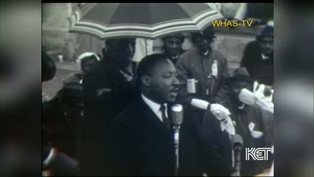
One of those visits became a landmark moment in our state's history on March 5th, 1960, for some 10,000 Kentuckians joined King and the March on Frankford calling for an end to discrimination and segregation in the state at the Fraser Museum in Louisville, preparations are underway for an event honoring the 60th anniversary of the March on Frankfort, the curator of the museum says the event will be an opportunity to talk about where we are today with civil rights and race relations and the role we can all play and making things better.
>> It may be unsure move that cannot be legislated behavior can be regulated.
>> I feel like Doctor King seems like this big national figure and we don't often think about the impact that he had in Kentucky.
It true that the law can not make a man love me, but it could KET him from the city.
And I >> he was really active in our civil rights movement here in Kentuckyian his brother, Reverend Ad King was actually a river and here in Louisville for several years.
So he came not only on business to help with the civil rights movement.
But he came here a lot to the his brother as well.
>> Probably the biggest events that Martin Luther King was known for doing here in Kentucky was the march.
I'm Frankfort and 1964.
And that in favor of a fair housing ordinance.
But they're hoping to pass here in Kentucky.
So people like Martin Luther King, Jackie Robinson, Georgia Davis Powers Peter Paul and Mary, the folk group.
All of these famous civil rights leaders led this march in Frankfort and over 10,000, Kentuckians came to that March and it was the biggest civil rights demonstration in Kentucky.
This year for the 60th anniversary.
Really hoping to honor that that huge events.
So we're having a panel in February on February 22nd did that's going to feature some of the people that attended that March.
Some civil rights leaders from the from And so we're we're really talking and hearing about the experiences of people that were there.
Well, we still have those people around.
>> We >> I feel like we have a really great responsibility to share diverse stories from all kinds of Kentuckians.
I really want anybody that comes to the phrase or 2 be able to see themselves in Kentucky's history and relate to it in that way.
So I think that that is part of Doctor King's legacy of.
Equality and you know, bringing light to the stories that we don't usually hear.
And so getting to show those.
You know, really the Kentucky side of that civil rights story is so important to us and now I just feel really lucky that we have the chance to share all of these stories in a permanent place in our museums.
I think what resonates to me about his work is the idea of hope.
And, you know, always striving to make things better.
You know, so Doctor King wasn't that long ago.
I've met people that talk to him that participated in the civil rights protests so that they could have equal space at restaurants and stores and Louisville, like this.
History is not that long ago and that we've come a long way.
We still have a long way to go.
So I think what Doctor King really teaches us as that we should always believed and strive for that.
You know that next step that next ideal of where we want to be ongoing and nobody.
>> Turn only people how much sun people talk in Montana, that freedom land.
>> The Frazier History Museum will present at bridging the divide.
March on Frankfort, the 60th anniversary on Thursday, February 22nd at 06:00PM Eastern Time.
The event is free but registration is required.
You can check out the Frazier History.
Museum's website for more information.
Last week, the Martin Luther King Junior State Commission held its annual MLK celebration and Frankfort, the awards event honored elementary middle and high school students for taking Doctor King's message of social justice and turning it into Art.
Governor Andy Beshear delivered remarks at the event.
He told us afterwards that King's message is one young people and the commonwealth as a whole need to embrace.
>> What today is all about celebrating diversity, recognizing that we have to work for equity and equality and recommitting ourselves to creating a commonwealth where everyone can truly succeed.
These awards are to students who put works out of art.
And again, that could be poetry.
Prose and others from schools all over Kentucky.
They've been selected by the commission, has truly embodying a doctor.
King, he and his mission.
And what I love is you look around that room and we have people from all parts of Kentucky, all different backgrounds, but all celebrating what Doctor King stood for, which I think is that universal truth that we are all children of God.
We need to see each other that way and work towards a world where everyone is truly treated that way.
It's special for it to be here in the history center when a lot of what we need to do is to correct historical wrongs to recognize that that they happen.
But and and that is going to take work and listening and learning to to truly address them.
When you see this many kids, we want to be a part of it and you want to be the change.
You gives you a lot of hope for the future.
>> The hallmark of Doctor King's work was fighting racial injustice and discrimination.
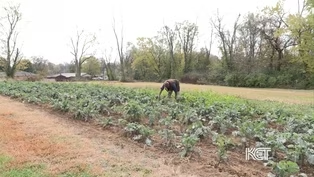
Of course, one group is helping Kentucky farmers who experience discrimination by the USDA and its farm loan practices.
Find justice.
They have been working to make sure those farmers get the support they need as they try to get back what they lost.
>> Discrimination financial assistance program is a 2.2 billion dollar program for farmers who face discrimination in farm loan programs prior to 2021, this discrimination can be proven by documentation.
For those who do not have the documentation to the lawsuit over time or in some instances, there was no documentation established.
Those farmers have the opportunity to tell their story.
>> I'm a 3rd generation This will be 70 years that my family has.
Stewart is and maintain this land.
We were sharecroppers for the majority of it was just perfect to be able to come back and buy something that my family has already put their blood, sweat and tears into it.
That loan process was a little bit different than what I remember as a child or what I've heard from other people.
So completed every test that they need to.
As far as the long guys, just like you approval at a bank.
But then I was denied requests because my property wasn't done correctly.
So that was a whole consortium of different problems where it talked to the field office in Washington, D.C., to get approval stating that there should be no issue.
But my field office said that was an issue per the loan requirements which later found out there was 9.
I also asked my city, they said they had no arguments against it, that it could be approved.
So that's how my fight with that to a Milo got press back and a missed opportunity to grow that season.
Very frustrating was very time-consuming money wise to because you still got to work.
But you got to meet these quotas and got me this time.
You're trying to balance all that and you're looking to have contractors come in and start clearing out some of the land cutting down trees.
But you can you and yeah, you're stuck in between this limbo where you put money into it and you start your investment into this lifestyle that grew up with.
But at the same time, I'm not seeing the return of because I can't.
Finish the rest of the process to do.
>> The discrimination.
It is not only based on race.
It also includes gender.
It includes a different protected classes.
We've had a lot of veterans veterans who who either went off to Vietnam and came back in needed to get loans to KET their barns going, where there were times in their narrative that some of the other landowners around them were in collusion with us.
USDA officials to to not help those veterans get the loans that they needed because the large landowners want to swoop in and take their land.
In Kentucky.
We're partnered with black soil and they have membership.
>> These local groups have memberships where we're able to reach into the farmer community or here right now.
I'm in the Kentucky that office.
It also serves as the blacks.
Okay.
Why fulfillment center many times when farmers are coming into the but Belmont centered there either delivering their seasonal produce their local meat and also gives us an opportunity to open up the conversation around the defect program.
A lot of times we're able to help the piece together.
Your story.
Sometimes the incidences have happened so long ago that the documentation isn't there that.
Person day.
They have the experiences with perhaps are no longer with agencies or no longer living.
And so it is our goal as the technical assistance support to really ensure that Farmer has the confidence that they need them to complete their application.
A lot of farmers know a lot of the stuff was never kept.
The receipts.
>> And when they go to the office and asking for ply their applications also never got a reply application.
They help me find some of my paperwork that needed to and request that.
So what they're doing is key because it's people that's from this community that know these farmers and know how to get to that information or make sure they get that information for that.
It is very hard to truly calculate the total cost of these >> There are some that are social.
There are some that are, you know, physical and in regards to the toll that it takes on people's mental health.
>> But more than a depressive feeling of.
How do you recruit people into work becoming a farmer wanting to get excited about growing food or owning land win?
>> This is the uphill battle as they see so many around experiencing.
So why would I want to pursue that?
So I really think it causes the loss of a deeper pipeline of individuals wanting to participate in agriculture.
I think it.
>> Don't give up because almost did Although it's in my blood, it was just a headache to go through that.
But I wouldn't trade it up for nothing because once you achieve in, you get your process going, you've got your land.
It's glorified this.
>> The deadline to apply for the program has past payments are expected to start going out next month to farm those who qualify?
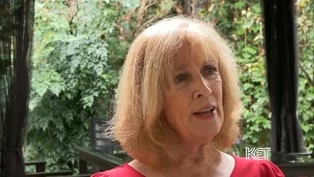
2 sisters and Louisville are trying to do their part to combat racism.
They started a community-based program to educate and change attitudes about race and relationships between the races.
It's a movement sparked by one of the darkest chapters in Louisville's history.
The police involved shooting death of Breonna Taylor.
>> This unlearn act as a group and little nonprofit began.
>> Back in May of 2020 with my sister Debbie, the port and it was in the wake of Breonna Taylor's murder.
We decided that we were outraged.
We know nothing about how to be an antiracist or justice warrior, anything like that.
But we definitely had to do something about it.
He wrote an e-mail to our friends and just said we have to do something.
We join us.
This was drafted for 50 women.
And if you are in just reply, yes, the next morning we've got replies from 100 people.
We KET we had touched a nerve beginning.
Our name was white.
Women demand justice for Breonna Taylor as we went on and further and further, we realize there was so much more for us to address and that we wanted everybody in it with us.
So we dropped the white women and we that.
It was specifically about what happened to breonna and what we're trying to do is learn everything that we can buy listening to black leaders by reading warming ourselves and then we try to give that information to other people, try to kind of be a bridge.
>> The antiracism challenge.
We both take these lifestyle challenges sometimes where you don't eat and foods and exercise every day and you sleep well and >> and the idea is that after doing this practice for a month or so, you have better habits and we thought that should be applied to anti-racism.
And so we developed it.
We realize this is a lifelong thing.
This isn't something that you just do occasionally.
This is something that you have to do again and again and again to break old old in our DNA genes of racism.
It goes so many generations back.
And if we pretend it's not there, he will always rear its ugly head.
We create a list of activities that people can do can be anywhere from read.
This article are right.
Your council person about this or patronize this black owned business.
These types of things just gives people a entry way to understanding and seeing what else is was seeing.
What's going on out there.
>> That you can do something that the fear is always been and I don't know what to do.
I don't know what to do.
Well here do this and it's really important to us to bring in as many people as we can.
>> You can learn more about the antiracism challenge by checking out the Listen.
Learn Act website.
The Kentucky Derby turns 150 this year often overlooked in the history of the Derby.
The contributions made by the African American jockeys.
But there's been efforts made in recent years to spotlight those pioneers back in September.
The winner of the first Kentucky Derby.
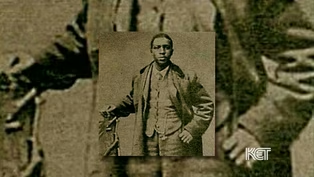
Oliver Lewis was inducted into the Lexington, African-American Sports Hall of Fame just before the event we spoke to his great, great grandson, actor Rodney Van Johnson about getting Lewis, the recognition he deserves.
>> It's very hard to believe that African-Americans were jockeys back then.
My great, great grandfather.
Robert Lewis was the first African-American jockey to win the Kentucky Derby, which is amazing feat with itself.
One of the biggest races in the world that everybody is attracted to and to know that that history.
Started with that, a small African American boy is pretty amazing.
19 years old.
I can't imagine being on a beast like that.
So that means that he had to train for 3 or 4 years.
That makes him 14.
You got to go back and you got to bring them and put more that night.
But what Ted?
I can even imagine.
But in my child on a horse at that age with a not a helmet.
But you know, all of this, every family had to do whatever he had to survive back then it was very difficult.
So a lot of people had different occupations outside of being a jockey.
My great great grandfather was also a b***** back.
Then bookies were considered a notable job, but now bookies and gaming and betting is is huge.
So when Oliver one and 19 and he did a couple more races and decided to not race again gambling.
Can you blame the guy why put your life out there and be heard?
And there was so many.
You know, women and men and women who who died, who are in the graves that died died because they were trying to feed their family by getting on this.
You know, 1000 pound beast to rise so they can make money buys everything.
African-Americans always waiting for things to happen.
That up a long time coming.
So.
Now we're here fast forward and this amazing history is going to be celebrated next year and the 100 50th anniversary just bought everything.
4 force for me.
So.
Since my mom is in her in her years and all the family members of the years, I pretty much the persons will be taking over the legacy, too.
KET the hope alive every year there's some type of black history.
But last year kind of affect me.
Pretty much because my son was in high school at the time.
He's a senior.
And information came up and they were asking people is like he's like, hey, my great, great grandfather won the Kentucky Derby.
Now that was everybody looked at him like, you know, he's 6, 3, almost 6 to it.
My way to that.
He's like, yeah, history.
It's so his teacher pulled up the information found out all the information was true and factual found out my name of the connection there.
That was it was huge.
So to be able to share that type of history and that type of a lineage with your kids with my kids right now.
It's pretty amazing to be able to come full circle and be there representing your your other, your grandfather's lineage.
And the history is is amazing.
Honor.
>> Indeed, Van Johnson said he and his family plan to make a documentary on his great, great grandfather's life.
It's been almost 4 decades since a Japanese base.
Toyota opened its largest vehicle manufacturing plant in Georgetown, Kentucky.
Now the facility employs nearly 9,000 people.
But the plan brought more than just jobs.
It's brought more diversity to central Kentucky with new businesses and restaurants.
>> I remember.
While bank given to students and I use the word ally, Japan, my son at the time was in middle school.
He was like, what is how I mean?
And I said a certain means it's a friend.
Then, you know, at a as a middle schooler, his comment was, oh, so Japan's our friend, a message out because they are best friend, you know, and in many ways, Japan in Kentucky, do you have a in the U.S. have a a best friend relationship?
There's a lot of similarities between Japanese culture and Kentucky culture in regards to family ties, family relationships.
So when that happens come they feel at home?
You know, we opener our homes, our neighborhoods and communities.
We develop those relationships.
>> I spend my life half of my life in Japan.
Half almost have in here.
I race in Tokyo.
I met my husband in Japan years later, we marry.
>> And he brought it here in 1998.
So I was able to see like a in the mutual positions between Japanese culture in American culture.
I was able to put together and to create >> Today we have over 206 staff and his company stuck on Kentucky home.
So right now, I'm 47% of all foreign investment into the state comes from Japan.
It's pretty diverse.
It's from manufacturing.
2 financial world to restaurants.
You know, like no 1, 6,000 Japanese nationals that are here on visas, you know, so we want to provide them with the most comfort.
Areas that we can so, you know, Japanese markets, Asian markets, those types of things have expanded throughout the entire state.
>> The people come from Japan the basically they don't have anything experience living Japan is more likely lately.
Young people coming to work to that plant.
Then those people has no light, no knowledge about what the American culture or to some people doesn't speak any English at all.
And we would like to help there in can in Lexington and hopefully they can feel like this is a second home.
You know, there's curry and the >> You know, the chickens and all of those things, the lives, you know, so so it's a it's a taste of Japan.
For us to move in the Japanese world, you know, and then for the Japanese nationals live here in the community aren't.
>> Would like people have open mind A&M.
>> Trying to something new that they never had before.
>> after that experience and hopefully they'll come back and try something new again and >> Looks good.
School sushi is located in downtown Lexington and recently expanded to include a karaoke room as well.
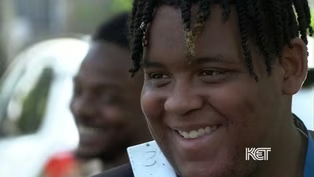
A Louisville man is using beats to build community.
Eric Granger decided to start the Louisville Drumline Academy to give young people interested in music, a place to belong and he thinks the young adults in the academy have learned more than just music.
♪ ♪ ♪ ♪ >> Been a good thing for me to be in something.
>> You know, positive formed a a lovely day.
The way to her soaking right to practice came way to just how funny joining each other's company is like a family to.
>> Being a group of people who love music again, we're going out and performing our talent.
And, you know, Sean, people, this is what we really love it.
And it's, you know, it's bringing people together.
People who like music and stuff like that is just this is a great feeling to members of his group.
>> Is awesome.
They dedicate it a loyal.
They have no problems being are.
We've got a we've got emergency performances.
Go get it, OK, let's go or so.
They were seen jumping ready to rock soul.
And that's the one thing I love about.
You know, and they are just absolutely awesome them in.
♪ >> I really shows like, you know, have to be on time and you have to practice.
You can just come to practice in play and then gone.
You have to go home and practice so you can get better occasion.
Moved to different mention man or something like that.
It's really more so like dedication, a communication and we have an independent and leadership with that, too.
♪ >> Okay.
Community gave a sense of hope.
Resilience and sincerity hoping that people see music as a way out in the angry, you know, Jones is very therapeutic.
It's a tool use with frustration.
You know it.
It works.
We're streaming everything, negative, negative in your life.
We use it turned to face the music.
We have put a hope.
And how to get people in the community.
We realize that music can be expressed turning to anger in balance.
And hey.
Negativity.
Turning to some positive.
>> Certainly a lot of fun catching up with them last summer.
Best of luck to them.
Well, thank you so much for joining us for this special edition of Kentucky EDITION.
And we hope to see you right back here again tomorrow night at 6.30, Eastern 5.30, central where we inform connect and inspire subscribe to our Kentucky Edition email newsletters and watch full episodes and clips of KET DOT Org.
You can also find us on the PBS video app on your mobile device and smart TV.
Send us a story idea that public affairs at KET Dot Org and of course, follow KET on Facebook X, formerly Twitter and Instagram to stay in the loop.
Thank you so much for watching.
Hope you had a great day today and we'll see you right back here again tomorrow night.
Take good care.
♪ ♪ ♪
Video has Closed Captions
Clip: S2 Ep163 | 2m 51s | Two sisters in Louisville are doing their part to combat racism. (2m 51s)
Video has Closed Captions
Clip: S2 Ep163 | 3m | A Louisville man is using beats to build community. (3m)
Farmer Discrimination Assistance
Video has Closed Captions
Clip: S2 Ep163 | 5m 23s | Group helps Kentucky farmers who experienced discrimination by the USDA. (5m 23s)
Video has Closed Captions
Clip: S2 Ep163 | 4m 36s | One of Dr. King's visits to Kentucky became a landmark moment in state history. (4m 36s)
Video has Closed Captions
Clip: S2 Ep163 | 3m 42s | Oliver Lewis, winner of the first Kentucky Derby, was inducted into the LAAS Hall of Fame. (3m 42s)
Providing Support for PBS.org
Learn Moreabout PBS online sponsorship
- News and Public Affairs

Top journalists deliver compelling original analysis of the hour's headlines.

- News and Public Affairs

FRONTLINE is investigative journalism that questions, explains and changes our world.












Support for PBS provided by:
Kentucky Edition is a local public television program presented by KET