
January 15, 2026
Season 4 Episode 301 | 26m 29sVideo has Closed Captions
A proposed bill aims to ease Kentucky's teacher shortage.
A bill looks to pay high school students to become teachers, education advocates call on lawmakers to prioritize funding public schools, JCPS announces a major budget reduction plan, and federal funding for recovery programs is restored.
Problems playing video? | Closed Captioning Feedback
Problems playing video? | Closed Captioning Feedback
Kentucky Edition is a local public television program presented by KET
January 15, 2026
Season 4 Episode 301 | 26m 29sVideo has Closed Captions
A bill looks to pay high school students to become teachers, education advocates call on lawmakers to prioritize funding public schools, JCPS announces a major budget reduction plan, and federal funding for recovery programs is restored.
Problems playing video? | Closed Captioning Feedback
How to Watch Kentucky Edition
Kentucky Edition is available to stream on pbs.org and the free PBS App, available on iPhone, Apple TV, Android TV, Android smartphones, Amazon Fire TV, Amazon Fire Tablet, Roku, Samsung Smart TV, and Vizio.
Providing Support for PBS.org
Learn Moreabout PBS online sponsorshipMusic These decisions are difficult.
These are the hardest choices I face.
[MUSIC] But student success must be the priority.
[MUSIC] >> What could be on the chopping block in Kentucky's largest school district?
[MUSIC] >> This isn't a political issue.
This is a public school issue.
[MUSIC] >> What a new poll says about spending more on Kentucky's public schools.
>> He has more of an elitist following, and I'm more of a grassroots guy.
[MUSIC] >> A Central Kentucky congressional candidate talks about the differences between him and his main rival.
[MUSIC] >> Production of Kentucky edition is made possible in part by the KET Millennium Fund.
>> Good evening and welcome to Kentucky edition for this Thursday, January 15th, I'm Renee Shaw one day until Friday.
We thank you for joining us this evening.
High school students could be paid to become teachers under a bill being considered in Frankfort.
The sponsor of Senate Bill 22 says it aims to ease the teacher workforce shortage by creating an intensive, quote, grow your own teacher program.
Our Mackenzie Spink kicks off tonight's legislative update.
[MUSIC] >> Kentucky is Ready to Work scholarship program includes teaching as one of the learning pathways for high school students, but it can only take students as far as an associate's degree.
Teachers are required to have a bachelor's degree.
Bill sponsor Senator Jimmy Higdon says his bill will take students all the way.
>> What this program is designed to do is get those students that participate in this when they graduate from high school to have a associate's degree and then go on to college.
And in two years, they would finish their their get their teaching certificate and hopefully return to the school they came from to go to work.
>> The proposed apprenticeship program would be registered with the Department of Labor and pay students as they attend classes and get real world experience with post-secondary institutions.
Lexington Democrat Senator Reggie Thomas raised concern with the intensity of the apprenticeship for high school students.
>> They've got to take 20 dual credit courses, which do not exceed eight courses per academic year.
That that just seems like a lot to me for a child to take.
>> A similar program is already underway in Nelson County, and a district representative shared that although the program is aggressive, students receive intense college and career advising as a part of the program.
Senator Higdon also mentioned that there are other teaching pathways that are not as accelerated as the proposed program, but students who do choose the more rigorous apprenticeship path will graduate with no student debt.
>> They're paid the apprenticeship.
They they work and they're paid through college.
And like I said, this associate degree is is paid for by by through the KY scholarship money and the work ready scholarship.
>> The Senate Education Committee approved the teacher apprenticeship bill and it now awaits action from the full Senate.
That same committee also advanced a bill from Senator Matthew Dineen, aiming to update previous legislation allowing passenger vans to transport children to school and related activities.
>> This bill will put us in line with the federal guidelines related to these types of passenger vans, and it simply moves it from a nine passenger van to a ten passenger van, which many districts had purchased over the summer, and some of them now are sitting in bus garages waiting to be used to.
Hopefully with the emergency clause on this bill, they will be back on the road saving districts thousands of dollars in fuel.
>> After discussion about the requirements for the van drivers, the bill was passed favorably with the expectation of further amendments to come.
For Kentucky edition, I'm McKenzie Spink.
>> Thank you.
McKenzie.
The current law allows nine passenger vans to take children to school along bus routes, and to take students to and from activities like club and sporting events.
Education advocates gathered in Frankfort today to encourage state lawmakers to prioritize funding for public schools.
The Protect Our Schools KY coalition says results from a new poll show that Kentuckians want to see the state make a bigger investment in public education.
>> We are at a critical juncture now regarding public education in our state.
According to the Kentucky Center for Economic Policy, state funding for public schools, known as Seac, has declined an inflation adjusted 25% since 2008.
Our schools have been asked to do more with less buying power year after year.
A new statewide poll conducted by Change Research found that Kentuckians Kentuckians overwhelmingly support lawmakers in making increased state investment in public schools a top priority.
Change research asked a simple question should it be a priority to increase state spending for public schools to allow an 8% raise for teachers and other school employees, and to hire 5% more staff to lower class sizes, expand preschool and higher mental health counselors.
Here are the results.
In a poll of 2079 Kentuckians with a margin of error of plus or -2.2%.
70% of Kentuckians support making this kind of reinvestment in public schools.
The same poll shows that 96% of Democrats support.
82% of independent support, and 53% of Republican support.
Support importantly, including 54% of Trump voters.
This is what bipartisan looks like.
Kentuckians coming together around the belief that strengthening public schools is not controversial.
It's common sense.
>> When parents, educators, and students name what they are living overcrowded classrooms, underpaid staff, rising costs, and communities stretched thin.
We can move past political talking points and focus on what actually helps families thrive.
What's possible when we do, we do.
This is Kentucky, where every kid in every single zip code has a fully funded public school with counselors, busses, books, and modern facilities that they deserve.
It's a Kentucky where teachers can afford to stay in the profession.
Support staff who earn living wages and students get the career pathways, special education services and mental health supports that make learning possible.
>> The investments Kentuckians are calling for are possible if lawmakers increase K-12 funding by 718 million per year, which is the same cost as the half point income tax cuts the legislature has passed in recent years.
>> We are willing to work across party lines.
This isn't a political issue.
This is a public school issue.
So we're willing to work with anyone to make sure that this makes this happens.
>> The advocates say public schools are $1.3 billion behind where they should be.
If funding kept up with the pace of inflation.
The superintendent of Kentucky's largest school district is proposing $142 million in budget cuts that would include eliminating 300 positions in central offices.
Kelsey Starks sits down with Jess Clark from Louisville Public Media to discuss what it all means in this week's Reporter's Notebook.
[MUSIC] >> JCPS Superintendent Doctor Brian Yearwood outlined his proposal to the Audit and Risk Management Advisory Council on Wednesday.
Here's what he had to say.
>> It's a new day in JCPS.
Renewed accountability.
I am proposing a responsible, student centered draft budget that realigns the district with its mission to challenge and engage each learner to grow through effective teaching and meaningful experiences within caring, supportive environments.
To fulfill our duty to students, teachers, families, and taxpayers, I have to make difficult decisions, including eliminating positions and programs that no longer align with our essential obligations as a school district.
These decisions will not all be popular, but they are necessary.
>> Jess Clark covers education and learning for Louisville Public Media's Kentucky Center for Investigative Reporting.
Thanks so much for being here.
Now, Doctor Yearwood knew he was coming into this position last fall with a huge budget shortfall.
The board was a little surprised to learn about it.
And now we have this proposal to make some serious cuts here.
What exactly is in the proposal?
>> Yeah.
So there are some major cuts.
It's a $142 million, which is sizable.
The biggest chunks are he wants to cut $44 million from central office.
That's around 300 positions.
He says another 41 million for supplemental add on funding that goes to schools.
There's another 30 million that's in the works pending negotiations.
So those are things that the district is actively negotiating with the different unions.
Cuts to transportation and some school closures as well.
>> Yeah.
And those school closures have been a big sticking point since he announced that earlier this year.
And teachers and parents were out protesting.
They pulled that back.
But there are still schools on the table.
>> Yes.
King elementary, which is in the Shawnee neighborhood in the West End, is still on the table for closure.
Zachary Taylor Elementary is also still on the table for closure.
The new proposal would leave leave intact.
Liberty High School, which is an alternative high school.
It would move the campus and it would also leave intact the Tap program, which is for high school mothers.
>> Yeah, the the biggest chunk of this, though, is those 300 positions eliminated from central office.
What kind of positions are these and what have you been hearing from administrators who are concerned about what that means?
>> Well, it's not super clear what the 300 positions are yet.
Central office.
These are folks who do administrative tasks, tasks, or perform tasks that are kind of centralized.
So things like it, things like human resources, things like finance, those are all things that are considered central office.
There are a number of positions that are considered technically central office that are actually school based positions.
So there are concerns from some, you know, principals that even though some of these positions may be termed central office, they're actually going to cut and they're not going to insulate these schools from having staffing cuts.
>> So we'll have more with Jess Clark on this developing story tomorrow, including what it means for teacher salaries.
Now the school board is scheduled to vote on the proposal January 20th.
It's not just school districts adjusting their budgets.
Starting this year, there will be some changes to the federal student loan repayment program.
Our Emily Sisk caught up with an expert to explore the changes that could impact more than 600,000 Kentuckians with unpaid student loans.
>> We are joined now by Scott Buchanan, the executive director of the Student Loan Servicing Alliance, coming to us from Washington, DC.
We so appreciate you being here.
And we know it's a new year.
It's 2026, and there are several changes that have come down the pike as far as student loan repayment.
So what do Kentuckians need to be aware of when it comes to federal student loan repayment plans and the new programs that are out there for that?
>> Yeah, absolutely.
And Emily, thanks for having me here today.
Yes, 26 is upon us, and there are a lot of changes that are going to be coming this year to the federal student loan program, in particular on repayment plans.
It's important to remember if you had loans that you took out 5 or 6 years ago, a lot of the repayment options that were available then are going to still be available for you, so you'll still have access to the original standard repayment plan.
You'll still have access to an income based repayment plan.
And effective July 1st of 26, you'll actually have access to a new repayment plan, the Rat Plan Repayment Assistance Plan.
And for those who are new borrowers going forward, there will be a new standard plan that is very similar to, you know, a mortgage repayment plan where it's set based upon the the balance of the loan.
But you'll also be able to access that income driven repayment plan.
I mentioned the repayment assistance plan, which is based upon your income level.
So as your income rises and you will have a larger and larger percent that is owed on that student loan.
For some folks, though, who make very low income, that repayment amount could be 1% of your of your discretionary income.
>> I want to switch gears a little bit also on the topic, of course, of federal student loan repayment, but a big subject has been wage garnishment, which is starting up this year under the Trump administration.
For people who are watching and might say, like I was earlier, what is wage garnishment?
What is it and how might folks be eligible for it?
>> Sure, wage garnishment is a program that's been around for decades, right across multiple administrations.
Wage garnishment was paused during the Covid situation and was scheduled to resume.
Really, what wage garnishment is is it is a program that the government goes to your employer and says, hey, borrower X your employee is not paying on their student loan.
We're going to take part of their income.
This is really a program that only impacts people who have defaulted on their student loan.
>> We know that.
Also, it wouldn't be a surprise, right?
You wouldn't just see your paycheck and say it's less, you should receive something in the mail.
And also it's not necessarily a done deal.
People do have an option to object to the wage garnishment, right?
Tell us more about that.
>> That's correct.
So before your wages start getting you will be notified that that's forthcoming.
You'll get a letter or an email depending upon how you selected to be reached out to.
And that will notify you that in the next 3060 days, wage garnishment could begin.
And that's your final opportunity, right, to reach out to the department and find some other solution before that happens.
>> Lastly, Mr.
Buchanan, just to put this in perspective, can you tell us how many Kentuckians are out there who have unpaid federal student loans, and what would your advice be to that population?
>> Yeah, they're roughly about 90,000 folks in the state of Kentucky who have defaulted student loans.
So who might be eligible for that wage garnishment.
And roughly the average balance is around $20,000 that people still owe on those loans.
So in my advice to those folks, if you are one of those people who is in default, now is the moment to pick up the phone, call the Department of Education and say, listen, what are the options are available for me?
The best thing, I think, for almost all borrowers is something called loan rehabilitation.
The Department of Education is able to set a reasonable and affordable monthly payment that you'll pay under that plan.
Getting that default off your credit history can be incredibly beneficial, and the only way you can do that is by loan rehabilitation.
>> All right.
Well there we go.
Great information.
It can be like drinking from a fire hose.
Right.
But it's if you stay on top of it, you can keep track of it and stay on top of it.
In the new year, Scott Buchanan with the Student Loan Servicing Alliance, thank you so much for breaking all this down for us.
>> Thank you, Emily, for having me.
>> Of course.
>> Buchanan also recommends anyone with student loans to keep in touch with their loan servicer.
He says there are many options to help avoid defaulting on your student loan payments.
[MUSIC] The Trump administration is reversing a decision that would impact access to an overdose reversal drug, Narcan.
We told you yesterday the administration was cutting $2 billion nationally for programs that help people with drug addiction and mental illness, as well as people experiencing homelessness.
That included $499,000 that paid for Narcan and two people who helped distribute it in Lexington.
Now, the city says it's received word that Lexington will be able to keep the money.
In other news, a state lawmaker seeking a seat on Capitol Hill in Washington calls himself a, quote, grassroots guy and labels his prime opponent as, quote, an elitist.
State Representative Ryan Dodson is one of five Republicans competing in the GOP primary in the sixth Congressional District, held now by Andy Barr, who is vacating that seat to run for the U.S.
Senate.
In part two of my interview with Dodson, he boasts of his conservative bona fides and defends President Trump and recent immigration raids that have turned deadly.
There are four now that the candidate filing deadline has passed.
We know that there are four other candidates officially who are in the GOP primary.
What do you think differentiates you from them?
In particular, former state Senator Ralph Alvarado, who has been on the Kentucky ballot before as a state senator and as a lieutenant governor when it comes to name recognition.
Do you think he's the one you've got to beat?
>> The race will between will really between him and I. And just to be quite honest.
But the differentiating factors are there and people see us in different lights.
He has more of an elitist following, and I'm more of a grassroots guy.
And they'll say that that'll be reflective on our reporting.
And and so there's a huge difference.
He left here and went to Tennessee and I stayed.
The only time I've left Kentucky is when I served my it served in the military in the US Army.
>> When you think about your Republican policy bonafides, though, do they stack up pretty evenly in aligned?
I mean, he's spoken at the Republican National Convention.
I mean, he's done a lot to kind of plump up his bona fides.
Do you see any kind of policy differences between you?
>> And there's a lot.
Now, he and I will agree on 90% of policy, but there's a 10% difference probably.
And that's what people are going to judge people.
And there are things that that he and I differ on.
You know, when it comes to Covid, I was very adamant about keeping your body autonomy.
And he was very adamant about taking the vaccine and taking the Covid shot.
I was not, and so I fought it from my position on the Health Service Committee in the House because people were getting fired from their jobs.
Nurses were getting fired from the hospitals, and I was doing everything I can to help protect those that just didn't feel like the Covid shot was for them.
So he and I differ on that issue.
We differ on several other issues and that will come out during the campaign, but there are some differences that people will take note of.
>> So if you do come out of the primary, you'll face one of seven Democrats who are vying to get that seat.
Are you confident that you can best whoever advances from the Democratic primary?
Even if President Trump's popularity declines, or some would say, continues to decline on a nationwide basis?
And if there's even tougher scrutiny of his administration and his policies.
>> I believe that whoever wins this Republican primary will actually win this seat.
When you look at all the higher name profile people, they stayed away from the race.
You know, there are people with much higher name recognition that didn't want to touch the race, because I've even been told by high ranking Democrats said, listen, I looked at getting in that race and we just didn't think it was viable for us to win.
So that's within the camp of the Democratic Party.
So we know where we are, and we have to win this Republican primary.
And whoever wins this, I think, will come out.
>> Do you think maybe some of the national media who spy on all these kind of political contests and who've said that the sixth district could be in play?
Do you think that's overplayed?
>> It's overplayed and it's to draw attention here.
And as for raising money, it's for fundraising purposes.
No doubt there's a lot of fear mongering even within the Republican Party.
Well, you need to choose this candidate because this candidate can win the general.
This candidate can win the primary, but this one can win the general.
So there's a lot of fear mongering taking place trying to get people to shift alliances because they want to play up that general election.
>> Given your background as a pastor, many people are saying that character does matter when it comes to who is in elected office, who represents us and puts a face on on who we say we want is a leader.
There are many people who criticize how President Donald Trump comports himself the language he uses.
How does that matter to you that the leader of the free world may not always show as much grace as some people give him?
>> Well, you look at the fire he's been under.
I mean, he was a political witch hunt from the Democrats from day one.
Impeachment after impeachment.
His first term in office.
He has went through a lot.
He's had to endure a lot.
So I understand the sense of the frustration that he's had to deal with.
What matters to me the most is the policy.
What matters to me is is he really, truly American first?
And he is.
And he's proven that this man has given up, if given his wealth and the opportunities that he has, most people would be sitting on a beach somewhere enjoying the rest of their life.
But this man is fighting for America.
He don't have to do this.
And so I believe that in itself is why people gravitate to him.
They see him as a true leader.
And so going back to what you stated, you know, there is a lot of frustration that he's had to deal with and a lot of probably a lot of sleepless nights because of all the political witch hunts that has been going on in his personal life for many years.
>> As we are talking, as we know, just watching the headlines, there are a lot of tensions and demonstrations are escalating over the Ice raids.
And when we think about some of the issues that might drive the sixth district race, do you think that what's happening outside of Kentucky has any bearing on how you advance during this political contest?
>> I think Ice is a good thing, because when you look at the financial implications of all the illegal immigrants, from health care to jobs to driving up housing costs, deporting illegal aliens is is really the right thing to do.
And so I'm in full support of that.
So I think going forward there's going to be more of it and we'll see where we are.
When I get to Congress, we'll see what type of results.
Data is very important.
We want to see the data.
We want to see how many that we've deported and how it's affecting us financially.
So I think going forward, we just have to gauge it year by year and see where we are.
But I'm in full support of it.
And, you know, I just think that going forward, when you look at Joe Biden's administration, he had 87,000 IRS agents coming after taxpayers, American taxpayers.
Now we've got 20,000 Ice agents going after illegal aliens who abused and fraudulently taken taxpayer money.
There's a difference.
And I want to be and I want to champion for the American people.
>> Do you approve or disapprove of the deadly force that's being used by Ice agents, even against Americans who are legitimate, born here Americans?
>> Well, what we've seen, especially in Minnesota, I hate that anyone's lost their life.
But at the same time, this lady used her vehicle as a weapon to run over an Ice agent.
So the thing is, is it's unfortunate, of course, but I think that sometimes those things do happen.
And it's unfortunate.
But I stand with ice and, you know, going forward, I think that people when you look at Minnesota overall and you have a failed governor, as Tim Walz is, the people are conditioned there to be disrespectful.
If the law pulls you over and ask for your driver's license and registration, simply give them your driver's license and registration, comply with the law.
And I think as simple as that.
But people are are abusive to the law.
And and I always will back the blue.
And so I think when you get pulled over or you've been asked to stop at a road road stop and just simply comply, it's not that big a deal.
Do what you're asked to do and then move on with your life.
>> You can see part one of my interview with State Representative Ryan Dodson from last night, online on demand at Keturah Julie Raque Adams Kentucky Edition.
From now until the May election, we'll bring you some more interviews with some key candidates running in some competitive races this spring.
[MUSIC] A busy news week comes to an end.
Tomorrow we'll go inside Kentucky politics with the A team.
Bob Babich and Trey Grayson.
You can join us for that.
Plus, part two of the interview with Jess Clark of Louisville Public Media about what's happening with Jake, all of that, and much more.
Friday on Kentucky Edition, which we hope that you'll tune in for at 630 eastern, 530 central right here on KET.
And you can connect with us online by all the social media channels Facebook, Instagram and X to stay in the loop on what's happening on Kentucky Edition and all of our great programing here, send us a story idea by email to Public Affairs at Keturah, and look for us on the PBS app that you can download on your phone and other smart devices.
Thank you so much for joining us today on Thursday, but we'll see you for Friday tomorrow night.
Take good care.
[MUSIC]
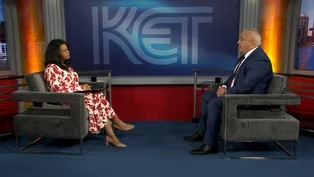
6th Congressional District Candidate On His Conservative Credentials
Video has Closed Captions
Clip: S4 Ep301 | 8m 29s | Central Kentucky congressional candidate talk about differences between him and his main rival. (8m 29s)
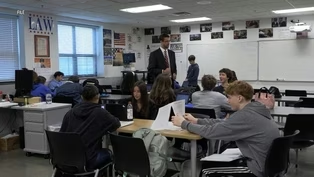
Bill Aims to "Grow" Teachers in the State
Video has Closed Captions
Clip: S4 Ep301 | 2m 15s | Program looks to high school students to help ease state's teacher shortage. (2m 15s)
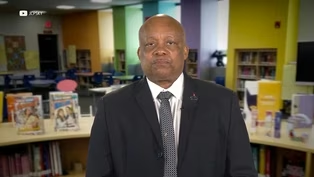
JCPS Could Cut 300 Positions Under Proposed Plan
Video has Closed Captions
Clip: S4 Ep301 | 4m 2s | What could be on the chopping block in Kentucky's largest school district. (4m 2s)

Kentuckians Brace for Changes to Student Loan Program
Video has Closed Captions
Clip: S4 Ep301 | 5m | How changes to federal student loan repayment program could impact Kentuckians. (5m)

Poll Shows Kentuckians Want More Education Investments
Video has Closed Captions
Clip: S4 Ep301 | 3m 3s | What a new poll says about spending more on Kentucky's public schools. (3m 3s)
Providing Support for PBS.org
Learn Moreabout PBS online sponsorship
- News and Public Affairs

Top journalists deliver compelling original analysis of the hour's headlines.

- News and Public Affairs

FRONTLINE is investigative journalism that questions, explains and changes our world.












Support for PBS provided by:
Kentucky Edition is a local public television program presented by KET