
January 17, 2024
Season 2 Episode 164 | 27m 31sVideo has Closed Captions
State House Republicans introduce their budget proposal.
State House Republicans introduce their budget proposal. Sen. Mike Wilson discusses his Kentucky Board of Education bill. The Senate passes a measure that could change when Kentuckians vote. Groups voice skepticism about an omnibus crime bill as well as legislation dealing with rights for landlords.
Problems playing video? | Closed Captioning Feedback
Problems playing video? | Closed Captioning Feedback
Kentucky Edition is a local public television program presented by KET
January 17, 2024
Season 2 Episode 164 | 27m 31sVideo has Closed Captions
State House Republicans introduce their budget proposal. Sen. Mike Wilson discusses his Kentucky Board of Education bill. The Senate passes a measure that could change when Kentuckians vote. Groups voice skepticism about an omnibus crime bill as well as legislation dealing with rights for landlords.
Problems playing video? | Closed Captioning Feedback
How to Watch Kentucky Edition
Kentucky Edition is available to stream on pbs.org and the free PBS App, available on iPhone, Apple TV, Android TV, Android smartphones, Amazon Fire TV, Amazon Fire Tablet, Roku, Samsung Smart TV, and Vizio.
Providing Support for PBS.org
Learn Moreabout PBS online sponsorship>> House Republicans released their budget plan here.
What's in it?
What isn't and how people are reacting?
Lawmakers consider a safer Kentucky bill, but will the results live up to the name?
>> Learning to navigate grief is also to me.
A fantastic way of understanding how to live in the world had an avigation tough circumstances.
>> And how Scott County schools hope to help students come back from tragedy.
>> Production of Kentucky Edition is made possible in part by the KET Millennium Fund.
♪ ♪ Good evening and welcome to Kentucky EDITION on this Wednesday, January, the 17th, I'm Renee Shaw.
Hope you're staying warm.
>> And thank you for spending some of your Wednesday night with us.
Roughly a month after Governor Andy Beshear released his two-year budget proposal.
House Republicans have introduced their own budget bill.
Details about it.
Big end.
Tonight's legislative update, House Bill 6 introduced yesterday calls for spending almost 125 billion dollars over the next 2 years compared to the governor's request of 136 Billion.
The bill does not include a guaranteed pay raise for teachers and it does not provide money for universal Pre-K, both things that were included in Governor Beshear's budget proposal.
Instead, the bill calls for allocating additional money through the state's main funding formula for K through 12 schools.
And House Speaker David Osborne says the bill strongly suggest that school personnel deserve pay raises a separate Bill House Bill one would spend 1.7 billion dollars on one time investments in public safety, infrastructure and economic development and pay down some of Kentucky's pension liabilities.
The bill calls for 150 million dollars for drinking and wastewater infrastructure.
75 million for site development to help attract new business.
And nearly 30 million for river port and airport programs.
The progressive leaning Kentucky Center for Economic Policy is critical of the House Republican plan.
Jason Bailey, the group's executive director put out a statement saying, quote, the House budget proposal released Tuesday fall short of delivering the budget we need and adds billions more to already over funded reserves.
The proposal provides too few resources to education and childcare and leaves out pressing needs like housing, unquote.
A bill to let Kentuckians decide who sits on the Kentucky Board of Education could soon see some action in Frankfort, Bowling Green.
Senator Mike Wilson's Senate Bill 8 would take away the governor's power to appoint most members to the state Education board and let Kentucky voters decide in partisan elections.
The Kde is the governing body of the state's K through 12 education system.
That sets policies and regulations for the state's 171 school districts.
Wilson says each governor since the advent of education reform 3 decades ago, this exercise their power over the board and he believes voters should make that choice.
>> When we did the legislation we purposely set up the Department of Education and the board outside of the governor's office so that it would not be part of this kind.
And so we continually see this, especially our current governor when he got elected in first came in the very first thing you did.
What's he dissolved the board of education than reappointed Re did the board and they put in all of his appointees, which at that time were all Democrats.
And so we had to change it to make it politically balanced, racially balance.
We did.
You know, so they couldn't dissolve the boarding door, but yet we've continued to see that they they obligation to the governor because he appoints them in the obligation should be to the citizens who have there.
Children in school.
And we see 171 district's school districts that are across our state and every one of their school boards are like that.
And that makes them accountable, you know, to their voters, to the people that have their children in their schools.
And so we felt like this is a a natural progression to actually have the totality the Department of Education accountable to the citizens of Kentucky.
>> And how did the Supreme Court districts figure into how these members are selected?
>> currently, I think you have like 14 members on the board.
And so we will have 14 members that are voting.
Members of the board will have 2 per Supreme Court district.
The Supreme Court district.
There are 7 of them and they will be divided into 2 actually areas area, one into area 2 and you'll have candidates from each area and the first election cycle be 2026.
And in the area, one, they will run for a two-year term.
The area to that Supreme Court district to run for a four-year term.
And then every 2 years after that, it will be, you know, their areas up again.
Area one will be up for a four-year term and then, you know, the next time around the Bay area to up for a four-year term.
That's how to rotate through that.
And you'll still have those that will on the board that currently are there.
But non-voting members the secretary of education, labor.
Also, you have the commissioner, the commissioner will be there will not be a voting member, but in case of a tie will be the tie breaker.
That's how that >> These be non-partisan races.
So they'll be partisan only partisan races.
So there will be a DNR beside it.
And will it go through the same type of nomination process?
Will there be a primary and general?
Yes, there will be primaries and nobody generals and they'll have to make their case to the voters to say, you know, I want to the board of Education in.
>> Here's you know, my state is what I want to see happen in in our education system.
And then the voters will choose.
>> For those who say, well, what we thought we didn't want politics to be involved in education.
Is this a pending that philosophy?
Well, all you have to do is look at the history of the Board of Education.
And you can say that politics has been very involved in it.
And I think this moves into it.
A different place where it's accountability to the citizens that actually have their children in our public schools.
>> Have you talked to the Republican caucus in the House to see if this also seems like an idea they could get behind.
>> Just in talking to different that I have or haven't talked to the whole cost of war.
But the ones that I've talked to, they like the idea.
Of course, I think we have about night as that of the sponsor of this bill and I have daily others talking to me about how they like the bill.
>> Wilson's bill also allows members to be removed for misconduct and capacity or willful neglect of their duties after a public hearing and a two-thirds vote last week, Governor Beshear said it was, quote, a terrible idea to make the state Board of Education politically partisan.
The bill could be heard in committee in the coming days.
Kentucky is one of just 5 states that elect its governor during odd-numbered years.
Today, lawmakers advanced a bill that could change that Republican State.
Senator Chris McDaniel is the sponsor of Senate Bill 10, which if passed by the Kentucky General Assembly would allow voters to decide if state elections for constitutional officers should occur during the same time as presidential contest.
He says moving Kentucky's elections would save counties and the state money and increase voter turnout.
>> These are my remarks on the same subject from the 2014 session, which was the second time I have proposed this measure.
If we had passed this measure then and the voters have approved it.
The counties of this commonwealth would have already realized over 30 million dollars in savings in the Commonwealth would have recognized nearly 4 million dollars in savings.
2.5 million additional ballots would have been casting gubernatorial elections and Kentuckians would have been spared countless hours of political ads interrupting their lives and odd numbered years.
>> But the bill drew criticism from many Democrats, including Minority Caucus Chair Senator Reggie Thomas of Lexington, who said the bill is purely political.
>> And it's really political.
Has nothing to do with with how well we've done is to stay focused, focusing on Kentucky issues.
How whale those elections at have have have stood up in a big honor.
This is purely a political measure designed to really be influenced by the presidential elections.
>> The bill passed the Senate by a vote of 26 to 9, 2, Republicans joined all 7 Democrats and the Senate opposing the bill.
If Senate Bill 10 also passes the House, it would appear as a constitutional amendment on the November ballot for Kentucky voters to decide.
Time to check in on the week's Political news with NPR's senior editor Rylan Barton.
Our Lore Rodgers talked with Reiland earlier today.
Laura.
>> Thank you so much.
Renee.
Welcome to your island.
>> I know it's gone.
It's going good.
We hope that you're saying warm where you are.
Kind of mess too.
And we'll get right to it here.
The House GOP released their budget plan last night.
So does their plan create an environment to have the necessary triggers for future income tax reductions?
>> They're trying to through some creative use of the of the state's rainy day fund and also designating some things as a appropriations or not.
So there is some of you know, clever budgeting that's going on there.
I think some of that will really be determined at the end of the fiscal year this year.
Once the you know what the final receives the receipts of your taxes are counted and how much the state spent on money and really get idea of what the state's budget surplus, which looks like a statesman have another one of those this fiscal year.
how much about what they're going into the state's rainy day fund.
So so little bit more to see a map of I think they're really hoping all my hoping for that next Other than that, this is this is not the budget.
The governor, Andy Beshear proposed earlier this month or or it's late last month in which he was proposing across the board, 11% raises for Kentucky educators also Universal Pre K of those 2 on it or not in there.
There is on the slight increase in state special occasion funding both years of the next of of of the next budget cycle.
And lawmakers to say that that will that can allow school districts to follow some of that of that money down to teachers to provide the race.
Is that something that teachers and and some groups have been calling to to really just create an across the board pay so that they don't so So this will happen because not all school districts treat that extra money in the same One other thing they did is a kind of separated the budget bills, 2 different bills once kind your recurring costs budget.
And another one is more debt dedicated one time of economic efforts and some other money.
So related to the wastewater infrastructure, water of infrastructure and adding more money into the state's pension systems which are doing better than they have say 5 years ago.
But they still require a little bit of extra attention from state budget writers or your.
They're a little bit of extra money to KET them solvent to make sure that future state workers and they will retire.
Will, you know, can reliably have those pension checks going out.
So this is early on in the process.
There will still be discussions over This is the House version of it to the Senate will get to weigh in on this after the House passes their version of budget.
In the end, this always gets hammered out kind of towards the end of the legislative session with both chambers deciding on those priorities.
And also the governor's trying to weigh in on the back end as well, trying to get their priorities in there.
>> And other legislation that's getting some attention is the House GOP say for Kentucky planned this is addressing violent crime public safety that's expected to come before our committee on Thursday.
So how has this of all?
It's getting a lot of reaction to big bill that tries to tackle public safety.
And this does everything from boosting penalties for things like carjacking and trafficking fentanyl, but also the homelessness and that it bans street This is that that provision earlier this week.
Lawmakers did say that, well, it's still allow cities set of designated areas for, for homeless people to But just trying to, you know, when people are camping in public places.
That's something that >> advocates have been calling out, saying that, you know, these are these are people who are already, you know, having interacting with the system, not exactly knowing what some of the rules are.
They just kind of get a push here and there it's almost a little But one of the big things that's always been there is a 3 strikes rule.
That's something that when somebody is convicted of 3 separate felony offenses of that after 3rd, it will be considered a life in sentence that's something also that advocates been calling out names during a little too far.
And what this whole bill does have a lot potential crimes for people to be convicted up.
And Kentucky is already a state that puts people behind bars at a higher rate than most other union.
>> Yeah, you know, advocacy groups are pushing back on specially on that 3 strike law.
They say instead of further criminalizing people, they would like to see more treatment for substance use disorders and then things mental health services and things like that.
So there's a lot of conversation around the state for Kentucky plan for sure.
So we'll see how that pans out.
As far as once it goes into committee tomorrow and then something else that's getting attention.
Senate Bill 6, which concerns diversity, equity, inclusion, policies at Kentucky universities.
And, you know, some people say that is divisive.
Others say supporters say its anti-discrimination.
What are you hearing about this legislation?
>> Yeah, this is a big national movement right of a lot of Republican led Legislature is are pushing bills like this that try to limit so cold, you know, dei programs at universities and also just how teachers or professors talked about the ER.
So this would this one in Kentucky would ban the use of you certain divisive concepts that make people feel discomfort.
regarding race or So there's a lot of really broad terms here that that would ultimately need to be hammered out by other universities the courts.
If there's ever a legal challenge over something like this.
All right, Roland, we appreciate it so much.
Thank you for your time and insight today.
Thank you, Renee.
>> Thank you, Laura.
Now more news from Frankfort.
House Republicans are pushing for an omnibus crime bill that you heard them talk about with tougher penalties for violent criminals as our June left are reports.
Some groups wonder if it will really make Kentuckyian safer.
>> House Republicans say for Kentucky Act would put away many people convicted of a crime for longer sentences.
But a recent analysis from the left-leaning Kentucky Center for Economic Policy says that approach doesn't curb crime and instead hurts families.
>> Research tells us that longer sentences don't decrease violent crime or deter people from committing it.
The human costs of House Bill 5 sentencing enhancements would be significant.
These enhancements will separate more families and for longer in a state where one in 10 children already experiences the incarceration of a parent.
>> The bill would reclassify some crimes so that they warrant longer sentences.
It also calls for a 3 strikes rule that would put violent offenders away for life with no chance for parole.
Some lawyers say this is unnecessary.
>> Prosecutors can use the park persistent felony offender statute to increase penalties.
The people statue already contemplates giving harsher sentences to repeat offenders.
We do not need to take away prosecutorial discretion in sentencing defendants.
It will c****** the prosecutor but making it harder to settle cases causing more delays in justice, more trials and costing local governments more money.
Others standing against this crime bill include the Kentucky Council of Churches, the ACLU of Kentucky.
>> And Public Defenders.
Same goes for groups representing people with the substance use disorder or insecure housing.
The bill would outlaw people from sleeping on the streets.
Something Louisville has already implemented locally formally on House.
Bill Smith says that's not the right way to treat people who have nowhere to go.
>> She's lived in the shoulders.
Affordable housing seson the majority of counties.
And that really show version.
We should be funding services that work.
They're proven rather that a new charge against people.
Holmes.
>> The bill also increases penalties for drug dealers.
The person can be liable for murder if they sell fentanyl to someone who ends up having a fatal overdose.
People in recovery say this could deter someone from calling EMS to save someone's life.
>> Individuals who may be sharing and using in groups could be swept up in this lab in this legislation in this language as it's currently drafted.
Kentucky's Democratic governor shares the same concerns on top of how Kentucky's crowded and understaffed prisons and jails could handle more inmates only have a certain ability.
The house people in our penal system.
>> I can tell you the challenge from from the executive branch side is you don't control the the the supply, right, but you you have to to meet it.
And that's a great fiscal challenge for the Commonwealth.
Us as well.
>> State offices are estimating how much that would cost for Kentucky edition of John Leffler.
Thank you, June.
The bold does have support from law enforcement.
The Kentucky Fraternal Order of Police says it will testify in favor of the bill.
>> In front of lawmakers tomorrow in a committee hearing.
Now, should landlords be able to turn away tenants with rent vouchers, specifically Section 8 vouchers from the federal government Senate bill.
25 from Senator Stephen West says yes, but some housing advocates say no.
Our Clayton Dalton has this story.
>> This bill is 2 paragraphs.
The first paragraph.
Specifically deals with Section 8.
All this paragraph states is that no city or county government can mandate that a landlord accept Section 8.
And there are some moves afoot in different cities to do that.
And in my opinion that it is very dangers.
For property for banks, for landlords in really for housing in general, the Section 8 voucher program uses federal tax dollars to help low-income tenants pay their rent.
>> In most Kentucky cities, landlords can refuse applicants with Section 8 vouchers.
However, in Twenty-twenty, the Louisville Metro Council passed its fair housing ordinance.
The law states landlords cannot reject renters based on the source of their income, including Section 8 vouchers state Senator Kasey Chambers, Armstrong, a Democrat from Louisville worry Senate bill, 25 would void that provision.
>> I do believe the legislation is written would invalidate Louisville source of income ordinance.
It passed unanimously.
No one voted against it had bipartisan support and it was adopted by a local government has an important local tool to respond to an affordable housing crisis in that city.
And I heard someone here today say landlords love Section 8.
We saw him move was that was not the case.
Their listings where people would say no section 8 excepted people aren't even eligible to apply for those apartments.
And we have people sleeping on the streets and not enough affordable places for them to live the local legislative body decided that was a policy problem that we wanted to fix and fix it in a unanimous resounding way.
>> Lexington, Kentucky, second largest city behind Louisville is also considering a ban on source of income Discrimination.
Lexington Councilmember Shayla Lynch shared why she believes the bill would do more harm than good, particularly for black Kentuckians.
>> In Lexington, 70% of recipients of Section 8 housing vouchers, African-American.
So they look like me 70%.
And when you look and I'm a local newspaper listing of >> for affordable apartment that you can rent our homes.
You can rent in Lexington.
They all fall in the northern part of the county.
So there's a whole part of a kind a whole southern part of the county is not attainable for anyone with the House and doctor as it is right now in from my perspective, from a legal background perspective, from my fair housing perspective, that's modern-day redlining.
>> But Senator West reinforced that for him.
This bill is primarily about property rights.
We want to protect.
Property owners.
We want to protect landlords and make sure that they are able to that the value of their property is maintained in that there are able to offer housing, too.
To their tenants and regional fashions for Kentucky edition.
I'm Clayton Dalton.
>> Thank you so much, Clayton Senate bill.
25 passed out of committee by a vote of 8 to one Senator Chambers.
Armstrong, the Democrat was the only no vote.
♪ >> Scott County schools and the Kentucky Center for grieving children and Families have teamed up to help students process grief in a healthy way.
It's something the center's executive director knows about firsthand.
>> We try to make sure we're addressing all the needs of our students and we would be doing things for students that are dealing with grief.
>> From the loss of a loved one, he how, however, this is a very pinpoint accurate, specific grant that's providing for the very targeted needs of these of these students.
They're dealing with these issues.
>> We're focused on Piers support and group work.
So we have school-based work where children during the school day and their school settings that they've had a significant loss and they're struggling with feelings of grief.
They can attendees peers puzzle take peer support groups at their school.
The Association of Health Plans and New York Life Foundation.
Our funding us to do a full two-year expansion of this work in the Scott County schools.
>> We have we have almost 20 schools in our district and we're going to be able to address the needs students and 8 of our schools.
The reason it's schools is because of the targeted made.
We have students that meet the qualifications for this.
If we end up having these and other schools that we think can be flexible and we can make sure that students that that have some need to be a part of these groups.
Get a chance to be a part of it.
>> we're grieving are also usually trying to protect their parent or caregiver because they know when they bring up the ads, mom get sad.
The virtue of the school based approach is that the kids really can say and talk about what they need to talk about.
Not worry you know, how how a is going to react.
We've had students who would say at the end of group, I didn't really have any friends at school.
But now I know, you know, there are people who had my back and can support me.
And I think especially for for any of us.
But for kids, that is that is huge.
And something really important for them.
>> We're seeing an increased need for this.
And we see the connection to what that what that need for students ends up resulting in.
>> How they might different things that might come about from that.
You know, sometimes they end up in the juvenile justice system are or they have.
They have other needs that they come up.
And so this is an opportunity to try and approach them at that at that I guess fragile point of need to try to address those concerns so that we don't we don't see them doing anything.
The manifest in a negative way in their life moving forward and learning to navigate grief is also to me a fantastic way of understanding.
>> How to live in the world.
How to navigate tough circumstances when they come up, whether?
>> You know, it's any kind of loss or something we wish hadn't happened.
You know, if we can learn the >> How to bounce back from that?
>> The Kentucky Center for grieving children and Families also has a community group in Lexington and online teen group for people who've experienced loss.
♪ >> It's said to do a body good, but not everyone drinks it in the same form.
>> Since it hasn't been heated up to those had temperatures of about 145 degrees.
All the nutrients in it are 100% bio available.
We visit a Kentucky farm that operates a herd share program.
How it works and why some people for for milk straight from the cow.
>> That story tomorrow on Kentucky Edition, we're going to learn a lot from that one.
We hope to see you tomorrow night at 6.30, Eastern 5.30, central for Kentucky edition where we inform connect and inspire subscribe to our Kentucky Edition email newsletters and watch full episodes and clips of K E T Dot Org.
Follow KET on Facebook X formerly known as Twitter and Instagram to stay in the loop and send us a story idea at Cape Public Affairs at K E T Dot Org and connect with us on the PBS video app as well.
Thank you so much for watching tonight.
I'll see you right back here again tomorrow night.
Take good care.
♪ ♪ ♪ ♪ ♪ ♪
Bill to Move Statewide Elections Advances
Video has Closed Captions
Clip: S2 Ep164 | 1m 59s | Bill to move statewide elections advances. (1m 59s)

Groups Push Back on Omnibus Crime Bill
Video has Closed Captions
Clip: S2 Ep164 | 3m 21s | Groups push back on Safer KY Act. (3m 21s)
Helping Students Process Grief
Video has Closed Captions
Clip: S2 Ep164 | 3m 12s | Helping Students Process Grief. (3m 12s)
Video has Closed Captions
Clip: S2 Ep164 | 1m 45s | House Republicans have introduced their own budget bill. (1m 45s)
Video has Closed Captions
Clip: S2 Ep164 | 3m 30s | Landlords and Rental Vouchers. (3m 30s)
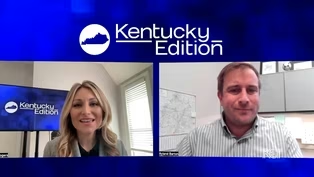
Mid-Week Political Check-In (1/17/24)
Video has Closed Captions
Clip: S2 Ep164 | 6m 19s | Ryland Barton discusses the latest developments in Kentucky political news. (6m 19s)
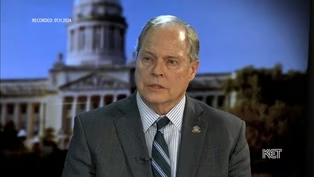
Video has Closed Captions
Clip: S2 Ep164 | 5m 2s | Sen. Mike Wilson discusses Senate Bill 8. (5m 2s)
Providing Support for PBS.org
Learn Moreabout PBS online sponsorship
- News and Public Affairs

Top journalists deliver compelling original analysis of the hour's headlines.

- News and Public Affairs

FRONTLINE is investigative journalism that questions, explains and changes our world.












Support for PBS provided by:
Kentucky Edition is a local public television program presented by KET