
Carolina Impact: January 19, 2021
Season 8 Episode 13 | 26m 4sVideo has Closed Captions
Public transit and COVID, Charlotte ToolBank, Country Doctor Museum and the Wienermobile.
Ridership on Charlotte Area Transit System (CATS) during Covid, The Charlotte Community ToolBank rents tools to non-profits and other organizations, The Country Doctor Museum is dedicated to preserving and teaching about rural medicine, and Zach Chatham of Indian Land gets a coveted job as a driver of the famous Oscar Mayer Wienermobile.
Problems playing video? | Closed Captioning Feedback
Problems playing video? | Closed Captioning Feedback
Carolina Impact is a local public television program presented by PBS Charlotte
Carolina Impact: January 19, 2021
Season 8 Episode 13 | 26m 4sVideo has Closed Captions
Ridership on Charlotte Area Transit System (CATS) during Covid, The Charlotte Community ToolBank rents tools to non-profits and other organizations, The Country Doctor Museum is dedicated to preserving and teaching about rural medicine, and Zach Chatham of Indian Land gets a coveted job as a driver of the famous Oscar Mayer Wienermobile.
Problems playing video? | Closed Captioning Feedback
How to Watch Carolina Impact
Carolina Impact is available to stream on pbs.org and the free PBS App, available on iPhone, Apple TV, Android TV, Android smartphones, Amazon Fire TV, Amazon Fire Tablet, Roku, Samsung Smart TV, and Vizio.

Introducing PBS Charlotte Passport
Now you can stream more of your favorite PBS shows including Masterpiece, NOVA, Nature, Great British Baking Show and many more — online and in the PBS Video app.Providing Support for PBS.org
Learn Moreabout PBS online sponsorship- [Announcer] This is a production of PBS Charlotte.
- Just ahead on "Carolina IMPACT".
- Why are these suburban buses so empty while other CATS bus routes actually have more passengers than expected?
I'm Jeff Sonier, stick around, we'll talk about how COVID is affecting both CATS ridership and revenue.
- [Amy] Plus, we'll show you a special kind of bank in Charlotte, that's doing a whole lot of good.
And we'll share details of Charlotte's special connection to the iconic Wienermobile.
"Carolina IMPACT" starts right now.
(digital music) - [Announcer] "Carolina IMPACT" covering the issues, people, and places that impact you.
This is "Carolina IMPACT".
- Good evening, thanks so much for joining us.
I'm Amy Burkett.
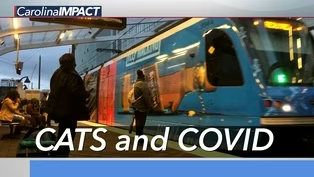
If you need a ride taking the bus usually isn't your first choice, but for many in Charlotte riding public transportation is their only choice.
That's why Charlotte area transit system is putting more buses on the streets where public transit is needed most.
Even as Coronavirus has some CATS bus and train routes at all time lows in ridership.
"Carolina IMPACT" Jeff Sonier joins us now to show us how it all depends on when you're riding and where you are riding.
- Yeah, We're out here in Matthews at the CATS park and ride lot at Independence Point.
Got my pass here, the bus is here, but it looks like nobody else is parking and riding the bus today.
- [Machine Voice] Please take transfer.
- You need a local transfer?
- [Jeff] Yes.
- Okay.
♪ Get up in the morning, get on the bus ♪ - [Jeff] It's Charlotte morning rush hour here on Independence Boulevard.
♪ Get up in the morning like the rest of us ♪ But no rush to find a seat on the Independence Express Bus, just the driver and me on a route with ridership only 4% of what it used to be.
♪ Bus rider.
♪ - And so what has happened is ridership has dropped significantly.
In the first three months, we dropped almost 80%.
- [Jeff] Charlotte area transit CEO, John Lewis says those are the ridership numbers system wide and fewer transit riders mean fewer transit dollars too.
- When you lose roughly 80% of your riders, you lose roughly 80% of your revenue.
- [Jeff] Lewis adds the ridership and revenue losses due to COVID are worst on routes and commutes between the suburbs and center city.
- The express services in April, we cut back 95%.
♪ Bus rider ♪ Because there weren't those people who were living in the suburbs, working in uptown area.
They were still working or working at home or in a virtual environment.
♪ Runaway train ♪ ♪ Running right off the track ♪ - [Jeff] How about light rail?
How is it doing during the pandemic?
- You know, light rail has continue to operate.
We've still had, reduced levels of ridership because of the nature of light rail.
We were mostly serving middle riders and those, just like our suburban service had gone away because of the changing work habit.
("Rock N Roll Train") - [Jeff] Yeah, it's just before five on a Friday at the transit center, light rail station.
(announcer machine beeping) - [Announcer machine] Face masks are required onboard all CATS services - [Jeff] We only count a dozen or so passengers waiting on the platform.
On board the train social distancing leaves most of the seats unavailable.
Many of the seats that are available are mostly empty.
And those who are on board light rail during this rush hour don't seem in much of a rush at all.
A few families riding for the fun of it.
But again not many white collar commuters boarding the train because with COVID there aren't as many white collar jobs to commute to or from.
- We still have a poor about 20 to 30% ridership that we continue to serve.
But again, at a reduced level of service.
So rather than every 10 minutes we're having a service every 15 to 20 minutes.
- [Jeff] So if fewer trains and buses, serving fewer passengers who's still riding Charlotte transit anyway?
Well, what we're seeing here on board passing car dealers selling cars, they can't afford are a lot of blue collar riders stopping at the shopping center to pick up food for the family and taking the bus from home to work when working from home, isn't an option.
What's the alternative if you don't take the bus?
- Get a bike.
(laughing) Get a bike.
- [Jeff] We're talking with Bobby at a bus stop on Central Avenue, the number nine bus where CATS is actually adding service because ridership on this route is rising COVID or no COVID.
What are the buses like when you do ride them?
- Well, sometimes the buses be already full.
Some of the seats is by whatever they said due to social distance they're not used.
So sometime we had the stand up.
So a lot of time I ain't got that far to go.
I just go like maybe about two or three blocks.
And so I'm not going to walk 'cause everybody don't wear a mask.
- Well, I have heard drivers tell people that they could not ride the city bus without the masks.
- [Jeff] Pamela takes the number nine bus to get to and from her doctor's appointments or sometimes just to get out of the house because when you're handicapped in a wheelchair like she is.
- Yeah, well I have no choice, ride the bus or I take special transportation.
- [Jeff] Does it feel healthy and the bus?
- No, it does not.
- [Jeff] Not even with those glass or plastic windows.
- No, it does not, because a germ is a germ - [Jeff] CATS is fighting those COVID germs with these plexiglass shields between seats and blocking side by side seat so there's nobody sitting right next to you.
They're also removing seats from buses to create even more social distancing space even when those buses are full.
- And so we're adjusting to the latest information we get from the health experts about how many people can safely be on a vehicle.
We've reduced that to no more than 20 people on a vehicle.
♪ Bus rider ♪ - [Jeff] We're also watching at the transit center where CATS cleaning crews, board buses before the passengers do spraying and wiping down every bus at the end of every route, especially those still busy blue collar routes where cleaner buses and more buses mean those who need a ride during COVID can still get ride.
- What our customers want and what we've found is they want reliability.
They don't care if it comes at 11 after at 21 after whatever.
Just give me reliability tell me one's gonna come every 10 minutes.
♪ Ride ride little man ♪ - Now, one thing CATS isn't talking about right now is a plan by Duke Energy to convert the entire fleet of CATS buses from the diesels and the hybrid diesels to all electric buses.
Nothing's official yet it's just a plan, but if it works out then Duke would pay the cost of converting the buses and CATS would pay for the electricity to run the buses going forward.
Now if it works out, it could put electric buses on the streets of Charlotte 10 years earlier than they might otherwise get there and it could save CATS millions of dollars which might help offset some of the losses that CATS is suffering now because of COVID, Amy.
- Thanks so much Jeff.
Future funding for CATS buses and trains could also come from a new mobility tax that city and County leaders are talking about right now and voters could be deciding on this fall.
The proposal would add a penny to the local sales tax.
Our website, pbscharlotte.org has more information about the mobility tax plan including an email and phone hotline with answers to your mobility tax questions.
Well, the Charlotte region is known for its commitment to community.
Volunteers help build playgrounds, clean Greenways and so much more.
But a lot of that work gets done with the help of the Charlotte Tool Bank "Carolina Impacts" Todd Wallace has the details.
(upbeat music) - [Todd] Charlotte isn't the largest city.
It is however the country's second largest banking center.
But unlike traditional banks there is one bank here where the assets aren't cash and the investments are in people.
The Tool Bank does just what its name implies.
(drill whirring) - [Maureen] Anyone who's doing good exclusively as their mission is able to come check out from our library of tools, borrow whatever they need for however long they need it and return it when they're done.
(upbeat music) - [Todd] The Charlotte Tool Bank maintains an 8,000 square foot warehouse in South End.
Your chairs, we're gonna stack on a pallet.
- [Todd] Charlotte Tool Bank, Executive Director Maureen Kruger says company's doing good as their mission are able to keep more money for projects and services because the Tool Bank eliminates the need for agencies to incur the expense of purchasing, repairing and even storing tools.
They're simply returned when customers are finished using them.
Kenneth Friday just brought back 30 shovels and hammers from a tree planting project with Charlotte-Mecklenburg Stormwater Service.
- This is a project guy helping with minimize erosion and flood zones in Mecklenburg County area - Our tools are cleaning up parks.
They're building playgrounds.
They're advocating on behalf of our member agencies through special events and fundraisers.
And they are really showing our community how strong our charitable sector is here and the great work that's being done every day.
- There are seemingly an endless number of tools here at the Tool Bank.
285 different kinds to be exact.
Whether it's a screwdriver, a tape measure, utility knife or even a hammer, the Tool Bank helps equip charitable organizations to fulfill their missions.
Kevin Warren is the director of volunteers and partnerships with beds for kids an organization providing donated beds and essential furniture to children and their families in need.
The goal is to take something old and make it new again.
And Warren says the Charlotte Tool Bank makes that possible.
- Because our families are working extremely hard to get into a new season of life.
And so I can call up Maureen or make my order online to the Tool Bank and she'll provide any really tool I need.
Sanders are really popular obviously and we use a lot of that different kind of things to assemble things.
- [Todd] The Tool Bank is able to provide so many tools thanks to donations from partner companies and fundraisers.
As a result, the bank has been able to do business with a lot of charitable organizations since opening it's doors back in March of 2011.
But this is the kind of banking not focused on making a profit.
A tool withdrawal from the tool bank costs only 3% of the retail cost of that item for seven days.
For example, the retail price for an electric pressure washer is $179.96 Getting it from the Tool Bank will cost an organization only $5.40 The retail price for backpack gas powered leaf blower is $299 the Tool Bank's 3% fee is $8 97 cents again for seven days.
(leaf blower whirring) That's exactly why Patrick Lynch says he got his gas powered leaf blowers from the Tool Bank.
- Well, the Charlotte Tool Bank is our go-to place.
We've been a member of them for a number of years now and always to them when we have special projects where we're gonna have more people than we have resources here locally to do.
- [Todd] Lynch is president of the Baxter Trail Club, a part of his HOA.
On this day, he and his team are using four leaf lowers from the Tool Bank to clear about 15 miles of trails in Baxter.
Lynch says he's been using the Tool Bank for about nine years for all kinds of projects.
- That's the great thing is I go down there and they end up suggesting things that I didn't know I would need until I get down there and see that they have it.
So they're very good at transferring knowledge that they've learned from other organizations that rent from him - [Todd] Maureen Kruger says they try to help whomever whenever they can, no matter the need or circumstance and that's been especially true this year - Just like with natural disasters where we also respond we don't charge for any tools that are used for COVID response.
So we've provided more than $27,000 in tools and we aren't collecting fees on that.
(sander whirring) - [Todd] Nevertheless maybe the Tool Bank really does make a big profit after all.
Just one that's not measured in dollars and cents.
- At the end of the day our goal is to forward the missions of our organizations our member agencies, and that's what we're here to do, that's what gets me excited.
- [Todd] And that's the kind of commitment you can bank on.
For "Carolina Impact" I'm Todd Wallace reporting.
- Thanks so much Todd.
The Tool Bank network is modeled after a program in Atlanta that started 27 years ago.
Well, as Americans built this country, there was a vital but sometimes overlooked person in the community, the country doctor.
Did you know that rural healthcare is celebrated in North Carolina with a special museum?
It's the oldest of its kind.
In this One Tank Trip "Carolina Impact" Suzette Rhee takes us there.
- Here's some more pills, you just keep taking them.
- Oh, thank you Doc.
- [Suzzete] Many remember Dr. Baker.
("The Little House") from "The Little House on The Prairie" show.
He was the country doctor many of us grew up with.
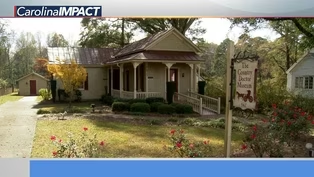
(upbeat music) Well in North Carolina there's a museum dedicated to the important role that doctors served in rural communities.
- The Country Doctor Museum is a small history of medicine museum and we focus on the country doctor or the rural physician that practiced in America during the late 19th and early 20th century - [Suzzete] TV characters like Dr. Baker showed us how the work was done and even how they were paid.
- And Doc I ain't got no cash again, but I got a shank and nice juicy I brought for you.
(upbeat music) - This mission is to share the story of the country doctor and to talk about the importance of the doctor patient relationship and how that formed over time in small towns across America.
So we keep our pharmacy collections in this room.
(upbeat music) Our apothecary room is a beautiful room it's like you're stepping back into time.
The cabinets that are just beautiful, they came out of the first drug store here in Bailey and they're filled with bottles and jars.
Some with their original contents.
This is a pill machine or a pill roller.
They would take it and go right down on top of that line of medicine, roll it out.
We go into the doctor's office and we talk a little bit about Dr. Brantley whose office you'll be standing in.
He went to medical school in the 1880s and so we talk about what that would have been like for him.
We also look at the doctor's desk and the ledger on the desk, and it shows how people used to pay their bill with corn and ham and peaches.
People learn to wash their hands more frequently cover their cough.
(upbeat music) We also have a Victorian era sick room.
So we talk about how health and sickness was handled in the home.
I love our history of nursing collection.
They date primarily from the early 20th century to about 1960, 1970.
Our midwifery set in our sick room is one of my favorite items on display.
It was used by midwife, the turn of the century and midwives made house calls.
They would go and visit with a new mother help her deliver the baby.
(upbeat acoustic music) The carriage house, our guests usually when we open the door, they're like, "Oh wow."
They just don't expect what we have.
We have buggies and Model Ts used by country doctors, (carriage honking) because making house calls and going to visit their patients was such an important part of their practice.
(jazzy music) And we also have a polio display and we talk about that virus and how it affected families all across America.
- [Suzzete] Museum visitors remember some parts of medical care from years ago - The Iron Lung that's displayed in there.
I can remember as a child, someone they were in an Iron Lung, in a house that was right near us like a neighbor's house.
And that was something I thought I wouldn't have even thought about again 'cause I was a little tiny girl when I saw it the first time.
And when I saw that it was like, Whoa that just brought me back.
- [Suzzete] The museum also gives perspective to the advancements in medicine.
- I think people, after they visit the museum and go on the tour, they will appreciate how far medicine has come and appreciate their doctors.
- [Suzzete] For some that appreciation also comes with much relief.
- (laughing) Yeah, there's a lot in there that I'm glad that we don't do anymore, but it does illustrate how far medical science's come.
(upbeat country music) - [Suzzete] Well, the country doctor may be a thing of the past the lessons learnt were real and being able to share that history to go back in time resonates with visitors.
- One of the most rewarding parts for us working here at the museum is that we get to interact and talk to our guests.
We have guests of all ages, but some of our more mature guests remember as a child might've had family members who suffer from diptheria or tuberculosis, that many kind of modern day Americans aren't really familiar with anymore.
We're very fortunate to hear those stories about how their family would treat different illnesses in the home.
I think a lot of these country doctors were very important in the life of their community.
And these were the individuals that families had to or needed or wanted to trust when someone in their family was gravely ill - [Suzzete] As American spread out across the land the country doctor was a vital part of every community a role that will never be forgotten and always honored here.
(upbeat country music) For "Carolina Impact" I'm Suzette Rhee reporting.
- Thanks Suzette.
There are COVID restrictions and special hours at the museum these days.
So you'll want to plan ahead.
Well, each year the United States colleges churn out more than 4 million graduates making jobs often hard to come by especially these days with COVID.
With just 12 annual openings and thousands of applicants one particular job just might be the hardest of all to land.
It might also be one of the most enjoyable "Carolina Impact's."
Jason Terzis has that story.
♪ Oh I'd like to be an Oscar Mayer Wiener ♪ ♪ That is what I'd really like to be ♪ - [Jason] No matter what generation you grew up in.
♪ They are so plump and tender too ♪ - It's Oscar Mayer for me and you.
- [Jason] At some point you knew at least one of the Oscar Meyer jingles.
♪ My Bologna has a first name its Oscar ♪ ♪ My Bologna has a second name it's Mayer ♪ The Wisconsin based company has always had a way with marketing and advertising.
- It's like a Wisconsin staple.
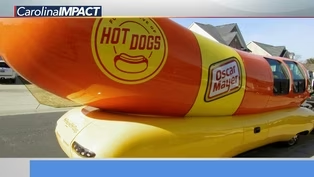
- [Jason] Like how about this gem of an idea a giant hotdog on wheels.
This was probably a major marketing tool for Oscar Meyer at the time.
- [Jason] The Wienermobile brought to life during the great depression, 1936.
The novelty was an instant hit with kids and adults alike.
- You know you get the kids started eating wieners and then the parents do to.
- [Jason] Over the years the Wienermobile has evolved.
In the late fifties it was placed on a giant Ford but the original concept has always remained the same.
- Once you saw it and it was in your neighborhood, you went running because you knew that if it stopped in your neighborhood then someone in there was gonna come out and get you to these little whistles.
(whistle blowing) And that was a prize possession when I grew up if you've got an Oscar Mayer whistle.
- And I have one someplace it's in a drawer.
- [Jason] In the 1970s, one of the Wienermobile drivers was Lon Baisden he's the tall one on the right.
Growing up, Zack Chatham of Indian land never thought he'd be able to follow in his great grandfather's footsteps but some 45 years later, the opportunity presented itself.
So they posted it on Facebook and my dad had actually sent me the article.
And at first I thought he was crazy.
'cause I didn't know what the job actually entailed and I didn't realize it was a super competitive job for marketing.
You got to do all these cool things.
So at first I was just like, "Oh, why would I apply for that?"
And then I read the description.
I was like, "Oh I have to apply for that."
- [Jason] With six Wienermobiles roaming the country with two drivers each that's just 12 drivers in total.
The job is only available to graduating college seniors who get it for one year.
And with upwards of 10,000 applicants per year, the joke is is it's actually easier to get accepted into Harvard than it is to get offered a job, driving a Wienermobile.
- We like to say, we're some lucky dogs to get this job too.
- And I thought it was perfect for him 'cause he's super creative and he's really good with people and I know that that is a huge part of the job.
So I thought if he got it, it would be a perfect fit for him and a really cool experience.
- [Jason] Earning his degree in marketing from the University of Alabama, Zach went through multiple rounds of interviews before finally getting offered one of the coveted positions.
- I've never seen my parents so proud of me, even more proud than graduating college which you'd think that was gonna be the peak.
- I was actually in the room when he got the call that he actually got the job.
And just like the look on his face was pure joy and that's always super exciting.
- My great-grandfather he's down in Georgia now.
He's very proud of the fact that I'm now living on his legacy and apparently around his assisted living home all he does all day is talk about the Wienermobile and he wears his Wienermobile mask every day in the assisted living home now and loves the brag on me.
- [Jason] Graduating last spring, it was then off to Wisconsin for Zack.
We off to two week training called Hot Dog High.
During Hot Dog High, We actually train with retired police officers.
- [Jason] With vanity license plates ranging from "Relish Me" to "Yummy," "Big Bun," "Our Dog" and "Wiener," Wienermobile drivers are known as Hotdoggers whose main job aside from driving is to meet and greet people and post to social media.
- I've been to Minnesota, North Dakota, Montana.
I've been to Nebraska, Iowa.
I've been to Oklahoma Tennessee, Arkansas, Illinois, Wisconsin, Indiana.
- [Jason] The number one question, Zach and other drivers get.
- Do you serve hot dogs?
- [Jason] The answer, no.
Another popular question.
- [Zach] Is there a bathroom onboard?
- Again, no.
- People say, "Do you live in there?"
I say "No, it's not a Winnebago."
(laughing) - [Jason] In case you hadn't noticed drivers know puns, lots of them.
- Buns and buns of puns.
We say we really haul buns.
We say we're some lucky dogs.
We say, when it starts getting cold outside we become some chili dogs.
And I'll tell you the Wienermobile has a meat belt, a bun roof.
You can ride shotbun - [Jason] Taking full advantage of his years as a Wienermobile driver, Zack did something in August no Hotdogger had ever done before.
- I Mustered up the confidence to propose?
- [Jason] He popped the question to girlfriend Hannah while driving the Wienermobile through Yellowstone National Park.
- So he said, look at the waterfall, I wanna get a picture of you from the back.
And so he was gonna do that and then I turned around and he was on one knee and it was such a shock.
"Cause I had told her when I'm on the road, it's impossible for me to buy a ring.
I cannot do it, there's no way, I mean, and she believed it.
- [Jason] Oscar Mayer couldn't let the romantic moment pass sharing snapshots of the proposal across its social media accounts.
The national media picked up the story as well with jokes about it running on Jimmy Fallon and Stephen Colbert.
- It makes sense.
If you drive a big hot dog, you're a Hotdogger drive a truck you're a trucker.
- [Jason] Zach and Hannah were recently in the area, the Wienermobile too.
That of course brought out the picture takers and curious onlookers.
And of course the neighbors up the road from Wisconsin.
- Coming around the bend and seeing that on my street it took me back to my youth.
- I'm in my seventies.
So they've been around since I was a kid.
So apparently Mayer should've done something right 'cause they're still at it.
- [Jason] The year 2020, wasn't the best for a lot of people, but for Zach, it was extra special.
Earning his college degree, getting engaged and traveling the country as a Wienermobile driver The job as a whole, it's been awesome to sort of have the experience to be running my own PR firm and I've truly relished the opportunity to do so.
- [Jason] And he also now knows buns and buns of puns.
For "Carolina Impact" I'm Jason Terzis reporting.
- I just always wanna sing that Oscar Meyer Wiener song.
Thanks so much, Jason, for that fun story.
Zach's year as the Wienermobile driver ends in June.
What our unique position.
Well that's all the time we have this evening.
Thanks so much for joining us.
We always appreciate your time and look forward to seeing you back here again.
Next time on "Carolina Impact."
Good night, my friends.
(upbeat music) - [Announcer] A production of PBS Charlotte.
Video has Closed Captions
Clip: S8 Ep13 | 6m 20s | Charlotte CATS and COVID (6m 20s)
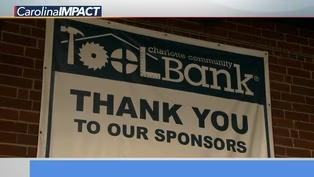
The Charlotte Community ToolBank
Video has Closed Captions
Clip: S8 Ep13 | 5m 3s | Rents tools to non-profits and organizations doing good in the community. (5m 3s)
Video has Closed Captions
Clip: S8 Ep13 | 5m 7s | Dedicated to preserving and teaching about rural medicine. (5m 7s)
Video has Closed Captions
Clip: S8 Ep13 | 5m 41s | Zach Chatham of Indian Land, SC got a landed as a driver of the Oscar Mayer Wienermobile. (5m 41s)
Providing Support for PBS.org
Learn Moreabout PBS online sponsorship
- News and Public Affairs

Top journalists deliver compelling original analysis of the hour's headlines.

- News and Public Affairs

FRONTLINE is investigative journalism that questions, explains and changes our world.












Support for PBS provided by:
Carolina Impact is a local public television program presented by PBS Charlotte