Vermont This Week
January 19, 2024
1/19/2024 | 26m 45sVideo has Closed Captions
Proposed Bill Would Establish a Climate Change “Superfund”
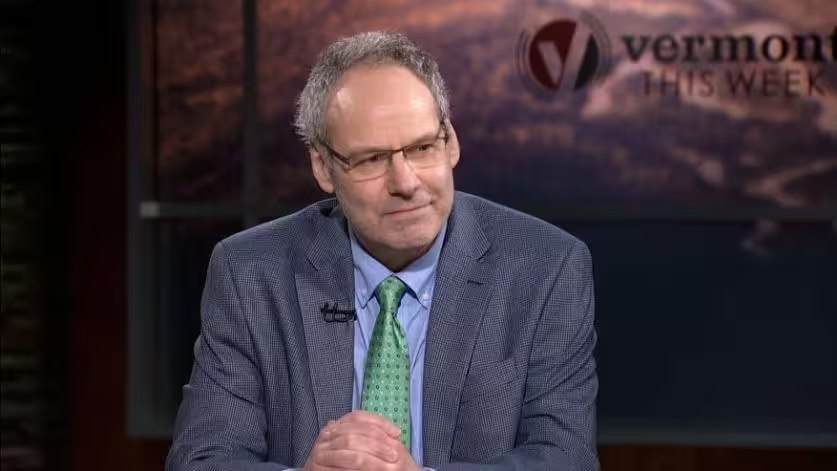
Proposed Bill Would Establish a Climate Change “Superfund” | Renewable Energy Standard | Is Vt. On Track to Meet Its 2025 Climate Commitments? | Panel: Cat Viglienzoni - Moderator, WCAX; Abagael Giles - Vermont Public; Calvin Cutler - WCAX; Kevin McCallum - Seven Days.
Problems playing video? | Closed Captioning Feedback
Problems playing video? | Closed Captioning Feedback
Vermont This Week is a local public television program presented by Vermont Public
Sponsored in part by Lintilhac Foundation and Milne Travel.
Support provided by:


Vermont This Week
January 19, 2024
1/19/2024 | 26m 45sVideo has Closed Captions
Proposed Bill Would Establish a Climate Change “Superfund” | Renewable Energy Standard | Is Vt. On Track to Meet Its 2025 Climate Commitments? | Panel: Cat Viglienzoni - Moderator, WCAX; Abagael Giles - Vermont Public; Calvin Cutler - WCAX; Kevin McCallum - Seven Days.
Problems playing video? | Closed Captioning Feedback
How to Watch Vermont This Week
Vermont This Week is available to stream on pbs.org and the free PBS App, available on iPhone, Apple TV, Android TV, Android smartphones, Amazon Fire TV, Amazon Fire Tablet, Roku, Samsung Smart TV, and Vizio.
Support the crew
Help Mitch keep the conversations going as a member of Vermont Public. Join us today and support independent journalism.Providing Support for PBS.org
Learn Moreabout PBS online sponsorshipToday on Vermont this Week, will big oil pay for climate change damages in Vermont?
Vulnerable Vermonters, mom and pop businesses and small cities and towns are the cause of the damage that came from climate change.
It is no coincidence that 2023 was the warmest year in Vermont history and also one of the most expensive.
And our changes on the way for the renewable energy standard in Vermont.
Plus, is the state on track to meet its climate goals?
From the Vermont Public Studio in Winooski.
This is Vermont this week, made possible in part by the lintel foundation and Milne travel and thanks for joining us on Vermont this week I'm Katt Williams on our panel today Calvin Cutler from WCAX, Abagael Giles from Vermont public and Kevin McCollum from seven days.
Thank you all for being here today.
Proposals in front of lawmakers in both chambers would create a climate change superfund, with many Vermonters still reeling from the impacts of devastating flooding.
The pitch is to make big oil companies pay for it.
So, Calvin, start us off.
How would this work?
Yeah, I mean, essentially it would set up a state fund, a super fund, a pot of money, essentially modeled after federal legislation where we see, you know, contamination and environmental contamination.
And essentially, the aim is to have fossil fuel producers, Exxon Mobil, others pay into this fund because a lot of the devastation that we've seen from climate change this past summer's flooding, it was about 600 million just in public infrastructure damage.
A lot of that, of course, is related back to climate change.
And, you know, this is the state's way or this is a proposal put forward by the Vermont Natural Resources Council.
The Vermont Public Interest Group, Research Interest Group, and others basically looking to hold those fossil fuel companies accountable.
I think there's a lot of questions about how it would work.
How do you determine, you know, what oil companies pay, what?
And also, you know, will costs be passed on to consumers?
I think these are all big questions.
So so we'll have to see.
But it's definitely ambitious, for sure.
Mm hmm.
Abigail, do you think it has traction given the flooding this summer?
Yeah.
You know, I think we're at this point in history where broadside scientific consensus has is now that, you know, the burning of fossil fuels is causing climate change.
Also attribution science.
So the degree to which climate scientists can say this event was this percent worse because of climate is really getting sharper.
And so from the scientific side of things, there are certainly questions to be asked there.
But when I've talked to legal experts about this this week, they said, you know, this Superfund approach, it's the legal argument is there.
But big oil is not going to want to give up their money without a fight.
So that's going to be, I think, the real question at the end of this.
And yeah, that was actually a follow up question I have for you, Kelvin.
So you mentioned the idea is how to figure out which oil companies pay, what?
Who's at fault?
The state would have to prove the companies were at fault in some cases.
Correct.
Or lawmakers potentially worried that the legal pushback from the companies would basically keep this law from actually leading to any real payouts?
Yeah, I mean, I think that's the big question.
Right.
I think we'll we'll have to see.
I mean, as to your point, it's tough to see, you know, who to which degree, which fossil fuel company is responsible.
I mean, this is kind of a similar approach like we've seen taken with big tobacco and some of or like the opioid manufacturers.
So I think, you know, maybe that's a little bit easier to to prove the case.
But, you know, we'll we'll have to see what this and I think what's what's interesting with this case too, or with this bill, you know, we also have a separate suit from the attorney general that was filed back in 2021, a consumer protection lawsuit basically saying that fossil fuel companies, you know, knew that their products were can contributing to climate change, but they, you know, covered it up and they obfuscated it and, you know, continued to to sell those those products.
So that is also a separate but also, you know, parallel conversation to this one as well.
And I think that's something that's interesting, too, about the Superfund approach versus the consumer protection approaches, where that approach you have to say legally, you know, the companies knew they lied and they knew that they were lying and they made a profit off of that.
With the Superfund approach, you just have to prove that the product had an impact.
So it will doesn't matter legally and that that particular path of pursuit, which is why the state and lawmakers, I think, are so interested in considering this as a possibility.
And I will say to one of the surprises to see at the press conference was Senator Dick Seers of Bennington County.
He talked a lot about how this is sort of related or to a similar concept of, you know, the PFAs contamination that we saw down in Bennington County after, you know, the the closure and the the Gilbane lawsuit that that we saw that, you know, resulted in, you know, negative health impacts on the community.
And they also had to pay out and install new water lines.
So I think it was also a really big deal that Senator Sears was there on this one, too.
There's definitely to, I think, intense pressure from lobby and lobbying groups on this.
Environmental groups have cited this as one of their highest priority bills.
I was on Church Street about six months ago when VP Bergh launched their campaign to save Make Big Oil Pay, and they had this massive pink blowup pig that they, you know, brought out, trotted out to sort of show everyone this is what they want.
This is the number one thing that they think the legislature ought to move forward on In Session.
So there's going to be tremendous pressure, even though the details haven't been ironed out.
There's going to be tremendous pressure on lawmakers to move forward on something like this.
And add to that the flooding we saw this summer.
I think there is a study from UVM from a few years back that found that projected that climate fueled flooding damages could amount to more than $5 billion in the Champlain Basin alone.
Over the next century.
We're seeing that there are still big gaps when it comes to the relief Vermont has gotten from the federal government and what's available through the state.
So I think there's a big political push and impetus to say, you know, this is going be expensive and maybe homeowners and small business owners aren't the people who should pay for it.
And in other climate news, changes could be coming to the renewable energy standard in Vermont.
That's the law that says Vermont is required to have 75% of its electricity come from renewable sources by 2032, 10% generated in state.
Abigail, what changes are lawmakers considering to this?
Yeah.
So last year they called for a big study.
They brought utilities and environmental advocates from affordable housing folks to the table to kind of try to come to a compromise on this.
And they put forward a report.
Most of the groups signed on to it to really push the state to a 100% renewable energy standard by 2030 for most of the big utilities.
One of the big differences I think that is in this proposal is this idea that Vermont has a really diverse array of utilities.
So it treats some utilities differently.
It gives a longer sort of timeline for small municipal utilities.
But another thing that that is part of this proposal and the bill that's moving through the legislature now is a substantial increase in the amount of power that utilities have to buy from new renewable energy built since 2010 in New England or new renewable energy built in Vermont.
That's something that developers are really pushing for.
Obviously, they benefit financially from that push, but they're really making this case and we've seen the administration echo this for really kind of the first time that it's getting those new renewables online that displaces carbon emissions when we look at our interconnected grid.
So buying more existing renewable power from places like Hydro-Québec, very cost effective.
That's where we get a lot of our power.
This bill doesn't say you can't keep doing it, but it says to utilities you need to ramp up the degree to which you're investing in new renewables that are going to bring our emissions down and the electric sector as a region.
Kevin, though, what are some of the challenges you think the state will face in meeting some of these goals?
I know you know, some of the large solar projects that we've seen try to go into some communities, there's a sense of, well, solar is great until you want to put it in a field near my house.
Absolutely right.
So one of the key provisions of the bill is to increase from 10% in state renewables to 20% in state renewables.
And the obvious immediate question of that is, where's all that going to come from?
We see town after town fighting solar arrays, fighting new wind turbines, pushing back on some of these developments, making the claims about all this is just a for profit industry is not really making much change in the emissions.
And so against that backdrop in the state, you have to wonder where are all this renewables going to come from?
Which is why the bill contains a sort of new category of regional renewables.
Right.
Because I think they're trying to acknowledge that that Vermont is not often terribly hospitable to new renewable energy production.
And so if we're going to hit these targets, we're going to hit these goals, we're probably going to need to look outside of the state.
And so that's one of the key one of the key elements and one of the key challenges.
Another key challenge is going to be cost, right?
If if we come up with a protocol that sort of doesn't allow utilities to count Hydro-Quebec, which is one of the cheapest forms of electricity that we use as renewable anymore because it's, you know, just from these old dams way up north that aren't really adding to our supply of renewable energy, then what does that mean?
It means one of our cheapest forms of electricity is going to go away and it's going to have to be replaced by sort of newer stuff that's going to.
What's that going to mean for the ratepayer?
And, you know, Governor Scott has always been very steady on his concern about the increasing costs and regular Vermonters.
And so he's probably going to continue to be concerned about about those impacts kind of jumping off of that question about cost.
And I do think, you know, at least in the bill that's in the House right now, it doesn't take away Hydro-Quebec or biomass, which is something some environmental groups in the state, especially grassroots organizing, grassroots organizers have been upset about.
But I think that for, you know, utilities in the state that have especially very rural and lower income customer, customer base, they're really raising this question of, yes, our grid as a whole relies a lot in fossil fuels.
In New England, we're all interconnected.
And where we get our electricity from Vermont utilities, their portfolios look pretty good on paper.
So you do see some of these utility heads in parts of the state saying, should my ratepayers pay for decarbonization of the New England grid or should that be somebody in Connecticut who may be drawing more directly from that power source and whose utility isn't doing their work to to to clean up their supply?
Mm hmm.
Now, Vermont has a looming deadline of 2025 already to meet some climate commitments regarding emissions.
But a recent report says that's not looking likely at this point.
Abigail, what is that 2025 goal?
Remind us and then how far do we still have to go to meet it?
Yeah.
So we have to get to by 2025.
So some pretty stringent reductions and this deadline is approaching really soon.
In some ways, you can make the case that we're already sort of too late for this year given, you know, we're 20, 25 is around the corner.
So basically, the administration put forward some modeling to lawmakers the other week saying essentially like, you know, we've run the numbers.
We looked at the the federal data for Vermont looking at fuel supply and how much was spot over the last couple of years.
And we think we've got a model that shows that we're looking pretty good for 2025.
And, you know, it kind of projected out from there.
And what we saw was Joe Duvall, who's a member of the climate council, also the head of Energy Action Network, who really has expertize in data analysis.
That's a lot of what his organization does.
He kind of pokes some holes in the model the administration put forward and said, you know, you really should have ground truth to this with available state data.
So without getting too much into the weeds, he basically said, you know, I think your model, your numbers are off by as much as a million metric tons for the year 2020, which passed some shadowy doubts on, you know, how accurate this model could possibly be moving forward.
And I think from Jared's perspective and what we heard from lawmakers after that meeting was, you know, it's really unclear whether Vermont is on track for 2025.
Likely we are not.
And there are some provisions in the global warming solutions Act which sets those emissions reduction targets, which say it's on air, to then undertake rulemaking to get us on track to meet that target.
So I think we're seeing some mounting pressure from folks who want to see that climate action happen for an hour to basically start creating new regulations to cut emissions in Vermont.
And Kelvin, if we don't meet those requirements, there are legal ramifications to the state.
Right.
The state could get sued, right?
Exactly.
I mean, that's been kind of the biggest looming question about, you know, if and when will the state get sued, what will that look like?
You know, there actually is a key deadline coming up.
I believe it is this this coming summer or this spring.
And to Abigail's point, it's about those regulations about because an R is going to be the one, you know, whatever the result of any lawsuit or any legal action and R will have to implement these regulations.
And so I think there's going to be a lot of people that are looking what what are those regulations going to be?
You know, how much are we you know, is it going to be increased prices like a carbon tax or, you know, fill in the blank?
So, yeah, I think that's still one of the big questions.
I find it really interesting that and Digger did some really good Vermont daycare, did some really good reporting on this.
They followed up with Julie after her testimony, testimony that was fairly optimistic and suggesting that we were probably on track to meeting our goals in 2025.
And after Jared's testimony.
Right.
She wasn't really able to stick to that anymore.
She said, look, oh, maybe not like we need to look at this more closely because it's very complicated.
It is weedy and it is very difficult.
But I find it fascinating that such a consequential bill and law in the state of Vermont, where we're putting all this energy and money and time and focus on reducing our carbon emissions.
And yet there's still debates about about how much we're actually reducing our carbon emissions and whether we're meeting these targets and and, you know, it's sort of setting the stage for 20, 20, 30.
I mean, the goals in 20 2030 are extremely ambitious.
2025 there was always this question about, well, maybe we could probably pull off 2025 and I agree with Abigail.
Will Probably not.
My calculations are this show that kind of we're about nine or 10% off meaning meeting those goals but like 2030 is even farther away in term I think.
Is it 40% reduction by from 1990 levels?
I think so.
Like we're way off meeting those goals.
And five years is not that long as we've seen here.
Right.
These things come up quickly.
So I think this is very concerning that we're having debates about whether we're going to meet 2025 when we've got 2030 looming on the horizon.
And I think to your point, Kevin, none of the modeling put forward by anybody who's looked at this suggests that Vermont is anywhere near near on track for 2030 and 2050.
We still don't have a comprehensive solution put forward by the Climate Action Plan or lawmakers for the transportation sector.
So, you know, some work was done to kick into motion something for home heating.
Last session, the clean heat standard is underway at the PUC right now.
But we we really, truly have no plan for how to reduce emissions in the transportation sector at this point.
Hmm.
Other statehouse news I wanted to get you briefly.
Your forecast came out.
It's a kind of an optimistic or a more optimistic economic outlook than we might have otherwise expected.
Calvin Right.
Yeah, absolutely.
I mean, this is something that, you know, it's the economic outlook leading into the governor's budget sort of gives lawmakers a baseline of how our state finances doing.
And I think it's really showing that, you know, reflective of more national trends that that soft landing that, you know, we've been trying to achieve or the Federal Reserve has been trying to achieve, is actually it's happening.
I mean, you know, tax collections are still robust.
You know, we're not seeing a huge downturn in the economy.
But, you know, they're the consumers are still feeling a bit of a pinch.
You know, they're spending through their their pandemic savings.
And so there is a concern there.
I think the big question, though, from, you know, whether the state from a taxing perspective and from a revenue perspective is whether this this new report that we got from the emergency board, whether this is going to make the Democratic supermajority a little more bullish or a little more optimistic about, you know, can we potentially pass you know, can we spend a little more is there more room in the budget to help people in, you know, human services or housing or homelessness or, you know, Medicaid reimbursement rates?
So, again, there was no big, you know, proposals on the table.
But I think this was really welcome news for a lot of people just to say we are most likely not going to see a recession.
Do you think it undercuts any of the governors kind of tone during his state of the state where he was saying this is going to be a really lean year, we need only, you know, a 3% increase on the budget, you know, that kind of talk?
Yeah, a little bit.
I mean, you know, the governor has always preached, you know, let's be fiscally conservative and let's watch our wallet and try to not, you know, raise taxes and fees on Vermonters.
So that's something we've heard from the governor, even dating back to his time in the Senate.
But yeah, I mean, especially over the past two, two and a half years since inflation's really been a thing, he's really been ringing the bell.
So I think this might, you know, potentially might have him be rethinking a little bit of his messaging as well.
I mean, certainly I think he's still opposed to any new tax, any new fee.
You know, he's hearing from still there's lots of Vermonters, especially in rural Vermont, that are seeing really big increase costs with fuel, food, etc., and housing thing in health care as well, which is a bigger, bigger looming question.
But yeah, I think, you know, we might see a little shift in the governor, but I think for for some Democrats at the state House, this is welcome news.
Mm hmm.
And very quickly, some flooding help that was going through today, right?
Yes.
So then the Senate basically pass this bill, which would allow for abatements on property taxes for properties in central Vermont, up in Memorial County and elsewhere that were flooded out.
And people, of course, can't pay their property taxes.
And, you know, towns are now facing revenue shortfalls because of because of that.
This bill that the Senate passed today is going to help with that.
Now it goes to the House, I expect this to go through.
But this is just one piece of the flooding puzzle.
You know, there's a galaxy of flooding bills that we're seeing from the financial side of things to the flood mitigation to dam safety to I mean, fill in the blank.
It touches every committee at the state house.
So this is an important one, but it's a lot more on this to come for sure.
On the National Front this week, we wanted to get to this Vermont Senator Bernie Sanders push for more scrutiny for U.S. military aid in Gaza.
He forced a vote among his colleagues over whether to investigate human rights abuses in the Israel-Hamas war.
That vote was defeated 11 to 72.
Kevin Last fall, the Senator took some heat for not calling for a permanent cease fire in Gaza when some of his colleagues were.
Is this a shift in tone for him, you think or not?
Well, I think it's a bit of a shift.
He has I've seen him be one of the first people in Congress to argue against or argue for restraint on the part of Israel.
He really was one of the first ones to say, my God, what what is happening here in Gaza?
I mean, the bombardment of this area is horrific.
And so he he was hurt when there were a lot of people at that point saying Israel needs to do what Israel needs to do in response to the October 7th Hamas attacks.
He was one of the first ones to say, go, you know, be careful.
Be careful what you do.
And now here we are several months later, and he's one of the strong guest voices for scaling back and forcing Israel to scale back some of its and some of its attacks and some of the tactics that it's using and its invasion of Gaza.
And what he found was and what he tried to do was sort of require a report to be to be done by the State Department about whether, in fact, the United States is military assistance to Israel is being used in a way that that constitutes essentially war crimes against essentially, you know, humanitarian suffering from what's happening here.
And so the report would have forced a assessment of whether that's happening and his colleagues were just not going for it.
They only seven people voted in favor of it.
He was very passionate about the suffering of the Palestinians.
He likened the bombing to Dresden World War Two.
Right.
And saying it was even worse than that.
He cited statistic after statistic of the suffering of the Palestinian people.
And he basically said to America, we're complicit in this.
Our bombs are being used by Israel to absolutely devastate this entire region and this this entire group of people.
So you could hear it in his voice.
The the the agony, really, that he's feeling over what he sees happening nightly on on the news.
But his colleagues felt that it would it would it would it would restrain Israel in a way that's just bad timing, inappropriate, and that there are things being done to sort of scale back their operation and make it more targeted.
So we should just see what happens there.
And of course, the larger question of aid for Israel is still on the table as lawmakers on Capitol Hill try to figure that out.
Back here in hall at home, a new push to hold local government accountable.
The commission proposes a statewide code of ethics for municipal officials.
I think it's important that people know what's expected of them.
So, you know, there are you know, a lot of people say that, you know, ethics are just black and white.
It's the difference between right and wrong, but not always or some, you know, just based on the number of inquiries within your office about when you look for guidance, it's not always that clear.
And so it's really an aid for people who are serving them in a special positions or state government positions.
It's not just a tool for accountability.
What's the pushback, though, Calvin, to this one?
Yeah, I don't know if there's any specific like Capital P pushback, but there's concern about whether local municipal officials have the capacity for this.
I mean, there's a lot of small local town clerks, town managers.
I don't think anybody wants to be unethical or wants to not have ethical framework.
But there's a lot of questions about whether smaller towns can pull off these types of trainings and, you know, have this this framework because they don't really have the resources.
So that's it's an evolving conversation.
We'll have to see.
Another ethical dilemma under the Golden Dome, should a commission tasked with correcting past wrongs undermine democracy?
The Vermont Truth and Reconciliation Commission was created to investigate systemic discrimination, and it wants to limit public access to its proceedings to shield victims from scrutiny.
But that led to pushback from media members.
If the public doesn't understand or doesn't have access to what's happening in their government and the discussions and deliberations that are happening, that are going to ultimately create the laws that are going to govern them, then that's a huge part of our democratic process that's being ignored.
Sometimes you have to protect people's safety, and that's important, too.
And you heard Wendy Mayes, the executive director of the Vermont Association of Broadcasters, of which Vermont Public is a member, and also the Truth and Reconciliation Commission.
General Counsel Michele Olvera.
Calvin Watts, kind of the gist of the debate here.
Yeah.
So essentially, I mean, this is the commission that was set up back in 2020 to investigate state perpetuated harms that were perpetuated by the state of Vermont, whether that be the eugenics movement or acts of racism or discrimination.
And to investigate these collect stories of survivors and their ancestors and then to at some point potentially put forward a report and recommendations as to how do we repair?
How do we heal?
How do we make right those those wrongs of the past?
And we don't know what those recommendations are going to be, but they're you know, they're starting to take testimony.
They're putting this group together.
And these are really deep, intimate, personal stories of of trauma and of of know medical history and pain.
And so, you know, the commission wants to be able to hear people's true stories.
And so essentially what's happening is, you know, number one, they want a little more latitude and they want some exemptions from the public records or the open meeting law because, you know, at times these are very sensitive stories.
And, you know, the commissioners and people who have testified in front of the commission have also received threats as well.
So they want to be able to go into not executive session, but they want to close the meeting where you have to have an invitation to actually go and participate in the meeting.
You can still watch it on YouTube and hear what people are saying, but you can't be led into the room and you can't actively participate.
And so that really has raised the concerns of a lot of a lot of people in the press, a lot of First Amendment advocates, because, you know, potentially there's millions, maybe hundreds of millions of dollars in tax benefits, housing, education, reparations, we don't know.
But this is a it's a very long, long road that we're at.
And so a lot of people are concerned about, you know, the access to these groups for sure.
Calvin, thank you.
What we haven't heard a lot of chatter about so far is the gubernatorial race because a lot of attention has been focused on the national race for the White House.
However, we did have a candidate enter the race for the state's governor this fall.
Esther Charleston throwing her hat in the ring.
She's a Democrat.
We will be seeing how that race plays out as this continues.
As so far, I believe, correct me if I'm wrong, she's the only one that we know of for sure who has entered the race officially.
So we will be watching who enters as well in the coming months.
So we don't expect the governor to officially announce that until around Memorial Day.
But normally, after the legislative session here.
Calvin Cutler from WCAX, thank you so much.
Abagael Giles from Vermont Public.
Thank you.
And Kevin McCollum from the Seven Days.
And thank you all for watching as well.
Take care, everyone.

- News and Public Affairs

Top journalists deliver compelling original analysis of the hour's headlines.

- News and Public Affairs

FRONTLINE is investigative journalism that questions, explains and changes our world.












Support for PBS provided by:
Vermont This Week is a local public television program presented by Vermont Public
Sponsored in part by Lintilhac Foundation and Milne Travel.