
January 19, 2026 - PBS News Hour full episode
1/19/2026 | 57m 46sVideo has Closed Captions
January 19, 2026 - PBS News Hour full episode
Monday on the News Hour, Europe stands firm against Trump's push for Greenland after he links the effort to not winning the Nobel Peace Prize. Federal agents clash with protesters in Minneapolis, further roiling a community threatened with military intervention. Plus, we report from Antarctica, where scientists are trying to explain why a massive glacier is melting so fast.
Problems playing video? | Closed Captioning Feedback
Problems playing video? | Closed Captioning Feedback
Major corporate funding for the PBS News Hour is provided by BDO, BNSF, Consumer Cellular, American Cruise Lines, and Raymond James. Funding for the PBS NewsHour Weekend is provided by...
Support provided by:

January 19, 2026 - PBS News Hour full episode
1/19/2026 | 57m 46sVideo has Closed Captions
Monday on the News Hour, Europe stands firm against Trump's push for Greenland after he links the effort to not winning the Nobel Peace Prize. Federal agents clash with protesters in Minneapolis, further roiling a community threatened with military intervention. Plus, we report from Antarctica, where scientists are trying to explain why a massive glacier is melting so fast.
Problems playing video? | Closed Captioning Feedback
How to Watch PBS News Hour
PBS News Hour is available to stream on pbs.org and the free PBS App, available on iPhone, Apple TV, Android TV, Android smartphones, Amazon Fire TV, Amazon Fire Tablet, Roku, Samsung Smart TV, and Vizio.
Providing Support for PBS.org
Learn Moreabout PBS online sponsorshipGEOFF BENNETT: Good evening.
I'm Geoff Bennett.
AMNA NAWAZ: And I'm Amna Nawaz.
On the "News Hour" tonight: Europe stands firm against President Trump's push to take control of Greenland after he links the efforts to not winning the Nobel Peace Prize.
GEOFF BENNETT: Federal agents again clash with protesters in Minneapolis, further roiling a community now being threatened with military intervention.
AMNA NAWAZ: And we report from Antarctica, where scientists are trying to explain why a massive glacier is melting so fast and what that means for the world.
DAVID HOLLAND, New York University: This is a special one that over the decades we have discovered is the most crucial to the future of sea level on planet Earth.
(BREAK) AMNA NAWAZ: Welcome to the "News Hour."
President Trump turned up the temperature on Greenland and threatened new tariffs on NATO allies if they don't let the U.S.
acquire Greenland.
GEOFF BENNETT: European leaders met this weekend to coordinate a response, potentially including tariffs on U.S.
imports, as they worked to resolve the crisis sparked by President Trump.
Tonight, Danish and allied European forces are reinforcing their presence in Greenland, sending additional troops as pressure mounts over the future of the Danish territory.
European leaders say they stand firmly with Greenland.
As first reported by PBS News, the president intensified his threats against Greenland, suggesting that, because he did not win the Nobel Peace Prize, he would not feel bound to pursue only peaceful means to acquire the territory.
In a letter to Norway's prime minister, Mr.
Trump wrote: "Considering your country decided not to give me the Nobel Peace Prize, I no longer feel an obligation to think purely of peace, although it will always be predominant, but can now think about what is good and proper for the United States of America.
The world is not secure unless we have complete and total control of Greenland."
SCOTT BESSENT, U.S.
Treasury Secretary: It's an honor to represent the U.S.
GEOFF BENNETT: Treasury Secretary Scott Bessent today sought to de-emphasize any connection between the prize and Mr.
Trump's ambitions.
SCOTT BESSENT: I think it's complete canard that the president will be doing this because of the Nobel Prize.
The president is looking at Greenland as a strategic asset for the United States.
GEOFF BENNETT: While military action remains uncertain, economic retaliation appears increasingly likely.
This weekend, Mr.
Trump said he would impose a 10 percent tariff on eight European nations over their opposition to U.S.
control of Greenland.
Today, British Prime Minister Keir Starmer countered that he believes there is room for dialogue.
KEIR STARMER, British Prime Minister: I think that this can be resolved and should be resolved through calm discussion, but with the application of the principles and values that I have set out in terms of who decides the future of Greenland and making clear that the use of tariffs in this way is completely wrong.
GEOFF BENNETT: As other European leaders condemn Mr.
Trump's rhetoric.
LARS LOKKE RASMUSSEN, Danish Foreign Minister (through translator): It is really, really important that all of us who believe in international law speak out to show President Trump that you can't go further down this road.
So forget it.
We live in 2026.
You can trade between people, but you can't trade with people.
And that rules stand.
Forget that road.
There are no Russian and Chinese ships all over the place.
And Denmark, together with Greenland, has kept Chinese investments out of Greenland.
FRIEDRICH MERZ, German Chancellor (through translator): Denmark and the people of Greenland can count on our solidarity.
We are prepared to support the talks with the United States.
These talks should always be based on the principles of sovereignty and territorial integrity.
GEOFF BENNETT: In response to the tariff threats, the European Union says it's preparing a potential $107 billion package targeting U.S.
imports.
EELCO HEINEN, Finance Minister of the Netherlands: We are part of the same alliance.
We make the same threat analysis.
We are willing to work together.
Most important is that we de-escalate.
GEOFF BENNETT: While global leaders try to figure out the next steps, in Greenland, the message is clear.
The country is not for sale.
And, for perspective, we turn now to Charles Kupchan, senior fellow at the Council on Foreign Relations.
He served as senior director for European affairs on the National Security Council during the Obama administration.
Thanks for being here.
CHARLES KUPCHAN, Former National Security Council Official: Good to be with you.
GEOFF BENNETT: I want to start with the message President Trump sent to Norway's prime minister, as first reported by our Nick Schifrin, that, because the president was not awarded the Nobel Peace Prize, he no longer feels obligated to, in his words, think purely of peace.
What's your reaction to that statement?
How does that strike you?
CHARLES KUPCHAN, Former National Security Council Official: It's a very odd reaction.
It helps me understand a little bit more what I think is going on in Trump's head.
This is in part about resources, rare earths, minerals.
It's in part about security.
He wants to deal with potential Russian and Chinese incursions or greater presence in the High North.
But I also think that Trump is thinking about his legacy.
Trump wants to have something to say to the American people when all is said and done.
And I think in some ways he is -- he wants to join the pantheon of American presidents who expanded the girth of the United States, alongside Thomas Jefferson, the Louisiana Purchase, Andrew Jackson, expansion to the West, James Polk, who took a large chunk of Mexico.
He in his inaugural address talked about manifest destiny.
He mentioned McKinley.
He mentioned Teddy Roosevelt, the Spanish-American War.
I think part of what's going on here is that Trump wants his legacy to be, I added a big chunk of territory to the United States.
And that in some ways is the words, the perspectives of a real estate developer.
GEOFF BENNETT: And the president has talked about, he's floated this idea of the U.S.
acquiring Greenland before.
But, this week, this past week, he has escalated the pressure by threatening tariffs on European allies.
How do you assess this latest turn in particular?
CHARLES KUPCHAN: It is a bit of a shock, to be quite honest, in the sense that I thought that this talk of the annexation of Greenland -- and he also has mentioned the annexation of Canada -- was more bluster than reality.
But over the weekend, Trump actually said, OK, on February 1, I'm going to hit Europe with 10 percent tariffs, and then I'm going to add 25 percent more come June.
And it's like, oh, my God, he's serious.
And so what we're actually looking at here, if this plays out as Trump has said it will play out, is the potential coercive annexation of the territory of a NATO ally by the United States.
That in some ways is the stuff of science fiction.
It borders on the unthinkable.
But, here, you and I are talking about it on the "News Hour."
And that, I think, puts in relief just what a break point an American attack on Greenland would be.
GEOFF BENNETT: Let's talk about the European perspective here, because the E.U.
's top diplomat said in a tweet, in part: "Tariff threats are not the way to go about this.
Sovereignty is not for trade.
We have no interest to pick a fight, but we will hold our ground.
Europe has a slate of tools to protect its interests."
You're in regular contact with current and former European leaders.
How are they interpreting this moment?
CHARLES KUPCHAN: I think this is a bit of a turning point.
And I support what the Europeans have been doing up until now, which is effectively trying to keep Trump onside, coming over here with President Zelenskyy of Ukraine, being nice to Mr.
Trump, looking at his peace plan for Ukraine and saying, it's a good start, but let's work on it.
They haven't stood up to him.
And they haven't done so because the downside risk of a bust-up with the United States is huge precisely because they are at a moment when they are threatened by Russia.
But I do think that this prospect of an American attack against a NATO country crosses a red line.
Europe has to stand up.
And I do think that this week in a summit that's occurring on Thursday, they will prepare serious response to American tariffs.
They're talking about tariffs on imports.
They're talking about potential blockage of U.S.
services.
This is a big deal.
This is a turning point in the relationship.
GEOFF BENNETT: And the administration argues, as you mentioned, that Greenland is vulnerable to growing Chinese and Russian influence, in part because of its location, where it is on the map.
You see it there.
Is there merit to this claim that Denmark, Greenland and NATO allies have not done enough to address those threats?
CHARLES KUPCHAN: Well, what Trump says he wants to get out of the relationship with Greenland is sensible, right?
He's worried about the naval situation.
And the Chinese and the Russians are stepping up their activity in the High North.
He's concerned about missile defense.
And we have a base there.
And the radar at that base monitors launches from Russia.
It monitors orbit -- low-Earth orbit satellites.
It's important.
But -- and it's a huge but -- everything Trump says he wants, including rare earths and minerals, we can get.
We have a 1951 agreement with Greenland that allows the United States access, that provides for American bases.
And so we don't need to own it to get those benefits.
And that's why, in the end of the day, you have to ask, what's going on here?
And Trump himself said, this is psychologically important to me.
I want to own it.
GEOFF BENNETT: In the 30 seconds that remain, what does this whole thing mean for NATO unity, especially at a time when, as you mentioned, Europe is focused on the Russia threat and the war in Ukraine?
CHARLES KUPCHAN: I think it's in some ways a gift to the Russians.
It's a gift to the Chinese, not so much because it shows that, yes, maybe great powers should all have their own spheres of influence.
But it is deeply, deeply divisive.
It's divisive inside the United States, where almost 90 percent of Americans oppose an attack against Greenland.
And it's uniquely divisive across the Atlantic.
And our European allies have been our best friends in the world, our best partners since World War II.
Trump is putting those partnerships at stake.
GEOFF BENNETT: Charles Kupchan, always a pleasure to speak with you.
Thank you for being here.
CHARLES KUPCHAN: My pleasure.
AMNA NAWAZ: In Minnesota, residents of Minneapolis and St.
Paul remain on edge, as clashes between protesters and federal immigration officers continue into a third week.
It comes as the Department of Justice announced its plan to pursue charges against protesters in Minneapolis, while confirming it does not plan to investigate the circumstances surrounding the fatal shooting of Renee Good by an ICE agent.
Special correspondent Fred de Sam Lazaro has the latest.
FRED DE SAM LAZARO: Another weekend and another intense wave of immigration enforcement in the Twin Cities, as more than 2,000 federal officers continue a crackdown characterized by aggressive force and unyielding protests.
It comes as weary residents brace for the potential deployment of active duty troops after President Trump threatened late last week to invoke the Insurrection Act, something Mayor Jacob Frey said Sunday would be -- quote -- "shocking.
JACOB FREY (D), Mayor of Minneapolis, Minnesota: You got to understand how wild this is right now.
In Minneapolis, crime is dramatically down.
We don't need more federal agents to keep people safe.
We are safe.
FRED DE SAM LAZARO: Frey himself, along with Minnesota Governor Tim Walz, are now reportedly under investigation by the Department of Justice for allegedly impeding federal law enforcement officers.
Yesterday, the Justice Department announced a separate investigation into protesters who disrupted a church service where they believed a local pastor was also an ICE official from the St.
Paul office.
That same day, Deputy Attorney General Todd Blanche again confirmed there would be no investigation into the altercation that has most roiled the city, the fatal shooting of Renee Good, killed by an ICE agent in her car on January 7.
TODD BLANCHE, U.S.
Deputy Attorney General: We investigate when it's appropriate to investigate.
And that is not the case here, it wasn't the case when it happened and it's not the case today.
FRED DE SAM LAZARO: The Department of Homeland Security said its agents are facing -- quote -- "rampant violence" and have made 3,000 arrests in the last six weeks.
The "News Hour" could not independently verify that number.
It all comes after a federal judge in Minnesota ruled agents could not arrest or pepper spray peaceful demonstrators, including those monitoring ICE operations.
Kristi Noem, DHS secretary, said on CBS' Face the Nation yesterday that the judge's ruling -- quote - - "didn't change anything."
KRISTI NOEM, U.S.
Homeland Security Secretary: That federal order was a little ridiculous, because that federal judge came down and told us we couldn't do what we already aren't doing.
We -- we are -- have not engaged in... MARGARET BRENNAN, Host, "Face the Nation": Well, we just saw video of chemical agents being used.
KRISTI NOEM: ... any -- we only use those chemical agents when there's violence happening and perpetuating and you need to be able to establish law in order to keep people safe.
FRED DE SAM LAZARO: Nonetheless, the Justice Department said today it would appeal the court ruling.
This weekend, a planned anti-Islam pro-ICE rally, which was set to feature a Koran burning, drew few supporters.
But its organizer, far right activist Jake Lang, had to be escorted from the scene, ironically by counterprotesters themselves, after he was swarmed and pelted with water balloons.
Lang could be seen bleeding from his head and later claimed he had been stabbed, but Minneapolis police said no report had been filed.
Even for Minnesota, weather here in recent days has been unusually cold, about the only indication that temperatures are turning down here.
For the "PBS News Hour," I'm Fred de Sam Lazaro in Minneapolis.
AMNA NAWAZ: Also today, a number of world leaders are weighing whether to join President Trump's new so-called Board of Peace.
That includes Russian President Vladimir Putin, with the Kremlin saying it's -- quote - - "studying the details of the offer."
The European Commission says that President Ursula von der Leyen was invited, but no word on whether she's accepted.
And there are reports that Israeli Prime Minister Benjamin Netanyahu was among those invited.
That is significant, because President Trump says the board will be tasked with overseeing the next phase of the Gaza peace plan.
Speaking to Israeli lawmakers today, Netanyahu said he objects to the makeup of the board, which could also include Turkey and Qatar, who have been critical of Israel's actions in Gaza.
BENJAMIN NETANYAHU, Israeli Prime Minister (through translator): We have a certain disagreement with our friends in the United States regarding the composition of the advisory council that will accompany the processes in Gaza.
Now there is a disagreement, and I'm laying it here on the stage, on the podium.
AMNA NAWAZ: U.S.
officials reportedly plan to charge $1 billion for those wanting a permanent seat on the board.
Last week, the White House announced the seven members of what it's calling the founding executive board.
They include Secretary of State Marco Rubio, Trump's son-in-law Jared Kushner, and former British Prime Minister Tony Blair, among others.
Gunmen in Nigeria have abducted more than 150 worshipers from three separate churches.
The attacks took place on Sunday in the northwestern Kaduna state while services and a mass were under way.
A Nigerian lawmaker told the Associated Press that 168 people were sent still missing today.
No group has taken responsibility.
The region has seen a surge in such kidnappings as armed gangs, target villages, schools, and places of worship.
President Trump and some U.S.
lawmakers have claimed this amounts to what they call a Christian genocide, which Nigeria's government has rejected.
Police in Spain say the death toll from a train collision on Sunday has risen to 40 and warn it could rise further.
Emergency workers were still searching for bodies earlier today.
Last night, the tail end of one train carrying almost 300 people from Malaga to Madrid went off the rails, slamming into the front of a second train heading in the opposite direction.
More than 150 other passengers were injured, some critically.
Spain's prime minister has declared three days of national mourning.
An investigation is under way.
PEDRO SANCHEZ, Spanish Prime Minister (through translator): We will uncover the truth.
We will find out the answers.
And when we know the origin and cause of this tragedy, as we must, we will inform the public via the media with absolute transparency and clarity.
AMNA NAWAZ: Spain's transport minister called the incident strange because the flat stretch of track where it occurred was renovated just last year.
China's birth rate plunged last year to its lowest level since the 1949 Communist Revolution.
That is despite government efforts to encourage new births.
Official data out today show that the number of new babies dropped by 17 percent to just under eight million.
By another measure, the number of births fell to its lowest level since modern records began.
It's the fourth straight year of declines and puts the country's total population at just over 1.4 billion.
And it comes even as China's economy grew 5 percent last year, despite President Trump's tariffs on Chinese goods.
Nearly 80 million Americans were under winter weather alerts today as abnormally cold air sweeps through large parts of the country.
Earlier today, temperatures with windchill felt like 27 degrees below zero in Minneapolis.
They fell below zero as far south as Kansas City and in the single digits in places like Buffalo and Detroit.
Outside Grand Rapids, Michigan, whiteout conditions led to a 100-vehicle pile-up that shut down part of interstate 196.
More snow is expected this week across much of the Great Lakes.
And temperatures even dipped below freezing in Florida, leading to rare snow in the Sunshine State.
Flurries dusted palm trees near the Alabama border.
U.S.
financial markets were closed today in observance of Martin Luther King Day, but the federal holiday was marked in other ways.
PROTESTER: No justice!
PROTESTERS: No peace!
AMNA NAWAZ: In the nation's capital, marchers called for equal justice in the city's annual MLK Day Parade.
In Upstate New York, volunteers engaged in acts of service, like putting together boxes of meals at a regional food bank, while, in California, admission to state parks was kept free.
That's after the Trump administration removed MLK Day from its list of days when you can enter national parks for free.
Instead, it added Flag Day, which is also President Trump's birthday.
And GPS pioneer and mathematician Gladys West has died.
Her calculations helped produce extremely accurate modeling of the Earth's shape, laying the foundation for modern global positioning system technology.
West was born in rural Virginia during segregation.
In 1956, she was hired as a computer programmer at a Navy base in Virginia, where she was one of only four Black employees.
Her work went largely unrecognized for years, though she was later acknowledged as one of the hidden figures of the era.
Despite being considered the mother of GPS, West said she's still preferred using a paper map when driving.
Gladys West was 95 years old.
And Italian fashion giant Valentino Garavani has died.
The famed couturier began his career in Rome in the early 1960s.
He met former first lady Jackie Kennedy in 1964, who helped propel him to global fame.
He soon went by one name, Valentino, and was known for one signature color called Valentino Red.
Julia Roberts, Princess Diana, and Elizabeth Taylor were among those who wore his designs.
Known as fashion's last emperor, he lived a life as lavish as his customers with multiple homes, including a chateau outside Paris.
During his roughly five decades in fashion, Valentino spoke often of his commitment to feminine beauty.
VALENTINO GARAVANI, Fashion Designer: I have always been very, very concerned to beauties.
I love beauties.
I love making women sensational, glamorous, elegant.
And I never destroyed a human being body, because I respect the proportion of a woman very, very, very much.
AMNA NAWAZ: Valentino's foundation announced his death today, calling him a -- quote -- "true source of light, creativity, and vision."
Valentino Garavani was 93 years old.
Still to come on the "News Hour": one year into this Trump administration, Congress finds itself divided over how much authority to cede to the president; we report from the fastest melting glacier on Earth; and one of the members of the Little Rock Nine reflects on her role in desegregation.
GEOFF BENNETT: Tomorrow marks one year since Donald Trump reentered the White House, and all this week we will be delving into various aspects of his presidency at this moment.
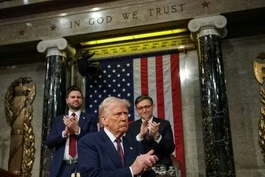
AMNA NAWAZ: Tonight, congressional correspondent Lisa Desjardins looks at his expansion of presidential power and how it's testing Congress and the system of checks and balances rooted in the Constitution.
LISA DESJARDINS: The second Trump White House is a blitz of executive actions... DONALD TRUMP, President of the United States: What we're going to be doing is a 25 percent tariff on all cars that are not made in the United States.
We're terminating those programs, and they're going to be terminated on a permanent basis.
LISA DESJARDINS: ... and use of the military and federal authorities in American cities and abroad.
DONALD TRUMP: All political and military figures in Venezuela should understand what happened to Maduro can happen to them.
LISA DESJARDINS: A forceful display of power that often leaves Congress sidelined... SEN.
LISA MURKOWSKI (R-AK): I think it's important to send the message.
LISA DESJARDINS: ... and trying to weigh in, like last week, when these senators met with a minister from Greenland, whose country Trump wants to take over, I asked about their power.
SEN.
LISA MURKOWSKI: Every day, we should be thinking if we are fully asserting our authorities under the Constitution.
LISA DESJARDINS: Is Congress right now?
SEN.
ANGUS KING (I-ME): No.
SEN.
LISA MURKOWSKI (R-AK): Some days, no.
SEN.
ANGUS KING: Congress has abdicated its power largely.
I'd say it's the seventh inning.
We're behind 4-3.
But the game isn't over.
SARAH BINDER, George Washington University: The big, long picture here over the 20th century into these years of Trump is a loss of congressional power.
LISA DESJARDINS: Sarah Binder is a professor at George Washington University, focused on Congress.
She points to how Congress grew and crises like the Great Depression and World Wars leading to Congress giving more power to past presidents.
But now there's another factor.
SARAH BINDER: We're in a world of high, intense partisanship, polarization, which means that the loyalties of members of Congress are quite often more to the president of their party than to their responsibilities as lawmakers.
LISA DESJARDINS: Add to a Congress driven by party loyalty, a president who uses social media to threaten those in Congress who oppose him.
SARAH BINDER: This president thinks he has no need for Congress.
LISA DESJARDINS: The Constitution starts with Congress.
It is Article I, and it is twice as long as article II, which covers the president.
Democratic lawmakers especially point this out.
REP.
JAMES WALKINSHAW (D-VA): I actually take the view that Congress has Article I powers and the founders intended Congress to be the more powerful branch of government.
LISA DESJARDINS: We spoke with 71 current members of Congress for this story.
The vast majority, members of both parties, bemoaned what they see as a long-term loss of power for Congress.
Some see it now as at historic lows.
But in our hallway conversations, we heard resignation.
Few members felt responsible for or talked of tackling the problem.
We asked Republican Ryan Zinke, who served as Cabinet secretary in Trump's first term and now is a House member for Montana.
REP.
RYAN ZINKE (R-MT): Congress over the years has let loose a lot of the power, primarily power of the purse.
LISA DESJARDINS: But next we asked him about Trump specifically, how he has sent the National Guard to states and cities uninvited, renamed the congressionally established Kennedy Center after himself, and ripped up congressional spending plans, dismantling agencies like USAID.
Zinke then defended the president.
REP.
RYAN ZINKE: Fraud, waste, and abuse is never congressional intent.
And the president is within an authority to remove and stop funding of fraud, waste, and abuse.
So... LISA DESJARDINS: But he has - - he removed entire agencies, USAID, that were established by Congress to be independent.
REP.
RYAN ZINKE: Well, but also was it in the best interest of the United States and did it follow and support U.S.
policy?
LISA DESJARDINS: But my question is, Congress hasn't weighed in on that at all.
REP.
RYAN ZINKE: Well, I would say the president is within his constitutional right to make sure we don't have fraud, waste and abuse and taxpayer dollars are spent wisely.
LISA DESJARDINS: That is broad leeway, which Trump also is getting in Venezuela, with Republican senators last week providing just enough votes to bat down an attempt to limit his powers there.
J.D.
VANCE, Vice President of the United States: And the point of order is sustained.
LISA DESJARDINS: Which brings us back to Greenland and Denmark, where protests about the U.S.
are rising and where senators visited this weekend.
But it was mostly Democrats.
And it's not clear what they will do about the president's threats.
SEN.
CHRIS COONS (D-DE): One of the things that's been made clear to us is that the people of Denmark are very anxious, are quite concerned, and the people of Greenland even more so.
LISA DESJARDINS: Hovering, what seems a basic question, doesn't Trump need congressional approval to act to send a military force to Greenland?
I asked House Speaker Mike Johnson this earlier this month.
He said, maybe, but maybe not.
REP.
MIKE JOHNSON (R-LA): Under Article II, as we talked about in the room, the president has broad authority as a commander in chief... LISA DESJARDINS: But why Greenland?
REP.
MIKE JOHNSON: ... as all previous presidents have.
LISA DESJARDINS: Democratic Illinois Senator Tammy Duckworth, a combat veteran, responded.
SEN.
TAMMY DUCKWORTH (D-IL): I strongly disagree with him.
That is absolutely not what the Constitution says.
But, in fact, it is where Republicans are.
They have basically given their powers over to the White House.
JAMEEL JAFFER, George Mason University: President Trump has been running the table on the legislative branch for two terms now in a row.
LISA DESJARDINS: Jameel Jaffer is a law and national security professor at George Mason University and a Republican.
He sees Trump as within the norm so far in terms of military action overseas, but he sees unique imbalance in power otherwise.
JAMEEL JAFFER: These are really interesting and perhaps dangerous times, an overly assertive executive without any constraint by Congress, with limited constraints by the court.
We have seen how that operates in other countries.
We haven't seen that here historically in America.
LISA DESJARDINS: Republicans are divided on the arc of power.
REP.
JOHN RUTHERFORD (R-FL): Look, I think the balance is where it's always been.
We have the appropriations process that is a check and balance.
SEN.
RON JOHNSON (R-WI): In general, in terms of our balance of powers, it's not very balanced anymore, mainly because Congress has willingly over the decades given up constitutional authority.
LISA DESJARDINS: While Democrats see them as throwing away power right now.
REP.
ALEXANDRIA OCASIO-CORTEZ (D-NY): As it pertains to President Trump, it is unprecedented.
There is virtually no pushback whatsoever.
LISA DESJARDINS: Congress overall recognizes, but has yet to reckon with the situation.
The first branch in the Constitution is often a second thought in critical decisions for the country and the world.
For the "PBS News Hour" I'm Lisa Desjardins.
AMNA NAWAZ: For more on the relationship between the White House and Republicans in Congress, I'm joined by our Politics Monday duo.
That is Amy Walter of The Cook Political Report With Amy Walter and Jasmine Wright, White House correspondent for NOTUS.
Tamara Keith is away this evening.
Jaz, great to have you here.
Nice to see you.
JASMINE WRIGHT, NOTUS: Thank you.
AMNA NAWAZ: Let's pick up where Lisa left off there.
Amy, this idea that Congress has been ceding its power over the years, she tracked that in the report.
We now have a president who's willing to push and exert authority in ways previous presidents have not.
What does that mean for lawmakers who want their power back?
AMY WALTER, The Cook Political Report: Right.
Well, some of it is, I think we have to step back for a minute and say for Republicans in Congress -- obviously, Republicans control the House and the Senate -- they actually are supportive of what the president's doing because the base Republican Party voters remain very supportive of the president pretty much down the line.
Overwhelmingly, they supported the job that he's doing in office.
There was a Quinnipiac poll out just the other week; 89 percent of Republicans approve the job he's doing as commander in chief.
They like what he's doing in Venezuela.
And remember 80 percent of those who sit in Congress who are Republicans in Congress sit in districts that Trump won by 10 points or more.
In other words, most Republicans sit in Trump districts and those voters in those districts like what Trump's doing.
So the idea of pushing back doesn't make much sense to them because the people in their districts are pretty happy -- at least the Republicans are -- with what he's doing.
AMNA NAWAZ: Jaz, when you mark one year of Trump's second term, what's the relationship between Congress and Trump here?
JASMINE WRIGHT: Well, if you ask the White House officials, they say the relationship is very good, that President Trump is calling lawmakers, specifically Republican lawmakers.
Over the last week, we have heard him call a Democratic senator, Elizabeth Warren, so he's willing to pick up the phone.
But, frankly, this White House and the president views the Congress as not a co-governing body, as some would say the Constitution stipulates, but a body put in place to further the president's agenda when need be.
Obviously, we have seen him coalesce a lot of power in the executive, trying to expand that.
And so they don't really see the need for Congress in the traditional sense.
And they say, basically, you go along with it or you get lost.
So those small handful of lawmakers on both the House and Senate side, Republican side, who don't want to go along with it, he's basically bullying them, trouncing them, arguing that he's going to primary them.
So I think that the totality of this is that you're not seeing a lot of pushback because the president has a firm grasp on his party, even though they may not like individual things that he's doing.
AMY WALTER: And when I talk to folks who cover Congress, one of them said to me, look, Republicans are willing to push back much more on Mike Johnson, the speaker, than they are willing to push back on the White House.
So where you're seeing sort of defections, it's against the speaker of the House, who they don't fear as much as they fear Trump.
AMNA NAWAZ: Well, Jaz, as you point out, we have seen the president, in your words, bully them or primary, threaten to primary Republicans who speak out against him.
There was another example of that over the weekend, when Donald Trump posted this on TRUTH Social about Louisiana Senator Bill Cassidy, essentially.
He's endorsing a Louisiana congresswoman, Julia Letlow, on a possible Senate run.
She hasn't even said she's running.
He's encouraging her to, in his word, "Run, Julia, run."
This would be against the sitting GOP Senator, Amy, Bill Cassidy, who has occasionally criticized Trump.
Is this meant to keep Senate Republicans in line?
AMY WALTER: yes.
Most importantly, it's not just that he's criticized Trump.
He voted to impeach Donald Trump.
And so... AMNA NAWAZ: In his second impeachment, yes.
AMY WALTER: The second impeachment, yes.
And so even as Kennedy has sought Trump's approval, sought Trump's stamp of... AMNA NAWAZ: Cassidy, yes.
AMY WALTER: Cassidy.
I'm sorry.
Cassidy has sought his approval and has sought support.
He was, of course, the deciding vote in the Senate to confirm RFK Jr., even as he had many concerns, Cassidy did, about RFK Jr.
and what he was going to do with vaccines.
At the end of the day, it really comes down to this.
The president has a very long memory.
And he believes if you have crossed him -- and, in this case, this is the greatest sin, is that you voted to impeach him.
There's not much you can do to win back his favor.
JASMINE WRIGHT: And, to be clear, we have reporting on NOTUS that folks like John Thune, Senate majority leader... AMY WALTER: Yes.
JASMINE WRIGHT: ... called Trump to try to basically get him to back down on wanting to primary Bill Cassidy, just because the numbers are already looking a little bit shaky for folks.
So this was kind of a full-court press on trying to get President Trump to back down and he didn't.
And the fact that he didn't is supportive of this idea that he utilizes the threat of primaries in a way that no other modern president did.
And I think back to the last president, former President Joe Biden, when he consistently ran into a problem with Joe Manchin and Kyrsten Sinema, two members who are not in the Senate anymore, but consistently ran into a problem with them not wanting to effectuate his agenda.
And did he call for them to be primaried?
No.
But you're seeing Donald Trump do it time and time again, and you are seeing the Republican Party for the most part fall in line.
AMNA NAWAZ: You're also seeing the Republican Party for the most part try to explain some of the actions we see from the president.
We're seeing some of it now.
We will see more of it.
And I want to put to you some of the reporting Nick Schifrin broke over the weekend, which was this note that Donald Trump sent to European officials basically laying bare the reason or one of the reasons that he wants to try to take over Greenland is because Denmark would not give him the Nobel Peace Prize.
It doesn't get any more clear than that.
Amy, how do lawmakers explain that, you think?
AMY WALTER: Right.
Well, we will start to get more of them on the record.
And most of them, I'm sure, are going to say things like, well, he says stuff like this all the time.
He doesn't really mean it.
Does it really mean anything?
AMNA NAWAZ: I didn't read it.
AMY WALTER: Right.
The question really is where things go from here.
And this is what -- I started this conversation by saying, look, where the Republican base is, is pretty consistent with where Trump is, or they like where Donald Trump is going.
Where they do draw a line, at least in the polling that we're seeing, is on this idea of either invading Venezuela or putting boots on the ground in Greenland.
They like the idea in polling, Republicans do, of, yes, let's buy Greenland, but they don't like the idea of taking military action.
And that's where I think you can push and push and push of this, Trump can, and still get support from his party.
Starting to talk about troop movements, that's a different story.
AMNA NAWAZ: I want to correct myself.
I said Denmark when I meant Norway, but please, Jasmine.
JASMINE WRIGHT: Yes, great reporting there from Nick.
I mean, I think just fundamentally, this is not a new thing for the president.
We know that he talked about this in his first term.
But the difference here is who he has around him.
Right now, he has people around him who are willing to trust in him more, who are willing to let him do more, who are willing to push back on him less than I think the folks in the first term.
And you know that is true because Donald Trump has said repeatedly, I like this group of people I have around me more than I did the last ones, even save for a couple of different members.
And so I think that you're not seeing the pushback from the White House that maybe people in the Republican Party thought that you would see when you're coming to this idea of we're going to invade Greenland or we're going to put boots on the ground in Venezuela, something that President Trump has ruled out, the Venezuela part.
And so I think that you're not necessarily going to see a lot of direct pushback to him, but you may see pushback to Speaker Mike Johnson or you may see pushback to John Thune.
The question is, how far does that go?
And, of course, the whole big picture of NATO and where does that play in is obviously another question mark.
AMNA NAWAZ: A lot of big question marks.
We will be talking about this a lot more.
Jasmine Wright of NOTUS, great to have you here this week.
Thanks for being here.
Amy Walter, always great to see you both.
Thank you.
AMY WALTER: Thank you so much.
GEOFF BENNETT: Scientists are worried about what's happening with the melting of the Antarctic's ice sheets and what it could mean for sea level rise and coastlines in many countries.
There's a two-month-long journey under way right now to conduct new research that will better explain what's happening and the role of climate change.
But it's a journey that provides no guarantees that researchers will even be able to get the data they want.
Our science correspondent, Miles O'Brien, is on that ride and filed this report for our series Tipping Point.
MILES O'BRIEN: So close and yet so far.
After years of meticulous planning and three long weeks at sea, a Korean icebreaker carrying two helicopters and a team of world-class scientists has made it as far as we had dared to hope.
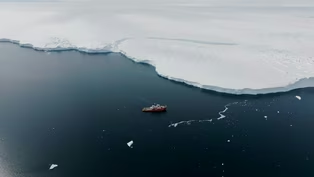
On January 8, we moored in the shadow of the most consequential glacier on the planet, Thwaites in West Antarctica.
But the anchor leg, an 18-mile hop by helicopter onto the ice, has so far been an air bridge too far.
Weather briefings in the wheelhouse of the Araon have offered little reason for optimism.
Dominic O'Rourke is the chief pilot.
DOMINIC O'ROURKE, Helisupport International: Hopefully, we can fly, scout the camp maybe tomorrow evening.
MILES O'BRIEN: The helicopters have flown about as much as the penguins.
And the marquee event of this expedition hangs by a thread.
The ambitious goal?
Establish a camp on the glacier to drill a small hole at the place where ice, land and the sea meet some 3,000 feet below, the so-called grounding line.
The instruments researchers hope to drop into the seawater would yield unprecedented data to help explain why no glacier is melting faster anywhere on Earth.
DAVID HOLLAND, New York University: That ice is beginning to fall apart in certain places.
MILES O'BRIEN: Abort the ship, mathematician and climate scientist David Holland of New York University.
Why all the effort for this one?
DAVID HOLLAND: This is a special one that over the decades we have discovered is the most crucial to the future of sea level on planet Earth.
MILES O'BRIEN: Full stop?
DAVID HOLLAND: Full stop.
MILES O'BRIEN: Thwaites has a floor-to-sized footprint and is on average more than half-a-mile thick.
It contains enough water to lift sea levels the world over by 2.5 feet.
And satellite images show it is melting at an astonishing rate, upwards of 300 feet a year in places, far faster than most Antarctic ice, where losses are typically measured in inches.
DAVID HOLLAND: Undeniably, it's melting.
Then the question is, why?
MILES O'BRIEN: Researchers believe climate change has altered wind patterns around Antarctica, weakening easterly winds and allowing cold meltwater from glaciers to flow more freely out to sea.
That in turn opens a pathway for deeper, warmer ocean currents to reach Thwaites' grounding line, where they erode the glacier from below.
DAVID HOLLAND: This is the place where warm water is on your doorstep.
MILES O'BRIEN: And the glacier appears to be acting as a keystone, buttressing two other large ice shelves.
DAVID HOLLAND: These ice shelves and associated ice could go too, so now you're up to 10 feet globally, which is an enormous volume.
MILES O'BRIEN: In 2015, the National Academies made predicting ice loss here the top Antarctic priority for the National Science Foundation.
But the Trump administration cut the NSF budget by about 55 percent, the Antarctic program by roughly 70 percent.
The NSF can no longer afford to operate a research icebreaker and isn't funding any of the science on this expedition.
South Korea, meanwhile, is steaming full speed ahead in the opposite direction, doubling down on polar science.
It is building a next-generation research icebreaker nearly twice the size.
And its polar work is funded through 2031.
WON SANG LEE, Principal Research Scientist, Korea Polar Research Institute: We are really grateful for having those kind of money for continuing our work, better understanding of global sea level wise.
MILES O'BRIEN: Principal research scientist Won Sang Lee is with the Korea Polar Research Institute, KOPRI.
Help me understand why Korea has made polar research a priority.
WON SANG LEE: My country is the kind of peninsula, so facing everywhere the ocean.
So it's really vulnerable to kind of millimeter-wise kind of sea level change.
MILES O'BRIEN: Our two-month voyage south began two days after Christmas.
This is getaway day to Antarctica.
We embarked from Lyttelton, New Zealand, southeast across the Southern Ocean for 3,200 miles to Thwaites.
By New Year's Eve, we saw our first iceberg.
Pretty darned amazing.
All right, we must be going in the right direction.
On January 5, we reached sea ice.
It's thin and we're going through it like a knife through butter, but there's a lot of thicker ice ahead.
That was an understatement as I learned the next day.
The Araon on was deep in a struggle to make headway.
The sea ice has gotten very thick and the ice breakers have been having a really hard time getting through it.
But our skipper is brave and sure.
After two sleepless days navigating a winding route through the ice, Captain Gwang-heon Kim got us through.
And on January 8, I woke up to this astonishing sight.
I can't even believe what I'm looking at.
It's just beautiful.
That's the face of the Thwaites Glacier.
On the journey south, science teams spent nearly every waking hour testing gear and refining plans.
They aim to sample the waters around Thwaites, bore the sea ice and fly deep-penetrating radar over the glacier.
Most of the gear belongs to the British Antarctic Survey, which pioneered hot water drilling into glaciers.
KEITH MAKINSON, British Antarctic Survey: So we're talking about 20, 25 tons of equipment and fuel and people as well.
MILES O'BRIEN: Keith Makinson is an oceanographer and drilling engineer.
He will help lead the effort to establish a hot water drilling camp, as they did on the Dotson Ice Shelf in 2022.
KEITH MAKINSON: It's really very simple.
I mean, ultimately, we're creating hot water.
We use a long hose.
We lower it into the snow and we make a hole.
The complication comes is that we're in a freezing environment.
Nature's fighting back all the time.
MILES O'BRIEN: No truer words have been spoken on this journey, as the helicopter pilots have been reminded.
Flying over the sea ice and crevasses is not a problem.
But so having these little reference points on the surface obviously make the difference.
DOMINIC O'ROURKE: Yes, a massive, massive difference, yes, exactly.
MILES O'BRIEN: But when we look toward the featureless place on the ice where they want to establish the drill camp, low clouds erase the horizon, creating whiteout conditions.
DOMINIC O'ROURKE: If we go charging off in there, you're just in the white.
You don't actually know which way is up anymore.
MILES O'BRIEN: O'Rourke and the team kept pressing.
A brief break in the clouds let him drop a three-person safety crew onto the ice to check for hazardous hidden crevasses.
They used a remote control vehicle to tow a ground-penetrating radar to see beneath the surface.
Mission accomplished, but the weather quickly went, well, south.
DOMINIC O'ROURKE: It looks very poor, very, very white.
MILES O'BRIEN: As nervous plans formed for an unexpected overnight stay on Thwaites, O'Rourke spotted a sliver of blue, slipped in, and landed safely.
(CHEERING) MILES O'BRIEN: The team returned to the ship to a hero's welcome.
As we waited for a break in the weather, the ship cruised near neighboring Pine Island Glacier, and the scientists did as much work as this harsh remote place would allow.
Finally, after 10 long days of gray, the clouds dissolved and the sun broke through.
The hot water drill team wasted no time implementing an improvised plan to fit the narrow window on the ice.
Their final possible workday is February 7.
PETER DAVIS, British Antarctic Survey: Let's go check out the drilling kit.
MILES O'BRIEN: Physical oceanographer Peter Davis is one of the team leaders.
By my count, 20 days... PETER DAVIS: Yes.
MILES O'BRIEN: ... between now and when - - the last possible workday on Thwaites.
PETER DAVIS: Yes.
MILES O'BRIEN: Is that enough time?
PETER DAVIS: Fingers crossed, it should be.
DOMINIC O'ROURKE: I could maybe try and come with the sling load.
MILES O'BRIEN: To reduce the number of helicopter flights carrying people and supplies to the camp, the team will leave behind some spare parts and some creature comforts.
PETER DAVIS: If all goes well, if the weather is good, that's good and we can continue to work.
That should be sufficient time.
MILES O'BRIEN: So, no margin?
PETER DAVIS: No margin anymore, yes.
MILES O'BRIEN: Yes.
PETER DAVIS: We have used that margin.
MILES O'BRIEN: It's a last-ditch bid for data that has eluded scientists for years.
Everything has to go right in a place where almost nothing ever does.
GEOFF BENNETT: And Miles joins us now from Antarctica.
So, Miles, what's the latest on the effort to set up camp there?
MILES O'BRIEN: Things are moving pretty smoothly here, Geoff.
By my count, they're about halfway through all these sling loads, those nets filled with equipment, that they are flying 18 miles into the glacier to the sweet spot where this camp will be built for the hot water drill.
They need to do about 40 of them to get all the equipment on the ice where it needs to be, so about halfway through.
I think, by tomorrow, they might have the job done and they can get busy with that drilling effort.
GEOFF BENNETT: And we saw that weather conditions can make things pretty dangerous.
How is the weather holding up?
MILES O'BRIEN: Well, right now, it's 29 degrees, about a 10-mile-an-hour wind, and I got my sunglasses on because the sun is out.
And, interestingly, it is still a little bit gray.
There's kind of a little bit of ground cloud in the area where they're landing.
But as they add pieces to the camp, it gives the pilots more things to fixate on as a point of reference.
So the bigger the camp, the easier it is for them to land in what would otherwise be marginal conditions.
So I think they're kind of over the hump on this one.
GEOFF BENNETT: And what can you tell us, Miles, about the other science projects being conducted on the ship there?
MILES O'BRIEN: Well, there's several teams on here that have projects associated with understanding sea ice, understanding other aspects of the oceanographic condition in and around Thwaites.
There's a team that is going to find a ground-penetrating radar over the glacier to really try to characterize what is beneath not just the ice, but the terrain below.
They're all kind of cooling their heels, waiting for this event to get under way so they can get some time on the helicopter.
So everybody here is taking sort of a team spirit approach to it, and everybody comes in with low expectations because of the environment they're in.
But they're sort of champing at the bit to do their science, frankly.
GEOFF BENNETT: Are you going to get to go to the camp?
MILES O'BRIEN: You bet, Geoff.
If I have to commandeer one of those helicopters myself, I'm going to that camp.
No, they have told us that, as soon as things settle down and the science gets a few helicopter rides, we will get an opportunity to go out there and really see what it's all about.
And we will report back for sure on that.
GEOFF BENNETT: Miles O'Brien with the exceptional assignment tonight, reporting from Antarctica.
Miles, it's great to see you.
MILES O'BRIEN: Good to see you, Geoff.
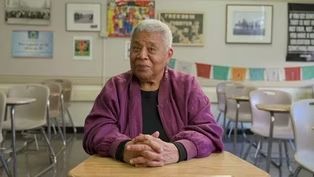
AMNA NAWAZ: On this Martin Luther King day, we turn for some wisdom to Minnijean Brown-Trickey, one of the original members of the Little Rock Nine, the teenagers who integrated Central High School after the 1954 Brown v. Board of Education ruling.
Tonight, she shares her Brief But Spectacular take on her hope for the next generation.
MINNIJEAN BROWN-TRICKEY, Little Rock Nine Member: When I look at pictures at Central, I see me smiling.
That was also a strategy.
The nature of racism, hatred, all those things is to dim your smile, dim your beauty, dim every aspect of you.
And, of course, I'm not going to let him do it to me.
(SINGING) MINNIJEAN BROWN-TRICKEY: Little Rock Nine.
ASHLEY GRAY, World History Teacher: In the fall of 1957, Minnijean Brown-Trickey took her rightful place in what had previously been a whites-only school, and she helped set America on a path towards desegregation in public schools.
Please rise and give a very warm and loving welcome to Ms.
Minnijean Brown-Trickey.
(APPLAUSE) MINNIJEAN BROWN-TRICKEY: Honestly, in a million years, I could not have anticipated what it was going to be like.
I actually rely on the photos, the people screaming hatred behind us and the soldiers not letting us go in, also the horror of what people were screaming and saying.
I was so scared.
They were saying: "Hang them."
They were saying: "Kill them."
I saw them, and I said to myself, I will never behave like that for any reason toward anyone as long as I live.
I was a kid who was told that our enemy was the Soviets, and we were hiding under the desks, and I was doing all the anthems and singing all the songs.
And then, on that day, I was really disappointed, and I just lost so much of my beliefs.
ASHLEY GRAY: Charlie H. wanted to know what gave you the courage to walk the halls every day.
MINNIJEAN BROWN-TRICKEY: There were 20 nice kids who would either speak to us or smile at us.
There were about 300 really mean kids, but then that meant there were 1,700 silent witnesses who stood by and said nothing.
So if you're walking through terror, if somebody smiles with a genuine smile, you're feeling, oh, there's hope.
There's hope.
What makes me interested in interacting with young people is because I know who I was, and I value that in young people.
I just want them to know that they are capable of so much, and that they don't have to tolerate things the way they are.
We have kids who have families who are being picked up and brutalized by ICE.
I'm not sure if it was like that for me.
So my so-called courage is small compared to what they have to come up with in their everyday lives, and I want them to feel up to the challenge.
ASHLEY GRAY: We have heard that you were especially targeted of all the nine, so I was wondering if you could expound on perhaps why.
MINNIJEAN BROWN-TRICKEY: Sociologists did interviews with white women about their experience at Central, and they said: We hated that Minnijean so much.
She walked the halls of Central like she belonged there.
This is what people said.
Excuse me, wherever you walk, you walk like you belong there, OK?
That is my challenge to you, OK?
Walk like you belong, because you do.
(APPLAUSE) MINNIJEAN BROWN-TRICKEY: My name is Minnijean Brown-Trickey, and this is my Brief But Spectacular take on walking like you belong.
AMNA NAWAZ: As always, you can watch more Brief But Spectacular videos online at PBS.org/NewsHour/Brief.
GEOFF BENNETT: And that's the "News Hour" for tonight.
I'm Geoff Bennett.
AMNA NAWAZ: And I'm Amna Nawaz.
On behalf of the entire "News Hour" team, thank you for joining us.

Amy Walter and Jasmine Wright on Trump's control of the GOP
Video has Closed Captions
Amy Walter and Jasmine Wright on Trump's control of GOP lawmakers (7m 49s)
A Brief But Spectacular take on walking like you belong
Video has Closed Captions
Minnijean Brown-Trickey's Brief But Spectacular take on walking like you belong (4m 58s)
Congress divided over how much authority to cede to Trump
Video has Closed Captions
As Trump expands presidential power, Congress divided over how much authority to cede (6m 51s)

Europe stands firm against Trump's push for Greenland
Video has Closed Captions
Europe stands firm against Trump's push for Greenland as he threatens new tariffs (10m 5s)

Minnesota protests enter 3rd week amid immigration raids
Video has Closed Captions
Minnesota protests enter 3rd week as immigration raids continue (3m 41s)
Voyage to Antarctica seeks to learn why a glacier is melting
Video has Closed Captions
On board the voyage to Antarctica to learn why a massive glacier is melting (12m)
Providing Support for PBS.org
Learn Moreabout PBS online sponsorship
- News and Public Affairs

FRONTLINE is investigative journalism that questions, explains and changes our world.

- News and Public Affairs

Amanpour and Company features conversations with leaders and decision makers.












Support for PBS provided by:
Major corporate funding for the PBS News Hour is provided by BDO, BNSF, Consumer Cellular, American Cruise Lines, and Raymond James. Funding for the PBS NewsHour Weekend is provided by...