
January 20, 2026
Season 4 Episode 304 | 26m 30sVideo has Closed Captions
Elon Musk donates $10 million to a candidate in Kentucky's U.S. Senate race.
The world's richest person gets involved in Kentucky's U.S. Senate race, Gov. Beshear is in Davos for the World Economic Forum, a bill aimed at making transfering college credits gets sent back to the drawing board, and a physician talks about the Dry January trend.
Problems playing video? | Closed Captioning Feedback
Problems playing video? | Closed Captioning Feedback
Kentucky Edition is a local public television program presented by KET
January 20, 2026
Season 4 Episode 304 | 26m 30sVideo has Closed Captions
The world's richest person gets involved in Kentucky's U.S. Senate race, Gov. Beshear is in Davos for the World Economic Forum, a bill aimed at making transfering college credits gets sent back to the drawing board, and a physician talks about the Dry January trend.
Problems playing video? | Closed Captioning Feedback
How to Watch Kentucky Edition
Kentucky Edition is available to stream on pbs.org and the free PBS App, available on iPhone, Apple TV, Android TV, Android smartphones, Amazon Fire TV, Amazon Fire Tablet, Roku, Samsung Smart TV, LG TV, and Vizio.
Providing Support for PBS.org
Learn Moreabout PBS online sponsorshipmusic >> This campaign is about, you know, it's a vote for Donald Trump or it's a vote for Mitch McConnell.
It's your choice.
[MUSIC] >> A candidate for U.S.
Senate looks ahead to the May primary after picking up a big endorsement.
[MUSIC] >> Students circumstances change, and they should be encouraged to remain in school until degree completion.
>> From community college to university, students need their coursework to carry over.
A bill in Frankfort.
Just might help.
[MUSIC] >> If we can save one family from that Philly, then we've done our job and that's what we want.
[MUSIC] >> Emotional testimony in Frankfort today from parents demanding action after their six year old's brutal killing.
You might.
>> Be having a drink every single day or multiple drinks in a day, and that's going to impact your mental health and your physical health.
>> Just how much is too much?
New federal guidelines offer a different approach.
[MUSIC] >> Production of Kentucky edition is made possible in part by the KET Millennium Fund.
[MUSIC] .
>> Good evening and welcome to Kentucky edition for this Tuesday, January the 20th, I'm Renee Shaw.
We thank you for spending some of your Tuesday night with us.
The richest person in the world is getting involved in Kentucky's U.S.
Senate race.
Elon Musk just donated $10 million to superPAC supporting Nate Morris.
The news was first reported by Axios.
Morris later confirmed it on a podcast hosted by President Donald Trump's son, where he again went after retiring U.S.
Senator Mitch McConnell, who he hopes to succeed.
>> Mitch has had a stranglehold on Kentucky for 40 years, and it is not the easiest thing to challenge the McConnell Mafia right here in the Bluegrass State.
But we've done it, and we've gone straight for the jugular of Mitch and his cronies.
And that's what has to happen to bring change here in Kentucky and to bring a new perspective.
We know that Kentuckians are hungry for a 180 and the establishment, they have been kicking, screaming, fighting every chance they got.
But we know, just like we saw with your father in 2016, this is what it takes to bring real change and to bring disruption to Washington and to usher in the America First agenda.
And that's why we're standing so strong.
That's why we're fighting so hard.
And this campaign is about, you know, it's a vote for Donald Trump, or it's a vote for Mitch McConnell.
It's your choice.
And you can't stand with both.
And we've got two people we're running against, as you know, Don, that would be puppets for Mitch McConnell.
And that's why we're fighting so hard.
>> Until Musk's donation, Morris's campaign has largely been self-funded.
The Republican from Lexington is the founder of Rubicon, a waste and technology company.
Morris is one of 12 Republican candidates in Kentucky's U.S.
Senate race.
Early polling suggests former Kentucky Attorney General Daniel Cameron and Kentucky's sixth District Congressman Andy Barr are leading candidates in that race.
Congressman Barr was quick to respond to news of Musk's donation.
His campaign manager campaign manager put out a statement saying, quote, the more money Nate Morris spends, the more Kentuckians get to see him and the worse he does.
Nate Morris and his Nevertrump allies have already spent $6 million on TV, and he's stuck in a distant third and statistically tied with a Democrat in a Kentucky general election poll.
Nate Moore is spending money made this a two man race between Andy Barr and Daniel Cameron.
Nate Moore is spending more money will cement it that way.
End quote.
Now, this afternoon, Cameron's campaign also issued a statement, quote, Nate Morris has a long history of convincing wealthy investors to light their money on fire.
He's a pretty good con man.
Quote.
End quote.
And it goes on to say this race has already taken shape, and it shows Daniel Cameron is a dominant force in Kentucky.
The other two guys are running a distant second and third, despite how much they bluster on social media.
End quote, President Trump has yet to endorse a candidate in Kentucky's U.S.
Senate race.
The World Economic Forum is taking place this week in Davos, Switzerland.
It's an annual think tank that attracts corporate executives, academics and for a second year in a row, Kentucky Governor Andy Beshear.
The term limited Democratic governor posted about the trip on social media.
He says it's a chance to meet with business leaders and to try and attract new economic development to Kentucky.
>> Hey everybody, it's Andy.
Brittany and I are finishing up a busy day in Helsinki.
We met with four companies that employ about 800 people in Kentucky, and a ton more that are looking to make Kentucky their new Kentucky home.
Proud to represent us on this national stage.
We're going to make sure we bring home opportunity.
>> The Republican Party of Kentucky is criticizing Beshear's trip.
Quote, Kentuckians deserve a governor who shows up and does his job.
Instead, Andy Beshear is skipping town, dodging responsibility and chasing headlines as he tries to build a national profile for a presidential campaign that's already six feet under.
End quote.
State representative TJ Roberts is also blasting Beshear's trip, calling it a waste of taxpayers dollars.
He's calling for more oversight of such travel and a bill he's filed for lawmakers to consider this session.
House Bill 86 would require governors to get permission from the state treasurer before traveling internationally.
A similar bill, introduced last year by the Republican from Burlington, failed to make it out of committee.
In response, Governor Beshear's office says to House Bill 86 about the international travel, says he has helped land some of the state's largest investments.
The state adds house Bill 86 would, quote, make Kentucky less competitive and risk our current economic success and job creation, end quote.
Too many college students are taking coursework that doesn't count towards a degree.
That's according to a Georgetown Republican.
She's proposing Kentucky's higher education officials make way for more college credit to be transferred from one school to the next.
But as our June Leffler reports, public universities are not quite on board.
That begins tonight's legislative update.
>> Students circumstances change, and they should be encouraged to remain in school until degree completion.
If they need to move or transfer to another university.
House Bill 47 would have ensured that students receive the college credits they earned and paid for from another accredited Kentucky University.
>> Representative, Vanessa Grasso's.
Bill passed in one chamber last year.
She presents House Bill 94 this year.
>> The Prichard Committee for Academic Excellence applauded our work on this and issued a letter highlighting four main reasons for their support.
It eliminates credit loss during transfer, creates clear transfer pathways, reduces time and cost to degree completion, and strengthens Kentucky's workforce.
>> More than a decade ago, the General Assembly required universities to accept general education transfer credits.
Grasso's bill adds on that.
>> That sometimes they take these courses at a two year, but when they go to the four year, it doesn't count toward the general credit.
They have to take those courses over again or take other courses.
Am I reading into that correctly?
>> So the general ed courses would transfer.
It's the it's the House bill 94 really addresses the issues of those major specific courses.
So you know, some there are you know, most majors have required courses in the 102 hundred level the first 60 hours.
This is sort of the next step that would just include that the majors that are chosen as part of this program, that those 110 level courses would be outlined that you need to take that would transfer into that major.
When the student transfers.
>> Though, universities could opt out for specialty degrees, they still oppose the measure.
>> By my recollection, all of the provosts in Kentucky met last year at the end of last year to discuss this bill.
We all agreed that we can improve transfer pathways and we will continue to work together to do so.
But my recollection of that conversation, which did include CPE, did not include any support for this bill.
>> We also recognize that some students may encounter friction points that slow their progress.
Addressing those challenges requires a clear understanding of where the problems actually exist, which is why data must drive the next phase of policy development.
Without that clarity, House Bill 94 proposes a solution before identifying the problem and risks creating new administrative layers that do not improve our student outcomes.
>> The House Post-secondary Education Committee did not vote on the matter.
The chair encouraged universities and the bill sponsor to go back to the drawing board before a vote later this session for Kentucky Edition.
I'm June Leffler.
>> Thank you.
June house Bill 94 targets degrees for high demand jobs like nursing and education.
A Woodford County family says the Kentucky General Assembly is making strides to right or wrong in the criminal justice system with the introduction of Logan's Law, six year old Logan Tipton was stabbed to death inside his family's Versailles home more than ten years ago.
His killer, Ronald Exantus, was found not guilty by reason of insanity for Logan's murder, but he was found guilty for assaulting other members of the Tipton family.
That night.
Exantus was released from prison early through the Mandatory Reentry Supervision program after serving less than half of his 20 year sentence.
His early release was met with outrage from many Republican lawmakers, and it prompted the introduction of Logan's Law, or House Bill 422 today.
Logan's parents and state representatives spoke about the significance of the legislation.
>> Thank you.
>> So Logan's law does get rid of not guilty by reason of insanity.
It does keep guilty, but mentally ill.
And the reason for that?
Our bill drafter looked through the law to make sure that what we were doing could ensure that those who commit these acts as a result of mental illness can get the help that they need, and still face accountability for the actions that they have done.
>> It's time to get tough on crime.
It's time on these violent criminals out here.
It's time to get tough.
They're not scared.
And with this bill, hopefully they'll think twice before they do what they do.
The time needs to fit the crime and there has to be accountability.
As far as Logan is, there will never be accountability, ability for his death.
And if we can save one family from that feeling, then we've done our job and that's what we want.
>> We'll have much more about Logan's law, including an interview with Logan's parents tomorrow night on Kentucky edition, a bill that would limit the governor's pardoning powers passed the Senate today.
Senate Bill ten would put a constitutional amendment on the ballot concerning how close to an election a governor can issue a pardon.
Supporters of the bill say more needs to be done to fix a broken system.
>> Now, our system of justice is built on the idea that we do not grovel to Kings for our freedom.
We do not buy indulgences from a church, but instead, in this nation, we are judged by a jury of our peers.
Pardons, especially those that are unlimited as they are in the Commonwealth, short circuit that system of justice.
>> For me, this this whole process of pardons has been a pay to play system.
For a long time.
I've had friends just recently told me he was told once to wait to get a pardon is give $10,000 to a certain person.
>> Senate Bill ten passed with 36 yes votes and one pass vote.
It will next head to the House for consideration there.
Today.
The full Senate also passed Senate Bill 28, known as the Phone Down Kentucky act.
The bill would prohibit nearly all handheld use of cell phones while driving.
We'll have much more about that tomorrow, when we'll hear from a Kentucky mother who favors the bill after losing her two year old daughter in a crash caused by a distracted driver in Kentucky.
Families of fallen firefighters are eligible for death benefits if their loved one dies of cancer as a result of exposure in the line of duty.
Lawmakers on both sides of the aisle have come together to file a bill extending the list of qualifying cancers.
Firefighters say it will affect more families than you would expect.
>> Here in Kentucky.
Since 2002, we've lost more firefighters to occupational cancer than to fires, cardiac events or other unseen incidents combined.
That means when a Kentucky firefighter raises their hand to take an oath, the most likely cause of their line of duty death is not fire, it's cancer.
I've stood beside families of Kentucky firefighters who battled pancreatic cancer, thyroid cancer, and multiple melanoma.
All all diseases strongly linked to occupational exposure.
Only learn those diagnoses weren't covered under state law.
>> House Bill 34 advanced from committee today and will next head to the House floor for consideration by the full membership.
Efforts to curb youth vaping could get a financial boost under a newly filed bill in Frankfort, Kentucky has received more than $14 million from a multi-state settlement with electronic cigarette maker Juul.
States accused Jewell of marketing their products to young people and misleading the public about the nicotine content.
State Senator Craig Richardson wants that money to go to a vaping settlement trust fund and be used exclusively to prevent and help stop youth from vaping.
Senate Bill 74 would place the trust fund within Kentucky's Department for Public Health.
The bill is currently waiting to be discussed in the Health Services Committee.
[MUSIC] A Blue Oval Union vote gets federal approval, but the company still plans to fight it.
Our Toby Gibbs has that story and more.
And our Tuesday look at headlines around Kentucky.
>> The Kentucky Lantern reports the National Labor Relations Board will certify a close pro-union vote by 1000 workers at the Blue Oval SK Electric Vehicle Battery plant in Hardin County.
The vote was in August, before news broke that the plant would close and convert to making batteries for the electric grid under the sole ownership of the Ford Motor Company.
The vote was 526 to 515 to join the United Auto Workers.
But Blue Oval wanted to count 31 votes from emergency response employees votes that could change the outcome.
The Labor Relations Board decided those are not manufacturing jobs, so those ballots won't be included.
Blue Oval says it will appeal this decision.
[MUSIC] In Pulaski County.
County leaders are thinking about replacing the emergency warning system after a cyber attack that disrupted service for weeks.
[MUSIC] The Commonwealth Journal says the code Red system went down November 11th, leaving some people unable to access the system for 60 days.
Pulaski County did not have a functioning mass notification system.
Code Red is the system many cities and counties use to issue alerts for weather, evacuations, missing persons, and other emergencies.
Almost $2 million could be headed to Paducah and McCracken County for wastewater upgrades.
The U.S.
House passed a bill that would allow Paducah and McCracken County to replace the dewatering building, where water and solids are separated before treated water is released back into the Ohio River.
The current building is around 40 years old.
A new building will have improved state of the art technology.
[MUSIC] The bill has not yet passed the U.S.
Senate.
The owners of the Casey Jones Distillery are selling it.
It's now owned by husband and wife AJ Jones and Peg Hayes and their business partner, Cody Turner.
The Hoptown Chronicle says they're selling it to the B3 beverage company.
Casey Jones Distillery opened on Whitley Lane in Hopkinsville in 2014.
The decision to sell it comes two years after a $2 million expansion.
With headlines around Kentucky, I'm Toby Gibbs.
>> New U.S.
dietary guidelines tell us to drink less, but stop short of giving some clear limits as Americans rethink their drinking habits.
Trends like Dry January are gaining momentum.
Our Christy Dutton talks with the physician about how alcohol impacts your health, and what happens when you stop drinking it.
That in today's medical news.
[MUSIC] >> Doctor Mona Lisa Taylor, internal medicine for Norton Health Care is here now.
Doctor Taylor, the new dietary guidelines for Americans.
The limit alcohol beverages section of this says consume less alcohol for better overall health.
That's a little different from the previous guidance, which said no more than one drink a day for women, no more than two for men.
What do you advise your patients?
And does this go far enough in your opinion?
>> It's really interesting how they've changed those guidelines, because they seem to indicate that alcohol could be something that helps you socialize a little bit better, and so they don't really have those limit recommendations the way we've seen in the past.
I'll typically ask my patients about their alcohol use and if it's on a daily basis, and how many drinks they're having in a day, because if you're using it as a stress reliever from a hard day or something else is going on, you think like it's helping with your sleep.
You might be having a drink every single day or multiple drinks in a day, and that's going to impact your mental health and your physical health.
>> So how much is too much then what do you advise your patients?
>> I typically tell folks if you're having alcohol every single day, if women are having more than seven drinks in a week, that's concerning.
If men are having more than 14 drinks in a week, that's concerning.
And obviously I'm using the old guidelines there, but I think it's still gives patients a good framework to see and compare your alcohol use to what would be considered at risk.
>> Okay, in the US, alcohol consumption on average has been going down since Covid years 2020 and 2021, and a lot of people believe that's the cultural shift, cultural shift from the younger generations not drinking as much.
So do you expect to see a shift in health in the in Americans because of less alcohol consumption from these younger generations?
>> Potentially?
I find that some of the younger generation is also finding other things to relieve their stress.
We all deal with stress in different ways.
Some people exercise, some people eat.
Some people were using alcohol.
And I found a lot of the younger generation are finding other ways to relieve their stress.
Like what?
Which could be more like cannabis or marijuana type options.
And it's harder to gauge what that looks like because they might be vaping it, they might be doing edibles.
And we know that there's not really a regulated version of that just yet.
So I think we're all still trying to find stress relievers.
They just look a little different depending on our generation.
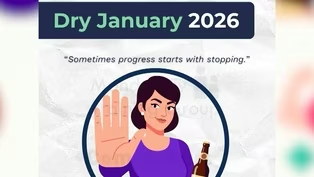
>> One trend that has been really taking off is dry January.
Yeah.
Do you see that in some of your patients and and is it a good idea bad idea.
What's your advice.
>> I think it's great.
So dry January actually comes to us from the United Kingdom and it came from Alcohol Change UK, which is a nonprofit organization there in the United Kingdom that started this back in 2013.
And it started with a small group of people just realizing that, hey, you have all these holidays, everyone's indulging a little bit more, you're spending time with family and you're drinking more alcohol.
And January just became this great reset period.
>> Okay, so what is dry January 1st?
I should have explained that.
So yeah.
>> So dry January is basically folks taking a break from alcohol for the entire month of January.
Okay.
And if you can make it, that's awesome.
If you can't make it.
They've also called it Damp January just because you've reduced your alcohol use.
So the goal is to see how much your body has been impacted by the alcohol by just taking a break from it.
And it's a great way to start the new year because it's a great New Year's resolution.
>> Yeah it is.
And can somebody see a health impacts from just abstaining from alcohol for one month?
>> Absolutely.
I think the biggest change that I've noticed for patients is the impact on the sleep and impact on the mood, because a lot of people feel like, oh, the alcohol will help me sleep.
In actuality, alcohol shortens the sleep cycle, so you don't actually get as much of the REM, the rapid eye movement sleep where you actually dream.
And so when you don't have the alcohol on board, you go through the full sleep cycle.
You're dreaming more, you're sleeping more soundly through the night, and you're going to wake up in the morning feeling more refreshed.
As well as alcohol is a depressant.
I don't know about you, but Louisville in January and just Kentucky in January.
Oh, it feels like the doldrums.
It's just gray.
It's cold.
Like it's already depressing being outside.
And the alcohol's further depressant.
So your mood is going to go down further.
So being without that alcohol will actually bring your mood up and you're going to feel a little bit better as well.
So those are the two biggest impacts I see from a mental health standpoint.
And from a physical standpoint.
It makes an impact on your blood pressure and particularly your liver.
So our liver is our natural detox mechanism that our body has.
And when you're not having as much alcohol, your liver is able to do a better job detoxing everything else for you because it's not constantly irritated.
>> Yeah.
This is so interesting.
Thank you so much.
Doctor Monthly from Norton Healthcare.
Thank you for walking us through this and giving us some insight on Dry January.
>> Absolutely.
Thanks for having me.
>> Thank you Christy.
Retailers report January has the lowest alcohol sales annually, and the slump has intensified over the past two years.
According to Market Watch.
[MUSIC] You're about to hear America's oldest vice president, the birth of Center College, and the end of the line for the USS Kentucky.
Our Toby Gibbs tells us more in tonight's look at This Week in Kentucky history.
>> British and Native American forces clashed with Americans, including many Kentuckians, during the War of 1812.
Battle of River raisin in present day Michigan.
On January 22nd, 1813, an estimated 400 Kentucky frontiersmen died in the fighting.
The Kentucky General Assembly voted to create Center College in Danville on January 21st, 1819.
The name reflected the location in the center of the Commonwealth, using the spelling of center common at the time.
[MUSIC] The US Navy sold the battleship USS Kentucky for scrap in Philadelphia on January 23rd, 1924.
It had been part of the fleet since 1900.
The Navy scrapped it to comply with the Washington Naval Treaty, requiring the world's naval powers to reduce the size of their navies.
This week marks the anniversary of the Great Louisville Flood of 1937.
Many believe the flooding was at its worst.
On the morning of January 24th, when every part of the Ohio River was above flood stage four, at 1.70% of Louisville was underwater, 190 people died, and a quarter million had to leave their homes.
[MUSIC] America's oldest ever vice president, Graves County native Alben Barkley, took the oath of office on January 20th, 1949.
He was 71 years old and served under president Harry Truman, leaving office in 1953 at the age of 75.
Kentucky endured its coldest weather on record on January 19th, 1994, when the temperature in Shelbyville dipped to 37 degrees below zero.
And that's what was going on this week in Kentucky history.
I'm Toby Gibbs.
>> Thank you, Toby, and we've got some winter weather coming up later on this week.
We'll report on that as that develops.
And we'll talk about the Ice raids that are happening in central and western Kentucky that tomorrow night on Kentucky Edition.
I'll see you then.
Take good care.
Video has Closed Captions
Clip: S4 Ep304 | 6m 27s | Doctor discusses health benefits of abstaining from alcohol. (6m 27s)
Bill Looks for Better Pathways to Transfer College Credits
Video has Closed Captions
Clip: S4 Ep304 | 3m 25s | Bill could help students carry over coursework from community college to university. (3m 25s)
Providing Support for PBS.org
Learn Moreabout PBS online sponsorship
- News and Public Affairs

Top journalists deliver compelling original analysis of the hour's headlines.

- News and Public Affairs

FRONTLINE is investigative journalism that questions, explains and changes our world.












Support for PBS provided by:
Kentucky Edition is a local public television program presented by KET