Compass
January 2021 Edition
Season 5 Episode 4 | 28m 47sVideo has Closed Captions
Dr. Kathleen Belew, COVID-19 vaccine in MN, Undowanpi & Pionner PBS's new GM Shari Lamke
"Compass" looks at the history of white power movements in America; explains the COVID-19 vaccine rollout in rural Minnesota; highlights the importance of Native song and drumming; and introduces Pioneer PBS’s new president and general manager.
Problems playing video? | Closed Captioning Feedback
Problems playing video? | Closed Captioning Feedback
Compass is a local public television program presented by Pioneer PBS
Compass
January 2021 Edition
Season 5 Episode 4 | 28m 47sVideo has Closed Captions
"Compass" looks at the history of white power movements in America; explains the COVID-19 vaccine rollout in rural Minnesota; highlights the importance of Native song and drumming; and introduces Pioneer PBS’s new president and general manager.
Problems playing video? | Closed Captioning Feedback
How to Watch Compass
Compass is available to stream on pbs.org and the free PBS App, available on iPhone, Apple TV, Android TV, Android smartphones, Amazon Fire TV, Amazon Fire Tablet, Roku, Samsung Smart TV, and Vizio.
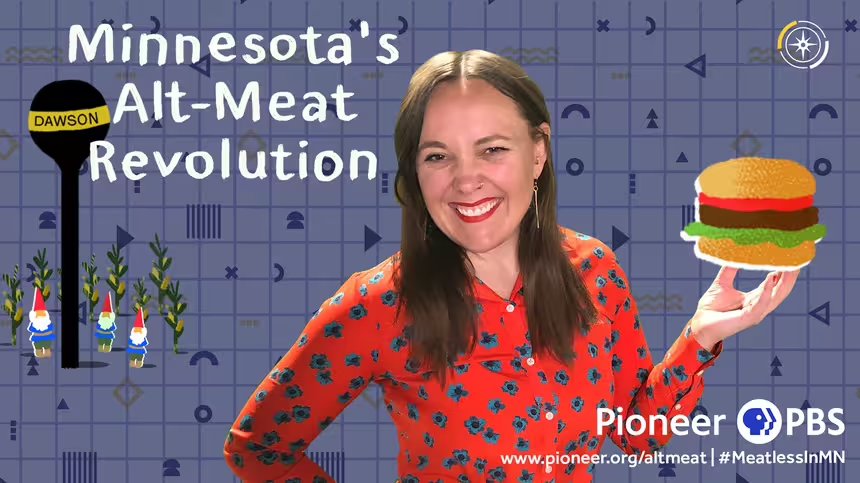
Minnesota’s Alt-Meat Revolution
“Minnesota’s Alt-Meat Revolution" is a year-long video and print journalism collaboration project, looking into the roots and impact of the plant-protein phenomenon that’s exploding across the globe.Providing Support for PBS.org
Learn Moreabout PBS online sponsorship(upbeat music) - [Announcer] Funding for Compass is provided in part by the Otto Bremer Trust and members of Pioneer PBS, thank you.
(gentle music) - Hi, I'm Amanda Anderson.
Welcome to the January edition of Compass the regional public affairs show on Pioneer PBS.
A quick reminder about this new Compass format all of these stories that you're about to watch have already been posted on Compass's website and social media pages.
We encourage audience interaction and feedback.
So have your devices at the ready so you can comment and tell us what you think of each story as you watch.
First, we continue our reporting of the Asatru Folk Assembly's move into Murdock.
A brief recap, after the white supremacist and Southern Poverty Law Center designated hate group purchased a church in Murdock.
They had to apply for a conditional use permit to practice there.
The Murdock City Council approved the permit during their December meeting.
The permit must be renewed yearly.
To unpack the complexities of the history of the White Power Movement in America, Compass spoke with teacher, historian and author Dr. Kathleen Belew.
Dr. Belew's most recent book Bring The War Home is a culmination of 10 years of researching the White Power Movement in America, from the Vietnam war to the Oklahoma City bombing in 1995.
She explains how as a country we've never faced America's history of white supremacy and we've also failed to see white power terrorism as part of a larger movement.
- So we usually encounter stories about white power violence through the idea of "the lone wolf" quote unquote.
In other words, we usually think about the shooting in Pittsburgh is anti-semitic violence.
The shooting in Charleston is anti-black violence.
The shooting and El Paso is anti-Latino violence.
And they are all those things, but they're all also white power violence.
They were carried out by people who have in some cases social ties with each other.
People who have ideological framing in common they use the same slogans.
They use the same symbols.
So this is not something that is inexplicable and mysterious, this is part of a social movement that is dedicated to this kind of violent activism and has been for decades if not generations.
So one way to think about this as the Oklahoma City bombing which most people still think of as the work of one or a few bad actors, but actually is the work of a social movement.
This is a social movement that has deliberately tried to evade our understanding.
It wants to disappear.
And it's used several strategies over the years to try to avoid being described and understood.
- Dr. Belew"s studies have revealed how White Power Movements mobilize people to violence by using trends.
This reminded me of a documentary from Independent Lens Feels Good Man.
If you stick around to the end of the story we'll watch the trailer, but briefly Feels Good Man is about how the white supremacy movement coacted the Pepe the frog character.
You might be familiar with Pepe the Frog.
It was meant to be this goofy little frog, but it turned into a hate symbol used by white supremacists.
It's one of the more recent examples of how the White Power Movement uses trends to spread their messaging.
Dr. Belew explained that white power activism is very opportunistic and uses what's cool, like Pepe the Frog memes to gain popularity.
- So that works in two different kinds of ways.
One is that it will ride whatever the prevailing tensions are within a community to foment violence.
And then the other way that they're opportunistic is by kind of tacking to the prevailing cultural trends.
So the time I study in the 1980s, a lot of activists switched to wearing camo fatigues instead of the uniforms that they'd had before.
Part of that is because they were interested in like paramilitary tactical readiness.
But part of that is just that paramilitary uniforms were cool in the 1980s.
Like not to be trained about it, but that's the same time people are going to paintball courses and reading Soldier of Fortune magazine and watching all those Vietnam War movies.
That whole thing was just cool in the eighties.
So what these activists are very good at doing is kind of tacking to the prevailing cultural wins so that they can follow the path of least resistance.
So in some cases that means wearing a suit and tie and going on TV and saying, "I'm not racist, I'm racialist" in some cases, that means a tiki-torch and a polo shirt.
But it just has to do with what's acceptable within a given cultural moment.
And they're very, very good at reading those windows of opportunity.
- When thinking about the geography of the White Power Movement, Dr. Belew said that this movement is incredibly diverse in every way but race, tackling what many people call the urban-rural divide.
- This is a movement that brought together white power activists of a lot of different ideologies.
People across a lot of different class backgrounds educational backgrounds, it's in every region of the country.
And it unified people across urban, suburban and rural spaces.
Now there are profound cultural differences between those spaces within this activism, just as there are big differences between city and rural area in other ways.
So the notable one in the time of my study is that in the rural areas, the activist tended to be more socially conservative.
So we're talking about faith-based white power communities with very gender normative practices.
Whereas in the cities, you were more likely to find things like skinhead activism.
Skinheads in the early nineties would be into like women would wear heavy makeup and go topless.
They would be into alcohol and drugs and serious music scenes.
That wasn't the case for people in the rural areas most of the time.
But all of these activists saw themselves as under attack and perceived a state of emergency so intense that they talked about this.
They said, we have to figure out how to accept all of these people into our movement because if we don't, the whole race will be annihilated and that'll be it.
- Thinking about this from a solutions-based perspective, Dr. Belew said that because this is a phenomenon that requires ignorance and inattention across multiple levels, there are also multiple levels of response that can have a big impact.
One is providing resources for teachers and parents.
Another is grassroots organization.
Murdock resident Victoria Guillemard co-founded the local organization Murdokh Area Alliance Against Hate.
- So when I first learned about the attitude, focus on blade moving into Murdock, I felt really powerless.
Like I didn't know what to do.
I spent probably a good 48 hours glued to my laptop googling, researching, trying to find out as much information as possible.
And I wanted to have friends and family members have a space where they could go with their questions and where we could form a group that was education-based and focused on not just what was happening at that very instant, but also the future of Murdock.
If a hate group was gonna move in.
- Guillemard said that she's gotten a lot of support and information from Heathens against Hate.
An organization that promotes inclusive Heathenry.
- The way that the AFA has been described to me by other Heathens is that they are an off branch like very small and a very extremist version of the Asatru belief system that many other churches including other Asatru religions have denounced them.
And that as a whole Hethernism is not inherently racist.
When you look at the Asatru Folk Assembly they've clearly been labeled dangerous by other Heathens enough so that there's even a declaration called the Declaration 127 that was signed by other Heathen and Asatru congregation, denouncing them because of their dangerous belief systems.
- In an email, Ethan Stark from Heathens Against Hate explained that Declaration 127 is named after the 127th stanza from a manuscript that Heathenly relies on for virtues and ethics.
The full declaration is under revision to address overall racism found in Heathenly beyond the scope of the AFA, but it was initially drafted for individuals and organizations to formally and officially denounce and disassociate with the AFA.
Over the past number of months Stark has been offering similar information to other residents of Murdock.
- Ethan has been hosting Zoom calls where people in Murdock can log in and listen to him talk about the difference between Asatru Folk Assembly and other Asatru Nordic religions.
- Welcome everyone one and all to Heathens Againist Hate.
Murdock, Minnesota, Q$A, Open hall.
- He gave him a space to go to learn about where you can safely practice a Nordic religion without having the white supremacist belief system.
- You know when they're saying that they're good neighbors, you're going into Murdock that is 90 plus percent Caucasian.
And when you're saying good neighbors, there's that subtlety of we're good neighbors to particular people.
And so I don't believe this good neighbor shit.
It's something that many other exclusionary groups have pretended to be.
- Guillemard is a second year law student.
And while she couldn't make a statement on the current situation or unconditional use permits as a whole, she did break down The Religious Land Use an Institutionalized Persons Act.
- Really bad that is the governing law in this matter.
And I will say this it's tragic that Hate organization is able to manipulate and control a situation knowing that they are preying on the vulnerability of an indigent community specifically Murdock as a municipality.
Murdock is very underfunded.
It does not have resources.
And they know that litigation is the number one fear that is holding back the city council on voting based on their beliefs.
And that is strictly a legal standpoint.
I feel it in my heart that city council members would not be granting a conditional use permit if they did not have fear of litigation in their hearts.
- Now as promised the Feels Good Man trailer.
- I've just always been into drawing.
It takes tons of time to come up with a character.
And then eventually it was Pepe the happy little frog.
They like drinking and hanging out became boys club.
- It's one of the funniest comics of the last 10 years.
- Feels Good Man.
- That was the frame that started it all.
(upbeat music) - Pepe is the best.
- Pepe became a meme.
I didn't even know what a meme was.
There were all these boys trying to own each other on the message boards.
In drops Pepe right from the taking.
(upbeat music) He had gone dark.
- [Man] The white supremacist movement has taken over Pepe The Frog.
- Dr. Belew mentioned that using the moniker white nationalism is a confusing misnomer.
In a New York Times Opinion piece, she writes that quote, "the nation at the heart of white nationalism is not the United States.
It's the Aryan nation imagined as a transnational white polity with interest fundamentally opposed to the United States, and for many activists bent on the overthrow of the federal government."
Next, the COVID-19 vaccine has started rolling out across the state.
Recently, the Minnesota Department of Health released a new web page dedicated to tracking COVID-19 vaccine data.
The data show that as of January 9th 144,503 Minnesotans have received at least one vaccine dose and 7,392 Minnesotans have completed the series.
There are times where you can see who's getting vaccinated and how the vaccine is being distributed and administered.
Guiding this rollout is the Minnesota Department of Health COVID-19 Vaccine Allocation Advisory Group.
Created in September of 2020, the group is made up of medical experts from across the state using guidelines from the Centers for Disease Control and Preventions Advisory Committee on immunization practices, they made recommendations on how to roll out this vaccine, which will happen in phases.
Minnesota is currently in phase one A.
This includes vaccine for healthcare workers and long-term care residents and should vaccinate around 500,000 Minnesotans.
More information on phase one B of vaccine distribution will be available January 18th but it's estimated that this will begin in February.
This phase includes vaccines for Minnesotans over the age of 75 and for frontline essential workers.
Next phase one C will include vaccines for Minnesota 65 to 74 years old.
People 16 to 64 years old with high risk medical conditions and other essential workers.
This messy process has another quirk.
The Pfizer-BioNTech vaccine must be stored between negative 80 and negative 60 degrees Celsius.
That's equivalent to negative 76 to negative 112 degrees Fahrenheit.
And although it may feel that cold this time of year transporting and storing vaccines at those extremely cold temps for healthcare facilities is another piece of this puzzle.
Minnesota has set up a system of hubs and spokes to distribute the Pfizer-BioNTech vaccine.
The hubs are facilities that have ultra cold freezers that meet the Pfizer-BioNTech vaccines temperature requirements.
The spokes are facilities that don't have that storage capacity and must travel to a hub site every week to pick up their allotted doses.
Bev Larson an RN at Stevens Community Medical center has been focusing on infection control, emergency preparedness and staff education lately.
She said that Lake Region Healthcare is the hub for Stevens Community Medical Center.
The state determines how many doses each hub receives based on how many healthcare workers are in that area.
Then each spoke site gets a percentage of those doses based on size.
- So what all of our other facilities have to do is we have to all of a sudden get everybody on a schedule and figure out how many doses we're gonna need for that following week.
And then we then let Shawn the Regional Coordinator know how many we want.
So then we pick it up Monday and we have five days to get it.
And once that five days is up it's expired and we cannot use it any longer.
- Another complicating factor is time and vaccine allotment.
Doing this dance of picking up vaccine and scheduling just the right amount of people to receive it in one week, especially as Minnesota moves on to next phases of distribution and the number of Minnesotans able to receive vaccine grows.
- We can only do so many at a time or we have to know like a number of how many people will come to get it done.
You know, if I go and pick up 200 doses of Pfizer because we're gonna do a clinic and only a hundred people show up, what do I do with those other hundred doses?
- Dr. Jason Huiko a family medicine physician at SCMC said to neutralize misinformation about the vaccine, people should refer to reliable sources like the CDC and the Department of Health.
- But also having individual conversations.
I think one of the biggest problems with, or concerns people have is just the speed that this vaccine came out as well as the new technology, the mRNA vaccines, and maybe not understanding of how that vaccine works.
Regarding the speed of the vaccine, these mRNA vaccines in general have been studied for quite some time now.
It was just a matter of putting the genetic code for this particular virus into something that they have been working on.
And the other thing that really sped this up is the amount of resources that were put to this vaccine development.
In general isn't well-funded but there was a lot of government money put towards developing this vaccine because of the pandemic.
- Dr. Huiko said that in order to reach effective herd immunity for COVID-19 the data that he's hearing points to an inoculation rate of about 70%.
- I feel pretty good about giving the vaccine.
I feel like it's part of my duty to contribute to the herd immunity as well as protect the people that are around.
So I was very happy to get it when I could and I'll be even more happy when more of the population will have access.
- And so I think that we've made a lot of progress in that short amount of time to get where we're at now.
As far as knowing that in a couple of months there could be a lot of vaccine out there for a lot of people.
So I think people just need to be patient and we'll get it done.
- Tanner Peterson talked with the Upper Sioux communitys Chief of Police, Christopher Lee about their vaccine rollout.
- Chief of police Christopher Lee said that when he decided to partner with the state the tries were initially left out of the rollout plans.
One of the major oversights was their ability to store the Pfizer-BioNTech vaccine.
- I point out the fact that we're one of the few facilities that actually has ultra cold storage capabilities and we could have facilitated the Pfizer vaccine.
And if nothing else, we could have partnered with the other Dakota communities and gotten some of that additional vaccine and gotten that out.
- After many conversations between governor Tim Walton staff and Upper Sioux Communities governing board a number of issues were addressed.
- One of the nice things that we were able to communicate to them right away was our idea of the vaccination priorities for our community versus that of the state.
We do have a different set of priorities here.
And so the governor's office did waive the initial mandates for the state's priorities.
- He said that their first priority was to identify staff and community members in the one A priority group and get them vaccinated.
The Upper Sioux Community has reallocated space in their multi-purpose building for a lab testing facility.
- That's also where we have the supplies and do the vaccination.
We've had to, again, in a very short period of time turn regular office space into patient care area.
- He said that they're prepared to administer their second dose for their one A age group and are making plans for subsequent phases.
- And we are actually prepared and are working towards a mass vaccination clinic, should we be able to get the Pfizer vaccine.
And that comes in again a thousand dosses.
- Chief of Police Lee that you should still get the vaccine even if you previously had COVID-19 and that you should give your body some time to recognize the vaccine.
- The vaccines are about whether you wanna split hairs 94, 95% effective.
There are still 5% chance that you can get it.
But the benefit to it is that when if you're one of the 5% that do get infected or get reinfected , your symptoms are diminished.
You usually have a shorter recovery time 'cause your body's already identified the virus and is responding to it.
So you have less chance of ended up in the hospital.
You have less severe symptoms or severe reactions to the virus.
- Tanner Peterson recently completed a video project highlighting what song and drum mean to four different native artists.
We'll be airing one video from his series for the next four months.
First we hear from Hoksida Blacklance a lead singer from the group Midnite Express.
- You're not just putting together something to make the noise you're creating life.
(drum beats) My passion right now is singing.
I do a lot of varieties of cultural singing.
I travel abroad, I do the ceremonial type singing and also around and singing.
One of art skills that I would say is drum making.
I do both in drum making the round ends portion and the big drum for palms.
Someone that shaped me growing up I would say is our lead singer for Midnite Express Opie Day.
He's taught me a lot about what it means to be a lead singer what it means to lead a group of people.
And he's taught me a lot different songs different variety of, you know what's appropriate to sing when and that's just the power and the round dance portion of it.
But I learned a lot from my uncles.
I learned a lot from my dad.
I always have relatives that are there to teach me and to correct me if I'm doing something wrong.
It's not just one person that I learned from.
It's not just my own family that I learned from I've learned from so many singers down the line whether it be powwows round dances or ceremonies there's always someone there that has taught me.
(singing in native language) My first project, I made my own drum a big drum for powwows with my little brothers.
We started this group a long time ago for our community.
We call ourselves Battling Scope.
We only had just this little drum that we used to practice on that was given to us by one of our uncles, but we decided that we needed our own drum and that we needed our own name and that we needed kind of our own materials to practice to go out with and to be recognized with.
So we put together our own drum.
We went and we got all the materials and we got the hyatt and we got the shell and we brought it back to the house and we all cut up the circles together and we all cut out the straps and we all put it together ourselves.
One of the things I was taught growing up when you're putting together a drum when you're putting together a hand drum or a big drum you're not just putting together something to make noise you're creating life.
And in our culture it's that belief that every drum has a grandfather and it has a spirit in it.
And also when you're creating this life you don't wanna put bad energy.
You don't wanna put bad thoughts in these drums.
You really wanna stay clear minded.
So when you're making these drums when you're making sacred items here, you pray.
That's what I was taught.
When you put these things together, you pray, you keep your head happy.
You keep your mind clear.
(drum beating) This is important to our culture because we're losing so many of our ways.
And we're losing so many of our traditions that the celebratory style of powwowing and round dancing kind of catches the eye of the younger generation.
And it really opens the door for them.
Like for my experience when I was younger and I saw a couple of my idols on the powwow I saw a couple of my idols as singers.
I wanted to be like them.
And it really helped open that door for me to be a singer.
And when I started singing, I found out there was more to go along with just singing other than powwows and round dances there was a ceremony part to it.
There's protocols, there's ways we're supposed to do things.
And that's the part of it that I didn't know growing up that I later found out from a couple of my older brothers, my uncles, my dad and they taught me the ways of our people and how these things are supposed to be used.
So I think it's really important that we learn these things.
Catch their eye with the fun part of it, and then teach them the basics and how things are supposed to be done the right way.
(singing in native language) This is our way of life.
This is how we hold ourselves.
This is how we live.
When I was growing up, my dad always told me that the regalia that you wear, I was a grad (mumbles).
And the regalia that you were the feathers that you have is a representation of your life and how you're living.
You keep your feathers clean, you keep your regalia together.
You know, it resembles how you carry yourself in life.
(singing in native language) - Finally, I'm pleased to introduce Pioneer PBS's new President and General Manager, Shari Lamke.
Let's get to know her a little better.
- I started at like age two at Twin Cities, PBS.
(upbeat music) I started at Twin Cities PBS about a month into journalism school in master control.
I worked in master control engineering for about 13 years kind of grew into leadership in the operations department, so on the technical side of things.
Outside of the station I was doing theater, independent film and telling stories.
So when an opportunity arose in the content side of things emerged my personal life with my business life and took a role in leadership on the content side of things.
So worked in local production for a long time including starting the Minnesota channel about 15 years ago which is a special service statewide.
A partnership or partnerships with area nonprofits, government agencies both tribal and state, a little bit of federal as well as educational institutions.
So coming up through engineering, doing producing, directing, running camera, editing, that kind of stuff, it's built a lot of respect in me for all of the people who contribute television as a collaborative affair.
So you partner with the community to tell their story.
You listen and reflect your community.
So I grew up in the Brainerd Lakes area Palisade technically.
All of my grade school to high school is in Brainerd.
Graduated from Brainerd, went to journalism school in Minneapolis, and from there got the TPT job, and then just never left.
Seeing the stories that are being told here.
I thought I did a great service to this community and shared a lot of the region's stories.
And I was attracted to that.
So this opportunity brings me back to my rural roots.
And I'm excited about that.
Fun fact, I will say that my love of storytelling and my love of engineering and analytical kind of merged in a personal project.
I'm big into genealogy.
I love knowing where my roots are.
Connected on ancestry.com with a fifth cousin who is master researcher has really dug in and gotten a lot of information.
And I took that information and interpreted it along with additional like in the region here was what life was like and kind of merged all of that into stories.
So we're about to publish a book on a common ancestor of ours that goes back to the 16 hundreds in Massachusets and then following 12 generations out of his descendants to her great grandmother and my great grandfather.
- Thank you for watching the January edition of Compass.
We encourage audience interaction and feedback.
So head over to our social pages and website and let us know what you think we should be covering.
And it heads up the February edition of Compass will air on February 11th at 9:00 PM.
See you then.
- [Announcer] Funding for Compass is provided in part by the Otto Bremer Trust and members of Pioneer PBS, thank you.
(gentle music)
Preview: S5 Ep4 | 53s | The January Edition of Compass airs Jan. 14 at 9 p.m. on Pioneer PBS. (53s)

The View From Here: Shari Lamke | Pioneer PBS's new GM
Video has Closed Captions
Clip: S5 Ep4 | 2m 53s | After 37 years at Twin Cities PBS, Shari Lamke is getting back to her rural roots. (2m 53s)

COVID-19 vaccine rollout in rural Minnesota
Video has Closed Captions
Clip: S5 Ep4 | 6m 33s | Learn about the COVID-19 vaccine rollout in rural Minnesota. (6m 33s)

COVID-19 vaccine data dashboard and rollout
Clip: S5 Ep4 | 2m 44s | Learn about the COVID-19 MN vaccine data webpage & the early stages of the vaccine rollout (2m 44s)
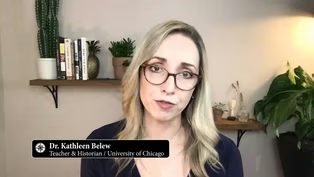
Putting white power organizations into context
Video has Closed Captions
Clip: S5 Ep4 | 11m 26s | The history of white power movements, MAAAH & inclusive vs. exclusive Heathenry. (11m 26s)
Providing Support for PBS.org
Learn Moreabout PBS online sponsorship
- News and Public Affairs

Top journalists deliver compelling original analysis of the hour's headlines.

- News and Public Affairs

FRONTLINE is investigative journalism that questions, explains and changes our world.












Support for PBS provided by:
Compass is a local public television program presented by Pioneer PBS