Northwest Profiles
January 2021
Season 34 Episode 1 | 29m 49sVideo has Closed Captions
Philanthropist Myrtle Woldson, artist Mel McCuddin, Geologist Nick Zentner, Fort Calgary.
On the season premiere of NW Profiles, It’s the amazing story of Spokane Philanthropist Myrtle Woldson; Expressionist artist Mel McCuddin and his thought provoking, humorous and haunting images; Meet Geologist and Educator Nick Zentner ,unraveling the mysteries of the Pacific Northwest. And visit Fort Calgary Museum - A mixture of early Alberta and First Nation legacy.
Problems playing video? | Closed Captioning Feedback
Problems playing video? | Closed Captioning Feedback
Northwest Profiles is a local public television program presented by KSPS PBS
Funding for Northwest Profiles is provided by Idaho Central Credit Union, with additional funding from the Friends of KSPS.
Support provided by:

Northwest Profiles
January 2021
Season 34 Episode 1 | 29m 49sVideo has Closed Captions
On the season premiere of NW Profiles, It’s the amazing story of Spokane Philanthropist Myrtle Woldson; Expressionist artist Mel McCuddin and his thought provoking, humorous and haunting images; Meet Geologist and Educator Nick Zentner ,unraveling the mysteries of the Pacific Northwest. And visit Fort Calgary Museum - A mixture of early Alberta and First Nation legacy.
Problems playing video? | Closed Captioning Feedback
How to Watch Northwest Profiles
Northwest Profiles is available to stream on pbs.org and the free PBS App, available on iPhone, Apple TV, Android TV, Android smartphones, Amazon Fire TV, Amazon Fire Tablet, Roku, Samsung Smart TV, and Vizio.
Providing Support for PBS.org
Learn Moreabout PBS online sponsorship♪ Hello and welcome to Northwest Profiles...
I'm your host Lynn Veltrie and before we get started, I would first like to wish all of you a happy, prosperous and most of all healthy new year.
For Northwest Profiles the start of 2021 is even more special because it marks the start of a brand-new season...
Which, for those counting at home will be our 34th, all thanks to wonderful viewers like you... As usual, our new season promises to deliver another fabulous collection of stories all about the people, places and events of interest that make us proud to call the Inland Northwest and western Canada home.
So, with four stories lined up and ready to roll let's lift the curtain on this new season and get started shall we?
For our first story get ready to meet an amazing Spokane businesswoman and philanthropist, Myrtle Woldson.
Miss Woldson, as she liked to be called, was a very savvy investor at a time when real estate was considered a man's world.
Ignoring the men, who often tried to tell her what to do, miss Woldson made her own way building a substantial fortune.
Quietly she would become one of Spokane's most impactful philanthropists, giving away most of her wealth to the community she loved.
♪♪ Miss Myrtle Woldson is not a name many recognize.
Yet, her influence in Spokane's history might surprise you.
>>Miss Woldson's story is a really important story to tell precisely because she is such an impactful figure in Spokane history and really was one of the key players who made Spokane as we know it, sort of the modern layout today.
>>She excelled in business in a man's world.
>>The wealth that she had she built for herself.
She made a fortune in the 20th Century in Washington state, and when she died, she gave it all away.
>>But nobody knows who she is because so few female philanthropists and businesswomen in the period that she came up in, really received the limelight.
>>There'd be streets, schools or parks named after If her if she would have been a man.
>>Myrtle Woldson was born in 1910 to Martin and Edwidge Woldson.
Her father was a Norwegian immigrant who made his fortune in the railroads and investments in mining operations throughout the Northwest.
>>He's the American success story.
Pulled himself up by his own bootstraps, moved to Spokane with a young bride at a moment when Spokane was a booming area.
>>Martin had a profound impact on his oldest daughter.
>>We hear stories about daddy as she referred to him, being in his office making business deals, and Myrtle sitting on the stairs listening and sort of hanging on every word that he had to say.
>>Being part of Spokane's social elite, Myrtle and her sister Francis were expected to meet certain social expectations.
Myrtle's mother, Edwidge, taught her how to be a true lady.
>>These girls were trained in how to be polite, how to be engaging in conversation.
And as they grew into young women, they also were trendsetters within Spokane society.
And so, the newspapers were very quick to describe the dresses that Frances or Myrtle were wearing.
>>At a young age, Myrtle developed a deep appreciation of music.
>>She was a classically trained pianist.
Friends and relatives tell stories about Myrtle practicing for hours every single day to perfect a piece.
>>She had an innate love for music, but also a love for the opera.
She, for many years, went to the opening of the opera in San Francisco; a lifelong member of the Spokane symphony.
>>After college, Myrtle moved home to live with her parents.
She never married and for years worked alongside her father.
She soon was investing her own money buying property in the very center of Spokane.
>>She wanted to buy a parcel of land on Havermale Island in the middle of the Spokane River.
And we know that place today as the site of the former Expo, it's a wonderful park, but in the 1950s, it was an industrial zone.
It was covered in railroad tracks and warehouses.
Why would you want that eyesore?
>>It is my high honor and privilege to declare Expo 74 officially open to all the citizens of the world.
>>And so, this turned out to be a great investment.
>>She took her profits and bought property in Seattle's waterfront district.
>>And invested in, in essence, a burnt-out building in downtown Seattle when many people had given up on Seattle and that really became the genesis of what was this very successful real estate company.
>>By the time Martin died in 1958, Miss Woldson, the name she now preferred, began conducting all her business dealings from her very elegant, very feminine, home office on Cliff drive.
>>I think that this moment of positioning potential business partners who would have invariably been male, in this highly feminine, highly orchestrated space is certainly a way to establish her power.
>>She was engaging in a man's world of finance and investment property ownership, but she was writing the rules because no rules existed for a woman to do this.
>>Over the next five decades of buying and selling properties, Miss Woldson would build her own multi-million-dollar enterprise.
>>Myrtle was nothing if not incredibly active about how she owned her own life.
She had an incredible sense of agency for her business profession.
So I think that she gained the reputation and maybe being a difficult business partner and I think that is a very particularly gendered impression, that a man who had such a clear sense of how he wanted to invest his money would have been thought of as savvy, and she was difficult because she refused to take the advice of men who wanted to tell her what to do.
>>Like her mother, Miss Woldson loved all things French.
>>I would refer to her as a Francophile.
She loved everything about French culture and French decor.
She favors an 18th century Rococo design which is incredibly opulent.
Everything that you can imagine that you could put gilding on would have gilding.
Every place that you could hang a crystal from a chandelier, it will have that crystal.
>>The love of classical French design extended to her backyard garden.
>>Her precision from inside her home continued to the precision outside her home.
All the flowers were measured at the distance of where and how far they were from the next.
>> Miss Woldson was a philanthropist throughout her life, but she did not seek the limelight.
She gave quietly to the things she loved.
The Arts.
The Fox Theater.
Catholic Charities.
And Gonzaga University.
>>She gave it away to the things she thought were most meaningful.
She gave it to the performing arts.
She gave it to scholarships so that kids can go to college.
>>In 2014, upon her death at age 104, Miss Woldson surprised everyone by leaving a $55 million dollar gift to Gonzaga University.
The Myrtle Woldson Performing Arts Center is a beautiful tribute to the woman whose passion for the arts made it all possible.
>>She's transformed the face of Spokane.
Her gift to the Fox Theater helped to ensure that it would remain there in downtown Spokane.
Her gift to the city parks helped to remodel and maintain the Edwidge Woldson heritage garden.
Her gift to Gonzaga reshaped the campus and so in that respect, she did reshape the landscape of the city through her giving.
♪♪ Miss Woldson's 55 million-dollar gift to Gonzaga University was the largest in Gonzaga's history.
$30 million was used to build the Myrtle Woldson performing arts center and $25 million for an endowment fund for scholarships.
Now on to our next story, you can call his painting style whimsical, but that would be missing the point.
Artist Mel McCuddin, a mainstay in the Spokane art scene, creates paintings that can either poke fun or flat out tell it like it is!
Art to Mel McCuddin, one of Spokane's premiere expressionist painters... is more than lines and figures.
With shades of influence from abstract expressionist artist Willem de Kooning, abstract figurative painter Francis Bacon and the modern style painter Amedeo Modigliani, McCuddin reaches into surrealism in his pieces, that say much about the human condition.
MEL MCCUDDIN: It just happens sometimes that, uh, things I feel pretty strong about end up in the paintings.
I guess I'm just affected by everything around me.
You know.
>>Beginning with an under - painting layer, layer upon layer is added creating an image that Mel says he forms as he paints.
MCCUDDIN: I sit and look sometimes for a couple of hours until I see an image then what I do is I paint around that image to start with paint the background in first.
And so, its anatomy is never quite right on these things and, uh, but just work on it until it seems right.
A lot of times I'll start a painting and it changes as it goes along, something doesn't work.
It kind of evolves into another meaning.
I never really know what's what I'm going to end up with exactly till it's done.
One of the remarks I get about it a lot is that it's dark and, and, uh, which I doesn't really seem that way to me, but, these things, everybody sees something different in them it seems like, so, I don't, I don't paint with a specific message in mind.
I'm doing it for myself, mainly.
>>Born and raised in Spokane, Mel's beginning as an artist began slowly... MCCUDDIN: When I first started school in first, second, third grade, I liked art, I like to draw.
And then, uh, then as I got a little older, kids are kinda cruel and critical sometimes, anyway they made fun of me pretty much.
High school was a hard time for me.
I was the littlest kid in school for three years and I got pushed around a lot I just really didn't really fit in, didn't have any real close friends.
Then when I was a senior, I grew, didn't get bullied cause I grew up a lot.
I got bigger all of a sudden, I was interested in cars and girls at the time.
I wasted a lot of time, which I'm sorry about now., I could have learned a lot more, but I didn't.
>>Beginning with a career as a milk truck driver, Mel began painting in his early twenties and didn't make art central to his career until later in life.
Now with the thanks he attributes to his supportive wife Gloria, Mel's painting career flourishes.
MCCUDDIN: She encouraged me to do what I wanted to do.
And she always stood behind me, I really appreciate that.
Um, when I had doubts myself.
She, she was there.
I'd been painting for a long time while I drove truck, and so for a long time I didn't sell enough to live on, now probably the last 10 years I could probably live on what I make but, um, never done it for the money and actually mostly.
Uh, for the love of it, actually, now everything I do is for better, for worse I'm the first one that sees it, you know, my age it is still pretty exciting for me sometimes.
And especially when I do a good one.
>>Mel's talent of creating thought provoking paintings persist, but one he created years ago, he remembers quite vividly.
MCCUDDIN: I did do a painting one time for a show.
It was a painting of a man holding a flag upside down.
It was about this thinking about the, plight of the small farmers at the time and how they were all in trouble I donated it to, Eastern Washington university.
they hug it in front of the veteran's administration building and a woman just went ballistic.
She thought it was unpatriotic.
And she thought the painting should be burned and me along with it.
And then there's a bunch of a whole lot of editorials in the paper about that.
And, uh, which is all good, good publicity for me, she didn't realize an- upside down and flag as a serious symbol of deep distress, you know, especially on the high seas.
And, uh, she thought it was, I was insulting the flag or something.
Pretty interesting for a while.
I'm pretty much on my own here.
I don't socialize too much with other artists anymore.
I used to, of course, with this pandemic and everything it's, everybody's kind of solitary now.
>>With Mel, now in his late 80's...his endeavor to create images on canvas for a wide array of McCuddin enthusiasts endures, and thanks in part to his loving relationship with his wife Gloria, Mel keeps churning out works that will become treasured keepsakes to lucky art enthusiasts far and wide.
MCCUDDIN: My wife has been supportive all the time, even when I had doubts myself, When we bought this house, this was the barn at one time that's 40 some years ago and this is where I've worked ever since it's worked really well for me.
I just walk out the door and I can paint.
A special thanks needs to go out to Doug and Sherry Clark who created a wonderful book that helped us tell Mel McCuddins' story.
He's truly a one-of-a-kind artist!
Its time now to shift from the creative world of art to the fascinating world of science.
If you're a regular KSPS viewer no doubt you've come across Nick on the Rocks, created and hosted by Nick Zentner, a geology professor with Central Washington University.
Let's meet Nick and see what makes him so giddy when it comes to our earth and why unlocking the mysteries of the Pacific Northwest is so interesting.
(soft music) - My family was a long line of dairy farmers.
My dad was the last to be on that farm and do all that hard work where you milk cows twice a day and the whole thing.
(soft music) It was a really pleasant growing up.
So I come from that farming background but my dad was the first to go to a university, both my parents actually.
And so once I found this geology thing, I decided, I think I need to leave Wisconsin.
(soft country music) I was at the University of Wisconsin and I ran out of money and I decided I would go out West and work in Glacier National Park in Montana just pumping gas, Lake McDonald lodge.
(soft country music) And that's where I discovered geology.
I just took day hikes on my days off with fellow coworkers.
I was living in the mountains for the first time.
And so it wasn't a professor.
It wasn't any kind of important geologists that intersected with my life.
It was just that amazing experience of living in the rocky mountains for the first time and learning just a few things about geology and I was hooked.
(soft music) Had that great experience in Glacier Park and then went back to Madison, Wisconsin and took Geology 101.
Almost every class, they are talking about the Pacific Northwest, they are talking about the West, they are talking about the mountains.
It's like, all right, well, why am I here in the Midwest if we keep talking about it?
Why don't I go out there?
So I went to graduate school in Idaho.
That was a great three years of learning a lot finally kind of owning this Geology kind of internalizing the Geology is part of who I am.
(country music) Many who get into Geology, realized that the Pacific Northwest has everything.
And I do mean everything.
So this is like Disneyland.
(country music) I'm here on purpose.
This place is unique.
The menu is full 30 years ago, people were visiting my office.
They had questions about the geology of the area.
And I was new to the area 30 years ago.
And the internet wasn't a thing yet.
So it was very hard to find information.
And so I felt like I wasn't serving the public.
They were asking questions about Saddle Mountains, or Crab Creek, or the Columbia, or this Big Boulder afraid of and I didn't really have much to share with them.
(Nick shouting) - Now we cooking.
- So, about 10 years ago, I knew there was enough of this interest where I thought, well, maybe I'll just make a public lecture.
Maybe I'll just lecture downtown.
And then a few people said, well, I missed your lecture.
Can't you like video record them and put them on television or something locally?
(television scrambling) Tonight we are going past that and we are gonna get into a controversy or scientific debate about Mount Stewart.
And that's the part that's got me a little nervous.
(television scrambling) So if the layers are tipped-- That was a shock to me that people would wanna sit down for an hour and watch this lecture on a screen at home.
So one thing led to another and I started making videos specifically for YouTube.
(television scrambling) ♪ Two minute geology ♪ ♪ The two minute geology ♪ (guitar playing) Hello, young people.
Coulees.
What is a Coulee?
CWU saw that there was something going on and that people were very interested in this.
Let's fund this a little bit and start making these five minute programs called Nick On The Rocks.
(loud bang) Crack the mysteries of the earth.
Discover the energy that drives a planet.
And explore the secret world below with me, Nick On The Rocks.
I don't think there is a goal, or a plan necessarily.
It's just fun to communicate this stuff.
In the initial few seconds of the eruption, a gas charged blast up to 500 miles an hour came up and over this ridge sweeping over everything.
(television scrambling) Hey this is a tight fit.
I'm a big boy.
And even I can fit into The Crawl, as it's known here.
This is a vacation paradise with boats and sun and water and apples.
Oh, thank you.
And wine.
What's the geology behind this scenery?
(drums beating) There's no shortage of topics even if we go to the cascades.
There's 47 different shows and different angles just in the cascades alone.
So there's no shortage there.
And I like it here.
I want to just keep doing stuff here in the Northwest.
(soft country music) I've had a lot of fun with all this video stuff.
This is Tacoma, Washington, and that is Mount St. Helens.
(beep) (claps) No it's not.
Normally this bedrock is thousands of vertical feet below, a bunch of glacial tilt.
(ocean whooshing) That'll fall.
And the land lifted abruptly-- (ocean whooshing) (beep) Was 908AD (ocean whooshing) or even like Giant Tootsie Rolls.
Crinkle Cut French Fries.
These Brown Milk Duds.
(laughing) We've done 75 of these since mid-March.
I did do some stuff this year during the pandemic and I kinda fell into this world of live streaming on YouTube.
And I'm so glad that you've tuned in this morning.
We are going to be talking about Southern Idaho and a particular place that's now a national monument, called Craters of the Moon-- Open almost corny, kind of loving kind of thing.
Okay.
Just a little bit of personal history if you don't mind.
So I drove out from Wisconsin-- You wanna find a good place to eat Pocatello.
Everybody was pretty stressed out.
So it was this kind of an organic community.
So I kind of leaned into that.
Reality minus three.
Why is the Eastern snake of a plane there?
Did the super volcanoes-- I've got people watching from around the world.
♪ Memories ♪ We're all ages.
We're all different countries and cultures.
But everybody's welcome here.
(soft country music) Try my hardest to keep learning new things and that is where the energy comes from for me.
People just get off on the enthusiasm.
They can feel that vibration like something is going on here.
And I'll stick with this program for as long as they are doing it.
(soft country music) Nick is going on 35 years at Central Washington University and he continues his work reaching out to the public and inspiring his students.
Nick on the rocks now has a permanent slot every Thursday night at 8.50 on KSPS, and all episodes are available on ksps.org.
Now for our final story, let's visit one of our region's important historic places, Fort Calgary National Historic site.
It's exhibits tell the story of how the city of Calgary was created, but it doesn't stop there.
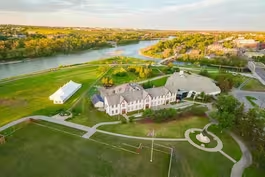
♪♪ Nicole Henbrey: This site, this confluence, people for hundreds of thousands of years have been coming here to meet because traditionally this has been a meeting place for the First Nations, where ceremony has taken place.
And it's really interesting that the Mounties were drawn to the site as well.
Now today we are a museum.
People come here.
So something about this site is continuing to bring people.
And we're hoping people will continue in the future.
Naomi Grattan: Fort Calgary seeks to reconnect people with each other.
In Canada, we recognize that indigenous peoples were mistreated for a very long time, through the residential school program.
And the Truth and Reconciliation Commission is about acknowledging that mistreatment, apologizing for it and healing together.
Nicole: The Truth and Reconciliation is redefining what Canada is and working towards acknowledging the true history of our nation.
What it looked into was the treatment of indigenous peoples in Canada.
And acknowledging that Canada was built on genocide and colonialism.
With Fort Calgary, and in particular even just the Mounties, that was in response to John A. Macdonald, the first Prime Minister.
He made a promise to build a railway.
But in order to build a railway you need to own the land.
And as a nation, Canada did not own the land that they were on, going back to 1763.
King George the Third created the thing called the Royal Proclamation which stated all land west with the Appalachian Mountains belonged to First Nations.
And the only person who could buy or sell land from those people was a monarch.
So, the King and their descendants.
John A. McDonald, he created the RCMP primarily to create good relations with the First Nations to ensure the signing of treaty.
And once you have treaty, then you can own the land.
When it came to the treaties there was a lot of misconception.
There was not very clear translations because lots of the times the interpreters that they brought in didn't speak the language.
If you look at a map of the number treaties in Canada you can see each one starting out in Dufferin, Manitoba where the Mounties were established and spent one-year training.
That's where treaty one is.
And you keep going, 2 3 4 5 6.
All the way up until they got out here, here at 7.
And the indigenous understanding of this was to be a peace agreement, that I would be living with you.
We would not fight.
But the Canadian government interpretation of it was you are giving us this land in exchange for this.
So things like cedes, yield, all these words that are very explicit and have weight did not translate.
So, people were signing to something that was never understood.
And today, all our treaties, the Indian Act, they're still legal holding documents.
And is because of Treaty Seven that we as a city, Calgary can be here.
And Fort Calgary that was just a tiny part in the creation of our city.
Naomi: I watched the Black Lives Matter movement come to the fore of public attention last summer.
And, of course it erupted here, too in Calgary, as the conversation happened everywhere.
And, I thought if there was an organization that would be ideal to explain to people the historical origins for the relationship between, in our case indigenous people and police, it should be us.
We have an indigenous advisory council.
So, and we in creating new exhibitions for the new building that we will build, we are turning over space to them create their own, tell their own stories in their own ways, create their own exhibitions.
We are seeking also to establish a formal relationship agreement with the nations here in Treaty 7.
Which set out the ways in which we'll work together, and which govern our relationships so we'll treat them as nations.
Nicole: As a museum we have a lot of responsibility.
And I see potential in this place of doing good.
♪♪ As always if you are interested in learning more about any of the stories you've just seen simply go on line to ksps.org.
Until next time this is Lynn Veltrie saying so long and remember there is much to see and do here in the Inland Northwest and western Canada, so get out there and when you do, in this age of covid, do it safely and as always take time to enjoy the view.
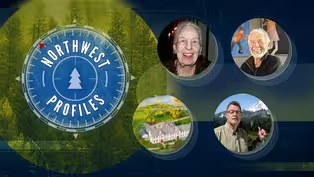
Preview: S34 Ep1 | 1m 39s | Philanthropist Myrtle Woldson, artist Mel McCuddin, Geologist Nick Zentner, Fort Calgary. (1m 39s)
Video has Closed Captions
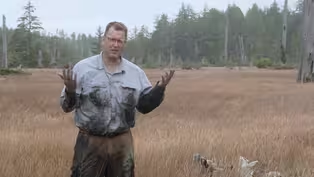
Clip: S34 Ep1 | 7m 28s | Geologist and educator Nick Zentner (7m 28s)
Video has Closed Captions
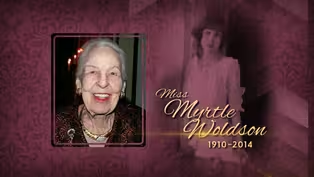
Clip: S34 Ep1 | 7m 54s | Meet the woman whose business acumen and charity has benefited the Spokane community. (7m 54s)
Video has Closed Captions
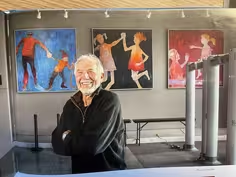
Clip: S34 Ep1 | 6m 2s | Mel McCuddin, Spokane expressionist painter. (6m 2s)
Video has Closed Captions
Clip: S34 Ep1 | 5m 22s | Find a confluence of cultures at Alberta’s Fort Calgary. (5m 22s)
Providing Support for PBS.org
Learn Moreabout PBS online sponsorship












Support for PBS provided by:
Northwest Profiles is a local public television program presented by KSPS PBS
Funding for Northwest Profiles is provided by Idaho Central Credit Union, with additional funding from the Friends of KSPS.