
January 2021: ZooTampa & Freedom Guide Dogs
Season 2021 Episode 1 | 26m 45sVideo has Closed Captions
ZooTampa and Freedom Guide Dogs helps to increase the access of disabled individuals.
A partnership between ZooTampa and Freedom Guide Dogs helps to increase the access of disabled individuals visiting the zoo while also training future guide dogs. This desensitization program helps acclimate the zoo animals to the presence of guide dogs and their handlers.
Problems playing video? | Closed Captioning Feedback
Problems playing video? | Closed Captioning Feedback
Up Close With Cathy Unruh is a local public television program presented by WEDU
January 2021: ZooTampa & Freedom Guide Dogs
Season 2021 Episode 1 | 26m 45sVideo has Closed Captions
A partnership between ZooTampa and Freedom Guide Dogs helps to increase the access of disabled individuals visiting the zoo while also training future guide dogs. This desensitization program helps acclimate the zoo animals to the presence of guide dogs and their handlers.
Problems playing video? | Closed Captioning Feedback
How to Watch Up Close With Cathy Unruh
Up Close With Cathy Unruh is available to stream on pbs.org and the free PBS App, available on iPhone, Apple TV, Android TV, Android smartphones, Amazon Fire TV, Amazon Fire Tablet, Roku, Samsung Smart TV, and Vizio.
Providing Support for PBS.org
Learn Moreabout PBS online sponsorship- [Narrator] This is a production of WEDU PBS, Tampa, St. Petersburg Sarasota.
- [Cathy] What do zoo animals and guide dogs have in common?
Well, it turns out these animals can help each other and humans in important ways.
Learn about a partnership between ZooTampa at Lowry Park and Freedom Guide Dogs that works to increase access for persons with disabilities through a special animal desensitization program coming up next.
(upbeat music) ZooTampa at Lowry Park, formerly Lowry Park Zoo is one of the most popular zoos in the Southeastern US with over 1 million visitors annually.
ZooTampa says it is committed to providing excellent care for the more than 1100 animals residing on its 56 acres.
The zoo says its goal is to maximize the well being of the animals while also engaging with guests and inspiring them to preserve wildlife.
Part of that mission includes creative ways of acclimating the zoo animals, to the myriad guests you may visit including those with disabilities who handle guide dogs in turn guide dogs in training must get acclimated to many different environments, scenes and situations to help assist their handlers.
Through this need a special partnership was born as a unique environment of the zoo provides a unique area of training for these guide dog puppies.
Welcome to Up Close.
I'm Kathy Unruh.
Today we are joined by Merry Schoch.
She's a volunteer puppy raiser for Freedom Guide Dogs and an advocate for the blind.
Merry is blind herself and has been a guide dog user since 1998.
Also with us is Dr. Larry Killmar.
He is Senior VP and chief zoological officer at ZooTampa at Lowry Park.
Thank you both for joining us virtually today.
We appreciate it.
Dr. Killmar, let's start with you briefly.
ZooTampa is formerly Lowry Park Zoo.
Why the change?
- Well, we thought, you know, with all of the Twitter and tweet addresses and everything, it was important to make our name more convenient for certainly for social media and it was time for a change.
You know, we had our name for many, many years and it was time to refresh our brand.
- And it's nothing unheard of to you that zoos are often called into question about where did the animals come from?
How are they treated?
You say that your mission is rescue, rehabilitate, care for the animals.
Where do they come from?
- Well, our biggest rescue project and the one we're known for is manatees.
However, we also work with Florida panther and the black bear in the area as well.
But manatees is our signature conservation program, that we are now treated more than 425 manatees that are all resolved mostly at most drinks, and crap, trap entanglements and so on so forth.
The other animals we have in our Zoo come from other facilities within our zoological organization, and we're here to help perpetuate threatened and endangered species.
Make sure we're giving them the best home and that these animals are around for many generations to come.
- And Merry, I just have to remark about the spelling of your first name.
Tell us why.
- Well, because I was a baby born 10 days before Christmas, but since I was born in, supposed to be born in February, my mother said I was her Christmas present.
So she named me Merry Christmas.
- And tell us why you were blind, how you became blind.
- I have a condition called Marfan syndrome, also known as a Blinken disease and different it affects the connective tissue.
And so I had different complications with my eyes and many surgeries.
Then, within that, I lost my eyesight in 1986.
- And since that time, you are now with your fourth guide dog.
- Yes, that is correct.
- Her name Pita.
She's a lolly and she is a freedom guide dog.
- And how important is the guide dog to you?
- Pita is first of all one of the best guide dogs I've ever had.
And she allows me to move around my environment safely.
She finds different things like curves and obstacles.
And she also allows me to not worry about using the limited eyesight that I have to move about my environment but to use that to look around freely in my environment and she gives me ease and independence as I move and navigate my world.
- And we talked with a couple of other handlers too about their experiences with their dogs.
- It makes quite a bit of difference because without Penny out have to use a white cane to get around which it works.
It works well.
You know, I've had some good mobility training, but having Penny it helps people to communicate better and ask questions about the dog and blindness and stuff.
So she's a good ambassador, even though she also helps keep me safe.
And that's the main reason that I got her then I could walk around my community and know that he's gonna guide me around obstacles, and she's gonna stop at the curbs and keep me safe.
But then there's all these other benefits as well.
- I love being a puppy raiser, my husband and I have been puppy raisers for 34 years Thunder was the 23rd puppy that we've raised, it's been life changing as much as you hate to give the dog up, because it's a part of your life, and you're so ingrained in it every time it leaves, you know that you're doing something really good for someone who needs the dog.
So it's important to me that as many people as possible can have guide dogs, it just, you know, enriches their life and makes it easier for them to do things on their own than having to rely on other people to help them all the time.
- [Narrator] Guide dogs are just so much part of our lives.
- So Mary, you work with guide dogs as a volunteer, how does that go?
What is your job?
- Well, currently, what I do besides being a guide, dog handler, and having my own guide dog, I am also a puppy raiser.
So I am currently raising my second puppy, my first Puppy was successfully placed with a blind person a few months ago.
And so my job as a puppy raiser is to teach the dog how to behave in different environments, restaurants, malls, stores, zoos, and to expose him to as many things that I can expose him to, because blind people are out there in our world, doing different things.
And so this is really an important job because we teach them how to behave.
Because if the dog does not behave in public, doesn't matter its status as a guide dog, we can be asked to remove our dog from that environment.
So the behavior is very important.
The confidence in the different places that we take it is very important, the exposure, all of those things are important for the pup to be a successful guide dog.
- Dr. Killmar, you have about 40 years of zoological experience, and you've been at ZooTampa since 2007.
- Yeah, you're kind is actually closer to 50.
- Okay.
Tell us how this program, the desensitization program started?
- Well, we were approached by Merry and her partner, Marion, more than six years ago, and we received a very good education as to what we were not providing for people with sight issues, and it really woke us up and it made us ponder for a minute and say, listen, we need to do this.
We need to-- - What were you told that you were not providing?
- Well, well, it was felt, I think by people with sight issues, that zoos were not friendly places.
And I'll be honest with you, we're so focused on our animals and taking care of them and making sure they're safe and well being which is fine.
We thought that service dogs were going to be a problem for us because here's a dog on site, that's certainly going to alert birds and other animals and frighten them and what's happened out of this, which is the best part of this whole program, as far as I'm concerned, is we learned a lot.
We learned stuff that we just were not aware of, and maybe some old wives tales about what would happen if you had a dog on site.
So we took that challenge on, and we learned a great deal and we've now disseminated it disseminated that information to our colleagues in the zoo world.
- Wild animals can tend to see dogs as either predators or prey and Merry how is that when you're with a dog.
And I want you to define for me please what desensitization means regarding this program, Merry?
- Well, desensitization for the puppies means that, for instance, you take a dog and you approach an animal, if that dog reacts, then what you would do is you would slowly introduce it back to that particular animal.
So it's just the exposure if they react, you want to slowly reinforce the positive behavior.
Sometimes even as the dogs get older, they may be more in tune to this might be danger and do something that we call alarm barking.
And so then you want to continue to work with it slowly to eliminate that type of behavior if they react to one of the zoo animals that way.
- And this process is a cause through what you call desensitization events.
Dr. Killmar.
How many dogs how many handlers come to these events?
How do they work?
- Well, we worked over several months, and we selected the areas that were the sensitive ones.
And we did basically more than two dozen intercepts in those areas until we were getting good reaction from our animals.
So we will-- - Let me ask you what the sensitive ones means.
- Well, we will, for instance, the main aviary, anybody thinking you could walk a dog through the main aviary, they think you're out of your mind.
So what we did is we slowly entered that aviary, and then if the reactions were good, then we back off and say, Okay, that was good.
And each time we went farther in until we could walk around that aviary numerous times, and certainly birds are going to alert but they weren't alerting to the point where they were flying into the wire or getting excited, it would be a normal alarm call.
Because again, a dog is considered a predator in their, you know, in their scheme of things.
So we even did that in our lorikeet feeding aviary, which was really the acid test for this year's birds that come down and rest on us and feed from our hands.
And they were actually after about four times very comfortable with the dogs.
- And does this kind of program exists elsewhere.
- Well, other zoos have now approached us and asked us how we did it.
Every Zoo has a different setup and has different concerns and issues that they have to go through.
And we're always here to help them and answer their question.
Like I said, I've done conference presentations or workshop presentations to help them with that we'd like to do more workshops.
Certainly, we can do them virtually.
But we'd love to do them in person when we can get conferences back live again, and help our colleagues understand this because there should be no Zoo should always be accessible to people with dogs.
- And we visited ZooTampa during one of these events to see exactly what happens when the animals are face to face.
(bright upbeat music) - I definitely think the Freedom Guide Dogs partnership is pretty unique to the zoo.
And that we have the dogs come in purposefully for training purposes.
The animals here at the zoo are being desensitized to everything in their environment all the time.
But this is really cool that we have the dogs specifically here to meet some of the animals and work through that.
- This is Thunder, Thunder is 21 months old, we trained him from when he was eight weeks until about three weeks ago.
So he's actually been delivered to freedom and in formal training for the last three weeks, we've been here together twice.
The first time he was much younger, and he was much more enthusiastic and today was a lot quieter.
So you can see how he's changed over the months that we've had him.
So I thought it was awesome to see the reaction of the dogs and our animals.
This is kind of training for both.
So training on the dogs end.
And then also for the zoo animal.
So I don't think any of our animals have seen that many dogs at one time.
So the Red wolves were super interactive, they wanted to play they're jumping on the the windows that was really fun to see.
But once we had a couple birds in our theater, that definitely changed things a little bit, and we saw some reactions.
But that's what training is all about is we have to expose the animals to things and we have to work through it and troubleshoot it.
And that's what we did here today with our animals and the dogs.
- She's been desensitized in a lot of areas.
So but being here kind of reinforces her sensitivity.
And also it kind of can help training all the exposure all the time, the more the better.
That's how I look at it.
- It's really awesome to have the dogs come in a controlled setting meaning this is the plan this is why they're here is to desensitize our animals, as well as work through the dogs and their behavior.
So when we do have an actual service dog that's here to guide someone through the zoo and make sure that they have a really great experience or animals are ready.
So they've seen the dogs before they know how to react.
And then our guest with that guide dog, can have a really awesome day here at the zoo.
- So actually, Penny did really well when the first thing that we did was they had the birds fly over.
And she just sat there and looked at me and then she saw the birds fly and then she was just looking she did really well there.
When she was looking at the porcupine.
She did the head tilting which I think is so cute.
She's kind of like curious to look but she's so calm.
And that's why right now she's kind of been working so I'm going to giving her some extra cuddle time.
She loves to be touched.
She loves to be cuddled.
So it's one of her rewards.
But she did extremely well even better than I thought she was going to today.
- So we saw in our theater today That the birds got a little bit startled when the dogs got excited during the flight, and they flew up into the trees, which is totally okay.
So everything's voluntary, it's their choice.
And that made them uncomfortable.
And they let us know by going up a little bit higher, where they felt a little bit more safe.
And then when they were ready, they came back down.
And that relationship between the trainer and the animal, that's where the animals came down pretty quickly, they still were making sure that the everything was safe, and the dogs are going to be okay.
But that relationship and that bond with the trainers, it's how we can teach them and walk them through these types of scenarios.
I think it's important for the dogs because they get to see things that they may encounter out in the real world.
And they may not but it does teach them control in certain situations.
And they realize that they can't just get up and chase other animals when they see them no matter what kind they are.
I think it's also important because when a blind person gets the dog finally, the dog has to know how to control that himself.
Because the blind person can't always see what's coming at them, they may have low vision or no vision at all.
And so the dog needs to know it can't react because the person doesn't know what they're reacting to sometimes.
- So there are some pretty chilled to hugs in that little clip there.
How long does it take to get the dogs to be that chill Mary ?
- It really depends on the dogs, some dogs you go in, and they have no reaction at all, anytime that you take them.
And then there are others depending on their age, and their sensitivity.
They may react there were Labradors in the desensitization program view, there was no reaction from them.
However, my first dog was a Labrador.
And when we took him to the painted dogs, he barked at them.
So it really is, depending on the dog, and their age sometimes as well.
- And we saw the freedom of choice, Dr. Killmar, the birds to fly up into the trees, how far does freedom of choice go for the animals at the zoo?
You know, we want our animals to be living comfortably we have federal agencies are making sure that we're following guidelines and not causing any harm to our animals.
So we're monitoring that behavior very closely.
And if we're seeing some, you know, stress behavior, then we're gonna have to go three steps back and retrain and re desensitize the animals to that.
So we don't want the animals to feel confined or restrained in any way, shape, or form.
Merry much mentioned the dogs, dogs were very excited, almost happy to see them, but they weren't lunging or doing anything negative.
And that's fine.
That's the kind of activity we want to see you thought it was great.
- And what kind of positive reinforcements are used both for the zoo animals and put the dogs, Merry first, how do you positively reinforce behavior with the dogs in this context?
- In this context, I may use a treat.
But I also use praise, I believe when working with the dogs, three quarters praise and a quarter correction when necessary.
But mostly it's praise.
And once in a while, randomly, I will give a treat as a reward.
- And Dr. Killmar, we don't give any treats out.
We just we -- Again, it's the repetitiveness of it.
And you know, as long as we're getting that positive reaction from the animals not alerting in a negative way.
That's reinforcement.
And we we then take that as a win.
But the important part is we take small steps to get there.
We don't, you know, go in one time and say, "Oh, that's it and move on."
We do many, many trials before we consider it done.
- And how do you decide which species will be involved in the program?
- Well, we've gone through the entire zoo, including having the dogs on our tram, which was certainly the last and what we thought was going to be a very difficult test.
So every area, we don't have any areas excluded.
Now, we did have a wallaby walkabout that was excluded, only because it was too tight.
And even Merry admitted that that would be difficult on the dogs to be in that environment.
That area has been remodeled.
Now we don't have it online.
We still have the Wallabies but it's a different environment.
But I think the other important part here for my staff was understanding how stressful this was for the dogs.
And appreciating that because again, we're focused on our animals not so much on on domestic dogs, but now my staff has learned and appreciated and I have to give them a lot of credit for accepting this challenge and they took it on and the program's been extremely successful.
- Merry why is this so stressful for dogs?
How does it compare to the other thing that they have to grow accustomed to so many environments and so Many things happening.
Why is this particularly stressful?
- Well, because when you take a dog into a zoo, it isn't the ordinary day to day thing that you would do with your dogs such as go on public transit, go to work, it is something that we do maybe a few times a year, so and sometimes not that much.
And so you have the different smells.
And you have animals that these dogs do not see on a regular basis.
So Yo, rhinoceros is a pretty ominous looking animal to a dog.
And so they may react and and they may be stressed.
But it's also to let them know that this is okay.
And we're safe and they are safe.
And it is very, very vital program for both sides of this partnership.
- Dr. Killmar, how do you let blind persons or people using working dogs know that, "hey, you can come to the zoo now, whereas you might not have before?"
- Well, our website certainly gives that message out.
But I think Merry and her colleagues have spread the word.
And I've also attended one of their conferences was over in Orlando a few years ago to talk about this.
So we got a lot of exposure and a lot of information going around.
And that's the important part is just getting the word out so people can know that and understand it.
So certainly word of mouth has been a big avenue to get this message out.
- And I'm moving away from this program just for a moment, the mission of ZooTampa to inspire visitors to want to preserve wildlife.
How do you measure whether that is actually happening?
- Well, we do surveys, repeatedly, we're really big into surveys to make sure we're getting our messages across to make sure our facilities are comfortable that there's things that we can improve on, it's all hand in hand.
But we do measure through surveys to see if people are getting the messages out.
And then we'll do spot surveys when we do new areas, renovate an area will survey the people and see how they enjoyed that area, what messages we were getting across through our graphics.
And then when we redo it, we take another survey to see if that's been successful.
So it's all about getting that data back from our visual or visitors.
- And Merry, besides working with the guide dogs, you're an advocate for blind persons in what other ways do you advocate?
- Yes, I'm a volunteer with the National Federation of the Blind in the National Federation of the Blind to Florida, we are a consumer organization.
So we work with legislators regarding legislation to help blind people live independent lives, and we have other programs for Braille literacy for children.
And we have a plethora of programs that benefit blind individuals throughout the United States.
- How important are guide dogs to blind individuals?
- Well, you know, that is a choice.
And usually only about 10% of individuals who are blind uses guide dogs because it is an animal and there is responsibility that comes with that animal.
So not everyone chooses to use a guide dog, a white cane is very sufficient and moving around independently.
However, with a white cane, you walk up to something and then you have to use your cane to feel around it, whereas the dog will just take you around it.
It's a different orientation, and mobility skill.
And but they're both very effective.
And it is a personal choice for blind individuals.
It's not for everyone, using a dog.
- And Dr. Killmar, what would you have us know about ZooTampa?
That we don't know?
- Well, so good question.
I think there are several things on the conservation side we're continue to do great work and in the state of Florida with native species, as well as overseas with other animals, elephants, rhinos, and so on and so forth.
Our education program is now reaching out into the community to help underserved visitors and citizens I should say, and making sure we're getting our messages out stronger in the school yard as well as that underserved community.
And I think, for the general public, we want them to know that this is a friendly place to come visit.
You're going to be nicely entertained, you're going to learn a lot when you leave.
And the one thing we want to notice when you leave the zoo, you say, "Gee, I didn't realize fill in the blank."
And we've that way we've helped you understand more about animals and also just enjoy the site while you're here.
- And are there any special requirements or restrictions right now due to the pandemic?
- Yes, we're following CDC guidelines on this.
We require masks in certain areas.
When you're out on the grounds in the open air.
We do not require a mask, but strongly encourage people to wear that.
We do temperature checks as you come in.
We have hand sanitizers throughout we're cleaning continually.
And so we're following the CDC guidelines very carefully.
- And Merry, if anyone wants to volunteer with guide dogs, what should they do?
- They can contact freedom guide dogs, they can email info at freedom guide dogs.org.
- So basically, just get in touch.
- Yes, absolutely.
- Okay.
Well, thank you both for being here today.
It's a fascinating program.
It's been interesting to learn about it.
We appreciate it.
- Thank you for having us.
- Thank you for the time.
- More information about ZooTampa at Lowry Park visit zootampa.org and you can learn more about freedom guide dogs at freedom guide dogs.org.
This episode of Up Close may be viewed in its entirety at wedu.org.
I'm Kathy Unruh.
Thank you for watching and we will see you next time on up close.
(upbeat music)
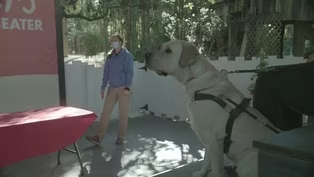
Preview: S2021 Ep1 | 29s | ZooTampa and Freedom Guide Dogs helps to increase the access of disabled individuals. (29s)
Providing Support for PBS.org
Learn Moreabout PBS online sponsorship













Support for PBS provided by:
Up Close With Cathy Unruh is a local public television program presented by WEDU