
January 2022: Jessica Muroff
Season 2022 Episode 1 | 26m 41sVideo has Closed Captions
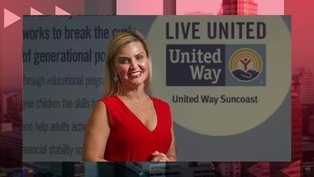
United Way Suncoast CEO Jessica Muroff leads local nonprofits in coping with the COVID.
Nearly half of all Floridians are barely getting by financially, including those with jobs. So what can be done to tackle widespread financial instability? United Way Suncoast CEO Jessica Muroff is bringing together the people and resources to tackle our community’s greatest challenges.
Problems playing video? | Closed Captioning Feedback
Problems playing video? | Closed Captioning Feedback
Suncoast Business Forum is a local public television program presented by WEDU
This program sponsored by Raymond James Financial
January 2022: Jessica Muroff
Season 2022 Episode 1 | 26m 41sVideo has Closed Captions
Nearly half of all Floridians are barely getting by financially, including those with jobs. So what can be done to tackle widespread financial instability? United Way Suncoast CEO Jessica Muroff is bringing together the people and resources to tackle our community’s greatest challenges.
Problems playing video? | Closed Captioning Feedback
How to Watch Suncoast Business Forum
Suncoast Business Forum is available to stream on pbs.org and the free PBS App, available on iPhone, Apple TV, Android TV, Android smartphones, Amazon Fire TV, Amazon Fire Tablet, Roku, Samsung Smart TV, and Vizio.
Providing Support for PBS.org
Learn Moreabout PBS online sponsorship- [Announcer] This is a production of WEDU PBS, Tampa, St. Petersburg, Sarasota.
- What would you do if a member of your family was facing financial instability?
If they were not sure if they could cover the day-to-day living expenses, if a problem arose.
Well you'd want to help, right?
Well, nearly half the people in Florida are in that situation.
So how do we help?
Certainly we can't do it alone.
We need a team and resources.
Well, you're about to meet the CEO, of a dynamic regional organization who's leading that team and who firmly believes united we rise, united we win.
Next on the Suncoast Business Forum.
- [Announcer] Suncoast Business Forum brought to you by the financial services firm of Raymond James offering personalized wealth management advice and banking and capital markets expertise.
All with the commitment {\an1}to putting client's financial wellbeing first.
More information is available at raymondjames.com.
(upbeat music) - There's strength in numbers.
When you have the right people working together with a shared vision, it's a force multiplier.
United Way, Suncoast CEO, Jessica Muroff understands that, and she knows how to make it work.
She's bringing together people, resources, {\an1}and a strategy of success to tackle our community's greatest challenges {\an1}and giving people the skills and resilience to thrive.
Jessica, welcome to the Suncoast Business Forum.
{\an1}- Thank you for having me.
- Now, when you started your job 2019, you had a really interesting, good news, bad news scenario.
The bad news was the pandemic.
The COVID pandemic started shortly after you got there, but the good news was within a year, you received a $20 million unsolicited gift from a philanthropist.
How did you deal with the good news and the bad?
- Well, it was certainly a huge challenge {\an1}and, you know, two months into walking into my job, having all of these big plans, you know, then all of a sudden, you know, the realities of those pandemic settling in and within a week, we pivoted to a completely virtual work environment {\an1}like so many across our whole entire country, our world.
And at the same time knew that United Way needed to show up in a big way.
So we launched our COVID-19 response and recovery fund.
And in a matter of weeks {\an1}raised nearly $2 million to support our community.
Which was really critical because our nonprofit partners were having to cancel fundraisers.
Things were really uncertain and in that timeframe as well, they were having an increase for their services.
So we had a rapid funding process where we were getting those dollars out each week.
A hundred percent of the dollars raised went right back out into the community.
Well fast forward to eight months later.
We, I get a random email that I ignored the first one, the second one came in and I looked at it a little bit more closely.
And I said, well, there's elements to this that look legitimate.
{\an1}And so I'll just respond.
And, you know, to make a long story short, it turned out to be a McKinsey Scott wanting to give us a $20 million transformational gift.
And so, you know, we won the lottery without playing, and we're incredibly just grateful for her generosity and for the way that she is really disrupting and transforming philanthropy.
And again, embracing that value of radical transparency treating this as a community gift.
This is not a gift to United Way.
This is a gift to our region.
And we went through a very thorough and intentional process for developing the strategies to implement that gift and giving us time to do that so that we can really have the biggest impact possible.
- The United Way was founded in 1887 as the Charity Organizations Society back in Denver.
Now it's been here in the Tampa Bay area {\an1}for nearly a hundred years, but over that time, it's changed its mission {\an1}and its changed its model because you have to change the society.
How would you describe the current mission and the current model of United Way Suncoast?
{\an1}- So our vision and mission of uniting people, uniting a community to elevate the lives of others is at the core of everything that we do.
And that's been who we are since day one.
Our approach is a stronger collective impact model.
So we have three specific areas in which we know our community needs us.
And we constantly check in with our community to make sure that those are the priority areas {\an1}that still remain of use.
So it's early learning, financial stability and youth success.
And so within those three pillars of priorities, we have certain outcomes and impact that we want to have and we want to achieve.
And so what we do is we invest in, you know, right now it's 93 programs, it's 78 nonprofit organizations.
So we invest in the best programs that are moving the needle in these areas, bringing these organizations and initiatives and services together.
We raised $17 million a year.
{\an1}And when you think about the scope of the counties, the region that we cover and the challenges that we're addressing, we have to make those dollars work for us in the most high-impact way possible.
But we also still show up in the moments of crisis {\an1}providing crisis funding.
And when we have just significant challenges or need in our community, we're very adept at bringing the right players to the table and, you know, funding initiatives to making sure that we're responding to them quickly and proactively.
- People are struggling in this area to make ends meet.
And it's not only people who are unemployed or people who have personal hardships.
It's families, it's it's people who are working.
{\an1}How big a problem is this?
It's a lot bigger than most people think.
- It absolutely is.
And we do a research study on this every two years {\an1}and it's our ALICE report.
And it's an acronym that stands for asset limited, income constrained, employed.
These are hardworking individuals and families who have jobs, but do not make enough to meet {\an1}a bare bones, basic budgets within our state.
They're living paycheck to paycheck, {\an1}struggling to stay afloat.
Just one car accident, one medical bill away from being thrown financially off course.
And unfortunately the data isn't going in the right direction, right?
So 46% of the people in our state fall within the ALICE threshold.
Within our region, that number is 43% and those numbers have only gotten bigger.
So if you think this is 2018 data, so you can only imagine {\an1}what that is going to look like when we come out with the new numbers as a result of the financial implications of this pandemic.
So, you know, we don't realize that, you know, almost half of our community is struggling the way that we are.
Our programs and services are designed to help these families, you know, {\an1}with support and services that give them the sustainability that they need for their future.
And we do that in so many ways.
From financial coaching to car, transportation savings programs.
{\an1}So they can actually have that private and personal transportation to get themselves to their jobs.
We do workforce development training.
We have a program now.
We're partnering with Quest to train phlebotomists and CNAs so that they can get the training that is necessary to get a good job {\an1}and to have a career path and growth for themselves.
One of the most important things we do and is very timely is our volunteer income tax assistance program.
Anyone who makes $66,000 or less of income can get their taxes prepared by trained volunteers for free.
{\an1}And last year we did nearly 8,500 tax returns.
And just in our region alone, that brought more than $11 million back {\an1}in financial impact to these individuals and families.
So it's not, this isn't just about supporting somebody when they're in a crisis.
This is giving them the tools and resources that they need to be sustainable, to have the right banking products, to have the right education, to have those supports that put them on a better path to success.
{\an1}And then we also go even more proactively than that in our other two focus areas and that's early learning and youth success.
So with early learning, we're focusing on making sure that children are reading on grade level by third grade.
We know that is pivotally important because, you know, from that point they're learning to read.
{\an1}And then from after that, they are reading to learn.
{\an1}And it is, there's so many, {\an1}there's so many data points that really prove and show how critical that moment in life is.
But we also know we can't just jump in right at that grade to help improve and support these children.
So we even make sure that they're ready to enter kindergarten, ready to learn.
So it's really going upstream and the same thing with youth success.
It's making sure that our middle and high school students have the right path in front of them for graduating on time.
{\an1}And then also making sure that they have that plan {\an1}for whatever that post-secondary journey might be for them, whether that's career or college.
- Well, uniting the community {\an1}to provide opportunities for learning and education {\an1}and to improve one's lives, is a very bold vision.
And it takes a lot of volunteers.
It takes a lot of community partners.
How do you work?
How do you find, how do you work with these partners and volunteer?
{\an1}- We work with over 3,500 volunteers annually who give more than 36,000 hours of time into our communities.
And that is a whole host of things, from helping us with food distribution, to a regular volunteer who is providing mentorship or tutoring and reading support help to our children.
We have, if a volunteer wants to give back to their community, just come to United Way, come to our website, sign up, because every single day there is an opportunity that you can sign up for {\an1}because we work with so many of our nonprofit partners to pull all of that information together so that it's all easily there for you to research it, sign up for it and continuing to see those opportunities become available to you.
We also have nearly a hundred volunteers who help us in our community investment process.
So we invest millions of dollars back into our community and these nonprofit partners {\an1}to help us achieve our results in our three focus areas.
But this isn't staff making these decisions.
{\an1}We have trained volunteers {\an1}who are following a rubric and an evaluation process for helping us to make the best decisions as to where our donors dollars are being best used in the community.
And so these volunteers, every single year, they come in {\an1}and they help us evaluate and create the list of organizations that we're going to fund for the year.
{\an1}And it's a wonderful thing.
If this pandemic has shown us anything, is that we cannot solve community challenges in silos.
We have to work together in order to have the greatest impact.
In order to really to achieve are the results that we want.
{\an1}We can't do anything alone.
And United Way has never done anything alone.
It's always in partnership with others.
- Let's talk about your formative years.
Let's talk about your family and growing up.
{\an1}- So, I was born in Texas because my dad was in the Air Force.
I lived out in Plant City with my mom {\an1}and we had a farm or a zoo, as I like to call it, because we had every animal under the sun.
I loved living in Plant City.
I graduated from Plant City high school.
And, you know, when I was growing up, I think back and I'm like, I sometimes complained, you know, when you're in the moment and you're in it.
{\an1}And you think about like the drudgery of every day of taking care of horses and chickens and cats and dogs and goats, and, you know, just this whole, you know, menagerie of animals.
And it's a significant undertaking every single day, seven days a week, sometimes thinking to, {\an1}you know, feeling a little, sorry for myself that I had to work so hard, but now looking back, I'm incredibly grateful because I think that my dedication, my bias for action, my loving working hard and appreciating and valuing that has really come from growing up in that experience.
But also from my dad always telling me that I could be or do anything that I wanted to be.
And so when somebody believes in you likes that, {\an1}especially somebody as important as your parent, the sky's the limit.
- After graduating from Plant City high school, you went to the University of South Florida.
What did you study and did you know what you wanted to do?
- I came in wanting to do communications, and I did get my bachelor's degree in mass communications and loved USF.
My undergraduate just really, you know, similar to high school, wanted to be involved in everything and wanted to just immerse myself in campus life.
I was student body president in my junior year.
I was president of my sorority.
I got to do so many incredible and wonderful things.
{\an1}Working with Betty Castor.
Like it doesn't get better than that.
And I loved USF, and I really enjoyed the activity and involvement that I had in my undergraduate programs.
- After graduating undergrad, you went on and got a master's degree, right?
- Yes, I did a study abroad program and then dove right back into graduate school.
Because it was a really, it was 2000.
{\an1}So it was not the best time to try to find a communications job.
And I thought, well, maybe I could be a teacher.
You know, I am really pulled to service.
It is something that's at the core of my being.
So I thought that that would be something that I'd really enjoy.
And I got my master's degree in an education with a focus on English literature.
- After getting your master's degree, you went to work for Robert's Communication and worked with De Ann Roberts, who was a very dynamic community and business leader.
{\an1}Tell us about working with De Ann and your first job.
- I loved every second of it because De Ann was the epitome of everything that I wanted to be professionally.
{\an1}She owned her own business.
She gave, she was a community leader.
She gave back to her community.
She was brilliant and innovative {\an1}and such a servant heart.
A strong and courageous woman.
{\an1}I learned so much from her and I'm grateful for everything that she taught me.
Her in Colleen Chapel.
{\an1}And everything that I was able to experience there.
Especially in the community involvement side, because that's really where I got connected with Emerge and the Chamber.
You know, Richard Florida had just, his book, "The Rise of the Creative Class".
The, I think it was the city or the chamber did a study called the young and the restless.
And it's still a point that's true today.
That a thriving, you know, metropolitan area, thriving city, it doesn't have their young people fleeing the city and leaving to go other places.
They stay here and their opportunities are here.
And so, you know, the whole premise was how are we involving our young professionals {\an1}in the business community?
And that's what the Chamber wanted to embark on.
We created Emerge with my wonderful chair, went co-chair and my dearest friend, Mike Griffin, who is also, you know, community superstar.
And I'm so proud that something that we started 16 years ago with 500 members when we kicked it off is still thriving and strong today.
- In 2005, you joined Raymond James Financial, a very large investment firm, financial firm here in St. Petersburg.
And what was your role there and tell us about what you did and how you grew at Raymond James?
- Again, I feel so fortunate for the opportunities that I've had professionally, but Mike White, the Chief Marketing Officer at Raymond James brought me on to be a part of their marketing department and their marketing department functions very similarly to an ad agency.
So I was an account executive just like I was at Robert's Communications.
I got to really support the private client group with advisor recruiting and working with the heads of the different business units within the private client group, some really dynamic and incredible leaders.
It was amazing to be a part of an organization with such a strong and positive culture.
And also an organization that was that, that had such great values that stood out from other financial services firms.
{\an1}And so really being able to promote and talk about the strengths of those values and the independence of the organization was just a really cool opportunity.
And so now to see the growth of the firm and where they're, you know, what they continue to do is, and now they're just an incredible partner of United Way.
So it's really awesome for me to continue to serve and be a part of Raymond James, because our partnership is so important.
{\an1}And I'm grateful for them.
- In 2012, you left Raymond James, you'd been in the business world for more than 10 years, and you made a pivot.
You went from the business world, the for-profit sector to the non-profit sector.
You work for an organization called Frameworks.
Tell us about that and making that transition to nonprofit.
- It was definitely a big change.
You know, coming from this very large well-resourced organization, {\an1}very strong strategy and business mind and thinking to a very small organization that didn't have much of that.
I was really grateful on two sides.
So one is, you know, the whole family, you know, balancing, you know, work-life balance.
I realized that I needed to change my habits.
And so, you know, that I quickly adjusted and realized, but then I also realized how much this was just fueling my passion and really given me purpose in my career {\an1}and taking my business skills and utilizing them in a really positive way to elevate the effectiveness of a nonprofit.
Because at the end of the day, a nonprofit it's a tax status.
{\an1}We still have revenue that we need to bring in.
We still have to manage our expenses.
So that we're running a business that is sustainable.
We have to have HR, we have to have technology.
We have to have strategy for how we do things.
I mean, all of the things that you, all of the things you have to do when running a successful business.
So it's just a social enterprise and one that's really important {\an1}and being really good stewards of donor dollars.
And so I'm just that, {\an1}that is probably one of the single best decisions {\an1}I've ever made in my life, {\an1}was making the transition from the for-profit sector to the nonprofit sector and being able to do all of the wonderful things that I know have made a big impact in the community.
- In 2015, you went from a small non-profit to a large nonprofit, Girl Scouts of West Central Florida, {\an1}which serves 20,000 girls.
{\an1}- Yeah.
- That's a big transition.
Tell us about that organization and becoming CEO of an organization that's that dynamic.
{\an1}- That was, again, another transformative experience.
Loved working at Girl Scouts.
We, I mean, we tackled a lot of things from a long range program and property planning process {\an1}to really elevate our camps and how we utilize them and improving them, really trying to improve our service to our volunteers and really listening to our volunteers.
{\an1}And then most importantly, improving the experience, the outcomes and the impacts, and really listening to our girls.
Two of my favorite things at Girl Scouts, {\an1}and there's a lot of them, {\an1}but was creating Camp CEO, which brought in executive level women and our high school Girl Scouts on a weekend camping experience, full of speakers and camping and camp activities and a mentorship, you know, experience.
And then my Girl Advisory Board.
{\an1}So I met almost monthly with girls from middle school, or I think it was fifth grade and above who joined the Girl Advisory Board to provide input.
When girls can see that their voice makes a difference and that they can, you know, their ideas, their suggestions can be made into action, {\an1}and we can empower that, that's just, it's magical.
- In 2019 you became the CEO of United Way Suncoast.
Now, what challenges and opportunities did you discover when you took the helm of a 90 plus year old vital nonprofit organization?
- Well, with any organization, this was similar to Girl Scouts, too.
{\an1}When, you know, when you are almost a century old, change is hard, and then you add on top of that, a pandemic, then you have all of these other dynamics.
The only constant now for us is change, right?
{\an1}And it had been seven years since we undertook a strategic planning process.
So that was overdue.
And so trying to do that during the pandemic, we launched that project in September of 2020.
So right in the middle of the pandemic, we launched a very comprehensive, {\an1}strategic planning process, but I'm so glad that we did.
And we were very intentional about that because we wanted to take in everything that was happening right now, right?
What were we learning from this?
How could we strengthen our organization {\an1}so that we could emerge from this with strengths?
And so, you know, it's been a lot to tackle all at the same time and it is hard.
I will say it's hard to balance {\an1}because I feel the weight of this balancing, {\an1}responding to a crisis and constantly responding to that crisis every single day and feeling the weight of that.
And then also trying to keep your eye on the future and trying to adjust and be prepared for what happens next and balancing those and being proactive, trying to get into that proactive mode rather than reactive and balancing those two and making you know, that operational excellence that helps you to achieve that, balancing those two things has been a lot, {\an1}but we've been successful.
{\an1}I mean, this past year was, we raised, we first year in a long time that we exceeded our fundraising goals.
And then of course, {\an1}and that doesn't include Mackenzie's Scott's gift.
{\an1}That's was aside from that.
{\an1}So, and strengthening our team and our culture, we improved our culture dramatically.
And again, that all goes back to that radical transparency, caring about your team and involving them in the decision-making processes, listening, and I think really, you know, embracing that and encouraging and rewarding that collaboration, and that risk taking to trying something new.
- How have you found you're able to manage the work versus family and personal life challenges that you face?
- You know, it really is about being intentional and being present.
So, you know, when I made this transition {\an1}to the non-profit sector, I also launched a blog and started writing about my journey on building this habit.
And it was called the Be Present Project.
And, that is single-handedly probably the most important thing that I've done in my career to be more successful, both personally with my family and in my career is being in the moment, being focused in the moment, building that connection and that relationship, not trying to do too many things at one time, which is hard for me because I'm a doer, like in fact, that's our family model.
{\an1}We're doers, we do things and I always want to be doing, but I know that I need to take a deep breath.
I need to focus on my family and manage my priorities better.
And I'm very clear about this with my team too.
And they all know it.
That when you need to focus on you, you need to focus on your family, you have to do that, because if you're not taking care of yourself, if you're not taking care of these things, it's only going to impact the way you show up at work.
And then there's times when, you know, when work is going to be really busy, but that ebbs and flows and just, you know, keeping an eye on that and being very intentional about where I'm spending my time and prioritizing the things that matter most to me.
And so, yes, I write all about that on the Be Present Project blog.
{\an1}- Well, Jessica, I'd like to thank you so much {\an1}for being our guest today.
- Thank you.
{\an1}I so enjoy talking to you.
- Thank you.
If you'd like to see this program again, {\an1}or any of the CEO profiles in our Suncoast Business Forum archive, you can find them on the web at wedu.org/SBF.
Thanks for joining us for the Suncoast Business Forum.
(upbeat music)
Preview: S2022 Ep1 | 30s | United Way Suncoast CEO Jessica Muroff leads local nonprofits in coping with the COVID. (30s)
Providing Support for PBS.org
Learn Moreabout PBS online sponsorship
- News and Public Affairs

Top journalists deliver compelling original analysis of the hour's headlines.

- News and Public Affairs

FRONTLINE is investigative journalism that questions, explains and changes our world.












Support for PBS provided by:
Suncoast Business Forum is a local public television program presented by WEDU
This program sponsored by Raymond James Financial