
January 2022: Tampa Bay Housing Crisis
Season 7 Episode 2 | 27m 54sVideo has Closed Captions
Explore the reasons behind this crisis and find out what leaders are doing about it.
All over Tampa Bay, rental home prices keep going up. Thousands of residents, both low-income and middle-class, wonder how they’ll afford skyrocketing rent. Tampa Bay’s hot housing market has led to a housing crisis in a region that already lacks affordable housing. Explore the reasons behind this crisis and find out what Tampa Bay leaders are doing about it.
Problems playing video? | Closed Captioning Feedback
Problems playing video? | Closed Captioning Feedback
That's All I'm Saying is a local public television program presented by WEDU
January 2022: Tampa Bay Housing Crisis
Season 7 Episode 2 | 27m 54sVideo has Closed Captions
All over Tampa Bay, rental home prices keep going up. Thousands of residents, both low-income and middle-class, wonder how they’ll afford skyrocketing rent. Tampa Bay’s hot housing market has led to a housing crisis in a region that already lacks affordable housing. Explore the reasons behind this crisis and find out what Tampa Bay leaders are doing about it.
Problems playing video? | Closed Captioning Feedback
How to Watch That's All I'm Saying
That's All I'm Saying is available to stream on pbs.org and the free PBS App, available on iPhone, Apple TV, Android TV, Android smartphones, Amazon Fire TV, Amazon Fire Tablet, Roku, Samsung Smart TV, and Vizio.
Providing Support for PBS.org
Learn Moreabout PBS online sponsorship- [Narrator] This is a production of WEDU PBS, Tampa, St. Petersburg, Sarasota.
(dramatic music) Premiere Eye Care is a leader in national managed eye care, with 4 million insured members nationwide through its network of optometrists, ophthalmologists, and specialists recognized for best practices in delivery of care, associate engagement and commitment to the community.
Premier Eye Care is proud to support, "That's all I'm saying," with Ernest Hooper.
For more information, go to premiereyecare.net.
(upbeat music) (upbeat music) - [Ron] Our motivation every day as the people around us in this community and it making better.
- [Woman] Workforce development.
- [Lady] Healthcare, Education.
- [Ron] Getting out there and making a difference in the lives that need it the most.
(upbeat music) (upbeat music) - [Ernest] The high cost of housing in Tampa bay has residents and lawmakers taking notice.
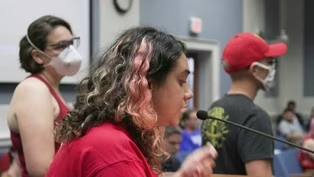
Here at St. Petersburg City Hall, a group of concerned citizens took their worries about rising rental rates to city council.
People are struggling with the fact that rent has increased in Tampa Bay faster than any other Metro area in the nation.
On this episode of "That's all I'm saying", we'll convene a panel of experts to talk about the fact that you have to make at least $24 an hour to afford a modest two bedroom apartment.
But first let's delve deeper into this issue, with the help of a resident who fears a rental increase we'll force her out of her St. Petersburg studio apartment.
- On your new rental.
- [Ernest] Stacey Rush is one of thousands of Tampa Bay residents, being priced out of a rental housing market that is skyrocketed.
The rent on her 300 square foot apartment is doubling, so she has to move.
- I stay in a studio and they went from 600 to like 1100.
- Wow.
- And then once they move out and renovate, it goes up to 1300.
And there's also one bedrooms here and they've gone up to 1500.
My income is not that much, so I'm like, well, I can't stay here.
- [Ernest] The average price of a one-bedroom apartment in St. Petersburg is $2,000.
Low inventory and high demand are leading to record price increases, and the lack of affordable housing, it's taken a toll on renters.
- We're being pushed out.
I have no problem with advancement, but I believe it needs to be balanced.
Have this much for this advancement, but still keeps some room for affordable housing.
- [Ernest] Tampa mayor, Jane Castor is making access to affordable housing a priority.
- Right, that's the need right now is critical and it's growing every single day.
- [Ernest] And newly elected St. Pete mayor, Ken Welch, says housing is one of the first issues he'll tackle.
- And so I wanna make sure we are urgent about drawing down those dollars, identifying places where we can even buy land and secure it, so that it isn't scooped up in this real estate crisis that's going on now.
- [Ernest] Last month, the people's council of St. Petersburg, addressed the housing crisis with city leaders.
They want local officials to declare a housing state of emergency, and let residents vote on rent controls.
That's something current Florida statutes prohibit.
- We need this, we need the state of emergency.
We need rent control now because these rent increases, they're not sustainable for us working people.
- When I entered the workforce 20 years ago, my parents said that you should never pay more than 30% of your income for housing.
(laughs) Now that seems like a cruel joke.
- [Ernest] The St Pete city council, voted to explore rent controls.
- [Stacey] And we step in this direction and we enter into the bedroom.
You see here's my bed.
- For people like Stacey, relief can't come soon enough.
She hopes her voice can make a difference.
- And I believe the light is greater than darkness, but it takes us together.
And that's the reason we gather in the city council meetings, and we gather in the groups.
And, you know, we got some stuff cooking right now, try to get out there and get the, our voice heard, you know, and hopefully they will take heed.
- [Ernest] Coming up, we'll have a special discussion with a panel of experts, about accessible and affordable housing.
(soft music) Are we at a crisis level when it comes to affordable housing?
And what relief is insight if any, when it comes to Tampa Bay's skyrocketing housing and rental market?
Joining me now to take a deeper dive into the issue are Kayon Henderson, the housing and community development manager, with the city of Tampa.
Dr. Elizabeth Strom, a university of South Florida professor, who focuses on affordable housing issues.
And real estate reporter, Emily L Mahoney from the Tampa Bay Times.
Thank you all for being with us today.
Emily, I wanted to start with you and ask, you've told me you could write a story about this issue every day.
What are the major factors that have gotten Tampa Bay to the point of being in a housing crisis?
- That's right Ernest, yeah.
This is an issue that Tampa bay really can't stop talking about, and that's for very good reason.
I wanted to throw out a quick statistic that I just got recently for 2021 in summary.
From January to now, according to one commercial real estate firm, rents have gone up by 24%, which is just not even close to the second highest year.
So this is really spectacular and really abnormal what we're seeing right now.
And as you said, it's caused by a lot of different things on both supply side and the demand side, but some of the big ones are, there's just a lack of housing supply nationally, and it's even more severe in the Tampa Bay area.
And that goes for both homes to purchase and also apartments to rent.
But on the demand side, the Tampa Bay areas is extremely hot right now, it's even hotter than the national averages that we're seeing.
And that comes in part from people moving to the Tampa Bay area from out of state, it's becoming a very desirable place to live nationally.
And a lot of the out of Staters moving here, have bigger budgets to play with, than some of the locals, because our wages here have not kept pace with the really dramatic rise in housing prices.
And all these things sort of compound on top of each other, when it becomes really hard for renters to buy a house, because the housing market is so intense, then they might decide to stay in the rental market.
And so then, you know, you just have more renters and more renters.
And so all these things are, like I said, building on top of each other and making our rents rise really quickly.
- Yeah, you know, Elizabeth, we have heard about these kinds of issues taking place in larger cities like New York, San Francisco.
Are you surprised that we're now dealing with it here in Tampa Bay?
- So can I say yes and no, because I'm a professor, so I get to equivocate.
(chuckles) No, because we have always had an affordability problem, it just wasn't quite as intense or advertised.
Even before the pandemic, about 50% of our residents were considered rent burden, meaning more than 30% of their income for their household expenses, and that's considered problematic.
As Emily mentioned, we've always had the problem of being a low wage area, where people in higher wage areas like to come and retire or have second homes.
And so those things have always been the case.
However compared to other markets, we've usually been much more affordable.
And so the fact that we're becoming more like a Miami in the past year or so, that has surprised me somewhat.
- So how much of this, as just a quick followup Elizabeth, how much of this is related to the pandemic?
Has that been a major factor in creating the environment we have right now?
- It appears to be, you know, we're we don't have really great data on population because the most recent data was the 2020 census, which was taken really before the pandemic started.
So we hear anecdotally and the Tampa Bay area has become a popular place to move for people from the Northeast and Midwest, from, even from South Florida.
And again these people have higher incomes and more wealth, and so they can bid up the price of homes.
At the same time, I am sure some of the bottlenecks we hear about, are making it harder to renovate and build new homes, and so construction may have been impacted in various ways by the pandemic as well, so the supply would be lagging too.
- So let me turn to you Kayon, you have been in the city of Tampa's housing division since 2013, I know you take great pride in trying to help people with this issue.
How much more difficult is your role now than it was say five years ago or even two years ago?
- So I think two years ago probably is even a great place to start, even before five years ago.
I mean, where we are now, I think both Dr. Strom mentioned it as well as, I forgot your name, sorry, the realtor Emily.
And so part of where we are is that we keep advertising Tampa Bay, and so we have a great place where people want to come but we don't have a housing inventory.
And so as we continue to look, one of our strategic goal is if we don't own it, we don't control it.
And so looking at, really looking at other parcels to purchase and do with other developers to do affordable housing, the problem is we're at a place where we have less than 4% vacant land in city of Tampa.
And so as we're looking to really incentivize developers, we're looking at also different strategies.
If we don't have land, how do we build on top of what we have or expand our inventory?
- All right, Emily, let me go back to you.
I know you wrote about this along with Margo Snipe, and it seems to be having a profound impact on minorities.
What has your reporting revealed in terms of the impact this is having on people of color?
- Right, that's a great question.
So obviously, you know, rent increases impact people of, you know, it all throughout the Tampa Bay region.
But one thing in particular that was really interesting, that I found recently was in regards to what parts of Tampa Bay are most desirable lately for investors to purchase homes.
The top three zip codes in the Tampa Bay area that investors purchase the most homes in quarter three of this year, all were higher minority areas than the Tampa Bay average, and all had lower household median incomes.
And basically what that means is that investors, some of whom are coming from out of state, but not all of them, are competing with locals in those areas at a higher rate.
And I talked with a local realtor in Midtown St. Pete Lou Brown, who said that he's seeing it in real time, that people, you know, black families who've lived in Southern St. Pete, are not able to break into home ownership.
If they've been renting, they're gonna have to possibly leave that neighborhood that they've lived in for a while because of the greater amounts of competition, even in that area, than even the already high competition that everywhere else is seeing.
And it's just because investors see opportunities in those areas, they see, you know, they're predicting higher price growth and higher value growth in those areas, and by default that creates more competition for locals.
Sure, so Dr. Strom, as we wrap up this first segment, I wanted to ask you, what is your research shown in terms of the impact on people of color?
- Well there are so many ways that people of color on average are disadvantage compared to white families.
Emily's touched on some of them in terms of the targeting of those neighborhoods.
Black families continue to suffer discrimination in mortgage markets, making it harder for them to become homeowners.
On average, they have lower wealth than even white families with similar income.
And also, people of color are much more likely to be evicted from their apartments.
The difference in addiction rates between a white and minority neighborhoods is just really noteworthy.
- So that's our first segment, when we come back, we will take a look at solutions, and talk about some ways maybe we can make this situation better.
Stay with us, we'll be right back.
(soft music) We're back with our panel of experts, and Kayon, I wanted to turn to you as we begin a discussion about solutions to the housing crisis.
I know that the city of Tampa, it's halfway to a goal of having 10,000 new units, actually you're halfway past that goal, how much is that going to help with this issue?
- So this will really greatly help with the issue as we realize that we have a lack of affordable housing.
I do wanna say that as we look at the 10,000 units, they're not 10,000 newly constructed units, we're looking at preserving some units also realizing that we have an aging population and it's they're in their home, how do we make sure that they can age in place and really help with those houses and fix whatever might need to be fixed our own occupied rehab program.
We are looking at different actions and initiatives to really encourage or facilitate affordable housing, while we still protect the ability of the property to appreciate in value.
And so we meet with our affordable housing advisory committee, and sometimes we're looking at existing policies and procedures and ordinances, so that we can regulate or plan provisions, on how do we create and expand what we currently have for affordable housing.
So as you stated, we are a little bit over our 50% mark, where we're looking at what we've actually constructed, what's under permit and as well as we look forward at some tax credit properties to really bring more newly units, newly affordable units on online.
- And the operative phrase for you guys Kayon, has been public private partnerships.
What's your message to those in the private sector about helping with this issue.
- So it's gonna take a holistic approach really for us get to that final affordable housing number and just really have that within our community.
We really encourage public private partnership, we've done so now in both our info phase one and our info phase two, where we're looking at city owned lots and really partnering with private developers to come in.
And sometimes it takes what we can give and what they have and so we can leverage to really expand what we have.
We realize that there's an issue, the city can't do it alone, and we realized that we can't also keep tapping on the same nonprofits as we all have capacity, so we're looking to partner in the best way possible.
- Dr. Strom, we mentioned in the prior segment, that this is a low wage state.
Is another solution creating higher paying jobs?
And how realistic is bringing that about?
- Well, don't forget we did pass an amendment in Florida to guarantee a $15 minimum wage.
So I feel like we already are recognizing that problem.
I think we also see efforts to bring in higher skill jobs to the area.
And so that means that perhaps our average wages will go up.
But there's always going to be low wage workers, even in places that are, have a higher median wage than Florida does.
And so we always need to make sure that our housing system is there for everyone at every wage level.
That's important not just for humanitarian reasons, but for our economy, we need workers in all kinds of jobs, and they need to be able to live near their work.
- You know Emily, in so many situations like this, we do look to government for answers, and Kayon has explained some of the things that the city of Tampa is doing.
What about the legislature and state government?
Is there anything they can do you think to improve this situation?
- Yeah, so like you said, a lot of affordable housing initiatives do happen on the local level, but there is a, there appears to be a conversation happening on the state level as well.
I know that governor Ron DeSantis, just rolled out his proposed budget last week, and it included an amount for affordable housing projects, that was higher than we've seen in the past decade.
Of course, that's just a proposal, and the legislature is really who controls the purse strings of the state.
And it will be interesting and important to follow, you know, whether they follow that proposal and what happens there.
- And let me put this out to all three of you, another factor that people don't always think about is public transit.
And we know public transit can be a housing solution, because it allows people to find housing that they can afford and still get to work.
How important is public transit into solution?
Kayon, I'll start with you.
- Sure, so it's extremely important.
So even as we look at new development throughout the city, and as we partner with public and private partnership through all the new development that we're looking at, we're also looking at what that looks like, how far is that from public transit?
Realizing that we don't want to create affordable housing in an area, and then we are unable to truly house anybody there, because it's not in relation to public transit.
So that's extremely important as we look at everything that we're doing right now.
- Yeah, Dr. Strom, we we've asked some people in Hillsborough and Pinellas moved to Manatee County and Pasco county to find more affordable housing, but that puts them further away from their jobs.
How important is improving public transit here to help with this situation?
- It's crucially important because when you move people further away from their jobs, a lot of the savings that they realize on their housing, they're gonna then be spending on gas and maintenance.
And then they're also going to be on our highways, creating pollution and congestion.
And so I think it's really imperative for us to have a more robust public transit system, and also look at our densities when we do zoning, to make sure that the areas that are accessible to transit, have the density so that we can take advantage of being able to build more affordably in those areas.
- What about, I guess you call them alternative housing solutions.
Can that be a factor in improving this situation, such as tiny houses, multiple family dwellings?
Emily, what is your reporting indicated in terms of somebody new ideas like tiny houses, can that help?
- I think that there are a lot of conversations when it comes to affordable housing about increasing the diversity of housing options.
And like you said, tiny houses are some of the, one of the favorite options people like to bring up.
I just had a conversation recently with an industry group that represents manufactured housing, which is, you know, kind of a broad term that encapsulates what we think of as mobile homes, but they also can make homes that look a lot like a regular, non-factory built homes.
And they're building them in factories now with pitched roofs and porches and everything.
So, and those can be more affordable than a house built traditionally on site.
And so I do think that that, you know, different options when it comes to types of housing is probably something that we're gonna see more of and going to be part of the conversation going forward for sure.
- Yeah.
Dr. Strom, I saw someone talk about building a house out of a outdoor shed, a tough shed as they say, I guess in this crisis we have to look at every possibility.
- I even found the video when I was teaching about, so in doing houses through 3D printing, which I still don't understand what that actually means, but it seemed like it was creating perfectly fine houses.
So I feel like we're in a situation where we need to use all the tools in our toolbox.
That means building smaller, it means building smarter.
And, you know, if tiny homes are gonna serve a certain population, multi-family housing, I think we don't have nearly enough of that in our region.
And so all of these things are gonna be part of our solution.
- We have an organization here in Tampa Bay that is proposing rent control, and that's an approach that's been used in places like New York City to help with the housing crisis.
Dr. Strom, is it even possible to have rent control in the state of Florida?
- Yeah, my understanding was that our constitution prohibits it, outside of certain emergency situations, like let's say right after a hurricane.
I was told by some other lawyers that prohibit me be strong, that there could be work arounds if a local government were to explore that.
But I think both legally and politically, that is an unlikely direction for Florida at this time.
- So it might not be possible, but Kayon, how much would it help if you were able to mitigate this situation by preventing rents from jumping by a thousand dollars a month?
- I mean, that would certainly help us out a lot.
We have waiting lists with thousands of people with nowhere to go, because there's no rent control.
And so we have a voucher on one hand, but there's really not an affordable unit, for someone to go into, because again, we can't, we don't have enough affordable units that are here.
So it really would help us and in agreeing with Dr. Strom, I mean Tampa has seen a huge jump, rent prices really are exploding, and we don't really have a statewide rent control.
And so it just makes it a little bit difficult for us to be able to manage as these rents continue to go up.
- Emily, could you ever envision the legislature tackling this issue or a constitutional amendment that could bring about rent control?
- I don't see it happening anytime soon.
Florida is a very landlord friendly state in its laws already, and that's actually one of the reasons why our rents, one of the many reasons why our rents are going up as well is, investors are buying multifamily units, they're buying apartment buildings as well, and part of that is because Florida is viewed as a landlord friendly state, and it's viewed as a good place to do business as a landlord.
And so given Florida's pro-business climate, I would see that as unlikely.
- All right, panel, thank you so much for your time and energy.
Kayon Henderson from the City of Tampa, Dr. Elizabeth Strom from the University of South Florida, and Emily L Mahoney, the real estate writer for the Tampa Bay Times.
Coming up, I'll have my final thoughts on the housing crisis.
(soft music) Financial experts will tell you, people must stabilize their housing options to gain control of their lives.
It's an essential, and in America, it should be an inalienable right.
In our area, that right, that ability to control your destiny, is threatened by a new set of dynamics.
It's a factor beyond the control of young renters, recent college graduates, single professionals, and even seniors on a fixed income.
One renter discovered her rent was increasing by more than a thousand dollars a month, and felt like she had received an eviction notice.
But there's a solution, rent control.
I'm told those two words will never receive consideration in Tallahassee, and perhaps our leaders never will capitulate.
But they can't respond to the cries of so many hardworking Floridians with a shrug of the shoulders.
Dramatic rent increases, require a traumatic solution.
If not rent control, then what?
Market forces can be met with a force of goodwill.
I'm challenging governor Ron DeSantis and the state legislature to explore all avenues.
It said home should be an anchor or port in a storm.
Well, the storm is here and our elected officials need to bring our deserving citizens into a safe Harbor.
No one deserves to live with the fear of being priced out of a roof over their head.
I'm Ernest Hooper and that's all I'm saying.
(upbeat music) - [Narrator] Premiere Eye Care is a leader in national managed eye care, with 4 million insured members nationwide, through its network of optometrists, ophthalmologists and specialists, recognized for best practices in delivery of care, associate engagement and commitment to the community.
Premier Eye Care is proud to support "That's all I'm saying", with Ernest Hooper.
For more information, go to premiereyecare.net.
(upbeat music) (upbeat music) - [Ron] Our motivation every day is the people around us, in this community and making it better.
- [Woman] Workforce development - [Lady] Health care.
- [Woman] Education.
- [Ron] Getting out there and making a difference in the lives that need it the most.
(upbeat music) (soft music)
Preview: S7 Ep2 | 30s | Exploring the Tampa Bay housing crisis, on the next That's All I'm Saying. (30s)
Providing Support for PBS.org
Learn Moreabout PBS online sponsorship
- News and Public Affairs

Top journalists deliver compelling original analysis of the hour's headlines.

- News and Public Affairs

FRONTLINE is investigative journalism that questions, explains and changes our world.












Support for PBS provided by:
That's All I'm Saying is a local public television program presented by WEDU