
January 2024
Season 8 Episode 4 | 25m 49sVideo has Closed Captions
Recreational opportunities include The Akron Baseball Project, ice skating and more.
Learn about The Akron Baseball Project Inc., a new effort that aims to connect and inspire Akron youth through baseball, before stopping at Retro Attic to peruse vintage memorabilia in a historic building. Then, host Blue Green finds out what the future holds for downtown’s Lock 3 as renovations are underway. Finally, discover the history of Akron’s Soap Box Derby with former manager Jeff Iula.
Problems playing video? | Closed Captioning Feedback
Problems playing video? | Closed Captioning Feedback
Around Akron with Blue Green is a local public television program presented by WNEO
January 2024
Season 8 Episode 4 | 25m 49sVideo has Closed Captions
Learn about The Akron Baseball Project Inc., a new effort that aims to connect and inspire Akron youth through baseball, before stopping at Retro Attic to peruse vintage memorabilia in a historic building. Then, host Blue Green finds out what the future holds for downtown’s Lock 3 as renovations are underway. Finally, discover the history of Akron’s Soap Box Derby with former manager Jeff Iula.
Problems playing video? | Closed Captioning Feedback
How to Watch Around Akron with Blue Green
Around Akron with Blue Green is available to stream on pbs.org and the free PBS App, available on iPhone, Apple TV, Android TV, Android smartphones, Amazon Fire TV, Amazon Fire Tablet, Roku, Samsung Smart TV, and Vizio.
Providing Support for PBS.org
Learn Moreabout PBS online sponsorship(funky upbeat music) - Hey out there, Akronites.
Welcome once again to "Around Akron with Blue Green".
And yes, you guessed it.
We have an amazing show ahead of us today.
I'm gonna learn all about youth baseball with Donny Brooks and the Akron Baseball Project.
I'm gonna learn about everything retro with Kevin McBryer at the Retro Attic.
I'm gonna go downtown and meet up with Chris Griffith and learn all about the future of Lock 3.
Then I'm gonna meet up with Jeff Iula and learn all about the Soapbox Derby.
Now to kick this show off today, I'm gonna meet up with Donny Brooks, and he's gonna teach me all about what's going on with the youth baseball scene.
Let's go see what the Akron Baseball Project is all about.
(exciting music) - It was 2003.
I was 11 years old, and we went to the Little League World Series Pennsylvania.
When I walked onto the field, before fans and everything shown up, at the time, I never seen hundreds of people gathered at once at that time of my life.
It was pretty amazing.
And you see the announcers, and the scoreboard, and it was beautiful, and they did little test runs, they'll say your last name, Brooks, number 32.
That was my uniform number.
And that's when I became, I felt official.
It was more than just Cracker Jacks and seeds.
And I remember when I walked up to the plate, I hit a base hit.
That was my first hit in the Little League World Series.
Ran someone in, and we did lose, but it was just the experience, and I knew this game was for me.
(dramatic exciting music) In Akron, it's not how it should be.
I remember in the 90s, that's when I started playing, baseball was huge.
I don't know if kids remember the name, the Kenton Indians, but that was before they named 'em the Arrows.
So I remember going to the first Arrows game when they changed the name in '98.
And then they became the Rubber Ducks in 2014, so it'll be 10 years this upcoming year of the name change.
When the year 2000 hit, I started to see a change in baseball.
A lot of people were gravitating more towards basketball and football around Akron.
A lot of the reasons you had a lot of, of course, LeBron James.
People wanted to be the next LeBron.
Then you had people in football, you had James Harrison, you had Joshua Cribbs, Kent State, James Harrison with the book though and Coventry, you had Beanie Wells.
I mean, you had so many people from Akron that made it in football to college and pros.
So you had a lot of people that wanted to be the next LeBron.
So you had a lot of them that they wanted to be like.
In baseball, there wasn't a handful, a select people from Akron that made it at a high level.
I started seeing a lot of my associates, 'cause their first sport was baseball.
And then somewhere down the line when we got like, you know, I guess you can say a big kid, 9, 10 years old, they stuck with football, stuck with basketball.
And mind you, I played football up until my freshman year of high school.
But I was in love with baseball.
That's just what I was called to do.
And I didn't let a lot of the negativity, you know, who plays baseball?
No one plays baseball.
This is Akron.
And you know, we're in northeastern Ohio, so it's not as popular as it would be out west, 'cause of the weather and the climate.
But with me, I practice, anywhere I even practice in the snow.
I'll walk to baseball fields, Hawkins baseball field off of Stoner, Kerr Park.
I mean, there's a baseball field every corner of every side of town in Akron.
So it wasn't hard to find, it was just the fact that getting out there, and focused on the prize, and that was to play college baseball and beyond.
(exciting music) As the Akron Baseball Project Incorporated, we have baseball teams, baseball clinics, camps, personal training.
One of the main goals is to keep the kids out of the streets.
Baseball, of course is a spring and summer sport, early fall.
And that's a lot of where children get into a lot of bad situations, during spring break, summer vacation, before school starts back up.
And this is another outlet for them to come to.
And they're gonna get the best experience from top of the line, past and present, baseball players.
And I feel like it's a good investment.
I feel that it will create some type of stability for them if they do eventually become good, that will help them keep their grades at a certain level, because with baseball, you can't get scholarships off of a 1.2 GPA or a 1.5.
You have to be above a 2.5 to even have scouts even looking your way beyond just your talent, because once they like you, the first thing that they're gonna ask is how are their grades?
And if they see you're under a 2.5, they're gonna go onto the next person.
So with baseball, it's gonna keep your grades at a level where that you have offers to colleges, to D1 colleges, universities, to even state colleges.
And maybe if you're interested, even HBCUs.
That's one of the main reasons, and another reason is to bring baseball back to Akron.
I remember baseball was just, you know, for me in the 90s, great.
I mean everybody played it.
That was one of the first sports.
My friends, we would go outside play stickball, even if we didn't have a bat.
We'd get a big stick, a nice stick one, and we could find a baseball anywhere in the grass.
They were somewhere 'cause somebody hit a baseball somewhere.
We'll play stickball, gathered everybody.
There was enough kids to have nine players in the backyard.
We didn't even need a diamond.
We made a diamond.
So I wanna bring that excitement back, and I want to bring it to where it stays consistent, and now with the resources that I have, that I didn't have, finding facilities that we can go to during the winter.
I have resources now.
And that's what it's about.
Having resources.
That's gonna draw the attention.
(upbeat music) - Next up, let's learn about everything retro with Kevin McBryer.
Let's go see what the Retro Addict is all about.
(upbeat synth music) - I've always been an avid collector, and pretty passionate about the types of things that I have in the shop.
Really, it started with sports memorabilia, you know, huge Cleveland fan, you know, Browns, Indians, Cavaliers, Buckeyes.
So my passion for collecting sports cards and things like that kind of trickled into just loving to collect in general.
I dabbled a lot in buying and selling.
And so what I would do is I would buy a collection, and because there were certain things I wanted, so it started with the passion of enjoying the product, and wanting some to add to my collection, and then I noticed that I was successful at parting the rest of it out, and finding a home for it on the secondary market, if you will.
And built a lot of contacts and a lot of friendships that way as I was getting into the hobby.
And then it just got to a point where the selling became more fun than the collecting, and here we are.
(casual jazz music) The building is amazing.
It's absolutely what drew me to this.
I did this outta my garage for, I don't know, probably the last four or five years while I managed car dealerships as my full-time gig.
And then that was more just a hobby, is how really it started.
It wasn't sustainable doing it outta my garage, 'cause I was getting busier and busier, and just bringing too much traffic to my house.
So I either had to stop doing it, or take it legit.
And coming here, finding a couple rooms, when I met the owners of the building, I fell in love.
This is exactly what I was looking for, with the wooden rafters and the beams.
And it's an old historical mill.
And so at one point, many moons ago, it legitimately was an old mill.
I get a lot of the locals that come in and tell me all the stories about how they came here when they were a kid, when it was later a hardware store, an apple cider mill.
And they would come in with their parents when they were little kids and get apple cider.
So yeah, the owners of the building now purchased it, I believe, a couple years ago, and they have since made some renovations themself.
But they have definitely kept the integrity of the history of the building, which is pretty fantastic.
(upbeat music) Music and sports have always really been my highest level of passion.
So when I first opened up the shop and just started with two rooms, it was primarily music and movies, some horror movies, DVDs, Blu-Rays, CDs, albums, the artwork that you see on the walls, framed albums, autographed pictures, things like that.
As I grew and demand force that I did, because it just literally so many people were coming in and enjoying it, and then bringing me things that they no longer wanted to trade things in, and the inventory kept growing, I took more space.
On a side note, I'll be taking over the whole building this month.
A lot more space, a lot more stuff.
It's gonna be amazing.
As I grew into other rooms, I started to bring more stuff in, like concert shirts.
So I've got about over 700 various concert shirts, band tees, pop culture type shirts, vintage clothing, and what have you.
Probably about at any given time, 3,500 to 5,000 albums, that many CDs as well.
There's two full movie rooms filled with DVDs, VHS movies.
In this room here, there's an entire horror section, so there's a lot of horror.
And then just a lot of fun toys, pop culture items, cool pendants, just a lot of fun board games, things like that.
(upbeat synth music) I get a lot of random rare items that you don't see every day.
Collectively, I think the biggest amount of feedback that I get more so on, wow, this is something I've never seen before, is the price point.
I get a lot of comments and a lot of compliments on the pricing strategy, and that it's that things are priced to sell, and I think that's why a lot of it does sell so quickly.
And I'll get a lot of pushback from people.
It's not something you think a customer would say, but you know, they'll actually razz me a little bit.
Like, you could get so much more money for this.
Like why aren't you, and the point is I don't want it here for a long time.
I want it to be in the hands of a collector who's excited about it so that I can put something else in that space, and just keep that going and it works.
So I think price point is extremely important in this arena when it comes to music and albums.
And these are not needs, these are wants, you know?
And so I think it's very important to have the right price point.
Folks from Canada who saw this shop online, and of course they didn't commute from Canada specifically for the shop, but they knew when they were in town they wanted to hit the shop, and they were from Canada, which I thought was pretty awesome.
I've had North Carolina, South Carolina, I've had Florida, I've had folks from quite a distance that either knew somebody, or someone shared my posts, and the connection was it was their family member who lived in Florida, so they saw it on their line and then went and liked the page.
So it just, the reach is just, it's fascinating.
It almost makes me wonder how businesses that were small local businesses even made it work back in the day when all you had was a newspaper, because it's so much easier now for small businesses if they manage their online marketing properly.
- Next up it's off to downtown Akron to meet up with Chris Griffith to learn about Lock 3 and the surrounding area.
Let's go see what the future of Lock 3 is all about.
(soft music) - Lock 3 is under renovation, so we're trying to get more people attracted to downtown.
So we're taking over trying to do and help with downtown Akron partnership at Cascade Plaza.
So we'll do and try to do more things over at Cascade Plaza.
We are trying to do more a little bit at Lock 2 area back there at Lock 2 Park.
And then we're also, we have what we call the Lock 3's Backyard where we hosted concerts last summer, and then more of the festival style events down Main Street.
So last year we did that basketball with Unknown, we did a little three on three basketball tournament on Main Street.
We do the rib festivals, the Italian festivals, and all of those.
So we're trying to branch out.
Yes, we want everybody to come to Lock 3.
That's gonna be the focal point, but we wanna start getting some branches out to show what downtown Akron has to offer, is more than just what Lock 3 is.
So we've become the downtown operations department.
(soft atmospheric music) Lock 3 is currently under a world class renovation.
So we're gonna come out of this with a brand new park.
So we're digging all the way down to rebuild all the way up.
So we'll have a pavilion that is year round.
So right now we have a temporary stage that we pull in and out each year.
It is past its lifespan.
That's why a lot of people go, why have you changed what's working?
Well, the stage in the pavilion that were there were kind of past its lifespan, so you know, we've added this new one that we were able to keep up year round to offer events from 365 days instead of just during the summer months with the stage.
So we'll have a stage, it'll have a pavilion, a canopy over top that you'll be able to see events year round from.
And then we'll still have our ice rink.
We're actually gonna have two ice rinks.
So we'll have a 7,000 square foot ice rink in the winter, and a 3000 square foot ice rink in the winter.
And then we'll just have a lot more open space to host events in the park.
And then when the park's not being used for events, it'll be accommodating to people to come in and sit and enjoy just downtown Akron.
It's almost like a facelift, or a refresh of the park with just adding some amenities to it that are year-round amenities.
Construction should be done in fall of 2024.
They're doing a lot of the underground work right now, so like the sewers, the water pipes, all the stuff that you're seeing underground is pretty much hopefully gonna be wrapping up here in January 2024 here.
So that should all be wrapping up, and you'll start seeing the pavilion taking shape.
You can kind of see the shape of the pavilion now.
And then there'll be this overlook deck that's right off of Main Street that they're working on now as well, so probably spring you're gonna start seeing the forms and the shapes of the park, where are the paths, and where everything will be from that.
So we're hoping spring you start seeing some shapes and designs, and then by the end of summer it's, you know, we're just putting the finishing wrapping touches on it as we move into fall, and hopefully ready to go next winter for our new ice rinks.
We still recommend you park in the same spots that you're comfortable parking in.
Our recommendation is you pull right into that State Street parking deck right behind the O'Neill's building.
We have jumped over to almost more of Lock 2 area.
So the ice rink is south of the parking deck where it used to be north of the parking deck.
So we're over there by the baseball stadium and Children's Hospital.
It is the same 10,000 square foot ice rink that we've always had.
We still use the building, we just use the south side of the building.
So you'll enter and exit basically from the south side instead of the north side.
It is a temporary ice rink.
It's not gonna be where the ice rink will permanently be.
It is a temporary location that we are utilizing while they get the park done.
When the park is done, we'll move back.
But it's just a great space to still come out and see downtown.
We have a lot of lights, we still have all the restaurants, we still have our concession area that has great food.
We still have our ice bumper cars, our igloos, and fire pits and all of that as well.
We just jumped over the canal.
We're still literally at Lock 3.
We're just on the north side, northwest side of the canal.
So we call it, since you know, it's the backside, we call it the Lock 3 Backyard.
So over there it is a smaller venue right now.
But we were still able to host all of our events last year.
We plan to expand our event capacity this year.
So we plan to expand what we did, and we plan to host still Rock the Locks, and all of those.
But we plan to do more concerts and more events over there.
We will bring back all the festivals that we did previously and we're gonna utilize Cascade Plaza, Main Street, and some of the other locations downtown a lot more this upcoming 2024 season.
So our summer schedule should hopefully be released in mid-April, April 15th is what our gauge is there.
You know, just bear with us.
We understand construction is tough on everybody, but we still want people to come downtown.
We still have a lot of great offerings, we're still very affordable and you can just check our website@lockthreelive.com.
(upbeat music) We made the switch a few years ago to try to branch out to encompass more of downtown as events.
So we want the core to be Lock 3, but we still want people to understand that we have these other great area.
So we have Cascade Plaza, which hosts a lot of small events.
We have Lock 2, which is a unique area.
Lock 4 is kind of hindered right now as it's blocked off with construction.
And then we'll have the Lock 3 Backyard.
So there's gonna be a lot of open space and places for people to host and enjoy downtown here in the next year or so.
We partner now, we have a great relationship with Downtown Akron Partnership, and we're working together instead of us doing our events, and them doing their events, we're gonna work together to create more of a unique atmosphere.
So we promote them, they promote us, we help each other out and it just makes a better overall experience for everybody.
- To wrap this show up today, I'm gonna meet up with Jeff Iula.
He's gonna teach me about everything about the Soapbox Derby, where it started, how it got to Akron.
Let's go see what the Soapbox Derby is all about.
(soft music) - The Derby actually didn't start in Akron.
It started in Dayton, Ohio in 1933.
Myron Scott, the one that was gonna, you know, was the first to go into the Hall of Fame, he saw these five kids racing down the hill in 1933 in these little homemade junkers they put together, and he said, "Hey you guys come back in a couple weeks, "and I'll give you guys some trophies "and we'll make a little thing out of it."
Two weeks later they came back and there were about 15 of 'em or whatever, and he thought, man, this could be really great.
He convinced his editor to give him $200.
$200 in 1933 during the Depression was a heck of a lot of money.
And they put that together, and he had a race, Scotty did, just for all the kids in the greater Dayton area.
362 kids raced, from all kinds of, they had three wheels, four wheels, six wheels, all kind.
They were from six to 16 years old.
They were boys.
At least that's what they thought, until they ran the final heat, and afterwards, they're giving out the trophies and the prizes, and second place prize was a boy's bike, and this girl took off her hat.
They didn't even know it was a girl.
Alice Johnson got second to Randy Custer that day.
And after that Scotty thought, this is really good.
He had some connections with Chevrolet.
He got a hold of them, and they decided, yep, we'll run a race the next year.
In '34 they ran the first All American.
They had 34 cities from around mainly east of the Mississippi.
I think there was only one or two west of it.
It was mainly in the East.
And they ran it.
It was very successful.
But Dayton didn't want it.
They had 60,000 people out there.
Dayton couldn't handle that many people.
They were a lot smaller.
Akron looked at that as that is a gold mine for us.
We want it in Akron.
(bright inspiring music) John S. Knight that was publisher of the paper and the four rubber companies all thought this is a gold mine.
We could be, you know, please Chevrolet, we can promote the heck out of it and all that.
So they brought it to Akron in '35.
They ran down the famous Tallmadge Hill.
It's over there by Britt Road heading, it's called West Avenue, actually, heading into Tallmadge Circle.
They ran it there, and that day there were two famous radio announcers, Graham McNamee and Tom Matting.
And those two were out in the middle of the track and they said, "You better get outta the way, "These cars will run you over."
'Cause some of the cars, the wheels were 36 inches high, and oh, we've been to Kentucky Derby, oh, we aren't worried about these little cars.
Well, Paul Brown from Oklahoma City ran 'em over, put 'em both in the hospital that day.
They're okay.
The very next day, every newspaper, radio station in the country was Graham McNamee got run over by a Soapbox Derby.
He was like Walter Cronkite, or whoever today.
You know, he was very, very famous.
What the heck is a soapbox derby?
And the Derby went from 52 cities to a 116.
But they promised him they had to have a derby hill.
They didn't wanna run on a street.
So Akron promised Chevy they would have a derby hill and Shorty Fulton went out there and start digging dirt out there where the airport was, where he owned the airport, actually, and started building it.
And they convinced the WPA to pay for a lot of it, but they said it was gonna be a toboggan and sled riding hill.
We all know there's not a lot of snow in Akron, Ohio on August 16th, but Shorty got it done for August 16th, and we ran the first All America.
And it has been in Akron ever since.
It ran every year, except the four years of the war, and the year of COVID.
But even the year of COVID, I had 35 of my friends went out to the track.
We had a big picnic that day.
We had a little parade where there's about six of 'em went down the hill.
I even took a derby car down to say that at least we ran some race that day of COVID, because we were determined we weren't gonna keep it without having the Derby continue every year.
And it has been there ever since then.
This year we celebrated our 85th All American.
So all we need is 15 more to go.
(bright music) Today there's about 80 cities running.
When I was still involved in the mid 90s, we had as many as 153.
The all time record, when Chevy pulled out after the '72 race, and in '71 Chevy had 271 cities in it.
And that was the all-time biggest.
But when I ran it in the 90s, because we have three divisions nowadays, we had over 350 kids, which was the all-time record.
But it's very easy to do now.
The kids of my era, back in the 60s and the 70s, they had to build their own cars.
They had to find it from scratch.
They got wheels, axles, and a steering wheel.
Everything else they had to do themselves.
Now we give you everything.
We give you weights, we give you the shell, the floorboards already cut out.
It's you put it together, you don't have to build it.
And whether it's girls or guys, and by the way, the girls have really been kicking butt for the last 30 years.
They've won a heck of a lot of titles.
They didn't even start racing till '71.
But since then they've won like 35 times.
(bright music) This coming year, it will be July 20th will be the 86th running of the All American.
There's, of course, a lot of different ways to get involved.
We'd like more and more Akronites, Cantonites, you know, Cleveland, whatever, to come and be involved.
Whether you want to get your kid in it, if you do, call the All American Soapbox Derby and they will send you out a brochure.
They'll help you out.
They'll tell you where your closest race is, what it costs.
A lot of people get other cars.
You can get somebody else's car today and revamp it.
You can't just get a car, and you like borrow a car and just go down the hill.
No, you need to do it.
So they'll have you take your car apart.
You can build a car in four hours today.
That's all it takes.
Or you can go and buy a brand new one from the All American.
- Thank you once again for watching this episode of "Around Akron with Blue Green".
Now if you have any questions or comments, you can catch me on social media.
Thank you, and have an amazing day.
Now a little tidbit of information.
Myron Scott, the guy who actually started the Soapbox Derby, also is credited for naming the Corvette.
Check it out.
(Blue humming) (smacks lips) (Blue giggling)
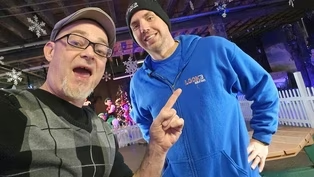
Preview: S8 Ep4 | 30s | Recreational opportunities include The Akron Baseball Project, ice skating and more. (30s)
Providing Support for PBS.org
Learn Moreabout PBS online sponsorship













Support for PBS provided by:
Around Akron with Blue Green is a local public television program presented by WNEO