
January 22, 2026
Season 4 Episode 306 | 26m 30sVideo has Closed Captions
Lawmakers consider changes to a 2025 law meant to protect students and set boundaries.
Lawmakers consider changing a 2025 law that sought to protect students by creating boundaries for communication, U.S. Senator Paul visits Frankfort to applaud efforts to reduce the income tax rate, Gov. Beshear is critical of President Trump's comments on Greenland, and all eyes are on the weather.
Problems playing video? | Closed Captioning Feedback
Problems playing video? | Closed Captioning Feedback
Kentucky Edition is a local public television program presented by KET
January 22, 2026
Season 4 Episode 306 | 26m 30sVideo has Closed Captions
Lawmakers consider changing a 2025 law that sought to protect students by creating boundaries for communication, U.S. Senator Paul visits Frankfort to applaud efforts to reduce the income tax rate, Gov. Beshear is critical of President Trump's comments on Greenland, and all eyes are on the weather.
Problems playing video? | Closed Captioning Feedback
How to Watch Kentucky Edition
Kentucky Edition is available to stream on pbs.org and the free PBS App, available on iPhone, Apple TV, Android TV, Android smartphones, Amazon Fire TV, Amazon Fire Tablet, Roku, Samsung Smart TV, and Vizio.
Providing Support for PBS.org
Learn Moreabout PBS online sponsorshipmusic >> A winter storm that will impact all of Kentucky with heavy snow, the potential for freezing rain for some, and bitter cold temperatures.
[MUSIC] >> So just how much snow will we get and when will it start?
[MUSIC] >> The speech was dangerous.
It was disrespectful and it was unhinged.
>> Governor Andy Beshear in Switzerland blast the president's speech about Greenland.
[MUSIC] .
>> Three.
>> Two.
One.
[MUSIC] >> Who's up?
>> And as America gets ready for birthday number 250, check out this birth announcement.
[MUSIC] >> Production of Kentucky edition is made possible in part by the KET Millennium Fund.
>> Good evening and welcome to Kentucky edition for this Thursday, January the 22nd.
I'm Renee Shaw, and we thank you for spending some of your Thursday night with us.
It's been the talk of school leaders and parents for months.
A 2025 law that sought to protect students by creating boundaries for communication between them and their teachers.
It banned certain electronic communications between them.
Now, state lawmakers say those rules need adjusting.
Our June Leffler kicks off tonight's legislative update.
>> Lawmakers passed a law last session to intervene in the case of inappropriate behavior between students and school staff.
>> Although the grooming of children can happen outside of electronic communications, recent data shows that near 90% of cases of sexual misconduct and grooming happen through this method.
>> So we have serious sexual misconduct.
We have grooming going on.
We have we have unauthorized communications with students without the consent of their parents.
And the legislatures had to step in.
>> Both chambers passed the bill unanimously last session, and the governor signed it into law.
>> And we didn't hear a peep out of anybody until mid-July.
And and all hell broke loose then.
Yeah, but anyway, just note to self what we do.
You know, we do have a lot of watchdogs in this as you've been, you've, you've corrected all the things that were that people have concerns about.
>> State Senator Lindsey Tichenor presents an updated version in Senate Bill 181.
>> We have exempted virtual school instruction, electronic translation services, calling or texting a phone number provided by the parent.
So if a student accidentally picks up the home phone or a parent's cell phone and they call, that would be exempted.
Communications with a parent included as a recipient.
So having those parents, along with the student in in any communication voice communications on a telephone number affiliated with the school, social media posts and comments that are public.
Again, this is specifically tailored toward to address the private communications.
>> The Senate Education Committee passed the bill unanimously.
>> This may not be a simple bill, but it's to me, it's a very simple concept because to me, this bill is all about boundaries.
>> I came into this meeting with the intent to vote no.
I was not going to go down that road again.
Your bill was very unpopular in my district, and I heard about it quite often.
I do appreciate the intent.
I'm not going to commit to voting on the floor.
I want to study this further and I want to hear from those within my district.
But I absolutely do appreciate the intent and the work that you put into this.
>> Obviously, we had a lot of complaints, but what I'm comforted by is it sounds like there's at least eight of our children out there, maybe 16 of our children out there in the last six months that have had somebody looking over their situation that are potential abuse.
16 kids, certainly eight.
That is worth what we did a year ago.
>> Senate Bill 181 now heads to the Senate floor for Kentucky Edition.
I'm June Leffler.
>> Thank you.
June.
Senator Tichenor says passed legislation may have prompted some unnecessary cases to the Educational Professional Standards Board.
A prominent House Democrat is calling on reproductive rights to be restored in Kentucky.
House Minority Caucus Chair Lindsey Burke, from Lexington, was joined by Planned Parenthood and the ACLU of Kentucky in Frankfort today to announce House Bill 22 and 23.
House Bill 22, referred to as the, quote North Star Bill, would restore access to abortion in Kentucky by repealing all existing abortion laws.
House Bill 23, what's called the shield bill, would prevent those seeking reproductive care outside the state from facing criminal and civil charges.
Advocates say these bills give women back the right to make their own health care decisions.
>> Today marks the 53rd anniversary of Roe v Wade, the landmark Supreme Court decision that affirmed the fundamental principle that people, not politicians, should be trusted to make deeply personal decisions about their own bodies and futures.
Roe provided the constitutional framework that allowed patients and providers to make medical decisions based on health, dignity and individual circumstances.
We are here today because those protections are gone and Kentuckians are being denied basic health care, denied care because extremist politicians have forced a total abortion ban on this state without exceptions for rape or incest, all the while ignoring the very real maternal health crisis happening right in front of them.
In fact, Kentucky ranks sixth worst for maternal mortality in the country.
>> The North Star bill is taking us back to where we were before Roe was decided.
It gives medical decisions to a woman and her provider, and it allows the pregnant person to decide for themselves how they want to manage their pregnancy.
Now it doesn't expand access.
So we're not talking about late abortions of babies that could survive outside the womb.
It's the same framework that most of us knew our entire lives.
The shield bill has become even more relevant, and that's protecting providers, doctors, ob-gyns, nurse practitioners, and then the public with protection for providing information about abortion, providing referrals to outside states where patients are still able to access those services so it doesn't course correct anything.
It only says that we're not going to go any further in the wrong direction, as we've seen Kentucky women going to jail and potentially to prison.
We know that.
It's not me crying wolf when I say that Kentucky women are in danger.
It's not just the unintended consequences of negative medical outcomes.
It's also the criminalization and punishment of women for exercising their right and control over their own body.
That continues to motivate me to file these bills.
>> Now.
Representative Burke introduced both of those measures last session.
Neither received a hearing.
She says she expects the bills to move further along this time around.
Legislators and advocates reintroduced another bill that didn't make it to the finish line last year.
The Family Preservation and Accountability Act aims to keep justice involved.
Families together.
>> They probably pled guilty.
Most cases are pled.
So you have folks who are taking responsibility for what what crimes they've committed, but they're ready to move on.
And sometimes they're granted probation, sometimes they're not.
I think it is important to consider if that person has children or not.
When we make that probation or incarceration decision.
So that's my goal behind this bill is to not only look closely at that, but also to provide those resources that are not really available right now.
There's not really a parenting class available for somebody who's incarcerated or on probation or facing charges.
>> It empowers the judges to use community based sentencing for primary caregivers convicted of low level, nonviolent offenses.
So this approach is fiscally responsible.
It costs so much less than incarceration.
It reduces repeat offenses.
And most importantly, it produces better outcomes for our kids.
So this bill does not excuse wrongdoing.
It does not weaken public safety.
And in fact, it improves it.
We know that stable families are one of the strongest foundations for a healthy society.
>> The first time I ever stood in front of a judge, I asked for help.
I didn't want to be that way because I was incarcerated with dozens of women who felt exactly like I did, who were trying to build connections with their children over a 15 minute, monitored phone call.
We together have the power to extend a helping hand instead of shutting a door.
What we're asking is one question in a courtroom and a few moments of thought.
We have a really, really, really big opportunity to make a really impactful interventions in these families and keep these moms home with their babies, keep them in rooms where they can hug and love on them.
>> Advocates say about 12% of Kentucky children have incarcerated parents.
As we mentioned yesterday, a Senate Republican has proposed new financial disclosure requirements for Kentucky's public schools.
Republican State Senator Lindsey Tichenor is the sponsor of Senate Bill three.
Yesterday, she told us why she thinks the bill is needed.
>> For public to have.
>> Access to the process of budgeting, requiring the superintendent to provide that to the board two weeks in advance and then present it publicly throughout the whole budgeting process starting in January, all the way through to the final product in the working budget.
It's also going to require our districts to have some fiscal transparency on on their expenditures, on their credit card statements and on their internal audits that they do.
And all of that will be listed on their website for the public to see.
And it's really just about financial transparency.
It's about good stewardship, and it's common sense measures that our taxpayers want to know that their tax dollars that they work hard for are being utilized in the most responsible way to educate the students of Kentucky.
>> The bill also requires districts to maintain a budget reserve, rather totaling 2% of the district's annual budget, something Senator Tichenor proposed in light of millions of dollars in budget shortfalls in Kentucky's two largest school districts.
That reserve would need to be about $37 million for Jefferson County Public Schools and $16 million for Fayette County Public Schools.
That's based on current budgets.
Kentucky's junior U.S.
Senator, Rand Paul, was in Frankfort today to speak to Republican lawmakers.
Senator Paul applauded the efforts of the supermajority to reduce the income tax rate, and said he's aligned with the state's efforts to make unhealthy foods ineligible to be purchased by food stamps.
>> I'm also here.
>> As a constituent to be complimentary of the job they've been doing.
I am very proud of the fact that they've kept the rainy day fund positive.
They're prepared for emergencies.
I'm proud that they're reducing the income tax for Kentuckians so we can compete with Tennessee and other states.
And I'm also very proud that they reined in unlimited gubernatorial power, not just for one party, but for all parties, such that if there ever are draconian rules that are placed on the public, they now ought to be passed by the legislature.
One thing I've been advocating for at the federal level, which I think they're also working on at the state level, is I think unhealthy foods should not be paid for by the taxpayer.
We don't pay for alcohol.
We don't pay for cigarettes.
I don't think food stamps should pay for unhealthy food.
I think sugar added to a drink is an unhealthy food.
We shouldn't subsidize it.
I think candy in a bag is unhealthy food.
We shouldn't subsidize it.
Chips, you know, Ding dongs, Twinkies.
There's a lot of stuff that we all kind of eat occasionally, but we shouldn't be encouraging.
The highest rate of obesity is among our poor population.
Highest rate of diabetes two largely related to obesity in our poor population.
>> House Speaker David Osborne says work on a measure that is resembling what Paul talked about is almost finished, and it should be filed soon.
Senator Paul also had some thoughts about President Donald Trump's attempt to take over Greenland.
Yesterday, President Trump backed off his threat to impose new sanctions on European nations that refuse to back his plans for Greenland.
And while speaking in Switzerland, he said he would not use force to take Greenland.
Senator Paul said the president's approach to Greenland has been a mistake.
>> You know, I think if you want to buy something, if I want to buy a horse from you, I probably wouldn't insult you and say, I'm going to come take the horse if you don't sell it to me.
It's not a good negotiating strategy if you were unsure, and it was a great racehorse and you were thinking about keeping it for another year, and I really wanted it, I'd probably take you to dinner.
I'd probably say nice things to you.
I'd probably compliment you and try to get you to negotiate a price on the horse.
It's just not a good strategy to say people were coming.
We're coming now.
He's saying we're not coming, but there's no Democrat support for invading Greenland with military force.
I think there's none on the Republican side.
It hasn't been as as vocal as I have, but I haven't heard anybody even privately saying, oh, yeah, it's a good idea to send the Marines to Greenland.
So I think it will fade.
He says he has a new deal.
I think the new deal is going to be what we actually already have.
That's the right to put more military bases.
They have said we virtually have unlimited ability and rights and prerogative to put more soldiers and more military bases, I think from a previous treaty, and I don't think Denmark has been objecting that to the whole time.
I don't think Greenland has.
That will bring some income to Greenland, but they still would be independent of the United States now if they wanted to be sold.
And it was a reasonable price.
I'm not against considering it, but I would just go about it in a different way now.
>> Governor Andy Beshear was there when the president spoke in Switzerland at the World Economic Forum.
He had some harsh reaction to what he said and how the president said it.
>> The speech was dangerous, it was disrespectful, and it was unhinged.
You saw him calling into question alliances that have kept our world stable for my entire lifetime.
You saw him make fun of world leaders in the room who we call friends.
You saw him ramble on in stories and even try to do voices.
I mean, this is really concerning.
And for the United States, frankly embarrassing.
>> Did it reassure you at all that he said he would not use military force?
So he basically made the argument that he could, that he would not use military force to take Greenland.
>> He spent probably a quarter of his speech talking about our military might, talking about different things in recent operations in Venezuela, saying maybe others should think about doing things like that, too, because of the bargaining that comes after it.
No, I think leaders are leaving more concerned after that speech than ever before, especially in the way that he talked about Greenland that apparently was so important to him.
He called it Iceland numerous times.
>> Now, while there, the governor is also taking part in discussions about Kentucky's economy.
Today.
He was part of a panel talking about the lack of economic growth among the middle class since the Covid pandemic.
Today, the Bluegrass Community Foundation announced an anonymous $1 million Challenge match to seed a new permanent civic education endowment fund for Civic Lex.
Civic Lex is a nonprofit organization that seeks to help their community understand and get involved in local civic issues, connecting with their neighbors, and make decisions that better engage the public.
Over the past three years, they've been building a civics education program for Fayette County Public Schools, and this endowment fund would help them expand to more schools throughout the district.
A donor's.
>> Why is what motivates their generosity for this couple.
They believe an important part of their success is being informed, engaged and active citizens.
They strongly believe that every child should have access to a quality education, and that an essential part of that education is a robust civic education that accomplishes three objectives one.
Equipping students with the information and skills to understand local, state, and national governance and how to make a difference.
Two fostering a commitment to democratic principles and promoting the common good, and three inspiring students to be informed, engaged participants in civic life.
>> This is going to be a significant opportunity for us moving forward, I think, for young people to have access for all young people in Lexington, to have access to high quality civic education that's locally grounded, that helps them understand what their role can be.
And getting involved here in Lexington, we think, could be pretty profound.
And having this gift be an endowment will allow it to exist in perpetuity.
And so, you know, 20 years from now, 30 years from now, this endowment will still be powering high quality youth civic education here in Lexington.
>> This new endowment will significantly scale up what Fccps students learn and will make Fayette County the envy of and a model for counties across the Commonwealth and communities in other states.
So civics is not just about memorizing facts and taking a test.
Civics is a way of life.
And it's not just about improving education or improving government.
It's about improving our workforce.
Research from the US Chamber of Commerce Foundation finds that many of the skills that are necessary to succeed in the 21st century workforce skills like civility and cooperation are associated with higher levels of civic education.
So there's no false choice between teaching civics to train citizens and our interest in training a workforce.
>> Change doesn't happen without collaboration, and that's one of the key skills that that civics teaches our students is how to work together, how to talk to people that you may not necessarily always agree with, and walk away in a way that can bring you back together the next time.
>> All contributions made to the endowment between now and December 31st, 2029 will be matched dollar for dollar, up to $1 million.
[MUSIC] All eyes are on the weather forecast.
Snow, ice and freezing rain are all possibilities this weekend.
There's even a chance some parts of Kentucky will see some double digit snowfall totals.
Meteorologist Christy Dutton is in our Louisville studio, with the latest on what is shaping up to be a major storm.
Christy.
>> That's right, a winter storm that will impact all of Kentucky with heavy snow, the potential for freezing rain for some, and bitter cold temperatures.
This is all going to begin as snow on Saturday.
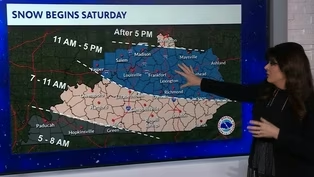
And when you start to see those first snowflakes fly, well, that all depends on where you live, as this system will be moving from the south up toward the north, you're expected to start to see those first snowflakes in western Kentucky around Paducah, Hopkinsville, perhaps even before sunrise or right around sunrise from 7 to 11 a.m.
you'll start to see that first snowfall for Owensboro, Campbellsville, Russell Springs, London, Harlan, now around noon, or perhaps even into the afternoon until 5:00, you'll start to see that snow working its way up toward Louisville, Frankfort, Lexington, Morehead, Ashland, and then finally reaching Northern Kentucky after 5 p.m.
on Saturday.
The big question is, how much snow are we going to see?
Since this system is still a couple days out, we still have some uncertainty about exact snow total predictions.
However, this map from the National Weather Service shows where we expect to see the heaviest snow on the current predicted storm track, which could be updated as we get closer to this storm.
This is the probability of seeing eight inches of snow or more, and you can see that probability of eight inches of snow or more 70% chance right here for central Kentucky and northeastern Kentucky that includes Lexington, Louisville, Morehead, Ashland, Cincinnati and all the way down toward Richmond.
Notice that probability is a little bit lower for southern Kentucky.
That's because in southern Kentucky, around the Kentucky Tennessee border, you may see some freezing rain mixing in with this early Sunday morning.
And that's really going to cut back on your snow totals after this whole system is gone and all the snow is on the ground, we are expecting another weather hazard and that's going to be dangerously cold temperatures.
Take a look at these temperature predictions from the National Weather Service out of Louisville.
Expecting one degree for that overnight low Monday and Tuesday.
Really these this these two days we're expecting the coldest temperatures.
And that's in Bardstown zero there for Campbellsville for overnight lows for Monday and Tuesday, five degrees for Louisville and one for Richmond, Kentucky.
And now these predictions will be updated from the National Weather Service.
And speaking of which, we're going to be talking to the National Weather Service for tomorrow as this system gets a little bit closer to us of what we should expect, the latest predictions, what we need to prepare for, and we'll also have the latest thinking of predicted snow totals across the state of Kentucky.
We'll have all that for you on Kentucky Edition tomorrow.
>> Officers with the University of Kentucky Police Department are now better equipped to go into high risk situations.
The department is the latest law enforcement agency to get new gear under the Body Armor Grant program through Kentucky's Attorney General's office, the Kentucky attorney or the Kentucky General Assembly allocated $15 million in 2024 to start the program, according to the AG's office.
Before the program, 20% of Kentucky law enforcement was wearing expired body armor or none at all.
That number has dropped to 1%.
The AG's office gave UK police 29 vests.
More than 2400 have already been given out to law enforcement officers in the state.
Attorney General Russell Coleman says his office plans to ask state lawmakers for an additional $10 million to continue the program.
He says it's an investment that can save lives.
>> I've seen this stop.
Three rifle rounds up close.
This is the difference in one of these deputies going home at night.
We don't put a price tag on that.
In fact, we're good stewards of the money that the General Assembly will give us.
One of these shields runs $10,000, 10 to $12,000 for one of those large shields.
One of these, approximately $1,000 deputy commissioner.
So on its face, this isn't a substantial investment.
But alongside the lives that we're saving and what we're asking these men and women to do, it is the best money we spend as a commonwealth.
>> Coleman says.
For the next phase of the program, he wants to start outfitting school resource officers with body armor as well.
[MUSIC] The U.S.
has a big birthday this year, 250 years.
Louisville was in the spirit yesterday as the city unveiled a copy of the Declaration of Independence, printed in 1823, 203 years ago.
The unveiling helped kick off Louisville's yearlong celebration of America's birthday.
Mayor Craig Greenburg talked about how the Declaration's message from 1776 still resonates today.
>> The declaration is honest about grievance, bold in its moral clarity and radical in its claim that power belongs not to kings, not to strongmen, but to the people themselves.
The declaration does not speak softly.
It asserts that rights are inherent, that power must be accountable, and that we, the people, are the ultimate stewards of a free nation.
>> The public can see the copy of the declaration from now until Labor Day.
The sons of the American Revolution Genealogical Research Library on West Main Street.
So check it out if you can, and check us out again tomorrow at 630 eastern, 530 Central on Kentucky Edition, where we inform, connect and inspire.
Lots of great coverage from the General Assembly.
Also, Christie Dutton is back about this weekend's winter weather forecast.
You'll want to be here to see that and to get prepared for what could come.
Thanks for being with us tonight.
We hope to see you right back here again tomorrow night.
Bundle up, go to the grocery store and take good care, and I'll see you soon.
[MUSIC]
Video has Closed Captions
Clip: S4 Ep306 | 3m 19s | Kentucky could get snow, ice, and freezing rain this weekend. (3m 19s)
Changes Possible to Student-Teacher Communication Bill
Video has Closed Captions
Clip: S4 Ep306 | 3m 23s | Lawmakers Dial Back on Bill Restricting Student-Teacher Electronic Communication. (3m 23s)
Providing Support for PBS.org
Learn Moreabout PBS online sponsorship
- News and Public Affairs

Top journalists deliver compelling original analysis of the hour's headlines.

- News and Public Affairs

FRONTLINE is investigative journalism that questions, explains and changes our world.












Support for PBS provided by:
Kentucky Edition is a local public television program presented by KET