
January 22, 2026 - PBS News Hour full episode
1/22/2026 | 57m 46sVideo has Closed Captions
January 22, 2026 - PBS News Hour full episode
January 22, 2026 - PBS News Hour full episode
Problems playing video? | Closed Captioning Feedback
Problems playing video? | Closed Captioning Feedback
Major corporate funding for the PBS News Hour is provided by BDO, BNSF, Consumer Cellular, American Cruise Lines, and Raymond James. Funding for the PBS NewsHour Weekend is provided by...
Support provided by:

January 22, 2026 - PBS News Hour full episode
1/22/2026 | 57m 46sVideo has Closed Captions
January 22, 2026 - PBS News Hour full episode
Problems playing video? | Closed Captioning Feedback
How to Watch PBS News Hour
PBS News Hour is available to stream on pbs.org and the free PBS App, available on iPhone, Apple TV, Android TV, Android smartphones, Amazon Fire TV, Amazon Fire Tablet, Roku, Samsung Smart TV, and Vizio.
Providing Support for PBS.org
Learn Moreabout PBS online sponsorshipAMNA NAWAZ: Good evening.
I'm Amna Nawaz.
GEOFF BENNETT: And I'm Geoff Bennett.
On the "News Hour" tonight: President Trump# la.. rebuilding of Gaza, as European leaders hold# an emergency summit on transatlantic tensions.
AMNA NAWAZ: A massive winter storm is set to## deliver damaging ice and heavy# snow to nearly half the U.S.
GEOFF BENNETT: And we examine# the Trump administration's## hard-line immigration crackdown# a year into its implementation.
JOHN SANDWEG, Former Acting ICE Director: You# can do this without all of this chaos.
And## I'd like to see ICE return to those tactics,# where we're focused on public safety first.
(BREAK) GEOFF BENNETT:## Welcome to the "News Hour."
President Trump is back at the White House# tonight.
He .. a whirlwind trip to Davos for the World Economic# Forum, where he seems to have defused a crisis## he first created by insisting the U.S.
acquire# Greenland, a self-governing territory of Denmark.
Leaders across Europe roundly# criticized and rejected a U.S.
takeover.
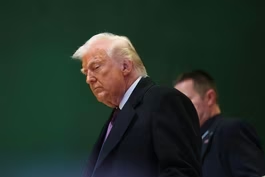
AMNA NAWAZ: Trump also presented his plan for what# he calls the Board of Peace, which he would chair,## in order to establish and oversee the cease-fire# and postwar plans for Gaza.
But, already,## the American president has expanded the proposed# board's purview to conflicts around the world.
MAN: Please welcome the chairman of the Board of## Peace, the president of the United# States of America, Donald J. Trump.
(APPLAUSE) AMNA NAWAZ: In Davos today, President Trump officially introducing# what he calls the .. DONALD TRUMP, President of# the United States: Together,## we are in a positi.. I don't even call it a chance, I think it's# going to happen, to end decades of suffering,## stop generations of hatred and bloodshed, and# forge a beautiful, everlasting and glorious peace.
AMNA NAWAZ: So far, some 35 nations have# signed on, many attending today's ceremony,## from Argentina and Bulgaria to Qatar# and Saudi Arabia to Turkey and Mongolia.
Some, including Canada, Germany and Israel,# have joined, but were absent today, and others,## like France and Britain, have rejected# the invitation.
The rollout of the board,## born of a peace plan for postwar# Gaza, was accompanied by this.
MAN: Thank you, ladies and gentlemen.
(APPLAUSE) AMNA NAWAZ: A pl.. DONALD TRUMP: See, I'm a real estate person at# heart, and it's all about location.
And I said,## look at this location on the sea.
Look# at this beautiful piece of property,## what it could be for so many people.
Special envoy Steve Witkoff and# Trump's son-in-law, Jared Kushner,## presented the vision, a $25 billion# proposal for gleaming skyscrapers,## 100,000 housing units, 75 medical centers,# and an expected GDP of $10 billion by 2035.
JARED KUSHNER, Former Senior Presidential# Adviser: I think that the war's over.
Let's## do our best to try working together.
Our# goal here is peace between Israel and## the Palestinian people.
Everyone wants to live# peacefully.
Everyone wants to live with dignity.## Let's put our efforts towards promoting those# who are doing the work to build this up.
AMNA NAWAZ: But there are no representatives# from Gaza on the board overseeing its future.
And on the ground, Olfat Al Shawaf,## still displaced from her home,# is skeptical of the plans.
OLFAT AL SHAWAF, Displaced Palestinian# (through translator): Honestly,## I don't expect not even .. reconstruction?
What reconstruction?
Let them# remove the rubble first, then start rebuilding.
AMNA NAWAZ: Trump has already expanded the board's# scope beyond Gaza to other conflicts around the## world, raising concerns about how the group he# chairs works with or around the United Nations.
DONALD TRUMP: Once this board is completely# formed, we can do pretty much whatever we want## to do, and we will do it in conjunction# with the United Nations.
You know,## I have always said the United Nations has# got tremendous potential, has not used it.
AMNA NAWAZ: Meanwhile, in Brussels, an# emergency summit for European leaders## to discuss Greenland's future a# day after President Trump walked## back military threats of a U.S.
takeover# and proclaimed a deal was in the works.
Before the meeting, Denmark's prime# minister reiterated her nation's red## line that the island, home to# 55,000 people, is not for sale.
METTE FREDERIKSEN, Prime Minister of Denmark:# We have said from the very beginning that a## discussion about our status as a sovereign state,# it cannot be discussed, it cannot be changed.
We## are willing to work together with the U.S., of# course, as we have always done, about security.
AMNA NAWAZ: Greenland strategically sits# in the middle of the shortest route for## land-based missiles and bombers between the# U.S.
and Russia.
And experts worry that,## as the ice melts, sea lanes open up,# including to Russian and Chinese ships.
Despite no official details for a deal yet,# Trump declared the U.S.
would have total access.
DONALD TRUMP: We're going to have all# military access that we want.
We're## going to be able to put what we need on Greenland,## because we want it.
We're talking about# national security and international security.
AMNA NAWAZ: And our foreign affairs correspondent,## Nick Schifrin, has been covering# this all and joins me now.
And, Nick, let's start with what# the president said about Greenland.## Total military access, what does that mean?
NICK SCHIFRIN: Multiple European officials tell me# tonight there is no agreement for what that means,## but there is a framework.
So that would# include more U.S.
bases on Greenland.
It## would include guaranteed American mineral# rights for mining on Greenland.
It would## be increased NATO presence, not only# around Greenland but across the Arctic.
And Chinese and Russian military and investments# would be specifically excluded.
There will be## two tracks moving forward, Amna.
The U.S.
will# negotiate directly with Denmark and Greenland over## the fate of the island itself.
Could that end up# with American sovereignty over bases in Greenland?
Despite what you have just heard from the prime# minister, one senior European official actually## tells me it's too early to tell the answer to that# question.
Secondly, NATO will increase its Arctic## presence with the goal of having actual plans# for that increased presence by a summit in July.
So this is just the beginning of the process.# But nothing we just talked about was what the## president has been demanding, which is# ownership over Greenland.
So, clearly,## he decided to take an off-ramp.
And to extend# the metaphor, European officials are asking me## whether there is like a 17-car pile-up in# the rearview mirror that he left behind.
What is the lasting impact of all of# this Greenland talk on the transatlantic## alliance?
European officials I talked to are split# between saying this is a real rupture and saying,## no, we have no choice.
We will# continue to rely on the U.S.
AMNA NAWAZ: So for those# who think it is a rupture,## why is that?
Why has this moment been so harmful?
NICK SCHIFRIN: I think there's a# psychological sensitivity to the## president flying to Europe to disparage Europe.
Yesterday in Davos, he said# of NATO -- quote -- "We have## helped them for so many years.# We have never gotten anything."
And that offends Denmark especially.# More Danish troops died in Afghanistan## per capita than U.S.
troops died# in Afghanistan.
And then there's## the reality of the relationship.
European# officials told me they are relieved that## the president has taken off the table# the military, the economic threats.
But multiple officials also# said to me they don't know## if that will be the president's policy tomorrow.
AMNA NAWAZ: Nick Schifrin, thank you, as always.
NICK SCHIFRIN: Thank you.
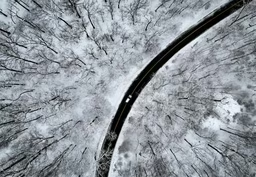
GEOFF BENNETT: A sprawling and# potentially devastating winter## storm is projected to slam a massive# swathe of the country tomorrow and## through the weekend from New Mexico# all the way to Northern Maine.
Heavy snow, life-threatening cold and dangerous# ice accumulation are all in the forecast.
More## than 130 million people are currently under# winter storm alerts, and nearly every American## east of the Rockies will be affected.
That's# according to the National Weather Service.
To help break down what we expect# to see and how you can prepare,## we're joined now by MyRadar senior# meteorologist Matthew Cappucci.
Thanks for coming in.
MATTHEW CAPPUCCI, Senior## Meteorologist, MyRadar: Yes,.. I have to say, the scale of this st.. the fact that we have roughly 1,800 miles# nonstop of winter storm alerts, watches,## warnings from Arizona all the way to the# East Coast shows just how big this storm is.
It's getting going right now off the U.S.# West Coast.
That's an upper-level pocket of## cold air or low pressure and spin, this big# swirly twirl on the water vapor satellite.## It's kind of the impetus for the# storm system.
But you will notice## it's still offshore.
So we can't# launch weather balloons into it.
And so actually last night the hurricane# hunters, those folks who fly into hurricanes,## flew into this storm to collect data to help us# figure out what this thing's going to do.
We pump## that into models.
And you can see just an absolute# mess on the simulated radar, rain, snow, sleet,## freezing rain, the worst of everything from New# Mexico, Texas all the way to Southern New England.
GEOFF BENNETT: What does the forecast say about# snowfall?
Where do we expect to see the most?
MATTHEW CAPPUCCI: So I think the# snow jackpot should be in roughly## a 50-to-100-mile-wide zone north of the# rain/snow line.
It starts near Oklahoma City,## pushes northeast all the way towards# D.C., Baltimore, Philly, New York City.
All those places have a roughly 50/50# shot of seeing a foot or more of snow,## Tulsa probably 12 to 18 inches.
Then# Southern Missouri, the Bootheel,## Western Kentucky along the Ohio River, that's# where the worst will be.
But in addition to that,## on the southern side.
It's not just the snow.# It's the sleet and the freezing rain too.
GEOFF BENNETT: And what about the life-threatening# cold?
There's also threats of ice accumulation.
MATTHEW CAPPUCCI: Yes, the ice accumulation# is really what worries me the most,## because for folks at home, ice happens when you# have rain that essentially falls as a liquid## and then turns into ice on the ground,# given sub freezing surface temperatures.
In that freezing rain zone,# temperatures might be in the## mid-40s a mile above the ground.# So liquid rain is going to fall,## but the surface might be 25, 30 degrees.# So all that liquid freezes on the ground.
Two main areas.
I'm really watching for the worst# ice accretion, I think Northwestern Mississippi,## Northeast Louisiana, probably south# of Memphis along Interstate 55,## that's the zone I'm really watching# for potentially significant ice## accretion.
We're talking like a# half-inch to an inch in spots.
And it only takes about a -inch of# ice to pull down the power lines,## get power outages, the roads impassable# probably from Friday night all the way## through Monday morning.
And then behind# it, of course, the cold comes in.
The other zone I'm really watching, northeast of# Atlanta into for example the Western Carolinas,## Asheville, Greensboro, Spartanburg, Greenville.# I'm really worried that cold air at the surface## draining down the Appalachians will# keep the surface subfreezing even when## it's warmer upstairs, so again serious ice# accretions possible northeast of Atlanta.
And I wouldn't even be surprised for some thunder# sleet and thunder ice to mix in too, thunder... GEOFF BENNETT: Thunder ice.
MATTHEW CAPPUCCI: Thunder,# ligh.. GEOFF BENNETT: All right, Matthew, so# two questions.
What are the dangers## of this type of weather and what# should people be doing to prepare?
MATTHEW CAPPUCCI: You know, I'm really concerned# about both the snow and the ice, especially,## because, snow, you can pre-treat.
You# can put stuff down in the roadways.
Ice comes down as a liquid and it washes# away any pretreatment.
So I think it's## going to be like a skating rink for a lot# of people until the middle of next week.
And the worst part, given these cold# temperatures invading, there's nothing## to really melt this until the end of next# week.
Look at temperatures early Monday## morning.
We're talking negative double digits# over the Upper Midwest, the Northern Tier,## excessive cold warnings in effect for a wide# area from really Minnesota down to Oklahoma City,## single digits, below zero, Little Rock, Oklahoma# City, single digits above zero in Texas.
And given how much ice is coming down, I think# a lot of folks will likely lose power too.
So## you have systematic -- the issues with# vulnerability.
You're going into a cold## air outbreak with a lot of people who won't# have power.
I'm very worried about that.
So, given the forecast, I'd say bundle up.# Make sure you have everything you need for## about three to five days off the grid.# Make sure you're taking care of elderly,## vulnerable neighbors, loved ones, and ultimately# having a plan to hunker down for days on end.
GEOFF BENNETT: That is good advice.
Matthew Cappucci, our thanks to you, as alwa.. MATTHEW CAPPUCCI: Thank you.
GEOFF BENNETT:## In the day's other headlines: President# Trump is suing J.P.
Morgan Chase and its CEO,## Jamie Dimon, for $5 billion saying# the company closed his accounts for## political reasons after he left office in 2021.
The lawsuit alleges the decision, known as# debanking, abruptly cut the Trump Organization## off from access to millions of dollars and# disrupted its operations.
In a statement,## J.P.
Morgan said the suit lacks merit,# adding that the company does not close## accounts for political or religious reasons.# Trump and other conservatives have accused## banks of improperly cutting off their# accounts following the January 6 attack.
In Davos, Switzerland, earlier# today, President Trump met on the## sidelines of the World Economic Forum with# Ukrainian President Volodymyr Zelenskyy.
QUESTION: How was your meeting with President# Trump?
Mr.
Zelenskyy, how was the meeting?
VOLODYMYR ZELENSKYY, Ukrainian# President: The meeting was very... GEOFF BENNETT: Their meeting happened away from# the cameras, but afterwards .. the word good when describing the talks.# And in his address to the forum, Zelenskyy## cited progress on peace efforts and called on# Russia to come to the table to end the war.
VOLODYMYR ZELENSKYY: The documents# aimed at ending this war are nearly,## nearly ready.
Ukraine is working with full# honesty and determination.
And that brings## results.
And Russia must become ready too# to finish this war, to stop this aggression.
GEOFF BENNETT: Zelenskyy was also critical of# Europe's slow and disjointed response to the war## in Ukraine, comparing his repeated warnings of the# threat Russia poses to the film "Groundhog Day."
It comes as President Trump's envoys Steve# Witkoff and Jared Kushner are in Moscow,## where they met with Russian President Vladimir# Putin.
Meantime, on the ground in Ukraine,## the latest Russian strikes hit the Eastern city of# Dnipro, where at least seven people were injured.
Today marks America's official withdrawal# from the World Health Organization one year## after President Trump signed an executive# order setting the nation's exit in motion.## The pullout threatens to plunge the# WHO into an even deeper budget crisis,## with Washington long being the health# agency's biggest financial backer.
The U.S.
is also leaving behind a# $260 million bill in unpaid fees,## even as it's required by law to pay all# outstanding debts.
The State Department## today argued that: "The American people have# paid more than enough to this organization,## and this economic hit is beyond any# financial obligations to the organization."
In Australia, a gunman who shot and killed three# people and injured one more remains at large.
The## suspect shot two couples in two separate locations# in the small town of Cargelligo in New South## Wales.
Police say the shooting will have a lasting# impact on the town of only about 1,500 people.
ANDREW HOLLAND, Assistant Commissioner, New# South Wales Police: What I will say is that,## again, it's a tragedy that's taken# place in a very small country,## and it will have a big effect on the community.
GEOFF BENNETT: The latest shooting took place as# that country observed a national day of mourning## for the 15 victims of last month's massacre# during a Bondi Beach Hanukkah celebration.
At a service in Sydney's iconic Opera# House, attendees lit candles and## heard from the country's prime minister, who# apologized for failing to prevent the attack.
Here in the U.S., a closely watched reading on# inflation ticked higher.
The Commerce Department## said today that the Personal Consumption# Expenditures Price Index rose 2.8 percent in## November from a year earlier.
That's a bit# more than the month before, and above the Fed's## preferred target of 2 percent.
Today's report# was delayed by last year's government shutdown.
Meantime, on Wall Street today, stocks continued# their rebound as tariff concerns ease.
The Dow## Jones industrial average added around 275# points on the day.
The Nasdaq rose nearly## 200 points.
The S&P 500 has now recovered# much of its losses from earlier in the week.
And a blues-infused vampire# epic has made Oscar history.
MAN: "Sinners."
(CHEERING) WOMAN: Michael B. Jordan in "Sinners."
(CHEERING) WOMAN: And Ryan Coogler, "Sinners."
GEOFF BENNETT: The film "Sinners" is# nominated for a record 16 Academy Awards,## including best picture.
That# breaks the previous record of## 14 nominations set by "All About# Eve," "Titanic" and "La La Land."
The action-packed "One Battle After# Another," starring Leonardo DiCaprio,## trails just behind with 13 nods.
Both# films made the cut in a brand-new category,## best casting, alongside "Hamnet," "Marty Supreme,## and "The Secret Agent."
The 98th Academy# Awards ceremony will air on Sunday, March 15.
And longtime Vatican reporter, author and# friend of this program John Allen Jr.
has## died.
The Kansas native covered multiple popes# starting in 1997 first for The National Catholic## Reporter and later The Boston Globe.
Allen# was also a frequent "News Hour" contributor,## sharing his insights as recently as last year for# a report about the conclave that elected Pope Leo.
John Allen Jr.
passed away today after a# long battle with cancer.
He was 61 years old.
Still to come on the "News Hour": former special# counsel Jack Smith faces congressional scrutiny## over his investigations into President Trump; a# Texas jury acquits a former Uvalde police officer## for failing to act quickly enough during the# Robb Elementary School shooting; and we examine## the president's confrontational approach to the# U.S.
court system one year into his second term.
AMNA NAWAZ: Vice President J.D.
Vance was in# Minneapolis today, as federal agents continue to## clash with protesters two weeks after an ICE agent# shot and killed 37-year-old mother Renee Good.
Vance had this message for city residents: J.D.
VANCE, Vice President of the United# States: Do we want these things to happen?## Do we want these arrests to be so chaotic?# No, we don't.
These guys want it least of## all.
But if we had a little cooperation# from local and federal -- or -- excuse## me -- from local and state officials, I think# the chaos would go way down in this community.
AMNA NAWAZ: This is just the latest development# in what's been a turbulent year as President## Trump has carried out his campaign promise# to crack down on illegal immigration.
Liz Landers takes a closer look.
DONALD TRUMP, President of the United States:## First, I will declare a national# emerge.. (APPLAUSE) LIZ LANDERS: Pre.. to crack down on immigration, signing# executive orders his first day in office## designed to expedite removal and reinterpret# the Citizenship Clause of the Constitution.
Border crossings began to drop soon after# and are down dramatically year to date, a## 93 percent reduction, according to the Department# of Homeland Security.
The agency estimates## 1.9 million self-deportations and 622,000# deportations have taken place in the last year.
DONALD TRUMP: This was an invasion.
This wasn't## people coming in.
This was# an invasion of our country.
LIZ LANDERS: But the administration quickly# ran into legal challenges with some deportation## measures when it deported more than 200# Venezuelan men to a notorious Salvadoran prison.
DONALD TRUMP: These were bad people.
That# was a bad group of, as I say, hombres.
LIZ LANDERS: The president invoking the# little used Alien Enemies Act of 1798,## claiming the men were part of the Venezuelan gang# Tren de Aragua, among them Kilmar Abrego Garcia,## a Maryland man with no criminal record, deported# despite a court order barring his removal.
Abrego Garcia was eventually returned to the# U.S.
and is now challenging efforts to deport## him to a third country.
A ruling is expected# next month.
The arrest of Mahmoud Khalil,## a Columbia University graduate student# and pro-Palestinian activist, signaled## a crackdown on international# student visas in early March.
MARCO RUBIO, U.S.
Secretary of State: We gave# you a visa to come and study and get a degree,## not to become a social activist that# tears up our university campuses.
LIZ LANDERS: In total, more than 8,000# student visas revoked in the past year,## the State Department says.
The Trump administration has also moved# to narrow pathways for legal immigration,## using executive orders to institute travel# bans in June, revoke humanitarian programs## that shielded migrants from deportation# and cut refugee admissions to record lows.
The shooting of the two National Guardspeople# in the nation's capital in November prompted## a further tightening of visas.
Also this year,# the administration began a controversial rollout## of deportation operations in major sanctuary# cities across the country, with agents often## masked arresting immigrants at workplaces,# courthouses, even Home Depot parking lots.
In June, fiery protests in Los Angeles caused# President Trump to send in National Guard troops.
DONALD TRUMP: These are paid insurrectionists.# These are paid troublemakers.
LIZ LANDERS: Prompting the president to# float the idea of using the Insurrection Act,## which would allow the president to use# the military in a domestic setting.
It's## a threat he's continued to make into the new year.
KRISTI NOEM, U.S.
Homeland Security# Secretary: We did discuss the## Insurrection Act.
He certainly has th.. LIZ LANDERS: Those targeted operations spread# nationwide to Chicago, Charlotte, New Orleans,## and, just this week, Maine, all this bolstered# by a surge in funding after the president's## signature tax and spending bill passed in the# summer, tripling the annual budget for ICE.
The administration faced significant# legal pushback in Chicago,## when a federal judge there determined# Customs and Border Patrol official## Greg Bovino was overstepping his# authority in handling protesters.
GREGORY BOVINO, Border Patrol Commander: The use# of force that I have seen has been exemplary, and,## by exemplary, I would say, the least amount# of force necessary to accomplish the mission.
LIZ LANDERS: In the aftermath of# the killing of an unarmed woman,## Renee Good, by an ICE officer in# Minneapolis, protests flared again.
White House Deputy Chief of Staff Stephen# Miller with this message to ICE officers: STEPHEN MILLER, White House Deputy# Chief of Staff: You have federal## immunity in the conduct of# your duties,.. lays a hand on you or tries to stop you or# tries to obstruct you is committing a felony.
LIZ LANDERS: But Democrats are hoping to# use the latest incidents to reduce funding## or force changes to immigration enforcement# if they do well in the midterm elections.
Joining us now to discuss all of this are# Chad Wolf.
He's a former acting secretary## of homeland security in the first Trump# administration and the current executive## director of the America First Policy Institute,# a conservative think tank.
And John Sandweg,## the former acting director of# ICE in the Obama administration.
Thank you both for joining us.
Chad, I want to start with you.
The president campaigned on this issue# of cracking down.. getting rid of people who are in the country# illegally.
But some of these chaotic scenes## that we're seeing out of Minneapolis, just# this week, we have seen CBP officer Bovino## using a smoke canister to clear a crowd, some of# this is causing public opinion to turn on him.
Polls are showing that a majority# of Americans think that ICE is## going too far.
Could this become a# political problem for the president?
CHAD WOLF, Former Acting U.S.
Secretary# of Homeland Security: Well, I think it's## certainly a political is.. I think it's important to remember, as# you indicated,.. very aggressive agenda, and the American people# agreed with him, but first to secure the border,## which I think most Americans would agree that has# happened.
We have record low apprehension numbers.
The second part, which is the most difficult# part, is to figure out where the millions## of folks went to that came across that# border during the Biden administration,## and then to remove the ones that don't have a# legal right to be here.
So that's what they're## doing in places like Minneapolis, Chicago,# but other places, like Texas and Florida,## also have a very high illegal alien population,# but you don't see those making the news, right?
You don't see big operations in Florida and Texas# making the news, and why is that?
Because you## have local law enforcement that support them.# And so places like Minneapolis and others are## really the exception to the rule, the rule# being that that close support with local## law enforcement really makes ICE's job, they# really do it outside of the limelight, right?
But when you don't have that,# then ICE is in the forefront.
LIZ LANDERS: John, speaking of how ICE# operates, yesterday, we learned about an## internal ICE memo that authorizes officers# to use force to enter a residence without## a judge's warrant to arrest someone with# an administrative final order of removal.
Vice President Vance said today# that this practice was also used## in previous administrations.
Was this part of# the training and guidance when you oversaw ICE?
JOHN SANDWEG, Former Acting# ICE Director: Liz, it wasn't.
It was a widely held belief and a firm legal# opinion of the departmen.. enter a residence without a judicial warrant,# right, a warrant that -- where you swear out## an affidavit explaining the probable cause and# it's issued by a federal judge or a magistrate.
Let me give you just a quick backdrop on this.# I mean, a lot of this is about -- first of all,## ICE has become very good at making apprehensions# of people at their residences without those## judicial warrants.
In my experience,# it was incredibly rare and I can't even## think of a single case where we obtained# a warrant by a civil enforcement action.
That said, the agents were great, would# approach the home, knock on the door,## ask the target to exit the house, make the arrest# there, or gain the consent of the homeowner in## order to enter the home.
It really wasn't a# significant impediment in ICE's operations.
What's changed, though, of course, Liz, is that# as part of these really highly publicized and,## in my experience, highly unusual law enforcement# operations, immigration and advocacy groups## have cautioned people to explain, really been# aggressive in promoting efforts to so people## know their rights, giving out those little# cards saying, know, be aware of your rights.
And included in there is this idea or the fact,# rather, that ICE agents could not enter a home## without a judicially authorized warrant.
Running# up against that, I'm sure the pressure at the## agency, it would be very cumbersome and slow if# they had to go get a judicial warrant every time.
LIZ LANDERS: Chad, I want to ask you,# the administration says that ICE agents## have absolute immunity.
We have heard# that from administration officials.
Do you think they should in all cases?
CHAD WOLF: Well, I think law enforcement enjoys## some pretty broad immunity# to do their job, absolutely.
But depending on if it's a state# official or a federal official,## there are limits to that.
So a lot depends# on circumstances.
A lot depends on the action## that they're involved in will depend on# what type of consequences can be held.
I will go back just to that last# question.
I think the larger issue## here at play is that -- and John's right.# You do have activist groups that are saying,## look, here's what you can do to stop ICE.# Here's what you can do to slow them down.
We have entered this world where most -- where# there are some people here that think ICE is## some type of second-class law enforcement# agency, that it's OK to put your car in the## middle of an operation, it's OK to slam the# door in their face.
You would never do this## for the DEA, the FBI if they are doing a# criminal operation in your neighborhood.
But yet somehow people believe it's# OK to do that because it's just ICE.## They're just enforcing immigration# law.
These are -- they are criminal## operations that ICE is involved# in.
I heard recently they go door## to door.
They don't go door to door.
They# have targets that they are identifying.
That could be in a car if they do a vehicle stop# or it's in a house if they approach the house.## These are criminal enforcement actions.# And this idea that you're going to have## activists and agitators and others trying# to impede or not adhere to lawful commands## is absurd.
You would never do that in any# other type of law enforcement operation.
And so I think the local officials, whether# that's a mayor or a governor or it's your## activist, telling citizens to do certain# things, they're putting them in danger.
LIZ LANDERS: John, I want to ask# you also about this image that we## saw of this 5-year-old boy who was# held in Minnesota by ICE yesterday.
ICE has said that the child was abandoned# by his father who was in the country## illegally and was being pursued by# officers.
But officials from his## school have said that officers used him# to lure family members from their home.
How should agents navigate this kind of situation?# And do -- did the agents do the right thing here?
JOHN SANDWEG: Liz, it's hard to know in any# one of these particular cases, right?
We're## only hearing glimpses of it, and we're thousands# of miles away from where these incidents happen.
That said, I will say one thing, a couple of# observations I have made.
I do worry about## the agency's reputation.
I do worry that it's# impacting its ability to do its job.
And I do## worry that what Chad is talking about, the lack# of respect the agency is getting, some of this is## brought on by the actions the agency is taking# or the manner in which they're being deployed.
In that case there, for instance, right, boy, you# want to have an -- you can have an immigration## enforcement policy that also recognizes we# need to protect family unity at all costs.## I understand there are allegations the father# went away.
And, again, I don't know all the facts.
But what I do know is, my understanding# is, there was no criminal history there.## And typically what the agency would do, and even# I venture to say, when I worked with Tom Homan,## Tom would do, is that, if you encounter a# case like that, where you decide we need to## take an immigration enforcement action, it doesn't# necessarily mean we have to effectuate an arrest.
Or if we do effectuate an arrest, we# can at least wait until the mother or## a legal guardian arrives to take# custody of the 5-year-old without## threat of being arrested.
But when you# adopt this zero-tolerance approach,## it creates these situations where now you're# going to have these risks of separating families.
The public has to see this image of ICE agents# hauling away a 5-year-old kid wearing a snow## hat that looks like an elephant.
And# it's hard to go out there and say,## hey, we're really focused on the worst of# the worst, and we're a serious criminal## law enforcement agency out here to promote# public safety when you see images like that.
I would just -- listen, I think -- I'm not# saying -- I think -- I have heard people say## it's a choice.
It's a choice between# open borders and supporting criminal## aliens or the images we're seeing.# And I just reject that.
The Obama## administration was heavily criticized# for its immigration enforcement record.
We deported hundreds of# thousands of criminal aliens,## and we did it without any of the scenes# you're seeing today or 5-year-olds,## images like that, being separated# from their brothers and sisters.
LIZ LANDERS: John Sandweg and Chad Wolf,# thank you so much for joining the "News Hour."
CHAD WOLF: Thank you.
JOHN SANDWEG: Thanks, Liz.
GEOFF BENNETT:## Republicans on the House Judiciary Committee# today sharply criticized former special## counsel Jack Smith over his investigation of# President Trump, which produced more than 40## criminal charges that have since been dropped.# GOP lawmakers accused Smith of partisanship.
But, as Ali Rogin reports, Smith defended his# conduct, saying the law required him to act.
REP.
JIM JORDAN (R-OH): Do you swear# a firm under penalty of perjury that## the test money you're about to give is true?
ALI ROGIN: The first public hearing# for former special.. REP.
JIM JORDAN: So help you God?
JACK SMITH, Former Special Counse.. ALI ROGIN: ... quickly became# a sharp pa.. REP.
DARRELL ISSA (R-CA): And with that,# I yield back in disgust of this witness.
REP.
ERIC SWALWELL (D-CA): These guys,# my Republican colleagues, are a joke.
ALI ROGIN: Even as Smith tried# to stay above the political fray.
JACK SMITH: I am not a politician# and I have no partisan loyalties.
ALI ROGIN: As he defended his more than two# year investigation into President Trump.
JACK SMITH: We followed the facts and we# followed the law.
Where that led us was## to an indictment of an unprecedented criminal# scheme to block the peaceful transfer of power.
ALI ROGIN: Smith's team charged Trump# with conspiring to overturn the 2020## presidential election he lost, culminating# in the January 6 Capitol riot.
Smith and the## Department of Justice dropped the# charges after Trump was reelected.
A separate case and 40 criminal charges# related to classified documents Trump## kept at his Mar-a-Lago estate in Florida# were dismissed by a federal judge in 2024,## who said Smith had been unlawfully appointed.
JACK SMITH: Our investigation developed proof# beyond a reasonable doubt that President Trump## engaged in criminal activity.
If asked whether# to prosecute a former president based on the same## facts today, I would do so regardless of whether# that president was a Democrat or a Republican.
ALI ROGIN: Smith's testimony comes as the# Trump administration continues to attack## his credibility.
The Justice Department has fired# many who worked on the January 6 investigation.## A watchdog agency is looking into Smith's work.
And President Trump continues to attack# him, including during the hearing,## posting on TRUTH Social that Smith# is a deranged animal who shouldn't## be allowed to practice law and that he hoped the# attorney general was looking at what he's done.
Democrats read the post aloud.
REP.
JOE NEGUSE (D-CO): We have a word for this.# It's called weaponization.
It's called corruption.
ALI ROGIN: But Republicans backed the president,## directly accusing Smith of being a partisan# actor weaponizing the Department of Justice.
REP.
DARRELL ISSA: You, like the# president's men for Richard Nixon,## went after your political enemies.
Maybe# they're not your political enemies,## but they sure as hell were Joe Biden's political# enemies, weren't they?
They were Harris'## political enemies.
They were the enemies of the# president, and you were their arm, weren't you?
JACK SMITH: No.
ALI ROGIN: Republicans.. calls made by Republican senators around# January 6.
Smith said it was common for## investigators to collect call logs,# which do not include their content.
REP.
JIM JORDAN: Not going to be charged.
They're# not going to see it.
They're not going to know## because we're not going to tell them.
So let's# go ahead and do it.
It's exactly what happened.
JACK SMITH: The toll records that we secured## in the nondisclosure orders# were consistent with policy.
ALI ROGIN: Democrats on the committee# praised Smith for his service.
REP.
STEVE COHEN (D-TN): I think# you're a great American and you## came out of this as being somebody# who people can respect and look up to.
ALI ROGIN: And asked about how# many Republicans he relied on## during his investigation into the 2020 election.
JACK SMITH: Some of the most powerful witnesses# were witnesses who in fact were fellow Republicans## who had voted for Donald Trump, who had campaigned# for him and who wanted him to win the election.
ALI ROGIN: The classified documents# case got far fewer questions.
The## Trump-appointed judge in that case had# sealed a report Smith's team prepared## and Trump's lawyers are asking for it# to be permanently blocked from release.
One question Smith left open was# whether someone could or should## revisit his charges when Trump leaves office.
REP.
HANK JOHNSON (D-GA): So they can be refiled## and he can be prosecuted after he# leaves office; is that correct?
JACK SMITH: I'm not going to speak to that.
ALI ROGIN: He only said the case# was dismissed without prejud.. meaning it was not closed for good.
For the "PBS News Hour," I'm Ali Rogin.
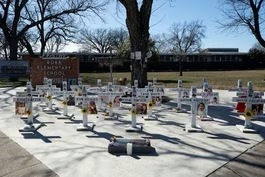
AMNA NAWAZ: Former school police officer# Adrian Gonzales was acquitted Wednesday## on charges that he failed to act# against the gunman during crucial## early moments of the mass shooting at# Robb Elementary School in Uvalde, Texas.
The 2022 school shooting, one of# the deadliest in American history,## left 19 children and two teachers# dead.
Gonzales was one of the first## officers to arrive and one of just two# charged for their initial response.
At## least 370 law enforcement officers# ultimately rushed to the school.
Jesse Rizzo, whose 9-year-old niece,## Jackie Cazares, was killed that# day, spoke after the verdict.
JESSE RIZZO, Uvalde Victim Family Member: I# was very hopeful for guilty verdicts.
I mean,## at stake, what do we have?
We# have children at stake, absolutely## innocent children that did everything that they# were trained to do, hide, turn the lights off.
But the officer that was trained to do exactly,# to encounter, to go towards the shooter,## to listen to the gunshot, everything, right,# and what does he do?
Sit back for an hour## and change -- I'm sorry -- for a minute in# chains while the massacre continues to happen.
AMNA NAWAZ: For more on the trial and# how the Uvalde community is reacting,## I'm joined by Tony Plohetski.
He's investigative# reporter for The Austin-American Statesman.
Tony, thanks for joining us.
So, Gonzales was facing 29 counts of# abandoning or endangerin.. were prosecutors saying he did wrong# and how did his defense team respond?
TONY PLOHETSKI, The Austin-American# Statesman: Amna, this case was,## according to experts, going to be# legally complicated from the outset.
But prosecutors contend that there were a# couple of crucial minutes when Officer Gonzales,## who was one of the first officers to arrive at# the elementary school, could have intervened## or even distracted the gunman prior to# his entry into Robb Elementary School.
But his defense set forward a case in which# they said he took a number of actions to,## in fact, protect children that day.
He# took a number of steps.
And they say that## he was also operating in a very confusing,# quickly moving and highly dynamic situation.
AMNA NAWAZ: What about some of the# families?
We know they were in the## courtroom during this trial.
You heard from# one of the uncles there.
And people have## been fighting for accountability.
How# were they reacting to this acquittal?
TONY PLOHETSKI: This is the latest in a profound## disappointment for the families of# those 19 children and two teachers.
They have been calling for action in the 3.5# years since the shooting.
They, of course,## went to state lawmakers to try to press for# some sort of gun reform.
And they also were## hoping that they would receive some measure# of accountability at the criminal courthouse.
Amna, many of them traveled hundreds of miles# from their home in Uvalde to Corpus Christi,## where this trial was held, for a change of venue,# but, again, leaving that courthouse and that## courtroom profoundly disappointed in the outcome,# but, as we also know, looking ahead to the future,## where there will be another trial of former Uvalde# School District Police Chief Pete Arredondo.
AMNA NAWAZ: And, Tony, what do we# know about that upcoming trial?## Does this acquittal and this trial mean# anything for that other upcoming trial?
TONY PLOHETSKI: Legal experts I have been# talking to today say that the ability -- and## we know that prosecutors did have the ability# to meet with jurors who delivered that not## guilty verdict yesterday evening -- that they# did have a chance to receive their feedback.
And so what legal experts say is that they# will likely take that information and use it## to continue to firm up their case against# the former police chief.
But, Amna, it's## also very important to note that Officer# Adrian Gonzales and the police chief,## the former police chief, are not similarly# situated in terms of their actions that day.
Experts say they took very different actions# and also had very different responsibilities.## So it is likely, according to numerous# experts we have talked to today who have## been following these cases, that# the prosecution almost undoubtedly## will proceed in coming months in this# case against the former police chief.
AMNA NAWAZ: Tony, I have got less than# a minute left, but I have to ask you,## because I know you have covered this# shooting, as have I, since it happened,## in the 3.5 years in this tight-knit community# in Uvalde, how are they doing today?
TONY PLOHETSKI: I think that many of# them continue to press forward.
They## want accountability, but also the profound# grief in that community still exists today,## as parents try to, as best as# anyone could possibly do so,## move forward with their lives with what# happened to them that terrible day in 2022.
AMNA NAWAZ: We should note those# children killed that day today## would be 12 or 13 years old.
Our# thoughts are with their families.
Tony Plohetski of The Austin-American# Statesman, thank you for joining us.
TONY PLOHETSKI: Thank you.
GEOFF BENNETT: America's judicial# system is undergoing one of its## most consequential stress tests in# decades, as the president pushes the## limits of executive power and strains the# nation's system of checks and balances.
Over the past year, the courts have# moved to the center of the country's## most significant political fights, while# the Trump administration has increasingly## challenged the authority of judges, whose# rulings have stalled key parts of its agenda.
As we mark a year into President Trump's# second term, we're returning this week## to guests from our On Democracy series,# which explores the laws, institutions,## and norms that have shaped this country and# the different pressures they face today.
We're joined now by Steve Vladeck,## a constitutional law professor# at Georgetown University.
Welcome back to the program.
STEVE VLADECK, Georgetown University Law.. GEOFF BENNETT: I want to start with# immigration enforcement be.. raising the most immediate# constitutional questions.
As you well know, there is this# newly revealed internal ICE memo## that authorizes federal agents to forcibly# enter homes with an administrative warrant,## instead of a warrant from a judge.
And# the whistle-blowers who presented this## memo to Congress says this goes not just# against their training, but also the law.
How do you assess the constitutional# legitimacy of this policy?
STEVE VLADECK: Yes, it's not legitimate.# I mean, the whistle-blower is right.
So the Supreme Court, even as it has poked# holes in the Fourth Amendment over the last 35,## 40 years, the one thing it has kept# coming back to is that an American's## home is their castle.
And so there# are exigent circumstances in which## law enforcement officers are allowed# to enter a home without a warrant.
We just had a case about that a couple of weeks## ago.
There are circumstances where a law# enforcement officer might have probab.. cause to believe that there's a# crime being under way in a home.
But this notion that an ICE officer can simply# sign a piece of paper called an administrative## warrant and use that as a basis for entering# someone's home without any probable cause, without## any exigency, without a federal judge signing# off has no precedent in our jurisprudence and is,## frankly, flatly inconsistent with everything the# Supreme Court has said about the Fourth Amendment.
GEOFF BENNETT: Our team reached out# to DHS and received a statement,## part of which reads this way.
"The officers issuing these administrative# warrants also have found probable cause.## For decades, the Supreme Court# and Congress have recognized the## propriety of administrative warrants# in cases of immigration enforcement."
Is that the case?
STEVE VLADECK: No.
So, administrative warrants, when there# is a basis.. crime under way or when there's a basis for# believing that you're definitely going to## find someone who's immediately arrestable and# subject to mandatory detention, that's closer.
But, Geoff, you can't put the cart# before the horse.
You can't say,## we went into the house without a judicially# signed warrant and then found someone who## we could arrest on an immigration# violation.
That's bootstrapping.
The reality is that the government's not supposed# to be able to go door to door without warrants,## barging into American's homes.
I mean, just to go# way back, this was one of the grievances against## King George III that we list specifically in# the Declaration of Independence.
There's a## reason why we have a Fourth Amendment.# There's a reason why it applies even## to folks who are suspected of and may well be# out of status from an immigration perspective.
GEOFF BENNETT: If immigration enforcement in# particular is pushing the limits of executive## power, where does the president's constitutional# authority begin and where does it end?
STEVE VLADECK: So, I mean, at least historically,## we have viewed immigration enforcement inside# the country not as part .. exclusive Article II powers, but as a shared# authority between the president and Congress.
Maybe, Geoff, it's different at the border,# because the president could have an argument## at the border that now I'm engaged in my Article# II self-defense function.
But once we're talking## about law enforcement on a house-by-house# basis in American cities, that's where## it has historically been up to the president# to carry out what Congress has provided for.
Congress hasn't provided for this.
And this# dovetails with this broader push by the Trump## administration, also dating back to last summer,# to treat anyone who's in the country who was never## lawfully admitted, even if they have been here# 30 or 40 years, as if they were stopped at the## border, so that the government can then try to# deny them a bond hearing if they're arrested.
It really is a categorical wholesale rethinking of# immigration law that, Geoff, so far federal courts## have been blocking overwhelmingly judges from# across the geographical and ideological spectrum.
GEOFF BENNETT: When we spoke almost# a year ago about this very topic,## whether the courts could meaningfully# act as a check on executive power,## we didn't really know much because# it was so early into the second term.
But looking back over that year, what has# stood out?
What has surprised you the most?
STEVE VLADECK: I think a couple of# the points that stand out, one is,## the federal courts, I think, have# done a really remarkable job of at## least serving as a speed break on many of this# administration's more aggressive tendencies.
The Alien Enemies Act, for example, was# never successfully deployed because of## the federal courts.
President Trump's# birthright citizenship executive order## still hasn't gotten into effect because of# the courts.
But the courts can't do it alone.
And some of that's because we have had all# these interventions from the U.S.
Supreme## Court that have allowed the administration# to carry out a bunch of these policies while## these cases are going forward.
But even in# the cases where there hasn't been Supreme## Court intervention, the courts are more# of a rearguard action here, Geoff, right?
And you really need multiple institutions# holding each other accountable.
GEOFF BENNETT: Are we in the# midst of a constitutional crisis?
STEVE VLADECK: That question, I think, is --# sort of has different meanings to everybody.
I don't know what the -- where the line# is, where you cross the line and say,## hey, now it's a crisis.
I think we're in# the middle of an institutional crisis,## and we have been for the better# part of a year.
And it's a crisis## caused largely by the fact that we have an# ambitious executive, we have a, I think,## fairly well-functioning judiciary, and we# have a completely sort of indolent Congress.
And the founders set up our constitutional# structure so that the branches would work the## best and our rights would be best protected# when the branches were all pushing against## each other.
With an ambitious executive# and ambitious courts and no Congress,## I think we're seeing the problem, which# is everything comes down to injunctions,## temporary restraining orders, and whether# the executive branch is going to comply.
I don't know that it's a constitutional crisis,# but also I'm not sure that that's the relevant## question.
Our institutions are under pressure in# ways that they really haven't been in American## history.
And although I think the courts have done# a very good job of holding the line to this point,## you know, there's going to come a# point where they need some help.
And whether that's going to be from# Congress perhaps on the far side of## this year's midterm elections or from some# other actors, I think that's going to be## the critical question as we look toward# the next 12 months of this presidency.
GEOFF BENNETT: Steve Vladeck,# always a pleasure to speak with you.
STEVE VLADECK: Likewise, Geoff.
Thank you.
AMNA NAWAZ:## In this morning's Oscars announcement, the movie# "It Was Just an Accident" made by acclaimed## Iranian filmmaker Jafar Panahi was nominated for# best foreign film and best original screenplay.
Senior arts correspondent Jeffrey Brown recently# met with the director to talk about his work,## his country in distress, and the work# of what he calls a social filmmaker.
It's for our Art in Action series,## exploring the intersection of art and# democracy, as part of our Canvas coverage.
JEFFREY BROWN: The sound of a# prosthetic leg dragging across a floor,## terrifying to a mechanic named Vahid,# who, blindfolded as a political prisoner,## was tortured by a man he knew only# from his voice and this very sound.
Vahid kidnaps the man and then he# and a group of others who suffered## the same horror and are now trying# to pick up the pieces of their lives## are forced to wonder, is this in fact# their torturer?
And, if so, what now?
For Jafar Panahi, the director of "It Was# Just an Accident," the story is personal,## partly based on his own experience in prison.
JAFAR PANAHI, Director (through translator):# When I was being interrogated, I always had a## blindfold on my eyes and I was facing a wall# with a piece of paper in my hand.
Someone## would ask me questions and I would answer on# the paper.
I didn't know who was behind me.
I only heard his voice or his movements when he# was walking.
And I always wanted to know who he## was, know what he looks like.
And if I saw him# outside of here, would I recognize him or not?
JEFFREY BROWN: Panahi, 65, is a celebrated figure# in world cinema, winner of top awards at major## film festivals, his films renowned for capturing# the humanity of life in Iran, even amid the ruling## Islamic Republic's authoritarian stifling of# daily existence and violent crackdowns on descent.
But he has also paid a price.
In 2010,# he was sentenced to six years in prison## for propaganda against the state.# He undertook a hunger strike and,## amid an international outcry,# was released after three months,## but not allowed to travel.
Film festivals# honored him with an empty chair on stage.
In 2022, he was arrested again and# served seven months in Tehran's## notorious Evin prison.
Upon his release,# he vowed not to forget those still held.
JAFAR PANAHI (through translator): Some# of them had not seen the outside world## for five or six years.
They shared their# pain and suffering.
They talked to you.## They ate with you.
They walked in the yard with# you.
All these things come together so that,## when you leave prison, you feel like# there is a weight on your shoulders.
JEFFREY BROWN: One result, a new film,# a different kind of vengeance thriller,## one that often sprinkles in bits of humor,# as when his characters constantly bickering,## one in bridal gown for her wedding photos,# have to push their van through Tehran traffic.
For Panahi, the real question isn't retribution,## but how a society ever moves# beyond the cycle of violence.
JAFAR PANAHI (through translator):# History has shown that these kinds## of governments can't survive.
One day it will# end.
One day it .. In the film, all these people in our# conversations with their emotional standpoints,## they want to release it in some way.
All# of this is just to make the viewer think,## what's going to happen?
The same conditions?# The same anger?
Same conflict?
Same violence?## Same harsh treatments?
Is it supposed to# continue?
Or, no, it must stop one day?
JEFFREY BROWN: You have said that# you're not a political filmmaker,## but a social filmmaker.
What does that mean?
JAFAR PANAHI (through translator): Social# filmmaking is a filmmaking that takes the## subjects of its films, its ideas and what's# in its past into consideration.
And it never## categorizes the characters into the good people# and the bad people, contrary to political films.
That is why I say I make social films,# but it may be a political subject.
JEFFREY BROWN: He's also an endlessly# creative filmmaker, often out of necessity.## When he was punished with a 20-year ban# on filmmaking, he responded with "This## Is Not a Film," a kind of home movie shot# on an iPhone.
It was shown the world over.
So, "This Is Not a Film," but it is a film.
It's# almost a kind of joke, but a very serious one.
JAFAR PANAHI (through translator): Yes,# because they give an order that was more## of a joke.
What does it mean when you tell a# filmmaker, you can't make a film for 20 years.. That's when you say, no, you can't stop the# filmmaker from making movies.
He finds a way.## He makes a film.
You say, stop making films.# So I will say this is not a film at all.
JEFFREY BROWN: That ban was eventually# lifted, but Panahi still refuses to## submit his scripts to government censors.# He shot "It Was Just an Accident" in secret,## made nightly backups of digital# material, and protected his actors,## many of them nonprofessional, by limiting# their knowledge of the full story.
JAFAR PANAHI (through translator): But# when you were in those circumstances,## the type of filmmaking, working underground,# that's what it looks like.
That's the norm.
JEFFREY BROWN: Do you believe that an artist --# do you believe that you as an artist, have some## responsibility to use your art, your filmmaking,# to address the social conditions in the country?
JAFAR PANAHI (through translator):# Whether I have a duty or not,## I don't look at it as a duty.
Rather, I feel# that, in these conditions,.. I must make this film.
Even if# my films are not being shown,## at the end of the day, I prepared a new set# of conditions for history, for the future,## for the time when the conditions are suitable for# these films to be seen, these films to be seen.
JEFFREY BROWN: As Panahi's film racks up acclaim# and awards, his country is again in turmoil,## with demonstrations in the streets and# deadly responses from the regime.
And## Panahi himself faces an uncertain future,# a new one-year prison sentence handed down## while he was out of the country for so-called# propaganda activities related to his work.
I know you're appealing, but you have also said# publicly that you will return to Iran.
Why?
JAFAR PANAHI (through translator):# I don't understand this question at## all.
When you know that what you do# has a price and you have to pa.. and when you see people in prison who# have been imprisoned over and over again,## but they stand on their beliefs, well,# why don't you as a filmmaker do the same?
JEFFREY BROWN: And, he adds, Iran is the# place he knows, its language and culture,## the small details of its life# and big questions of its future.
For the "PBS News Hour," I'm# Jeffrey Brown in New York.
AMNA NAWAZ:## And that is the "News Hour"# for tonight.
I'm Amna Nawaz.
GEOFF BENNETT: And I'm Geoff Bennett.
For all of us here at the "News Ho..
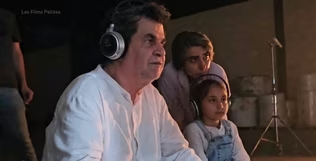
Filmmaker Jafar Panahi on 'It Was Just an Accident'
Video has Closed Captions
Filmmaker Jafar Panahi on 'It Was Just an Accident' and challenging the Iranian government (6m 57s)
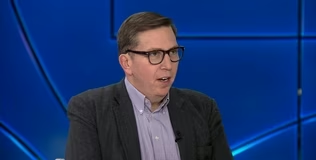
How Trump is challenging America’s judicial system
Video has Closed Captions
How Trump is challenging America’s judicial system during his second term (6m 40s)
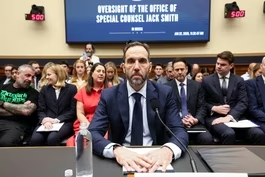
Jack Smith defends criminal investigations into Trump
Video has Closed Captions
Jack Smith defends criminal investigations into Trump during House hearing (4m 29s)
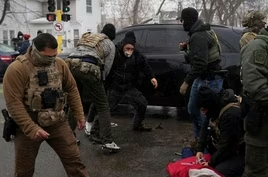
A look at the impact of Trump's immigration crackdown
Video has Closed Captions
One year in, a look at the impact of Trump's immigration crackdown (12m 50s)
Trump unveils vision to rebuild Gaza as seaside metropolis
Video has Closed Captions
Trump unveils his vision to rebuild Gaza into a seaside metropolis (6m 42s)
Uvalde officer acquitted of failing to act during shooting
Video has Closed Captions
Jury acquits Uvalde officer of failing to act during school shooting (5m 15s)
What to expect from the potentially devastating winter storm
Video has Closed Captions
What to expect from the potentially devastating winter storm (4m 37s)
Providing Support for PBS.org
Learn Moreabout PBS online sponsorship
- News and Public Affairs

FRONTLINE is investigative journalism that questions, explains and changes our world.

- News and Public Affairs

Amanpour and Company features conversations with leaders and decision makers.












Support for PBS provided by:
Major corporate funding for the PBS News Hour is provided by BDO, BNSF, Consumer Cellular, American Cruise Lines, and Raymond James. Funding for the PBS NewsHour Weekend is provided by...