Capitol Journal
January 23, 2026 - Week in Review
Season 21 Episode 12 | 56m 39sVideo has Closed Captions
Birmingham Mayor Randall Woodfin; Sen. Matt Woods, (R) - Jasper
We're reviewing the highlights of this week in the Alabama Legislature while also checking in w/ the delegation in Congress. Packed show! Todd's guests: Birmingham Mayor Randall Woodfin State Sen. Matt Woods, (R) - Jasper
Problems playing video? | Closed Captioning Feedback
Problems playing video? | Closed Captioning Feedback
Capitol Journal is a local public television program presented by APT
Capitol Journal
January 23, 2026 - Week in Review
Season 21 Episode 12 | 56m 39sVideo has Closed Captions
We're reviewing the highlights of this week in the Alabama Legislature while also checking in w/ the delegation in Congress. Packed show! Todd's guests: Birmingham Mayor Randall Woodfin State Sen. Matt Woods, (R) - Jasper
Problems playing video? | Closed Captioning Feedback
How to Watch Capitol Journal
Capitol Journal is available to stream on pbs.org and the free PBS App, available on iPhone, Apple TV, Android TV, Android smartphones, Amazon Fire TV, Amazon Fire Tablet, Roku, Samsung Smart TV, and Vizio.
Providing Support for PBS.org
Learn Moreabout PBS online sponsorshipFrom ou statehouse studio in Montgomery.
I'm Todd Stacy.
Welcome to Capital Journal's week in review.
The Alabama legislature met for the fourth, fifth, and sixth day of the 30 day session this week.
That means we are one fifth or 20% way finished, at least in terms of legislative days.
We do expect the pace to slow down a bit going forward.
Most legislative action so far has been non-controversial, with lawmakers taking care of the basics at the start of the session.
But that is, as it often does.
The House Judiciary Committee saw some point of debate this week over some hot button bills.
That's where we begin our coverage this week, with Randy Scott reporting.
One issue on the minds of lawmakers deals with Representative Met Simpson's House Bill 41.
This proposal seeks to includ the death penalty as punishment for those guilty of rap and sodomizing young children.
But this is not mandatory death penalty.
This is a decisio that the prosecutor would make as to charge capital rape, capital sodomy, or capital of capital rap or sodomy with sexual torture.
Meaning that charging instrument would be the valuation that we're talking to the family, we're talking to the officer, we're evaluating where we go through.
Beyond that, the grand jury would have the determination as to whether or no they want to be able to approve the capital charges through this.
You aren't going to deter anyone that wants to do something from doing anything.
But I think it's one of those situations where the death penalty, probably should be on the table.
The problem with that is here in Alabama most of our death penalty cases plead down to the life without parole or a plead down to a lesser charge, and we end up filling our prisons up.
And right now we have an overcrowded prison system.
House Bill 4 is slated to hit the House floor for debate next week.
The House Judiciary Committee hosted a debate on House Bill 13 Representativ Ernie Yarborough proposal seeks to allow state and local la enforcement officials permission to help their federal counterparts arrest illegal immigrants if faced a tense debate.
It is known as the Lake and Rally Act, and it comes from a similar bill out of Georgia.
That was passed.
Obviously, we all know the story of Lake and Raleigh, and so in a nutshell, what this bill does is it provides an optional path for state and local law enforcement agencies to enter into an MoU with the federal government to enforce existing federal immigration laws that are on the books.
You have a lay police officer on the beat who's not educated in these laws.
There's absolutely a a there' there's a very high probability that that officer who's not trained in the law is many times is going to look at a person's lack of paperwork, and if they have a thick accent or they have a an olive color or a darker color skin, they're going to assume tha that person is here illegally.
House Bill 13 is carried over and will return next week at the statehouse.
Randy Scott, Capitol Journal.
Thank you.
Randy.
That immigration bill was als the subject of a public hearing, where supporters and opponents were invited to share their views on the bill with lawmakers.
The subject of immigration is obviously pretty touchy these days, which was reflected in those public comments.
The probable cause concerns me.
On top of that, the fact that there is no recourse for law enforcement officers.
The bill gives the law enforcement officers immunity for getting it wrong.
So if they arrest my daughter, we have no recourse against that And it's not an isolated story.
There are thousands of la abiding immigrants in our state that will be at risk.
And I'm fearful for what it does for law enforcement, too.
My oldest child is a is in law enforcement.
He's a sheriff's deputy over in Georgia, and see that from this side as well.
If we pass this bill, we are going to make a larger percentage of our population fearful and maybe even antagonistic towards law enforcement, preventing them from doing the job of actually keeping us safe.
We are all here because I believe that each and every one of u wants the best quality of life for Alabamians, and I think that's why every one of y'all ran and won your positions.
HB 13 ain't it y'all?
That's not goin to give the best quality of life for Alabama.
I have no problem with the state of Alabama creating a la that the increases participation with the federal government with regard to, customs operations.
I think that that's a great thing.
The state and federal government work together.
However, we need to make sur that those agents of the state is acting consistent with th limitations of the Constitution.
United States of America provides in the execution of their duties.
Again that bill is slated for a vote when the committee meets again next week.
One bill that saw significant debate this week was House Bill 90 from state.
State Representative Matt Butler of Rainbow City.
The measure seeks to streamline rules on the eviction process in Alabama to make it more efficient.
But that can also be a touchy topic, so it led to plenty of questions on the floor.
Would you please give me the process again of, with the tenant versus the landlord, and I understand what you're doing.
Yes, ma'am.
And I know that the shares usually have a backlog law that they're backed up and can't get to everyone.
So what is your process in which a bill is doing?
Okay.
And this is what is actually taking place currently.
But what what this bill does is the sheriff comes out is this sheriff constable.
And then we have a sub where they amended it to add a special service, a process server also.
But they come out to keep the peace.
Only the landlord would be responsible for changing the locks, disposing of the property.
And as a realtor, you know, 99 out of 100 times the house has been vacated and the only debris is left there sometimes.
Yeah, but but if there was furniture there, it protects the the the sheriff and the landlord from any amenity.
Say, someone says my grandmother's $10,000 bracelet was there, you know, where is it?
Or you chipped my my living room furniture or something.
Oh, are they giving, the tenants time to move out?
Yes.
Oh.
So basically you give them time to move out and not putting your things on the sidewalk, right.
And this right now, the currently is no requirement to notify them of the disposition.
This requires that, to, to track it down all they ca to make every effort possible.
That that protection is no longer there.
But yes, that is addin that protection for the tenant.
So basically, the tenant is able to hav a stone at the time to move out.
So are we saying that now the sheriff is not moving their things out for them?
That's and leaving that his side, while to my knowledge that's never taken place, at least in our county it's always been the landlord.
We we have been in this business for 26 years.
It's one of the they reached out to me and I thought I knew the law, but there was no law and I was I was shocke when I actually we had a meeting with our presiding judg with the Sheriff's department, and everybody was floored that there was no law, only the administrative rule and that Ministry of rule only applied to foreclosures.
Right, right.
So I'm I'm I'm glad that you brought this bill.
I support it 100%.
Thank you.
I was ad myself, do property management, and we see a lot of stuff.
Yeah, you know more about it than all of it.
So, Yeah.
And some folks, I'm not going to say that, but I'm glad that you allowe them time to get the things out.
And it's not being moved out.
It just thrown on the side walls.
Right.
Because no landlord wants to want to take possession of their property, nor d they want to deal with it right.
That bill passed without objection and now goes to the Senate.
In all, it was a pretty productive week in the House.
Here's a look at some notable bills that also passed.
House Bill 138 from State Representative Kenneth Pascal of Pelham would allow retired state or education employees to become school bus drivers without their retirement benefits being penalized.
House Bill 128 from Stat Representative Marilyn Lands of Huntsville would authorize the state Board of Midwifery to accept donations so it doesn't have to solely rely on licensing fees or fines, and House Bill 161 from State Representative Chris Sales of Greenville, would require smartphone app stores to verify a user's age and link children's accounts to their parents.
There would be different age categories under the bill as well.
House Speaker Nathanie Ledbetter noted the legislation as an important way to protect children online.
The cell phone bill we just passed, I think is important, Bill.
You know, it' something that kind of been back and forth for a couple of years to try to get it right and, a lot of people work very hard on that.
But I think the vote today proved it was something that people wanted on both sides.
Something that parents needed to help control what's on their kids phones.
And, you know, I think it is one of those things the polls show it was over 80% of people approved of it.
So I think getting it right was important enough.
Like they did a very good job.
I applaud Chairman Sales for his work on that legislation.
A related issue to keep an eye on this session is AI or artificial intelligence.
There are several bills already filed seeking to regulate that technology one way or the other.
This week, we heard from advocates seeking to crack down on grok AI and its ability to generate pornography.
State Representative Ben Harrison is working with faith groups and the law enforcement community to craft a bill that holds grok AI accountable for the proliferation and promotion of pornography, especially as it relates to children.
What this bill does, it protects those that are those websites and those, content creators and, and the AI platforms that produce material, photo and video, adding material for legal purposes.
What it goes after is those people that, that purposely, entice people to create content, shows them how to creat pornography, with using images of, of real people and where they during, illicit things.
What I've seen is a law enforcement officer and now is the CEO of Covenant Rescue Group and working in law enforcement.
When you look at child exploitation, we always think of the free candy vans showing up and stealing our kids from our yard or from a playground.
And even though that still happens sometimes, those days for the most part, are over.
Now we're seeing another progression in technology and digital programs that we have that, hey, this is a 21st century These are good things to have.
They make life easier.
But nefarious individuals are utilizing a, to develop child pornography, taking the face of your child and building nude images off of your child to the point that they can exploit not just your child and blackmail your child, but also blackmail an innocent family who might not believe that this child never sent those pictures.
So I think it's very important that one at the state level, the closest form of government to the people is the most effective form o government at the state level.
We get involved in this to make sure that we protect our kids and the families in the state of Alabama.
I also like, the articles that you can read.
Senator Britt has been talkin about it at the federal level, bringin in some congressional mandates and regulations to start protecting families and children from nefarious individuals who would use whatever technology they have at their hand to steal the innocence and the lives of our kids.
Movin now to the Alabama State Senate, where this week lawmakers considered a bill named in memory of a young man whose family says legal silence contributed to tragedy.
State Senator Matt Woods o Jasper is sponsoring Trey's Law, which would make nondisclosure agreements unenforceable in civil cases involving sexual abuse.
The bill is named for Trey Carlock, a Texas native who was sexually abused for years and later forced into a settlement that included a restrictive non-disclosure agreement.
His family says being legally barred from speaking about the abuse played a role in his decision to take his own life.
While the bill is drawing bipartisan support, some lawmakers are raising concerns about possible unintended consequences.
I think they made the right decision in doing this from the outside in.
I'm not trying to make a judgment here but they agreed to a settlement and did a non-disclosure statement.
And that non-disclosure statement is a lifelin very often for the institution to continue its efforts in trying to do good, it will have to clean up its act.
It'll have to do things and institute procedures and things or protections, which it needed to do before.
But somehow it failed.
But they paid th price and they paid the money.
The nondisclosure allowed them to continue in operation in some way.
Just the thought of our children being sexually assaulted by some buying brain adults is, is very, disheartening to me.
And I think we need to be more concerned about our childre than some entity or institution.
This bill is going to allow people who end up in a situation where they don't feel like they can express themselves, they don't feel like they can talk about the terrible things happened to them, to be able to unburde themselves by talking to others.
And there's a big public interest here in this.
People need to kno that these perpetrators exist.
We need to be able to protect our children.
We need to be able to protect our families.
And they can't be protected if they don't know these bad actors are out and about.
So this bill is going to d a lot of things to help victims, but it's also going to help the public be safer.
That bill passed the Senate unanimously and now heads to the House for consideration.
Senator wood also managed to pass legislation aimed at addressing Alabama's ongoing teacher shortage.
Senate Bill 149 would allow military veterans to temporarily teach in certain K-12 classrooms, even though they don't hold a bachelor's degree yet.
That's provided they meet specific education, testing and background requirements.
Woods says the bill not only addresses teacher shortages, but helps veterans continue to serve their communities.
We've all experience a teacher shortage in the state.
Every school district is facing shortages, and so we're trying to find unique way that we can engage populations.
That would be great fits in the classroom and get them into, a pipeline for our education system.
Other states have done something similar.
And so we felt like we should adopt that here in Alabama.
We want to be a military friendly state, and that include being a veteran friendly state.
I believe this will help our veterans give them opportunity, lead and serve, and continue to serve here in the state of Alabama.
That bill now also goe to the House for consideration.
And I'll be speaking with Senator Woods about his busy week later in the show.
And the Senate also passe a bill aimed at improving safety during traffic stops for peopl with certain medical conditions.
Senate Bill 46 from State Senator Marica Coleman of Birmingham, would allow driver and non driver ID holders to voluntarily designate certain invisible medical conditions, giving law enforcement officers immediate awareness during an encounter.
The designation would be optional and free of charge.
Supporters say the measure could help prevent misunderstandings and improve communication between officers and the public.
Aliyah has worked with this bill as well, just to make sure we can come up with something that law enforcement officers can identify.
So someone who's on the autism spectrum or has epilepsy or some type of other invisible ailment, the law enforcement officer knows as soon as they stop how to deal with that person.
So very proud of that.
My bonus son, my children' brother, name is Edward Weaver.
We call him E.J.. So he's been calling this bill his bill.
So we're really, really excited about the last day of Senate Bill 46.
And that bill also head to the House, where a companion bill by state Representative Ontario Tillman has already passed out of committee.
The Senate Health committee this week considered legislation on vaping in public spaces.
Senate Bill nine from State Senator Gerald Allen of Tuscaloosa would treat electronic cigarets and other vaping devices the same as traditional tobacco products, under state law banning their use in most public indoor places.
The bill would also rename the Alabama Clean Indoor Act.
That's after State Senator Vivian Figures, who has long advocated for restrictions on smoking in public.
Allen says the idea for the bill came after an encounter with someon vaping at a youth sports event.
Genesis of this bill came from Bill County when I was sitting in a junior high football game and, a guy was sitting below me, April vaping and, and, and so a timeout came and, and I follow up young man, to the concession stand, and I said, you're breaking the law.
He says, no, I'm not.
Well, I came back here and got off the involved, and he has grown and well, the young man with.
Right.
Okay.
So what we're doing is, is that when going into the current statute of the law and adding vaping that public places should be protected from such activity like that, that bill passed unanimously out of the committe and now goes to the full Senate.
So now we've gone through two busy weeks of this 2026 session in the Senate.
Lawmakers have spent much of the past week approving a long list of local bills and confirmations, with little controversy hitting the floor.
But with an election year underway, both parties acknowledge tha cooperative tone may not last.
Capito Journal's Jeff Sanders reports.
Senate resolution Number 22.
As week two of the 2026 legislative session comes to a close, the Alabam Senate is moving at a fast pace.
All three meeting days this week were largely non-controversial, with lawmakers approving a lengthy slate of local bills and confirmations.
By law, all confirmations must be completed by the 10th legislative day.
I do know that we're all eager to get out of here and get to our districts and campaign and do that kind of things, state Senator Clyde Chambliss of Prattville speaking on behalf of Republican leadership, was asked whether the smooth pace on the Senate floor is likely to continue.
There's always things that may cause hiccups and, things to be a little bit slower.
I don't expect any of those in the near term.
There, you know, there always is.
The Democratic state senator, Marika Coleman of Birmingham, agrees that both parties have bee getting along, at least so far.
We've been singing Kumbaya.
It would be nice if we finished the session.
This way.
So we are actually moving pretty fast.
Got some really good things passed thus far, but Coleman says that cooperation could be tested once more.
Controversial bills make thei way up from the lower chamber.
I think we may be in trouble then in a week or so.
What are some of those things?
I mean, immigration bills that are coming, some of the, the voting legislation that may come up as well.
So, you know, I always talk about, you know, election year and read me.
Chambliss says disagreements are inevitable as the session moves forward and debate is part of the legislative process.
But, you know, that's the way the system was designed.
We all come from different areas of the state, all walks of life, and we have different opinions where we're not supposed to come here and agree on everything.
We're supposed to come here and debate things and we'll we'll do that.
As we get deeper into the session that always happens and it will this session as well.
And another issue that has not come up so far is that of possible rules changes following that Democratic filibuster which capped off last session.
Senator Coleman says Democrats have heard no further mention of it from Republican leadership, but only time will tell.
Reporting from the statehouse in Montgomery.
I'm Jeff Sanders.
Support Capitol Journal.
Thank you Jeff.
The House and Senate are scheduled to come back into session on Tuesday, but that could be delayed depending on the weather.
And a quick reminder these are only the highlights of this week's legislative action.
As as much as we can fit into the show, at least.
But Capitol Journal is on the air nightly during session, with reports from that day's action here in the state House.
You can find all of this week's shows on our YouTube channel.
Just go to YouTube and search Capitol Journal.
And while you're there, hit that subscribe button so you never miss an episode.
We'll take a quick break and be right back with more Capitol Journal.
You can watch past episodes of Capital Journal online any time at Alabama Public Television's website.
aptv.. org.
Click on the online video tab on the main page.
You can also connect with Capital Journal and link to past episodes o Capital Journal's Facebook page.
Thanks for staying with us.
We'll turn to Washington now.
Where?
This week, the U.S.
House of Representative was busy passing appropriations bills ahead of next week's funding deadline.
All members of Alabama's congressional delegation voted in favor of bills funding the Departments of Defense, Health and Human Services, education and transportation.
But members were split along party lines for the Department of Homeland Security bill.
Our own Alex Angle reports from Capitol Hill on Congress's efforts to avert another government shutdown.
House Republican appropriators were quick to celebrate the passage of all 12 annual spending bills Thursday, ahead of the January 30th deadline.
It is a great day for preparations.
Congressman Robert Aderholt oversees funding for the Department of Labor, Health and Human Services and Education.
Those programs are going to be funded, and they will be funded in a conservative manner, and we're going to make sure that we've got restrictions.
But the bill reject some of the president's proposed steepest cuts to the health department, and it maintains funding for th National Institutes of Health.
It also keeps funding levels relatively flat for the Education Department, ensuring programs remain under the direction of that agency, which Trump has sought to dismantle.
One of the things that we would like to have gotten language in there to let the president do whatever.
The rebuild package received broad bipartisan support.
Congresswoman Terri Sa championed it for including her bill named in honor of her lat mother, to recover multi cancer early detection tests.
This legislation would expand access to cutting edge cancer screenings for America's seniors.
But Alabama's delegatio split on party lines in voting at the Department of Homeland Security funding bill.
Most Democrats opposed it for not including enough accountability measures in the wake of President Donald Trump's immigration crackdown.
Republicans have the opportunity in this bill to enact common sense checks on Ice operations.
They refused.
But Republicans touted the homeland security bill as a way to secure the country's borders.
The package now moves to the Senate.
It will be coupled with two other spending bills that senators have to pass before the end of next week.
Reporting on Capitol Hill Alex Angle, Capitol Journal.
Thank you.
Alex.
Or less.
You've been hiding under a rock lately.
You know that there's going to be weather soon.
Specifically, winter weather as a front moves through the southeast, threatening snow and ice.
Governor Kay Ivey this week issued a state of emergency for 19 North Alabama counties as part of that state, braces for blustery, icy weather in Alabama.
We are no stranger to Mother Nature.
However, when it comes to winter weather, we are not as familiar.
So as we head into this weekend, I'm urging my fellow Alabamians, especially in the northern part of our state, to stay weather aware.
Based on the current forecast, we have a few concerns, including potential dangerous driving conditions.
For those reasons, I have issued a state of emergency for potentially impacted counties.
I have also directed certain state agencies to position resources so we can prepare and respond effectively.
Be sure to tune in to your local meteorologist.
You all stay safe, stay warm, and stay weather aware.
Big changes are coming to Alabama High School sports and a 13 to 2 vote.
The Alabama High School Athletic Association's Central Board of Control approved a new classification system separating public and private schools into different championships.
The plan, covering the 202 and 2027 seasons, will feature six public school classe and two private school classes.
The decision stems partly from frustration over how the body that oversees high school sports handled the Choose act, which allows parents to use tax credits to send their children to a different school, including private schools.
The a the a HCA last summer said students utilizing choose act funds must sit out a year of athletics, a move that angered many parents and state officials.
Governor Kay Ivey and House Speaker Nathaniel Ledbetter sued the organization over that issue, and were successful in getting that decision blocked.
Executive director Heath Harmon said that will no longer be an issue with this new restructuring.
After careful review and after listening to our public and private school members, the Central Board determined that now is the appropriate time to restructure championship play.
This is.
This will result in restructure championship for public and private schools.
This model will be implemented for the next two years.
The Central board has approved a championship model that applies only to postseason play.
Its purpose is to expand opportunity and strengthen the overall championship experience for student athletes across Alabama.
All championships will be played together, both public and private, at our Championship venues.
The Alabama High Schoo Athletic Association remains one unified association serving all member schools.
Public and private schools will continue to compete against one anothe throughout the regular season.
Through multiple meeting with our private school members.
They expressed a desire fo greater financial flexibility.
This model directly addresses concerns while maintaining fair play for all.
Because postseason competition will followed restructured pathways.
We're now able to wor on removing financial barriers for private schools.
Private school members also voiced their desire to remove the 1.3 multiplier and competitive balance adjustments.
Private schools will now be classified strictly on their enrollment.
Friday a 5:00 marked the end of candidate qualifying for the 2026 elections in Alabama.
Those wanting to run for state office had to have their paperwork into the state, Republican or Democratic parties in order for their name to appear on the ballot.
Much of the candidate qualifying deadline is what we expected.
But there were some notable surprises.
John Wall has qualified to run for lieutenant governor.
He is the chairma of the Alabama Republican Party.
This came after an unexpected late night endorsement from President Donald Trump on Thursday that has shocked the Alabama political world.
Of course, that's an already crowded primary, with Secretary of State Wes Allen and Commissioner Rick Pate and economic developer Nicole Wadsworth vying for that position It's going to be one to watch.
And another surprise move former state Auditor Jim Ziegler has filed to run for the Public Service Commission.
That's also a crowded field with incumbent Chip Baker, Priscilla Andrews and Brant Woodall already running.
And the most stunnin development came from Mo Brooks, the former congressman from north Alabama has filed to run for the Alabama House of Representatives in House district 20.
Nobody saw this coming, especially since Brooks pretty recently said he was stepping back from politics.
He'll be challenging incumbent representative James Lomax.
There are too many candidates and too many races to go through them all.
But if you want to see an updated list from both parties, you can find it online via the Alabam Daily News at Al Daily News.com.
We got a sneak pea this week at the new statehouse under construction just next door.
As we've reported extensively, the new building is scheduled to be completed later this year and be up and running as the home of the Alabama Legislature in time for the organizational session in January of 2027.
House Speaker Pro Tem Chri Pringle invited Capitol Journal for a quick tour of the site to see how things are progressing, particularly the House and Senate chambers and the large committee rooms the building will feature.
The current state House was retrofitted from the old highway building in the 1980s to serve as a temporary home to the legislature.
Whil the Capitol was being restored, but the legislature never returned to the Capitol for various reasons, and this building has far outlived its intended lifespan.
Legislative leaders are counting on the new building to be more accessible for those visiting the legislature, and are waiting to interact with state government.
Whic governs how the Senate handles people going through the eight door.
Now, like we always go to, God's going to be right here.
That's Pringle right there.
He's standing in what appears to be the House chamber under construction.
And here are some renderings of what those are supposed to look like.
They'll be, as he wa mentioning, on the same floor.
Right now, the house is located on the fifth floor and the Senate on the seventh floor.
They're kind of right on top o each other in the new building.
They'll be on the same floor, similar to how it is in the United States Capitol.
And you see there the House chamber, the Senate chamber, much updated, architecture there.
And so we're looking forward to seeing how these, these, these chambers develop.
And again, the larger committee rooms right now.
Much of the committee action happens in committee rooms that can't fit the public.
So we're looking forward to those larger committee rooms with every single one having video access for live streaming.
It's going to be a big deal.
And thank you to Representative Pringle for including us on the tour.
We'll be right back with Birmingham Mayor Randall Woodfin.
Stay with us.
Since 1997, Alabam Public Television has provided programs, services, and resources to childcare professionals, teachers and parents.
Visit AP tv.org/education to learn more.
Welcome back to Capitol Journal.
Joining me next is Randall Woodfin, mayor of the City of Birmingham.
Mayor thanks for coming on the show.
Todd, thanks for having me.
Glad to be here.
Absolutely.
I've been looking forward to this.
I remember running into you at that.
There was an event up there, I think a, the American enterprise Institute.
We ran each other.
And so I've got to get you on the show.
So I really appreciate you coming down.
Of course, you're in th statehouse this week advocating.
Right?
You're talking to lawmakers about issues.
What's on your plate?
What are you asking of the legislature?
I think the first word, and they can only sum it up in one word, is accountability.
Okay.
On the city of Birmingham, we are fortunate to be a city of 200,000 residents, 2 communities, 99 neighborhoods.
But we have some challenges around neighborhood revitalization.
And what I mean by that is whe you had a significant decrease in population like we have over the last 60 years, it's left a lot of tax delinquent properties, for the city to have to fend for it.
So and I appreciate the state having and creating very strong laws for property owners.
However, within that, what the City of Birmingham needs, for revitalization to work, for neighborhood stability, to work is accountability.
What does that mean?
Let's say you are a homeowner, and this is your house.
And on each side of your lot, on one side you have an empty lot with overgrown grass.
On the other side, you have an abandoned house.
Both are privately owned.
They both may be owned by an absentee owner who doesn't even live in the state.
What we're simply requesting is more accountability for them to do their part.
Keep that lock, maintain and cut and or tear this property down.
And for us, as a city, we have over 15,00 types of delinquent properties.
It puts a strain on not only on that resident in the middle like you.
As for that example, but it puts a strain on our public tax dollars having to b used to go in private property to make sure you, the homeowner in the middle, is safe and taken care of.
I would imagine a lot of mayors in a lot of cities are interested in that because you need the authority from the state to basically enforce that.
Right?
Right.
Okay.
How's that look at do you thin you're going to be successful?
I am I'm highly encouraged as I talk to state senators and state representatives.
The word again is we're not trying to take anyone's property from them, but I think you consider you own neighborhood where you live.
You have a simple expectatio when you walk out of your door.
One, I'm going to take care of my own property into your neighbor's going to take care of theirs.
And that is literally all this is about, right?
Interesting.
Well, that's something to follow as a session goes forward.
What do they ask you about?
Oh, look, it's no secret that Birmingham is the largest metropolitan area.
It's really the economic engine for this state.
And a lot of decisions get made in Montgomery.
But again economically, Birmingham is it.
So what's the outlook looking like?
What are we I mean I see the growth in biotech.
Everything is happening not just at UAB but southern research Everything is going on up there.
What other sectors you go looking at in terms of future growth for the city of Birmingham that will impact the whole state?
Yeah.
Well look that's a great question.
Again, being the economic engine of our state, the first thing I'd say is that it's important for me as mayor to continue to continue to use my convening power as I talk to other mayors in the region, as I talk to our county commission, in Jefferson County, as I talk to our Jefferson County delegation as elected officials, we all need to be working together to make sure we sing from one hymnal sheet one one voice around economic development.
The second thing to d is make sure with our convening power, all the economic development organizations, we have one shared vision, we have alignment, and then we have metrics where we hold ourselves accountable around job growth and job creation.
Yes, biotechnology is the driver related to UAB help scientists.
But we want to continue to also focus on other strengths.
We have financial services, advanced manufacturing and other things we can do to support our automotive industry, which, is above and under us, whether it's link, Lincoln to the east or to the south southwest, Tuscaloosa Area Rail, Mercedes and others.
We believe because we are centrally located in the state, believe because we're centrally located in the southeast, with three major rail lines.
We have with our four majo interstates we have in our area.
With our airport, we can be the logistics hub of our entire state.
And that in itself is going to drive interstate commerce and all other types of activitie and goods to move in and about, not just our city but be productive for the state, not to mention the inland port.
We have that gets you all the way down to mobile.
That's been such a cool development to watch.
It's the same thing about Gummer.
There's plans for North Alabama, so that's pretty cool.
There's so much potential.
There's so much potential.
I think, everybody agrees.
And so it's fun to se the beginnings of some of that.
Y'all have some, really good news on the issue of crime lately.
Yes, obviously, you go back, turn back the clock to 2024.
Horrible year for crime, not just in Birmingham, but a lot of metropolitan areas, including here in the city of Montgomery.
Almost night and day.
When you when you flip the calendar to 2025, you've had some a dramatic reduction in crime.
Talk about those numbers and what we've seen.
Well I would tell you and start off by being honest and telling you one homicide is too many.
But I can also tell you 202 was, as you said, night and day.
From 2024 2024, we had our worst homicide snow city since our city's existence.
Our backs are against the wall and we needed to do things differently.
We had a new police chief, Chief Michael Pickett.
We stepped up our police force, which was down in numbers from 73% to 2025, literally 99%.
We hired almost 300 officers 296, if I'm correct to be exact.
Which was important.
So by putting more officers on the street, by having more enforcement, but we also arrested those who were committing the most heinous crimes.
And I think that's really important to send a signal if you commit a crime in the city, if you shoot someone in the city, if you commit a homicid in a city, you will be arrested.
We had a clearance rate of 86%.
Now, think about that for a second.
We say clearance.
That means they're they're being processed, going to jail you.
If you committed the crime, you were arrested 86% out of 100.
The national average of clearance rate for homicides in our country is right around 50%.
So we're well above the national average compare to not just around the country, but for our own city, which was below 50%.
So I think that's a testament to good leadership.
I think that's a testament to a shared vision of making this not the number one, but also the number two an number three priority as well.
And in addition to that, we ge we created a crime commission.
And so these were stakeholders from the private sector, corporate Birmingham small business faith leaders.
They made recommendations to the mayor council.
We acted on out of 82 recommendations.
We've acted on over almost 50% of them.
So we're basically just chopping wood and doing everything necessary to make it safe.
But enforcement and preventio efforts are the bread and butter what we're doing, which also includes more youth sports and youth activities and investing in the next generation.
You know the state has gotten involved, here in the capital city they created this metropolitan, crime suppression unit.
That's been pretty successful because, you know, like a lot of cities, Montgomery had a police shortage.
So the state come in and kind of fill in some of that.
There's been tal of expanding it to other cities.
Birmingham, Huntsville, mobile.
Are y'all interested in that?
Has there been any talks with the with the state in terms of a similar arrangement, and is it needed?
And so at the first part o your question, I would say that, Michael Pickett our chief of police, continues to talk to Al Taylor and the Aliyah.
I think they have great working relationships and, open line of communication.
I would sa when your police force strength can go from 73% to 99%, and in that one calendar year you can have not one, not two, but a minimum of three police recruitment classes.
And you can hir almost 300 officers in one year.
I think we have the numbers we need, but I also want to be honest and say that we believe in partnerships.
She Pickett engages the sheriff for Jefferson County, in partnership with federal partners as well DEA, FBI, ATF, major partner.
And I know chief enough to know enough.
I know him enough to know this.
If the state wants to actually participate and support the efforts we're doing, all the more.
Mary.
Yeah, well, and a part of that also, you know, a year from now we're gonna have a new governor.
Might be Tommy Tuberville, a leader in the clubhouse.
I think he'd be, you know, honest to say that he talks a lot abou National Guard kind of mimicking President Trump's deployment of National Guard to cities and things like that.
I've heard him say i a couple of times in interviews, not just Birmingham, Montgomery and places like that.
What's your reaction to that?
I mean, you already talked about the state, but that's that's police.
That's not exactly National Guard.
What would your reaction be if Tuberville became governor and wanted to deploy the National Guard?
You know, a personal on a personal note, I have two team members who are part of the National Guard and know what they do for City Hall.
I kno they go home to their families.
But they've confided in me and also tell talk to me about their training, type of training.
The National Guard person has is not the same as an actual police officer.
To engage thos who may be in criminal activity.
I think it's important, for city, for state, and even for our country at the federal level, for us to not to abuse thos who are part of National Guard.
We know their deployments for, when my parents lost their home in a tornado, in 2011.
Oh, my great grandmother lost her home in 1998.
I knew what that deployment was for, and it was clear in the mandate of protecting the community, and, like, helping and assisting.
But when you have a fully police force and they actually been trained, I'm not sure what the guard will be need it for.
Okay.
Well, look, we're out of time.
I really appreciate your time.
We're going to follow these issues going forward.
And I want to mention this.
We, we want to take Capital Journal on the road after session sometime to have a show based in Birmingham there, and just kind of highlight some of the things that are going on.
So we'll keep in touch with you about that.
Maybe find a good location.
We'll take care of you up there in the Magic City.
By the way, I can't let you go without giving a shout out.
You've got some new help on your, team that Susan Kennedy, Wells and Kennedy is great.
Well-respected government affairs professional and a friend of the program.
So, mayor, thank you for your time.
We'll see you next time.
Thank you.
We'll be right back.
Launched in retaliatio for the attack on Creek warriors by territorial militia at Burnt Corn Creek on August 30th, 1813, a force of about 700 Creek Indians destroyed Fort Mims in the first major battl of the Creek War of 1813 to 14.
The massacre of civilians rally U.S.
armies under the cry Remembe Fort Mims and the ensuing Creek War culminated in the Creek Nation.
Subsequent session of over 21 million acres of land.
Welcome back to Capitol Journal.
Joining me next is state senator Matt Woods of Jasper.
Senator thanks for coming on the show.
Thank you.
Todd.
Good to be with you again.
Well, we're through two weeks of session.
Y'all had a pretty another very busy week this week.
It was a busy week for you because you passed your first bil as a member of the state Senate.
That's pretty, pretty big accomplishment.
So congratulations.
Thank you.
It's exciting to get tha first one across the finish line obviously, and a great first week.
I saw some of your colleagues coming down cause you know y'all kind of give each othe a hard time for the first bill.
The House does the same thing.
Sure.
But, you know, a fun, kind of hazing, if you will.
But it's an important bill.
This is not a, you know, you know, inconsequential.
Bill's a big one.
Trey's law having to do with nondisclosure agreements and things like that.
We aired a segment earlier about the bill's passage, but I was hoping you could really take u in-depth where this came from.
Why?
There's a need, for this type of protection.
So.
Yeah.
Take a soup to nuts.
Sure.
Well, the bill's named after Trey Carlock, who was a Texas resident who sadly endured sexual abuse over a number of years.
At Kennicott Camp Ministries, it was a sports camp, Christian sports camp in Missouri.
And, the director that committed this atrocious acts actually wa sentenced to three life terms.
But after that, try pursued justice even further by trying to hold the camp and others involved responsibl who had shielded this bad actor.
And so as a result of that, there was a settlement agreemen that included a very restrictive non-district closure agreement.
And sadly, several years later, at age 28, Trey took his life and, he told a therapist before that, they'll always call me.
I'll always be trapped.
I'll never be free.
And it just just pulled my heart strings.
And the way it came under my radar, if you will, is Trey has several family members.
Cousins, from Walker County in my home county that had reached out to me and made me aware that this was a national movement.
And as soon as I read the story, I just felt convicted that we needed to try to do this here in the state of Alabama.
So what would your bill do?
So this bill would render unenforceable provision of a civil settlement agreement that disclosed the act of sexual abus and the details of that abuse.
Any other settlement?
You know, settlement amounts, if you will.
Those can still remain confidential.
But what this will do is allow a victim of sexual abuse, assault or trafficking to be able to talk about what happened to them so they ca promote their healing process.
And so that's the big win for victims and survivors of sexual abuse, is that they can actually move on and try to heal from it.
Okay.
So so he sued.
They reached a settlement presumably a bunch of money, things like that.
And as a part of that, you know, that was a hey, you can't talk about it in Indiana I guess.
Sure.
That's right.
You call it.
And so for that reason, he had spoken out, then he would have been penalized in maybe that that money wasn't coming his way.
It would have broken that agreement.
And so and so does that what you mean by he felt trapped.
He was felt silenced.
Well, I think that's what that means, is that, you know, you say the perpetrator, obviously he went to prison, but the camp remained.
So things that really looked like life was moving on for everyone else and these things were being protected.
But he had to suffer in silence.
Yeah.
And so I think the mental health aspect of that situation, just the cumulative effect of it, led to him taking his life.
You know, we don't know every instance of this because of the nature of, in Indiana, people don't talk about it.
And so this will allow peopl to at least have an opportunity to heal moving forward.
And, you know, really no amount of money in a settlement can heal somebod from this type of event, right?
So they need to ability to, you know, talk about and it's in the public's interest to know so that your children or your loved ones are not coming in contac with someone that's capable of doing such a terrible thing unknowingly.
Oh, absolutely.
And we have seen over the decades this kind of stuff gets swept under the rug.
And things like that passed unanimously.
I think the House is working on a version of it, so I think this is probably moving on the fast track to the governor's desk.
But, in committee and on the floor, some of your colleagues raised some concerns about the bill, saying it's very well-intended, but there could be some unintended consequences, legally speaking, coming down the tracks, you know, court challenges, things like that.
How do you respond to those criticisms?
Well, and I respect my colleagues.
I bring up good points.
And these are these are no new questions about choice law.
These come up in every state that it's passed.
And I will say to my knowledge, it's passed unanimously in Texas and Missouri and Tennessee as well.
So this is not a new idea b any stretch of the imagination.
But, you know, there's always unintended consequences to any bill.
I will contend that.
But until we have evidenc that these are actual problems, and I'm going to say, let's on the side of caution and protect our survivors of sexual abuse.
You know, I'll be the first one to the microphone if this ends up being something that's a real problem for somebody.
And but at the end of the day, we've got to stand up for the victims.
Do what's in the best interest of them, because that's the people we're trying to protect, not the bad actors or negligent institutions.
You know, I don't want to unfairly hurt or harm anybody, especially a good group that's trying to do right.
But at the end of the day we've got to look out for folks who can't take care of themselves.
And in this situation, they're being restricted.
You mentioned it's a it's a national movement.
Obviously.
The, you know, is native of Texas that's going on there.
But what about nationally?
Is there been movement?
Because sometimes we saw this with the whole like in Raleigh, we saw it with Lulu's Law.
There's sometimes state laws that end up being having a federal Nexus two.
Sure.
So is there any movement in Congress that they might try to do the same thing?
Because that would, you know, presumably apply to the whole country?
Sure.
Well, I want to I want to give a shout ou to my sister, Elizabeth Carlock.
Phillip.
She is the one really leading the charge nationwide on this movement.
Obviously, it's her brother it's named after.
And, I was sent a clip earlier this week of, Governor Kemp in Georgia, his state of the state, saying that this is going to be a priority bil for their legislative session.
So that's exciting.
I have heard that there are some prominent U.S.
senator who are looking at this, as well as potentially hearing it on a federal level.
So, to your point, I think this could end up being a more national movement in the end.
Yeah, we'll be, following that for sure.
And again, if anything is on the fast track, this seems like it is.
Could be one of the first bills to pass.
Switching gears, you've got other bills.
I was really curious about this veterans teaching bill, essentially, as I understand it.
And correct me if I'm wrong, we want to make it easier for veterans to ente the teaching profession, maybe even in retirement.
Things like that.
Maybe take away some of those barriers.
Is that an accurate description of what you're doing?
Yeah, it is.
And you know, we have a teacher shortage.
We struggle with recruitment for educators across the state.
And so what are some ways that we can do things that are not necessarily of a monetary nature, or to remove a barrier for someone to enter into that field?
I can't think of a better group to try to interact with than someone who served their country, and let them continue to serve our state as an educator and instill all of those great qualities they learned as a as a veteran and as someone who has served their country.
You know that leadership, dedication, patriotism, all things we will a lot instill in a child.
So I think it's going to be great, when it's fully implemented.
Oh, yeah, I absolutely agree.
I remember in high school, having, you know, teachers, coaches, that had served in the armed forces, whether that was Vietnam or Desert Storm or whatever.
And they had a, you know, a certain vibe to them.
Right.
And I think it's really important.
I and of course, my generation, that was when 9/11 happened and all that.
And so, you know, that that was the next generation joining up and everything.
So I do think there's there's certainly that that patriotism that, that called public service.
But, you know, it's it goe even beyond that because there's I think this has been talked about for a while.
We all we want qualified teachers.
And there's a reason why they do certifications and things like that.
And we have great institutions of higher learning that are preparing teachers.
But, you know, if you've been an engineer for 30 years, you're probably pretty qualified to teach.
Sure.
You know, physics.
That's right.
You know, things like that.
So sometimes removing some of these barriers might, you know, serve a couple of different things, you know, helping schools find those, fill those slot that are sometimes hard to fill.
And again, you know, finding really qualified teachers for the classroom.
So, do you think this one you know, is going to get across the finish line?
And, what's been the reaction from the education community?
Well everyone's been very supportive.
Obviously.
Governor mentioned the state of the state.
We had a lot of co-sponsors on the Senate version.
I know Representative Rick Ream is going to be carrying the bill in the House.
And he said, a lot of support as well from conversations with him.
You know, everyone wants to make sure that we are backfilling those open positions.
We want to have fully staffed schools.
And, you know, this is a group of people have some really interesting real world experiences.
A lot of them have seen the whole world.
And I just think about a, a history teacher who has been all around the world on duty and coming back and talkin about some of those experiences.
And, you know, you have naval officers who are the only really high tech situations coming in and teaching, yo know, a pre-engineering class.
There's just so many interesting aspects to what can be done through this program.
And I think it's the benefit in the Wednesday of the day is for students.
Absolutely.
Well, we'll be following that one as well.
Well, look, again, we're two weeks into session.
And going really fast.
I'm hearing that next week will be a little slower because we're kind of waiting on the weather.
Right.
But what's been the vibe so far?
It looks like the Senate, pretty kumbaya.
Right now, of course, you know, being the Senate, we're kind of waiting on when the filibusters might happen and things like that.
What's the conversation in your caucus and in the chamber about you know, troubled waters ahead?
Y'all expect the filibuster to come back?
Do y'all expect some of that slow down, when maybe more of the controversial bills hit the floor?
Well, it's been one big happy famil thus far as you've, alluded to.
And of course, I've only been in a couple of weeks, as a member of the Senate, and everyone's been just very cordial and and very smooth.
And of course, I've had a lot of bills that I'm working on.
So I've been focused on that.
But, you know, if controversial bills start moving through the process, obviously that's going to slow things down.
And, you know, that happens every year.
So I anticipate, you know, this year we'll have some of that.
But I'm not hearing anything specific that makes me think it's going to be, you know, i stop the session type situation.
So I think we're going to kee moving bills for a little while.
Yeah.
And you know, when I say, you know, filibuster and breaking down and slowing things down okay, it's usually over pretty specific issues.
It's not like Congress where they just can't agree on the lunch menu.
Yeah.
Right.
And that's something I d try to remind our audience quite often is, while there are two parties and you have different perspectives on everything, and the Alabama legislature, y'all really do manage to get along really well on a bipartisan basis, not agree on everything, but find a way to get along.
I think that's admirable, and I hope that continues, as we move forwar past these elections, I agree.
Well, Senator I know you got to get back home.
But thanks for your time today We'll be following these bills.
All right.
Thanks so much.
I appreciate you having me.
We'll be right back.
Since 1997, Alabam Public Television has provided programs, services, and resources to childcare professionals, teachers and parents.
Visit AP tv.org/education to learn more.
That's our show for this week.
Thanks for watching.
We'll be back next week with more legislative coverage starting on Monday, right here on Alabama Public Television.
For our Capital Journal team I'm Todd Stacey.
We'll see you next time.
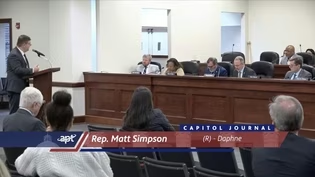
House Bill 41 & 13: Death Penalty & Immigrant Arrests
Clip: S21 Ep12 | 3m 28s | The House debates the death penalty and illegal immigrant arrests. (3m 28s)
Providing Support for PBS.org
Learn Moreabout PBS online sponsorship
- News and Public Affairs

Top journalists deliver compelling original analysis of the hour's headlines.

- News and Public Affairs

FRONTLINE is investigative journalism that questions, explains and changes our world.












Support for PBS provided by:
Capitol Journal is a local public television program presented by APT