
Carolina Impact: January 26, 2021
Season 8 Episode 14 | 26m 17sVideo has Closed Captions
In-person learning, historic mill, helping homeless, and vinyl records.
In-person learning during Covid, Historic Bost Grist Mill in Cabarrus County, Hope Vibes provides vital services for the homeless and the resurgence of vinyl records in a digital world.
Problems playing video? | Closed Captioning Feedback
Problems playing video? | Closed Captioning Feedback
Carolina Impact is a local public television program presented by PBS Charlotte
Carolina Impact: January 26, 2021
Season 8 Episode 14 | 26m 17sVideo has Closed Captions
In-person learning during Covid, Historic Bost Grist Mill in Cabarrus County, Hope Vibes provides vital services for the homeless and the resurgence of vinyl records in a digital world.
Problems playing video? | Closed Captioning Feedback
How to Watch Carolina Impact
Carolina Impact is available to stream on pbs.org and the free PBS App, available on iPhone, Apple TV, Android TV, Android smartphones, Amazon Fire TV, Amazon Fire Tablet, Roku, Samsung Smart TV, and Vizio.
Introducing PBS Charlotte Passport
Now you can stream more of your favorite PBS shows including Masterpiece, NOVA, Nature, Great British Baking Show and many more — online and in the PBS Video app.Providing Support for PBS.org
Learn Moreabout PBS online sponsorship- [Announcer] This is a production of PBS Charlotte.
- Just ahead on Carolina IMPACT.
High school feels more like homeschool for most teens in Charlotte, but COVID, isn't closing all campuses.
We'll take you to one high school where students and teachers have been on campus instead of online.
- I'm Sheila Saints.
This truck delivers not just laundry and shower facilities, it delivers hope for the homeless.
We'll meet the incredible couple behind The Hope Tank.
- [Amy] And remember the vinyl album, you can call it a throwback but they're making a huge comeback.
Carolina IMPACT, starts right now.
(upbeat music) - [Announcer] ] Carolina IMPACT, covering the issues people and places that impact you.
This is Carolina IMPACT.
(digital music) - Good evening, thanks so much for joining us.
I'm Amy Burkett.
If you've got a high school teenager at home it's probably been a pretty tough school year.
Charlotte Mecklenburg High School students have spent most of the year without seeing the inside of a classroom.
No Homecoming, no Fall Friday Night Football either.
All in-school clubs and classes canceled all because of the coronavirus.
And as CMS High School start another semester online only for now.
Is this the new normal until the pandemic's over?
Carolina IMPACT's Jeff Sonya takes us to one Charlotte high school with a different plan for coping with COVID.
Where back to school, also means back to campus (upbeat music) - Morning.
- [Students] Morning.
- Y'all going to lunch or class?
- [Students] Lunch.
- Okay.
- [Jeff] The new normal here at Charlotte Catholic High School looks and feels kind of like the old normal.
1200 students, mostly returning to the in-person learning they're used to.
- You can't get that online.
- You know, it's not perfect but we do the best we can with what we have right now.
So one company, one country, one person can make more with the same resources, that's the important caveat.
- [Jeff] Teachers and students masking their faces, social distancing their spaces and so far limiting their cases of coronavirus.
♪ Don't stand so close to me ♪ - It's been a challenge.
- [Jeff] Principal, Kurt Telford says that challenge bringing high schoolers on campus, keeping COVID off campus starts here at the front door every morning.
♪ Don't stand so close to me ♪ - Each day, every student, every faculty member has to have a temperature check.
(muffled voice speaking) - [Machine Voice] Normal temperature.
- Temperature is your first indicator of someone who may have COVID.
- Sanitize you hands - We're also having them sanitize their hands.
That's the first line of defense.
It's not tough at all.
Either risk, forehead, sanitize, and work your way to class.
So it's really a non-issue - [Jeff] Once inside Charlotte Catholic, there are lines and signs in every hallway urging students to stay in their lanes and keep their distance.
- [Principal] So they might be walking like we are down to class.
We're not gonna get on them about that but distance, try to stay six feet apart and the kids know that.
- [Jeff] The principal says kids know these school lockers are off limits too.
And so are lots of tables here in the school cafeteria where lunch often spreads out into the hallway.
So everybody still has their space.
♪ Don't stand so close to me ♪ - [Jeff] Next stop here at the home of the cougars is the Charlotte Catholic gym.
That's gotta be a challenge, a PE class, I would think.
Wow.
(students shouting) Yep, out here on the hardwood, it's still faces covered.
Same story next door in the band hall, - Three four.
One, two, three, four.
- [Jeff] And check out that red tape on the band room floor.
Every drummer laying down beats inside of personal six foot square.
(drums beating) ♪ Amen ♪ ♪ Amen ♪ - [Jeff] Even the Charlotte Catholic choir practices with masks that are, you know, required.
And when the whole chorus performs, they often move outdoors to the echoes of the school's covered parking deck.
♪ Amen, amen ♪ ♪ Amen ♪ - I never thought it would be a multi-purpose room but as I've said COVID-19 has made a lot of us think differently.
(upbeat music) - [Jeff] Telford adds that classrooms are different because of COVID too.
- [Principal] Well we've put plexiglass in classrooms where there are tables.
- [Jeff] Charlotte Catholic also put cameras in classrooms.
So even when kids are quarantining they can still go to every class and see every teacher every day.
- Everybody at home wave.
(lady laughing) There's the people at home- - [Jeff] Charlotte Catholic calls this synchronous learning.
♪ Synchronicity ♪ ♪ Synchronicity ♪ - The kids at home are able to watch the class and the teachers again have really use of technology so the kids could see just as though they're in class.
- So if you're a student who has to stay home because of COVID, you're on the same schedule watching the same teachers interacting with the same students.
- Exactly the same.
- [Cameron] We still have the in-person classes.
We still have our teacher connection and we can go after class if we need them.
Because I think a lot of us didn't realize how much we liked school until we couldn't go.
- [Jeff] Cameron Green and Nick Clemente are both seniors at Charlotte Catholic.
They both remember what it was like missing so much of junior year because of COVID.
And they're both thankful just to be sitting in a classroom again.
- [Cameron] Because learning online is a whole different story.
- [Nick] And that's what people in other schools are having a tough time with right now.
They're stuck at home, they're not able to communicate with their friends how they usually are used to.
Not able to see their teachers how they're usually used to.
- [Greg] Regardless of what school a student goes to, it has to be the right fit but all of our students need to be in person.
- [Jeff] Catholic school superintendent Dr.Greg Monroe says, that's the goal not just here at Charlotte Catholic, but at 19 Catholic schools in the Charlotte diocese.
From Asheville to Greensboro, K through 12, all students getting their education in person without getting coronavirus.
- [Greg] 0.02% of our community has contracted COVID.
We've seen little to no school spread.
So we're very proud of the success we've had and we're hoping that the success we've had will be a model that other people can follow as well.
♪ Don't stand so close to me ♪ - [Jeff] Does what works here, could it work somewhere else?
Could it work in other high schools?
- It can.
But again, my focus is on this high school and the biggest thing is buy-in from the whole community.
- [Jeff] Here at Charlotte Catholic, that buy-in includes the school staff still willing to work in the middle of a pandemic and willing to change how they work.
- Yeah, and it's so much better than the alternative of not having anything.
- [Jeff] And students willing to follow a lot of new rules just to stay in school.
- We have to stick this out and we have to keep this going.
No one wants to leave school.
♪ Don't stand so close to me ♪ - [Jeff] Being in a class, walking through the halls it feels very much like a normal school year.
- It is in many ways it is.
it is very normal.
And every day is an adventure.
- [Jeff] For Carolina IMPACT, I'm Jeff Sonier report.
- Thanks so much Jeff.
At pbscharlotte.org, you'll find a link to the COVID safety plan they're using in Charlotte Catholic High School.
A daily shower is something you probably take for granted.
People living without permanent housing have access to that amenity thanks to a Charlotte couple.
They're bringing showers and laundry service directly to those in need.
Carolina IMPACT's Sheila Saints introduces us to the people behind the Hope Tank.
(upbeat music) - [Emmanuel] Who doesn't like to take a good shower?
Who doesn't like to have fresh, clean clothes on?
Individuals who's living out in the streets or in a tent or in their vehicle, they don't have the opportunity to do that all the time.
- [Sheila] Now they do.
- [Adrienne] So I think today went really well.
- [Sheila] Because of Charlotte's couple Emmanuel and Adrienne Threatt.
- We're literally best friends and we happen to be married.
- She's awesome.
Like she's my best friend and we have tons of fun together.
(upbeat music) - [Sheila] They're the creators of Hope Tank, a mobile shower and laundry facility for homeless neighbors.
Their desire to help homeless residents happened years ago on their first date.
- So I saw someone sleeping on the street and just to see someone in that condition like it really just broke my heart and that I had this sense of wanting to do more but feeling like, feeling helpless.
- [Sheila] One day Adrienne shared a video on Facebook about a homeless woman.
- It was like probably around 100 people commenting and offering to go out with me.
And I was like, I never said I was going out and people were offering to bring me hygiene products and I really had no intention of doing anything like that.
I tell people, Facebook kind of pushed us into our purpose.
- [Sheila] In 2016, the couple created the non-profit Hope Vibes to distribute hygiene products to people living on the street.
They also built solar powered mobile sinks so people could wash their hands.
In 2020, the average number of people experiencing homelessness in Charlotte, Mecklenburg topped 3000.
- And I remember one night I went to sleep and had this little dream and seeing this vehicle with laundry and showers in it and it was like really nice.
And it was like I had never seen anything like that before, like ever.
- And he woke me up at like three o'clock in the morning and was like, "Hey, I just had this dream."
And I was like, okay, I'm going back to sleep.
He stayed up and research that.
(upbeat music) - [Sheila] The dream became reality.
They received a grant to purchase a box truck.
Volunteers retrofitted and painted the outside.
Inside the bathrooms feel like home.
With artwork by Frankie Zombie who worked on the black lives matter mural.
The couple hopes have changed the perception of homelessness because many of the people who live in tents or on the street actually have jobs.
That's why they were referred to them as homeless neighbors.
And the Hope Tank delivers those homeless neighbors dignity.
(upbeat music) - If you were to go to a job interview, what's the likelihood of a manager giving you that job if you come to that interview and you don't smell fresh and your clothes are dirty.
And so for us, we see that the access to be able to just do those basic things as huge on the trajectory to getting a person out of homeless.
- If they want laundry, they just get a tag, our volunteer will write their name on the tag and then they'll take it over with their clothes to the laundry area and give it to one of the volunteers over there and showers they just write their name and if a shower is open they just go right in and get some towels and go right in.
- All this is free?
- Oh yeah.
Oh yeah.
Nothing cost anything.
These are items like hygiene packs that are donated from different churches, sponsors, individual groups.
Once our neighbor gets the tag, they'll bring it over to the laundry center.
The gray baskets here is they would put their dirty clothes and the dirty clothes from there goes to our volunteer that's here in the laundry center and then their name tag goes with them.
So it goes on the basket and then there's on the washers and dryers there's these little hooks so it stays with the clothes during the whole cycle.
Once it's done comes out the dryer, volunteers fold them up, put them in a nice bag.
- The laundry alone is in big demand?
- Yes, yes.
Laundry is one of the biggest services that we've seen that the need is so high on laundry.
Into 237 loop, there's not any laundry mat like a first we can actually walk up in and wash their clothes.
Behind these washers and dryers, there's two, 300 gallon water tank behind there and there's water pump, water heater behind there - [Sheila] Melissa Brown and her husband volunteer at the sign in table.
- And so I just wanna be a part of something bigger and I wanna give back and just show people that they're humans just like we are, you know?
And so while they're in different circumstances than some of us that we should treat them the same and they wanna have dignity and respect too.
- [Sheila] Like this visitor who lost her job due to COVID and wanted us to protect her identity.
- Whoever invented it I sure appreciate him.
People like y'all coming out and helping us out and encouraging us that we can have a second chance out here and he's making it better.
Thank y'all so much.
(upbeat music) - [Adrienne] This is something that we've been planning for and working towards for a few years now.
And to actually see it go from being a concept on paper to like reality.
Like I can tangibly walk up in this truck and people can actually receive these services, it feels amazing.
- [Sheila] Amazing because the Hope Tank is a moving demonstration of love thy neighbor.
For Carolina impact I'm Sheila Saints reporting.
- Thanks so much Sheila.
What an awesome service they're providing.
And they're still thinking big.
The couple wants to build several Hope Tanks in the future.
Well, it's time for a little history lesson now.
Back in the day, every community needed a gristmill.
That's where you'd take your grain products and have it turned into flour or corn meal or even grits.
Well, there's a family in our region That's been doing it for eight generations.
Carolina IMPACTs Jason Terzis and producer John Briscoe have that story.
(slow music) - [Jason] In Eastern Cabarrus County up on a hill stands a weather worn building surrounded by pieces of an agricultural past.
Pieces representing eight generations of one family's farming legacy.
Here at the Boston Grist Mill Historic Site.
The purr of an antique Allis Chalmers tractor radiates from the mill building.
- Can't use a John Deere though.
- [Jason] Why not?
- Pup foot, can't use the pup foot.
It has gotten to run real smooth.
You can't have something that's going to jerk.
- [Jason] The mill started out on the nearby Rocky River where water powered its operation.
But over a century ago, flooding forced to move and more modern power sources.
- At first it was steam powered with a steam engine.
And then later on, they went to a gasoline engine.
- [Jason] And as the classic tractor warms up, the sixth generation mill owner, Gene Bost inspects and prepares the mills inner workings.
- [Gene] We just make sure everything's in working order.
The belts, you make sure they're not going to be slipping.
Once you're started, that's the hard part.
Once you're started, you can run all day long.
- [Jason] Running the mill requires a bit of help from Gene's son Brandt, he represents the seventh generation giving in a bit of gas, Brandt throttles up the tractor to power this small pulley.
It drives a wide belt that turns this massive pulley that then spins round and round in turn transferring the tractor's energy to the various belts and gears under the building.
It's a lot to keep track of.
- And what I do is just sit there and watch it in case something happens.
I mean, there's a lot of older stuff and all this is going on, anything can happen, anything can apart.
So we just kinda watch it out and be ready to stop it and hurry, get it started and get it stopped.
That's my main role and I kind of keep an eye on underneath.
- [Jason] But the real magic happens on the inside.
- [Gene] We're making cornmeal.
We put it in a machine, in a mill.
The meal is two shafts of stone, it was going down through in the center of those stones getting in between them it was crushing it.
And you adjust your stone.
The lower tighter, you get them, the finer it gets, the wider you get them, the courser it gets.
You want grits?
Grits and cornmeal is the same thing about except that coursers ground.
- [Jason] The ground cornmeal flows down this wooden chute into a vibrating screen, which further refines the product.
- [Gene] It takes out a good product, puts it in that band.
And in the end where it's running out, that is actually a outside part of the corn, the outside layer.
It's called a brand and that's coming out into a bag and maybe some little particles or anything you know that didn't grind comes out there and it's fed by the animals, it's not wasted.
- [Jason] And the finished cornmeal ends up in the bin underneath the sifter.
Most agricultural communities at one time had a mill.
Area farmers would bring their corn and other grains to be ground into products, such as flour, cornmeal and grits.
- It's usually a farmer bringing his own grain in usually on Saturday.
And they would be lined up, I've heard stories they'd be lined up a couple hundred yards.
- [Jason] But with the industrialization of farming and modern food distribution like grocery store chains, mills like the historic Boston Gristmill became obsolete or did it?
Today instead of milling for other farmers the Bost family preserves their mill by opening it to the public on Saturdays.
They run a small country store inside offering their own fresh ground corn meal and other products.
And it's in the other products category where the eighth generation Bost steps in.
Meet 12 year old Gradin Bost.
- We carry all different kinds of sausage.
We carry mild sausage, cajun sausage, mild with extra sage, we carry all kinds.
We do pork chops, we do bacon and a couple other little things.
- [Jason] And to get those delicious products Gradin is continuing a different Bost family farming tradition, raising free range pigs.
- My grandpa done and Dan, his daddy done it.
Just to legacy.
- [Jason] One thing is for certain.
This young entrepreneur is all business.
- [Jason] Now you understand they're not pets?
- Oh yeah, they're bacon or sausage.
It ain't the easiest job but some days it goes good and some days it don't.
- [Brandt] The main reason we started this pig thing too is we care about what people eat.
Just try and do it right because we care about what we get ahold of.
It's not really the profit we're making, we care.
- [Jason] Farm life will never be called an easy life but here on the Bost Historic Gristmill and farm, it can be summed up as a good life.
- [Brandt] I wouldn't tell you nothing about the experience I have a love for the land.
And like I said, it gets in your blood and I've even asked Dennis, I said, you know why don't we do this?
He said, seeing the blood boy.
A lot of people asked me I said, well, let's just go to the beach, spend more time but when you sit here, it means more to you to see and look, what's your family worked for and in you are you see the rewards at the end.
That's what means the most to me.
- [Jason] for Carolina IMPACT, I'm Jason Terzis reporting.
- Thanks so much Jason and John.
I see a very bright future for young Gradin in that story.
The first gristmill in America was built in Jamestown, Virginia, back in 1621.
Well, do you remember the first album you ever bought?
I had a 45 of "Love Will Keep Us Together" by Captain and Tennille when I was just a kid.
Many of us saved our money to make that first big purchase.
For a time, vinyl records just sat on the shelves, collecting dust but not any more.
- So today you're reacting to this.
- Whoa!
It's like a DJ thing, my aunt Barbra had.
But like really old.
- Baby boomers and generation X certainly know what it is.
- Oh my gosh, I cannot think of the name.
- After phonograph.
Tape recorder, tape player.
- A radio player.
- [Jason] Just about every house had one.
- This thing is weird.
I don't get this.
- Just place a CD in it.
- I think it's cool.
- [Jason] But many kids today have no idea what it is.
This is a record player - A record player?
It looks broken.
- [Jason] So record players have been used in their permanent forms for over 100 years and many people still use them today.
- What?
That's a long time.
- [Jason] Which is why these days you can find cute videos with kids being shown a record player.
So you'll need this.
- Yeah!
Found it.
CD - [Jason] And Other video showing how to use it.
- [Instructor] Position the needle where you want it.
- Google's much easier than this.
Hey Google, play whatever.
- The first thing I got to do is teach them how to put the record on.
- [Jason] Leigh Northrup works as a middle school teacher in Concorde.
He's helping introduce a whole new generation to a media of yesteryear.
- [Leigh] I've got about 300 kids that come through my room and they'll grab their favorite record and pop it on there and check it out, which is pretty cool.
- [Jason] On this day we came to Plaza Midwood to visit Lunchbox Records.
The place is hard to miss.
A giant brick building painted teal.
- I had always bought records because the music I was into mostly came out on record.
- [Jason] There's a constant stream of people coming in.
Some even lining up outside.
From the new Bruce Springsteen and ACDC albums to classics from Motown and Bob Marley, you can find just about everything at Lunchbox, including record players and of course, lunchboxes.
- [Molly] I kind of got introduced to it by a guy that I used to date.
And then, you know, that came and went but he brought me here and that's why I came to know it and have just really liked this like being introduced to it.
- [Jason] Vinyl sales have been increasing every year for 13 years now.
And with record sales at Christmas that trend seems to be continuing into the new year.
- [Scott] There used to be definitely more of a niche underground kind of thing and at this point, it's, you know it's everything across the board mainstream stuff.
- I'm glad the records are back.
- [Jason] Just down the street in Charlotte's Commonwealth Park neighborhood is Repo Record.
Owner Jimmy Parker has been working in the record industry since 1972.
- I moved back to Charlotte in '88 and opened my first Repo Record on Central Avenue.
Since then I've had seven Repo Records.
This is the last one.
- [Jason] His store kind of looks like a musical museum with Beatles dolls, posters, used stereo equipment, Coke bottles, speakers of velvet Elvis, cassette tapes, eight tracks and of course records, lots of them.
- This is one thing I know I'm good at.
- So what is it with records?
CDs made them obsolete in the '80s but they're making a comeback, a big one.
So why now?
Why the renaissance?
- I guess it's because it's this stylistic the kids won't hold the record, bigger lyrics.
- You know, the art is lost.
Like the kids, miss album covers.
- Kind of like a backlash against digital because you know, people want something tangible to hold onto to, to connect to the music and the artists.
- [Jason] Just around the corner from Repo and the east way crossing shopping Plaza sits Visart.
If you thought video stores were a thing of the past, guess again.
- Visart has been around for almost like 40 years here in Charlotte.
- We have the largest collection of film and video on the East coast by now.
- [Jason] Visart is absolutely packed with videos from new release movies to TV shows and even the most obscure of foreign films.
- We have Indies, we have documentaries, we have a little bit of musicals.
We have a little bit of everything.
And our goal is to have every movie ever made.
- Last I checked Netflix, Hulu and Amazon combined have about 25,000 movies that you can rent and stream.
And we have about 40,000.
So all the old stuff and all the weird stuff that you just can't find, we have it here.
A five day DVD rental cost, just 350.
But if you're wondering how a video store is still in business these days, think of his art not necessarily as a traditional video store, but as a library of sorts.
- [Gina] How are we gonna survive in this climate?
Blockbuster hasn't been able to, Hollywood hasn't been able to, how do we do it?
We are not only surviving, we are thriving as a nonprofit, as a film and video archive.
Our essential goal is not to make money.
Our essential goal is to provide a community service.
- [Jason] Whether it's Visart, Repo or Lunchbox Records, East Charlotte is where you'll find all of them.
- I really feel like East Charlotte is the last frontier for diversity.
We are so diverse and we've been getting along really well for a long time.
We're culturally diverse, we're ethnically diverse, we are age diverse.
- We need these kind of stores.
We need the local businesses and I wanted to at least be able to support them in a little bit of a way so I'm very glad they're here.
- [Jason] It's small, locally owned businesses serving up old school media, creating a little East side pride in the process.
For Carolina IMPACT, I'm Jason Terzis reporting.
- Thanks so much Jason.
One study shows more than 60% of vinyl record buyers range in age from 13 to 44 years old.
Amazing how what's old is new again.
Well, that's all we have time for this evening.
Thanks so much for joining us.
We always appreciate your time and look forward to seeing you back here again next time.
Goodbye my friends.
(upbeat music) - [Announcer] A production of PBS Charlotte.
Video has Closed Captions
Clip: S8 Ep14 | 6m 29s | COVID High School: How one high school is on campus instead of online. (6m 29s)
Video has Closed Captions
Clip: S8 Ep14 | 5m 4s | The Bost Grist Mill in Cabarrus County. (5m 4s)
Hope Vibes Inc.: Helping the Homeless
Video has Closed Captions
Clip: S8 Ep14 | 5m 35s | A local couple provides shower and laundry facilities for the homeless (5m 35s)
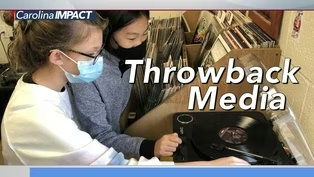
The Resurgence of Throwback Media
Video has Closed Captions
Clip: S8 Ep14 | 5m 18s | A look at East Charlotte throwback media stores. (5m 18s)
Providing Support for PBS.org
Learn Moreabout PBS online sponsorship
- News and Public Affairs

Top journalists deliver compelling original analysis of the hour's headlines.

- News and Public Affairs

FRONTLINE is investigative journalism that questions, explains and changes our world.












Support for PBS provided by:
Carolina Impact is a local public television program presented by PBS Charlotte