Vermont This Week
January 26, 2024
1/26/2024 | 26m 45sVideo has Closed Captions
Governor’s 2024 Budget Address
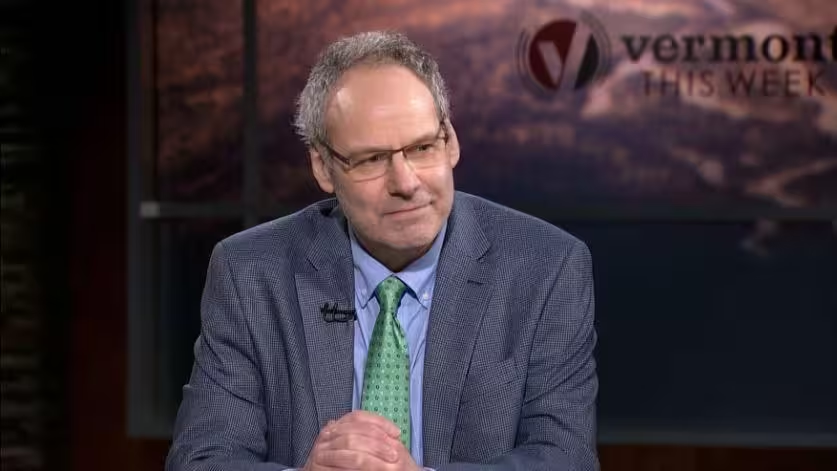
Governor’s 2024 Budget Address | Democratic Leadership Responds to Gov’s Budget Address | Senate Fails to Override Bottle Bill Veto | Panel: Cat Viglienzoni - Moderator, WCAX; Stewart Ledbetter - NBC5; Peter Hirschfeld - Vermont Public; Anne Wallace Allen - Seven Days.
Problems playing video? | Closed Captioning Feedback
Problems playing video? | Closed Captioning Feedback
Vermont This Week is a local public television program presented by Vermont Public
Sponsored in part by Lintilhac Foundation and Milne Travel.
Support provided by:


Vermont This Week
January 26, 2024
1/26/2024 | 26m 45sVideo has Closed Captions
Governor’s 2024 Budget Address | Democratic Leadership Responds to Gov’s Budget Address | Senate Fails to Override Bottle Bill Veto | Panel: Cat Viglienzoni - Moderator, WCAX; Stewart Ledbetter - NBC5; Peter Hirschfeld - Vermont Public; Anne Wallace Allen - Seven Days.
Problems playing video? | Closed Captioning Feedback
How to Watch Vermont This Week
Vermont This Week is available to stream on pbs.org and the free PBS App, available on iPhone, Apple TV, Android TV, Android smartphones, Amazon Fire TV, Amazon Fire Tablet, Roku, Samsung Smart TV, and Vizio.
Support the crew
Help Mitch keep the conversations going as a member of Vermont Public. Join us today and support independent journalism.Providing Support for PBS.org
Learn Moreabout PBS online sponsorshipComing up on Vermont this Week, we're following the money as governor Phil Scott lays out his budget to lawmakers.
I don't think there will be a lot of disagreement about what's in this budget.
The disagreement will lie in what's not in.
But pretending we can fund everything isn't realistic.
So what will those disagreements mean for this legislative session?
And where does Governor think investments need to be made?
All that straight ahead from the Vermont Public Studio in Winooski.
This is Vermont this week, made possible in part by the LinTel Foundation and Milne travel.
Thanks for joining us on Vermont this Week Im Cat Viglienzoni.
All eyes are on the money at the state house this weekend.
Here to help us break down the governor's budget, picture a familiar face to this show, Stewart Ledbetter from WPTZ, Anne Wallace Allen from Seven Days and Vermont Public's Pete Hirschfeld.
Thank you so much for being here.
So, Pete, the governor promised a lean budget to lawmakers in his $8.6 billion pitch.
Do you think the governor delivered that?
Certainly.
If we're comparing this year's proposed budget to what we've seen in years past.
Yes.
Last year, the legislature enacted a state budget that relied on a general fund increase of 13%.
The governor has presented them with a budget that uses a general fund increase of about 3.6%.
So considerably less, not just in last year, but in years past.
If you look back over the past five budget cycles, we've seen an average increase, average annual increase in general fund spending of about 7.5%.
Phil Scott says we need to depart from this.
We've gotten ourselves to a point where we're on the brink of creating some real fiscal instability as a result of this spending.
And he is prevailing upon lawmakers to join him in sort of reining that in this year.
And Stuart, not a surprise, though, to hear the governor ask for a lean budget.
He does that a lot, says that's the available money this year and we should only, only spend what we have and absolutely not pass any new tax or fee increases.
Noting that there are some that passed last year that have yet to take effect this year.
So yeah, it was a more sobering address and it comes a week after a pretty good revenue report that suggests there's no risk of recession in the forecast and state got a modest revenue upgrade.
But boy the tone of the governor's speech was not something that Democratic leaders seem to appreciate.
Yeah, you know, it certainly was inferred by some of their commentary afterwards that they felt like he was scolding them a little bit.
Yeah, this is politics, though, and they're $8 billion of taxpayer dollars at stake.
And I think that, you know, some reality is one thing.
I mean, he is coming off a session in which he was he objected to a number of bills, including the budget last year, and was overridden over and over and over again.
I think that stuck in his craw and he wasn't going to sugarcoat it.
Do do you were you surprised by anything in the governor's budget address or was this kind of what you expected to hear from him?
What I expected to hear.
You know, you can't continue on the kind of trajectory when you don't have the revenue.
I mean, we we've created sort of this artificial expectation because we were showered in hundreds and hundreds of millions of dollars from Washington over the last several years.
And that's still working its way through.
But a lot of that is mostly committed at this point.
And so that's why you got a three and a half percent, 3.6% spending proposal.
And we did hear a pretty consistent message from the governor about spending, including in education, where he's pitching 2.4 billion for the ED Fund.
But he did bring up concerns that we are not getting off bang for our buck and that some Vermont communities could see double digit tax increases this year.
Taxpayers could see their property tax bills rise by an estimated 17.3%.
Vermonters can't afford this increase, but we have to be honest, it's not something we can simply by down or take from another pocket because getting it to 2%, as some of you have suggested, would take about $213 million.
So we need to work with school boards, administrators, parents and teachers, because the reality is changes need to be made before budgets pass.
At a minimum, you need to address the factors that fuel these increases year after year, even if it won't reduce costs this year.
So and it's one thing to ask for changes to be made and a whole other thing entirely to get communities to actually make them.
Do you think the governors message in the budget address is resonating though this year when people think about.
My home might have a double digit tax increase?
Well, you know, I think when that was announced, when we learned about that tax increase last year, there was a real shock factor that came along with it.
And I do think that it suddenly focused people's attention on affordability in a way that we hadn't really, hadn't really come together as strongly as before.
And now affordability has risen to the top of the agenda for in many of the the the smaller races that we're going to see in March in town meeting day like people are talking about how affordability has become a bigger problem.
So it did resonate.
And there's there's no question that people that's that's a very unpalatable tax increase.
But if you put it on the districts to save money, you're going to run into a lot of opposition to it because it's going to mean cutting programs and also a feeling of losing local control, having to meet that.
But to come up with $200 million to find some way to defray that cost to I don't know how you would be able to do that or where that would come from at this point with the budget lean.
Mm hmm.
There was a hearing on on Thursday, sort of sort of asking that question, which a couple of dozen local school district leaders spoke before a couple of committees at the statehouse.
And, you know, there's there's a lot of oh, my, oh, my, what?
What can we do?
I'm not sure, Pete, how much of this is is blamed or can be traced back to that 127 that that adjusted per pupil weighting.
But it came it's very complicated and that's that's part of the downfall of the system because it's intensely complicated.
A lot of people don't don't understand the intricacies of it.
But there was this five and 10% spending cap that was intended to help districts that have a lot of kids who are either from poor families or who don't speak English as a primary language and who are more expensive to educate.
But the lawmakers in their stern letter to local school districts that precipitated Thursday's hearing, said it's created a lot of unintended spending consequences.
Yeah.
It's it's not the primary factor of what we're seeing in terms of projected increase in school expenses next year.
But it's contributing to it.
It's yet another thing that is contributing to these higher costs.
Lawmakers are prevailing upon superintendents, school administrators, to not avail themselves of this opportunity to increase spending in their district and not suffer the tax consequences that on any other year they would experience.
But that's sort of a smaller part of a much bigger dilemma that both the governor and the legislature face.
And that is what tools do we really have at our disposal to get at this longstanding issue of this increase in education spending at this time when the number of students we're actually educating is going down?
We heard the governor in his speech say, I've given you ideas before.
I put stuff on the table.
Some of those things include mandatory growth caps on school spending.
They include minimum ratios in terms of staff to student ratio in schools.
He said Democratic lawmakers, you ridiculed me when when I did that, you tried to make political hay out of it.
You rejected it out of hand.
So I'm not putting anything on the table.
You got to come to me.
Work with me.
Let's do something together.
That didn't go over well with lawmakers.
They say you're the executive lead by example.
You've got this team of advisors that can come up with specific policy and draft legislation.
They say that's what they want to see from him.
But we haven't seen from anybody yet a concrete policy proposal that they can show Vermont and say, here's what we're doing to make sure that this trajectory that we're on doesn't continue.
Lawmakers have indicated they're going to be working on something to that effect.
But it is the the big dilemma that they're facing right now.
And Senate President Pro-Tem Phil Brewer said there's nothing worth thinking or talking more about within our own chamber than this issue of property tax increases this year.
Is that in part because they feel some political risk if they don't act?
You know, I don't know that Democrats in the House and Senate have a high degree of fear about what the Vermont GOP is going to do to them if they don't deliver for taxpayers.
We've seen in recent cycles that Republicans have not been able to take advantage of weak spots that Democrats may have given them an opening on.
But they're hearing it from their constituents.
That's what I think, that they I think they're hearing from people on the ground in their communities.
You got to do something about this.
What incentive, though, is there for districts to, you know, who are maybe not seeing quite as high of tax increases as some others to rein in their spending?
I think that's kind of a question.
I think.
I would like to know the answer to.
To be honest, I think that's what lawmakers are asking, too.
They're saying, is there an incentive for them to do that?
And, you know, or so that's why they're sort of asking them, please do the right thing.
And imagine if we did the state budget the way we do, the way we do the education fund, where every community in Vermont got together at town meeting and said, how much do we want to spend on our little geographic region here?
Those numbers would probably increase pretty quickly.
Right.
If you're making that decision with everybody, with more for their community.
Exactly.
That's that's the system that we have for school spending.
We all get together in our communities and we decide what we want our kids to have.
And when it's your kids that you can see around, you know, your neighbors, you want them to have the very best.
And so you're going to be willing to support a budget that that rises at a at a pace that you might not otherwise feel comfortable with.
So so that's the dilemma lawmakers face.
Do you actually begin to erode the principles of local control that have governed our education system for so long?
And there are a lot of people that think that that's where you need to go.
That's the policy decision you need to make if you're actually going to get at this once and for all.
Yeah, it's a it's a fascinating topic and it's certainly one that I think we'll be following on this show throughout the entire legislative session here, because it's not going to go away, certainly not as we get closer to town meeting day and those budgets are actually coming up in front of voters.
So we'll be curious to see what happens with that.
The governor in his budget address also talked a lot about public safety changes he wants made.
Let's start with something you don't hear too often in this building.
I may have been wrong.
I've supported and signed some of the very legislation I'm asking you to change today.
I agree.
People deserve second chances and maybe even third or fourth, especially when it comes to mistakes made as a young adult or when struggling with addiction.
But I wish I better anticipated the challenge of implementing laws to raise the age of criminal accountability.
Because we weren't ready.
We put the policy idea ahead of the fundamentals, the real work of actually helping our youth.
So, Stuart, the governor saying he and lawmakers may have been wrong about some of the public safety reforms.
What do you make of that?
Well, he's right.
You don't hear that all the time.
But, you know, we have really been smacked by the impact of fentanyl and psilocybin and the grip of addiction in our newsrooms.
Hardly a week goes by where we don't have a news release from a police agency talking about picking up somebody who has been in trouble, you know, 30 or 40 or 50 times before and has not been held.
It's very frustrating to them.
The governor in his budget address cited some specific examples in places like Rutland and Saint Johnsbury where people commit all manner of crimes and a lot of it focused on drug trafficking while they're out for a previous offense up to and including homicide.
So this this, you know, there's been some criticism that we have a revolving door.
This catch and release is what in some communities it's almost come down to that frustrates the heck out of police.
We know Democrats push back on some of the governor's proposals that we want to put kids in jail, I think was what the House speaker said in response.
But bail reform would seem to be a target this year to try to get at at the revolving door.
The Democrats would like to increase funding for the judiciary as part of the revolving door stems from the big backlog of cases that started during the before the pandemic.
And it was interesting because part of you picked up on this, too.
The governor, in his budget address, while he talked a lot about the changes he wanted lawmakers to make to Vermont criminal justice laws.
There weren't a lot of dollar figures that he mentioned attached to those.
There is notably within the governor's budget an increase in the court system at the defender general's office.
This is one area where he did exceed that 3.6% baseline that he held other agencies to.
And he said that was precisely because we are dealing with this backlog of criminal cases in the Vermont judiciary.
There's funding in there for two full time, what they're calling roving superior court judges that would be able to go to different counties around the state and be able to help help courts work through that backlog.
But but I think Stewart's right, the sticking point from a policy perspective between the governor and lawmakers is do you sort of break with this decade long effort in Vermont to make the criminal justice system more progressive?
Or do you just stick to your guns and commit to the path you're on, which is one that largely relies on decarceration, increasing education, giving services and programs to people that find themselves in the criminal justice system.
There's a question of whether it is those programs that have led to this increase in crime.
Some people say yes, some people say no.
But there's obviously it's reached a crisis point in some people's minds in Chittenden County.
And it's another thing that is at the top of people's agendas now.
It's a priority along with the cost of living.
I think some of the specific measures, for example, you know, raising the the age for which people can be prosecuted, some police will say, well, that is just led crime cartels, for lack of a better word, the smaller ones to send younger people up here to commit some of those drug crimes.
You know, there's there are there's plenty of people saying that they can see the consequences of those moves.
And then for part of the crime, it's kind of hard to hard to know why this is happening.
Certainly, though, the business community, you know, is, I think, starting to be way more vocal about its frustrations as we see businesses on Church Street and other places say, you know, this is actually making it impossible for me to do business down here.
They are.
And if you if you can shoplift at a dozen different stores and not be prosecuted because each shoplifting episode, episode fell beneath a certain amount, even though the aggregate is, I think, $900 or something like that, where you get prosecuted for it is practically it's just a free ticket to shoplift.
And I think a lot of people have, if there's any police officer available to respond.
Right.
And organizations like the Vermont chapter of the ACLU will counter, though.
So what are we talking about?
We talk about putting these people in jail.
You want to go to prison?
They cited a cost.
I don't know if this is accurate or not of $95,000 a year per incarcerated individual per year, whatever the number is, it's it's a lot of money.
And that's money that adds up quickly when you're looking at a state wide approach.
So so that's a consideration that elected officials are going to have to take.
And criminal justice reform advocates would argue there are much more efficient and effective ways to expend those resources than putting somebody in a jail cell like a lot like drug treatment, which is, you know, there's a lot of there are new drug treatment programs even now that are efforts to divert people from jail just because it's known that that shoplifting, that underlying causes is a substance abuse problem.
I remember former Governor Shumlin made a big point to at a previous legislature how it's important to have that that stick, particularly the first time someone is picked up on a drug related offense to say, look, treatment or you're going to jail.
And, you know, perhaps that that will become fashionable again as a strategy, because this I mean, it was just it was it was the day or that maybe it was the day before in Burlington, we had a a case in which two people were held hostage in a in a bar from a tenant with a 22 year old kid who police said later had had 100 previous interactions with the police.
Another priority we wanted to get to in the governor's budget address was housing.
Here are some of the dollar amounts the governor is proposing for those initiatives.
We have 6 million to bring blighted rental units up to code, 4 million to help low income homeowners with their septic systems.
2 million for mobile home repairs and 7 million to expand shelters.
And do you think the governor and lawmakers will agree on any of those dollar figures?
Well, it's very, very early in the process.
And who knows what we're going to end up with even three or four weeks from now.
But the striking thing about those numbers is how much smaller they are than the numbers that we have seen over the last few years.
Even well before the pandemic, we had a $37 million housing bond, which at the time seemed astronomical to build affordable housing.
And then when the pandemic and the ARPA money came along, we've talked hundreds of millions of dollars, most of it going into affordable housing like multifamily housing, apartment buildings.
So housing advocates are saying that the numbers they're seeing this year from the governor are laughably small compared to what they've been seeing.
And as we know now, that one of the big obstacles to building housing is cost.
It costs an estimated half million dollars to build a unit of affordable housing right now.
A lot of those costs are out of our control.
They're building cost labor that they have to pay to get it.
And so if we're if we want to move the needle on housing and keep doing so, then I think lawmakers are going to push for for more money because they're hearing from the constituents and from businesses and from just people who want the state's population to rise and want younger people to move in.
That housing is the number one obstacle.
Brattleboro Representative Emily Kornheiser, the Democratic chair of the House Committee on Ways and Means, said after the governor's speech, We can't be nibbling around the edges.
She perceived this budget as in those amounts, those housing amounts he talked about as nibbling around the edges.
She said, If we've learned anything from the past five years with this massive infusion of money where we we've actually been able to turn that into government interventions that move the needle.
She's saying we need to do more of that.
There are a lot of Democrats in both the House and Senate that say we need to be doing more of that, not just on housing, but, you know, we're looking at legislation that would vastly expand Medicaid eligibility in Vermont, you know, money to improve to increase Medicaid reimbursement rates for providers.
So, you know, you talk to her about here's how much revenue we have.
And the governor says we need to build a budget that accommodate that amount of revenue.
And lawmakers, I think, are taking a different approach there.
They're basing what they think the budget ought to look like at the end of the day on what they perceive the need to be and their perception of need.
And the governor's perception of need are two very different things right now.
No, I think you're absolutely right.
What about in Act 250, taking an approach that would focus more on regulatory reform?
That is one way that another avenue that the governor is emphasizing as a way to enable the building of more housing, because a lot of developers, developers will say that permitting is holding back a lot of the housing construction.
And he's suggested some pretty draconian changes to the appeals process and act to 50 that would make it more difficult for local people to stop a project or to limit its size.
And we have seen that that's happening.
But there is a big question about how much that permitting is really holding back home construction, because in places that don't even have zoning like midtown, there's there's there's still no housing being built and there's a dire need for it.
And that's because of the cost.
I mean, for sure, developers say that A250 is and we know that appeals in towns have stopped projects or made them much smaller, but it's not going to solve it.
And I do want to make sure we have time to hear from Democratic leaders responding to the governor's plan.
They said it lacked specifics.
He talked a lot about fixing problems rather than funding them.
When he didn't want to spend money.
When he did want to spend money, then it was a great initiative that he was willing to describe.
I think in Vermont we have challenges, that's for sure, but we also have opportunities.
I think his speech was long on fear and short on hope.
All right.
It's now up to lawmakers to take the governor's pitch and see what they want to do with it.
Pete, what do you think we're going to see given some of the statements we're hearing from the leadership in the House and Senate?
I think you're going to see a budget that is passed by the House of Representatives in 6 to 8 weeks.
That is in some ways fundamentally different from the one that Governor Scott put on their desks.
Just one example.
The governor's budget assumes a vacancy rate in state government of about 9% next year.
That's owing to the high vacancy rate in state government right now.
Democratic lawmakers early on in this session are making it clear we want to fix that.
We want to look at how we can get more people interested in working for state government.
We want to bring that vacancy rate way lower than it is right now.
That in and of itself is a big ticket item that is not in the governor's budget.
And I could list ten more.
So I think you're going to see a very different budget.
Now, interestingly, Stuart, somebody got shot down by lawmakers this week, though they tried to override the governor's veto on the bottle bill in the Senate.
And it's after it sailed through the House at the start of the session here.
It fell three votes short of the majority needed to override the governor's veto.
What do you make of that?
The Senate took a different view than the House.
The bottle bill override sailed through the House.
I think with 80% of the vote in the Senate, you need two thirds as well.
And it fell three votes short.
There were some Democrats in the Senate who just weren't comfortable with such a dramatic change to, you know, impose a deposit on wine bottles and sports drinks and water bottles.
And they got pushback from some of the trash haulers that this would devalue the the their efforts at recycling blue bin recycling.
So this will come back another year.
The person says that it has broad support, but maybe the Senate didn't feel it was ready.
Yeah.
Interesting bit of politics, though, to see it kind of pass one.
And then they thought it was going to pass in the Senate and, you know, didn't have didn't have the umph it needed to get through once to get to a piece of education news in Vermont that we think was interesting this week.
A small Vermont college goes remote only, and it's not because of COVID cases gotten college says it's temporarily dropping residency programs and the future of its campus in Plainfield is uncertain.
And I think this is interesting.
When our reporting happened this week on it, you know, I found I learned there were only 12 to 18 students actually on campus in Plainfield at any given time.
Right.
They have a 115 acre campus, but it's built on they're using a lovely old estate from the that they've been using for decades.
But yeah, only 12 to 18 people were coming to campus for their residencies.
The college has slowly been contracting over the decades.
You know, they used they once had 1200 students there in the seventies and they were full time.
And then around the round, I think year 2000 is when they went to part time residencies and a lot of people in the area and a lot of got undergraduates have been watching and with trepidation to see what's going to happen to the school because we know what's happening to small colleges.
We've we've lost a lot of them, especially like small alternative colleges like Marlboro in Vermont and southern Vermont College, Green Mountain College.
So Goddard is struggling with the same demographic challenges that other schools are.
And this latest move by their latest president shows that things aren't getting any better.
And people in the community are already talking about ways that they could use the campus and then, you know, actually put it to use like Cabot Creamery is already housing workers in the dormitory.
They have said that they could use more dorm rooms and actually bring back some vitality to Plainfield.
And we'll be curious to see what happens with Goddard College there as they move forward, whether they actually end up removing the temporary remote only or whether they just keep it in place.
And thank you so much.
That does it for this edition of Vermont this week.
Thanks to our panel.
Stewart Ledbetter from WPTZ, Anne Wallace Allen from Seven Days and Vermont Publics Pete Hirschfeld.
Thank you all for watching as well.
Have a great rest of your day.

- News and Public Affairs

Top journalists deliver compelling original analysis of the hour's headlines.

- News and Public Affairs

FRONTLINE is investigative journalism that questions, explains and changes our world.












Support for PBS provided by:
Vermont This Week is a local public television program presented by Vermont Public
Sponsored in part by Lintilhac Foundation and Milne Travel.