
January 26, 2026
Season 4 Episode 308 | 26m 40sVideo has Closed Captions
Three deaths possibly tied to winter storm.
Governor Beshear says at least three deaths may be tied to winter storm, Kentucky getting support from outside to help restore power to thousands, Northern Kentucky sets another snowfall record, and Republican congressman James Comer of Kentucky says it might be time for ICE to leave Minneapolis.
Problems playing video? | Closed Captioning Feedback
Problems playing video? | Closed Captioning Feedback
Kentucky Edition is a local public television program presented by KET
January 26, 2026
Season 4 Episode 308 | 26m 40sVideo has Closed Captions
Governor Beshear says at least three deaths may be tied to winter storm, Kentucky getting support from outside to help restore power to thousands, Northern Kentucky sets another snowfall record, and Republican congressman James Comer of Kentucky says it might be time for ICE to leave Minneapolis.
Problems playing video? | Closed Captioning Feedback
How to Watch Kentucky Edition
Kentucky Edition is available to stream on pbs.org and the free PBS App, available on iPhone, Apple TV, Android TV, Android smartphones, Amazon Fire TV, Amazon Fire Tablet, Roku, Samsung Smart TV, and Vizio.
Providing Support for PBS.org
Learn Moreabout PBS online sponsorship>> We are not in the clear yet.
>> The snow and ice have stopped falling, but the slick roads and bitter cold aren't going away.
[MUSIC] >> Imagine bringing in an ice covered big truck that's just not working the weather for whatever reason, and then having to troubleshoot that at 2:00 in the morning and get it back into the fight.
>> How crews in southern Kentucky are working around the clock to keep their city safe.
[MUSIC] >> We'll take snow all day long instead of ice.
[MUSIC] >> And we'll get a glimpse into conditions in the northern part of the state, where they're breaking yet another snow record.
[MUSIC] >> Production of Kentucky edition is made possible in part by the KET Millennium Fund.
>> Good evening and welcome to Kentucky Edition for this brand new week.
It's a blustery Monday, January the 26th.
I'm Renee Shaw.
We thank you for joining us this weekend.
Well, the winter storm has come and gone, but it will take days to recover.
Snow, sleet and ice are causing issues all across the state.
The Kentucky Transportation Cabinet is working to clear more than 28,000 miles of state roads.
That includes interstates, and here you can see snow plows side by side tackling Interstate 75 in Madison County.
Road conditions vary across the state.
In Elizabethtown, Kentucky, State Police and some good Samaritans help free a driver stuck in the snow.
Scenes like this are pretty common.
That's one reason why universities around the state called off classes for today.
The Kentucky General Assembly was also not in session today because of the weather.
State lawmakers plan to return to Frankfort tomorrow.
This morning, Governor Andy Beshear said at least three deaths may be related to this winter storm.
He did not provide many details other than saying one death may be tied to the use of a generator, and he continued to encourage everyone to stay off the roads if possible.
>> The system has now moved out of the eastern side of our state, but I want to emphasize we are not in the clear yet.
Some roads, especially secondary, are still impassable.
Our interstates that while we have made significant progress, if you're on them, if you have to be on them, you need to slow down.
If you're going the full speed limit on our interstates, you are driving dangerously.
Roadways are still slick and temperatures are still dangerously cold.
And that will continue throughout this whole week.
We hope that there will be a period today, but we especially think there will be one tomorrow where the temperatures will rise enough for us to make significant headway on our roads.
We need folks to continue to avoid travel today if possible.
>> The storm knocked out power to more than 73,000 Kentuckians statewide.
That number has been cut almost a half in quarter, according to Governor Beshear.
Currently, the highest concentration of outages is in the southern region of the state.
Kentucky Electric Cooperatives says crews are working around the clock to get power restored there, and more support is pouring in.
But the icy conditions are still making restoration difficult.
>> Obviously, we deal with all kinds of natural disasters and severe weather throughout the year, tornadoes and such and floods.
Those are things that are sudden onset and it's very dramatic with ice.
It's it's just think about it.
It's just water.
It's just a glaze, if you will.
It sounds pretty innocuous, but enough of that.
Builds up, builds up, builds up to the point where those trees, they might be able to hold on to that weight for a certain period of time, but that's when you hear that sickening snap sound of a tree and all those limbs, and it echoes across the the wilderness, if you will.
And that's when you know, when those limbs come on top of those, those lines.
But in addition, it's not just when the freezing rain is coming down.
We know that this cold is going to be here for at least a week.
This extreme cold, this ice isn't going anywhere.
And at some point the the trees that are holding up okay, so far, maybe 2 or 3 days down the road, they might also begin to be compromised compromised by this.
So just because the freezing rain has stopped doesn't mean that the ice accumulations are stopping.
They're effect wires are down, poles are broken, and a broken pole is a lot more comprehensive of a repair or a restoration than perhaps, you know, putting conductor or putting electric lines back up, because then you're talking about a construction project that can be a an eight hour project on a good day, much less having to access a, a icy, you know, debris and, and clearing out limbs and trees and things to get to the point where you can dig that new hole, set that pole, and, and then reapply all of that equipment on there.
So it's a big construction project for each one of these outages.
It's carnage in terms of the amount of limbs and trees and and just what they have to get through the roadways included to be able to access that.
And then imagine you're in many cases, you want to be able to use a bucket truck, and they can use them in some areas.
But in some parts of of Kentucky where we had so much rain, it's not stable enough on the ground.
And they have to climb that glazed with ice pole, you know, and get to the top of that.
So they're they're swaying there in the breeze.
The wind gusts are coming along, the ice is falling on them.
And they're trying to, you know, reconstruct the power system.
Some mutual aid crews are already here.
Some are still making their way in from farther away, such as from Illinois.
But there are crews from salt River electric near like Nelson County and that area, Bullock County crews from Owen and in the northern Kentucky area, among other cooperatives that are that are coming in, you have to make sure that when you're deploying crews, you're not just sending someone and saying, go help.
You have to make sure that they're, for instance, in eastern Kentucky, the mountainous areas there, do you have the right equipment and the right tires on your vehicles to be able to traverse some of that very rugged terrain and some other areas you might go, you know, farther to the to the west that might not have the same kind of issues there.
You know, how many people will be on the crew?
Do you have the right kind of equipment to be able to like an auger, to be able to make a new hole for a pole?
So all those things have to be assigned like a military deployment.
Are we sending the right people at the right place to be as effective as possible?
Typically, you're going to look at critical infrastructure first.
That needs to be restored hospitals, nursing homes, etcetera.
And then you're going to look at where what outage can you fix that's going to improve or restore to the greatest number of consumers?
Even though co-ops are rural in our nature, we still serve a lot of industrial as well as subdivisions and neighborhoods.
So if there can be an outage that they can work on, it's going to be able to bring a whole neighborhood back on that will come before that one house at the end of the country lane, however, co-ops serve the last mile, and what that means is that this is probably going to be, I would say, a good week before all the lights are back on to those people at the very end of the line.
>> And our gratitude to the utility workers and those road crews who are out doing that work.
If you are without power or you lose power in the coming days.
There are more than 130 warming shelters set up across the state, and you can find a shelter near you online at ky.ky.gov.
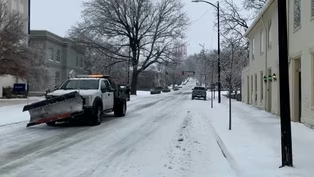
The Bowling Green Warren County area hasn't had any major power outages, but they do have icy roadways.
Even the interstate and main roads are down to one lane at best.
The cold temperatures are also posing a concern.
We go now to our Laura Rogers in Bowling Green for the latest on the weather situation there.
>> Hey, Renee.
Yeah, Warren County Emergency Management telling me the top concern so far has been icy roadways.
Bowling green receiving 3.5in of snow and sleet over the weekend.
And then add to that the ice.
It's all led to a very slick conditions.
Emergency services have had some issues as far as access, but with the help of local fire departments side by side and four wheel drive vehicles, they have been able to get where they need to go.
Those first responders.
So that's good news there.
Now, we also checked in with the City of Bowling Green's public works department.
Of course, those crews were out before the winter storm treating the roadways with deicer.
And we talked to Director Andy Souza about current conditions and priorities as they now shift to response.
>> They've been out today with our plows and we are salting right now, and we're focusing on businesses and our priority and our priority A and B groups.
We had six downed trees with that ice storm.
So we've got to be able to get those out of our right of ways, clear those big trees out.
And so really, it's just a dance of making sure we have the right equipment postured, getting our crews rested because we've been working 24 over seven.
These same crews worked all last week.
And then we sort of sent them home Friday and said, hey, if you guys get some sleep and we'll have you working on those 24, seven shifts.
So the crews are tired and hopefully we're on the tail end of this right now, even though it may not seem like it.
The sun's out.
It's helping melt some stuff and we're just hopefully on the back end of it.
What we try to plan for is we have ten zones in the city.
Makes it easy to sort of recognize I live in this zone or that zone, and we try to have one plow, one plow per zone so we can tackle everything all at once.
And this time we've had some maintenance issues.
Not totally unheard of.
I mean, when it's cold and it's salty, we're going to have some plows break down.
So we had to break down this time heartbroken so we could not get those back into the fight.
So our maintenance guys have been working 24 over seven also.
And they've averaged one work order per hour.
So on a 12 hour shift they've got 12 different things coming in electrical, mechanical, hydraulic, all those kind of issues that we have.
So we're down two plows.
But I think we're doing great.
We're making up for it with the plows.
Like think pickup truck with the Psalter in the back.
That's what we're trying to make up for.
The sun is our best ally right now.
It's helping.
Combine with that deicer.
And honestly, when folks drive over the Deicer, it creates sort of that surface friction and it heats it up just a little bit.
So the best thing people can do is just drive over it.
And that will help us actually get that blacktop that you see when you're out driving.
>> Now the American Red cross is on standby.
And the event that we need warming centers.
But so far that has not been an issue as we've had only minor power outages and Bowling Green Municipal Utilities and Warren Rec have been able to quickly respond to those, get those homes back up and running quickly with power.
However, the potential for power outages will remain throughout the week as we continue to see temperatures well below freezing.
You're encouraged to stay home, stay off the road.
If you do need to venture outside, you should limit your time outdoors and dress in layers.
Exposure to the cold very much a big concern right now.
Reporting in Bowling Green for Kentucky Edition I'm Laura Rogers.
>> Thank you, Laura, for that report.
And get inside now.
The snow and ice caused problems this morning in Lexington.
Here's a look at I-75 at the Athens Boonesboro exit that exits 104 at noon today.
You can see the lanes were still covered.
This is the area where a semi jackknifed this morning, shutting down the southbound lanes around town.
It's a similar look, with snow and ice still blanketing many of the main roads.
As you can see, ice covering some of the city's traffic cameras.
City offices in Lexington will be closed tomorrow, and city garbage collection is also suspended.
Fayette County Public Schools are also closed for a second day in a row tomorrow.
The district says tomorrow will be a nontraditional instruction day.
The University of Kentucky was also closed today, and here you can see why many streets around campus are still covered in ice and snow.
And looking at the parking lot near Kroger Field, which you can barely see, you can see many of the cars haven't moved.
Neighborhood streets around campus are also slick and slow going, so take it easy out there.
Now we go to Northern Kentucky, which saw less ice than the rest of the state, but the region got its fair share of snow.
In fact, it was enough for another snowfall record.
Our Emily Sisk has more on the conditions in Campbell County as our winter storm coverage continues.
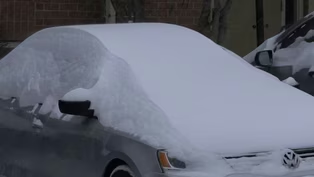
>> Well, it's the headline Northern Kentucky has heard three times so far this winter record breaking snowfall, but this time subzero temperatures and large accumulations may travel more dangerous.
Here in Campbell County, most communities received about a foot of snow that started late Saturday evening and continued all day on Sunday.
The three northern Kentucky counties of Boone, Kenton and Campbell all declared a level two snow emergency, while more rural areas like Mason, Pendleton and Gallatin counties are under a level three emergency, meaning that roadways are closed except for those emergency vehicles.
Earlier today, I caught up with the Campbell County Assistant Administrator to talk to him about why this snowfall was particularly challenging and how long it might take the transportation crews to clear the roads.
>> We got in Northern Kentucky a lot of snow, and when I say a lot of snow, you know at least what I've seen about a foot of snow and what really impacted us was how long it snowed.
The reason I like to mention that is our guys, because it's not just an hour of snow or two hours of snow, they can get out and clear it.
It was continuous.
I went out late Saturday night, early Sunday morning with our plow truck drivers and did a ride along and we would clear a road, turn around, come back, and it was like we had not even touched it.
So right now we're in a level two snow emergency.
So in a level two snow emergency, we ask that folks stay off the roads.
Like do whatever you can to not drive.
It's not illegal to drive, but we just ask make your make the best call.
If you don't have to get out there.
The roads are hazardous.
Please don't drive unless you absolutely have to.
A lot of roads.
You'll see that there's one main lane that's been plowed, so we got to get back and do that other lane.
So really today and probably through Wednesday, we'll be playing catch up all throughout the county and Northern Kentucky.
If you have to go out, make sure that you're prepared with an emergency kit in your vehicles.
That may mean a shovel.
If you've got to dig your car out.
Winter clothing, dress appropriately, water, snacks, and really, really, really.
I can't stress this enough.
Make sure your phone is charged and that you have a backup charger if you've got one.
We'll take snow all day long instead of ice.
We'd rather have that, but we did experience just a little bit.
And I think what's going to make this difficult for us as we clear these roads is the cold temperature.
The best thing for us is sun right now, because it's so cold, a little bit of sunlight can really help melt that snow.
>> While the sun was out some this afternoon, temperatures are still in the teens, dropping to single digits and even below zero throughout the rest of this week in Campbell County.
Trying to stay warm for Kentucky edition.
I'm Emily Sisk.
>> Thank you Emily.
Now get back inside and bring on the sunshine now.
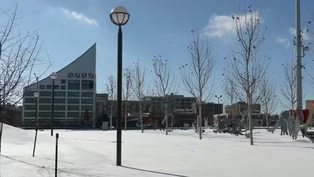
Kentucky's largest city is still largely shut down.
No schools, no bus service, and many businesses are closed.
Even gas stations.
This afternoon, Louisville officials gave an update on their progress to reopen Derby City.
>> So in terms of roads, we are making significant progress.
I was thrilled that when I left my house this morning and got to a main road, we were able to see pavement.
We've got 111 snow routes, as we've talked about, 2750 miles.
Now, just because we're making good progress, there's still slick spots and we still need people if they are going out to use extreme caution.
Hopefully people will stay home for the remainder of today to give our crews as much time for the rest of the day, let the sun do its work and get through the night before tomorrow.
We're going to continue to focus around the clock on this until all of our snow routes are clear.
>> What we're concerned with are the single digit temperatures that are coming up, and we're going to be seeing those overnight pretty much for the rest week, overnight.
Open up your cabinets where you have any like of your sinks faucets, especially if they're on an exterior wall.
Open up one of your faucets and let it drip just a little bit.
Just a little steady stream to make sure that those don't freeze.
Because what happens then?
You have no water, which becomes a health hazard.
But also then you're going to be worried about flooding when those thaw out and those pipes burst.
>> We do monitor that.
We call it no water.
And fortunately the message seems to be getting out there because since Friday we've only had 40 no water complaints.
>> Also, in addition to the cold weather, there are some folks that do not have a home and are out on the street that are homeless.
We're operating under a white flag conditions right now, so all of our shelters are taking anyone who needs space inside.
We also last week issued three permits to emergency shelters that are also operating as well.
Just because we're making progress in the sun is out does not mean we're back to normal.
So if you do go out, please use extreme caution when you're driving around town.
Drive slow and make sure you take care of yourself, your family, and your pets.
It is going to be incredibly cold even once our roads are back to where we want them to be.
>> Mayor Craig Greenberg says by tomorrow, all community centers and several libraries will be open.
The Transit Authority of River city, or Tarc, as it's called, plans to open most bus routes back up tomorrow as well.
Well, some of the official snow and sleet accumulations from across the state are being reported by the National Weather Service.
The totals vary from nearly six inches in Louisville and under four inches for Lexington and Bowling Green.
Paducah reports just over eight inches, and Florence received almost ten inches of snow.
Forecasts predicted significantly higher snow totals than what fell in much of the state.
Our Christie Dutton asks a National Weather Service meteorologist why we got less snow than expected, and what we need to do and know about the bitter cold weather settling in.
>> Michael Koch with the National Weather Service joins us.
So, Michael, with these snow totals that we've seen, what have we seen across the state of Kentucky?
How much has it varied?
>> Absolutely.
So the forecast straight up was originally supposed to be 12 to 18in, mainly along the I-64 and I-71 corridors, but we got Sleeted.
And what happens is when you get more sleep and more ice, it kind of robs the moisture from the snow to kind of form.
So we saw lesser snow totals anywhere from 5 to 7in along the I-71 corridor, at least around Louisville.
But as you go up to Covington area, northern Kentucky, they saw a little more snow, a greater than eight, but there was a lot of sleet too.
So it's a real heavy, wet snow because it was right around that freezing line.
So if you're outside shoveling, be careful because it's crusty and it's heavy.
>> Yeah.
And what about the freezing rain there for portions?
A lot of people just got a complete glaze over a freezing rain.
Where was that?
The worst.
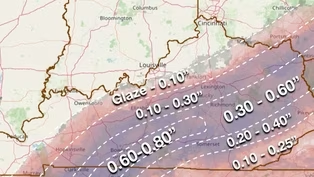
>> Southcentral Kentucky around bowling Green, a little bit to the east of Bowling Green.
Barren Monroe.
Allen County saw the worst.
And then it went northeast towards Campbellsville, all the way up to Ashland.
If you can imagine a line from Ashland to Bowling Green, we saw anywhere from at least half an inch to maybe even three quarters of an inch.
Some locally higher spots than that, up to an inch was reported.
So a lot of heavy ice there on power lines and trees and makes for a lot of slick conditions.
>> Oh yeah, that causes a lot of problems.
That much freezing rain.
So let's talk about shoveling snow.
You mentioned that.
So what do we need to watch out for?
Because I know a lot of people are heading outside to do that today.
>> Absolutely.
Well, take it slow and easy.
A lot of folks, you know, aren't used to that kind of strenuous labor.
I believe we lost several folks in the January 2025.
We called it the ice sandwich, where it snowed, then iced and snowed again.
People went outside and started shoveling and it was really heavy.
And you have a heart attack or you slip and trip and fall.
So just be careful.
Drink lots of water, take breaks and it's okay.
It'll get done eventually, but it doesn't have to be done all at once.
>> Yeah.
Okay.
And let's talk about this bitter cold weather we have right now.
We have an extreme cold warning in effect.
How cold is it going to get?
>> Well, we're talking about single digits, maybe even slightly below zero in some spots.
And then when you factor in a little bit of a wind chill with that, you're talking as low as -20°F, which is very, very cold.
You're talking a minimum of ten minutes if you're outside unprotected to have frostbite or hypothermia.
Hypothermia.
Excuse me.
So you're talking about very, very cold temperatures, please.
Dress bundle warm.
And that way you're ready to go in case you're outside.
But try to avoid being outside as much as you can during the morning hours.
>> Yeah, and that applies to pets too.
I know a lot of people have indoor outdoor pets, so what do they need to know about this?
>> Well, if it's too cold for you, it's too cold for fluffy.
So please don't leave them outside for any long duration periods.
That ten minutes of minimum time that could apply to them as well.
So try to remember your pets, bring them inside.
You know that kind of thing and keep them protected.
>> Okay.
That is great.
Great advice.
Thank you so much.
We will try to stay warm and you do the same.
>> Very well.
Thanks for having us.
>> And thank you Kristi.
Temperatures will stay below freezing for the entire week across most of the state.
This will keep much of the snow and ice from melting.
Dangerous wind chill temperatures below zero will also last through tomorrow morning for most of Kentucky.
[MUSIC] Now to other news.
Over the weekend, U.S.
Immigration and Customs Enforcement agents shot and killed another citizen in Minneapolis.
This time, it was 37 year old man.
His name is Alex Pretty on the Fox Business Channel.
Congressman James Comer, a Republican from Kentucky's first district, said it might be time for Ice to leave that city.
>> I would almost think about, okay, if the mayor and the governor are going to put our Ice officials in harm's way and there's a chance of losing more, you know, innocent lives or whatever, then maybe go to another city and let the people of Minneapolis decide, do we want to continue to have all of these illegals?
>> Congressman Andy Barr of Kentucky's sixth district says he fully backs Ice.
He said this on Facebook.
Quote, I proudly support funding Ice and the largest deportation of criminal illegals in American history.
Democrats opened the border to millions, including hundreds on the FBI terror watch list.
Biden failed.
President Trump shut it down.
Two plus million deported.
We won't back down.
End quote.
Congressman Thomas Massie of the fourth district in Kentucky is defending the right for citizens to carry guns.
A Trump appointed prosecutor said citizens with guns might be shot if they approach law enforcement.
Massie wrote on social media that being armed is a constitutional right.
[MUSIC] The assassination of a governor, the South's first civil rights bill, and a Kentucky county that voters didn't want.
Our Toby Gibbs has details in tonight's look at This Week in Kentucky history.
[MUSIC] >> The Maysville and Washington Turnpike Company formed on January 29th, 1829.
[MUSIC] Within two years, it had built a paved road between Maysville and Washington, a town four miles away.
It was the first road west of the Alleghenies built with multiple layers of crushed stones, a process known as macadamizing after its creator, John Macadam.
On January 26th, 1867, the Kentucky General Assembly voted to create Henrietta County, made up of parts of Trigg and Marshall counties.
There's a reason you've never heard of it.
It was up to voters in Trigg and Marshall counties to approve it, and they voted it down.
[MUSIC] On January 30th, 1900, a sniper shot William Goebel, the Democrat who claimed the governorship after the disputed election of 1899.
[MUSIC] [MUSIC] Republican William Taylor also claimed to have won.
Goebel would be sworn in from his hospital bed the next day.
He died February 3rd.
As historic flooding continued, the state declared martial law in Louisville on January 26th, 1937.
At the time, the floods had trapped 20,000 people in the downtown area.
[MUSIC] The Ohio River crested the next day at 40ft above its usual level.
Governor Ned Breathitt signed the Kentucky Civil Rights Act of 1966 on January 27th, 1966.
It was the first civil rights bill ever passed in a southern state.
Later, doctor Martin Luther King Junior would call it the best civil rights bill ever passed in the South, and those are a few of the big events this week in Kentucky history.
I'm Toby Gibbs.
>> Thank you Toby.
With bitter cold expected all week, the ice and snow aren't going anywhere.
We'll continue to cover this impact of this weekend's weather storm and join us for that and the rest of the day's news tomorrow night on Kentucky edition, which we hope we'll see you again for at 630 eastern, 530 central, where we inform, connect and inspire.
We hope that you'll connect with us all the ways you see on your screen, social media channels, Facebook and Instagram.
To stay in the loop.
Send us a story idea at Public Affairs at Keturah and look for us on the PBS app that you can download on your phone and other smart devices, and of course, stream our program all the time online at Keturah.
Until I see you again.
Stay warm and take good

Crews Work to Restore Power in Southern Kentucky
Video has Closed Captions
Clip: S4 Ep308 | 4m 55s | Highest concentration of power outages in the southern region of the state. (4m 55s)
Icy Conditions Leads to Road Closures
Video has Closed Captions
Clip: S4 Ep308 | 3m 34s | Bowling Green-Warren County sees lane closures on interstate and main roads due to icy conditions. (3m 34s)
Louisville Remains Largely Shutdown Due to Winter Storm
Video has Closed Captions
Clip: S4 Ep308 | 2m 26s | Louisville officials give update on plans to fully reopen city. (2m 26s)
Northern Kentucky Sets Another Snowfall Record
Video has Closed Captions
Clip: S4 Ep308 | 3m | Northern Kentucky communities receive foot of snow, declare snow emergencies. (3m)
Winter Storm Brings Less Snow Than Expected, More Bitter Cold
Video has Closed Captions
Clip: S4 Ep308 | 4m 10s | National Weather Service explains why the state got less snow than expected. (4m 10s)
Providing Support for PBS.org
Learn Moreabout PBS online sponsorship
- News and Public Affairs

Top journalists deliver compelling original analysis of the hour's headlines.

- News and Public Affairs

FRONTLINE is investigative journalism that questions, explains and changes our world.












Support for PBS provided by:
Kentucky Edition is a local public television program presented by KET