
January 27, 2026
Season 4 Episode 309 | 26m 31sVideo has Closed Captions
Situations are improving across Kentucky following a dangerous winter storm.
The number of power outages is trending down and road conditions are improving across Kentucky, lawmakers file two new priority bills in the General Assembly, and Kentucky's federal delegation reacts to the situation in Minneapolis.
Problems playing video? | Closed Captioning Feedback
Problems playing video? | Closed Captioning Feedback
Kentucky Edition is a local public television program presented by KET
January 27, 2026
Season 4 Episode 309 | 26m 31sVideo has Closed Captions
The number of power outages is trending down and road conditions are improving across Kentucky, lawmakers file two new priority bills in the General Assembly, and Kentucky's federal delegation reacts to the situation in Minneapolis.
Problems playing video? | Closed Captioning Feedback
How to Watch Kentucky Edition
Kentucky Edition is available to stream on pbs.org and the free PBS App, available on iPhone, Apple TV, Android TV, Android smartphones, Amazon Fire TV, Amazon Fire Tablet, Roku, Samsung Smart TV, and Vizio.
Providing Support for PBS.org
Learn Moreabout PBS online sponsorship>> Folks need to stay indoors as much as possible.
>> The cold weather isn't just a nuisance.
It is dangerous.
[MUSIC] >> It's brutal.
It's 5 or 10 degrees out right now and the wind is whipping.
>> Farmers are braving the cold to keep their livestock fed and watered.
>> As far as getting the ice up, it's probably going to be with us for days.
[MUSIC] >> And emergency management officials in northeast Kentucky say conditions are now out of their hands.
[MUSIC] >> Production of Kentucky Edition is made possible in part by the KET Millennium Fund.
>> Good evening and welcome to Kentucky edition for this Tuesday, January the 27th.
I'm Renee Shaw, and we thank you for spending some of your Tuesday night with us.
Kentuckians are cleaning up from the weekend snow and ice, and they're doing it in bone chilling, dangerous cold.
Governor Andy Beshear says power outages now affect about 27,000 customers, down from a peak of 73,000.
There are 7000 people under boil water advisories, and the state has opened 130 warming centers.
The governor says while snow and ice are still problems, the big problem now is the bitter cold.
>> Folks need to stay indoors as much as possible and limit outdoor exposure.
Even 10 to 30 minutes outside could cause frostbite or hypothermia.
We also need Kentuckians to make sure they're bringing their pets inside.
This cold is dangerous for them as well.
The extreme cold warning ends at 11 a.m.
this morning, but dangerously cold temperatures extend through the week.
A cold weather advisory continues through tonight with dangerous wind chills for days to come.
So we need everyone to remain alert.
>> Transportation Secretary Jim Gray says that even though roads are better today than yesterday, Kentuckians are still better off staying home if they can.
The governor says a couple of thousand Kentucky National Guard troops are doing wellness checks and evacuations, taking people to hospitals and checking on people stuck in traffic backups.
The state's largest city is close to fully reopening after the winter storm almost caused a complete shutdown this morning, Louisville Mayor Craig Greenburg gave an update on the city's progress.
This as we continue our winter coverage.
He says main roads and thoroughfares are passable, with crews plowing all 111 snow routes at least four times.
Bus service in the city is running again and trash collection is resuming.
Greenburg says Louisville Metro government will be fully operational tomorrow.
Jefferson County Public Schools will not be in session tomorrow or Thursday.
Both will be NTI days for students.
A decision has not been made about Friday yet.
The superintendent of J-c-p-s says they are waiting to see if the temperatures drop again.
A doctor from the University of Louisville Health reports since Saturday, 23 people have been treated for frostbite.
This is the advice he had for staying safe in freezing temperatures.
>> Number one, if you're going to be outside longer than an hour, or your kids have been outside playing for longer than an hour, especially in weather like this, wet plus cold equals frostbite.
So especially kids, when they come back inside, you got to take their clothes off, warm them up, put a blanket on them if their hands, fingers, toes, nose and ears appear reddened.
The best thing to do is to rewarm with just warm water.
Max temperature of 102 degrees for 30 minutes.
If after 30 minutes, there's either you or the child is still having numbness, increasing pain, starting to develop, blistering or even blackened skin, which is kind of the worst degree of frostbite, then they need to be seen and you can bring them to UofL and we'll take a look at them.
It's important to rewarm and not re-injure yourself.
So if you do develop frostnip, which is kind of the reddened fingertips and things like that.
Stay out of the cold, because basically it is the water in your body that is freezing, and having a second go of it makes the injuries worse.
>> Mayor Greenburg says there have been no reports of weather related deaths in the Derby City.
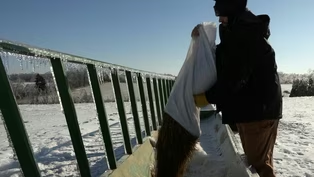
Now to southern Kentucky's Barron County, one of the hardest hit areas of the state, farmers are SEC says more than 6000 members lost power.
Now, that number is now down to 1700.
Our Laura Rogers spent time with one of those impacted a farmer.
Now, on day three with no electricity.
>> This first time I've seen ice like this around here definitely makes everything a lot more difficult.
>> Especially when you lose electricity.
>> Of course, we don't have power right now.
Generally, we have power in this barn.
>> Austin Burch, his wife and children live in the lamb community of Barron County, about a mile from the Monroe County line.
>> I know Monroe County and southern part of Barron County all got hit really hard.
A lot of people in this area are still still battling all this.
>> That includes his neighbor, Tyler Hamer, who prepared days ahead of the storm for safe use of his generator.
>> We lose power a lot down this road.
There's a lot of trees around here that fall on power lines.
>> They say the last time Barron County saw ice like this, the year Tyler was born.
>> Was in 1994.
I would say this is probably the second worst one.
>> It does pose challenges for farmers taking care of their livestock and frigid cold temperatures.
>> Everything freezes up so quick that, you know, you kind of kind of got to check it pretty regularly every several hours to make sure all your animals stay, stay hydrated because they, they drink as much or more right now than they do in the summertime.
>> The Burgess lost electricity early Sunday morning.
>> It got pretty cold in the house pretty quick.
We rely on electric heat pumps.
We haven't had any heat in our house for the last couple of days.
>> So they've been staying with his sister's family in nearby Glasgow.
>> Makes it tough having to travel so much to do things that you usually walk out your back door and start doing.
>> There's lots to do between breaking up frozen water and feeding grain and hay.
>> I try to feed hay, obviously a little bit heavier right now for the horses.
I grain them a little bit heavier.
Just give them a little more energy to give their bodies a chance to battle the cold a little bit easier.
>> He's battling the cold too, but says it comes with the territory.
>> I try to take optimistic view of it that, you know, I chose to do this and pretty much every other person who has livestock, they're they're making the choice to own and care for livestock.
So you know what comes with it.
And it's just part of it.
>> And he's just happy warmer days are ahead.
>> I like the days in April and May a lot more than I hate what's going on right now.
So that's that's that's kind of my incentive is just keep pushing through.
We're 50 days till spring and everything will be better.
>> For Kentucky edition.
I'm Laura Rogers.
>> Thank you.
Laura and Austin, we are with you.
We're counting down to Austin.
Says his next concern will be once thawing begins.
They could have frozen pipes and leaks that need to be repaired.
Residents hope to have their power restored by sometime tomorrow and we hope for them to.
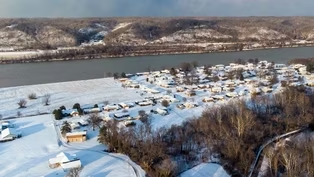
The situation is improving a bit and Boyd County and northeastern Kentucky.
But officials say the region isn't out of the clear just yet.
Our Emily Sisk spoke with the emergency management director there to see what concerns still linger.
>> Tim England, the director of Boyd County Emergency Management, is with us now taking a break from being out in the field.
So we so appreciate your time.
Director England, we want to ask you, you know, we've heard about weather conditions in south central and central Kentucky.
But what was it like in northeast Kentucky?
>> Well, we got very lucky compared to what some of our counterparts, the impacts that they had.
We did have the small amount of snow, but unfortunately we did get the sleet and freezing rain on top.
We had probably just over two inches of that compacted, so it made it challenging.
But we and we did have some glazing on the trees.
But so far our power outages have been very minimal.
So we did not have the impacts we had in other counties.
So we're very fortunate in that respect.
>> Yeah.
So tell us about, you know, when the storm first hit, what were the road conditions like.
And now that a couple days have passed, what is it like now.
>> Yeah.
So the first 12 hours we didn't have a lot of accumulation.
But they did.
They did plow and they salted.
Unfortunately the temperatures have crashed and we've not had a lot of help with that.
So today was going to be a bright spot.
We were hoping to have the sun out and the temperatures are going to be close to 25 or so, and the sun was out for a few hours, and then it went back behind the clouds.
And it's not been back out.
So temperatures are back down around in the teens.
So it's not being effective no matter how much we put down.
Roads now are better.
Some of our main roads are in decent shape.
Our secondary and and our side streets in most areas, especially in the rural parts of the county, are are ice covered and dangerous.
>> Yeah, definitely.
And you know, I think I just seen a post from the Emergency Management Facebook page talking about how adding more road salt is not always the answer.
When you got these cold temperatures, I think I saw Ashland is expecting windchill to feel like it's in the negatives today and tonight.
So you know what's next?
What do you do whenever you have these kind of conditions?
>> Well, there's not a lot we can do.
The treatments are not working.
The teams are.
Crews are still going to be out.
And we're trying to to get at least a little bit wider path on some of those shoulders that we have snow plowed up as far as getting the ice up, it's probably going to be with us for days, unfortunately, through the weekend at least, if not to the first of the week, some areas will not melt and we will not be able to get it off.
That's going to be our challenge, and that's why we're asking the public to be patient, to understand that if we have crews out, it's just it's not very effective in this type of weather, especially with the temperatures the way they are.
>> We hope the temperatures can keep rising and maybe see some more sun at some point.
But we thank you all for all your hard work, and I'm sure you got to get back out in the field.
So director Tim Englund with the Boyd County Emergency Management, we so appreciate it.
Thank you.
You know, stay safe and stay warm as you can out there.
>> All right.
Thank you I appreciate it.
>> And thank you Emily.
This afternoon, Boyd County reduced its snow emergency from a level two to a level one.
That's good news.
That means while road conditions are improving, they are still hazardous.
And drivers should still use caution.
The Kentucky General Assembly is slowly heading back to Frankfort after statewide snowfall.
Today.
A Louisville Republican filed Senate Bill two to keep public school pay raises for teachers and administrators comparable.
Though Democrats have called for major increases in school funding, in part for teacher salaries, some Republicans say districts would have money for teacher raises if they didn't spend so much on superintendents and non-classroom personnel.
>> Classroom teachers are at the center of student learning and school success.
When compensation decisions favor administrative growth over classroom instruction, it can undermine morale, trust, and long term workforce stability.
So Senate Bill two is designed to support teacher recruitment and retention, promote fairness and transparency, and reinforce public confidence in education funding decisions.
Compensation decisions should reflect classroom priorities.
Teachers should not be asked to fall behind when administrators move ahead.
>> Under Senator Julie Raque Adams measure, pay raises for school administrators would not exceed the average pay bump given to classroom teachers in that same district.
Another bill filed, Senate Bill four, would create a five year mentorship and training program for new school principals.
Sponsor Senator Stephen West of Paris says this could help teachers to.
>> Invaded a lengthy survey of the southeast southeastern states and the survey of teachers and classroom.
And what asked the question, what is the key item?
What is the key thing that is driving you out of the classroom?
And as Senate Education chair, I just assumed it would be the normal items teacher pay, discipline in the classroom, those sorts of things.
But that survey stated by a large margin that teachers are leaving because of poor leadership in their building.
This is a uniform, mandatory across the board approach where each principal gets specific training.
The first five years of their work.
>> West two chairs, the Senate Education Committee, says the caucus wants to take a more targeted approach to public education funding, like in the areas of principal leadership, rather than just give a big block funding increase toward the overall base.
Education funding consumes more than half of the overall biennial budget.
The state's two year spending plan is being crafted now in the House, where it must start before the Senate can weigh in.
Well, now turning to national politics, U.S.
Senator Rand Paul of Kentucky is calling for the officers involved in a deadly shooting in Minnesota to immediately be put on administrative leave.
Senator Paul is chairman of the Senate Homeland Security and Governmental Affairs Committee.
He's also sent letters to three Department of Homeland Security officials asking them to testify before Congress.
The move comes after federal agents shot and killed a second protester in Minneapolis over the weekend.
In the letter, Senator Paul says Congress has a duty to oversee taxpayer dollars and, quote, ensure the funding is used to accomplish the mission, provide proper support for our law enforcement, and most importantly, protect the American people.
End quote.
The shooting in Minneapolis could lead to a partial government shutdown by the end of this week.
Senate Democrats say they'll oppose a funding bill for the Department of Homeland Security.
It's one of six annual spending bills that must be signed into law by Friday to avoid a shutdown.
Congressman Morgan McGarvey of Kentucky's third district, that's in Jefferson County, says it's time to end what he called a, quote, campaign of terror.
>> I hope you're as outraged as I am right now.
Ice has murdered another American again.
Let that sink in.
They have murdered another American again.
And this is on top of the campaign of terror that Donald Trump's personal police force has been unleashing on all of our communities.
You're looking for something to do.
Let's stand up and call the Senate and tell them to stand up and not give DHS a single dime until this stops.
Because when we stand up together, that's how we make this stop.
>> Congressman Brett Guthrie of Kentucky's second district is also commenting on the situation in Minnesota today on social media.
He said in part, quote, there must be full and transparent investigations into both ice involved shootings in Minneapolis.
End, quote.
[MUSIC] In other news, UPS says it has now retired its entire fleet of Boeing MD 11 planes following a deadly crash in Kentucky last year.
The November crash at the Louisville airport killed three crew members and 12 people on the ground.
Video of the crash shows an engine falling off during takeoff.
The NTSB says it was because of a known heart failure.
The Courier-Journal reports UPS had more than two dozen MD 11 as recently as last month.
UPS plans to replace MD 11 with the more modern Boeing 767 over the next year and a half.
Louisville Mayor Craig Greenburg was asked about that this morning in a news conference.
>> If there's any question about safety, the planes should not be flying.
And so I am no expert in this area.
I trust the expert.
But clearly UPS made this decision with safety in mind, and I applaud them for making putting safety first.
>> Greenburg also says UPS is expected to reimburse the city for damages caused by the crash.
Will the Federal government act to help save an endangered salamander that calls Kentucky home?
And the president names energy executives from Kentucky to a revised energy board.
Our Toby Gibbs has details in this look at headlines around Kentucky.
>> President Donald Trump has revived the National Coal Council and appointed several Kentuckians with ties to the state's mining industries.
Louisville Public Media reports the council now includes Sam McCowen, president of the Kentucky Coal Association.
Joe Craft, president and CEO of Alliance Resource Partners.
Tony Campbell, retired president and CEO of the East Kentucky Power Cooperative, and Don Gulley, president and CEO of Big Rivers Electric Cooperative.
[MUSIC] During a meeting with the group, Secretary of Energy Chris Wright said, quote, no coal, no modern world, end quote.
[MUSIC] The state expects to file more than 700 criminal charges after an illegal harvest of 300,000 pounds of catfish.
The Daily Independent says a ten month investigation called operation River raid, led to 25 people who will be charged with illegal harvest and sale of catfish from public waters stretching from Paducah to Ashland.
[MUSIC] Northern Kentucky University will close its Grant County campus in Williamstown on February 28th, according to the Grant County News.
The university says enrollment there has been on the decline for years.
[MUSIC] Right now, no students are enrolled.
Williamstown's acting Mayor Dave Henson says the campus filled a need when it opened, but since then, local high schools began offering the same types of vocational training.
[MUSIC] The Kentucky Lantern reports the center for Biological Diversity is suing the federal government to force a decision about a threatened salamander that lives in Kentucky.
[MUSIC] The center says there are just a few hundred yellow spotted woodland salamanders left in Kentucky, Tennessee, West Virginia and Virginia.
The lawsuit asks for a federal judge to require the U.S.
Fish and Wildlife Service to make a decision about whether to list the salamander under the Endangered Species Act.
With headlines around Kentucky, I'm Toby Gibbs.
>> The word traipsing is the word of the day, and traipsing or to traipse means to walk around with no real purpose or direction.
But as our Chip Polston tells us in this Kentucky Life extra, an Appalachian native known as the Traipsin woman helped cement folk music right here in the Commonwealth.
Over to you, Chip.
>> Thanks so much.
It's good to be with you again.
Gene Thomas, known as the Traipsin woman, was born in eastern Kentucky.
She made a name for herself, traveling via wagon and traipsing through Appalachia as a court reporter.
During her travels, she learned about traditional singing and gathering within the region.
Thomas would later take this experience and form the American Folk Song Festival, which ran through most of the 20th century and was dedicated to the preservation of traditional folk music.
Let's take a look at the complicated legacy of Kentucky's own Traipsin woman.
[MUSIC] >> This is Gene Thomas, the Traipsin woman founder director of the American Folk Song Festival, held each year on the second Sunday in June in the woodland beyond the garden wall of my museum home, we house in the Wood in Ashland, Boyd County, Kentucky.
[MUSIC] >> Gene Thomas was born Jeanette Bell in 1881, here in Boyd County, Kentucky.
[MUSIC] She was the fifth of six children, and she grew up to become, I like to call her an Appalachian folklorist.
She was an entrepreneur.
She was also a manager for a little while.
She had a great number of many different things.
>> Gene Thomas was a woman of her time, and that was a time when people from other parts of the country were getting interested in and discovering folk music.
Many people were fascinated by and wanting to establish these connections between mountain culture and Elizabethan England.
>> Thomas believed that the Elizabethan era's minstrels, the traveling minstrels, were directly connected to the folk music in Appalachia because they would have been brought here from England by colonists, and she thinks that those were just continuously passed down by an oral tradition.
They might have been modified somewhat over the centuries, of course, if it was an oral tradition, but she definitely thought that was where the root of it was, and she thought it was invaluable for people of the mountains to understand where they had come from.
[MUSIC] During Gene's travels as a court stenographer, she had an opportunity one day on a Sunday that she went traveling with some friendly neighbors she had met, and they heard some music playing, and they told her they're like, oh, it's the singing gathering.
You go on, you can go sit and listen to that and we'll pick you up on our way back.
And she said that she came into this clearing with a windowless cabin, and there were all these musicians that had gathered.
And this was something they just did for fun.
They would come and play religious music, folk music together.
And that was clearly a huge turning point for Gene.
She held on to that for decades.
And that is the idea behind the American Folk Song Festival.
>> The American Folk Song Festival was her rendition of what she first witnessed when she happened upon this.
It was like a one room cabin with no windows, and they were all these people gathered around on a Sunday in Kentucky, in the mountains, singing Elizabethan ballads, and she was probably just blown away.
>> The very first American Folk Song Festival was actually an informal event held at Gene's house in her backyard.
This was just a small gathering of some friends, but one of them was the First Lady of Kentucky at that time, Mrs.
Samson.
Mrs.
Sampson in particular, was very fond of the event, and her guests were so enthusiastic, gene thought, you know, I could probably do this every year.
The second American Folk Song Festival is sometimes considered the official first, because this one had 18 acts.
It was a formal event that Gene had created.
In it, Gene performed as the narrator, and that was always what she liked to be.
She wore just a simple black dress, and she kind of sat to the side on the stage, and I think that's her again, being the storyteller.
She's not in the story, but she is telling you the story.
And so they did this in front of a windowless cabin to try to emulate that first singing gathering that Gene was a part of.
And they included singing, dancing, different musicians, all of them folk musicians.
>> She just did things her own way and wasn't afraid to be deemed a certain thing that was dishonorable.
She was like this solo lady traipsing around the mountains and documenting all these songs of mountain people.
[MUSIC] >> In 1926, Thomas met James William Day, a blind fiddler from Rowan County.
She changed his name to Jilson Setters and booked him successfully as the Singin Fiddler from lost Hope hollow, an act viewed by some today as controversial.
>> She got certain chairs for him to sit in, props to take with him when he was performing, to give him that look of the Appalachian minstrel.
He did do several recordings with the Victor Phonograph Company.
They went to New York together in 1928 for him to perform, and then he also went to England together, and they performed there at the Royal Albert Hall.
I feel like she is a little overlooked.
There are people that come in that are not familiar with her and they're like, I've lived here my whole life, how have I not heard of her?
But then at the same time, I will get people who say I am descended or related to Gene Thomas.
I was in one of the productions.
I attended one of the productions.
So there are people left that still remember the American Folk Song Festival.
And even though it's no longer held the way Gene had it, there are other festivals that have sprung up inspired by that festival.
And so I think that that is her legacy.
It never really ended.
It's still going just in a different format.
>> But a long way from home with friends standing around.
>> Great stories like this one come your way on our show each Saturday night at 8:00 eastern, seven central, right here on KET.
As we continue to cherish this great Kentucky Life back to you.
>> Thank you Chip.
Always going to tune in for Kentucky Life on Saturdays.
We hope that you'll tune in to Kentucky edition tomorrow night again at 630 eastern 530 central where we inform, connect and inspire.
We're back in Frankfort.
We'll have more about what's happening in your state House tomorrow evening.
In the meantime, we encourage you to subscribe to Kentucky Edition email newsletters and watch full episodes and clips online at Keturah.
You can also find us on the PBS video app that you can download on your smart TV and other devices, and we encourage you to send us a story idea by email to Public Affairs at Keturah and follow us on the social channels, Facebook and Instagram to stay in the loop.
Thank you so much for being with us.
Hope you're safe and warm at home, and we hope to see you right back here again tomorrow night.
Take really good care.
So long.
[MUSIC]
Farmers Feeling Winter Storm's Impact
Video has Closed Captions
Clip: S4 Ep309 | 2m 47s | Farmers RECC says more than 6,000 members lost power. (2m 47s)
Northeastern Region Sees Conditions Improve, But Not in Clear Yet
Video has Closed Captions
Clip: S4 Ep309 | 3m 20s | Emergency management officials in Northeast Kentucky say conditions now out of their hands. (3m 20s)
Providing Support for PBS.org
Learn Moreabout PBS online sponsorship
- News and Public Affairs

Top journalists deliver compelling original analysis of the hour's headlines.

- News and Public Affairs

FRONTLINE is investigative journalism that questions, explains and changes our world.












Support for PBS provided by:
Kentucky Edition is a local public television program presented by KET