
January 28, 2026
Season 4 Episode 310 | 26m 30sVideo has Closed Captions
The death toll from recent winter weather in Kentucky has jumped to 10.
Gov. Beshear says at least 10 people have died from this week's major winter storm. House Republicans unveil their two-year state budget. Lawmakers again debate fluoride and cigar bars. The superintendent of Jefferson County Public Schools discusses legislation targeting the district. How one Kentucky city is tackling the housing crisis.
Problems playing video? | Closed Captioning Feedback
Problems playing video? | Closed Captioning Feedback
Kentucky Edition is a local public television program presented by KET
January 28, 2026
Season 4 Episode 310 | 26m 30sVideo has Closed Captions
Gov. Beshear says at least 10 people have died from this week's major winter storm. House Republicans unveil their two-year state budget. Lawmakers again debate fluoride and cigar bars. The superintendent of Jefferson County Public Schools discusses legislation targeting the district. How one Kentucky city is tackling the housing crisis.
Problems playing video? | Closed Captioning Feedback
How to Watch Kentucky Edition
Kentucky Edition is available to stream on pbs.org and the free PBS App, available on iPhone, Apple TV, Android TV, Android smartphones, Amazon Fire TV, Amazon Fire Tablet, Roku, Samsung Smart TV, and Vizio.
Providing Support for PBS.org
Learn Moreabout PBS online sponsorshipMUSIC >> Kentucky's death toll jumps as bitter cold keeps snow and ice from melting.
[MUSIC] >> This is killing weather.
This isn't just inconvenience.
[MUSIC] >> How?
Homeless advocates are making sure Lexington's most vulnerable are coming in from the cold.
[MUSIC] >> You know, I've been here just six months, and I just need time to get everything in order.
>> The superintendent of Jefferson County Public Schools outlines his priorities as the district faces a major budget shortfall.
[MUSIC] >> Production of Kentucky edition is made possible in part by the KET Millennium Fund.
[MUSIC] .
>> Good evening and welcome to Kentucky Edition for this Wednesday, January the 28th, I'm Renee Shaw, and we thank you for winding down your Wednesday with us.
Kentucky's death toll from the weekend's winter weather has now jumped to ten.
More in tonight's weather.
Winter weather.
Storm coverage.
Governor Andy Beshear announced the updated number today.
He says the deaths are from hypothermia, falls and at least one heart attack.
There are now 12,000 customers, almost without electric power, and it could be a week before it's restored to everyone because of the cold, the ice and snow are not melting.
The governor warned people wind chills will remain near zero through at least next Tuesday.
In Lexington, volunteers are working to make sure the city's most vulnerable are not left out in these dangerously cold temperatures.
Lexington's Catholic Action Center opened a 24 hour warming center Saturday for those experiencing homelessness.
The center served 154 people before closing this morning.
With shelters at capacity, the center had to place another 190 people in hotels.
Director Ginny Ramsey says a quick response was needed to save lives.
>> A week ago, we began the effort to put people in safe shelter, knowing that once it hits, it's harder to get to them and harder for them to get to us.
We had the police, we had the sheriff's department.
We had the Hope center outreach getting to us with those who could not be sheltered.
This is killing weather.
This isn't just inconvenience.
The first night that we were getting people, which was Monday a week ago, we had four people with frostbite.
The other thing is we have come upon so many elderly and disabled living in their cars.
The oldest we have is an 85 year old woman who was living in her car with her animals.
We had a 81 year old who was living in a car with her 62 year old daughter, who both are disabled.
We had a, you know, 70 plus year old who has been living in his truck for a year, but they can't survive this.
Even if we give you the emergency blankets, the NASA blankets, we give them those, we give them sleeping bags that go down to 20 degrees.
We give them extra socks, hats, etc.
they're not going to make it.
I think this points to the fact that we've got to have this kind of response available for our vulnerable citizens, because this would be a time that they'll be counting the dead bodies.
>> Ramsey says she expects their emergency outreach to go on through Tuesday of next week.
Now, turning to news in Frankfort, Kentucky's House Republicans have unveiled their first stab at the state budget for the next two years.
It funds state agencies K through 12 and higher education and more.
The House budget chair says agencies will need to make their case for the additional $10 billion in executive branch budget requests, as House GOP leaders seek to rein in spending and, quote, right size government's focus.
As our June Leffler reports in tonight's legislative update, this is just the first draft of the General Assembly's most important document this session.
>> Unlike in prior years, where we have prepackaged hundreds of decisions, if not thousands, and been able to move through the process fairly quickly this session.
And these bills are designed differently, especially the executive branch, so that we have a bare bones budget.
There are no line items that have been placed in this.
These operational budgets.
So to that end, you'll see one that what normally is a 250 something page bill is about 150.
>> The chair of the House Budget Committee says lawmakers and constituents will fill the gaps.
>> How long will it take?
Mr.
speaker, I wish I could answer that as fast as we could, but no earlier than we need to.
>> Though the state faced a $150 million shortfall this fiscal year, revenues should climb modestly the next two years.
>> Today, we do not have a revenue problem, but we always have to fight spending that's out of control.
And that's what a major theme of this budget is going to be.
>> The left leaning Kentucky Center for Economic Policy released its analysis of the proposed budget, saying, quote, the budget shorts funding for school transportation by $129 million a year and freezes the seek base and other parts of K through 12 school funding.
It cuts higher education institutions by $339 million over the biennium, or a remarkable 15%.
The plan also leaves an unexplained shortfall of over 800 million in Medicaid funding over the two year period, and reduces funding for community based services by nearly $100 million, without explaining how new costs from the federal government's H.R.
one for SNAP and other public benefits will be covered.
The big beautiful bill passed last July, requires states to take on more costs to administer Medicaid and SNAP, among many things, Governor Andy Beshear proposed millions of dollars to meet that task and make up for additional Medicaid losses, explains the state's budget director.
>> Kentucky may be at risk of losing 35 rural hospitals, and so the governor wanted to come up with an idea to help bridge some of that.
He came up with $125 million, this rural particular hospitals in reaction to that.
>> House Republicans did not propose dipping into the $3.7 billion budget reserve trust fund for one time expenditures.
Lawmakers are not obligated to do this, and it's only become more common in recent years.
However, Republicans have not ruled out such a spending plan as they begin their lengthy budget process for Kentucky Edition.
I'm June Leffler.
>> Thank you, June.
And the budget also does not include any money for pre-K, which has been a bill in an effort that the governor has called for for several years.
The House bill does call for spending cuts of 4% in fiscal year 27 that begins in July, and 3% in the second year of the biennium for most state agencies.
House Bill 500 includes nearly $15 billion in annual base level spending, which is less than what it was approved two years ago.
There are educational exemptions from the proposed budget cuts and juvenile justice, veterans affairs, behavioral health and corrections are also spared from budget cuts in this House draft.
More to come on that.
Senator Lindsey Tichenor says she's heard a lot of feedback on last year's law requiring electronic communication between school and employees and students, and she's put Senate Bill 181 back before lawmakers so it can be improved.
The 2026 version of the bill includes changes like adding additional family members to those exempt from the bill, redefining what a school volunteer is, and allowing school resource officers to communicate electronically with students under supervision of school leadership.
Senate Bill 181 passed the Senate unanimously yesterday.
Legislation aimed at protecting and expanding access to health care across Kentucky.
Advance today in Frankfort.
Representative Amy Nabors says House Bill three would allow Medicaid to reimburse pharmacists for routine preventive and chronic care services they're already providing, often for free, especially in rural communities.
The bill does not expand pharmacists scope of practice or add new mandates.
Instead, Representative Neighbor says it aligns Medicaid with the 2021 law requiring private insurers to pay pharmacists the same as other non-physician providers.
House Bill three cleared a committee today and now awaits a vote by the full House chamber.
Research suggests 1 in 4 girls and 1 in 20 boys will experience child sexual abuse in the United States.
State lawmakers in Kentucky are fighting back by trying to criminalize what's called grooming.
The act of building a relationship with a minor with the intent to abuse them.
Our McKenzie Spink brings us the discussion on House Bill four from today's House Judiciary Committee.
>> Representative Mariann Proctor, sponsor of Bill four, says the measure will close the current gap in the law between predatory behavior and the physical sexual abuse of a minor.
>> What it is seeking to do is criminalize the behavior of grooming.
When an adult engages in, entices courses, or solicits a minor to prepare them for sexual conduct.
>> House Bill four has specific language regarding persons of authority or trust, such as a coach or teacher.
The bill would make intimate or secret relationships with minors a felony.
There are exceptions laid out protecting curriculum on sex education, but concerns about protecting teachers arose during discussion.
>> A teacher teaching health or sex education to young people, to a whole class, and then after the class, say one of the students wants to clear something up or come to the teacher and talk about it.
My concern is it would prevent that.
Or the teacher may be nervous about discussing anything from the class.
>> Supporters of the bill say the language protecting those conversations is clear.
>> The language is you can't entice, coerce, solicit or prepare the minor to engage in sexual conduct with yourself or another person.
I think that's pretty clear.
So someone saying, hey, I'm having, you know, these, these, these issues with my body or whatever, that is nowhere near the language of the statute.
>> The attorney who helped draft the bill says the process of having to prove intent was designed to help weed out good faith discussions.
>> We knew this.
>> Intent portion is going to be difficult to prove, and that's should be the case.
Law enforcement, when they investigate these crimes, they kind of have to see, do I think this fits the statute?
They have to apply some common sense and interpretation.
Then that comes to a prosecutor who then has to make a similar interpretive look at it.
It will have to because it's a felony if it's charged in district court.
Let's have a preliminary hearing where a district court judge is going to have to say, does this meet the elements?
We think, between the statutory language and all those things that that should filter out these good faith discussions that we are not intending to include.
>> There were five past votes on the measure.
Several lawmakers voiced concern about tightening up the protections even further.
Democratic Representative Lindsey Burke took issue with the phrasing prepare for sexual conduct as part of the definition of grooming.
>> Preparing a minor for sexual conduct makes me think about a conversation between an 18 year old sister and a 14 year old sister who says, you don't have to be scared of sex.
Sex is nothing to be scared for.
Just make sure when you do it, you use a condom.
I want to be completely certain that under no circumstances is that kind of conduct punished.
>> With 14 yes votes.
House Bill four passed the House Judiciary Committee and will next head to the House floor to be considered by the full body for Kentucky edition.
I'm Mackenzie Spink.
>> Thank you.
Mackenzie.
House Bill four has over 30 co-sponsors, including Democratic Representative Daniel Grossberg of Louisville.
Should the decision to have fluoride in Kentucky's drinking water left to be up for local water boards to decide?
It's a question that's been raised in nine different legislative sessions, and it's back again this year.
Plus, while many Kentucky communities have smoking bans, another bill looks to make cigar bars more accessible.
Our Emily Sisk explains as we continue our legislative update.
>> It makes it it takes.
>> A Northern Kentucky lawmaker wants to again, make a push for local water boards to decide if their community's water will contain fluoride.
>> This bill does not ban fluoride.
It makes it it takes away the State unfunded mandate and makes it a local control.
>> Representative Mark Hart said under this bill, local water boards would need to seek out medical expertise to make the best decision for their community.
But those who oppose the bill say fluoride is the best defense against dental decay.
And in rural communities, removing fluoride could be harmful.
>> In my district, it's 43,000 people.
We've got one provider, and that's for in one county.
And they take care of 98% of the Medicaid patients.
I mean, that's one dentist, but I worry about if you take that one line of defense out, what does that mean to those to those patients?
>> Another Northern Kentucky lawmaker brought up a federal court ruling which said that community water fluoridation could pose a, quote, unreasonable risk linked to lower IQ in children.
>> That's from that federal court ruling.
So I just wanted to get your take, because I'm hearing something very different in your defense of fluoride.
>> We feel that the court overreached a little bit.
The preponderance of evidence shows that fluoride has been safe.
As a matter of fact, in fall this year, a new article and review came out in Scientific American, which indicated that there were no indications of cognitive decline.
>> Ultimately, the bill passed out of the Local Government committee despite a handful of no votes, mostly from Democratic lawmakers, who said there wasn't enough evidence presented to prove that fluoridation is a problem.
The committee also passed a bill regarding cigar bars or businesses, where at least 25% of their gross income comes from the sale of cigars and pipe tobacco.
This bill would allow for these establishments to exist even in communities that have smoking bans.
>> This bill does not fully roll back existing smoke free laws in any local municipality in the Commonwealth.
>> Sponsoring representative Chris Lewis said the bill creates a narrow exemption which allows these types of establishments to exist, while the bill mostly receives support.
One Lexington Democrat voiced his opposition.
>> We in Lexington had have a no smoking ban, and I think this is a counter to local control.
And it's a problem for for Lexington-Fayette County, so I vote no.
>> The bill ultimately passed out of committee, and the House local government chair said he expects it to also pass in the full House for Kentucky edition.
I'm Emily Sisk.
>> Thank you Emily.
Several other bills also made their way out of today's local government committee, including a bill that would allow chickens to be kept on residential property.
Several bills introduced this legislative session target Jefferson County Public Schools, the state's largest school district.
This comes as the district is facing a major budget deficit, with a new superintendent at the helm.
This week on Inside Louisville, Kelsey Starks sits down with Jcpc J-c-p-s Superintendent Brian Yearwood.
>> Let's talk about the General Assembly underway right now.
JCPS again in the spotlight with many of these bills.
A lot of different proposals out there.
To a split up the district, which has been talk of that for a while.
And another bill is proposing to give more local control to the superintendent.
What are your positions on on that legislation and what are you looking for right now in Frankfort?
>> So, you know, I received a promise that they will not split up JCPS, that I would be given some time to come in and make necessary changes and adjustments to do just to, to get us to where we need to.
And, you know, I'm asking for that time, you know.
So again, things are underway.
We are right.
We are having a responsible budget.
Next, we'll be looking at academic outcomes and how we can improve there.
So, you know, all I can ask for is give me more time.
You know, I've been here just six months, and I just need time to get everything in order.
And I believe that, you know, those in Frankfort will do just that.
And as far as you giving, you know, you mentioned, superintendent, I really have not spent enough time looking at that.
So I can't really speak to that.
But one thing I do know is that yes, we will improve our finances, we will get a responsible budget, and yes, our academics will allow our students to thrive.
I just need more time.
>> What what kind of support are you looking for from Frankfort and Kentucky lawmakers?
What are you hoping would come out of Frankfort?
Maybe not this session, but in the future.
>> To look at the formulas that we have or seek formulas, because, again, transportation, making sure that that's funded at 100%, you know, the number of for multilingual students keep increasing over time.
And now that's a large portion of it's about 22% of our overall student population.
We want the formula to to align with that.
And so that we can receive adequate funding.
So we can address, you know, those areas or special needs population making sure that there's adequate funding there.
So again, all I will ask is that the funding formulas that are in existence, that they do help us to address the rising costs, the inflation that's associated with programs.
And, you know, just help us with those rising costs and stay true to the formula.
>> You can watch the entire discussion, plus an interview with Louisville Mayor Craig Greenburg on the next Inside Louisville that airs this Sunday at noon 11 a.m.
central right here on KET.
[MUSIC] Now to western Kentucky and efforts to tackle the housing crisis.
It began a couple of years ago when community partners came together to brainstorm ideas.
That collaboration will pay off dividends for families who need an affordable place to call home.
Our Laura Rogers has more from Daviess County.
>> The community came together, identified that we had a problem.
>> That problem is a lack of affordable housing.
>> With what happened in 2007 and 2008 with the housing market.
We just haven't recovered as a nation.
>> Not enough houses to rent.
There's not enough affordable rental units anywhere, and there's not enough houses that are in the range of medium to low income for folks to buy.
>> While it's not a unique challenge to Owensboro.
What is extraordinary the collaborative effort that's been forged to provide solutions.
>> We're not in the housing and development business, but we have a role to play.
We had to figure out what that role might be.
>> Debbie Zerner with Owensboro Health says housing is imperative to a community's well-being.
>> It is a social driver of health.
Housing impacts so many things related to your health.
>> That includes areas like education, transportation and food security.
>> There's a number of areas that are impacted by where you live and where you live matters.
>> We manage the federal grants for the city of Owensboro.
We are an entitlement community.
>> That's a program under the U.S.
Department of Housing and Urban Development, or HUD.
The City of Owensboro's five year plan had identified affordable housing as a top concern.
>> It's always been a priority for Owensboro.
It's just been a growing need, of course, nationally, and that trickles down to the local effects.
>> The Kentucky Housing Corporation agreed a 2024 housing gap analysis showed Davis County nearly 4000 units short.
>> So there's 4000 individuals or families, 4000 plus individuals or families that have no options.
They're just not out there.
>> As conversations continued, concrete plans began to take shape.
>> What do we want to tackle and how can we make an impact together in a room?
What does that look like as a project?
>> Turns out there was a project to provide inspiration.
Habitat for Humanity of Owensboro Davis County was building ten homes called the Carter Court Community.
>> So we had that model to look at.
And then we began to look at what land was available.
>> Owensboro Health had some open property on Parrish Avenue across from its cancer center.
>> It was a prime location.
>> 17 parcels of land that could potentially mean space for up to 20 new homes.
>> It really was an asset that we could bring to the table.
>> This donation gave this affiliate here in Daviess County a land bank, which is unheard of.
>> The site is located on the city bus route and just steps away from the farmers market.
>> We've got to start moving the needle.
We've got to start looking at different models.
So what can we bring to the table?
And it was those parcels.
>> For the city.
It was those federal grants.
>> It was a perfect fit.
>> Add to the expertise and business model of habitat for humanity.
And the project was a go.
>> We don't give houses away.
We build houses and we give affordable loans to people to pay for their houses.
>> Those future homeowners also invest in sweat equity.
>> You actually have to help build houses for other people first.
They'll have somewhere in the range of 5 to 10 families that are ready to start building their houses.
They've built other people's houses.
Now it will be time to build theirs.
>> The collaborative acknowledges it may not be a solution to the affordable housing crisis, but it does lay the foundation to make meaningful change for Kentucky edition.
I'm Laura Rogers.
>> Thank you Laura.
Now, for decades, free roaming horses have called the Eastern Kentucky mountains home.
But when they wander into the road or damage someone's property, they need safe harbor.
That's where the Appalachian Horse Project comes in.
Leaders in Perry County recently leased farmland to the nonprofit, giving rescued horses a place to retire or be adopted.
The executive director says it's good for the horses and it's good for the community.
>> The Appalachian Horse Project was born out of a necessity for care that was needed for the free roaming horses over eastern Kentucky.
They spent about nine counties.
The last count that we had whenever we were inventorying them, there was around 1000.
We're talking about domestic horses that were dropped off to free roam.
That was the original plan about 50 years ago, you know, when coal mining was starting to slow down and the coal companies were reclaiming and, you know, they planted these wonderful flat pastures full of grass.
So it was kind of an ideal opportunity for livestock owners at the time.
So they would take them up, drop them off, let them graze for the summer, and then they'd take them back home.
Of course, over the years, things changed.
You know, maybe the the horse owners passed away and the family wasn't interested in continuing care or whatever the reason may be.
The two reasons that we've removed horses from the mine sites has been for health concerns, whether they're getting too thin or they've gotten an injury or if they get onto the highways, then, you know, obviously they've they've got to be removed, especially if they're there's a few herds that were habitually going on to the roads.
So, you know, at that point, once they made a habit out of it, they need to be removed.
The original owners, the Minyard family, owned this property since the late 1800s.
It used to be a working cattle farm.
Their family wanted the county to have the opportunity to obtain the property and to keep it as a working farm.
Perry kind of knew about our plans already, and so whenever we'd had meetings with them and things, and so whenever they got the opportunity to buy this, they, of course thought of us.
And bringing the horses out here, it has definitely helped us to be able to help more horses, because now we have all this extra space to bring them to.
We do still have fosters, but this is also going to serve as an adoption center for us.
So we have a few horses here on the property that, you know, once we feel like they are trained well enough and, you know, they're used to being handled by people and everything, then they will be offered up for adoption.
We hope to offer farm tours as early as this spring so that we can bring folks out, you know, and that will be kind of a tourism effort to it's been a place for the community, you know, to come together.
I mean, local families were always going and visiting the horses and feeding them.
And, you know, I mean, we have people who for generations have gone up and visited the horses.
So everyone's very happy to see that some of the horses that they have loved for so many years now have a safe place to call home to.
>> And that's good news.
Well, that will do it for us tonight here on Kentucky Edition.
But we sure hope to see you right back here again tomorrow night where we connect, inform and inspire.
Connect with us all the ways you see on your screen, Facebook and Instagram to stay in the loop on the social media channels and so much more.
Until I see you again.
Stay warm and I'll see you tomorrow
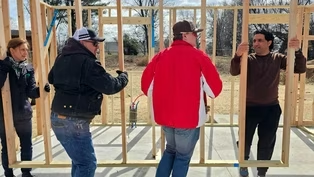
City Collaborating to Tackle Local Housing Crisis
Video has Closed Captions
Clip: S4 Ep310 | 3m 42s | Community partners in Daviess County are coming together to brainstorm ideas. (3m 42s)

Group Working to Save Free-Roaming Horses
Video has Closed Captions
Clip: S4 Ep310 | 3m 12s | The non-profit says it's good for the horses and the community. (3m 12s)

House Unveils Two-Year Budget Plan
Video has Closed Captions
Clip: S4 Ep310 | 3m 56s | This is just the first take on the General Assembly's constitutionally mandated task. (3m 56s)

Lawmakers Again Debate Fluoride Mandate
Video has Closed Captions
Clip: S4 Ep310 | 2m 9s | This is the ninth time the issue has been debated in the Kentucky General Assembly. (2m 9s)
Lawmakers Look to Criminalize Grooming
Video has Closed Captions
Clip: S4 Ep310 | 3m 33s | Research shows one in four girls and one in 20 boys face child sexual abuse in the U.S. (3m 33s)
Providing Support for PBS.org
Learn Moreabout PBS online sponsorship
- News and Public Affairs

Top journalists deliver compelling original analysis of the hour's headlines.

- News and Public Affairs

FRONTLINE is investigative journalism that questions, explains and changes our world.












Support for PBS provided by:
Kentucky Edition is a local public television program presented by KET