Vermont This Week
January 30, 2026
1/30/2026 | 26m 46sVideo has Closed Captions
Scott condemns federal immigration tactics | Tracking Vermont’s opioid settlement money
Scott condemns federal immigration tactics | Tracking Vermont’s opioid settlement money | Vermont border crossings | Moderator - Mitch Wertlieb; Kevin McCallum - Seven Days; Liam Elder-Connors - Vermont Public; Lucy Tompkins - Seven Days.
Problems playing video? | Closed Captioning Feedback
Problems playing video? | Closed Captioning Feedback
Vermont This Week is a local public television program presented by Vermont Public
Sponsored in part by Lintilhac Foundation and Milne Travel.
Support provided by:


Vermont This Week
January 30, 2026
1/30/2026 | 26m 46sVideo has Closed Captions
Scott condemns federal immigration tactics | Tracking Vermont’s opioid settlement money | Vermont border crossings | Moderator - Mitch Wertlieb; Kevin McCallum - Seven Days; Liam Elder-Connors - Vermont Public; Lucy Tompkins - Seven Days.
Problems playing video? | Closed Captioning Feedback
How to Watch Vermont This Week
Vermont This Week is available to stream on pbs.org and the free PBS App, available on iPhone, Apple TV, Android TV, Android smartphones, Amazon Fire TV, Amazon Fire Tablet, Roku, Samsung Smart TV, and Vizio.
Support the crew
Help Mitch keep the conversations going as a member of Vermont Public. Join us today and support independent journalism.Providing Support for PBS.org
Learn Moreabout PBS online sponsorshipGovernor Scott condemns federal immigration tactics after agents fatally shoot a second person in Minneapolis.
Here's what I know.
I know there's one person, at the top of the heap who can, tell his, his his secretaries, commissioner, his directors, what to do.
And, it's within his power, to de-escalate this.
Plus, Vermont is getting millions each year from opioid settlements.
Where's the money going?
And a look at a new era of enforcement on the state's northern border.
All that and more ahead on Vermont this week.
From the Vermont public studio in Winooski.
This is Vermont this week, made possible in part by the Lintilhac Foundation and Milne Travel.
Here's moderator Mitch Wertlieb.
Thanks so much for joining us.
I'm Mitch Wertlieb.
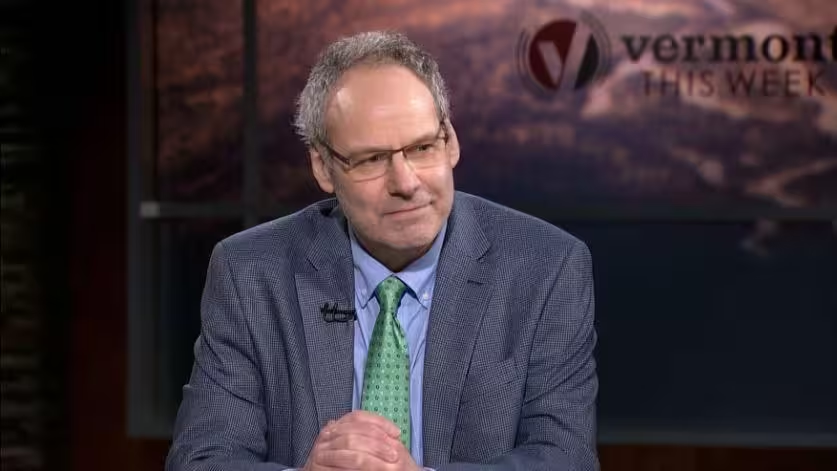
It's Friday, January 30th, and with us on the panel today we have Kevin McCallum from Seven Days, Lucy Tompkins from Seven Days, and Liam Elder-Connors from Vermont Public.
Thank you all so much for being here.
And I want to start by talking about, the news that everyone is really talking about, some of the, the horrific events that have happened in Minneapolis.
We heard Governor Phil Scott, Kevin McCollum there at the top, the press statement talking about, you know, his reaction to what happened in the shooting of Alex Pretty.
I'm wondering if you feel like, the governor's statements that he has made to this point have been you know, pretty forceful, maybe the most forceful we've seen.
I agree with that for sure.
For a long period of time, it was clear that Governor Scott was trying to, you know, stay cool and not antagonize, the president after the shooting of Alex Pretty, on Saturday morning, he came out with a statement that was far more forceful than, any statement he has issued so far about his concerns about Ice.
And I want to read that statement, actually, that the governor said and, this is what he said, he said enough.
It's not acceptable for American citizens to be killed by federal agents for exercising their God given and constitutional rights to protest their government at best, these federal immigration operations are a complete failure of coordination, of acceptable public safety and law enforcement practices, training and leadership.
The governor goes on to say, at worst, it's deliberate and federal intimidation and incitement of American citizens that's resulting in the murder of Americans.
Again, enough is enough, the governor continued.
The president should pause these operations, de-escalate the situation and reset the federal government's focus on truly criminal illegal immigrants.
In the absence of presidential action, Congress and the courts must step up to restore constitutionality.
That's right.
Pretty bold statement there from the governor.
But again, Kevin, you know, in a press conference later, he was asked about those comments.
Did you feel that his tone in the press conference, in reacting to those comments was any different?
It was similar.
But when we asked him multiple times to explain why he put out a statement that forcefully and what he thought about what had happened subsequently, he largely backed up what he said, but he did soften his tone a little bit by pointing out, I believe he said something to the effect of, well, there were antagonism.
There was antagonism going on on both sides in that incident.
And what he was doing was he was he was taking pains to point out that Vermont's protests to date have not been like that.
Vermont's protests have been respectful.
They have been peaceful.
And what he was trying to articulate, not very effectively, but he tried to say that if Vermont sticks to the pattern of protests that we've been having so far, that we probably should not see a similar ice enforcement ramp up in Vermont, because that's what all the reporters wanted to know.
Right.
What are you doing, governor?
To protect the state from a similar sort of increase in enforcement, are you in touch with Ice officials about whether they're going to do something here?
Right.
We saw some enforcement action in Maine.
Everyone's kind of concerned that that something similar to what happened.
But he didn't think that something similar is in Vermont's future.
But he admitted he didn't know he.
Well, he admitted.
Admitted that?
Yes.
But certainly after his written statement came out, the Vermont House then passed a resolution supporting that statement.
What can you tell us about that?
That's right.
So the entire House passed a statement, unanimously condemning this activity.
And, I think Jill Kruczynski put out a statement afterward that talked about, said something to the effect of, you know, the abuse of power of the Trump administration seems to know no bounds.
So, so the House came out with a very forceful statement as well.
That's not terribly surprising for the democratically controlled House, but it is noteworthy that both branches of government in the state were pretty forceful about this.
Vermont's congressional delegation, no surprise here either, came out very forcefully with some statements.
Here's what Senator Bernie Sanders had to say.
America is not and must never be about federal agents shooting American citizens down in cold blood, breaking down doors to arrest people, or sending five year olds to detention centers, all in a clear violation of our Constitution.
There's that word again.
Constitution, of course, the governor mentioning constitutionality.
When I think about what you were saying, Kevin, when it comes to the governor saying, you know, we're not seeing the same type of protests here in Vermont.
We're not seeing the same types of things happening.
Lucy Tompkins, there have been smaller incidents happening, though, in Vermont.
There was, you wrote about something that happened at the airport recently.
What can you tell us about that?
Yeah.
It's true that we haven't seen a sort of, surge in enforcement in the way that Maine or Minneapolis have seen here, but there has been a big increase in, in arrests in the state compared to 2024.
I wrote about a Somali cabdriver who on New Year's Day, he was sitting in a taxi line at Burlington Airport, when several vehicles with Ice agents came up and apprehended him.
And he's been in in prison here in the state for the last month.
So that's just, you know, one example.
But there have been over 100 detentions over the last year in Vermont that they've just been a little bit more scattered than what we've seen elsewhere.
Well, you know, Governor Scott talking about these issues, the mayor of Burlington, Vermont's largest city, has been indicating that she is stepping up at least preparations, for what may happen should ice come here.
One of the things that she was talking about was letting people know that, you know, we have to be careful about verification because Ice agents come in.
They're not they're wearing masks.
They're not necessarily identifying themselves.
But Emma mulvaney Stanek is saying that she has been talking to law enforcement here in Burlington, and there is a at least some plans in place to deal with these kind of things.
There's an ice tracker that she's pointing people to, but again, telling people not to like, call 911, for example, you know, if something's happening unless you really know what's going on.
And the congressional delegation against, a brother of the Vermont House, is responding to this, too, with the mask situation.
Kevin, what can you tell us about that?
Sure.
So, one of the things that lawmakers are trying to do is to pass some bills in the state that might restrict the possible enforcement actions of Ice agents when they are here now, they're very limited in what they can do, but they have, drafted two bills, 208 and 209208 would, restrict law enforcement agencies throughout the state from wearing masks during regular, enforcement actions?
They have to make that law apply to all law enforcement agencies, sheriffs, police officers, state police, because they can't be seen to be singling out federal agents in this law.
So the law as drafted would cover all law enforcement agencies in the state.
And it would have an exemption, I think, for when it gets really, really cold.
So like ten below zero, they will be allowed to wear masks.
But the governor said at his press conference that he actually supports that.
He's been saying for weeks that he does not think it's appropriate at all for law enforcement agents to be walking around masked and snatching people off the streets.
So that's one of the bills.
There's another bill, that is called, something expanding the number of sensitive places in the state of Vermont that would presumably prevent law enforcement agencies from going there and making civil arrests.
Right now they know.
Like what?
Schools.
Yeah.
Right.
Right now, the only place where that is, prohibited is courts.
You can't you can't be picked up for a civil violation when you go to a criminal proceeding at a courthouse in the state, which I didn't even know.
But, senators are now trying to expand that to add schools, public buildings and churches, to that list, sort of an unofficial policy of ice before this administration.
But that's been done away with since Trump took over.
So now that the states like Vermont are trying to sort of impose their own limitations, but I think we're running up against or they're running up against, you know, how much a state can can interfere with federal, enforcement before they get viewed as a sanctuary state and it blows up in their faces.
So that's apparently what the senators are struggling with a little bit.
How expansive can we make this this rule?
And apparently in recent days, in the Senate, they've been trying to narrow it like it's not going to apply to, like, you know, parks or it's not going, you know, public spaces like that.
It's going to they're going to try to tailor it to the types of, places and public buildings where people need to go, like the DMV or the tax department or wherever.
So there is a narrowing of that bill, but it's still moving forward.
The governor hasn't said it.
We were asking him about that.
Would you support that?
And he was ambivalent.
He said he hadn't seen the bill yet.
So we'll see if the legislature can find ways to restrict future actions of Ice in this state.
But, again, it's very difficult for states to find ways to control and restrict the activities of federal agencies, for sure.
To be clear, again, even if they did pass this mask bill, for example, there is no teeth there.
There's no enforcement to say that the ice agents would have to unmask themselves.
It would.
This would only be for local law enforcement.
No it would.
The law says that it would cover those federal agents.
So it's local and federal agents.
But the question you're asking is an excellent one.
How can it?
That's what I'm saying.
How can a local state law affect federal agents and I'm sure it would be challenged in court.
What do you think there?
Well, there was some testimony from Vermont law enforcement that said it would put them in an awkward position of having to enforce, this law against fellow law enforcement officers, federal federal law enforcement officers.
But obviously, like Vermont, law enforcement would be enforcing that potentially.
And so that would put them in a tough spot.
So I, you know, it will say so confusing.
And it's frankly a little scary.
I mean, we're all talking about this.
You know, we saw what happened in Minneapolis.
Those images are so horrific.
You know, ice has gone to Maine now they're leaving.
We just everybody seems to be in this heightened state of what is going to happen next.
And clearly, there were officials here in the state of Vermont that believe ISIS going to come here.
And, but do we all feel that this we're going to move on to this topic in a second?
But do we all feel that this is inevitable?
Do we feel like ice is going to be coming here?
Oh, I don't know the answer to that.
I mean, Lucy and I both got emails from people today saying that they're they there was word that Ice agents were flooding here from Maine and going to Burlington and and South Burlington and going to hotels and stuff.
So there's rumors all over the place.
I tend to suspect that Ice is probably going to stay focused on some of these larger cities with larger immigrant populations in Vermont, and then not come pick a fight in a in a state as liberal as Vermont is, that has a Republican governor that's saying the right things in May in many ways.
But I would clarify that Ice is already in Vermont, is already arresting people in Vermont.
That's been happening.
It just had there hasn't been, you know, an operation catch of the day, like what they called it in Maine.
Or, you know, what we've seen in Minnesota, where there's a sort of surge of agents that come and target a whole community.
So whether that will come here, I think is an open question.
That's hard to say.
It's a challenge just to know what's going on.
Like you said, I think one of the jobs, you know, that, you know, Lucy's done a great job of trying to verify when these things are happening.
And we hear all these things as reporters and, I think a lot of the chaos that can come out can create more confusion and breed more a sense of, of insecurity that people are feeling.
And so I think kind of the job that we're all facing as journalists is how do you kind of cut through the rumors and, and noise to get to what's actually happening?
Absolutely.
Well, let's cut to something, Liam elder Connors, that you have reported on factually here that we know we can talk about, and that is money that the state of Vermont is getting from, opioid settlements.
It's a lot of money.
How much money are we talking about here, and what kind of what's the breakdown?
How's Vermont going to use this money?
So it's been about more than $41 million over the last couple of years with more on the way over the next decade or so.
And I think about it in there are three buckets of, how this money is getting divided.
Most of it is going into a state wide fund that is being used to repair damage caused by the opioid crisis, and then the rest is getting split between covering legal fees that the state has incurred by hiring outside counsel, and then municipalities that signed on to these various lawsuits against opioid manufacturers and distributors.
They're getting it as well.
And you said it's a lot of money, and in some ways it is.
It's millions of dollars.
But once you start cutting that, like pie up, it gets smaller and smaller and smaller.
And some of the municipalities that are getting money are just getting a couple hundred dollars.
Really?
Just a couple hundred.
Okay.
Yeah.
What one town J I think is has gotten $188 so far.
So it can get really small and it's finite.
So figuring out what to do with the money is a real challenge.
The state abatement fund, the legislature directs that money.
And there's a committee that gives them some recommendations.
And they're sending things towards recovery, housing, social workers, the Burlington Opioid Overdose Prevention Center, things like that.
But some some municipalities really struggle to figure out what do you do with this money when it's not going to last forever?
We have a graphic that's up on the screen for those who may be listening.
We're looking at a breakdown of some of this money.
Liam treatment looks about nearly $8 million for treatment.
Nearly $8 million for harm reduction.
What would that mean, exactly?
Harm reduction, for example.
That can be things, like, like a test kit to tell if there's fentanyl or psilocybin, which are, you know, dangerous drugs that can sometimes be in, in street opioids.
I mean, most opioids are fentanyl right now, which is a very powerful synthetic opioid.
And those are things that, the idea of harm reduction is saying people might not stop using, but we can prevent them from causing more harm to themselves.
And it's about saving lives and keeping people from dying from overdoses.
And so that's one area that has gotten a lot of attention.
Though the states putting also a lot of money into treatment and recovery as well.
I know we've talked to you about this before, and I think, the last time we had you on talking about this, there was a slight reduction maybe in the overall amount of, opioid deaths that have been happening.
Are we still looking at a downward trend or what do we know about that right now?
There has been a decline.
And that is tracking so far from we don't have all the data for 2025 yet.
But the numbers are still lower than they have been in the last couple of years.
And so that's positive.
But remains to be seen at least a little bit encouraging.
Thanks, Liam, for that update.
Lucy Tompkins, I want to get back to you on this issue about, immigration.
And you did a great story about Vermont border crossings.
And, you know, people that may be trying to come into Vermont.
What can you tell us about what's happening at the border?
Are these crossings increasing?
Decreasing?
What are, law enforcement officials telling you?
Yeah.
So, crossings have decreased a lot.
This story was this reporting was looking at illegal border crossings or, you know, people coming to request asylum at the border, which in 2024, we saw historic highs in the number of people coming through the Swanton sector, which is the section of the border that includes Vermont and New Hampshire and part of, New York state.
Those numbers have dropped dramatically.
93%.
In 2024 compared to 2025 is dramatic.
So, yeah, and that there's a few reasons for that.
Trump's, stance on immigration and his kind of policies are part of that.
Although the numbers were dropping, before he took office.
So as things have kind of quieted down up at the border, Border Patrol has been also assisting with interior enforcement.
So Border Patrol, typically, you know, their mandate is to police the border between official ports of entry.
So they're looking for people who are crossing the border illegally.
Their job is to detain people and then, you know, deport them or it right now, what they're doing is charging everyone that they catch criminally with illegal entry or smuggling, which wasn't the case before this administration, but they're taking a much harder line.
But now that things have quieted along the border a bit, they're they're doing more interior enforcement in the state.
So they've been also carrying out targeted raids on construction, crews or roofing crews, for instance.
So the line between kind of border patrol and, interior enforcement, which is usually what Ice does, is blurring under this administration.
It's an interesting breakdown, too.
I think there's a confusion, understandably, between, you know, an ice age and a Border Patrol agent.
They're all federal agents.
But can you tell us a little about the breakdown, how that breaks down?
Yeah, it is a little confusing.
So the parent umbrella agency is the Department of Homeland Security.
Within that, there's Customs and Border Protection, which, is in charge of the northern and southern borders and I think maritime as well.
So they manage the official ports of entry.
And, and then Border Patrol is is part of Customs and Border Protection.
And they like I said, man, in between the official ports of entry.
And they have expanded authority within 100 miles of the border to conduct searches of vehicles or do immigration checkpoints.
But Border Patrol agents can actually, enforce immigration law anywhere in the country, which is why we're seeing them deployed to cities like Minneapolis and Chicago and, Charlotte, you know, that are far from the border.
And then, separate a separate agency under the Department of Homeland Security as Ice, who are in charge of interior enforcement.
And, and then within that, there's also, Homeland Security Investigations who've also been participating in this crackdown.
That's the first I've heard of that one.
Okay.
They yeah, they they do more of the sort of investigating, that sort of the, you know, intelligence gathering for, for some of these enforcement actions.
But then they can also go out and make arrests as well.
So there's a, there's a lot of different agencies and agents, and it's kind of an alphabet soup of, of agencies that are out there participating in the crackdown.
Yeah.
And they're getting a lot more funding.
At least Ice is to do all of these operations from the federal government.
Kevin McCallum, I want to turn to you, getting into more of a Vermont story about, one of the things we talk about a lot on this show, and that's housing, the lack of it.
There's an effort now to catalog some state land, right?
With an eye towards housing.
How would this help?
What are they doing?
That's right.
Well, So lawmakers and and the governor are really, you know, racking their brains to try to figure out what else they can do to solve the housing crisis in the state of Vermont.
They've tried a whole number of things.
I think, the general consensus is it hasn't really changed the trajectory of the crisis in the state very much over the last several years.
Still a huge problem.
But so they are now, what the governor did in an executive order last fall was to tell the agencies of the state to pull together all of the properties that they own and create a catalog of properties that could theoretically be turned over, sold to developers as used to be used for affordable housing.
And so that's a big job, like the state has thousands of parcels around the state.
Hundreds of them could possibly be, you know, turned into housing theoretically.
And that, that, that charge fell to a housing official to sort of collate and sort all these properties.
There's, you know, there's dog parks, there's empty buildings, there's all kinds of things.
And so they're trying to figure out and get a short list that they can just turn to and say, here's a top ten list of properties that we as a state don't really need anymore.
They're underutilized.
And if we turn this over to a developer, it's 20 acres.
Somebody could build 200 apartments there.
So it seems like a good idea.
But in reality, when you start to look at the list that they cobbled together, it's kind of a hodgepodge of random pieces of parcels next to a highway that would never be appropriate for that.
So it's actually a big challenge.
You have to you have to almost do site visits to all these and, and look at the zoning and, and look at the infrastructure and look at the water and look at the, the traffic patterns and, and then make a decision about whether these properties, would be appropriate for housing.
It was interesting to me that last summer, as you may recall, Republicans in Congress talked about selling off a bunch of federal land.
Remember, that idea was like, let's do let's sell millions of acres of timberland and, and, national forests and things, national parks, not national parks, National forest.
And there was this huge outcry like, oh my God, how can you do that?
That's ridiculous.
Those are the public's assets.
But here in Vermont, we're so concerned about the housing crisis that I think most people are on board with the idea of, like, if you've got a parcel that hasn't been used as a sand shed for a couple, you know, decades or whatever, you might as well just make it available to developers.
So it's going over well.
It sounded good, though, as you were saying.
There are issues too.
I would think some of these buildings, for example, must be pretty old.
They might have some specialist problems, things like that.
Yeah, absolutely.
There's some that are on the short list that once you drill down a little further, you're like, oh, that's going to be that's going to be a tough to pull off.
Liam Elder Connors, I want to turn back to you for, this bill that is trying to prevent police shootings of people who are in mental health crisis.
You've done a lot of coverage on this.
It really sad situation when it happens.
What would this bill to do exactly.
So yeah, there's there's been a pattern over a number of years of people in the midst of a crisis being shot by police.
And the bill, one of the main things it would do would it would mandate more training for police officers on de-escalating mental health crisis.
Right now, officers only need eight hours of training, when they go to the police academy to get certified.
And then there's no annual or even, biannual recertification on that.
So this would increase the number of hours to 15, I believe, to get initial certification and then require, kind of retraining on mental health issues every two years for officers.
There are a few other things in the bill around, you know, making de-escalation of mental health crises, putting that into statute rather than just having it be part of the use of force policy and some ways of treating families and, victims of police shootings, giving them access to funds that would allow them to clean up scenes of other shooting as well.
And this is tied to, a family whose, son, was shot and killed this summer, who, while he was in the midst of a mental health crisis, Scott Garvey, he had just moved to Vermont, and, his family was hoping he'd have better mental health treatment here.
And, unfortunately, he the police were called.
He was, making comments that were scaring some of his neighbors.
And he ended up, being shot and killed in the apartment that he and his mom had just moved into.
Yeah, I remember your coverage of that story, but it's good to know at least some efforts are being made to deal with this problem now.
Yeah, we'll see what happens with the bill.
It's, you know, it still has to go through a lot of process.
Sure.
Very briefly, Liam, I wanna stick with you for a second, because another sheriff, has been arrested in Vermont.
What can you tell us about this?
Yeah.
So the Windsor County Sheriff, Ryan Palmer, was arrested, this week, on several charges, and is accused of sexual misconduct.
And, you know, this is an issue, we've seen sheriffs arrested for sexual misconduct and other crimes before, and it's kind of reigniting calls of what kind of oversight should we have of sheriffs who are elected officials?
They can only be removed, through impeachment.
Sheriff Palmer has said he's not resigning.
He's stepped back from his operations, day to day operations, but he's not stepping down from the office.
So, there have been efforts in the past that haven't gone anywhere in the legislature to create more oversight.
And there's some talk, you know, the people that were proponents of it before would like to see it come back.
But, no indication if that's going to happen yet.
Okay.
I really appreciate your updating on that, story.
We're just about out of time here.
But before we go, I want to mention that if you are brave enough to get out there this weekend, it's been so cold.
Tomorrow is free ice fishing day in the state of Vermont.
You can go ice fishing.
You do not need a permit to catch fish tomorrow.
Elmore State Park has a great event starting at 11 in the morning till three in the afternoon.
I won't be joining you, but let me know if you caught a big one out there on free ice fishing day in the state of Vermont.
Just have the hot cocoa and marshmallows ready afterwards.
today.
I want to thank our panel so much today.
Kevin McCallum from seven days, Lucy Tompkins also from seven days.
And Liam Elder Conners from Vermont public eye, Mitch Wortley.
I hope you'll join us again next Friday for Vermont this week.

- News and Public Affairs

Top journalists deliver compelling original analysis of the hour's headlines.

- News and Public Affairs

FRONTLINE is investigative journalism that questions, explains and changes our world.












Support for PBS provided by:
Vermont This Week is a local public television program presented by Vermont Public
Sponsored in part by Lintilhac Foundation and Milne Travel.