
January 5, 2026
Season 4 Episode 293 | 26m 37sVideo has Closed Captions
Kentucky's federal delegation reacts to news out of Venezuela.
Lawmakers from Kentucky react to the capture of Venezuela's president, a look at new state laws on the books for 2026, why one community is concerned about license plate readers, and Congressman Barr campaigns on coal in Harlan.
Problems playing video? | Closed Captioning Feedback
Problems playing video? | Closed Captioning Feedback
Kentucky Edition is a local public television program presented by KET
January 5, 2026
Season 4 Episode 293 | 26m 37sVideo has Closed Captions
Lawmakers from Kentucky react to the capture of Venezuela's president, a look at new state laws on the books for 2026, why one community is concerned about license plate readers, and Congressman Barr campaigns on coal in Harlan.
Problems playing video? | Closed Captioning Feedback
How to Watch Kentucky Edition
Kentucky Edition is available to stream on pbs.org and the free PBS App, available on iPhone, Apple TV, Android TV, Android smartphones, Amazon Fire TV, Amazon Fire Tablet, Roku, Samsung Smart TV, and Vizio.
Providing Support for PBS.org
Learn Moreabout PBS online sponsorshipMUSIC It's a new year, and some new laws are now on the books in Kentucky.
Just ahead of a new session of the Kentucky General Assembly.
>> They're collecting over 7000 license plate reads a day in a town of less than 2000 people.
>> License plate readers are common across Kentucky, gathering mounds of data for law enforcement.
What to know about the AI crime fighting tools.
Watching you.
>> Flu cases are increasing across the country, and we're seeing a lot of flu here locally.
>> If you or someone you know is dealing with the flu, well, you're not alone.
What we're seeing across the Commonwealth.
>> So much history, so much nature, so much culture, so many nice people.
So then I was like, okay, let's we're going all in on Harlan.
>> And here, one developer's vision to turn Harlan's history into a future tourist destination.
>> Production of Kentucky Edition is made possible in part by the KET Millennium Fund.
>> Good evening and welcome to Kentucky Edition for the start of a brand new year.
Monday, January the 5th, I'm Renee Shaw hope you had a great holiday season and we thank you for joining us tonight.
The 2026 Kentucky General Assembly session begins tomorrow.
The state budget will dominate this year's 60 day session, which lawmakers are constitutionally required to pass every two years.
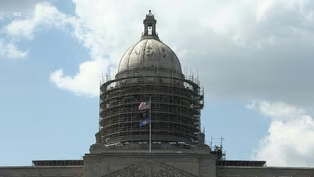
It will also be the first session in modern history that isn't held in the state capitol.
Instead, the House and Senate will convene in a new temporary building as the Capitol undergoes major renovations.
The project is expected to take several years.
As we gear up for a new session, some of the laws passed last year just went into effect on January 1st of this year.
Our Emily Sisk has more on what you need to know.
>> The Kentucky General Assembly passed more than 140 bills during the 2025 legislative session.
Many of those bills went into effect last summer, 90 days after their passage.
Some had an emergency clause that made the bills effective immediately when they were passed.
But a few bills went into effect last week on January 1st.
One of the most notable pieces of legislation is House Bill one, which reduces Kentucky's personal income tax rate from 4% to 3.5%.
The bill passed quickly in the session with mostly bipartisan support, and it was signed into law by Governor Andy Beshear.
According to the Kentucky Chamber, State taxpayers will collectively save more than $700 million a year due to that reduction.
Many conservative lawmakers hope to completely eliminate the state's income tax over the next several years.
Senate Bill 100 also went into effect at the start of 2026.
It requires any retailer selling tobacco, nicotine and vapor products to obtain an updated license from the Kentucky Department of Alcoholic Beverage Control.
The department can make unannounced visits to smoke shops to ensure they are not selling products to anyone under the age of 21.
Similarly, Senate Bill 202 prohibits the sale of cannabis infused beverages at fairs, festivals, and other similar events.
The intoxicating drinks may only be sold at licensed liquor stores.
And rounding out the list is the Kentucky Consumer Data Protection Act.
The legislation gives Kentuckians more rights to their personal information online.
Individuals can correct and delete information.
They can also opt out of targeted advertising and the sale of their personal data.
For Kentucky Edition.
I'm Emily Sisk.
>> Thank you.
Emily.
The Kentucky Consumer Data Protection Act was signed into law during the 2024 Kentucky General Assembly regular session.
It requires businesses to provide Kentuckians with an easy way to view and edit their personal information online.
This will be the final legislative session for State Representative Ashley Lafferty.
She represents the 95th House district in eastern Kentucky, which covers Floyd County and part of Pike County.
Posting to social media on New Year's Day, Lafferty says she intends to run for District court.
Judge Lafferty has served in the House since 2019, and she is the only remaining rural Democrat in the Kentucky General Assembly.
For leaders of the Kentucky General Assembly, two from each party will join me tonight on Kentucky.
Tonight, we'll preview the 2026 session that starts tomorrow and will, of course, take your questions and comments.
That show is tonight at 8:00 eastern, seven central, right here on KET.
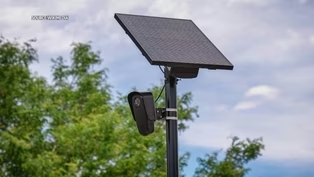
Some residents in Henry County are questioning the recent deployment of a police surveillance technology, specifically cameras that read license plates.
Local reporting shows these cameras are common throughout Kentucky, and the data collected is reaching those outside the state.
Our June Leffler explains.
>> In November, Eminence Police rolled out license plate readers known by their brand name flock, something this local woman says is uncalled for in her mostly quiet town.
>> They're collecting over 7000 license plate reads a day in a town of less than 2000 people.
It's excessive.
>> These cameras and other technology can speed up investigations, says the Henry County sheriff.
>> So as citizens, you have to ask yourself if you're a victim of property crime, violent abuse, if there's an amber alert of a kidnaped kid, a dementia patient that's wandered off, do you want us to have a tool to find those kids?
Anybody can go out here in the parking lot and look at a license plate.
No different than flocks doing.
Until the U.S.
Supreme Court ruled that it's unconstitutional and they're usable, they're going to be used.
And they are a vital tool for law enforcement.
>> But Destinee Kelly worries using these tools could amount to overpolicing.
>> Which will target multiple communities that are often already targeted.
>> The police chief says flock cameras are, quote, not used to map, track, follow or gather information on the routines and routes of the general public.
The local police policy is to use license plate readers only to investigate reported crimes involving a vehicle, including if a car was stolen or to find a missing person.
Police officers must confirm the vehicle matches an active case before pulling someone over.
Race and any other protected status are no reason alone to track a vehicle in.
All, images are deleted after 30 days unless needed for an active investigation.
But Kelly says local police are not necessarily the only ones accessing this footage.
>> We're not even selling or compiling our information for license officials.
We're compiling it for anyone that has the ability or the money to retrieve it from that system.
>> Aside from a possible data breach or private pay per view access, local reporting confirms law enforcement outside of Kentucky have access to such data.
>> The software will do these audits where you can see every time someone searched Louisville's database and it showed searches being conducted of Louisville data, but the searches were from law enforcement elsewhere in Kentucky and and from across the country.
>> While law enforcement can collaborate across state borders, the Kentucky Center for Investigative Reporting found police in Florida and elsewhere were using local data for immigration enforcement, something Louisville police don't investigate themselves.
Some state lawmakers have sought across the board guardrails on FLoC and similar systems.
State Senator Jimmy Higdon, chair of the Senate Transportation Committee, proposed all police agencies purge data after 90 days, and former state Senator Adrian Southworth, who spoke before Henry County's fiscal court, recently, had proposed cameras only be used with a search warrant.
Neither bill became law for Kentucky edition.
I'm June Leffler.
>> Thank you, June, for that report.
These flock cameras are throughout Louisville, Lexington and Bowling Green and even smaller cities like Elizabethtown, Georgetown and Glasgow, Venezuela.
President Nicolas Maduro made his first appearance in an American courtroom today, days after being captured by the U.S.
military.
The Trump administration accuses Maduro of working with drug cartels to ship thousands of tons of cocaine to the U.S.
President Donald Trump says the U.S.
will temporarily, quote, run Venezuela.
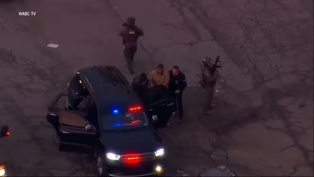
Lawmakers from Kentucky are responding to the news.
Congressman Hal Rogers of Kentucky's fifth district praised the Trump administration, calling this a, quote, monumental display of U.S.
force against the cartels and dictators who pursue terrorism over peace.
And Republican Congressman Andy Barr said, quote, I applaud President Trump for taking decisive action to protect the American people from narco terrorists seeking to poison and murder the American people.
But another Republican sees things a little differently.
Congressman Thomas Massie of the fourth district said, quote, wake up, MAGA.
Venezuela is not about drugs.
It's about oil and regime change.
This is not what we voted for.
End quote, the only Democrat in Kentucky's congressional delegation, Congressman Morgan McGarvey of Jefferson County, warns against U.S.
involvement on social media.
He said, quote, America must not start another reckless, unjustified war fought for the interests of oil companies, end quote.
According to The New York Times, a replica of Maduro's compound was built in Kentucky, where U.S.
forces trained for the mission.
Soldiers based at Fort Campbell were also reportedly tasked with flying special operation forces in and out of Venezuela.
To that, Congressman Brett Guthrie of Kentucky's second congressional district had this to say, quote, Kentucky is once again proving that our Commonwealth is at the forefront of our national security.
Proud of the work done in Kentucky to prepare our service members for Operation Absolute Resolve in Venezuela.
End quote.
Congressman Barr was in eastern Kentucky today campaigning on coal.
Barr is seeking to replace U.S.
Senator Mitch McConnell in the Senate.
He stood with coal miners in Harlan County today to announce his plan to make to use Kentucky coal to power AI development.
Barr says it's essential that the U.S.
keep up with China in the technology race, adding that coal isn't just good for Kentucky but necessary to the country's future.
>> This is a vision that that lays the groundwork for the future jobs and prosperity of Eastern Kentucky.
But it's also at the center of America's national security imperative, which is to win the race for these technologies of the future.
Kentucky is uniquely positioned not only to put our coal miners back to work, but to advance our national security.
And we can do it right here in Harlan County, Kentucky.
>> Congressman Barr says he's already working on the plan with President Donald Trump and his cabinet.
More on the details of Barr's plan tomorrow on Kentucky Edition.
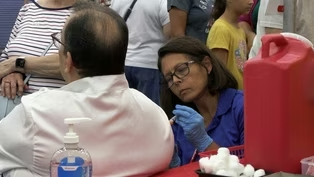
Cases of flu are on the rise in Kentucky following the state's first pediatric influenza death this season.
Our Christie Dutton spoke to a pediatric infectious disease physician about how this flu season compares to previous years.
More about this in tonight's medical news.
>> Doctor Chris Bryant from Norton Children's.
We have heard a lot in the news about a surge in flu cases.
What are you seeing there and how does this flu season compare to, say, last year or previous years?
>> Flu cases are increasing across the country and we're seeing a lot of flu here locally.
Last week within Norton Healthcare, we had 779 adults test positive for flu and 674 children.
It's too early to tell if this is going to be a severe flu season as last year's was.
But there are some early indicators that this season could be rough.
We are seeing a lot of influenza A, H3n2 circulating, and this year's strain is a mutated strain that's not well matched to the vaccine.
In other countries where this subclade has circulated, there have been a very high number of cases.
The other thing that that could point to this being a rough flu season, is that less than half of adults and children have had a flu shot and are unprotected against circulating strains.
>> And where does Kentucky fall in those statistics for getting a flu shot?
>> Well, I can tell you the latest data for Jefferson County are about 28%.
>> Okay.
So even lower for that.
And let's talk about getting the flu shot.
Who needs to get a flu shot and who's most at risk?
>> A an annual flu vaccine is recommended for everyone six months and older.
And I want to emphasize that just because we have this mutated strain doesn't mean that the flu vaccine won't work.
It still protects against severe outcomes.
>> I've seen it grocery stores, drugstores, flu tests, a flu and Covid test that you can give yourself at home.
It's over the counter.
Are these reliable and is it?
Are they handy to have on hand?
>> I do think they're handy to have on hand.
You know, Christie flu is a virus and a lot of viruses have to run their course.
But but flu or influenza is a virus for which we have medications that can help if they're started early, particularly within the first 48 hours of illness.
Treatment is especially important for people who are at higher risk for complications.
Young children, especially those under five older people and people with underlying conditions.
And so a test can help, you know, if you have flu, that and maybe you'll qualify for a medication.
>> Okay.
So if you find out soon enough that you have the flu, like maybe with a home test or going to the doctor.
There's treatment.
What exactly is the treatment?
>> So there are a couple of oral medications that can be given.
And they're most effective if they're started early okay.
>> And that what does it do.
It kills the virus.
It reduces the virus.
How fast do you get better.
>> Well it it it really depends on the person and how soon it started.
But these medications can help people feel better, faster.
And if you're a person that is at risk for severe flu, they may help you from progressing to severe flu.
>> Okay, that is good to know.
Doctor Bryant, thank you so much for your time today.
>> Thank you.
>> And thanks to you, Christie Dutton, the developer behind Louisville's successful Nulu neighborhood, has been working for a decade on revitalizing the city's Portland neighborhood.
But now, for the first time, he has a vision for development outside of Louisville, and he has his sights set on eastern Kentucky.
Our Kelsey Starks sat down with developer Gill Holland to find out more about his big plans for Harlan, Kentucky.
>> Now you've got your sights set even further outside of Louisville, and Portland's still in the works, and you still got your hands in there.
But now.
Now you're looking at Harlan.
So tell us why.
And and and what took you there and what's happening.
>> Yeah.
Well, so part of the Portland thing was like breaking down the ninth Street divide.
And because I was like, that's so crazy.
And then I feel like in the last eight years in America, we have this urban rural divide, which is kind of tearing the country apart in some ways, you know, not to get political, but like, yeah, there's a big problem.
And, you know, rural, we need each other, these two areas.
And then I started thinking about Kentucky.
And you know, if you go to Tennessee or North Carolina or West Virginia, they all have like go to Appalachian getaway towns, Pigeon Forge, Gatlinburg, Asheville, you know, the Greenbrier, whatever.
And I started thinking, Kentucky doesn't really have a Appalachian go to town.
Like, why do people, you know, people in Louisville don't talk about going to the mountains?
When I grew up in Davidson, North Carolina, you know, we would talk about going to Asheville all the time, right?
So then I started thinking about, okay, well, let's let's do something in Appalachia.
Also, we got to we got to diversify these coal towns economies.
We got to find jobs for our coal miners.
They're amazing hard workers, super talented.
You know, folks, there's great history.
And I have a personal connection because my dad was born in Harlan.
My granddad was the doctor for the coal company.
My great great granddad died in Harlan, but I had actually never been there until about five years ago.
And when I went, I was like, oh my gosh, there's three state parks.
There's the longest, tallest zip line in Kentucky.
There's the highest mountain in Kentucky.
And then, you know, you start listening to all the songs.
You'll never leave Harlan alive.
>> Right?
>> And then the movies Harlan County, USA when the Oscars start.
>> It has a brand.
>> It has a brand.
It's got it's like the most famous county in America.
Right?
And then you start thinking about, like, the coal for all the coal that built New York City came from Harlan because, you know, the metallurgical coal that's used to then make steel comes from Appalachia.
And, you know, when we went into World War One and two, they were like, we need more of the metallurgical, the coal to make the tanks.
And, you know, so Harlan County played a major part in, like, winning the World war.
So, so much history, so much nature, so much culture, so many nice people.
So then I was like, okay, let's we're going all in on Harlan.
And I love Harlan because for many reasons.
And I looked at some other towns in Appalachia, but there's a flood wall.
It's a courthouse square town.
So it you know, it looks like a hallmark movie.
There's still I mean, we've lost a bunch, but there's still some 100 year old buildings, hundred plus year old buildings.
So we need to save them all.
And, you know, again, micro-targeting same, same methodology as using a newly like find locally owned businesses, create more tourist experiences, get more good stories out of Harlan because there's so many stories out of Harlan anyway.
So, you know, branding, community involvement, it's super exciting and I love it.
And, you know, we have lots of folks that used to work in the mines who are now working at the Harlan County Beer Company or, you know, so that's kind of gratifying to see also.
>> So it's a little bit of just rinse and repeat.
>> A little bit.
And, you know, knowing the history, talking about the history, working with the locals.
You know, Harlan used to be the third most populous county in the state of Kentucky.
And it's, you know, I mean, Lynch used to have like 10,000 people.
And I think there's 560 people there now.
>> Wow.
>> So like, let's kind of bring Harlan back to the glory it had in the in the middle of the century.
>> What do you envision Harlan looking like?
I mean, what, ten, 20, 50?
>> Hopefully there's no more vacant buildings, dilapidated buildings on Main Street, which there are probably, I don't know, 50% of the buildings are still vacant, falling down, dilapidated.
So we need to save all those.
We're working on the Harlan Hotel, which was a historic.
The Llewellyn Hotel in 1922 opened, was the jewel of Appalachia.
So we're working with the state historic tax credits, trying to get the, you know, it's a $10 million project for a 28 room hotel.
But there is no there is no hotel in downtown Harlan.
So, like, how can you know?
And then that will provide a ton of jobs.
And then the people that can stay in downtown will then go shop and spend money in downtown.
So there's going to be that positive ripple effect.
And then I think lots of people don't realize there's three state parks in Harlan.
Lots of people don't realize the headwaters of the Cumberland, which is the river that flows through Nashville.
Country music basically starts in Harlan.
So maybe country music actually started in Harlan all along.
Yeah.
So just, you know, storytelling.
And I do think we can increase the population greatly and the, the decrease the unemployment greatly with having a pretty low effect on the physical, because it's really right now we're just trying to reclaim these old buildings that are vacant.
>> Do you think?
I mean, it's one thing revitalizing a neighborhood in Louisville where there's already a lot of money, there's already a lot of people.
There's a lot of investment to be had.
Do you feel like Harlan seems to me, would be a much bigger lift?
>> So Harlan was a very wealthy town because of all the coal money, the the challenge.
And I saw this in Portland is the historically the definition of success was getting out of Portland or getting out of Harlan.
So how do we change that to the definition of success is come back to Portland, come back to Harlan, invest in Harlan.
Like this is worth investing.
There's amazing stories, amazing history.
It's a beautiful place.
Yeah.
So changing that narrative and then finding all those people whose.
Because, like, everywhere around the country, people are like, oh, yeah, my grandparents used to live in Harlan.
I mean, I hear that all the time.
Yeah.
So how do we get those people to then think, you know, historically and then think into the future and like, okay.
Yes.
You know, and if we think about how Harlan literally built this country, let's invest in Harlan.
>> Tapping into that.
Yeah.
And as success for something in eastern Kentucky has ripple effects across the whole state.
>> Yeah.
And we think Harlan can be replicable, just like I thought like the what we were doing in Nulu with the green building, with the streetscape improvements, with the pedestrian friendly, the Bioswales, all that like that is replicable throughout the whole state.
And we'll see the positive ripple effects in other people be like, oh, we should do that in our community.
Yeah.
And I feel like people are going to see what we're doing in Harlan.
They're like, oh yeah.
So Jeff and Skye, you know, they opened Moonbow Cafe, which is also now a bookstore.
So lots of people aren't going to Starbucks now.
They go to, you know, the locally owned coffee shop, just like in Nulu.
Right.
And then we open the Harlan County Beer Company, which is really just a restaurant, but, you know, so they don't have to go to McDonald's anymore.
Right?
And, you know, in the past they would go to McDonald's to get free Wi-Fi, like, okay, you can get Wi-Fi in other places now.
>> Right, right.
>> So it's it's how this community's building, you know, and it's a long term.
It's a long you know, we need patient investors.
>> A fascinating conversation.
And you can find out more about the history of the Portland and Nulu neighborhoods, including how Nulu got its name.
That's on the next Inside Louisville that airs this Sunday at 12 noon, 11 a.m.
central right here on KET.
As the new year begins, we look at the beginning of women voting in Kentucky and the end of a long Kentucky basketball winning streak.
Our Toby Gibbs has that and more in this look at this week in Kentucky history.
>> Ann Rutledge, believed to be Abraham Lincoln's first love, was born in Henderson County on January 7th, 1813.
The Union ironclads Essex and Saint Louis battled the Confederate ships General Polk, Ivy, and Jackson on the Mississippi River next to Carlisle County.
On January 11th, 1862.
On January 7th, 1867, Kentucky rejected the proposed 14th Amendment to the U.S.
Constitution, the amendment granting citizenship to everyone born or naturalized in the U.S.
including people who'd been enslaved.
But enough states ratified the amendment to make it law.
On January 6th, 1920, the Kentucky General Assembly passed the proposed 19th Amendment, giving women the right to vote nationwide.
When Tennessee ratified the amendment in August of 1920, the amendment had enough states to become part of the Constitution.
Georgia Tech beat Kentucky in basketball 59 to 58 on January 8th, 1955, ending Kentucky's remarkable 129 game home winning streak that began in 1943.
Louisville was almost home to a major League Baseball team in the 1960s.
On January 6th, 1964, Charlie Finley signed a deal to move the Kansas City A's to Louisville, but other major league owners vetoed the deal.
The A's would move to Oakland in 1968, and that's what was going on this week in Kentucky history.
I'm Toby Gibbs.
>> And that'll do it for us tonight.
We hope to see you in just a bit on Kentucky tonight as we preview the 2026 legislative session.
See you soon.
Kentucky Lawmakers React to Capture of Venezuela's President
Video has Closed Captions
Clip: S4 Ep293 | 1m 56s | Lawmakers react to the U.S. military's capture of Venezuelan President Nicolás Maduro. (1m 56s)
Kentucky Seeing Surge In New Flu Cases
Video has Closed Captions
Clip: S4 Ep293 | 4m 12s | The surge comes amid the state's first pediatric flu death this season. (4m 12s)
New Laws In Kentucky to Start 2026
Video has Closed Captions
Clip: S4 Ep293 | 2m 56s | Some laws passed in Kentucky in 2025 just went into effect on Jan. 1. (2m 56s)
Police Surveillance Technology Questioned in Henry County
Video has Closed Captions
Clip: S4 Ep293 | 3m 45s | Some Kentuckians are questioning the need for cameras used to read license plates. (3m 45s)
Providing Support for PBS.org
Learn Moreabout PBS online sponsorship
- News and Public Affairs

Top journalists deliver compelling original analysis of the hour's headlines.

- News and Public Affairs

FRONTLINE is investigative journalism that questions, explains and changes our world.












Support for PBS provided by:
Kentucky Edition is a local public television program presented by KET