
January 7, 2026
Season 4 Episode 295 | 26m 31sVideo has Closed Captions
Gov. Beshear delivers his 2026 State of the Commonwealth and Budget Address.
Gov. Beshear delivers his 2026 State of the Commonwealth and Budget Address. A look at some of the early bills filed in the Kentucky General Assembly. Republican Daniel Cameron makes his entry into the U.S. Senate race official. Details on the state's first digital ID platform.
Problems playing video? | Closed Captioning Feedback
Problems playing video? | Closed Captioning Feedback
Kentucky Edition is a local public television program presented by KET
January 7, 2026
Season 4 Episode 295 | 26m 31sVideo has Closed Captions
Gov. Beshear delivers his 2026 State of the Commonwealth and Budget Address. A look at some of the early bills filed in the Kentucky General Assembly. Republican Daniel Cameron makes his entry into the U.S. Senate race official. Details on the state's first digital ID platform.
Problems playing video? | Closed Captioning Feedback
How to Watch Kentucky Edition
Kentucky Edition is available to stream on pbs.org and the free PBS App, available on iPhone, Apple TV, Android TV, Android smartphones, Amazon Fire TV, Amazon Fire Tablet, Roku, Samsung Smart TV, and Vizio.
Providing Support for PBS.org
Learn Moreabout PBS online sponsorshipDaniel Cameron files for the U.S.
Senate and rolls out his first commercial.
>> We started top crops, thinking that we would provide opportunities for gardeners to learn and grow.
>> But those lessons quickly grew beyond the garden.
>> This is my seventh state of the Commonwealth and my last budget address in this job.
>> What's the governor's plan for your tax dollars?
A recap of today's budget address from Frankfort.
>> Production of Kentucky Edition is made possible in part by the KET Millennium Fund.
>> Good evening and welcome to Kentucky edition for Wednesday, January 7th.
I'm Laura Rogers.
Thank you for joining us.
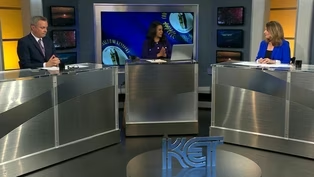
Governor Andy Beshear just wrapped up his 2026 state of the Commonwealth and Budget address.
You saw it live right here on KET and his roughly 40 minute speech, the Democratic governor talked about creating new jobs, the state's housing challenges, health care issues and education.
And for more on the governor's address, let's go to Renee.
Shaw, who is here in our studio with her guest, Renee.
>> Yeah.
Thank you.
Laura, a pleasure to be with you.
We hope you stayed with us since 530, when the governor made his seventh state of the Commonwealth and final budget address and quote his words in this job.
And we're glad to have Amy Wickliffe, who is a Republican strategist with she's also a partner with McCarthy Strategic Solutions and Sherman Brown, who's also with that same firm and is a Democratic strategist.
And they are often here to help us break down what the governor says and dissect what others may be saying as well.
So we just heard the governor wrap up, and he made the point about, as we mentioned earlier, about this being his last budget address.
For now, if there was any kind of confusion about perhaps political ambitions beyond this job that might have been put to rest tonight.
>> That's exactly right.
I think this look, this was a big moment for the governor.
I think that I'm sure he's going to hope that some of the pieces of this speech are going to be picked up on the national scale and the national media to talk about Kentucky.
It's no surprise to me.
You know, I think every speech we hear from the governor continues to kind of set the stage for a future run for whatever that might be for him.
So, yeah.
So, you know, I think it's more of was it a state of the Commonwealth or a state of the campaign?
I think it was probably a little bit of both tonight.
>> Right.
And what are the main themes that he really hit on tonight?
>> Sherman Brown as I said, you know, when we were wrapping up there, I think the the positivity, unity promise, and he really took the opportunity to talk just about our politics, just toning down the rhetoric, finding compromise, finding things that we can all get around and get along on.
I really thought that was one of the things I was kind of looking for where that is.
It was to the point of a national.
It could have been a very easy thing.
It's one thing to say and be critical of policies that that the that are coming from the federal government, which is what he did.
But he didn't really there was not it was not an attack.
It was not there was not that it was a difference stating that showing where you differ and what we're going to do here as far as specifically on health care, what we're going to have to do to address the the shortcomings of where the money is coming from.
But really.
>> He did rename the big ugly bill.
>> He did and noted some federal failures.
Right?
So I would say, yeah, he took his shots at the which I would expect him to do.
Right.
Especially if you're looking at running for president or VP or whatever that might be.
You're going to take some shots at this current and in his role as the chair of the Democratic Governors Association.
Right.
I think he's trying.
>> To be under underscored.
Right.
He's going to be in that prime position.
And so, so looking at maybe some of the content elements of what he discussed tonight, job creation, he really did chalk up a lot of what he's done in his administration, the billions of dollars of investment that he's taken credit for.
I will say that's right.
And you always like to clarify.
That's right.
How this works.
>> Someone has to also create the environment so that these manufacturing businesses, that these entities that want to locate and break ground in Kentucky, somebody has to help create the tools that are needed to help invite those entities to Kentucky.
And I would always say the Republican legislature, when you go back and you look at the tax reform, you look at the fiscal conservative budgets that they've had, you've looked at all of the bond ratings that we have in Kentucky.
Those are things that are all beneficiaries that Governor Beshear, right.
It helps him as he goes out and recruits new business to Kentucky.
So it really is you know, it it's the legislation as well.
It's the governor who gets to stand up there and cut the ribbon and announce the jobs.
And so it's tricky.
>> And but you would say he should do that, right?
>> Absolutely.
I think when you look at the other states around us, other states are doing the same thing as far as taxes.
And we're modeling.
A lot of the things that we've done has been modeled after other states that have been led by Republicans for a long time.
Why are they not all going there?
So there is some there is something else happening.
Not saying that that it's not you know, legislature doesn't get credit.
But you also heard we we did this.
We did this.
And he's presenting a budget that goes to the legislature and goes through the process.
So it is all about that.
It is a comprehensive and collaborative effort that it should be anyway.
>> So we should let our viewers know that the budget presentation that the governor made tonight is, we think now in bill form, that should be available for the public to review in short order, hopefully online.
And so then those discussions will begin in earnest.
And we know that the House, the super majority, House and Senate, it always originates in the House.
They will take liberties with it and do as they will.
Right.
And perhaps they already have their own plan that they will unveil in the coming days.
>> Well, it's no secret.
The House and the Senate, the House in particular, because they are the ones who are required to submit their budget first after the governor or whenever they choose.
They have been working on this bienniums budget since April of last year, if not before.
And so they they have had very open and transparent dialog through the interim joint committees about what what pressures different agencies are feeling.
There has not been a lot of open dialog between the executive branch and the legislative branch, which I think has made it a little bit hard, right, to really finalize some numbers.
I think what's different this year is in past budget cycles, the House has already dropped their budget prior to the governor this year, they didn't.
I think they're looking to see, especially as we have maybe an anticipated budget shortfall of about $156 million over the biennium.
What does that do to the governor's budget.
Right.
What does that do to the budget that the House presents.
And so I think being able for the House to see what the what the governor has presented, then this will kind of kick off.
Right?
And I don't know when we will see that house budget hopefully in the next couple of weeks and then that negotiation will begin.
>> Sherman, we know that agencies have been asked to kind of present back to the governor of what their reductions might be.
We don't know what those numbers will be.
We don't know if that's I haven't heard.
That's across the board.
So is it where is you know, where are they prioritizing where that money is?
That's something that we're going to see here in the actual document.
I mean, it's one thing to go through a 40 minute speech and be able to talk about it.
You can't do that.
You can't give everything that's going to be in those, you know, hundreds of pages of a budget.
>> So we just received a joint statement in response to the governor's State of the Commonwealth and Budget address from the Kentucky House speaker, David Osborne, and the Senate President, Robert Stivers.
And I won't read the entire passage here, but one quote is just kind of piggyback on what we mentioned earlier.
They say, quote, in keeping with the constitutional role of the General Assembly, we have received the governor's remarks and appreciate the governor's comments.
We are hopeful they will include the data and information we've requested of his administration for the last several months.
And I'll put a pin right there.
And, Amy, toss it to you.
>> Yeah.
I mean, look, especially we saw that in an open committee hearing recently, right, where Chairman Jason Petrie requested some very specific data from Budget Director Hicks, and that was denied.
Right.
And there was a little, you know, discourse back and forth.
I think good budgeting happens when all parties who have a role in the budget process, right?
The legislature crafts the budget, the implementation happens at the executive branch.
And so if the executive branch is not sharing where those pressures are right with the legislature, it makes it very hard to actually have the legislature craft a budget that meets the needs of what we're hearing.
And so I think, I hope that after this, there will be some some more data given.
Right.
Because I think the governor was still probably making some decisions.
Right.
And before tonight.
And so hopefully after this, there will open up some dialog so that they can have the data to respect each other enough to be able to really get down and talk about what the needs are to make sure agencies have what they need going forward.
>> The joint statement also goes on to say Kentucky is well positioned because of the sound, fiscally responsible policies enacted by Republican supermajorities, often overriding gubernatorial vetoes to do so.
These policies have produced a record budget reserve trust fund and allowed us to responsibly lower the state income tax.
And we know that will be a big issue.
And that's not something the governor mentioned in his speech a little bit ago.
>> No, I mean, we don't we don't know whether whether that's going to actually happen.
I would look back to to Amy on that as far as where the House and the Senate are on both of those, I think we've had some differing information or differing opinions there of just kind of where where leadership is on both sides.
So don't know if that's.
>> Going to happen.
Yeah.
Well with that we're going to leave it there.
And on Monday night on Kentucky tonight, the House speaker, David Osborne, and the Senate president, Robert Stivers, will be here, along with Representative Lindsey Burke and the House Democrats and also Cassie Chambers Armstrong the new Senate Democratic whip.
They will be here in this studio to talk more about the governor's speech and where things now go from here for Kentucky General Assembly Session 2026.
For now, right now, we'll send it back over to you.
Laura, thanks so much.
>> All right.
Looking forward to that conversation.
Thanks, Renee.
You can see our coverage of the governor's address and his speech in its entirety online and on demand at KET dot.
It is day two of the 60 day 2026 Kentucky General Assembly, and already dozens of bills have been filed in Frankfort.
That includes a bill aiming to end diversity, equity and inclusion, or Dei, in Kentucky's public schools that begins tonight's legislative update.
Senate Bill 26 is dubbed the Kentucky Education, equality, Protection or Keep Act.
It calls for prohibiting K through 12 schools from having Dei programs, trainings, and resources.
The bill is sponsored by Republican State Senator Lindsey Tichenor of Smithfield.
Testifying in a committee meeting last month, Senator Tichenor categorized current Dei efforts in Kentucky's public schools as both wasteful and ineffective.
Senate Bill 26 is similar to a bill passed by the Kentucky General Assembly last year that banned die in Kentucky's public universities.
Another new bill seeks to make October 14th Charlie Kirk Day in Kentucky.
That is the birthday of the conservative activist who was assassinated in September while speaking on the campus of Utah Valley University.
State Senator Steve Rawlings of Burlington filed Senate Bill 31, which calls for Kentuckians to use the day to, quote, reflect on the principles he championed and honor his legacy as a martyr for truth and liberty.
Last month, the Kentucky Supreme Court struck down Senate Bill one, a law from 2022 that shifted power from the Jefferson County Public School Board to the superintendent.
The court said it was special legislation targeting Jefferson County in violation of state law.
Monday on Kentucky Tonight, lawmakers talked about revisiting that idea.
>> They didn't say what we did was wrong.
They said the way the way they perceived we did it was wrong.
So we can address the board procedurally.
>> You can.
>> Go and we can go back and do it again.
We certainly can.
And you may well see that.
I feel confident you'll see us redefine the role of the board.
I think you also may even see conversations.
>> Is that just for Jefferson County?
Because they also said it couldn't be a specific.
>> We will write it in such a way that it will fit any district that looks like Jefferson County.
>> Which would be Jefferson County.
>> That's the only one that looks like Jefferson County.
Listen, we.
>> Have the guidance of the Supreme Court on what they expect, and we're going to be following that.
You'll see that coming back.
You'll also see coming back.
Thank you for letting me finish.
I Hale you'll also see us having a robust conversation about, should these boards in these large districts be elected or should they be appointed?
We have large the Denver school District, for example.
Those are appointed boards, not elected boards.
And so we're going to have a rationale for.
>> Changing it and taking it out of the hands of the people to decide.
>> Elections are not working right now.
They're sure.
Why do you.
>> Say the elections aren't working?
>> Number one, financially, Jefferson County alone, financially is struggling.
Fayette is struggling.
The failure rate to educate these young citizens, these future leaders in Jefferson County points to reason enough.
We've got to take a look at doing things differently, substantially differently.
>> All right.
Nunn Neal.
You've got a minute, sir.
>> Now that my good friend has finished and he's allowed me to speak.
Thank you, my friend.
Look, the state should not be directing what happens on these local levels with respect to these boards.
We ought to be giving support to these boards.
We should be giving them the tools to create better results in outcomes.
We need to engage with them in terms of our advisory capacities, and lend them the supports that we need.
With respect to that, let me tell you, when we start doing that from the federal level, the state level, and we try to determine how they're going to do their business down there, we're going to miss the mark, I suspect.
>> See, all of Monday's hour long discussion online on demand at Keturah Johnny Nash KY.
Tonight, four months before the May primary for the U.S.
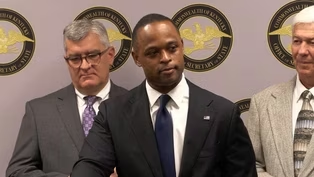
Senate, Republican candidate Daniel Cameron is out with his first TV commercial of the campaign.
Here's part of it.
>> We don't need an America that is built on diversity, equity and inclusion.
We need an America that is built on merit, excellence, and intelligence.
>> Cameron says he's running on a platform of advancing President Trump's America First agenda and a faith centered approach to public service.
Cameron served as Kentucky's attorney general.
He was the Republican nominee for governor in 2023.
We were in the secretary of state's office in Frankfort today as Cameron officially filed to run.
>> We feel very strongly about our position in this race and that come the May primary, Daniel Cameron is going to be the Republican nominee.
We got into this race because of these two little ones here and our one on the way.
We want to ensure that they have a country that lives up to the ideals of our founding country that is based on merit and opportunity, one that preserves the American dream, an American dream that has made this country a shining city on a hill.
>> I like his morals.
I like his ethics.
I think he's a strong candidate for our party.
And I like that he has a young family like, you know, like John F Kennedy.
I mean, kind of changes your way of thinking a little bit.
>> My focus is going to be what I think most folks in this room care deeply about, which is the the ensuring that we get taxes lower and lower so people have more money in their paychecks.
I want to make sure that we are standing up for our law enforcement community here in Kentucky.
We're never going to allow a reimagining of our law enforcement community or defunding of our police.
We need to make sure that regardless of who is in the white House, that we secure that southern border, because securing that southern border means poison doesn't make its way into Kentucky and harms our people.
And then as a fourth component, energy independence.
I mean, we stand at a really critical juncture in our country.
China is trying to take the lead on a bunch of forward technologies.
But here in Kentucky, we have low cost and reliable energy to take part in the economy of the future.
And I want to make sure we're generating and producing as much coal and natural gas as we possibly can.
Our people here in Kentucky have been plagued by drug epidemic that has ravaged our communities and hurt so many folks.
And when you have someone who has trafficked in drugs and made that a central part of their country, President Trump was right to bring Maduro here for for justice.
I am honored to have been endorsed by President Trump two times now, and certainly would be grateful if he decided to to jump into this race on on my behalf as well.
But what what what President Trump cares deeply about is a candidate that's going to to run and work hard to earn this nomination.
And that's that's my intention is to run hard and get to as many places as possible and have conversations with folks and earn his help.
I'm running like my identity is in Christ, and I'm going to fight hard, and I'm going to work hard, and you all in this room deserve that.
And.
We're going to let the chips fall where they may.
But I'm going to win this race.
>> Two polls looking at this Senate race show Cameron leading in the GOP primary on the Democratic side, Amy McGrath filed her paperwork to run for the U.S.
Senate yesterday.
She is a retired Marine Corps colonel who ran for the U.S.
House in 2018 and the U.S.
Senate in 2020.
There are five Democrats who who filed to run for the Senate.
Ten Republicans have filed the deadline to run for office in 2026.
Is this Friday, January 9th.
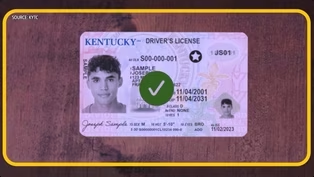
This week, Kentucky rolled out the state's first digital ID platform.
Kentuckians can now download an app on their mobile device to have a digital version of their ID.
Our Emily Sisk caught up with the Kentucky Transportation Cabinet to learn more.
>> Thank you Laura.
Here now is Nate Morris with the Kentucky Transportation Cabinet here to talk all about the new digital ID.
So we want to ask what is the purpose of this mobile ID and how can folks use it?
>> Sure.
Well, we're really excited to be able to offer this to Kentuckians as an optional, convenient way to verify their identity.
So Kentucky Mobile ID is the state's first digital ID that we're offering and basically has all the the the benefits of your driver's license in terms of verifying your identification.
But you have it in the convenience of your phone.
Everything's on your phone.
And so now your your license can be too.
The real benefit of this is you can use it at airport, airport security checkpoint.
So same way you would use a digital boarding pass to make things easier.
Don't have to dig through bags.
Same thing here.
You can present your digital license to TSA and be able to to get through if you've got a real ID license.
>> I want to ask, you know, some people are skeptical about putting personal information on their cell phones, whether it's, you know, credit cards or their license.
But Governor Beshear said that actually, this mobile ID should help protect against identity theft.
So what makes it a safe option?
>> Sure.
Well, privacy and security are extremely important to us, and we're working with the card vendor who has done this with several other states with success.
You have to unlock it using your face or touch ID or unique pin that you set.
So even if your phone were to be lost or stolen, someone couldn't just get into the app.
Even if they were able to unlock your phone, they're even in the enrollment process.
You have to prove your life liveness by doing a series of kind of tests on the app to even enroll for it, and this is more secure in that a wallet can get lost or stolen, and someone can take that physical card and use it, pretending to be you.
Well, with this digital ID, it's it's way less likely for someone.
It's very difficult for some to pretend to be you because of all the safeguards and tests that ping against our state system to prove that it is actually you.
>> And as we understand the digital ID, it's not meant to take the place of physical license.
Right?
So if you're at a traffic stop or you got pulled over, police are still going to expect you to have your card.
This kind of just is something supplemental.
Is that right?
>> That's right.
So for law enforcement interactions you will still need to have your physical card with you.
Think about about it like your payment apps that people use to tap and pay at when they check out.
You still leave the home with your credit or debit card with you just in case.
Same thing.
You're always going to want to have your card with you even if you get the mobile ID, okay.
>> I see.
And so finally, for folks who are at home, if they're watching this and say, okay, I want to get started, what is the app that they download?
Is there any cost associated with it?
>> You can just go to your phone's app store or Google Play to download it for free.
It's Kentucky mobile ID we encourage folks who are interested to go ahead and get it right.
>> Well, we love free.
Absolutely, so that's great to hear.
Now, Tori with the Kentucky Transportation Cabinet, thank you for telling us all about this new mobile ID.
>> Thank you.
>> All right.
Thank you Emily.
The transportation cabinet says not all businesses may accept a digital ID, so it is important to continue to carry your physical license.
A Bowling Green group is growing healthy food for their neighbors, but other lessons are taking root.
It comes with a meaningful reminder about growing potential and community, making these gardeners the cream of the crop.
More on our farm focused segment we call rooted.
>> There you go.
That's a nice one, Jenna.
>> I like picking carrots and I like picking spinach and kale.
>> Gardening is among the many interests Jenna Greer's parents encouraged her to explore.
Upon high school graduation.
>> While everybody else is headed off to college or they're going to tech school, they're getting married.
They're having kids.
>> Bill Greer feared those with intellectual and developmental disabilities didn't have many of those same milestones.
>> Nice work.
We wanted to create an opportunity, an opportunity for Jenna to continue to learn and grow, but not just her.
Lots of other really cool people that have incredible potential.
>> They grow that potential here at Top Crops, a year round garden and greenhouse at the Western Kentucky University Farm.
>> A lot of these folks have been part of the garden since day one.
>> That includes John Michael Huffman.
>> I like to pick everything like broccoli, carrots and all that stuff.
>> And cabbage.
>> I love the community.
>> I think we're going to pull up all the broccoli.
>> And truly, I mean, these are some of the truest, kindest people I've ever met.
>> Hayley McBride is a WCU honors College student who interns at Top Crops.
>> I love that we really try to make sure everybody has a role.
We're able to pull different types of people in and make sure that everybody's contributing and being able to learn the essential life skills, and I love being a part of that.
>> Other volunteers also helped the operation run smoothly, like Julie Denton Price and her son Grady.
>> It didn't take us long to realize the ones who were really learning and growing are the people who are privileged to work with the gardeners.
>> About ten gardeners make up their core group, with another 10 to 15 from other groups and organizations like The Hive.
>> Each year we have kind of a rotation of crops that we go through.
So we plant, we all work together, digging the holes for them, planting inside and in our high tunnel.
>> Could you hold on to this for a second?
>> Then eventually it's time to harvest with a thorough washing, packaging and trip to the market to sell.
>> We go to the farmers market every Saturday morning.
>> I'm proud of their work because they produce something that's beneficial to the health of the community.
They're growing fresh vegetables, fresh herbs.
They're growing flowers that bring a smile to people's face on a Saturday morning when they sell them at the farmers market.
>> Being a vendor at the farmers market brings its own set of lessons.
>> They're learning how to sell.
They're learning how to make change.
>> They're also making change in how others view those with special needs.
Interacting and building relationships with the community.
>> They get a chance to see what these young people are capable of, what anybody's capable of if we're given a chance.
>> Top crops began in 2013 and is a year round venture.
They are a staple at the Community Farmers Market in Bowling Green.
Another busy news day tomorrow.
House Democrats talk about their priorities for the 2026 Kentucky General Assembly session, plus reaction to Governor Andy Beshear budget address that and much more tomorrow on Kentucky Edition.
We hope you'll join us again tomorrow night at 630 eastern, 530 central for Kentucky Edition, where we inform, connect and inspire.
You can find Kentucky edition on the PBS video app on your mobile device and smart TV.
Email us a story idea to Public Affairs at Keturah and follow us on social media.
Thanks so much for watching.
Have a good night.
Cameron Officially Files to Run for U.S. Senate in Kentucky
Video has Closed Captions
Clip: S4 Ep295 | 3m 45s | The GOP candidate is also out with his first ad in the senate race. (3m 45s)
Gov. Beshear Delivers Annual Budget Address
Video has Closed Captions
Clip: S4 Ep295 | 9m 1s | This was Beshear's final budget address as Kentucky's governor. (9m 1s)
Kentucky Rolls Out New Digital I.D.
Video has Closed Captions
Clip: S4 Ep295 | 3m 43s | The digital I.D. can be stored on a user's mobile device. (3m 43s)

Life Lessons Taking Root in Gardening Program
Video has Closed Captions
Clip: S4 Ep295 | 3m 19s | It comes with a meaningful reminder about growing potential and community. (3m 19s)
Providing Support for PBS.org
Learn Moreabout PBS online sponsorship
- News and Public Affairs

Top journalists deliver compelling original analysis of the hour's headlines.

- News and Public Affairs

FRONTLINE is investigative journalism that questions, explains and changes our world.












Support for PBS provided by:
Kentucky Edition is a local public television program presented by KET